Intent Based Marketing: How to Turn Buying Signals Into Pipeline
Intent data promises to tell you who is shopping before they raise a hand. Here is what the signals actually measure, which vendors are worth the spend, and how to build a workflow that produces meetings instead of dashboards.
TL;DR
- Intent based marketing means prioritizing accounts that are already researching your category, using behavioral signals instead of static firmographics.
- Most "intent" you buy is probabilistic: bidstream, co-op content consumption, and topic surges. It tells you a company is curious, rarely who inside it.
- First-party intent (your pricing page, your docs, your demo form) converts 3-10x better than third-party topic surges. Start there before you spend $30k on a data subscription.
- The signal is worthless without contact-level execution. You still need the right person's email and phone before the surge window closes — usually 7-14 days.
- Build the loop in this order: define trigger → score account → resolve contacts → route to a human within 24 hours. Skip any step and you get a dashboard, not pipeline.
What is intent based marketing?#
Intent based marketing is the practice of targeting buyers based on what they are doing right now rather than who they are on paper.
Think of it like a bookstore owner who notices the same customer lingering in the personal-finance aisle three Saturdays in a row. Nothing about that person's demographics changed. Their behavior did. The owner who walks over and says "looking for something on index funds?" converts. The one who mails everyone a generic catalog does not.
Technically, intent based marketing joins three data layers:
- Behavioral signals — content consumption, search queries, review-site page views, competitor comparisons, job posts, tech installs.
- Identity resolution — mapping that anonymous behavior back to a company (and occasionally a person) via IP, cookie graphs, or logged-in publisher data.
- Activation — routing the resolved account to an ad audience, a sequence, or an SDR before the interest decays.
Most teams nail layer one, buy layer two, and completely fumble layer three. That is why so many intent programs die quietly after two quarters.
How is intent data actually collected?#
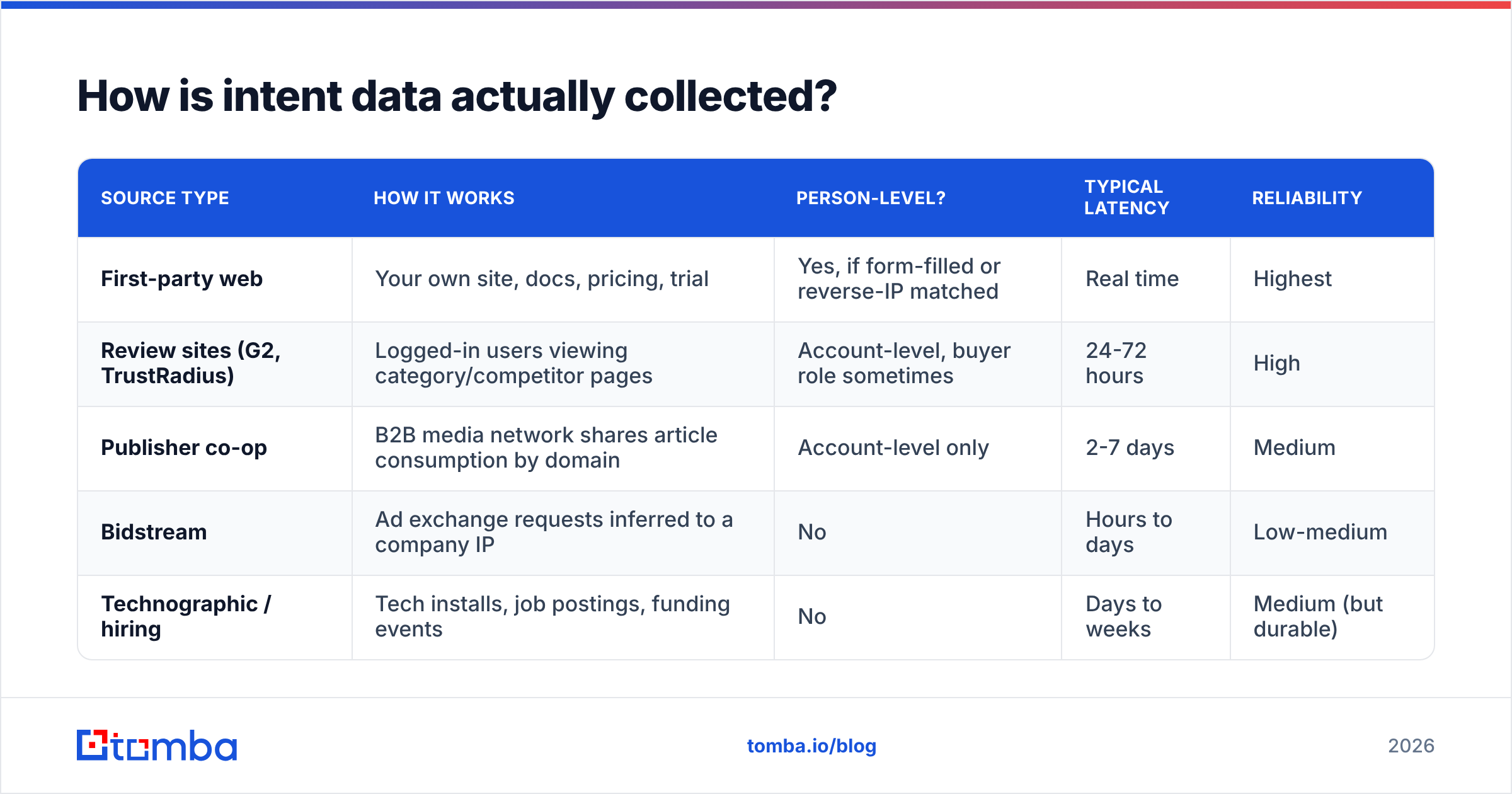
There are four collection mechanisms, and they differ wildly in reliability. Understanding which one your vendor uses matters more than their logo count.
| Source type | How it works | Person-level? | Typical latency | Reliability |
|---|---|---|---|---|
| First-party web | Your own site, docs, pricing, trial | Yes, if form-filled or reverse-IP matched | Real time | Highest |
| Review sites (G2, TrustRadius) | Logged-in users viewing category/competitor pages | Account-level, buyer role sometimes | 24-72 hours | High |
| Publisher co-op | B2B media network shares article consumption by domain | Account-level only | 2-7 days | Medium |
| Bidstream | Ad exchange requests inferred to a company IP | No | Hours to days | Low-medium |
| Technographic / hiring | Tech installs, job postings, funding events | No | Days to weeks | Medium (but durable) |
Bidstream is the cheapest and the noisiest. A single engineer at a 4,000-person enterprise reading a marketing blog on the corporate VPN can light up your "surge" dashboard for a company that has no budget and no project. G2's buyer intent documentation is more transparent than most about what its signals represent, which is one reason review-site intent tends to outperform pure bidstream.
The durable signals — hiring, funding, tech stack changes — are underrated. They decay slowly and they are verifiable. If a company just posted three "Demand Generation Manager" roles, that is a real budget event, not an inferred cookie.

Is first-party intent better than third-party intent?#
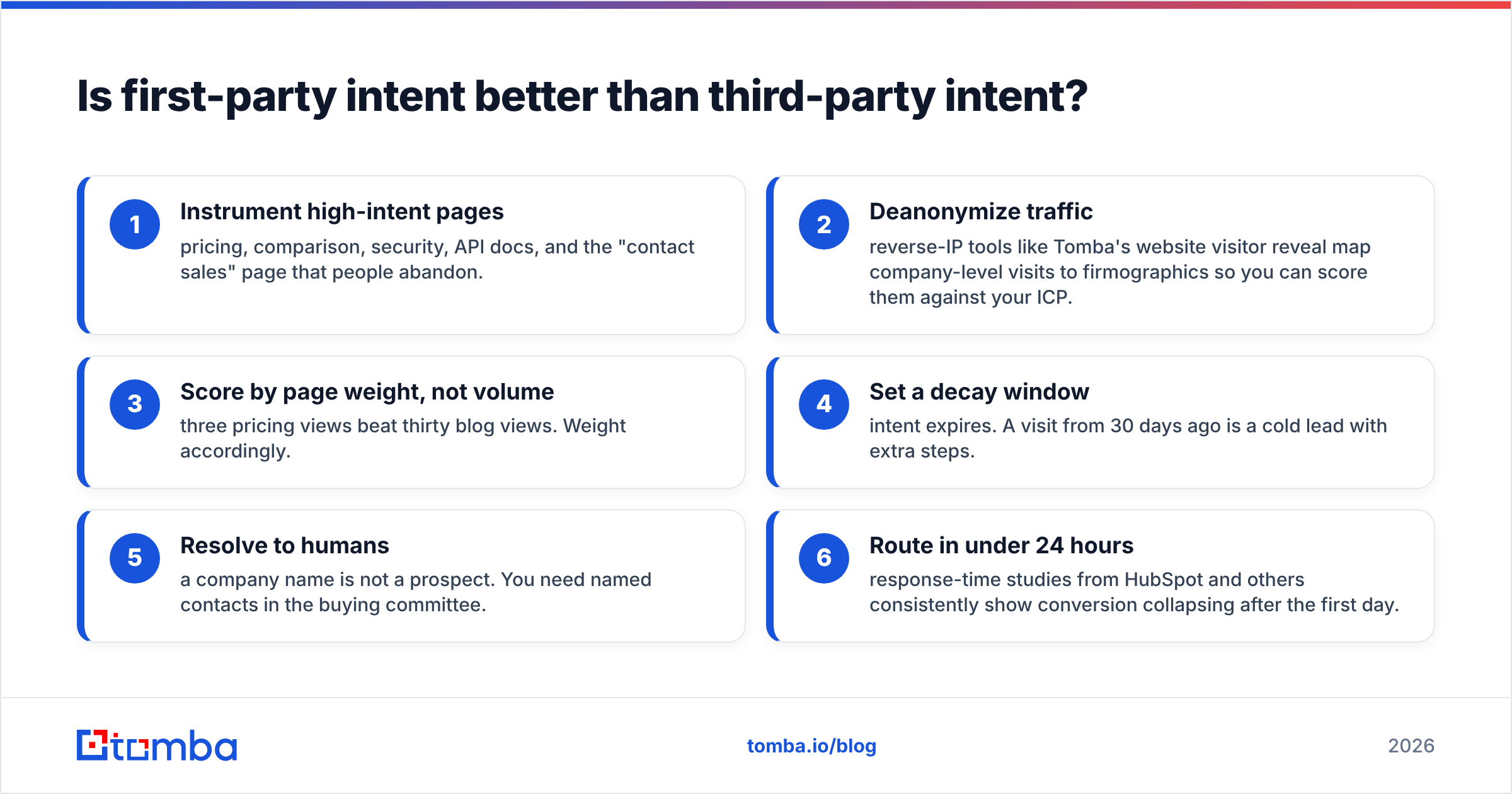
Yes, almost always — and it is free.
Your own properties generate the highest-fidelity intent available. Someone who read your pricing page twice, opened the integrations doc, and bounced off the security page is telling you more than any topic surge score. They are also already aware of you, which collapses the education cycle.
The practical playbook:
- Instrument high-intent pages — pricing, comparison, security, API docs, and the "contact sales" page that people abandon.
- Deanonymize traffic — reverse-IP tools like Tomba's website visitor reveal map company-level visits to firmographics so you can score them against your ICP.
- Score by page weight, not volume — three pricing views beat thirty blog views. Weight accordingly.
- Set a decay window — intent expires. A visit from 30 days ago is a cold lead with extra steps.
- Resolve to humans — a company name is not a prospect. You need named contacts in the buying committee.
- Route in under 24 hours — response-time studies from HubSpot and others consistently show conversion collapsing after the first day.
Third-party intent earns its keep in one specific scenario: reaching accounts that have never touched your site. That is genuine top-of-funnel expansion. If you are paying six figures to re-discover accounts already in your CRM with open opportunities, you bought an expensive mirror.
Which intent data vendors should you compare in 2026?#
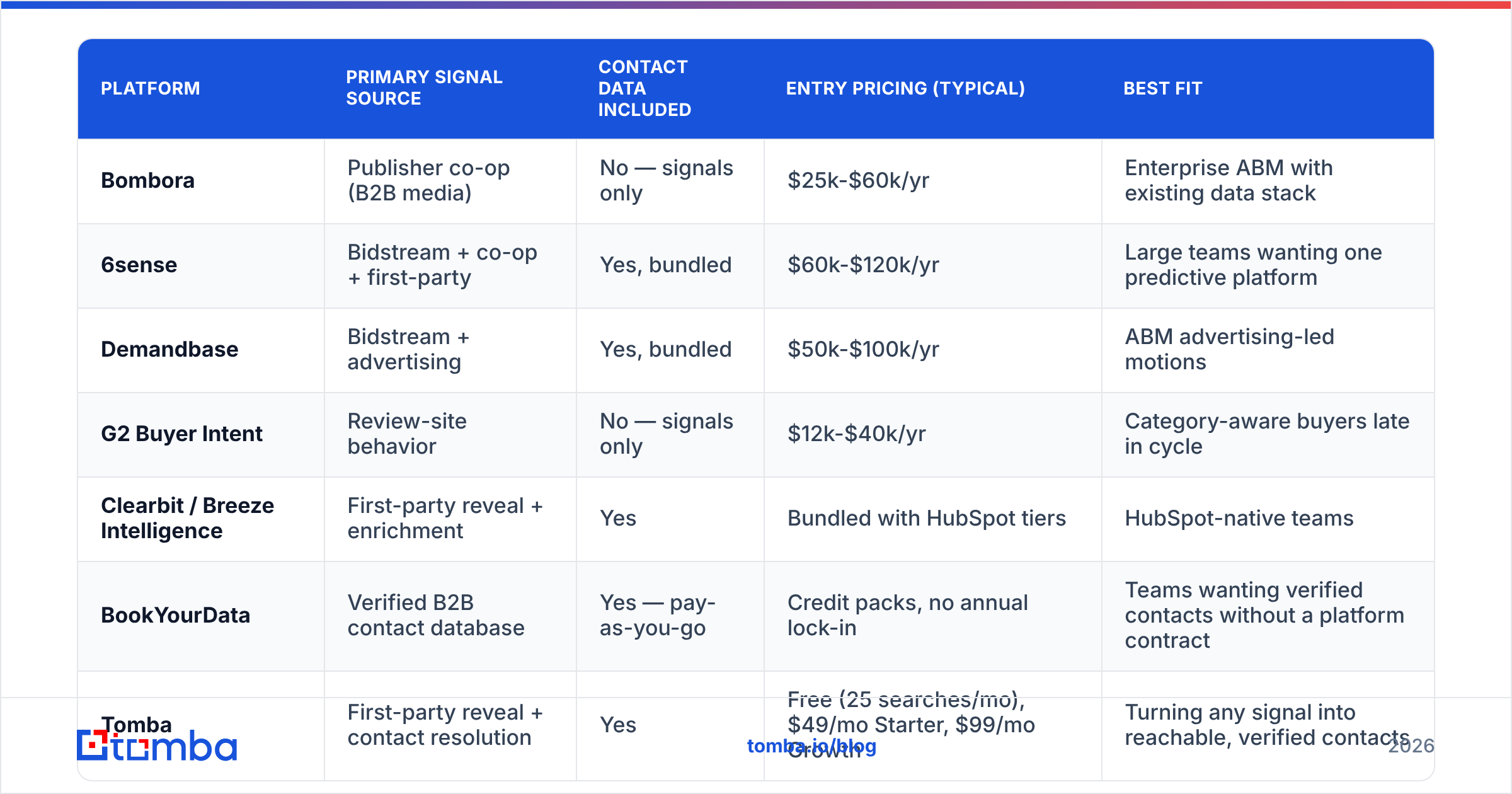
The market has consolidated into three rough tiers. Pricing below reflects publicly discussed ranges and typical mid-market contracts — always get a quote, because seat and credit structures vary more than list price.
| Platform | Primary signal source | Contact data included | Entry pricing (typical) | Best fit |
|---|---|---|---|---|
| Bombora | Publisher co-op (B2B media) | No — signals only | $25k-$60k/yr | Enterprise ABM with existing data stack |
| 6sense | Bidstream + co-op + first-party | Yes, bundled | $60k-$120k/yr | Large teams wanting one predictive platform |
| Demandbase | Bidstream + advertising | Yes, bundled | $50k-$100k/yr | ABM advertising-led motions |
| G2 Buyer Intent | Review-site behavior | No — signals only | $12k-$40k/yr | Category-aware buyers late in cycle |
| Clearbit / Breeze Intelligence | First-party reveal + enrichment | Yes | Bundled with HubSpot tiers | HubSpot-native teams |
| BookYourData | Verified B2B contact database | Yes — pay-as-you-go | Credit packs, no annual lock-in | Teams wanting verified contacts without a platform contract |
| Tomba | First-party reveal + contact resolution | Yes | Free (25 searches/mo), $49/mo Starter, $99/mo Growth | Turning any signal into reachable, verified contacts |
Two honest notes on this table.
First, the enterprise platforms (6sense, Demandbase) are genuinely good at prediction and genuinely expensive at everything. If you have fewer than 2,000 target accounts and no dedicated ABM headcount, you will not extract the value. Their own case studies assume a team operating the platform full time.
Second, signal vendors and contact vendors solve different problems. Bombora tells you Acme is surging on "email verification." It does not tell you that Priya Raman runs demand gen at Acme and her address is priya@acme.com. You need both halves. BookYourData and Tomba both address the contact half — BookYourData through a verified prebuilt database you buy in packs, Tomba through live resolution against a domain or a name. Many teams run one of each depending on whether they need list volume or just-in-time lookups.
If you are evaluating Apollo alternatives or Clearbit alternatives specifically for the enrichment layer, the deciding factor is usually catch-all handling and refund policy on bad records, not raw database size.
How do you turn an intent signal into a real conversation?#
This is where programs live or die. A surge alert that lands in a Slack channel nobody owns is a notification, not a motion.
Here is the operational loop that works:
Step 1 — Define the trigger precisely. Not "surging on marketing automation." Something like: account matches ICP (50-500 employees, SaaS, US/EU) AND shows topic surge on two related terms AND has no open opportunity. Loose triggers produce volume your reps will learn to ignore.
Step 2 — Enrich the account. Pull firmographics, tech stack, recent funding, and headcount growth. This is where you confirm the signal is a real company with real budget rather than an agency or a student.
Step 3 — Resolve the buying committee. Identify three to five roles, not one. For a demand-gen purchase that is typically VP Marketing, Demand Gen Manager, and RevOps. Use domain search to pull the email patterns and named contacts at the account, then run email verification so you are not burning domain reputation on guesses during a 10-day window where timing is everything.
Step 4 — Choose the channel by signal strength. Weak signal (one bidstream topic) → ad retargeting only. Medium signal (co-op surge + ICP match) → a light sequence plus LinkedIn. Strong signal (pricing page visit + competitor comparison view) → a rep calls the same day.
Step 5 — Reference the behavior without being creepy. "Saw you were on our pricing page" is unsettling. "Most teams evaluating this ask about seat-based vs credit-based billing — happy to break down the difference" delivers the same relevance without the surveillance vibe.
Step 6 — Measure to pipeline, not to opens. The only honest metric is opportunity creation rate on intent-flagged accounts versus a matched control group. If you cannot run a holdout, you cannot claim attribution.

What does an intent based marketing program cost to run?#
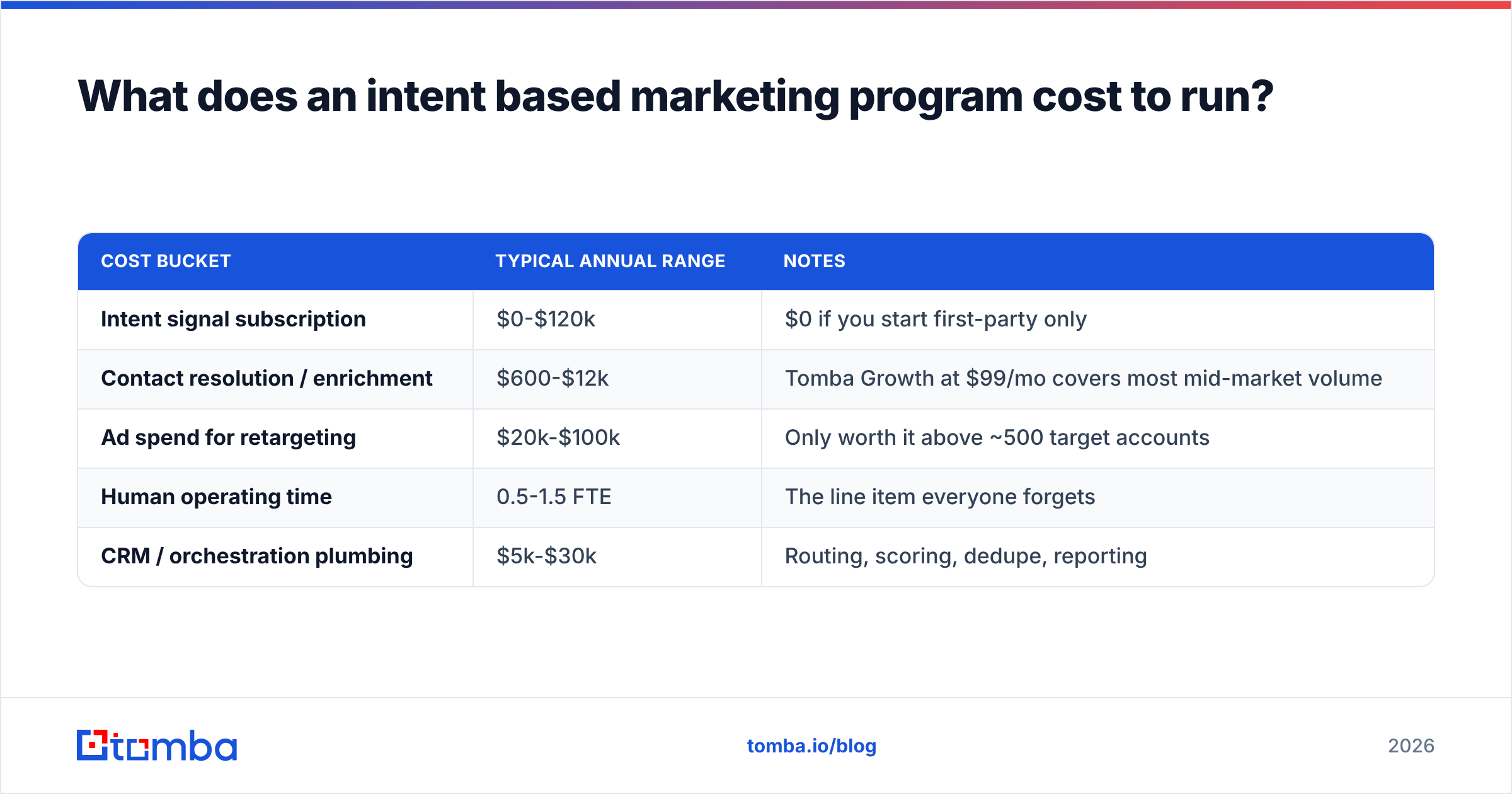
Budget in three buckets, not one. The software line item is usually the smallest part of the real cost.
| Cost bucket | Typical annual range | Notes |
|---|---|---|
| Intent signal subscription | $0-$120k | $0 if you start first-party only |
| Contact resolution / enrichment | $600-$12k | Tomba Growth at $99/mo covers most mid-market volume |
| Ad spend for retargeting | $20k-$100k | Only worth it above ~500 target accounts |
| Human operating time | 0.5-1.5 FTE | The line item everyone forgets |
| CRM / orchestration plumbing | $5k-$30k | Routing, scoring, dedupe, reporting |
A team spending $80k on signals and zero on the operating headcount to act on them gets nothing. A team spending $0 on third-party signals but instrumenting first-party behavior properly and resolving contacts with a $99/mo tool frequently outperforms them. See Tomba pricing for where the contact-resolution layer lands.
Start cheap. Prove the loop converts on first-party signals. Only then buy third-party surge data to widen the top of the funnel.
What are the biggest mistakes teams make with intent data?#
Treating account-level signals as person-level. A surge at a 5,000-person company narrows your target from "everyone" to "5,000 people." That is progress, not precision. You still have to pick the right humans.
Ignoring the decay curve. Third-party intent has a useful life of roughly 7-21 days depending on source. Batch-processing surges monthly means you contact buyers after they have shortlisted three vendors.
Over-indexing on the vendor's own score. Every platform sells a proprietary composite score. Those scores are tuned to make the product look busy. Build your own weighting against your closed-won data.
No holdout group. Without a control, every intent program reports a lift, because the accounts you flag were already more likely to buy. That is selection bias wearing a dashboard.
Letting bad data poison deliverability. Intent tells you to move fast. Moving fast with unverified addresses is how a domain ends up with a 12% bounce rate and a dead sender reputation. Verify before you send — always, but especially when you are sending in a hurry. Check your sender reputation before scaling any surge-triggered sequence.
Confusing intent with fit. A company can be actively researching your category and still be a terrible customer. Fit gates intent, not the other way around. Score fit first, then let intent decide sequencing.
Is intent based marketing worth it for small teams?#
Yes — but only the first-party half.
If you have under 20 sales and marketing people, a $60k intent subscription will sit unused. What works at that size:
- Reveal and score anonymous website traffic
- Watch hiring signals and funding announcements for your ICP (free, via job boards and Crunchbase)
- Track competitor comparison page visits on your own site
- Resolve and verify contacts at any account that trips a threshold
- Have one human call within a day
That stack costs a few hundred dollars a month and beats most enterprise deployments on efficiency, because there is no orchestration overhead between signal and action.
Once you are consistently converting first-party intent and you have exhausted the accounts already aware of you, third-party surge data becomes the logical next spend. Not before.
Where do you go from here?#
Pick one trigger. Instrument it this week. Route it to one named person with a 24-hour SLA. Measure opportunities created against a holdout for 60 days. If it works, add a second trigger. That sequence has produced more pipeline than any six-figure platform purchase I have watched get rolled out and abandoned.
The bottleneck in almost every intent program is the same: you know which company is interested and you cannot reach the right person fast enough. That gap is where the surge window closes.
The Tomba Email Finder closes it — enter a domain or a name and get verified, deliverable addresses for the buying committee in seconds, with a free tier at 25 searches a month and paid plans from $49/mo. Wire it into your intent triggers via the Tomba API and every signal becomes a contactable human instead of a row in a dashboard.
Related guides#
// get started
Find, verify and enrich your first contacts today
Start on the free plan with 25 searches a month, then scale when your team is ready.
Free plan · No credit card required · GDPR & CCPA
// about the author