Interactive Sales Training: The 2026 Guide That Actually Sticks
Most sales training is forgotten within a week. Here's how interactive sales training formats compare on cost, time and retention — plus how to measure whether any of it moved your win rate.
TL;DR
- Interactive sales training means reps do the work — role-play, live call teardowns, AI simulations, real-data drills — instead of watching someone explain it.
- Passive training decays fast. The classic forgetting-curve research puts recall at roughly a third after a week without reinforcement, which is why one-off bootcamps rarely move numbers.
- The highest-ROI formats in 2026 are recorded-call teardowns, AI role-play simulators, and live drills run on real prospect data rather than invented personas.
- Budget 45–90 minutes weekly, not a two-day annual offsite. Frequency beats production value.
- Measure ramp time, connect-to-meeting rate and objection-handling win rate at 30 and 90 days — not smile-sheet survey scores.
What is interactive sales training?#
Interactive sales training is any enablement format where the rep produces output during the session — speaking, writing, deciding, or handling pushback — and gets feedback on it before the session ends. That's the whole definition. If a rep can sit through your session with the camera off and lose nothing, it isn't interactive.
Think of it like learning to drive. Nobody becomes a driver by watching a 90-minute video about clutch control. You get in the car, stall it six times, and someone next to you says "less gas, more patience." Sales works identically. Discovery questions, pricing pushback, multithreading into a stalled account — these are motor skills wearing a business suit.
The contrast matters because most companies label their LMS library "sales training" and wonder why ramp time never shrinks. A content library is a reference. Training is a rep failing safely, repeatedly, on your time instead of a prospect's.
Why does traditional sales training fail so consistently?#
Three reasons, and they compound.
Retention decay. Hermann Ebbinghaus documented the forgetting curve in the 1880s and it has survived every replication attempt since. Unreinforced material drops off sharply within days. A two-day onboarding bootcamp delivered in week one is largely gone by week four — right when the rep starts handling real objections.
No transfer context. Learning "here are our five discovery questions" in a slide deck is not the same skill as asking question three when a CFO just said "we already have a tool for this." Skill transfer requires practising in conditions that resemble the real thing.
No failure loop. Reps improve when they get something wrong, hear why, and immediately retry. Most training programs contain zero retry attempts. A quiz at the end doesn't count — recognising the right answer from four options is a different cognitive task than generating it under pressure.
What formats count as interactive sales training?#
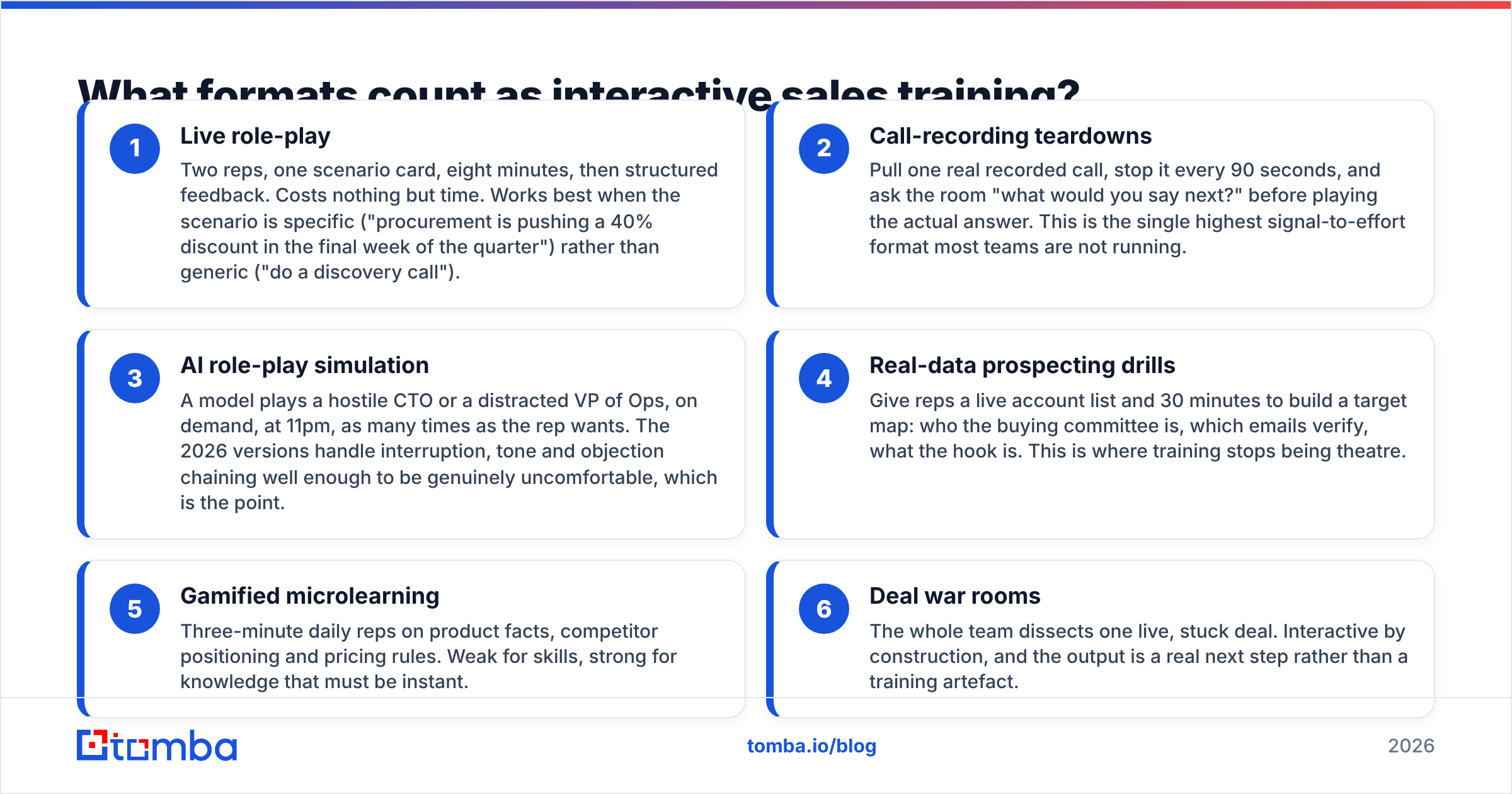
Here are the six formats worth your calendar, roughly ordered from cheapest to set up to most involved:
- Live role-play — Two reps, one scenario card, eight minutes, then structured feedback. Costs nothing but time. Works best when the scenario is specific ("procurement is pushing a 40% discount in the final week of the quarter") rather than generic ("do a discovery call").
- Call-recording teardowns — Pull one real recorded call, stop it every 90 seconds, and ask the room "what would you say next?" before playing the actual answer. This is the single highest signal-to-effort format most teams are not running.
- AI role-play simulation — A model plays a hostile CTO or a distracted VP of Ops, on demand, at 11pm, as many times as the rep wants. The 2026 versions handle interruption, tone and objection chaining well enough to be genuinely uncomfortable, which is the point.
- Real-data prospecting drills — Give reps a live account list and 30 minutes to build a target map: who the buying committee is, which emails verify, what the hook is. This is where training stops being theatre.
- Gamified microlearning — Three-minute daily reps on product facts, competitor positioning and pricing rules. Weak for skills, strong for knowledge that must be instant.
- Deal war rooms — The whole team dissects one live, stuck deal. Interactive by construction, and the output is a real next step rather than a training artefact.
Which interactive sales training format fits your team?#
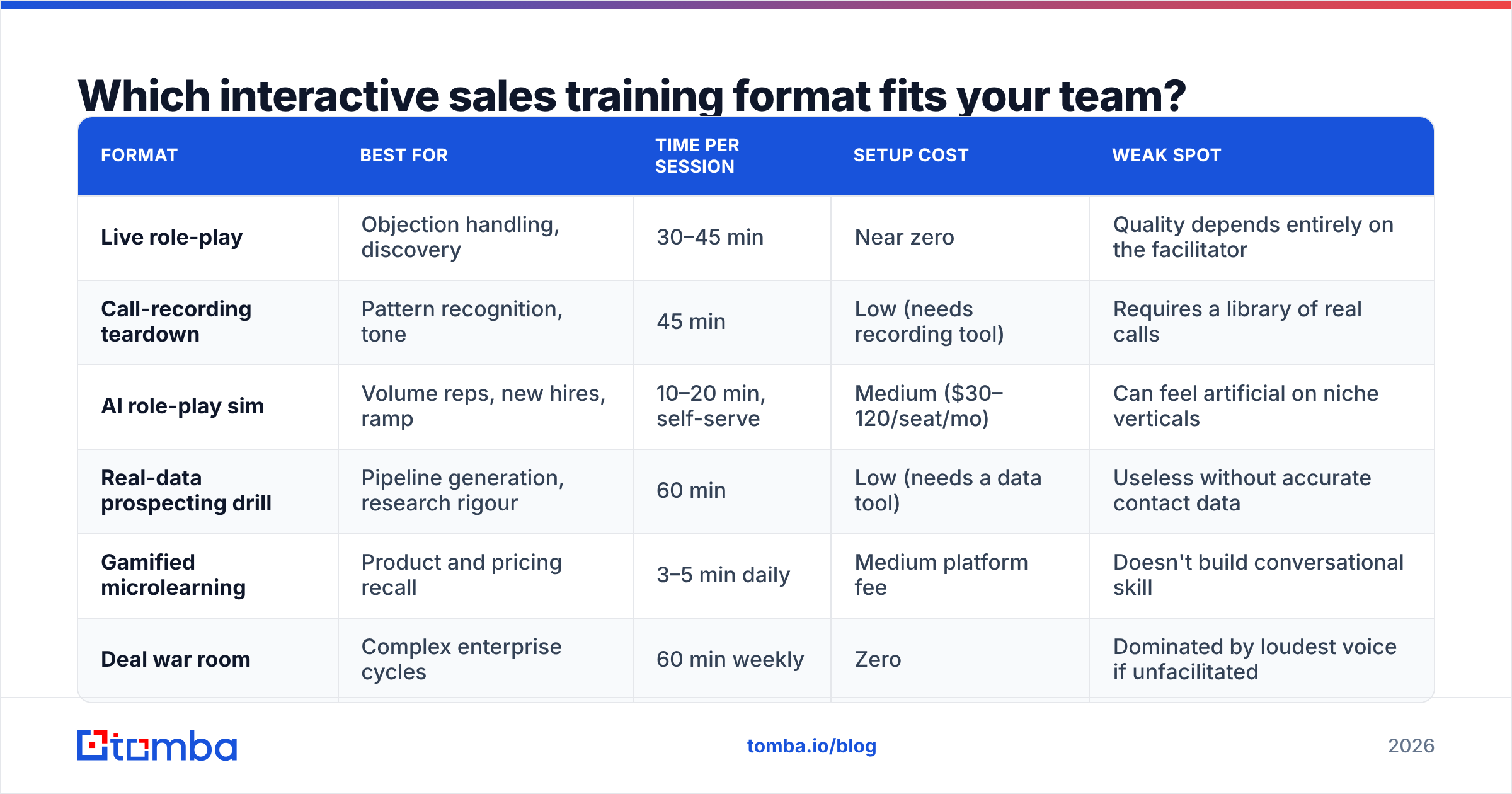
| Format | Best for | Time per session | Setup cost | Weak spot |
|---|---|---|---|---|
| Live role-play | Objection handling, discovery | 30–45 min | Near zero | Quality depends entirely on the facilitator |
| Call-recording teardown | Pattern recognition, tone | 45 min | Low (needs recording tool) | Requires a library of real calls |
| AI role-play sim | Volume reps, new hires, ramp | 10–20 min, self-serve | Medium ($30–120/seat/mo) | Can feel artificial on niche verticals |
| Real-data prospecting drill | Pipeline generation, research rigour | 60 min | Low (needs a data tool) | Useless without accurate contact data |
| Gamified microlearning | Product and pricing recall | 3–5 min daily | Medium platform fee | Doesn't build conversational skill |
| Deal war room | Complex enterprise cycles | 60 min weekly | Zero | Dominated by loudest voice if unfacilitated |
If you run one thing, run the call teardown. If you run two, add AI role-play for new hires so your senior reps stop burning hours on basic reps.
How do you run a role-play session reps don't hate?#
Reps hate role-play for a predictable reason: it's usually public humiliation with no clear rubric. Fix the structure and the resistance mostly evaporates.
Use a scenario card, not a vibe. Written on the card: company profile, the persona's actual job pressure, the specific objection they will raise, and the one thing that would genuinely change their mind. Vague prompts produce vague practice.
Cap it at eight minutes. Long role-plays drift into improv comedy. Short ones stay on the skill being drilled.
Score against three criteria, maximum. For a discovery drill: did the rep quantify the problem, did they identify a second stakeholder, did they book a specific next step. Everything else is noise this week.
Feedback in the "keep / change / retry" pattern. One thing that worked, one specific change, then immediately run the same eight minutes again with the change applied. The retry is non-negotiable — it's where the learning actually happens.
Rotate the objector role. Reps who have to argue against your product for ten minutes understand the competitive landscape faster than any battlecard achieves.
Record it. Watching yourself say "does that make sense?" eleven times does more than any coach's note.
What should sales training actually cover in 2026?#
The skill mix has shifted. Product knowledge is now the cheapest thing a rep can acquire — an AI assistant handles that. What separates performers is upstream and downstream of the pitch.
Research and account mapping. The average B2B buying committee sits somewhere between six and ten people depending on whose research you read; HubSpot's sales research and Gartner's B2B buying studies both land in that band. A rep who emails one contact and calls it outreach is failing before the conversation starts. Drill account mapping explicitly: find the economic buyer, the technical evaluator, the blocker.
Data hygiene as a sales skill. Reps who send to stale or guessed addresses destroy domain reputation for the entire team. Training should include a hard rule: nothing gets sent to an address that hasn't passed an email verifier. Bounce rate is a coachable metric, not an IT problem.
Multichannel sequencing. Email, phone, LinkedIn, and — increasingly — a relevant comment on something the prospect actually published. Drill the order and the spacing, not just the copy.
Objection chaining. Real objections arrive in sequences. "Too expensive" becomes "we don't have budget this quarter" becomes "let's revisit in Q3." Train the chain, not the isolated line.
Multithreading after a ghost. The most valuable single drill you can run: the champion has gone silent for 11 days. Sixty seconds to decide the next move. Run it weekly.
Why does training on real prospect data change the outcome?#
Because fake practice produces fake confidence.
When reps rehearse against a fictional "Acme Corp," they never encounter the things that actually derail outreach: the contact who left six months ago, the catch-all domain that swallows every message, the company where the email pattern is first.last for executives and flast for everyone else.
Run the drill on live accounts instead. Give each rep ten target companies and thirty minutes. The deliverable is a mapped buying committee with verified contact points. You'll find out very quickly which reps research and which reps guess.
That's also why the tooling in the room matters. A prospecting drill that stalls because nobody can find a decision-maker's address teaches learned helplessness. Give the team a domain search to pull the contact map for a target company, a catch-all verifier for the domains that don't respond cleanly to standard checks, and a phone finder so the multichannel half of the drill isn't theoretical.
How do you measure whether interactive sales training worked?#
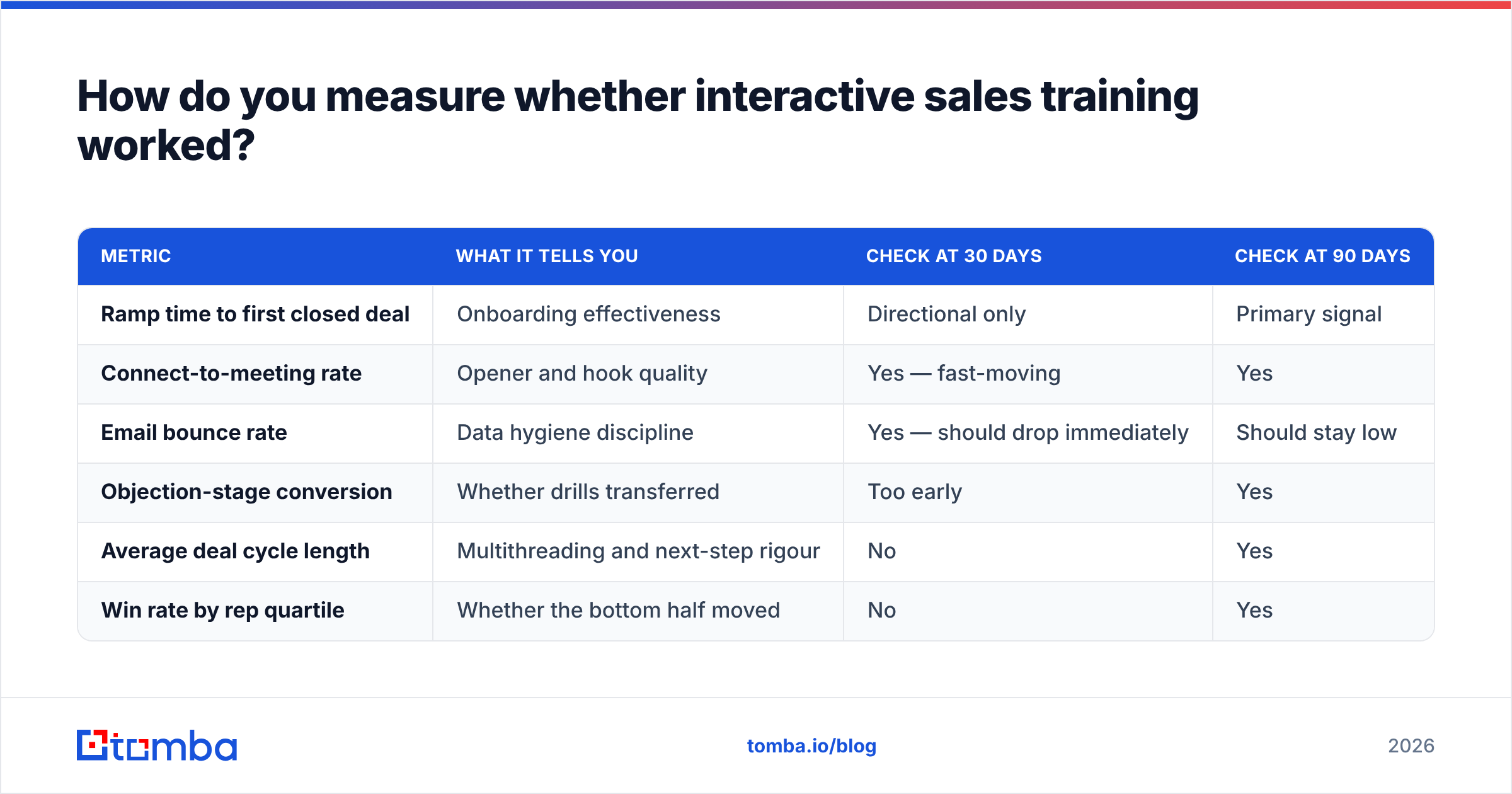
Satisfaction surveys measure whether reps enjoyed the session. That's worth roughly nothing. Measure behaviour and outcomes on a fixed cadence.
| Metric | What it tells you | Check at 30 days | Check at 90 days |
|---|---|---|---|
| Ramp time to first closed deal | Onboarding effectiveness | Directional only | Primary signal |
| Connect-to-meeting rate | Opener and hook quality | Yes — fast-moving | Yes |
| Email bounce rate | Data hygiene discipline | Yes — should drop immediately | Should stay low |
| Objection-stage conversion | Whether drills transferred | Too early | Yes |
| Average deal cycle length | Multithreading and next-step rigour | No | Yes |
| Win rate by rep quartile | Whether the bottom half moved | No | Yes |
The quartile view is the one most managers skip and the one that tells the truth. Good training lifts your bottom two quartiles. If only your top performers improved, they'd have improved anyway and you just held a nice meeting.
Set a baseline before you change anything. Two weeks of clean before-data is worth more than six months of after-data with nothing to compare it to. And watch response rate separately from meeting rate — they degrade for different reasons.
What are the most common mistakes teams make?#
Training annually. A yearly offsite is an event, not a program. Forty-five minutes every week beats two days every year by a margin that isn't close.
No manager participation. If the sales manager doesn't role-play in front of the team and take feedback publicly, nobody else will take it seriously either. Go first, be mediocre at it, model the behaviour.
Skipping the retry. Feedback without an immediate second attempt is just criticism.
Training the pitch, ignoring the list. A perfect pitch delivered to the wrong 400 people is a worse outcome than a mediocre pitch delivered to the right 40. Half your enablement hours should go upstream — targeting, research, data quality.
Buying a platform before defining the drill. Teams routinely spend five figures on an enablement platform while nobody has written a single scenario card. Write ten scenario cards first. If the program survives eight weeks on nothing but a calendar invite and a doc, then buy tooling. Check G2's sales training category when you get there — but get there second.
No content refresh. Scenarios built on 2023 competitor positioning teach reps to win arguments nobody is having anymore. Review the scenario library quarterly.
Where should you start next Monday?#
Pick one recorded call. Book 45 minutes. Play it with stops. Ask the room what they'd say next before revealing the answer. Do it again the following week with a different call.
That's the entire minimum viable interactive sales training program, and it costs you nothing except the discipline of putting it on the calendar and not cancelling it when the quarter gets loud.
When you're ready to add the prospecting drill — the one where reps map a real buying committee against real accounts under a real clock — the constraint you'll hit immediately is contact data. Tomba's Email Finder gives your team verified work addresses by name and domain, so a training session spent on research rigour doesn't collapse into an hour of guessing email patterns. The free tier covers 25 searches a month if you just want to run one drill and see how it lands; paid plans start at $49/mo on Starter and scale to $99/mo on Growth as the team's volume grows — full Tomba pricing is public. Train on real data, and the skills transfer on the first real call.
Related guides#
// get started
Find, verify and enrich your first contacts today
Start on the free plan with 25 searches a month, then scale when your team is ready.
Free plan · No credit card required · GDPR & CCPA
// about the author