Interim Sales Manager: When to Hire One and What It Costs
An interim sales manager can stabilize a team in weeks — or burn a quarter. Here's what they cost in 2026, when a fractional VP is the better call, and the 90-day plan that separates the two.
TL;DR
- An interim sales manager is a full-time, temporary operator who runs your sales team for 3–12 months while you recover from a departure, a restructure, or a growth spike you can't staff for yet.
- Expect $12,000–$25,000/month in 2026 for a credible interim in a B2B SaaS or services context — roughly 1.3–1.8x the loaded cost of the equivalent permanent hire, with none of the severance risk.
- Interim is not fractional. Interim = one company, near-full-time, fixed end date. Fractional = 1–2 days a week across several clients. Picking the wrong one is the most common and most expensive mistake.
- The hire fails when the interim inherits a broken pipeline and no data. Fix contact data and territory coverage in week one, before you touch comp plans or forecast calls.
- Measure them on leading indicators — meetings booked, pipeline created, rep ramp time, documented playbook — not on closed revenue that lands after they've gone.
What Is an Interim Sales Manager?#
An interim sales manager is a temporary, hands-on sales leader hired for a defined window to run a team that currently has no one running it.
Think of it like a locum doctor. The hospital didn't shut down because the consultant left; someone qualified stepped into the same rota, saw the same patients, kept the ward functioning, and handed over clean notes when the permanent hire arrived. The interim isn't there to reinvent the hospital. They're there so nobody dies while you recruit.
That framing matters, because it rules things out. An interim sales manager is not a consultant who delivers a deck. They carry a number. They sit in your CRM, run your Monday pipeline review, do ride-alongs, approve discounts, fire the rep who's been coasting for three quarters, and take the escalation call at 6pm. Interim management as a discipline has existed in operations and finance for decades — sales adopted it late, mostly because founders kept assuming they could cover the gap themselves for "just a few weeks."
Typical triggers:
- Sudden departure. Your VP or head of sales quits mid-quarter and the team has six reps, no manager, and a forecast call on Thursday.
- Post-acquisition integration. Two sales teams, two comp plans, two CRMs, and nobody wants to be the one who merges them.
- Turnaround. Attainment has been under 60% for three quarters and the board wants an outsider's read before committing to a permanent leader.
- Scale spike. You raised, you need to go from 4 reps to 14, and your best AE is not ready to manage — yet.
- Maternity, medical, or sabbatical cover. A defined 6–9 month absence where the seat genuinely returns to its owner.

Is an Interim Sales Manager Different From a Fractional One?#
Yes, and conflating them is the single most common budgeting error.
Fractional means part-time and parallel — one or two days a week, usually serving three to five clients simultaneously. Interim means temporary and exclusive — four or five days a week, one client, a fixed end date. A fractional leader is a strategist who occasionally executes. An interim leader is an operator who occasionally strategizes.
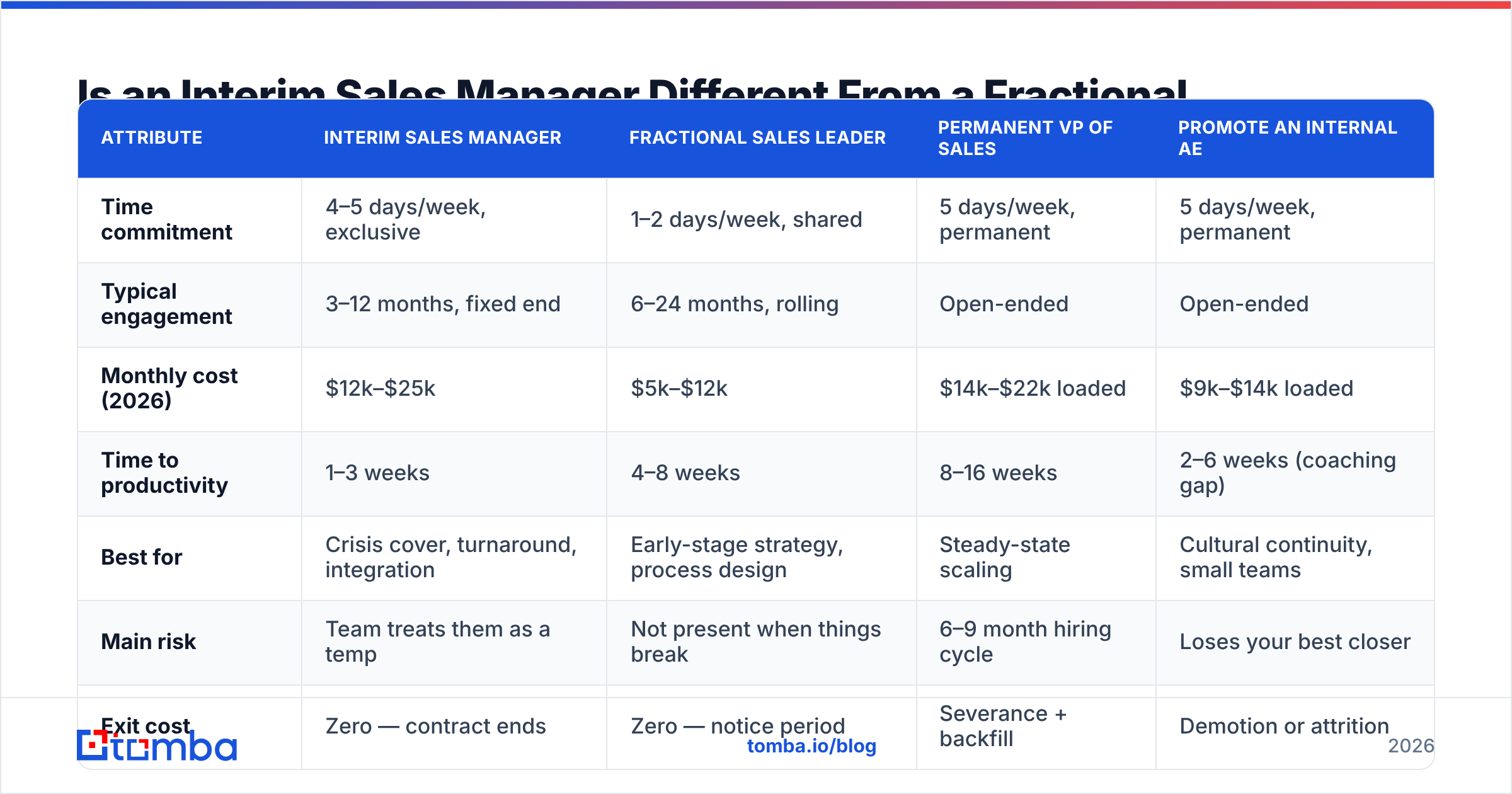
Here's how the four realistic options compare when a sales leadership seat opens up:
| Attribute | Interim sales manager | Fractional sales leader | Permanent VP of Sales | Promote an internal AE |
|---|---|---|---|---|
| Time commitment | 4–5 days/week, exclusive | 1–2 days/week, shared | 5 days/week, permanent | 5 days/week, permanent |
| Typical engagement | 3–12 months, fixed end | 6–24 months, rolling | Open-ended | Open-ended |
| Monthly cost (2026) | $12k–$25k | $5k–$12k | $14k–$22k loaded | $9k–$14k loaded |
| Time to productivity | 1–3 weeks | 4–8 weeks | 8–16 weeks | 2–6 weeks (coaching gap) |
| Best for | Crisis cover, turnaround, integration | Early-stage strategy, process design | Steady-state scaling | Cultural continuity, small teams |
| Main risk | Team treats them as a temp | Not present when things break | 6–9 month hiring cycle | Loses your best closer |
| Exit cost | Zero — contract ends | Zero — notice period | Severance + backfill | Demotion or attrition |
| Knowledge transfer | Contractual deliverable | Usually ad hoc | N/A | N/A |
The pattern is readable. If the problem is urgency, hire interim. If the problem is expertise you need occasionally, hire fractional. If the problem is long-term ownership, run the permanent search properly — and hire an interim to cover the eight months that search will actually take.
One caution on the last column. Promoting your top AE to cover a gap looks free and almost never is. You lose a quota carrier, you gain an untrained manager, and you do it during the exact period when the team most needs stability. Gartner's sales research has consistently flagged manager quality as a bigger driver of rep performance than rep selection itself — which is a polite way of saying a bad manager is more expensive than an empty seat.
What Does an Interim Sales Manager Cost in 2026?#
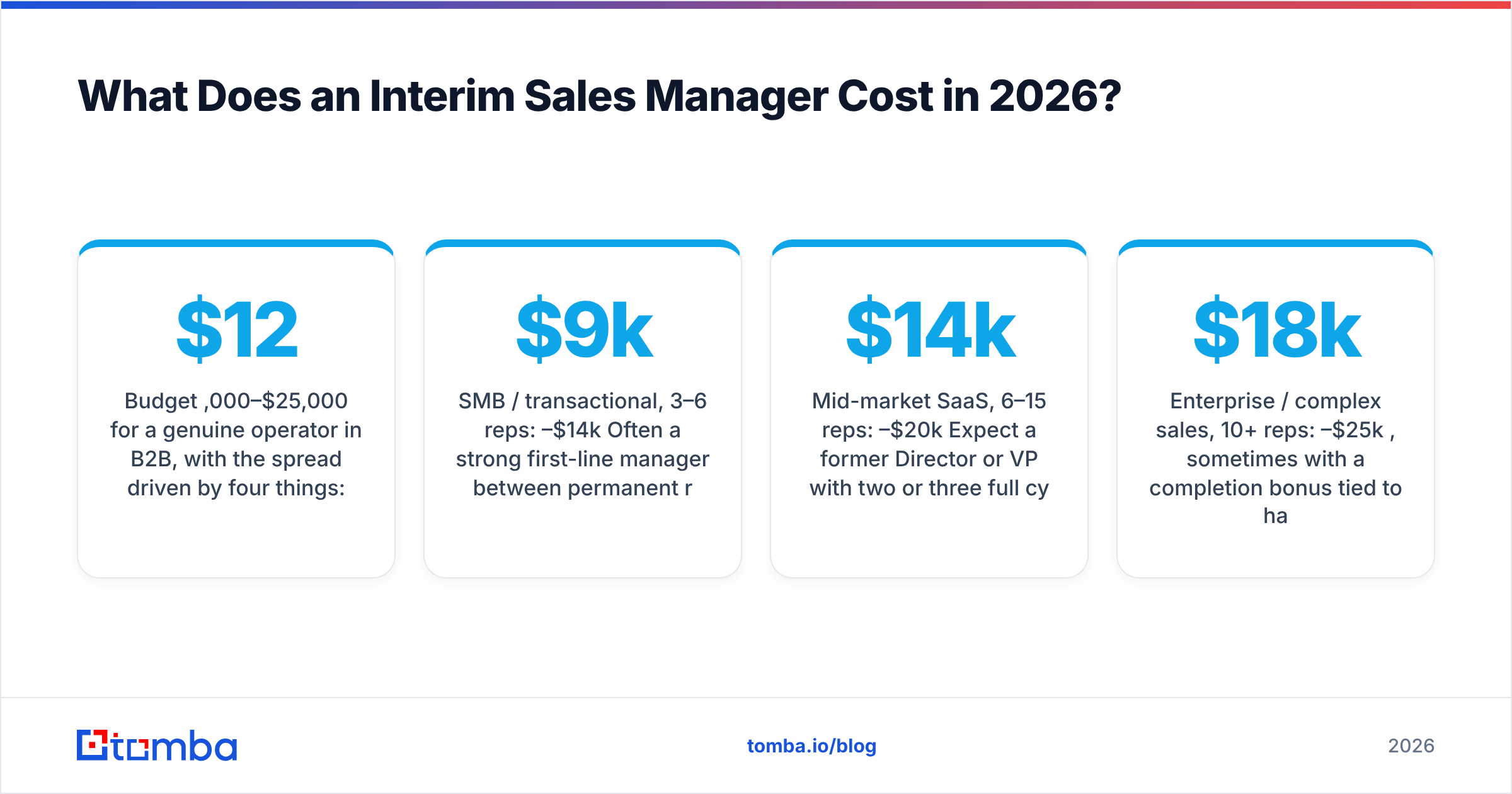
Budget $12,000–$25,000 per month for a genuine operator in B2B, with the spread driven by four things: deal size, team size, market seniority, and whether you want turnaround experience or caretaker experience.
Rough bands, based on what's currently quoted in the US and Western Europe:
- SMB / transactional, 3–6 reps: $9k–$14k/month. Often a strong first-line manager between permanent roles.
- Mid-market SaaS, 6–15 reps: $14k–$20k/month. Expect a former Director or VP with two or three full cycles behind them.
- Enterprise / complex sales, 10+ reps: $18k–$25k/month, sometimes with a completion bonus tied to handover quality.
- Turnaround mandates: add 15–25%. You're paying for someone willing to be disliked for six months.
Structure matters as much as the rate. Three contract patterns that actually work:
- Flat monthly retainer with a 30-day notice clause. Simplest, most common, least adversarial. Good for cover engagements.
- Retainer plus a handover bonus. 80–85% monthly, with the remainder paid on delivery of a documented playbook, a trained successor, and a clean CRM. This aligns incentives brilliantly and costs you nothing extra if they deliver.
- Retainer plus pipeline-created bonus. Tie 10–20% to qualified pipeline generated, not closed revenue. If your sales cycle is 90 days and the engagement is 120 days, a closed-revenue bonus is a lottery ticket, and they'll behave accordingly — discounting hard in month four to hit it.
Avoid pure commission for interims. It sounds founder-friendly and it produces exactly one behavior: the interim works the three deals most likely to close and ignores the team, the process, and the handover you actually hired them for.
What Should the First 90 Days Look Like?#
Data first, people second, process third. Every good interim engagement follows roughly that order, and the ones that fail almost always invert it — arriving with a comp plan redesign before anyone has checked whether the CRM contains real contacts.
Days 1–15 — Diagnose and stabilize. Sit in on every rep's calls. Pull 12 months of closed-won and closed-lost. Audit the CRM for stale records, duplicate accounts, and bounced contacts. Do not change a single process yet. The team is watching to see whether you're a real leader or a consultant with a login.
Days 16–30 — Fix coverage. This is where most turnarounds are won. Map territories against actual addressable accounts, then rebuild contact coverage where it's thin. A rep with 40 accounts and no verified decision-maker contacts isn't underperforming; they're under-equipped. Running the account list through a bulk email finder and a round of email verification typically recovers more meetings in two weeks than any pep talk will in two months.
Days 31–60 — Install the operating cadence. Weekly pipeline review with a fixed agenda. Monthly one-to-ones with documented development goals. A single, enforced definition of each pipeline stage. Publish your win rate by stage and by rep, and let the numbers do the arguing for you.
Days 61–90 — Build the handover. The playbook, the scorecards, the onboarding doc, the named successor. If your interim starts writing this in month five, they've already failed.

How Do You Measure an Interim Sales Manager?#
Measure inputs and assets, not the revenue number — because the revenue from their work will land after they've left, and the revenue landing during their tenure came from their predecessor's pipeline.
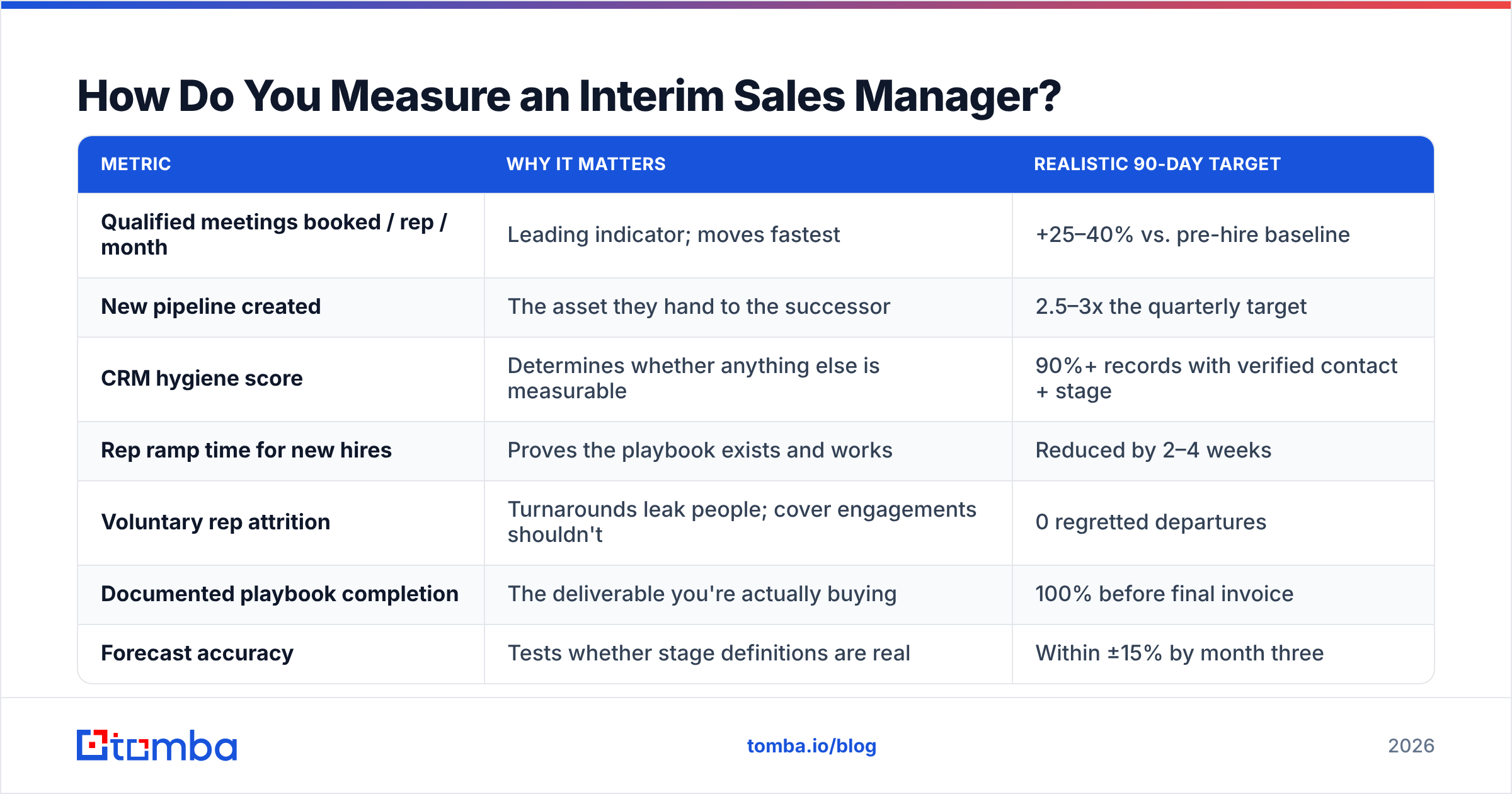
A workable 90-day scorecard:
| Metric | Why it matters | Realistic 90-day target |
|---|---|---|
| Qualified meetings booked / rep / month | Leading indicator; moves fastest | +25–40% vs. pre-hire baseline |
| New pipeline created | The asset they hand to the successor | 2.5–3x the quarterly target |
| CRM hygiene score | Determines whether anything else is measurable | 90%+ records with verified contact + stage |
| Rep ramp time for new hires | Proves the playbook exists and works | Reduced by 2–4 weeks |
| Voluntary rep attrition | Turnarounds leak people; cover engagements shouldn't | 0 regretted departures |
| Documented playbook completion | The deliverable you're actually buying | 100% before final invoice |
| Forecast accuracy | Tests whether stage definitions are real | Within ±15% by month three |
Two of those deserve emphasis. CRM hygiene sounds like an administrative nicety until you realize every other metric on the list is computed from it — garbage records mean a garbage forecast, and a garbage forecast means the board loses faith in the interim by week six. Documented playbook completion is the line item that separates an interim hire from an expensive temp: you are buying a durable asset, and it should be a payment condition, not a hope.
What Are the Real Risks?#
Four, in rough order of how often they bite.
The team treats them as a placeholder. If reps believe the interim has no authority, they'll wait them out. Fix this on day one: announce the hire yourself, state explicitly that the interim has full hiring, firing, and comp authority, and then visibly back a decision they make in the first fortnight.
Scope creep into permanent. Sometimes the interim is great and you want to keep them. That's fine — but convert deliberately, with a proper offer and a reset of expectations, not by silently extending a rolling contract for two years. Interims who drift into permanence without the title tend to leave abruptly.
No knowledge transfer. Everything lives in the interim's head, they leave, and you're back to square one at month nine. This is entirely preventable with a contractual handover clause.
Data debt is mistaken for a people problem. The most expensive interim engagements are the ones where six months get spent coaching reps who were working a contact list that was 38% invalid. Verify before you diagnose. If a rep's sequences bounce, the problem is the list, not their discipline — and repairing outbound data foundations is cheaper and faster than a performance-management cycle. HubSpot's sales research has documented for years how much rep time disappears into non-selling admin; bad data is the largest single contributor.
Where Do You Find a Good One?#
Three channels, in descending order of reliability:
- Your investors and board. Anyone who has sat on five B2B boards knows two or three interims by name and has seen them work. This is the highest-signal source and it's free.
- Specialist interim networks. Firms that place interim commercial leaders specifically. Higher fee, faster placement, pre-vetted references. Check reviews on G2 or Capterra for any tooling they insist you adopt.
- Your own alumni. Former VPs from portfolio companies, former managers who left on good terms, ex-competitors between roles. The warm-intro conversion rate here is far better than cold outreach.
When you do reach out cold — to a shortlisted name, a referral's referral, or a leader you saw speak — you'll hit the usual wall: no email address. That's a five-second problem now. Run the name and company domain through an email finder, or use domain search to see the company's format and who else sits in the commercial org. Same tooling your interim will end up using on your account list.
Screening questions that separate operators from tourists:
- "Walk me through the last handover document you wrote." (If they can't, they've never really done interim work.)
- "Which rep did you let go, and how long did it take you to decide?"
- "What did you change in the first 30 days, and what did you deliberately not change?"
- "How did you measure yourself when the revenue landed after you left?"
Should You Hire One At All?#
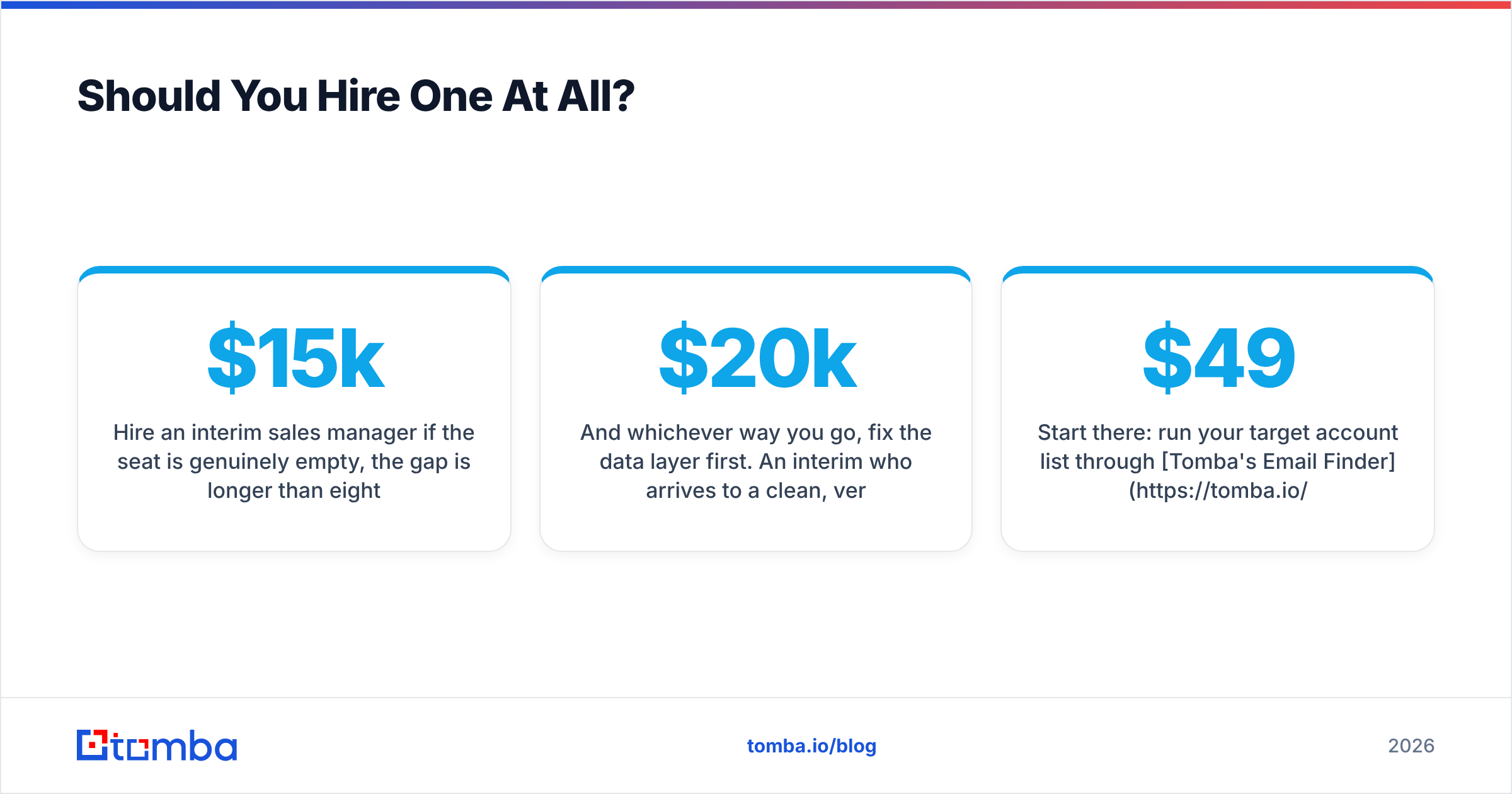
Hire an interim sales manager if the seat is genuinely empty, the gap is longer than eight weeks, and the cost of drift exceeds roughly $15k a month — which, for any team of four or more reps, it almost always does.
Don't hire one if you have two reps and a founder who still closes half the deals; that's a fractional engagement at most. Don't hire one as a way to avoid making a permanent decision indefinitely — the fixed end date is the feature, and removing it removes the value.
And whichever way you go, fix the data layer first. An interim who arrives to a clean, verified, well-covered account list can start managing on day two. One who arrives to a CRM full of bounced addresses and phantom accounts spends their first month doing archaeology at $20k a month.
Start there: run your target account list through Tomba's Email Finder to rebuild verified decision-maker coverage before your interim's first Monday. The free tier gives you 25 searches to sanity-check your worst territory; Starter is $49/mo and Growth is $99/mo if you need to repair the whole book at once — see Tomba pricing for the full breakdown. Give your interim a real list and you're buying leadership. Give them a broken one and you're paying premium rates for data cleanup.
Related guides#
// get started
Find, verify and enrich your first contacts today
Start on the free plan with 25 searches a month, then scale when your team is ready.
Free plan · No credit card required · GDPR & CCPA
// about the author