Interseller vs Apollo.io (2026): Which Outreach Tool Wins?
Interseller was built for recruiters. Apollo.io was built for sales teams. Here is how they actually compare on data accuracy, pricing, sequencing and stack fit in 2026 — and when a dedicated email-finding API beats both.
Interseller vs Apollo.io comes down to one question. Are you hiring people, or selling to them? Here is the short answer first.
TL;DR
- Interseller is a recruiting tool in a sales jacket. It finds candidate emails from LinkedIn and GitHub profiles. It runs email drips and syncs to an ATS like Greenhouse, Bullhorn or Lever.
- Apollo.io is a huge contact database with a sending layer on top. You get filters, drip sequences, a dialer and a light CRM, priced per seat.
- They rarely fight head to head. Source candidates and Interseller wins. Chase B2B buyers at volume and Apollo wins.
- Both charge for the bundle, not the data. If you just need good emails, an API tool like Tomba costs a fraction of either seat.
- Check every address before you send. Stored emails go stale by 2–3% a month, whichever tool you pick.
What are Interseller and Apollo.io?#
Start with the origin story. It explains every choice in both tools.
Interseller launched in 2016 in New York. It was built for recruiters and staffing firms. The loop is simple: open a LinkedIn or GitHub profile, click the Chrome plugin, and get a work or personal email. Drop that person into an email drip, and every touch is logged in your ATS.
Greenhouse bought Interseller in October 2021, and the tool now sits inside the Greenhouse stack. Plans have shifted since the deal, so ask for current terms before you plan a rollout.
Apollo.io came from the other side. It is a B2B contact database first, and it holds hundreds of millions of contact records. You can search by job title, staff count, tech stack, funding and intent. On top of that sits a sales layer. You get drip sequences, a dialer, meeting booking and deal tracking. The pitch: swap four tools for one seat.
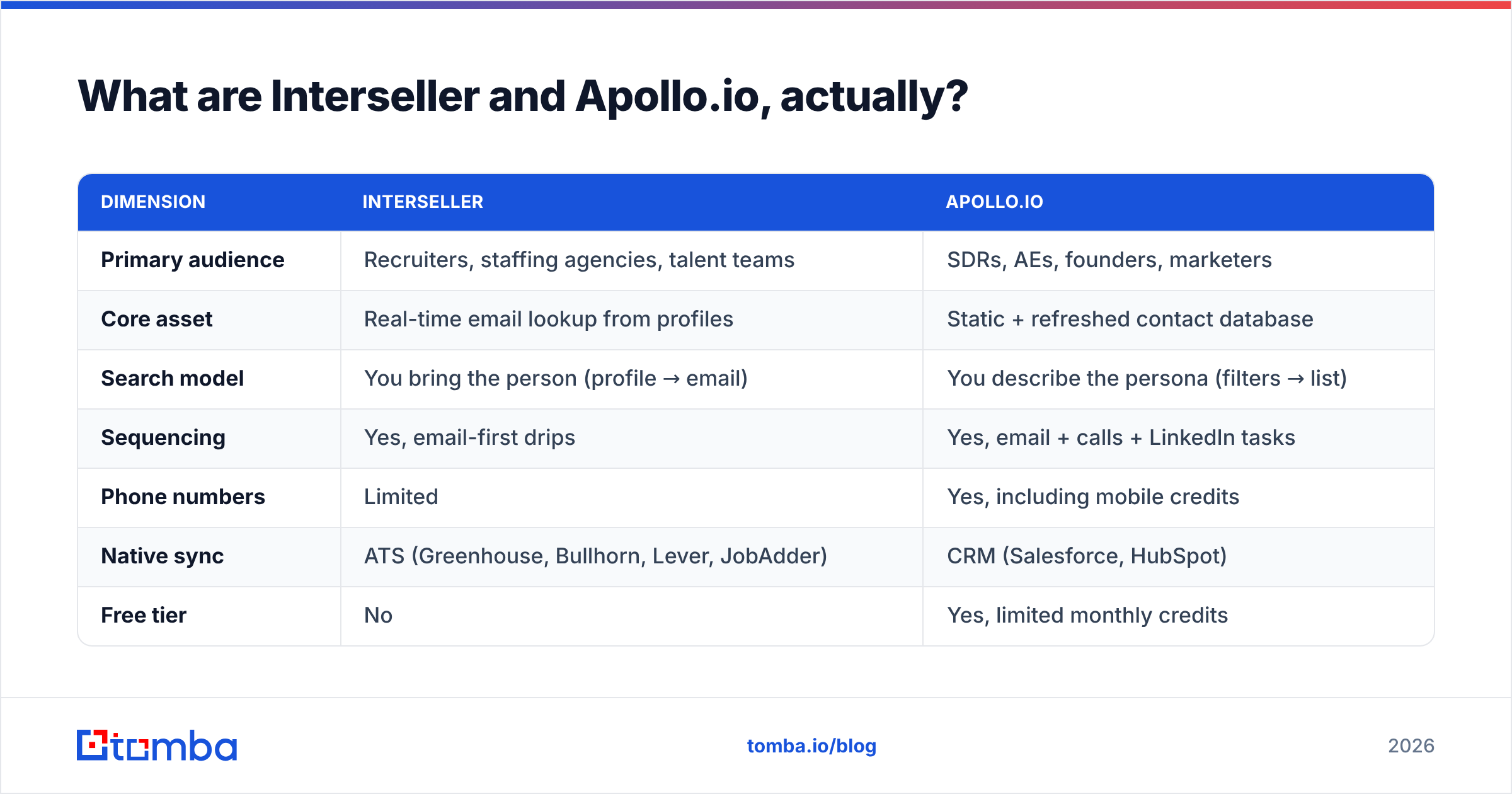
Here is the honest split.
| Dimension | Interseller | Apollo.io |
|---|---|---|
| Best for | Recruiters and staffing teams | SDRs, AEs and founders |
| Core asset | Live email lookup from a profile | Large stored contact list |
| Search style | You bring the person | You describe the persona |
| Drip sequences | Email only | Email, calls and tasks |
| Phone numbers | Few | Yes, on credits |
| Native sync | ATS tools | CRM tools |
| Free tier | No | Yes, small |
That table is the whole Interseller vs Apollo.io debate in short. Interseller assumes you know who you want. Apollo assumes you do not, and sells you a list.
Interseller vs Apollo.io: how does the pricing compare?#
Price is where the two tools stop looking alike.
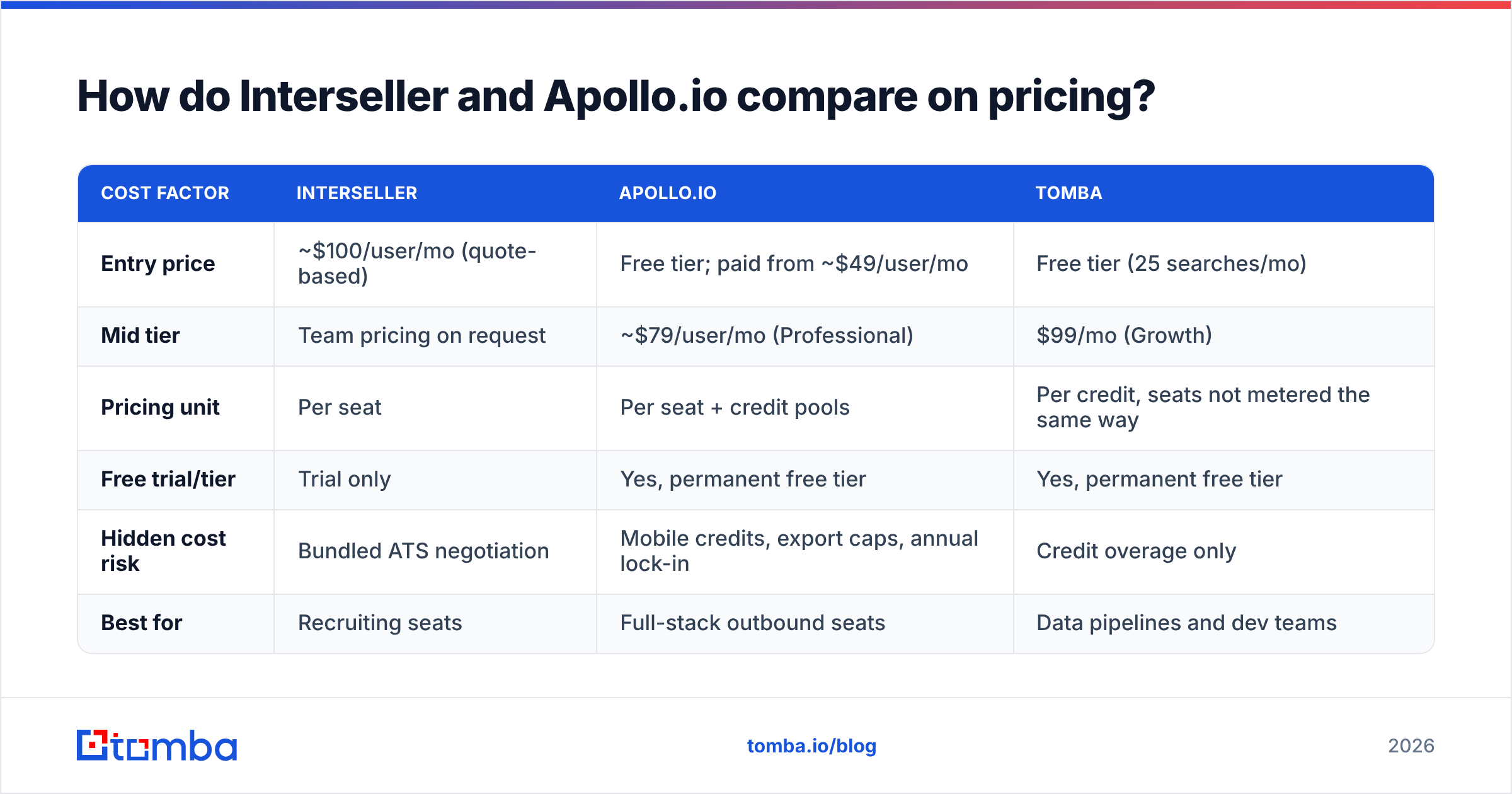
Interseller has sold seats at about $100 per user each month. Team and agency plans are quoted by hand. There is no free tier. Since the Greenhouse deal, price is often folded into a wider talk. Treat any number in a blog post, this one too, as a rough guide.
Apollo lists its plans. On a yearly deal, prices run near this. Free, with a small credit pool. Basic near $49 per seat. Pro near $79 per seat. Org near $119 per seat, with a seat floor. Paying month to month costs more. Mobile numbers and big exports draw on other credit pools. That is where teams get a shock.
| Cost | Interseller | Apollo.io | Tomba |
|---|---|---|---|
| Entry | ~$100/seat, quoted | Free tier, then ~$49/seat | Free tier, 25 searches |
| Mid tier | Quoted | ~$79/seat | $99 a month |
| Billed by | Seat | Seat plus credits | Credits |
| Free tier | Trial only | Yes | Yes |
| Watch out for | Bundled talks | Mobile credits, export caps | Credit overage |
| Best for | Recruit teams | Full outbound teams | Data and dev teams |
The point is simple. Both tools charge per human. Six recruiters means six bills. Tomba pricing charges per lookup instead. That is why many teams pair a cheap data API with a cheap sender.
Interseller vs Apollo.io: which one has better data?#
Good data drives outbound results. For these two tools, the question splits in two.

Interseller has to find one named person. It looks up the email live from a profile, so the hit rate rides on how public that person is. For a coder with a GitHub trail, it is strong. For a shift lead at a 40-person truck firm, it will come up empty. Interseller does check each address before it sends, which keeps bounces low.
Apollo has to keep a huge list fresh. A store that big is broad, but it ages fast. People change jobs, firms change domains, and catch-all servers hide dead inboxes. Reviews on G2 praise Apollo's reach and flag stale job titles. That shows up most outside the US and at small firms.
Four rules apply to both:
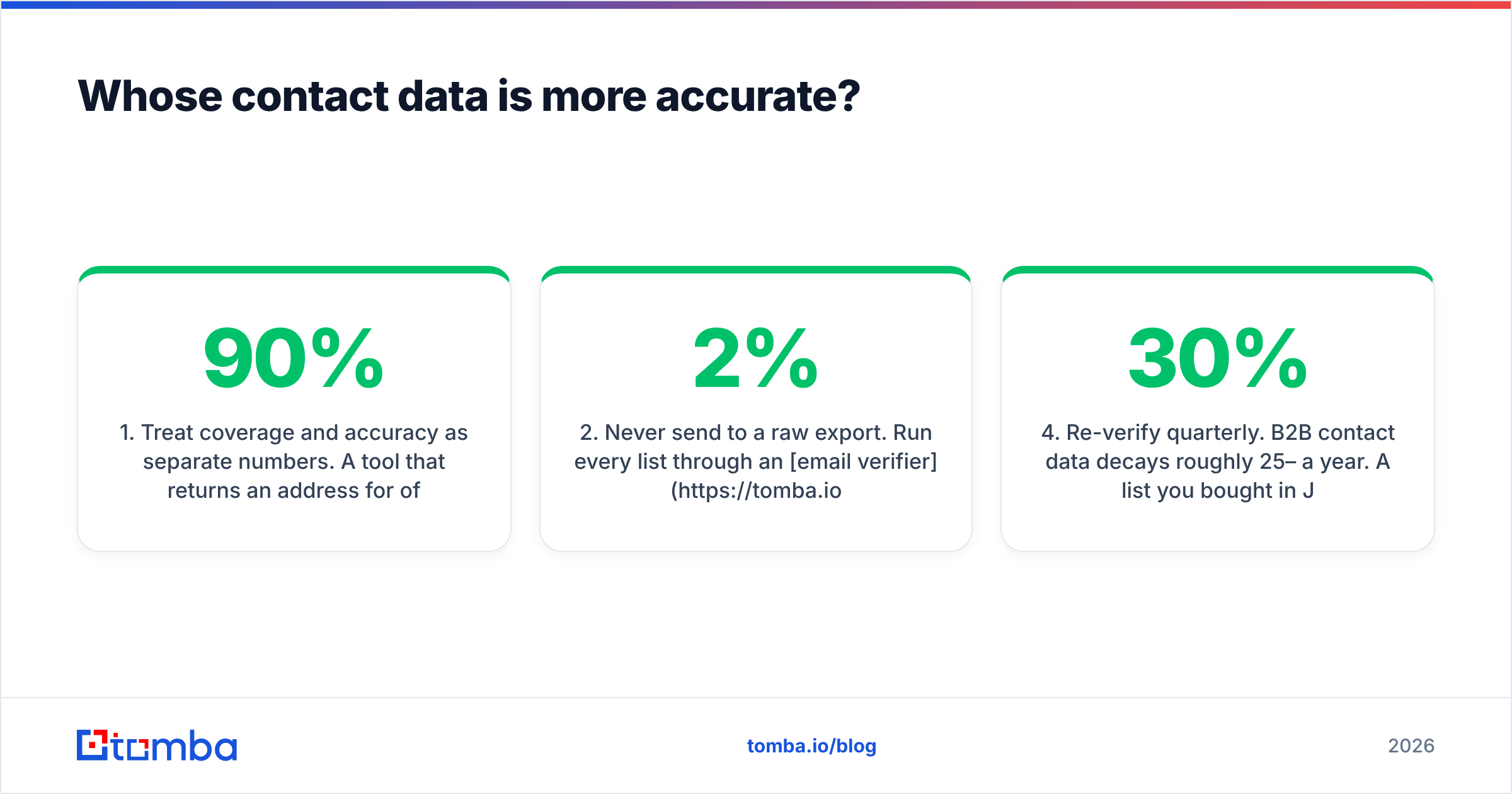
- Treat reach and accuracy as two numbers. A tool that answers for 90% of your list and is right 70% of the time is worse than one that answers for 60% and is right 95%. Bounces cost you. Blanks cost nothing.
- Never send to a raw export. Run the list through an email verifier first. Keep bounces under 2% to stay in the inbox at Google and Microsoft.
- Handle catch-all domains on purpose. A plain SMTP check says "accept-all" and tells you nothing. A catch-all verifier turns a coin flip into a list you can use.
- Check the list each quarter. B2B data goes stale by 25–30% a year. A list you bought in January is worse by April.

Interseller vs Apollo.io: which one sends better email?#
Apollo wins on features. Interseller wins on focus.
Apollo runs multi-step plays: email, calls on the built-in dialer, LinkedIn tasks and manual to-dos. You also get A/B tests, AI draft help and reply spotting. It ships sending tools too: inbox rotation, warm-up and daily send caps. For an SDR team at high volume, that breadth pays.
Interseller is narrow on purpose. It runs email drips with merge tags and reply spotting. Touches stop the moment a candidate writes back or is marked placed. Recruiters do not need a dialer in a sourcing tool. They need clean stops and a full log on the record. Interseller does that well.
The hard part is the same for both. Neither tool saves you from the two faults that sink a campaign:
- You send from a domain that is not signed. Check your SPF record, DKIM and DMARC first. Google and Yahoo now demand it from bulk senders.
- You send to bad addresses. A 10% bounce rate will hurt your sender reputation faster than any subject line can fix.
Do you already run Instantly, Smartlead, Salesloft or HubSpot? Then this whole column is moot. You are shopping for a data source, and the math changes.
How do they fit your stack?#
This one usually settles it, and it is not close.
Interseller is built for an ATS. It syncs both ways with Greenhouse, Bullhorn, Lever and JobAdder. That sync is why recruiters accept the seat price. You find, send, log and update without a single tab swap. If your team lives in Bullhorn, a sales tool will always feel bolted on.
Apollo is built for a CRM. It syncs with Salesforce and HubSpot and fills in missing lead fields. It also has an API and a Chrome plugin, so it can feed other tools.
Neither is a good data layer for coders. If the job is "fill in 40,000 rows tonight," you want an endpoint and a credit pool. Not a seat and a screen. A bulk email finder or an email finder API wins there. No seat fees. No export caps.
Is Apollo.io better than Interseller for sales teams?#
Yes, and it is not close. But read the caveat.

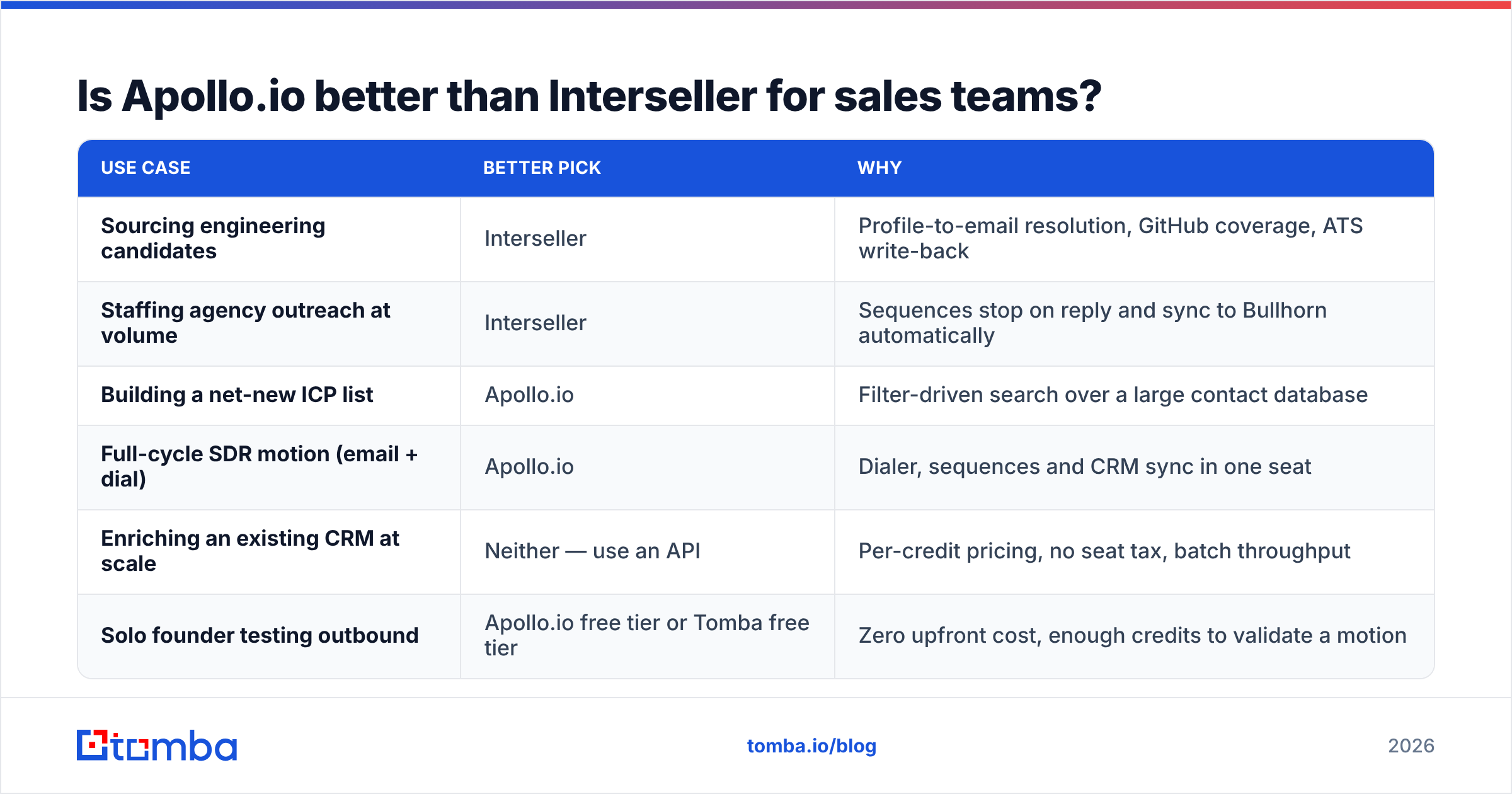
| Job to be done | Better pick | Why |
|---|---|---|
| Sourcing engineers | Interseller | Profile to email, plus ATS logging |
| Agency outreach at volume | Interseller | Drips stop on reply and sync to Bullhorn |
| Building a new list | Apollo.io | Filters across a huge database |
| Email plus dial motion | Apollo.io | Dialer, drips and CRM sync in one seat |
| Filling gaps in a CRM | Neither, use an API | Pay per credit, no seat tax |
| Solo founder testing | Either free tier | No cost upfront |
Now the caveat. "Better for sales teams" does not mean cheapest. Many Apollo seats are bought for one job: finding and checking work emails. The rest goes unused. If that is your team, the real question is not Interseller vs Apollo.io. It is Apollo against a lean data source plus the sender you already pay for. Our Apollo alternative guide runs that math.
When should you skip both?#
Four signs, all common:
- You like the sender you have. Paying for a second drip engine is waste. Buy data, not features you will never switch to.
- Your volume is spiky. Seat prices punish teams that run two big pushes a quarter. Credits do not.
- Your lookups happen in code. If a lead fills in a form and your server needs the email, a screen-first tool is the wrong shape. An email finder endpoint fits better.
- You need a paper trail. Legal teams ask where a record came from. Vendors that publish their data sources make that talk short.
Tomba is built for this shape. The free tier covers 25 searches a month. Starter is $49 a month, Growth is $99 and Pro is $249, and large teams get a custom quote. Email finder, domain search, checks, catch-all and lookups all draw on one credit pool, through one API key.
Interseller vs Apollo.io: which should you pick?#
Pick Interseller if you recruit for a living. It fits teams inside Greenhouse, Bullhorn, Lever or JobAdder. You get sourcing, outreach and logging in one loop. Ask Greenhouse for current pricing first.
Pick Apollo.io if you run a sales team and build lists from scratch. Plan to use the dialer, the drips and the CRM sync. Start on the free tier. Test 200 contacts and watch the bounce rate before you sign for a year.
Pick neither if you own your sender and your CRM. What you need then is good contacts by API at a price you can predict. That is the quiet majority of teams weighing Interseller vs Apollo.io.
Whatever you pick, check each address, keep bounces under 2%, and refresh the list each quarter. No tool choice survives a burnt domain.
Ready to test the data layer on its own? Start with the Tomba Email Finder free tier. You get 25 searches a month, no card, with a check built in. Run it on 50 contacts you know are good, compare the hit rate to what you pay today, and let the numbers pick your stack.
Related guides#
// get started
Find, verify and enrich your first contacts today
Start on the free plan with 25 searches a month, then scale when your team is ready.
Free plan · No credit card required · GDPR & CCPA
Get the Tomba newsletter
Product and data updates
// about the author