Introvert Sales Success: How Quiet Reps Outsell Extroverts
The loudest rep on the floor is rarely the top of the leaderboard. Here is the research on ambivert selling, plus a concrete playbook and stack for introvert sales success in 2026.
TL;DR
- The "extroverts make better salespeople" assumption does not survive contact with data. The strongest performers in the best-known study were ambiverts, and pure extroverts underperformed their reputation.
- Introvert sales success comes from a different motion: fewer accounts, deeper research, asynchronous-first outreach, and written follow-up that compounds.
- The biggest constraint on a quiet rep is not confidence. It is bad contact data, which forces high-volume activity to compensate for low-quality lists.
- Build a process around preparation, scripted discovery, and calendar design that protects deep-work blocks — then let tooling absorb the repetitive parts.
- You do not need to become someone else. You need a smaller, cleaner target list and a system that rewards depth over decibels.
What does "introvert sales success" actually mean?#
It means hitting or beating quota using a motion built around depth, preparation, and written communication — instead of one built around volume, improvisation, and constant live interaction.
Think of it like two chefs. One runs a diner: 200 covers a night, short-order speed, everything improvised at the pass. The other runs a 24-seat tasting menu: fewer guests, obsessive prep, every plate intentional. Both can be profitable. Both can fail. The diner chef who tries to run a tasting menu with no prep time will fail, and so will the tasting-menu chef forced to short-order 200 covers.
Most sales orgs are built as diners. The activity metrics — dials per day, emails sent, meetings booked per week — reward the short-order motion. That is why so many introverted reps conclude they are bad at sales when what they are actually bad at is someone else's operating model.
The distinction matters because introversion is about where you recover energy, not whether you can talk to strangers. Plenty of introverted reps are excellent on calls. They are simply spent afterwards, and they need the schedule to account for that.
Does the research support the extrovert sales advantage?#
No, and this is the single most useful fact to have in your pocket.
The best-known study on this is Adam Grant's 2013 paper in Psychological Science, "Rethinking the Extraverted Sales Ideal: The Ambivert Advantage." Grant tracked call-center reps over three months and plotted revenue against a standard extraversion scale. The relationship was not linear. It was an inverted U. Reps in the middle of the scale — ambiverts — produced the most revenue per hour. Strong extroverts performed roughly on par with strong introverts.
The mechanism Grant proposed is straightforward: high extroverts talk too much, listen too little, and can come across as pushy. High introverts under-assert. The middle listens and then asks for the business.
Two practical implications:
- If you are an introvert, the gap between you and the top performer is a small number of learnable assertive behaviors — not a personality transplant.
- If you manage a team, hiring for "high energy" is a filter with no evidence behind it, and it quietly discards a large share of your candidate pool.
The buying side supports this too. Gartner's B2B buying research has consistently found that buyers spend only a small slice of their purchase journey with any supplier's sales reps — most of the work happens in independent research and internal consensus-building. A rep whose advantage is producing clear, useful written material that circulates inside the buying group is playing to where the decision actually gets made.
Where do introverts actually have the edge in B2B sales?#
Five places, and they are all measurable.
- Pre-call research depth. Quiet reps tend to over-prepare. In complex B2B deals that is not a quirk, it is a competitive moat — you walk in knowing the buyer's funding round, their new VP, and the job posting that reveals their roadmap.
- Discovery listening. The inverted-U finding is largely a listening effect. Introverts naturally leave silence after a question, and silence is where buyers reveal the real problem.
- Written follow-up. A tight recap email that a champion can forward without editing does more for a deal than three charming calls the champion cannot reproduce internally.
- Multi-threading in writing. Reaching a CFO, a security reviewer, and an ops lead is a research-and-writing task, not a charisma task. Depth wins here.
- Consistency over streaks. Extroverted motion often runs hot and cold. A process-driven rep who ships 25 researched touches every week beats a rep who ships 200 one week and 40 the next.
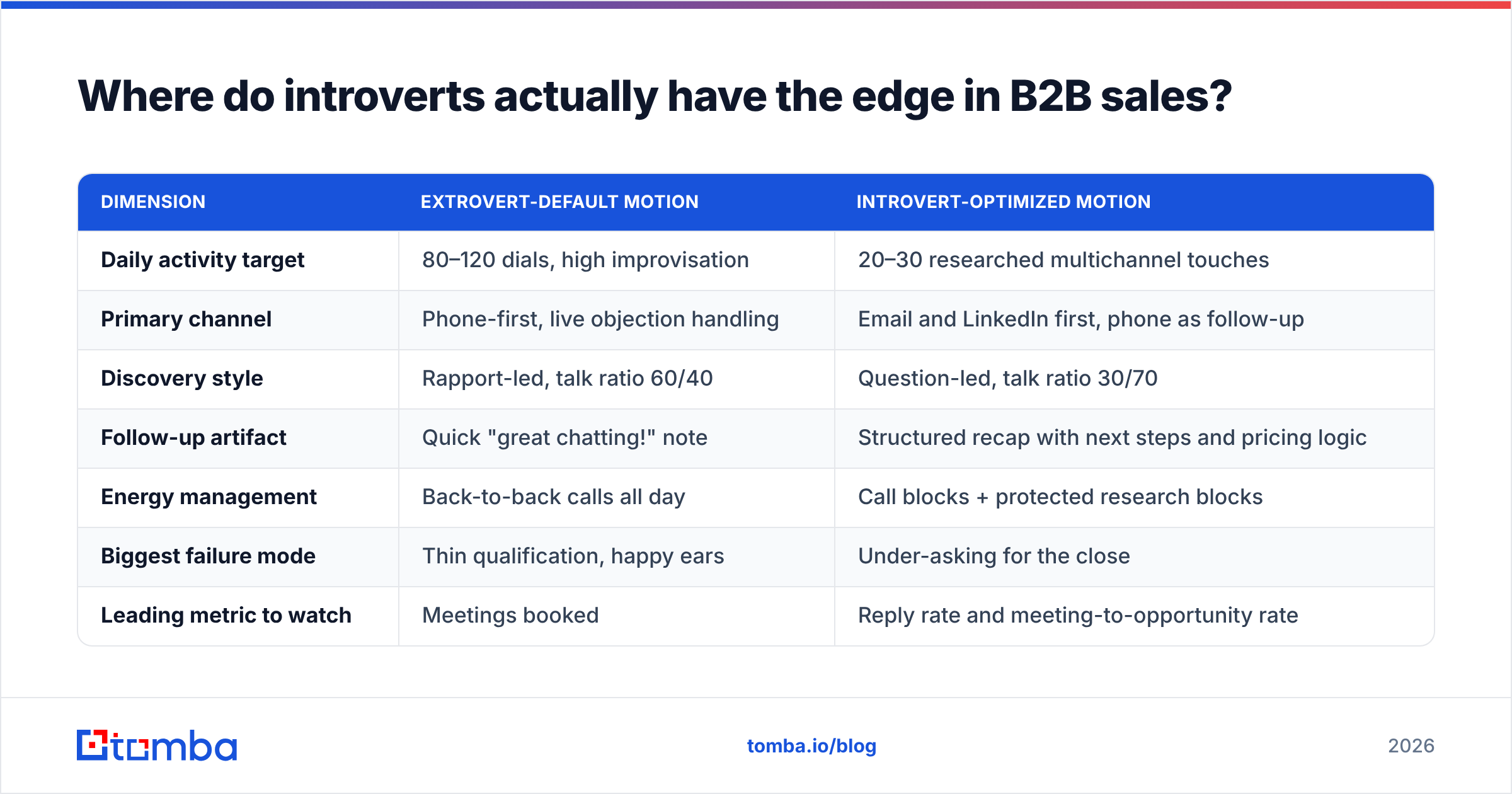
| Dimension | Extrovert-default motion | Introvert-optimized motion |
|---|---|---|
| Daily activity target | 80–120 dials, high improvisation | 20–30 researched multichannel touches |
| Primary channel | Phone-first, live objection handling | Email and LinkedIn first, phone as follow-up |
| Discovery style | Rapport-led, talk ratio 60/40 | Question-led, talk ratio 30/70 |
| Follow-up artifact | Quick "great chatting!" note | Structured recap with next steps and pricing logic |
| Energy management | Back-to-back calls all day | Call blocks + protected research blocks |
| Biggest failure mode | Thin qualification, happy ears | Under-asking for the close |
| Leading metric to watch | Meetings booked | Reply rate and meeting-to-opportunity rate |
Notice the last row. If your org only measures dials and meetings booked, you will always look mediocre. Push your manager toward response rate and stage-conversion metrics, which reward quality of targeting. Those are the numbers where a prepared rep wins on paper.
How do you design a sales week that doesn't drain you?#
Treat energy like a battery with a known capacity, not a moral failing.
Batch live interaction. Two call blocks of 90 minutes beat eight calls scattered across nine hours. The scatter pattern means you never leave "on" mode, and you burn the whole battery on transitions.
Put research before the calendar, not after. Most reps research in the fifteen minutes before a call. Move it to a dedicated block the day before, in bulk, across ten accounts. You will produce better notes in less total time.
Script the first ninety seconds. Cold-call anxiety is mostly anxiety about improvising an opening. Write three openers, memorize them, and the rest of the call becomes questions — which is the part you are good at.
Use a discovery framework you can lean on. MEDDICC, SPICED, whatever your org uses. A framework externalizes the structure so you are not simultaneously building the conversation and holding it.
Default to async when the buyer will accept it. A Loom walkthrough plus a written summary often converts better than a 30-minute call that the buyer half-attends. It also scales: one recording serves five stakeholders.
Schedule a recovery buffer after demos. Fifteen minutes, blocked, non-negotiable. Use it for the recap email while the call is fresh. You get the artifact and the reset in one slot.
Why does contact data matter more for introverts than extroverts?#
Because an extroverted rep can brute-force a bad list. You cannot, and you should not want to.
Here is the trap. Your manager gives you a 5,000-row list scraped from somewhere with a 30% bounce rate and stale titles. The volume-oriented rep sends 500 emails a day, eats the bounces, and gets enough replies to survive. You send 30 carefully written emails a day, and if 30% of them bounce or hit someone who left the company eighteen months ago, your reply rate looks catastrophic — even though your messaging is better.
Depth-based selling has less margin for data error. Every wasted touch costs you a research block, not thirty seconds.

The fix is unglamorous: verify before you write. Run the list through an email verifier so you are not composing thoughtful messages to dead mailboxes, and use an email finder to fill gaps on the accounts that actually matter rather than buying more rows you will never touch. Then enrich leads with the firmographic and technographic context that makes your research block ten minutes instead of forty.
According to HubSpot's sales statistics roundup, prospecting remains the hardest part of the job for most reps. It is also the part most amenable to systems. That is good news if your comparative advantage is systems rather than stamina.
Which tools actually help a quiet closer?#
Pick tools that reduce live improvisation and increase leverage per touch. Here is how the main categories stack up for this specific motion.
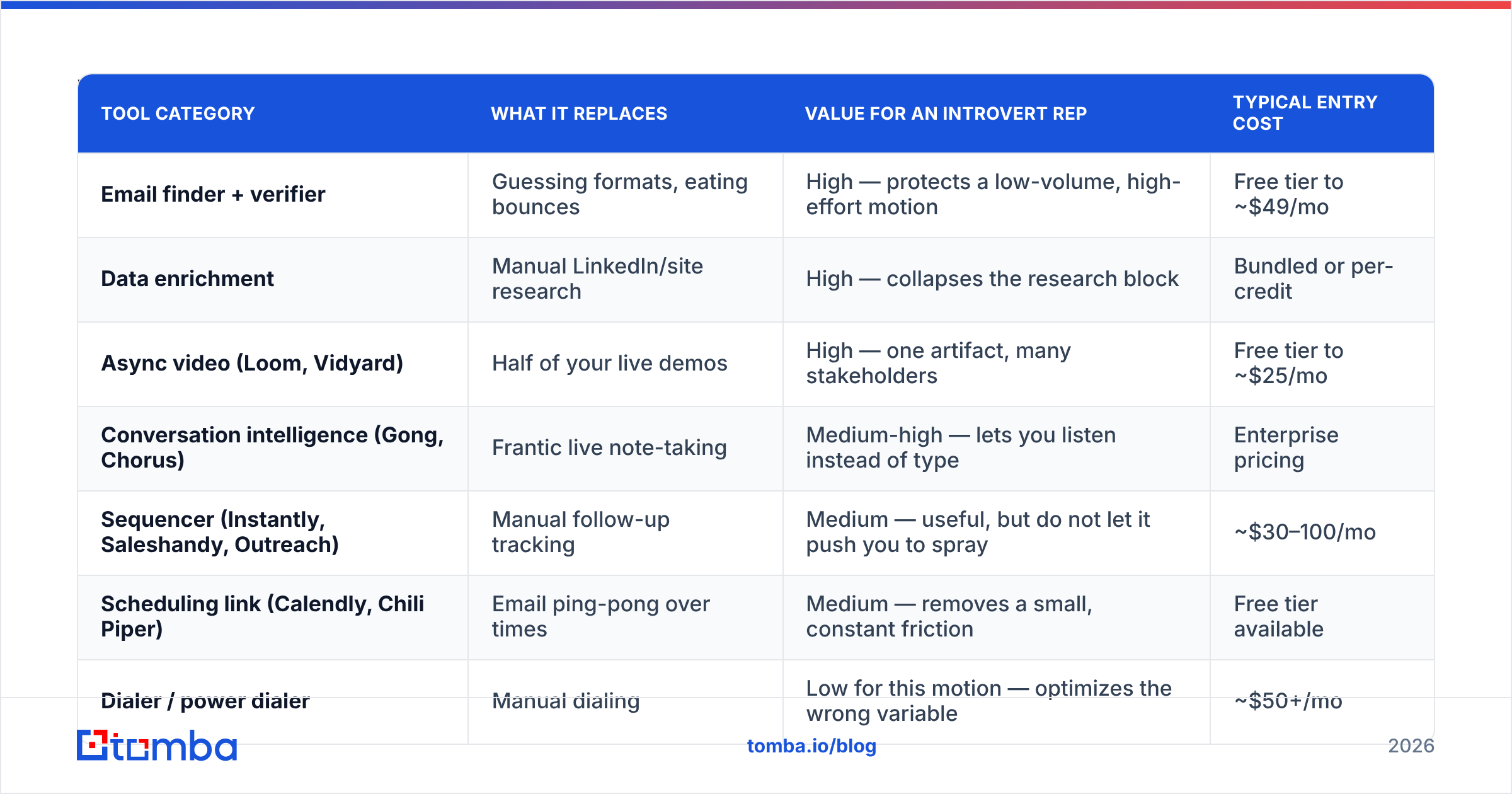
| Tool category | What it replaces | Value for an introvert rep | Typical entry cost |
|---|---|---|---|
| Email finder + verifier | Guessing formats, eating bounces | High — protects a low-volume, high-effort motion | Free tier to ~$49/mo |
| Data enrichment | Manual LinkedIn/site research | High — collapses the research block | Bundled or per-credit |
| Async video (Loom, Vidyard) | Half of your live demos | High — one artifact, many stakeholders | Free tier to ~$25/mo |
| Conversation intelligence (Gong, Chorus) | Frantic live note-taking | Medium-high — lets you listen instead of type | Enterprise pricing |
| Sequencer (Instantly, Saleshandy, Outreach) | Manual follow-up tracking | Medium — useful, but do not let it push you to spray | ~$30–100/mo |
| Scheduling link (Calendly, Chili Piper) | Email ping-pong over times | Medium — removes a small, constant friction | Free tier available |
| Dialer / power dialer | Manual dialing | Low for this motion — optimizes the wrong variable | ~$50+/mo |
The pattern: buy tools that raise the quality of each touch, not tools that raise the number of touches. A power dialer is a great purchase for a diner chef and a bad one for a tasting-menu chef.
On pricing, be honest about what a small, sharp list actually costs. Most email-finding platforms have a usable free tier for testing — Tomba's free plan includes 25 searches a month, with paid plans starting at $49/mo and Growth at $99/mo. Check current Tomba pricing before budgeting, and compare it against what you would spend on a bloated database seat you use at 5% capacity.
How do you handle cold calls and live objections without dread?#
Three things, in order of impact.
Reframe the call as a qualification interview, not a pitch. Your job in the first two minutes is to find out whether this person has the problem. That framing removes the performance pressure, because you are gathering information, not persuading.
Pre-write your objection responses. Not scripts to read — bullet points to glance at. "We already use X" gets three bullets. "Send me something" gets three bullets. You are removing the improvisation tax, which is the part that actually exhausts you.
Practice asking for the close out loud. This is the single behavior where introverted reps lose measurable revenue. Grant's research points at under-assertion, not under-preparation. Write your closing ask verbatim: "Based on what you described, the next step is a 30-minute technical review with your ops lead. Does Thursday at 10 work?" Say it the same way every time until it stops feeling like a confrontation.
One more note on cold calling: it is legitimate to weight your channel mix toward email and LinkedIn if your data shows it converts. It is not legitimate to abandon the phone entirely because it is uncomfortable. Buyers who reply to a well-researched email often close faster on a call.
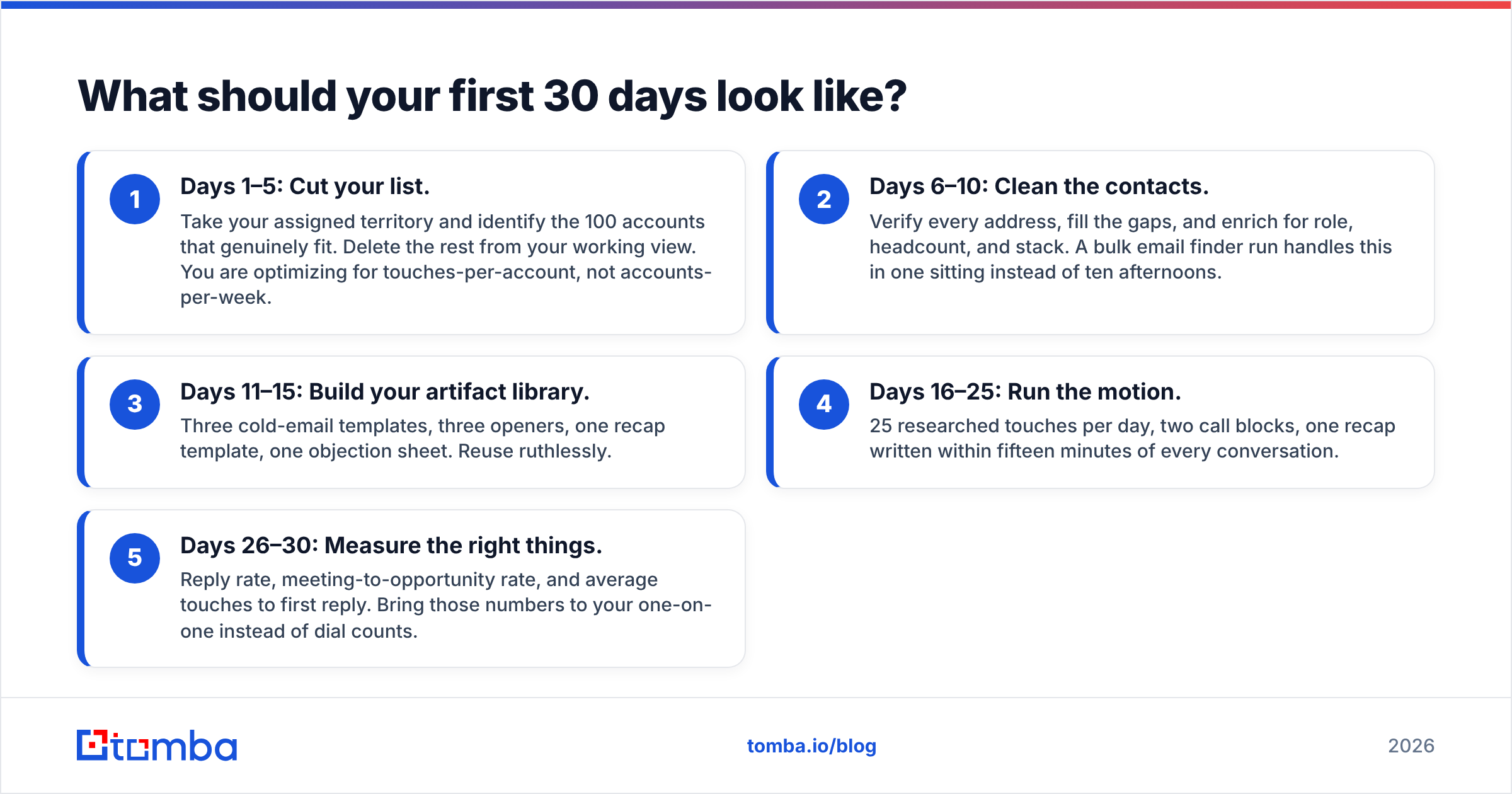
What should your first 30 days look like?#
- Days 1–5: Cut your list. Take your assigned territory and identify the 100 accounts that genuinely fit. Delete the rest from your working view. You are optimizing for touches-per-account, not accounts-per-week.
- Days 6–10: Clean the contacts. Verify every address, fill the gaps, and enrich for role, headcount, and stack. A bulk email finder run handles this in one sitting instead of ten afternoons.
- Days 11–15: Build your artifact library. Three cold-email templates, three openers, one recap template, one objection sheet. Reuse ruthlessly.
- Days 16–25: Run the motion. 25 researched touches per day, two call blocks, one recap written within fifteen minutes of every conversation.
- Days 26–30: Measure the right things. Reply rate, meeting-to-opportunity rate, and average touches to first reply. Bring those numbers to your one-on-one instead of dial counts.
If reply rate is above 8% and meetings still are not converting, the problem is qualification. If reply rate is below 3% with clean data, the problem is messaging. Separating those two diagnoses is why the data-cleaning step comes first.
Where do introvert reps most often get it wrong?#
They mistake thoroughness for progress. Research is only valuable up to the point where it changes what you say. Forty minutes of reading that produces the same email as ten minutes is forty minutes of hiding.
They also under-multi-thread, because reaching out to a second stakeholder feels like going behind the champion's back. It is not. Single-threaded deals die when your champion changes jobs, and in 2026 they change jobs constantly.
And they wait too long to ask. If you have had three conversations and never proposed a commercial next step, the deal is not in your pipeline. It is a pen pal.
Start with a list you can actually trust#
You do not need more calls. You need fewer, better-aimed ones — which means every contact record has to be right before you spend a research block on it.
Tomba Email Finder gives you verified professional email addresses by name, domain, or company, so a 100-account target list turns into 100 real conversations instead of a bounce report. Start on the free tier with 25 searches a month, confirm your reply rate moves, then scale up when the numbers justify it. Quiet reps win on precision. Make sure your data earns it.
Related guides#
// get started
Find, verify and enrich your first contacts today
Start on the free plan with 25 searches a month, then scale when your team is ready.
Free plan · No credit card required · GDPR & CCPA
// about the author