Is Cold Outreach Dead in 2026? What the Data Actually Says
Reply rates fell, spam filters tightened, and half of sales Twitter declared cold outreach dead. The numbers tell a different story — here's what actually changed and what still works in 2026.
TL;DR
- Cold outreach is not dead. The spray-and-pray version of it died somewhere between Google and Yahoo's 2024 bulk-sender rules and the 2025 flood of AI-generated sequences.
- Median cold email reply rates dropped, but top-decile teams still hit 8-15% — the gap between median and top performers widened, which is the opposite of a dead channel.
- Three things changed the math: mailbox authentication enforcement, spam-complaint thresholds under 0.3%, and buyers who can now spot a templated AI email in two seconds.
- Data quality is the single largest lever. A 30% bounce list will torch a domain faster than bad copy ever will.
- The teams winning in 2026 send fewer, better-targeted emails to verified contacts, and treat outreach as one channel in a multi-touch sequence — not the whole plan.
Is cold outreach actually dead in 2026?#
No. But the version most people are asking about — buy a list, load 10,000 contacts, blast a four-step sequence, book meetings — has been dead since roughly 2024, and it's been getting deader every quarter since.
Here's the honest framing. When someone says "cold outreach is dead," they almost always mean one of three different things:
- "My reply rates dropped." Usually true, and usually a data or targeting problem rather than a channel problem.
- "My emails land in spam now." Almost always an authentication, volume, or list-hygiene problem — fixable, not fatal.
- "Buyers don't respond to strangers anymore." Demonstrably false. Buyers don't respond to obviously automated strangers. That's a different claim.
The channel is crowded, expensive to do badly, and unforgiving of sloppiness. That's not death. That's maturity. Every channel goes through this — display ads in 2008, SEO content in 2019, LinkedIn InMail in 2022.
What actually changed between 2023 and 2026?#
Four structural shifts, in rough order of impact.
1. Bulk sender enforcement became real. In February 2024 Google and Yahoo began requiring SPF, DKIM, and DMARC for anyone sending over 5,000 messages a day to their users, plus a one-click unsubscribe and a spam complaint rate held under 0.3%. Microsoft followed with similar requirements for Outlook.com in 2025. This wasn't a suggestion. Senders who ignored it watched delivery collapse over a two-week window.
2. AI made mediocre outreach infinitely cheap. Every rep now has a copy generator. The result: inbox volume went up, average quality went down, and the baseline for "this feels personalized" moved. An email that would have felt thoughtful in 2022 now reads as machine output, because it probably is.
3. Buyers got faster at pattern-matching. The tell-tale AI opener ("I noticed your recent post about scaling...") is now a recognized signal to delete. Personalization at scale stopped working the moment everyone had it.
4. Data decay accelerated. B2B contact data degrades roughly 22-30% per year in normal conditions. The 2023-2025 layoff cycles across tech pushed that higher in certain segments. A list you bought 18 months ago is mostly fiction.
What do the numbers say about cold email reply rates?#
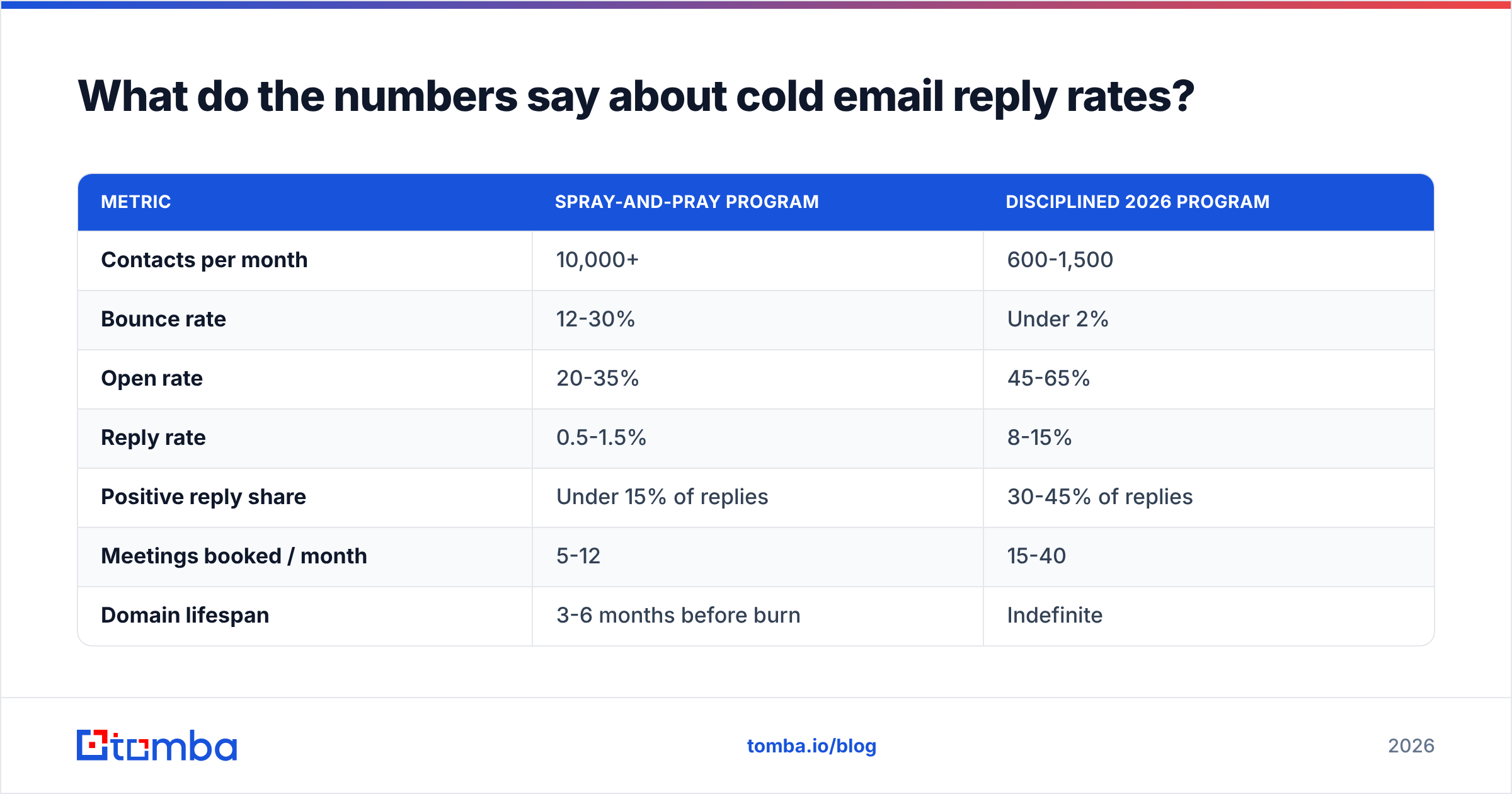
Aggregated benchmarks from vendors and review platforms like G2 put median B2B cold email reply rates in a 1-3% band in 2026, down from 3-5% a few years earlier. That's the headline everyone quotes when declaring the channel dead.
The more useful number is the spread. Well-run programs — verified lists, tight ICP, genuine research, sub-1% bounce rates — report 8-15% reply rates and 2-5% meeting-booked rates. That gap is the whole story. When a channel dies, everyone's numbers converge toward zero. When a channel matures, the gap between the careless and the disciplined widens.
| Metric | Spray-and-pray program | Disciplined 2026 program |
|---|---|---|
| Contacts per month | 10,000+ | 600-1,500 |
| Bounce rate | 12-30% | Under 2% |
| Open rate | 20-35% | 45-65% |
| Reply rate | 0.5-1.5% | 8-15% |
| Positive reply share | Under 15% of replies | 30-45% of replies |
| Meetings booked / month | 5-12 | 15-40 |
| Domain lifespan | 3-6 months before burn | Indefinite |
| Cost per meeting | $180-$400 | $60-$140 |
Read the last two rows carefully. The high-volume program burns sending domains every few months, which means recurring setup cost, recurring warmup time, and a permanent ceiling on deliverability. The low-volume program compounds — its sender reputation improves with every clean send.
Why does data quality matter more than copy now?#
Because bad data fails you before your copy ever gets read.
Think of your sending domain like a credit score. Every bounce, every spam complaint, every message to a dead mailbox is a late payment. You can write the most compelling email in your category, but if 20% of your list bounces, the mailbox providers stop delivering the other 80% — and your beautiful copy never enters the equation.
The chain works like this:
- Invalid addresses cause hard bounces. Providers read high bounce rates as a signal you didn't earn your list.
- Bounces damage sender reputation. Reputation is scored per-domain and per-IP, and it recovers slowly.
- Damaged reputation moves you to spam. Not just for the bad addresses — for everyone.
- Spam placement kills reply rates. Now your "cold outreach is dead" conclusion becomes self-fulfilling.
- Teams respond by sending more volume. Which accelerates the whole cycle.
This is why the 2026 playbook starts with data, not with copy. Run every address through an email verifier before it enters a sequence. Handle catch-all domains explicitly with a catch-all verifier rather than guessing — catch-all servers accept everything at SMTP time and bounce later, which is the worst possible failure mode for a sending domain. And when you source contacts, source them from a provider that re-validates rather than resells a 2022 scrape.
Which outreach channels still work, and how do they compare?#
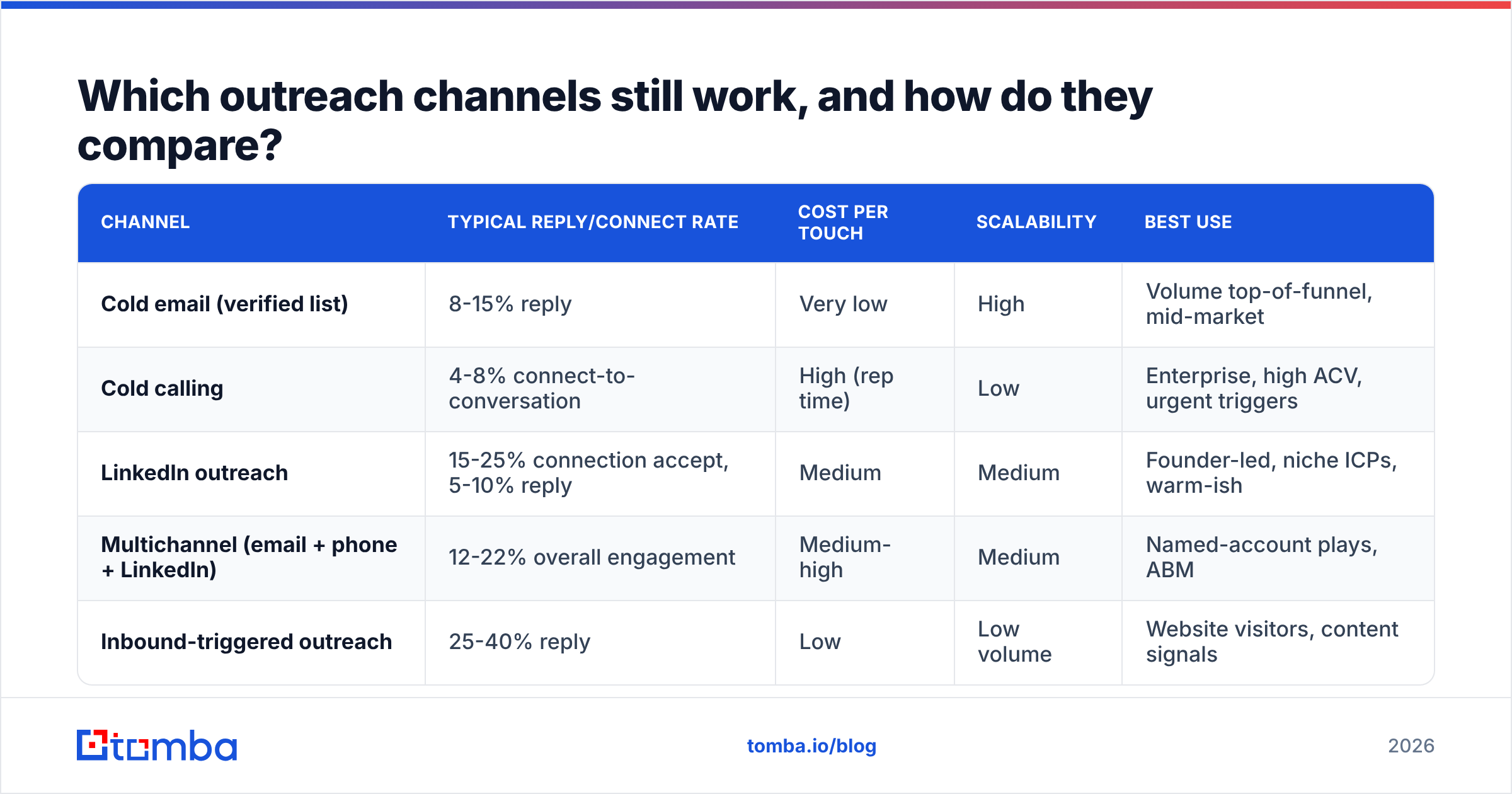
Email isn't the only cold channel, and the "is cold outreach dead" question usually collapses email, phone, and LinkedIn into one bucket. They have very different economics in 2026.
| Channel | Typical reply/connect rate | Cost per touch | Scalability | Best use |
|---|---|---|---|---|
| Cold email (verified list) | 8-15% reply | Very low | High | Volume top-of-funnel, mid-market |
| Cold calling | 4-8% connect-to-conversation | High (rep time) | Low | Enterprise, high ACV, urgent triggers |
| LinkedIn outreach | 15-25% connection accept, 5-10% reply | Medium | Medium | Founder-led, niche ICPs, warm-ish |
| Multichannel (email + phone + LinkedIn) | 12-22% overall engagement | Medium-high | Medium | Named-account plays, ABM |
| Inbound-triggered outreach | 25-40% reply | Low | Low volume | Website visitors, content signals |
The last row is the one most teams underuse. Someone who read three of your pricing pages last week is not a cold contact — they're a warm one who hasn't identified themselves. Tools that handle website visitor reveal turn anonymous traffic into named accounts you can reach with genuine context. Reply rates in that motion routinely beat pure cold by 3-5x, because the relevance is real rather than manufactured.
Multichannel deserves its own note. Single-channel email sequences have been losing effectiveness steadily; sequences that pair email with a LinkedIn outreach touch and a phone attempt convert meaningfully better on the same contact list. You're not adding volume — you're adding surface area on the same targets.
How do you run cold outreach that still works in 2026?#
Six moves, roughly in order of ROI.
- Fix authentication first. SPF, DKIM, and DMARC on every sending domain, verified with a real checker, before you send anything. This takes an afternoon and prevents six months of mystery.
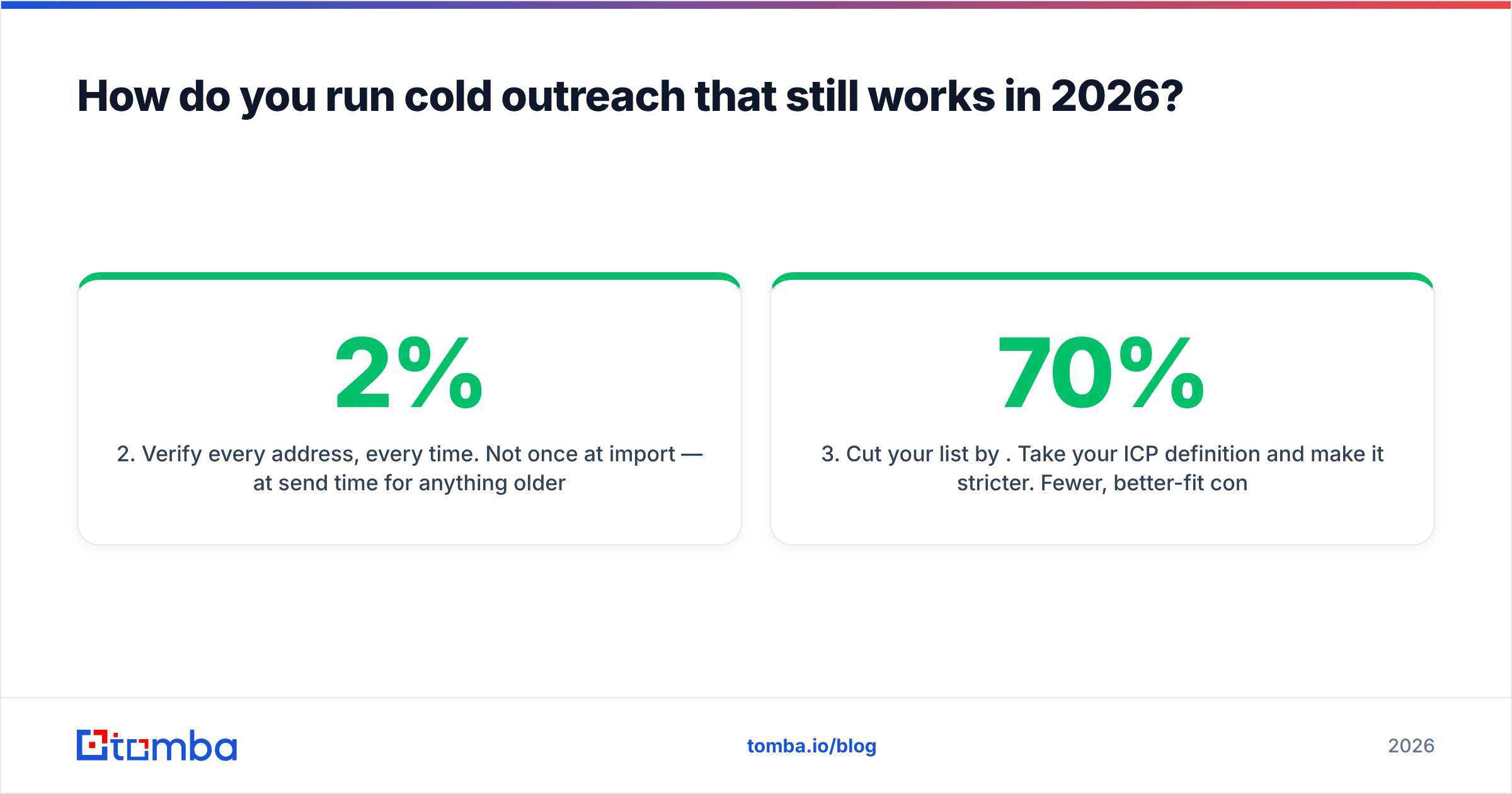
- Verify every address, every time. Not once at import — at send time for anything older than 60 days. Aim for under 2% bounce; under 1% if you can.
- Cut your list by 70%. Take your ICP definition and make it stricter. Fewer, better-fit contacts outperform broad lists on every metric that matters, including total meetings booked.
- Warm the domain properly. New domains need 3-6 weeks of gradual volume ramp. Use a warmup calculator rather than guessing at a schedule.
- Write one email a human would send. One specific observation, one clear ask, under 90 words, no "hope this finds you well," no three-paragraph value prop. If an AI could have written it about any of 500 companies, rewrite it.
- Sequence across channels, not just across days. Four emails to a silent prospect is noise. Two emails, one LinkedIn touch, and one call is a campaign.
Where does most outbound budget get wasted?#
Three places, consistently.
Buying static contact databases. A CSV is a snapshot of a moving target. By the time you've finished loading it, 2-3% of it is already wrong, and that compounds monthly. Sourcing contacts on demand — resolving a name and domain to a current address at the moment you need it — costs less and bounces less than maintaining a stale warehouse. This is the core argument for an email finder workflow over a database subscription, though a well-maintained B2B database has its place for market sizing and account discovery.
Over-tooling the stack. Many teams run a data provider, a separate verifier, a sequencer, a warmup tool, an enrichment tool, and a CRM sync layer — six line items where three would do. Consolidation isn't just cost; every handoff between tools is a place where data quality degrades.
Paying for volume you can't safely send. A plan with 50,000 monthly credits is worthless if your deliverability ceiling is 3,000 sends a month. Match credits to sending capacity, not to ambition. Worth checking Tomba pricing and comparable vendors against your actual monthly send volume rather than your target one.
What does the tooling landscape look like now?#
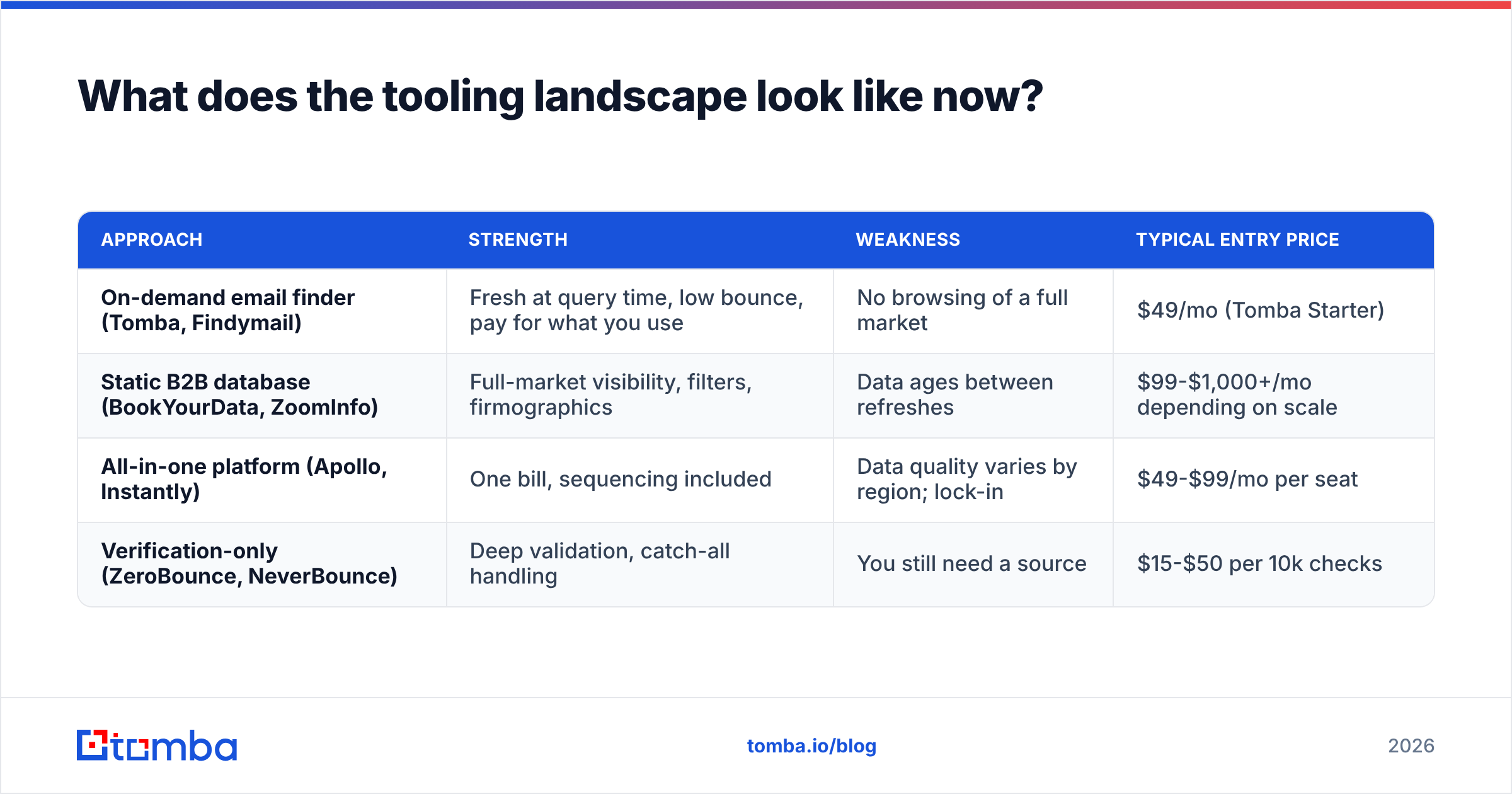
Contact data providers split roughly into three camps in 2026: on-demand finders, static databases, and all-in-one sequencers with bundled data.
| Approach | Strength | Weakness | Typical entry price |
|---|---|---|---|
| On-demand email finder (Tomba, Findymail) | Fresh at query time, low bounce, pay for what you use | No browsing of a full market | $49/mo (Tomba Starter) |
| Static B2B database (BookYourData, ZoomInfo) | Full-market visibility, filters, firmographics | Data ages between refreshes | $99-$1,000+/mo depending on scale |
| All-in-one platform (Apollo, Instantly) | One bill, sequencing included | Data quality varies by region; lock-in | $49-$99/mo per seat |
| Verification-only (ZeroBounce, NeverBounce) | Deep validation, catch-all handling | You still need a source | $15-$50 per 10k checks |
There's no universally correct choice. If you're running named-account outbound against a defined list, an on-demand finder plus a good sequencer is cheaper and cleaner. If you're still defining your market, a database with strong firmographic filters — BookYourData does this well with pay-as-you-go pricing, as do the enterprise incumbents — earns its cost during the discovery phase. Most mature teams end up running both: a database for account discovery, a finder for contact resolution at the moment of outreach.
If you're consolidating, check that whatever you pick exposes an API. Manual CSV shuffling between tools is where data decay and human error both live. A proper email finder API lets you resolve and verify inside your CRM workflow instead of alongside it.
So what's the actual verdict?#
Cold outreach in 2026 is a channel with a high floor and a high ceiling. The floor rose — you can no longer succeed by being cheap and loud. The ceiling also rose, because the noise floor drove buyers to reward genuine relevance more than they used to.
The teams declaring it dead are usually the ones who never adapted to the 2024 sender requirements, never fixed their list hygiene, and never stopped measuring success by emails sent. The teams quietly booking 40 meetings a month off 1,200 contacts are not writing think-pieces about it.
Practical test: pull your last 1,000 sends. If your bounce rate is over 3%, cold outreach isn't dead — your data is. Fix that first, then judge the channel.
Start with clean data. Most "cold outreach is dead" diagnoses are really "my list is 25% invalid" diagnoses. Tomba Email Finder resolves names and domains to verified, current addresses at query time — with verification built in, so bounces stay under 2% and your sending domain keeps compounding reputation instead of burning it. Start on the free tier with 25 searches a month, or move to Starter at $49/mo when you're ready to run real volume. Fix the data layer, and the channel works exactly as well as it ever did.
Related guides#
// get started
Find, verify and enrich your first contacts today
Start on the free plan with 25 searches a month, then scale when your team is ready.
Free plan · No credit card required · GDPR & CCPA
// about the author