Is Email Dead in 2026? What the Reply-Rate Data Shows
Every year someone declares email finished, and every year it quietly outperforms the channel that was supposed to replace it. Here is what the 2026 reply-rate and deliverability data actually shows.
TL;DR
- No, email is not dead. What died is the 2018 playbook: buy a list, blast 5,000 sends a day from one domain, hope volume covers sloppiness.
- Aggregate reply rates fell because send volume exploded, not because buyers stopped reading email. Median B2B cold email reply rates now sit in the 1-5% band, with well-targeted campaigns still clearing 8-12%.
- The 2024 Google and Yahoo bulk-sender rules, followed by Microsoft's 2025 tightening, reclassified sloppy senders as spam by default. That is an enforcement change, not a channel death.
- Email still beats LinkedIn DMs, cold calls, and paid ads on cost per booked meeting for most B2B teams, mainly because it scales without a seat license per prospect.
- The single highest-leverage fix is data quality. Bounce rate above 3% is a deliverability problem masquerading as a "email doesn't work anymore" problem.
What do people actually mean when they ask "is email dead"?#
Three different questions get collapsed into one. Separating them is the whole trick.
- Is email as a communication protocol dead? Not remotely. It is the last open, federated identity layer on the internet. You need an email address to sign up for the tools that were supposed to replace email.
- Is email marketing (newsletters, lifecycle, nurture) dead? No. It is the highest-ROI owned channel most companies have, precisely because nobody else controls the distribution.
- Is cold email dead? This is the real question, and the honest answer is: cold email as it was practiced between 2016 and 2022 is dead. Cold email as a targeted, verified, low-volume research-backed motion is very much alive and still cheaper than everything else.
When someone tells you email is finished, ask which of those three they mean. Nine times out of ten they mean the third one, and they mean it because their own sequence stopped working after they tripled send volume.
Is email dead in 2026? What the numbers say#
Here is the uncomfortable part: the pessimists are reading a real signal, just attributing it to the wrong cause.
Total B2B outbound email volume has climbed every year since AI writing tools made it trivial to generate a thousand "personalized" first lines. Inboxes did not grow. When supply of messages rises and attention stays flat, average performance falls. That is arithmetic, not a eulogy.
What has not happened is a collapse in email's usefulness as a channel. Email remains the default business communication protocol, and HubSpot's ongoing marketing statistics research continues to show email at or near the top of the ROI table for owned channels. Buyers still read email. They just read less of it, faster, and with a harsher filter.
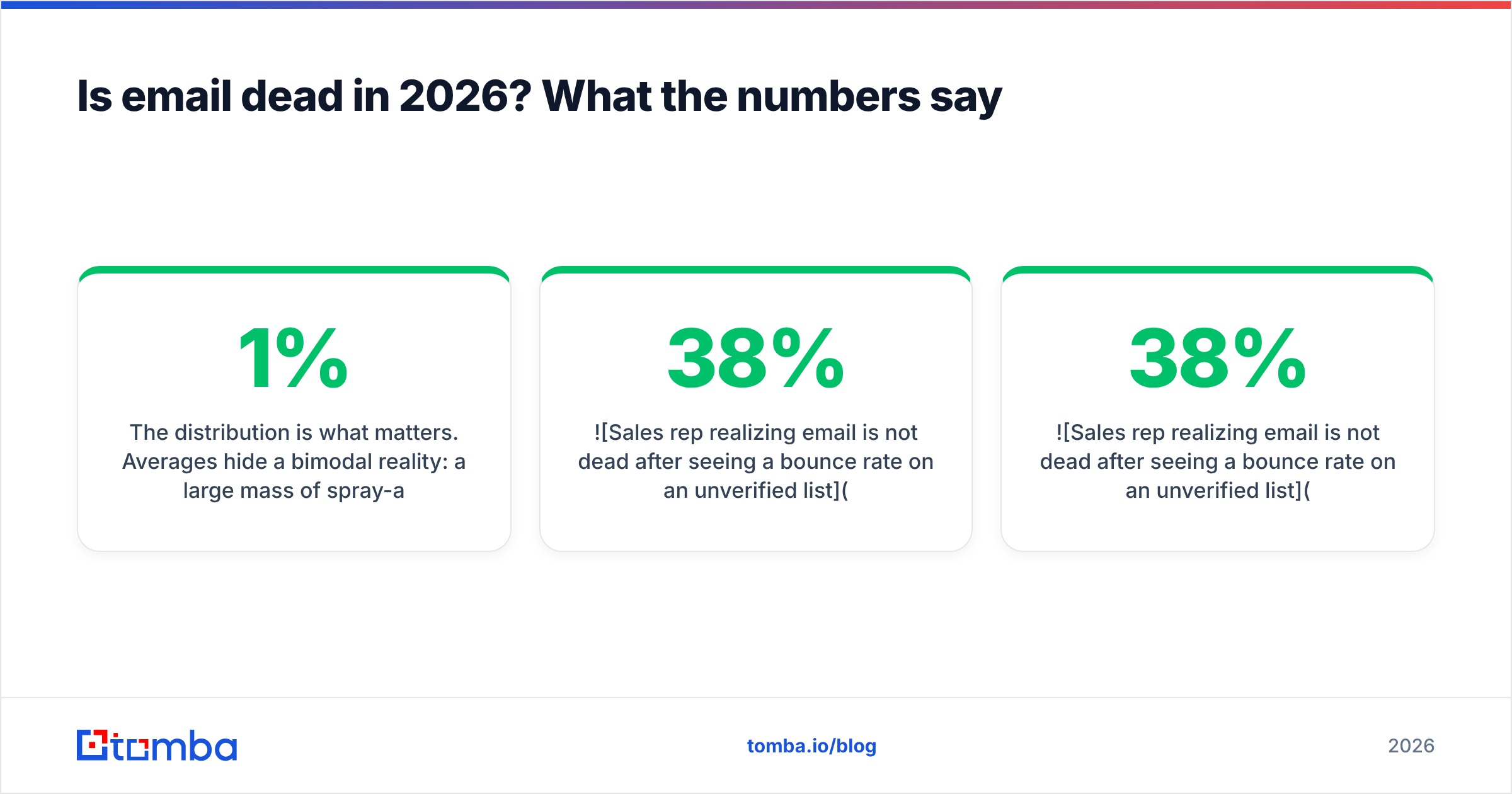
The distribution is what matters. Averages hide a bimodal reality: a large mass of spray-and-pray campaigns pulling under 1%, and a smaller group of tightly targeted campaigns pulling 8-15%. If you average a 0.4% campaign and a 12% campaign you get a number that describes neither.
Wait, that renders wrong. Here it is properly:
Why does email feel dead when the data says otherwise?#
Five things changed between 2022 and 2026, and every one of them punishes the old playbook specifically.
- Bulk sender enforcement became real. Google and Yahoo's sender guidelines made SPF, DKIM, DMARC, one-click unsubscribe, and a spam complaint rate under 0.3% hard requirements for anyone sending over 5,000 messages a day. Microsoft followed. What used to be "best practice" is now a gate.
- AI made mediocre personalization free. When every prospect gets six emails that open with "Loved your post on scaling RevOps," the tactic stops signalling effort. It signals automation.
- Inbox tabs and AI triage got better. Gmail's categorization plus AI summarization means a generic pitch often never reaches human eyes, even when it technically delivers.
- List decay accelerated. B2B contact data goes stale at roughly 2-2.5% per month through job changes and restructuring. A list bought 18 months ago is close to half wrong. Every dead address is a deliverability tax.
- Buyers got a defensive reflex. The modern B2B buyer has been cold-emailed thousands of times. The bar for "this is worth two seconds" moved, and it moved toward relevance rather than cleverness.
Notice what is not on that list: "people stopped using email."
Is email dead compared to LinkedIn, cold calling, and paid ads?#
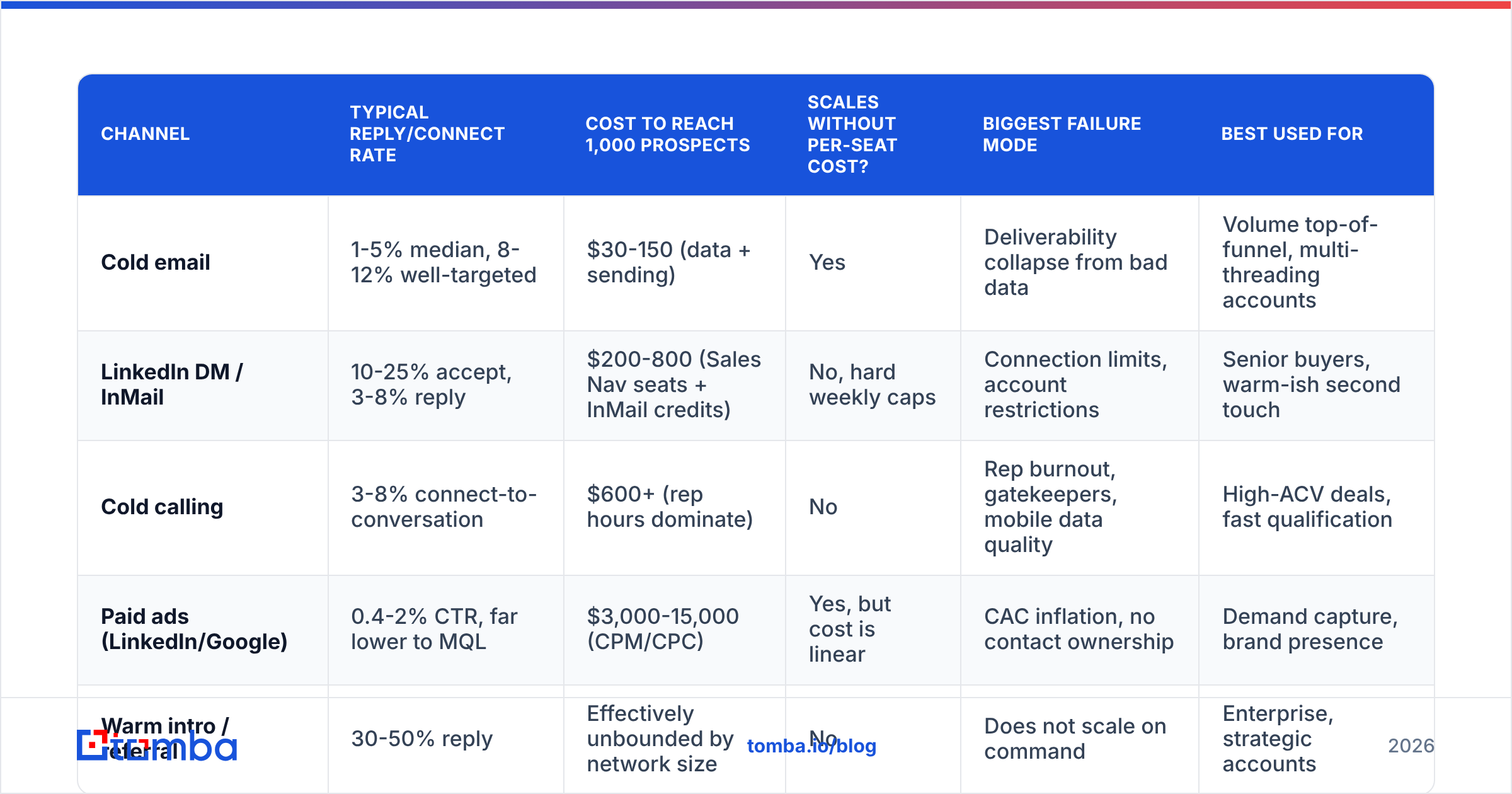
This is where the question gets decidable. Compare channels on the metrics that actually control pipeline cost.
| Channel | Typical reply/connect rate | Cost to reach 1,000 prospects | Scales without per-seat cost? | Biggest failure mode | Best used for |
|---|---|---|---|---|---|
| Cold email | 1-5% median, 8-12% well-targeted | $30-150 (data + sending) | Yes | Deliverability collapse from bad data | Volume top-of-funnel, multi-threading accounts |
| LinkedIn DM / InMail | 10-25% accept, 3-8% reply | $200-800 (Sales Nav seats + InMail credits) | No, hard weekly caps | Connection limits, account restrictions | Senior buyers, warm-ish second touch |
| Cold calling | 3-8% connect-to-conversation | $600+ (rep hours dominate) | No | Rep burnout, gatekeepers, mobile data quality | High-ACV deals, fast qualification |
| Paid ads (LinkedIn/Google) | 0.4-2% CTR, far lower to MQL | $3,000-15,000 (CPM/CPC) | Yes, but cost is linear | CAC inflation, no contact ownership | Demand capture, brand presence |
| Warm intro / referral | 30-50% reply | Effectively unbounded by network size | No | Does not scale on command | Enterprise, strategic accounts |
Read the middle two columns together. Email is the only channel that combines a workable reply rate with a cost structure that does not multiply by headcount. That is the entire reason it refuses to die. Cold calling converts better per conversation, but you cannot hire your way to 10,000 dials a week without a budget most teams do not have. LinkedIn works, but the platform actively caps your volume, and those caps tightened again in 2025.
The correct framing is not "email vs. LinkedIn." It is "email as the scalable spine, with LinkedIn and phone as the depth layer on accounts worth the depth." Teams that run LinkedIn outreach and email as separate silos get the worst of both.
Is cold email dead, specifically?#
Cold email is not dead. Cold email at volume with bad data is dead, and it died loudly.
Here is the mechanism, in plain terms. Your inbox provider watches a handful of signals: bounce rate, spam complaint rate, engagement, authentication, and sending pattern consistency. Think of it like a credit score for your domain. One bad month drops the score, and a dropped score means your next campaign lands in spam regardless of how good the copy is. The copy never gets a chance to be judged.
Bounces are the fastest way to wreck that score. A list with 20% invalid addresses will typically push you past every provider's tolerance in a single send. You then conclude "email is dead" when what actually happened is that you burned your sender reputation in 40 minutes.
This is why the fix is almost always upstream of the copywriting. Running every address through an email verifier before the send is not a nice-to-have in 2026; it is the price of entry. The same goes for catch-all domains, which are the quiet killer on enterprise lists because they accept everything at the SMTP layer and bounce later.
What does a healthy email program look like in 2026?#
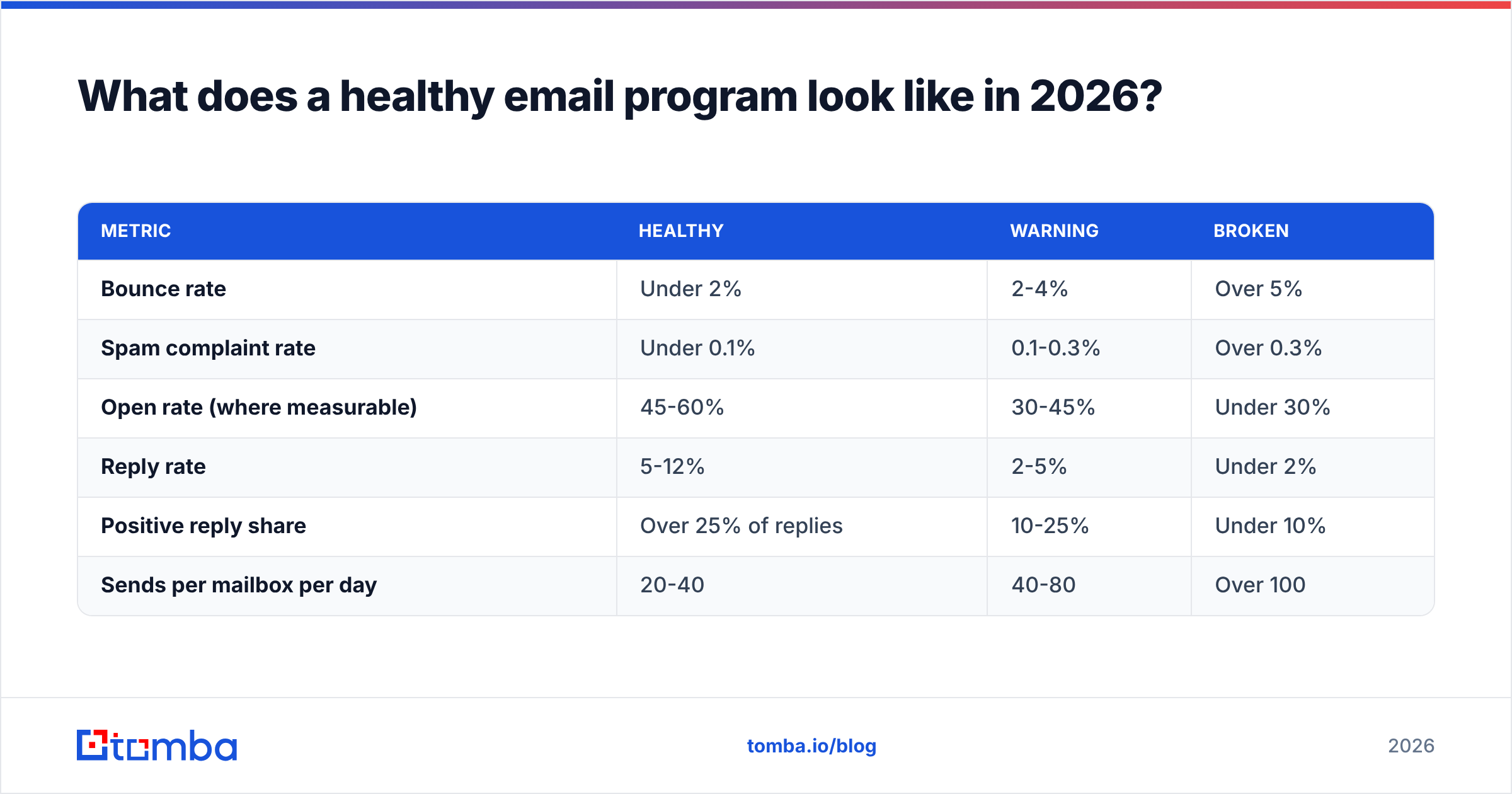
Concrete benchmarks, so you can diagnose rather than guess.
| Metric | Healthy | Warning | Broken |
|---|---|---|---|
| Bounce rate | Under 2% | 2-4% | Over 5% |
| Spam complaint rate | Under 0.1% | 0.1-0.3% | Over 0.3% |
| Open rate (where measurable) | 45-60% | 30-45% | Under 30% |
| Reply rate | 5-12% | 2-5% | Under 2% |
| Positive reply share | Over 25% of replies | 10-25% | Under 10% |
| Sends per mailbox per day | 20-40 | 40-80 | Over 100 |
If your bounce rate is broken, nothing else on that list is diagnostic yet. Fix data first, then judge copy. Teams routinely rewrite subject lines for three weeks while sitting on a list where a third of the addresses no longer exist.
The "sends per mailbox" row surprises people. The 2026 pattern that works is many mailboxes at low volume, not one mailbox at high volume. Twenty sends a day from eight mailboxes beats 160 from one, because per-mailbox volume is itself a spam signal now.
How do you actually make email work again?#
Six moves, ordered by leverage.
- Verify before you send, every time. Not once a quarter. Data decays monthly, so verification belongs in the send workflow, not in an annual cleanup project. Run catch-all domains through a dedicated catch-all verifier rather than guessing.
- Cut list size by 70% and raise relevance. A 300-person list where every contact matches a real trigger outperforms a 3,000-person list with a job-title filter. This is the single change most teams resist and most teams need.
- Fix authentication before you scale. SPF, DKIM, DMARC at p=none minimum, custom tracking domain, one-click unsubscribe. Check your SPF record is actually valid rather than assuming your ESP handled it.
- Warm domains on a real ramp. New domains need 3-4 weeks before meaningful volume. Use an email warmup calculator to plan the ramp rather than eyeballing it.
- Write for the two-second scan. Under 90 words, one specific observation about their business, one clear ask, no attachment, no image, no five-link signature. Run it through a spam checker before it ships.
- Multi-thread the account, not just the contact. Three relevant people at one company beats one person at three companies, because internal forwarding is the highest-converting "reply" you will ever get.
None of this is exotic. It is just more work per prospect than the 2019 approach, which is exactly why fewer competitors do it, which is exactly why it still works.
Will AI kill email outreach entirely?#
Probably the opposite, though not in the way vendors claim.
AI raised the floor on volume and lowered the cost of generic messages to roughly zero. The predictable result is that generic messages stopped working. What AI has not done is make relevance free. Knowing that a company just opened a Berlin office, changed its billing stack, or lost a VP of Sales still requires real signal, and acting on it still requires a correct email address for the person who cares.
So the equilibrium is: AI handles drafting and research summarization, humans handle targeting judgment, and data quality becomes the binding constraint. In a world where everyone can write a decent email, the advantage shifts to whoever knows who to send it to and can actually reach them. That is a data problem, not a copy problem.
Worth noting too that AI inbox assistants summarize rather than delete. A clear, specific, short email survives summarization better than a clever one. Plain language is now a deliverability tactic.
So is email dead, or not?#
Not dead. Consolidating.
The channel is going through the same maturation that paid search went through around 2012. Cheap arbitrage closed, enforcement tightened, and the winners became the teams that invested in fundamentals instead of hunting the next loophole. Average performance fell while top-quartile performance held steady or improved. That pattern gets misread as decline every single time.
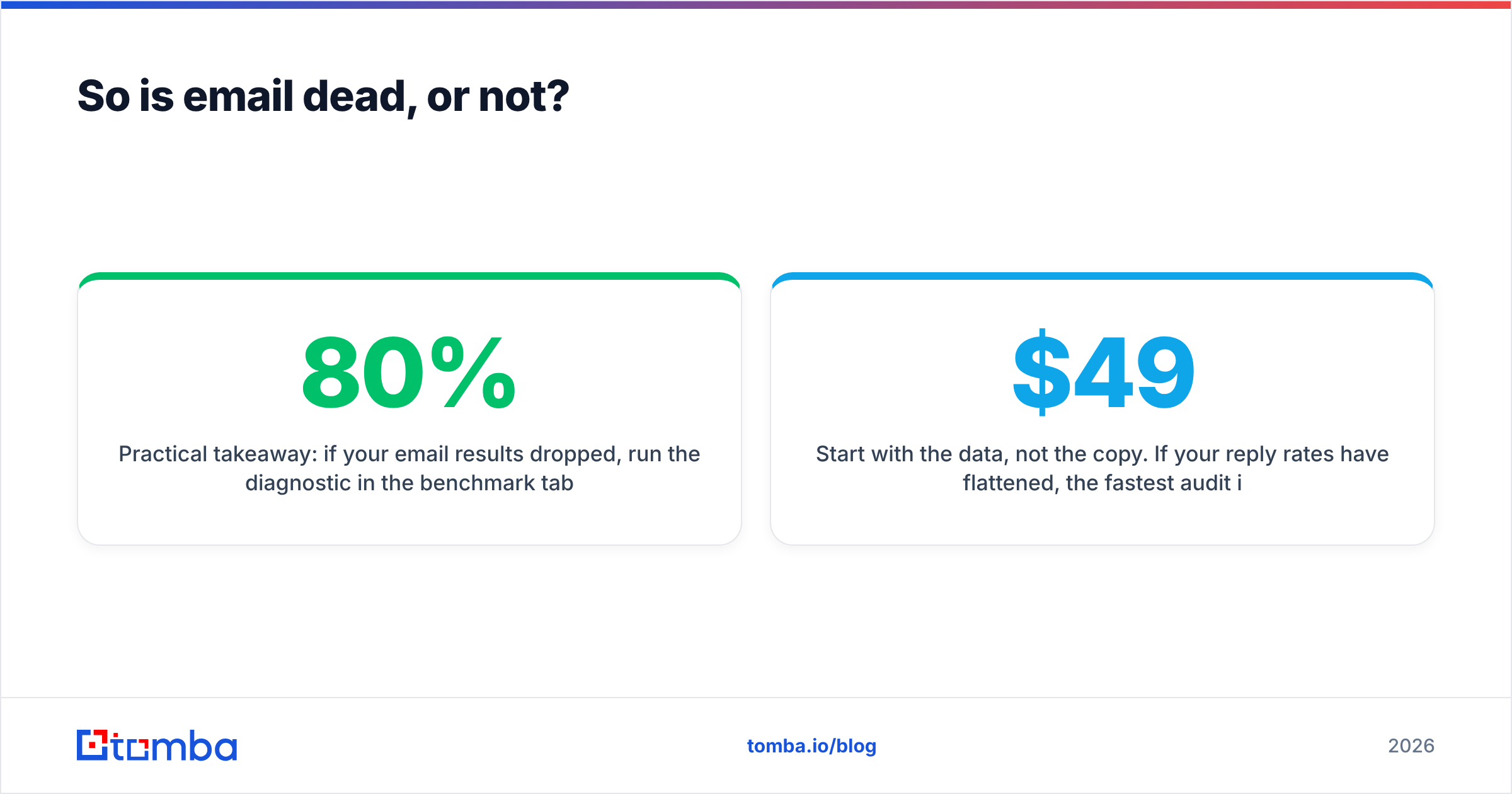
Practical takeaway: if your email results dropped, run the diagnostic in the benchmark table above before you conclude the channel is finished. In our experience the failure is bounce rate or targeting roughly 80% of the time, authentication 15%, and copy the remaining 5%. Most teams work that list in exactly reverse order.
Email is still the only outbound channel where a two-person team can credibly reach 2,000 qualified buyers a month without a platform taking a cut or capping their volume. Whatever replaces it will have to beat that, and nothing currently does.
Start with the data, not the copy. If your reply rates have flattened, the fastest audit is to check how many addresses on your current list are real. Tomba's Email Finder pulls verified professional addresses by name, company, or domain, with source attribution so you can see where each one came from. The free tier gives you 25 searches a month to test your list quality before you commit, and paid plans start at $49/mo on Tomba pricing. Clean the data first, then judge whether email is dead.
Related guides#
// get started
Find, verify and enrich your first contacts today
Start on the free plan with 25 searches a month, then scale when your team is ready.
Free plan · No credit card required · GDPR & CCPA
// about the author