Istari AI vs Apollo.io: Which B2B Data Tool Wins in 2026
Istari AI maps entire markets from web data. Apollo.io books meetings. They get compared constantly, but they solve different problems — and picking wrong costs you a year of budget. Here's the honest breakdown.
Istari AI vs Apollo.io shows up in almost every B2B data shortlist. It is the wrong fight. One tool maps a market. The other works a list. Here is what each one does, what it costs, and when you need neither.
TL;DR
- Istari AI vs Apollo.io is not a real head-to-head. Istari AI mines the web to classify and profile companies at national scale. Apollo.io is a sales engagement platform with a contact database, sequences, and a dialer.
- Pick Istari AI if your question is "which companies exist in this market, and what do they do?" Pick Apollo.io if your question is "who do I email on Tuesday?"
- Apollo publishes per-seat pricing. There is a free tier, and paid plans land roughly in the $49–$149 per user per month range.
- Istari AI sells on a custom quote. Expect a sales call, not a checkout page.
- Neither is cheap if you only need verified emails. A dedicated finder-and-verifier stack costs a fraction of a seat-based sales suite.
- The most common mistake: buying Apollo seats for a research job, or signing an enterprise data contract to send 200 cold emails a month.
What is Istari AI?#
Istari AI is a German company-data platform built on large-scale web mining. It does not buy contact lists. Instead it crawls company websites and reads them with AI models. From that text it infers what each company actually does: industry, technology focus, products, and activity signals. It does this across millions of firms at once.
Think of it as a satellite survey of an economy, not a phone book. A phone book gives you a name and a number. A satellite survey shows where the factories are, which ones grew last year, and which fields sit empty. Istari AI grew out of economic research. That work needs every company in a country classified the same way, not just the 40 that match your ICP filter.
That origin shapes the product:
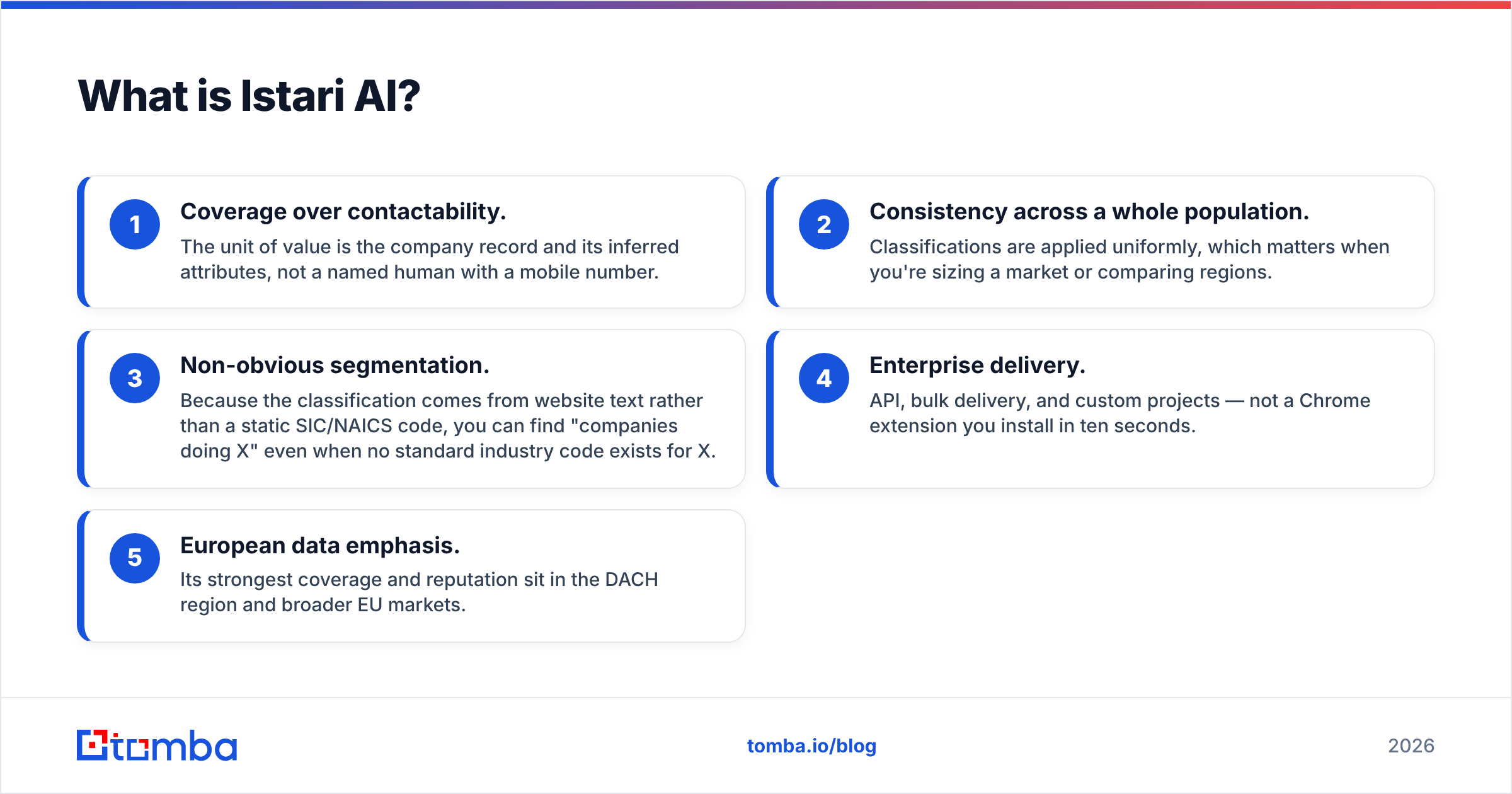
- Coverage over contactability. The unit of value is the company record and its inferred traits. It is not a named human with a mobile number.
- Consistency across a whole population. Every company is classified the same way. That matters when you size a market or compare regions.
- Non-obvious segmentation. Labels come from website text, not a static SIC or NAICS code. So you can find "companies doing X" even when no standard code exists for X.
- Enterprise delivery. You get an API, bulk files, and custom projects. There is no Chrome extension to install in ten seconds.
- European data emphasis. Coverage is strongest in the DACH region and the wider EU.
In an Istari AI vs Apollo.io comparison, that is the profile of the research side. It fits corporate strategy teams, economic development agencies, M&A screening desks, and GTM teams that need to define a category before they prospect into it.
What is Apollo.io?#
Apollo.io sits at the other end of the pipeline. It pairs a large B2B contact database with sequences, email sending, a dialer, LinkedIn workflows, meeting booking, and light CRM features. Apollo publicly claims hundreds of millions of contacts and tens of millions of companies.
The pitch is consolidation. Find the lead, enrich it, sequence it, call it, and track the reply in one tab. For a ten-rep SDR team that is genuinely useful. One login, one bill, one onboarding.
The trade-offs show up often in Apollo reviews on G2:
- Data quality swings by region and seniority. North American mid-market is strong. EU SMB and non-English markets are weaker.
- Credits, exports, and advanced filters are gated by tier. People are often surprised after signup.
- Deliverability is your problem. Apollo will happily sequence a stale list straight into a spam folder.
So in an Istari AI vs Apollo.io stack, Apollo is the execution layer.

Istari AI vs Apollo.io: how do they actually compare?#
Here is the head-to-head on the points that change a buying decision.
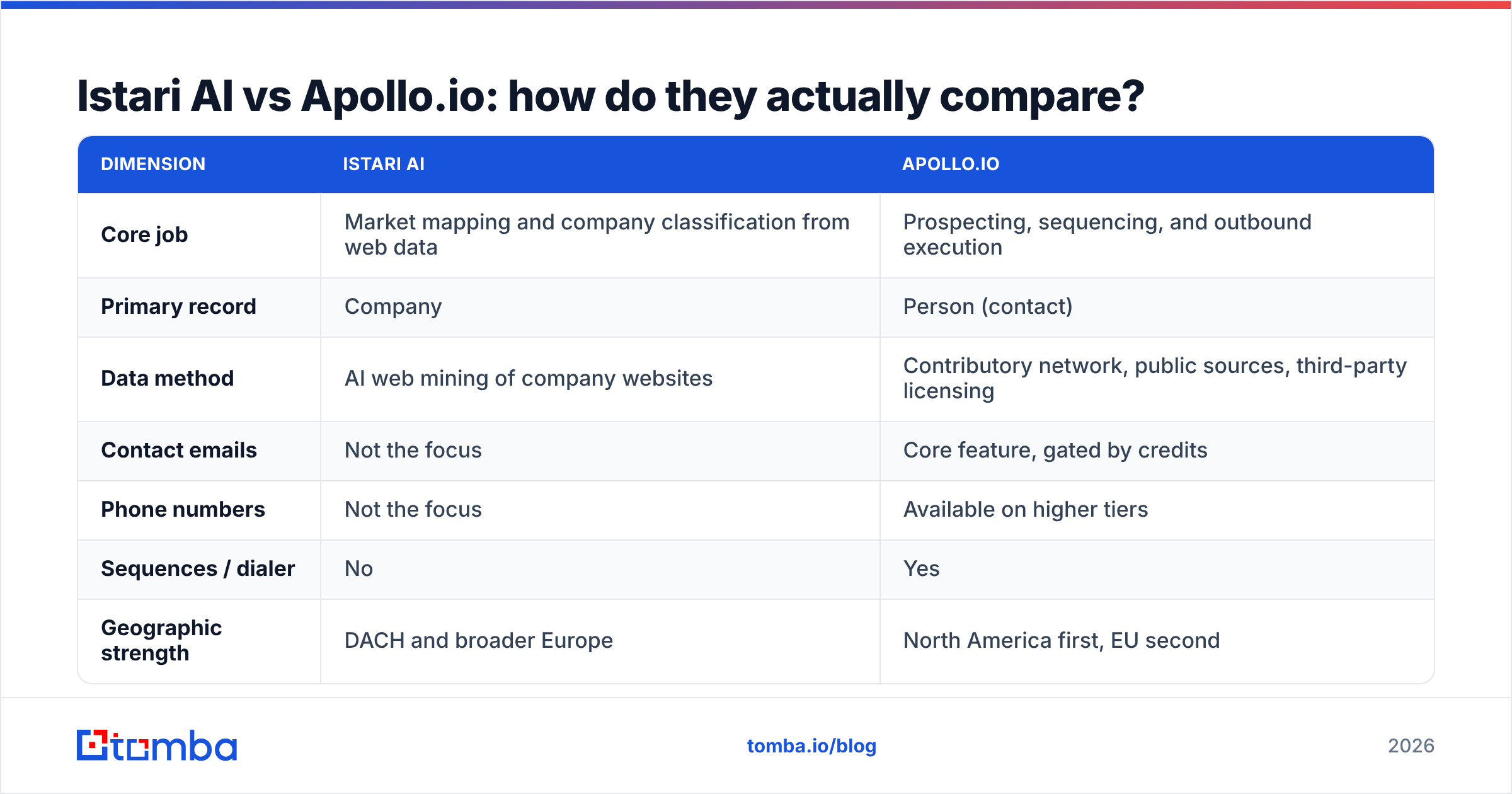
| Dimension | Istari AI | Apollo.io |
|---|---|---|
| Core job | Market mapping and company classification from web data | Prospecting, sequencing, and outbound execution |
| Primary record | Company | Person (contact) |
| Data method | AI web mining of company websites | Contributory network, public sources, third-party licensing |
| Contact emails | Not the focus | Core feature, gated by credits |
| Phone numbers | Not the focus | Available on higher tiers |
| Sequences / dialer | No | Yes |
| Geographic strength | DACH and broader Europe | North America first, EU second |
| Pricing model | Custom quote, project or subscription | Free tier plus per-user/month plans |
| Time to first value | Weeks (scoping, delivery) | Minutes (self-serve signup) |
| Typical buyer | Strategy, research, market intelligence, policy | Sales, SDR teams, founders doing outbound |
| Contract shape | Annual enterprise agreement | Monthly or annual, per seat |
| Best for | "What does this market look like?" | "Who do I contact today?" |
Read that table twice before you shortlist. Most "Istari AI vs Apollo.io" searches come from one question: do I have a research problem or an execution problem? The two tools are complements far more often than rivals. Istari AI defines the account universe. Apollo works it.
How do the pricing models differ?#
Pricing is where Istari AI vs Apollo.io splits hardest. It is also where budgets get burned.
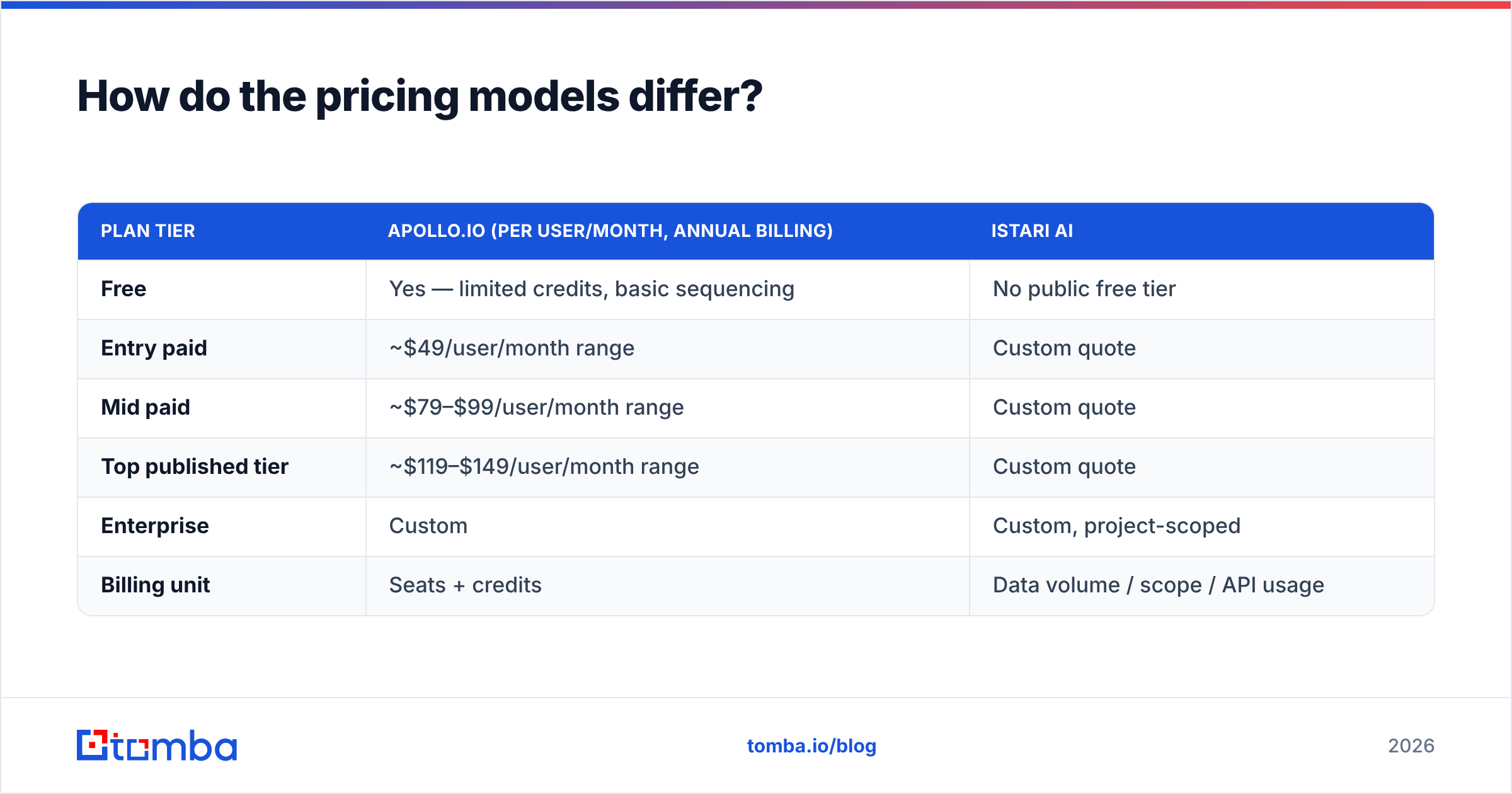
| Plan tier | Apollo.io (per user/month, annual billing) | Istari AI |
|---|---|---|
| Free | Yes — limited credits, basic sequencing | No public free tier |
| Entry paid | ~$49/user/month range | Custom quote |
| Mid paid | ~$79–$99/user/month range | Custom quote |
| Top published tier | ~$119–$149/user/month range | Custom quote |
| Enterprise | Custom | Custom, project-scoped |
| Billing unit | Seats + credits | Data volume / scope / API usage |
Vendor pricing moves, so check two things first. Verify the current numbers on Apollo's own pricing page. Then request a quote from istari.ai. Apollo has reshuffled credit allocations more than once.
The structure matters more than the exact figures. Apollo scales with headcount. Ten reps means ten seats, even if only four pull data. Istari AI scales with scope. One analyst can query a national dataset. Add five more analysts and the data cost may not move at all.
So the cost curve flips with your org:
- Small team, big research question → Istari AI's model is friendlier than you would guess.
- Big team, simple contact need → Apollo's per-seat model gets expensive fast. Much of that spend goes to sequencing you may already own.
- Big team, big research question → you buy both, and that is a real budget conversation.
Which one has better data, honestly?#
Wrong question. The two tools measure different things, so "accuracy" means two different things in an Istari AI vs Apollo.io test.
For Istari AI, accuracy asks: does the label match what the company really does? You can check that against ground truth, and it holds up well for firms with a real website. The weakness is structural. A company with a one-page brochure site is nearly invisible to a web-mining engine. Micro-businesses, stealth startups, and traditional firms with neglected sites come out thin.
For Apollo.io, accuracy asks: is this person still here, and will this email land? Records go stale in a predictable pattern. Job changes travel fast for connected users and slowly for everyone else. Tests of large contributory databases keep finding bounce rates that are fine for spray-and-pray. They are not fine for a named-account campaign to 200 VPs.
Most teams land on one rule: never send to a database export without re-verifying it first. Whatever platform the addresses came from, run them through an email verifier the same week you send. Verification decays. A list verified in March is not a verified list in September. Catch-all domains need extra care. A plain SMTP ping tells you nothing there, which is why catch-all verification exists as a separate step.
Who should pick Istari AI?#
Choose Istari AI when the deliverable is a map, not a list:
- Market sizing and TAM work, where you need every company in a segment. That includes the ones no standard industry code captures.
- Ecosystem and cluster analysis — regional development, innovation policy, supply chain mapping.
- M&A and investment screening across a set geography, above all in DACH and the EU.
- Category definition before a GTM launch, when you do not yet know who your buyers are.
- Research and reporting that has to survive methodological review.
If your quarterly goal reads "identify and size the segment," this is your tool. If it reads "book 40 meetings," it is not.
Who should pick Apollo.io?#
Choose Apollo when the deliverable is pipeline:
- SDR teams running multichannel sequences who want one tool instead of four.
- Founder-led outbound in North America, where Apollo's coverage is strongest.
- Teams without a CRM yet that can live inside Apollo's lightweight one for a while.
- Anyone who values setup speed over data precision. You can be sending within an hour.
One honest caveat. If you already run a sequencer you like — Instantly, Smartlead, Salesloft, or HubSpot Sequences — you are paying Apollo mostly for the database. There are cheaper ways to buy that. We break the trade-offs down on the Apollo alternative page.
Can you run both — and where does a dedicated email finder fit?#
Yes. In mature GTM orgs the layered setup is common, and it ends the Istari AI vs Apollo.io debate:
- Define the universe. Istari AI, or a similar market intelligence source, produces the account list. Every company in the segment, classified the same way.
- Pick the accounts. RevOps scores and ranks them. That is a spreadsheet or warehouse job, not a vendor job.
- Find the people. Identify the decision-makers per account. Use titles from LinkedIn, org charts, or a domain search that returns everyone publicly reachable at a company.
- Get verified addresses. Turn name plus domain into a deliverable address. Then verify before you send.
- Execute. Apollo, or whatever sequencer you already trust, does the sending and tracking.
Steps 3 and 4 are where both platforms are weakest for the price. Istari AI does not claim contact discovery as its core job. Apollo does claim it, but charges per seat and bundles tooling you may not need.
That gap is where a focused email finder fits. Flat pricing. No per-seat tax. No second sequencer to pay for. Tomba's pricing starts free with 25 searches a month. Starter is $49/month, Growth is $99/month, and Pro is $249/month. Because it is not seat-based, adding analysts or reps does not change the bill. For engineering-led teams, the Tomba API drops the same finding and verification into your own enrichment pipeline. Step 4 becomes a function call instead of a vendor.
What's the fastest way to decide?#
Answer these three questions honestly:
- Do you know who your buyers are? If not, you have a research problem. Look at Istari AI or a similar market intelligence source.
- Do you already own a sequencer? If yes, Apollo's main remaining value is its database. Price that against dedicated data tools, not against nothing.
- How many seats will really touch the tool? Above five, per-seat pricing starts to eat your data budget.
Most teams reading an "Istari AI vs Apollo.io" comparison find they needed a third thing entirely. They needed reliable, verified contact data at a price that does not scale with headcount.
Ready to fix the contact-data layer?#
Whichever side wins your Istari AI vs Apollo.io review, the bottleneck is the same. You still have to turn a company list into deliverable addresses without burning your sender reputation. Start with the Tomba Email Finder. Search by domain, name, or company. Get confidence-scored results, and verify before you send. The free tier gives you 25 searches a month. Run it head to head with the export you already have, and compare bounce rates before you sign anything annual.
Related guides#
Ready to find emails that actually work?
Join 150,000+ professionals who stopped guessing and started sending. Free credits on signup — no credit card required.
Get the Tomba newsletter
Practical outbound tactics and product updates — once every two weeks.
About the author