IT Sales Lead Generation: A Practical 2026 Playbook
IT buyers ignore 90% of outbound. Here's how the top-performing MSPs, VARs, and software vendors actually source, qualify, and convert technical leads in 2026 — with real channel math.
TL;DR
- IT sales lead generation fails for one structural reason: you are selling to a buying committee where the technical evaluator can veto but rarely signs, and the signer rarely reads your email.
- Paid search still produces the fastest pipeline for MSPs and managed services, but the highest-margin deals come from partner/vendor ecosystems and technical content — both slow, both compounding.
- Blended cost per SQL across IT verticals typically lands between $250 and $900. If you are not measuring it per channel, you are guessing.
- Outbound to IT buyers works when it is narrow (one stack, one trigger event, one problem) and dies when it is broad. Tech-stack detection beats firmographics.
- Data hygiene is the cheapest lever available: bad contact data quietly destroys 20-35% of outbound capacity before a single reply is possible.
Selling to IT is not selling harder. It's selling to people who have been pitched by 40 vendors this quarter, who can independently verify every claim you make, and who will Google your company before they open your second email. The lead generation motions that work in this market look different from generic B2B advice — and most of the "10 lead gen tips" content out there was written for someone selling marketing software to a VP of Demand Gen.
This is the version for people selling managed services, infrastructure, cybersecurity, DevOps tooling, hardware, licensing, and integration work.
What is IT sales lead generation, and why is it different?#
IT sales lead generation is the process of sourcing, qualifying, and warming buyers for technology products and services — MSPs, VARs, ISVs, systems integrators, cybersecurity vendors, and infrastructure providers.
Three structural differences change everything about how it works:
- The evaluator is not the buyer. A network engineer or DevOps lead will shortlist you. A CFO, COO, or CIO signs. Your lead gen has to reach both, with different messages, at different times.
- Claims are verifiable. If you say "40% faster deployment," someone will ask for the benchmark methodology. Puffery that survives in marketing-tool sales gets you disqualified in IT sales.
- Switching costs are enormous. Nobody rips out a backup provider on a whim. This means trigger events — a breach, a contract renewal, a merger, an end-of-life notice, a compliance deadline — matter more than any message you write.
That third point is the one most teams underuse. The difference between a 1% reply rate and a 9% reply rate is almost never copy. It is whether you reached someone in the 60-day window where their current solution just became a problem.

Which lead generation channels actually work for IT sales?#
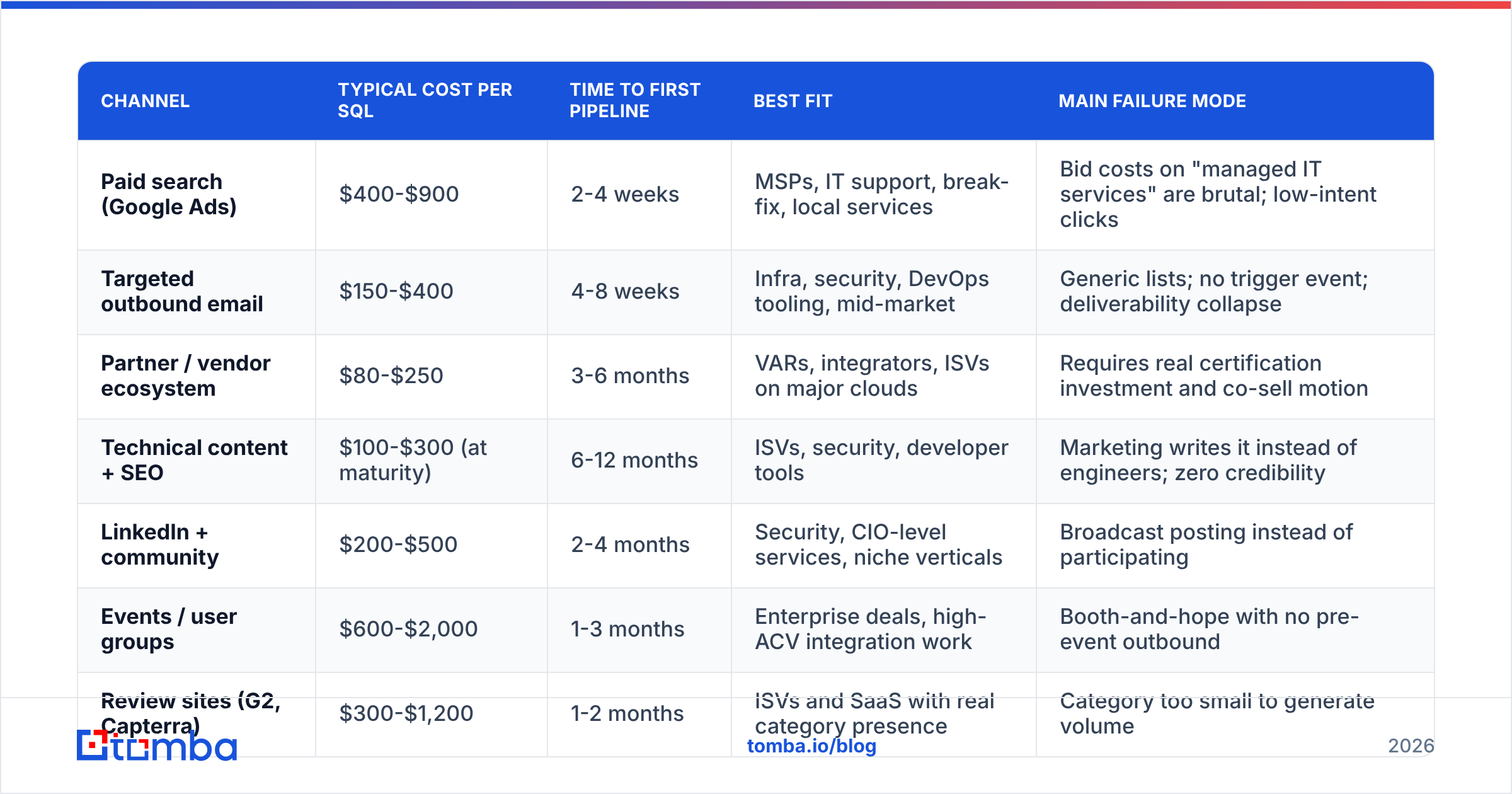
Here's the honest channel breakdown based on how IT-sector teams typically report performance. Treat the numbers as planning ranges, not guarantees — your vertical, ACV, and geography move all of them.
| Channel | Typical cost per SQL | Time to first pipeline | Best fit | Main failure mode |
|---|---|---|---|---|
| Paid search (Google Ads) | $400-$900 | 2-4 weeks | MSPs, IT support, break-fix, local services | Bid costs on "managed IT services" are brutal; low-intent clicks |
| Targeted outbound email | $150-$400 | 4-8 weeks | Infra, security, DevOps tooling, mid-market | Generic lists; no trigger event; deliverability collapse |
| Partner / vendor ecosystem | $80-$250 | 3-6 months | VARs, integrators, ISVs on major clouds | Requires real certification investment and co-sell motion |
| Technical content + SEO | $100-$300 (at maturity) | 6-12 months | ISVs, security, developer tools | Marketing writes it instead of engineers; zero credibility |
| LinkedIn + community | $200-$500 | 2-4 months | Security, CIO-level services, niche verticals | Broadcast posting instead of participating |
| Events / user groups | $600-$2,000 | 1-3 months | Enterprise deals, high-ACV integration work | Booth-and-hope with no pre-event outbound |
| Review sites (G2, Capterra) | $300-$1,200 | 1-2 months | ISVs and SaaS with real category presence | Category too small to generate volume |
Two patterns fall out of this table.
Cheap channels are slow, fast channels are expensive. Partner ecosystems and technical SEO produce the lowest cost per qualified lead in IT, and both take two to four quarters before they produce anything at all. Paid search produces pipeline in three weeks and costs four times as much. Most IT companies need both running simultaneously, funded from different budgets, and measured on different timelines.
Outbound sits in the middle and is the most controllable. You can change your targeting on Monday and see results by Friday. That makes it the right place to run experiments, and the right place to concentrate data quality effort.
How do you build a target list that IT buyers respond to?#
Stop with firmographics as your primary filter. "Companies with 200-1000 employees in manufacturing" is not a segment; it's a phone book.
For IT sales, build lists on technographic and event signals instead:
- Tech stack detection. If you sell a Kubernetes cost-optimization tool, the only companies worth contacting are the ones running Kubernetes at meaningful scale. A website tech stack check narrows a 10,000-company list to the 600 that can actually buy.
- End-of-life and renewal windows. Vendor EOL announcements are published. Windows Server versions, VMware licensing changes, hardware refresh cycles, certificate expirations — each one creates a dated buying window you can work backwards from.
- Hiring signals. A company posting three SRE roles is scaling infrastructure. A company posting a "Security Operations Manager" role after not having one is building a SOC. Job boards are the most underrated intent source in IT.
- Compliance deadlines. SOC 2 renewal, PCI DSS assessment cycles, NIS2 and DORA in the EU, state-level privacy laws in the US. Regulatory dates create budget where none existed.
- Funding and M&A. A Series B means infrastructure spend. An acquisition means two stacks that need integrating — and one vendor contract that gets consolidated away.
- Breach and incident news. Uncomfortable but true: post-incident is when security budget unlocks. Approach with genuine help, not ambulance-chasing.
Once you have the account list, you need the people. That is where most IT outbound quietly breaks — you identify 600 perfect-fit accounts and then send to info@ addresses scraped from contact pages. Use a domain search to pull the actual named contacts at each company, then narrow to the roles that matter: for infrastructure, that's usually a Director of IT plus a hands-on lead engineer; for security, a CISO plus a SecOps manager.
Why does contact data quality decide your outbound ceiling?#
Because bounced email doesn't just fail to reach someone — it degrades the domain reputation that lets your other emails land.
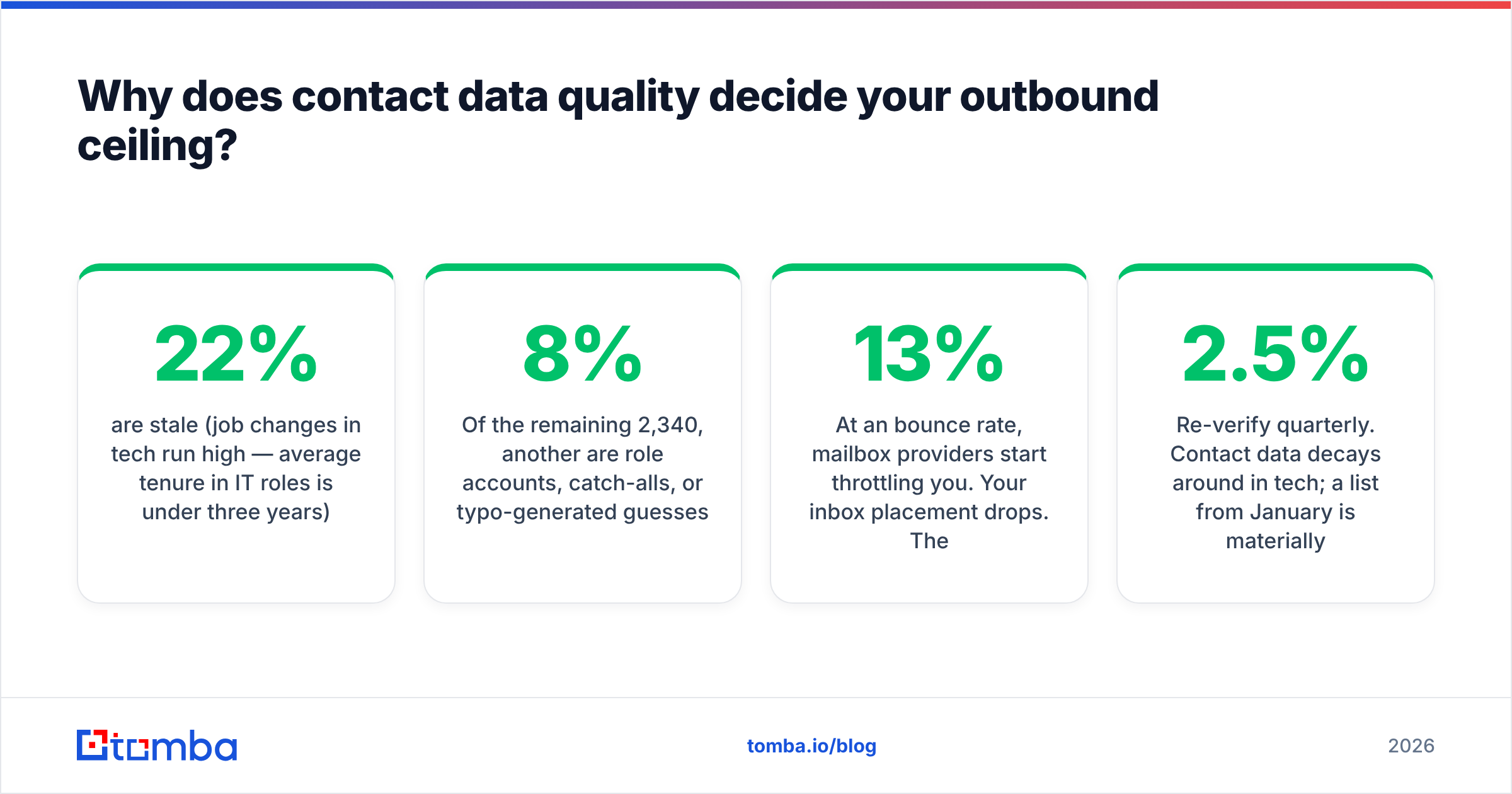
Run the arithmetic on a typical IT outbound month:
- 3,000 contacts sourced
- 22% are stale (job changes in tech run high — average tenure in IT roles is under three years)
- Of the remaining 2,340, another 8% are role accounts, catch-alls, or typo-generated guesses
- You send 2,150 real emails, but bounce 400 of the original 3,000 along the way
At an 13% bounce rate, mailbox providers start throttling you. Your inbox placement drops. The 2,150 "good" emails now land at 60% inbox rate instead of 90%. You've lost roughly a third of your outbound capacity to a data problem, not a messaging problem.
The fix is unglamorous and costs less than one paid-search week:
- Verify every address before it enters a sequence. An email verifier pass catches dead mailboxes, syntax errors, and disposable domains before they touch your sender reputation.
- Handle catch-all domains separately. Large enterprises — exactly the ones IT sellers target — frequently run catch-all MX configurations that accept everything and confirm nothing. A dedicated catch-all verifier gives you a confidence score instead of a coin flip.
- Re-verify quarterly. Contact data decays around 2.5% per month in tech; a list from January is materially wrong by June.
- Keep bounce rate under 3% and monitor it weekly, not per-campaign.
Getting your email deliverability right is not a separate project from lead generation. It is lead generation — it determines what fraction of the work you already did ever reaches a human.
What does a message that IT buyers actually answer look like?#
Short, specific, technically literate, and containing zero adjectives you can't prove.
Compare these two openers sent to a Director of Infrastructure:
Version A: "I wanted to reach out because we help companies like yours transform their IT infrastructure with best-in-class solutions that drive efficiency and reduce costs."
Version B: "Noticed you're still on VMware vSphere 7 — support ends this October. We moved three manufacturing firms your size to Proxmox last quarter; the licensing delta averaged $140K/year. Worth 15 minutes?"
Version B works because it demonstrates you did specific research, names a real deadline, quantifies a claim, and asks for a small commitment. Version A could have been sent to anyone, which is exactly how the recipient reads it.
A few rules that hold consistently in IT outbound:
- Lead with the trigger, not with yourself. The first sentence should prove you know something about their situation.
- Name the technology. IT buyers pattern-match on whether you speak their language. Getting a version number right earns more trust than three paragraphs of positioning.
- One ask, and make it small. "Worth 15 minutes?" outperforms "book a demo" at roughly every stage.
- Send from a human, to a human. No-reply addresses and marketing-automation footers signal "mass mail" instantly.
- Sequence to the committee, not the individual. Engineer gets the technical angle. Director gets the risk and cost angle. CFO, if they're in scope, gets the contract math. Same account, different threads.
For the technical-evaluator persona specifically, plain-text email with a link to real documentation beats any designed template. HubSpot's research on sales email performance has consistently found that simpler, personal-looking emails outperform heavily formatted ones — and that gap is wider with technical audiences than with any other segment.
How should you qualify IT leads before they hit your pipeline?#
MEDDIC and BANT both work in IT sales, but they miss the failure mode specific to this market: the technical veto.
You can have budget confirmed, an executive champion, a clear pain, and a signed-off timeline — and still lose because one senior engineer decided your architecture doesn't fit their environment. That person is often invisible in the CRM until week six.
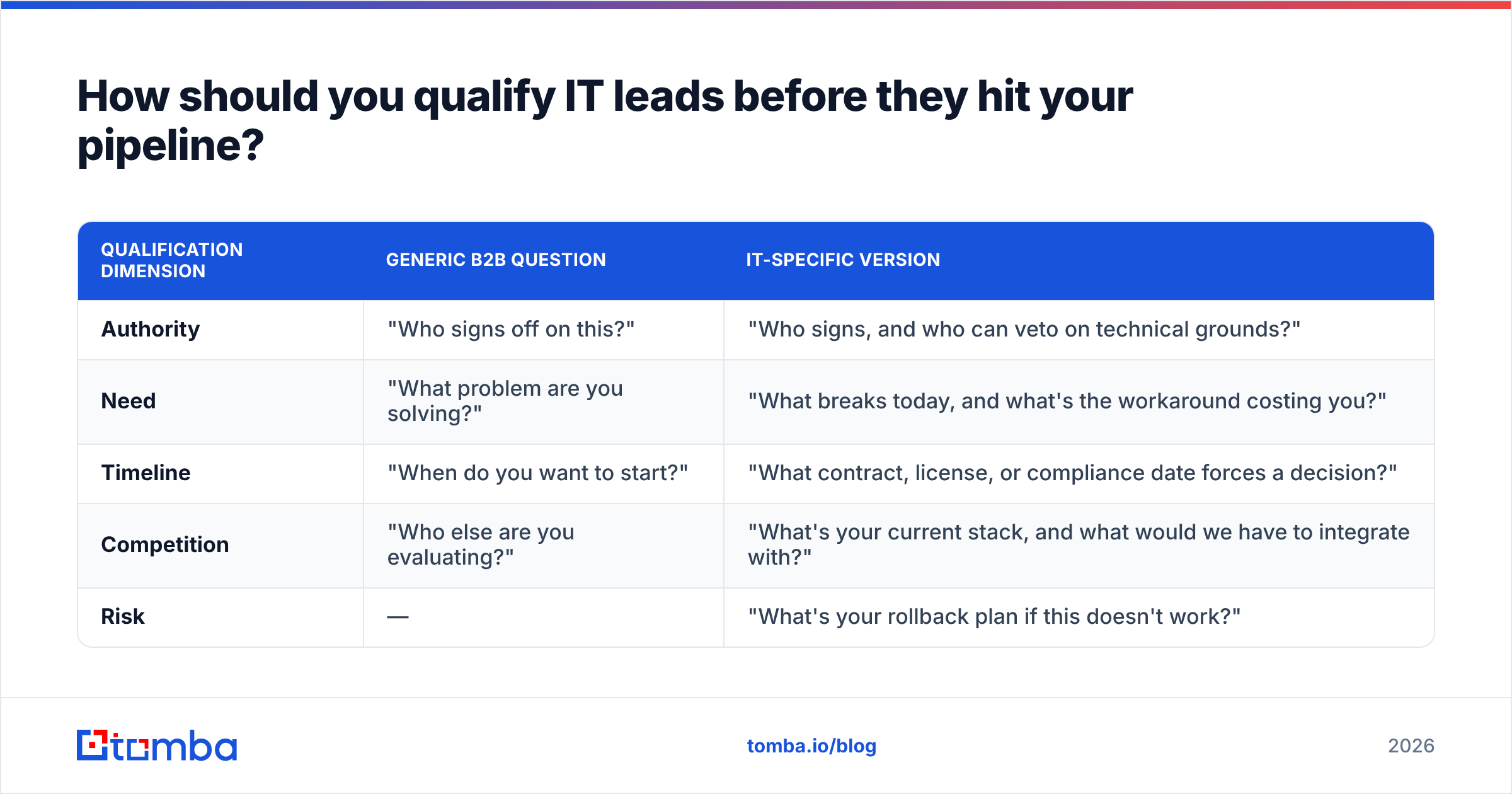
Add three IT-specific qualification questions to whatever framework you use:
| Qualification dimension | Generic B2B question | IT-specific version |
|---|---|---|
| Authority | "Who signs off on this?" | "Who signs, and who can veto on technical grounds?" |
| Need | "What problem are you solving?" | "What breaks today, and what's the workaround costing you?" |
| Timeline | "When do you want to start?" | "What contract, license, or compliance date forces a decision?" |
| Competition | "Who else are you evaluating?" | "What's your current stack, and what would we have to integrate with?" |
| Risk | — | "What's your rollback plan if this doesn't work?" |
That last row is the one that separates real opportunities from tire-kickers. A buyer who has thought about rollback is a buyer who has thought about implementation, which means they've thought about actually doing it.
How do you measure whether your IT lead generation is working?#
Track four numbers per channel, monthly, with no blending:
- Cost per SQL — total channel spend (including loaded SDR cost) divided by sales-qualified leads. Blended numbers hide which channel is subsidizing which.
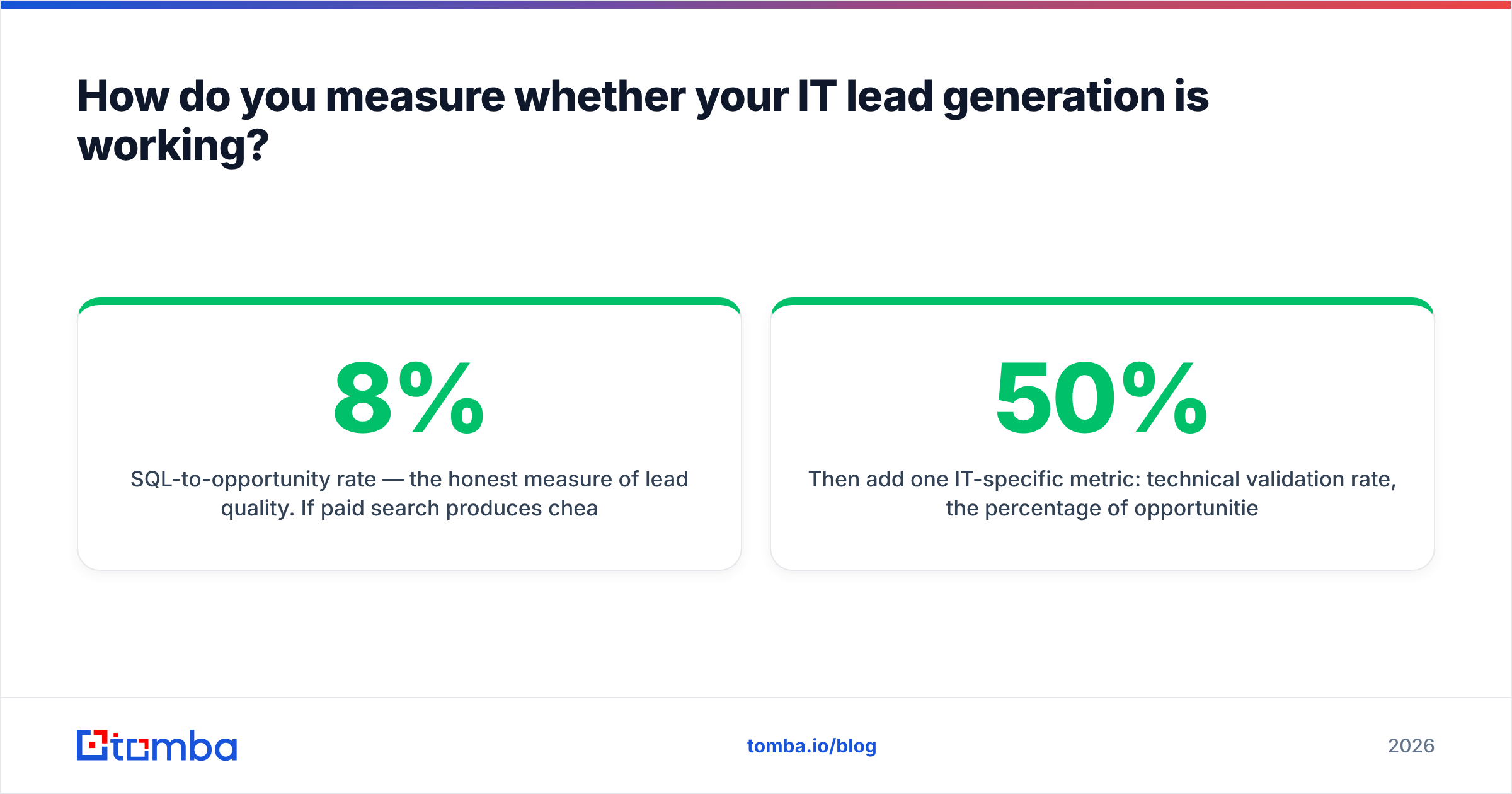
- SQL-to-opportunity rate — the honest measure of lead quality. If paid search produces cheap SQLs that convert at 8% while partner referrals convert at 44%, your "cheap" channel is your expensive one.
- Time to first meaningful conversation — not "time to first touch." How long from list entry to a real two-way exchange.
- Pipeline per rep per month — the only number your CFO actually cares about.
Then add one IT-specific metric: technical validation rate, the percentage of opportunities that clear a technical review without stalling. If that number is below 50%, your targeting is wrong upstream — you're generating interest from companies your product can't actually serve, and burning weeks discovering it.
Firms like Gartner and Forrester publish regular research on technology buying behavior that's worth reading against your own numbers; both have documented the shift toward buyers completing the majority of their evaluation before contacting any vendor. That shift is the entire argument for investing in technical content and third-party presence on sites like G2 rather than assuming outbound alone will carry your number.
What should a 90-day IT lead generation plan look like?#
If you're rebuilding from scratch, sequence it like this:
Days 1-30 — Fix the foundation. Audit your existing contact data and verify everything. Set up SPF, DKIM, and DMARC properly; run an SPF checker to confirm your records are valid. Define one narrow ICP based on tech stack, not company size. Build a 300-account list you'd be genuinely excited to work with.
Days 31-60 — Run one channel well. Pick outbound if you need speed, partner motion if you need margin. Do not run five channels badly. Send to 300 accounts with three genuinely researched sequences segmented by persona. Measure reply rate, meeting rate, and bounce rate weekly.
Days 61-90 — Double down and layer. Whatever produced meetings, do more of it with a bigger list. Start the slow channel in parallel — publish the technical content, get the certification, request the reviews — knowing it pays out in Q3, not Q2.
Most teams fail this plan by skipping days 1-30. They jump to volume with dirty data and generic targeting, get a 0.4% reply rate, and conclude that outbound doesn't work in IT. Outbound works in IT. Broadcast doesn't.
Ready to build a cleaner IT prospect list?#
Everything above depends on one input: accurate contact data for the specific technical and executive buyers at the accounts you've identified as fits. That's the part you can fix this week.
Tomba Email Finder finds verified professional email addresses by domain, name, or company, so your IT outbound reaches real people instead of dead mailboxes and catch-all voids. Start on the free tier with 25 searches per month, or check Tomba pricing — Starter runs $49/mo, Growth $99/mo, and Pro $249/mo with bulk processing and full Tomba API access for teams building list-building directly into their GTM stack.
Get the data right, then go be specific.
Related guides#
// get started
Find, verify and enrich your first contacts today
Start on the free plan with 25 searches a month, then scale when your team is ready.
Free plan · No credit card required · GDPR & CCPA
// about the author