Jeeva AI Reviews (2026): Features, Pricing, Pros and Cons
An independent look at Jeeva AI: what the AI SDR actually automates, where reviewers say it stalls, what it costs, and which teams get real pipeline from it.
TL;DR
- Jeeva AI is an AI SDR platform: it finds accounts, enriches contacts, writes sequences, and runs multi-channel outreach with minimal human touch. It is not an email-finding tool with a sequencer bolted on — the agent layer is the product.
- It works best for teams that already have a repeatable ICP, a warm domain setup, and someone who can supervise the agent. It works worst as a replacement for a sales team you never built.
- Pricing is quote-based rather than fully self-serve, which makes it hard to benchmark against per-credit data tools. Budget for a platform commitment, not a $49 subscription.
- The most common complaint across public reviews is the same one every AI SDR faces: output quality collapses when the underlying contact data is stale or unverified.
- If your actual problem is "our emails bounce and our CRM is full of dead contacts," a dedicated data layer solves it for a fraction of an AI SDR contract.
What is Jeeva AI?#
Jeeva AI is an AI sales agent platform that automates the work a junior SDR does: building target lists, researching accounts, writing first-touch emails and LinkedIn messages, following up, and handing warm replies to a human closer. The pitch on jeeva.ai is straightforward — deploy digital SDRs that run outbound continuously instead of hiring, ramping, and churning human reps.
That puts it in the same category as Artisan, 11x, and the agent features now shipping inside Apollo and Outreach. The category is young. Most vendors in it, Jeeva included, were founded or repositioned within the last three years, which matters when you're reading reviews: you are evaluating a product that has changed significantly since half of the published opinions were written.
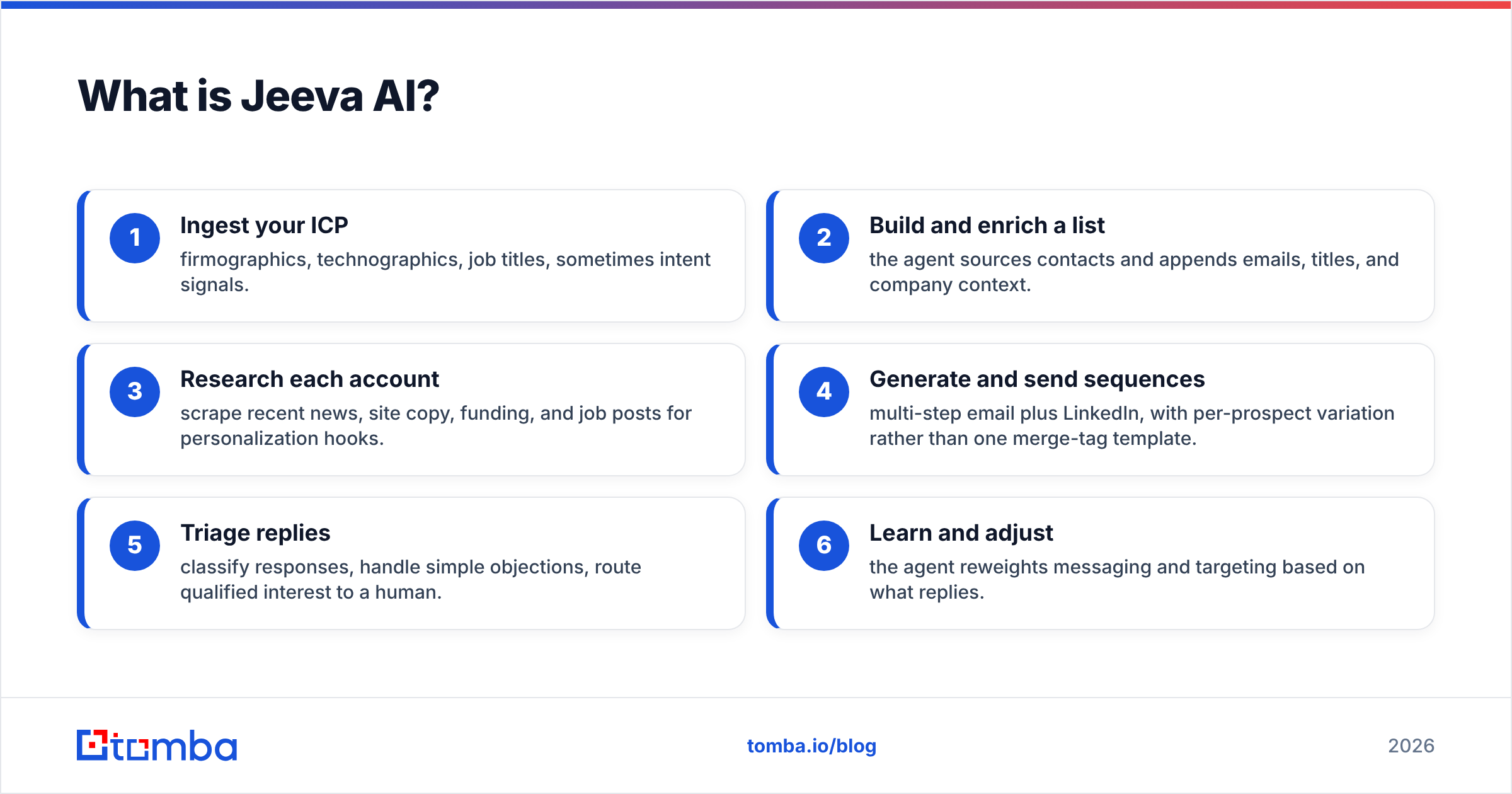
The core loop looks like this:
- Ingest your ICP — firmographics, technographics, job titles, sometimes intent signals.
- Build and enrich a list — the agent sources contacts and appends emails, titles, and company context.
- Research each account — scrape recent news, site copy, funding, and job posts for personalization hooks.
- Generate and send sequences — multi-step email plus LinkedIn, with per-prospect variation rather than one merge-tag template.
- Triage replies — classify responses, handle simple objections, route qualified interest to a human.
- Learn and adjust — the agent reweights messaging and targeting based on what replies.
Steps 4 through 6 are where AI SDR platforms genuinely earn their keep. Steps 1 through 3 are where they mostly resell someone else's data — and that is where most of the variance in user satisfaction comes from.
What do Jeeva AI reviews actually say?#
Pull the public feedback on G2 and the pattern is consistent with the broader AI SDR category rather than unique to Jeeva.
What reviewers consistently praise:
- Speed to first campaign. Teams report going from onboarding to live sequences in days, not the four-to-six weeks a new human SDR needs to ramp.
- Volume without headcount. One operator can supervise outbound that previously required two or three reps.
- Personalization depth. The research step produces openers that beat generic "I saw you're the VP of Sales at {{company}}" spam, which is a low bar but a real improvement.
- Responsive support. Smaller vendors in this space tend to over-service early customers, and that shows up repeatedly in reviews.
What reviewers consistently flag:
- Data quality variance. Contacts sourced by the agent are not uniformly accurate. Bounce rates climb on lists the agent builds itself, especially outside US tech.
- Voice drift. AI-written copy is competent but converges on a recognizable style. Prospects who receive three AI SDR emails a week start pattern-matching.
- Opaque pricing. No public self-serve tier means you cannot estimate cost before a sales call, which frustrates smaller teams.
- Supervision is not optional. "Set it and forget it" is the marketing; "review the agent's work weekly" is the reality. Teams that skipped supervision report burned domains.
Treat any review older than about nine months as historical. This category ships fast enough that a 2024 complaint about copy quality may simply no longer apply.
How does Jeeva AI compare to other AI SDR and data tools?#
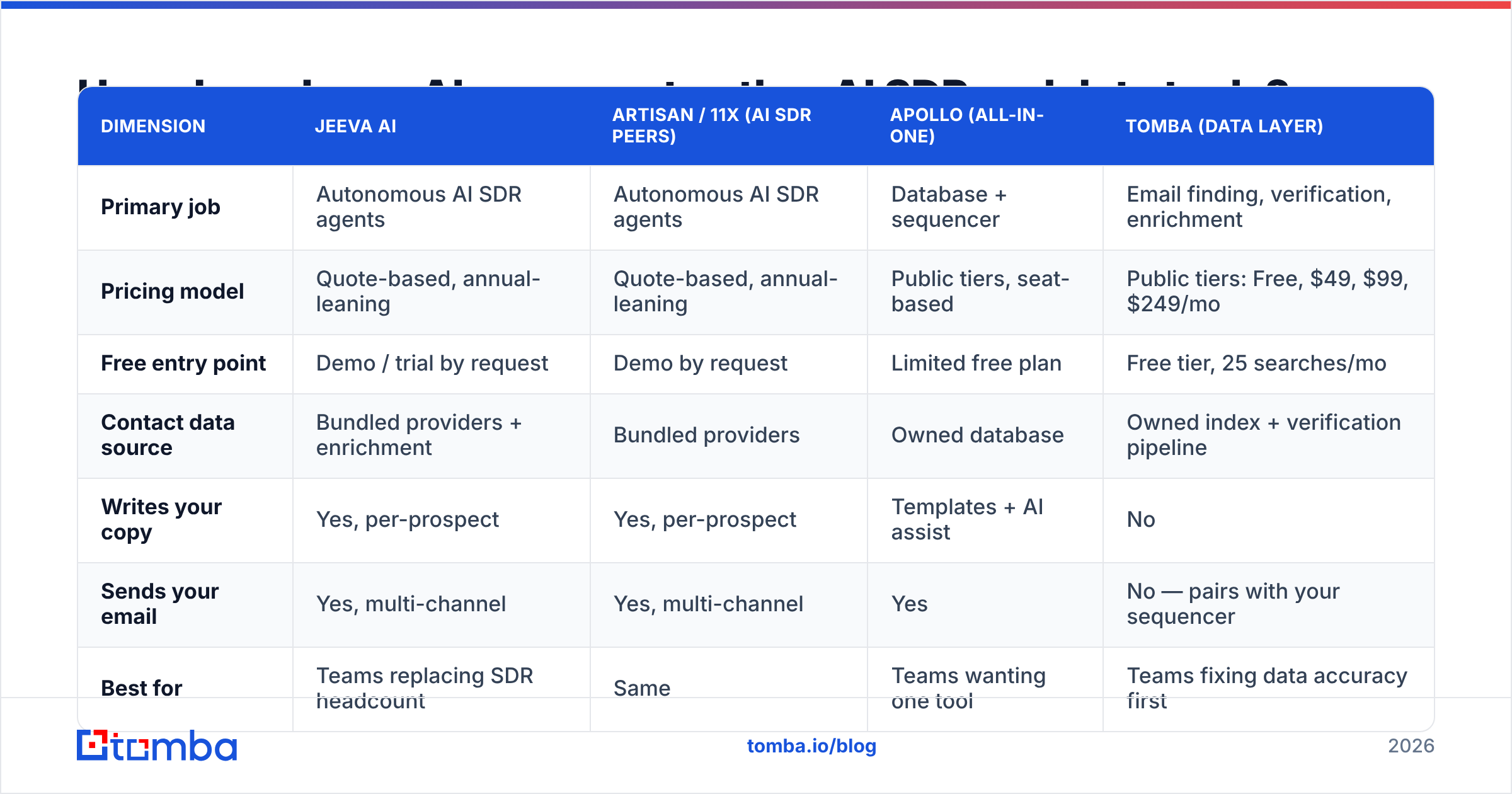
The honest comparison is not Jeeva vs. one competitor — it is "full-stack AI SDR" vs. "assemble your own stack." Here is how the options line up on the dimensions that actually change your monthly invoice.
| Dimension | Jeeva AI | Artisan / 11x (AI SDR peers) | Apollo (all-in-one) | Tomba (data layer) |
|---|---|---|---|---|
| Primary job | Autonomous AI SDR agents | Autonomous AI SDR agents | Database + sequencer | Email finding, verification, enrichment |
| Pricing model | Quote-based, annual-leaning | Quote-based, annual-leaning | Public tiers, seat-based | Public tiers: Free, $49, $99, $249/mo |
| Free entry point | Demo / trial by request | Demo by request | Limited free plan | Free tier, 25 searches/mo |
| Contact data source | Bundled providers + enrichment | Bundled providers | Owned database | Owned index + verification pipeline |
| Writes your copy | Yes, per-prospect | Yes, per-prospect | Templates + AI assist | No |
| Sends your email | Yes, multi-channel | Yes, multi-channel | Yes | No — pairs with your sequencer |
| Best for | Teams replacing SDR headcount | Same | Teams wanting one tool | Teams fixing data accuracy first |
| Typical failure mode | Agent sends confident emails to dead inboxes | Same | Shallow data outside core ICP | Requires a separate sending tool |
Two things fall out of that table.
First, AI SDR platforms and data platforms are not substitutes. They sit at different layers. An AI SDR without a verified contact layer is a very expensive way to generate bounces, and a verification tool without a sequencer does not send anything. Teams that describe Jeeva as "not worth it" usually bought it to solve a data problem.
Second, the pricing structures are not comparable. A quote-based platform contract and a $49/mo credit plan are different purchases with different approval paths. If you need to prove ROI in one quarter with a company card, quote-based tooling is the wrong starting point. You can see how transparent tiering looks by comparing against published Tomba pricing.
Is Jeeva AI worth it in 2026?#
It depends on which of three situations you're in.
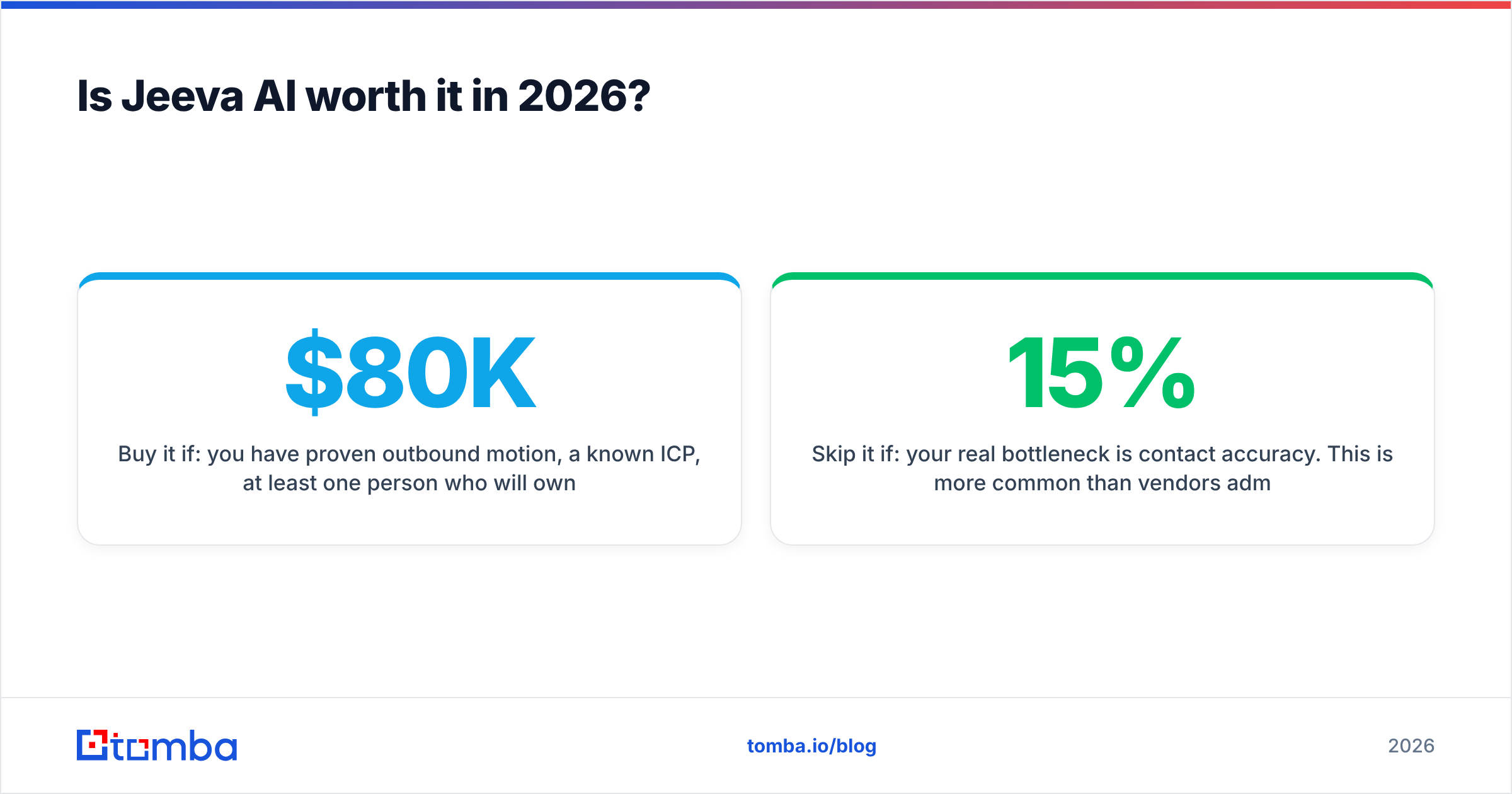
Buy it if: you have proven outbound motion, a known ICP, at least one person who will own agent supervision, and a hiring budget you'd rather not spend on another SDR. In that case the math is simple — a fully loaded SDR in North America costs well north of $80K, and an AI agent that produces even 40% of that output at a fraction of the cost is defensible.
Wait if: you haven't validated your message with humans yet. AI SDRs amplify your positioning; they don't discover it. Running an agent against an unproven value prop just generates statistically significant proof that nobody wants your thing — expensively.
Skip it if: your real bottleneck is contact accuracy. This is more common than vendors admit. Before you sign an AI SDR contract, run a diagnostic: pull 200 contacts from your current list, verify them, and measure the invalid rate. If more than 15% are dead, no amount of AI copywriting fixes your reply rate. According to HubSpot's sales research, prospecting remains the hardest part of the sales process for most reps — and the hard part is reaching real people, not writing more sentences.
What does Jeeva AI cost?#
Jeeva does not publish a fully self-serve price list, so treat any specific number you find in a third-party roundup with suspicion — most of those numbers are scraped, stale, or invented. Confirm directly with the vendor.
What you can plan around structurally:
- Platform fee, not seat fee. AI SDR pricing usually bundles an agent allocation plus usage (contacts enriched, emails sent). It behaves more like a SaaS platform contract than a per-user tool.
- Annual bias. Expect annual terms to be the default and monthly to carry a premium, if it's offered at all.
- Data included — up to a point. Enrichment credits are typically bundled and then metered. This is where costs surprise people at scale.
- Implementation time is a real cost. Even a fast setup consumes your RevOps person's attention for a few weeks.
Compare that to the layered alternative: a verification and enrichment layer at $49–$249/mo plus a sequencer you already own. That stack costs less and is easier to cancel, but you supply the strategy and the human hours. The AI SDR contract buys you those hours back. Which is the better deal depends entirely on how expensive your team's hours are.
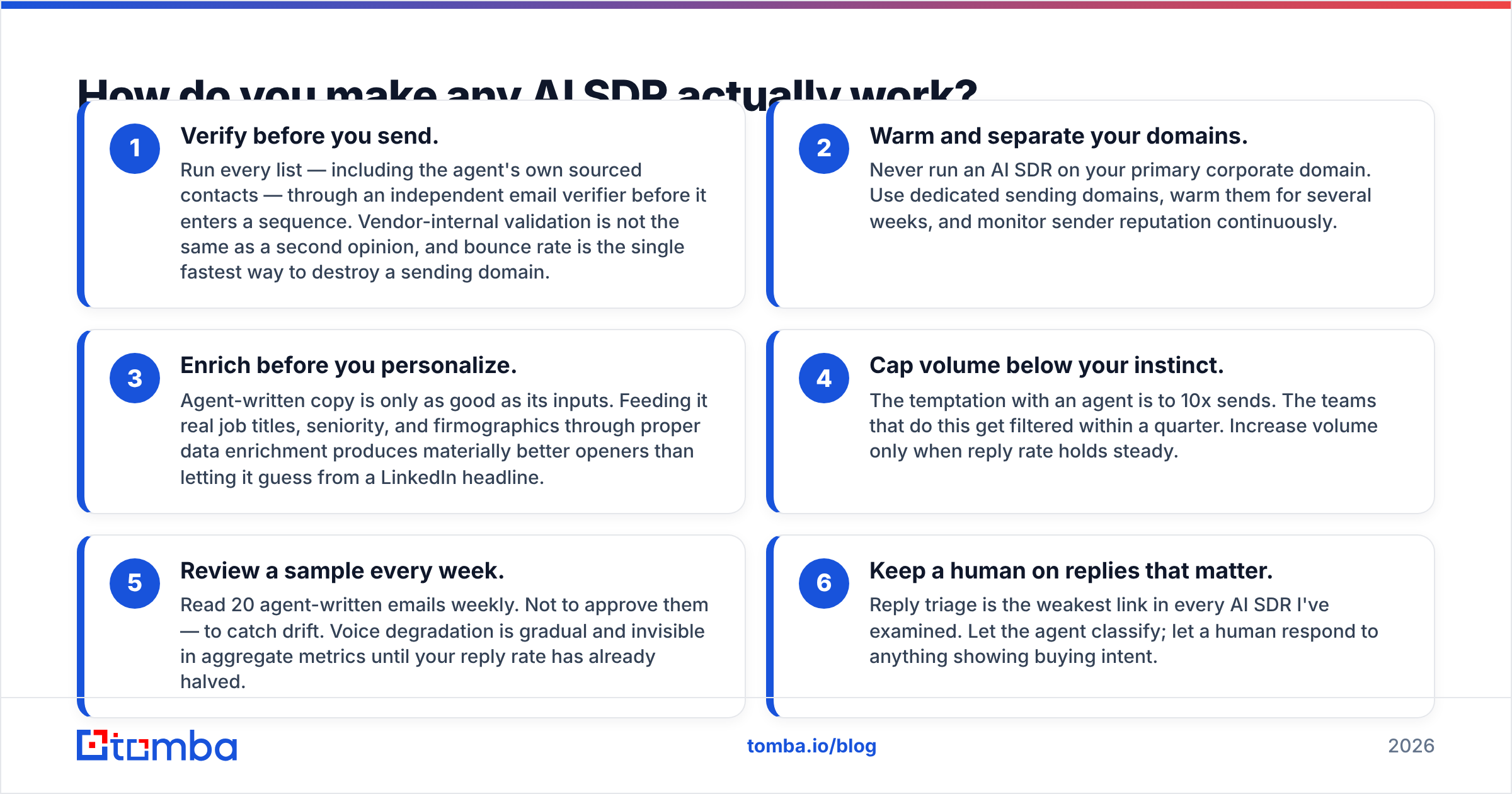
How do you make any AI SDR actually work?#
The teams getting results from Jeeva and its peers do five unglamorous things first.
- Verify before you send. Run every list — including the agent's own sourced contacts — through an independent email verifier before it enters a sequence. Vendor-internal validation is not the same as a second opinion, and bounce rate is the single fastest way to destroy a sending domain.
- Warm and separate your domains. Never run an AI SDR on your primary corporate domain. Use dedicated sending domains, warm them for several weeks, and monitor sender reputation continuously.
- Enrich before you personalize. Agent-written copy is only as good as its inputs. Feeding it real job titles, seniority, and firmographics through proper data enrichment produces materially better openers than letting it guess from a LinkedIn headline.
- Cap volume below your instinct. The temptation with an agent is to 10x sends. The teams that do this get filtered within a quarter. Increase volume only when reply rate holds steady.
- Review a sample every week. Read 20 agent-written emails weekly. Not to approve them — to catch drift. Voice degradation is gradual and invisible in aggregate metrics until your reply rate has already halved.
- Keep a human on replies that matter. Reply triage is the weakest link in every AI SDR I've examined. Let the agent classify; let a human respond to anything showing buying intent.
Do those six things and almost any competent AI SDR will produce pipeline. Skip them and no vendor on the market will save you.
What are the main alternatives to Jeeva AI?#
- Artisan and 11x — closest direct substitutes. Same autonomous-agent thesis, similar pricing opacity. Worth running all three through the same pilot criteria.
- Apollo or Outreach with AI features — if you already pay for one, the marginal cost of turning on agent-style features is much lower than a new platform. Less autonomous, more controllable. Tomba users often evaluate an Apollo alternative on the data layer specifically.
- Clay plus a sequencer — the "build it yourself" path. Maximum control, maximum RevOps overhead.
- A data layer plus your existing stack — the cheapest credible option. Fix accuracy, keep your human reps, add AI assistance incrementally.
- BookYourData or similar list providers — solid when you need verified contacts in a defined segment without committing to an agent platform at all.
There is no universally correct answer here. There is a correct answer for your stage, and it is usually the cheapest thing that removes your current bottleneck.
The verdict#
Jeeva AI is a credible entry in a category that is still proving itself. If you have validated outbound, real budget, and someone to supervise the agent, it can genuinely replace a chunk of SDR headcount. If you're hoping it will manufacture a go-to-market motion you haven't built, it won't — and neither will its competitors.
The one thing that is true regardless of which AI SDR you choose: the agent is downstream of your data. Wrong email, no reply, no matter how well-written the sentence.
Start there. Use the Tomba Email Finder to build and verify your contact layer before you spend a dollar on autonomous outreach — the free tier covers 25 searches a month, paid plans start at $49/mo, and the Tomba API drops straight into whichever AI SDR you end up choosing. Get the data right first; the agents get much smarter after that.
Related guides#
// get started
Find, verify and enrich your first contacts today
Start on the free plan with 25 searches a month, then scale when your team is ready.
Free plan · No credit card required · GDPR & CCPA
Get the Tomba newsletter
Product and data updates
// about the author