Jeeva AI vs Apollo.io: Which AI Sales Platform Wins in 2026?
Jeeva AI sells autonomous AI SDR agents. Apollo.io sells a 275M-contact database with a sequencer attached. They solve different problems, and picking wrong costs you a year of pipeline. Here's the honest breakdown.
TL;DR
- They are not the same category. Jeeva AI sells autonomous AI SDR agents that research, write, and send. Apollo.io sells a large B2B contact database with a sequencer and CRM-lite layer on top.
- Apollo wins on data volume and price transparency. Published list pricing, a free tier, and a database Apollo markets at 275M+ contacts and 73M+ companies.
- Jeeva wins on labor replacement. If your bottleneck is "nobody has time to run outbound," an AI SDR agent does more for you than a seat license ever will.
- Both have the same weak point: data decay. Neither vendor's database is a substitute for verifying an address before you hit send.
- The cheapest stack is usually unbundled — a dedicated finder/verifier feeding whichever sequencer or agent you already like.
What Are Jeeva AI and Apollo.io, Exactly?#
Start here, because most "Jeeva AI vs Apollo.io" comparisons pretend these are two versions of the same product. They aren't.
Apollo.io is a sales intelligence platform. Its core asset is a contact and company database, wrapped in filters, a Chrome extension, email sequencing, dialing, and enough pipeline tracking that small teams occasionally use it instead of a proper CRM. You buy seats. Your reps do the work.
Jeeva AI is an AI SDR product. You configure agents — an outbound agent, an inbound-reply agent, a research agent, a LinkedIn engagement agent — describe your ICP, and the system runs the prospecting motion largely without a human in the loop. You buy outcomes (or at least agent capacity). The work is supposed to happen whether or not anyone logs in.
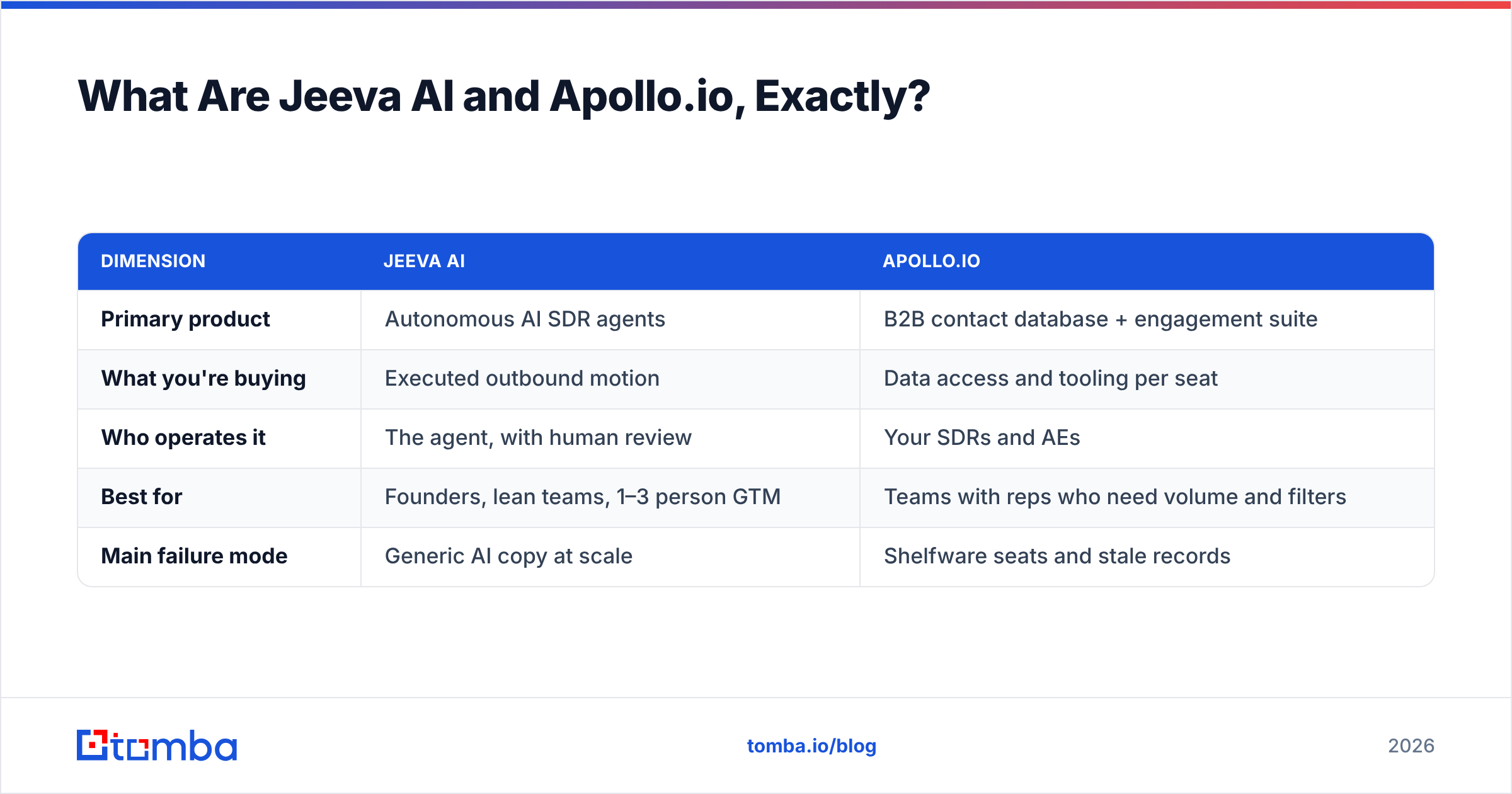
| Dimension | Jeeva AI | Apollo.io |
|---|---|---|
| Primary product | Autonomous AI SDR agents | B2B contact database + engagement suite |
| What you're buying | Executed outbound motion | Data access and tooling per seat |
| Who operates it | The agent, with human review | Your SDRs and AEs |
| Best for | Founders, lean teams, 1–3 person GTM | Teams with reps who need volume and filters |
| Main failure mode | Generic AI copy at scale | Shelfware seats and stale records |
Here is the practical way to tell which problem you actually have:
- You have reps but no data. Apollo. The database plus filters is the fastest path to a list, and your team already knows how to sequence.
- You have data but no reps. Jeeva. You don't need another seat license; you need someone (or something) to actually run the sends and replies.
- You have neither. Start with data. An agent with a bad list produces bad pipeline faster than a human would.
- You have both but low reply rates. Neither tool is your problem. Your targeting or your offer is, and no amount of AI copy fixes a weak offer.
- You have compliance constraints. Check both vendors' sourcing and regional coverage before signing. This is where most EU-based teams get stuck.

How Do Jeeva AI and Apollo.io Compare Head-to-Head?#
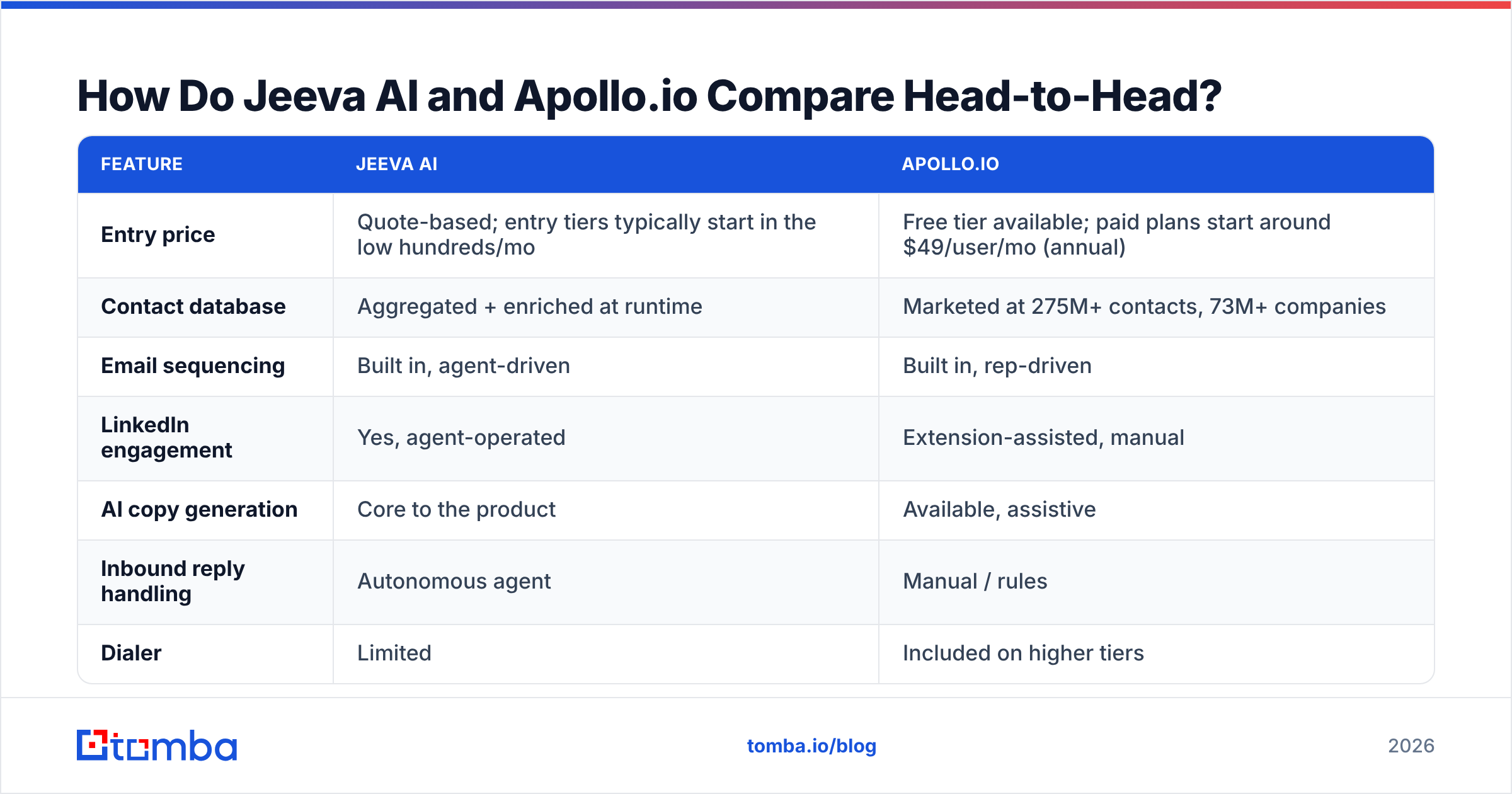
Below is the feature-level comparison. Treat every pricing figure as "published list price at the time of writing" — both vendors reprice, and Jeeva in particular runs a quote-driven motion where the number you see depends on seats, volume, and contract length.
| Feature | Jeeva AI | Apollo.io |
|---|---|---|
| Entry price | Quote-based; entry tiers typically start in the low hundreds/mo | Free tier available; paid plans start around $49/user/mo (annual) |
| Contact database | Aggregated + enriched at runtime | Marketed at 275M+ contacts, 73M+ companies |
| Email sequencing | Built in, agent-driven | Built in, rep-driven |
| LinkedIn engagement | Yes, agent-operated | Extension-assisted, manual |
| AI copy generation | Core to the product | Available, assistive |
| Inbound reply handling | Autonomous agent | Manual / rules |
| Dialer | Limited | Included on higher tiers |
| CRM sync | HubSpot / Salesforce | HubSpot / Salesforce / Pipedrive |
| API access | Available on higher tiers | Available on higher tiers |
| Free trial | Demo-gated | Self-serve free plan |
| Learning curve | Low to set up, high to tune | Medium; filters reward expertise |
Two honest observations from this table.
First, Apollo's free tier is a real evaluation advantage. You can test the data on your own ICP in an afternoon without a sales call. Jeeva's demo-gated motion means you evaluate on the vendor's terms, with the vendor's examples. That's not disqualifying — most AI SDR vendors work this way — but it slows you down and it makes apples-to-apples testing harder.
Second, Jeeva's agent autonomy is genuinely different from Apollo's "AI assist" features. Apollo's AI writes a draft you approve. Jeeva's agent is designed to research, draft, send, and triage the reply. Whether that's an asset or a liability depends entirely on how much you trust unsupervised AI to represent your brand in a stranger's inbox.
Which One Has Better B2B Data?#
Apollo has more of it. That is not the same as having better data for you.
Apollo's scale comes from a contributory network — users install the extension, data flows back, the graph grows. It's the same model ZoomInfo and several others use, and it produces excellent coverage of US-based, tech-adjacent, mid-market companies. Coverage gets thinner outside that profile: smaller European firms, non-English-speaking markets, and industries that don't live on LinkedIn.
Jeeva doesn't pitch a proprietary database of comparable scale. Its agents assemble and enrich contacts at research time from multiple sources. In practice this means your results depend heavily on how well the agent can find public signal for your target accounts — strong for well-documented companies, weaker for the long tail.
Both share the same structural problem, and it's the one that quietly kills campaigns: B2B contact data decays at roughly 22–30% per year, and neither vendor's record is guaranteed valid on the day you send. A contact that was correct in Q1 is a bounce in Q4 because the person changed jobs. This is why serious outbound teams treat database records as candidates and run them through a dedicated email verifier before they enter a sequence.

If you want the receipts on how much this matters, pull your last 1,000 sends and check the hard-bounce rate. Anything over 3% means you are burning sender reputation to save a verification step that costs fractions of a cent per address.
How Do the Pricing Models Actually Differ?#
This is where the two products diverge most sharply, and where buyers most often miscalculate.
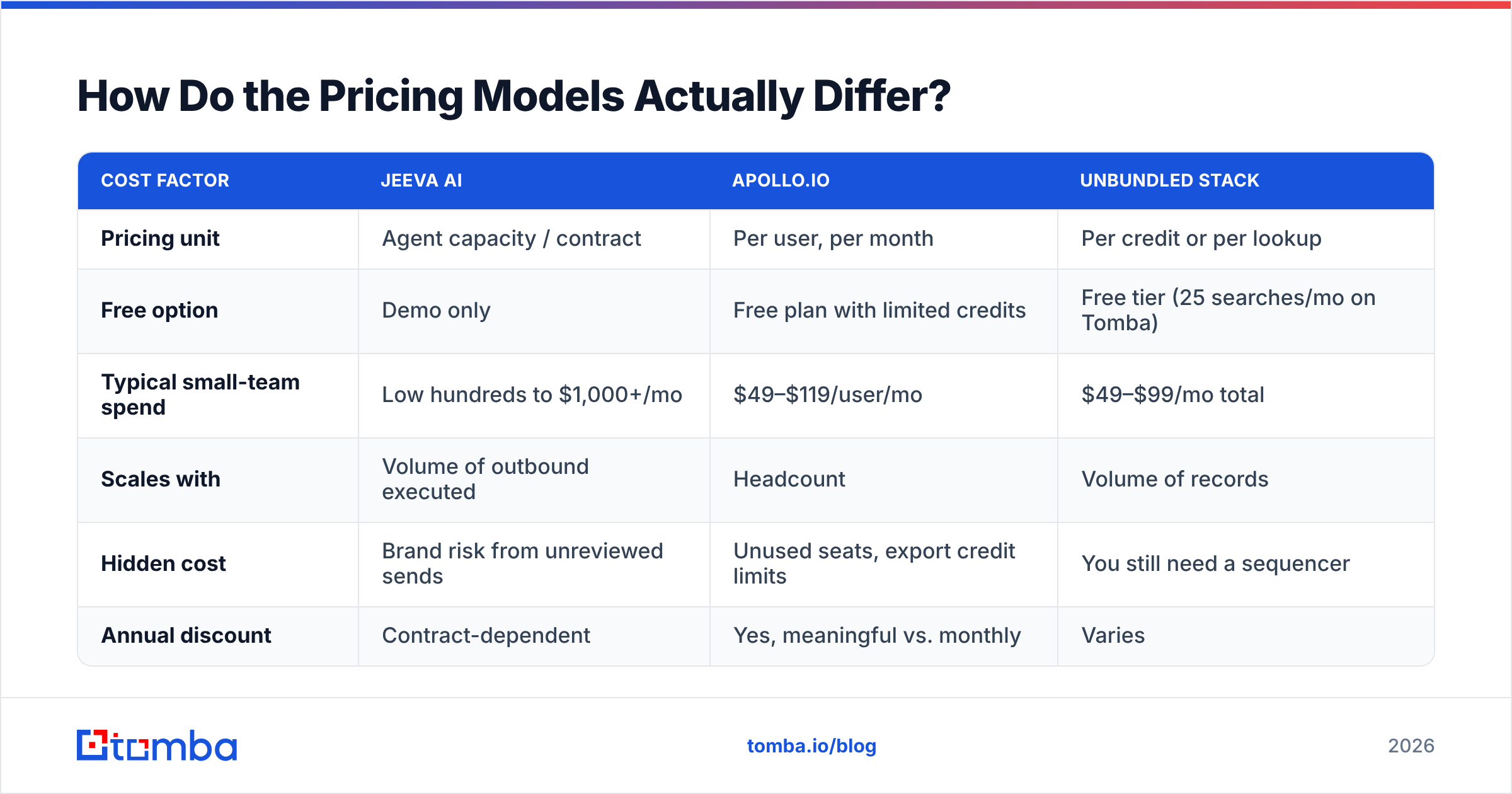
| Cost factor | Jeeva AI | Apollo.io | Unbundled stack |
|---|---|---|---|
| Pricing unit | Agent capacity / contract | Per user, per month | Per credit or per lookup |
| Free option | Demo only | Free plan with limited credits | Free tier (25 searches/mo on Tomba) |
| Typical small-team spend | Low hundreds to $1,000+/mo | $49–$119/user/mo | $49–$99/mo total |
| Scales with | Volume of outbound executed | Headcount | Volume of records |
| Hidden cost | Brand risk from unreviewed sends | Unused seats, export credit limits | You still need a sequencer |
| Annual discount | Contract-dependent | Yes, meaningful vs. monthly | Varies |
The per-seat model punishes you for growing a team. The agent model punishes you for growing volume. The credit model punishes you for sloppy list-building. Pick the one whose penalty you can control.
A concrete example. A four-person GTM team on Apollo's mid tier lands somewhere near $300–$400/month before annual discounts, and every new hire adds to it. The same team running Tomba pricing at the Growth plan ($99/mo) plus a $30–$50/month sequencer spends under $150 — but they're doing the sequencing work themselves. Jeeva sits above both, and justifies it only if it genuinely replaces the labor of a half-SDR or more.
That's the actual buying question: does the AI SDR replace enough human hours to beat the delta? If a Jeeva contract runs $800/month and saves you 15 hours of prospecting a week, it's cheap. If it saves you three hours and produces copy you rewrite anyway, it isn't.
When Should You Choose Apollo.io?#
Pick Apollo when these are true:
- You have two or more people actively prospecting and they need a shared data source with good filters.
- Your ICP is US-heavy, tech-adjacent, and mid-market or above — Apollo's coverage sweet spot.
- You want self-serve evaluation without booking a demo.
- You want one bill for data, sequencing, and dialing rather than three vendors.
- Your team is comfortable with a tool that rewards expertise. Apollo's filters are powerful and most users never learn half of them.
Skip Apollo if your outbound is targeting European SMBs, if your team is one person who will never log in, or if you've already got a sequencer you like and only need data — in which case you're paying for a suite to use a database. That's the scenario where an Apollo alternative built around lookups and verification costs a fraction of the seat price.
When Should You Choose Jeeva AI?#
Pick Jeeva when these are true:
- You're a founder or a one-to-three person GTM team and outbound keeps falling off the calendar.
- You'd otherwise hire an SDR and the agent contract is materially cheaper than a salary plus tooling.
- Your offer is simple enough to explain in three sentences, which is roughly the ceiling for AI-generated cold copy that still converts.
- You're willing to review agent output for the first 60 days rather than trusting it blind.
- Your motion is multichannel — Jeeva's LinkedIn plus email combination is more integrated than stitching Apollo to a separate LinkedIn tool.
Skip Jeeva if your deal cycle depends on nuanced, researched, genuinely personalized outreach to a small named-account list. At that end of the market, 40 hand-written emails beat 4,000 generated ones, and no agent changes that math. Check recent buyer reviews on G2 before you commit to a term — AI SDR products in this category iterate fast, and a review from 18 months ago describes a different product.
Is There a Third Option Most Teams Miss?#
Yes: unbundle.
The assumption behind both products is that you should buy data, execution, and intelligence from the same vendor. That bundle is convenient and it is almost always more expensive than the parts. A large share of teams evaluating Jeeva AI vs Apollo.io actually need three cheap things:
- A reliable way to find and verify work emails at the accounts they already care about.
- A sequencer — and there are competent ones in the $30–$50/month range.
- Enrichment to fill in firmographics and job titles before the first touch.
That's the case for a data-first stack. Tomba's email finder resolves names and domains to verified professional addresses, domain search pulls every discoverable address at a target company, and data enrichment fills the gaps your CRM left empty. The Tomba API drops the same capability into whatever agent, sequencer, or internal script you're already running — including a Jeeva or Apollo workflow, if you decide one of them is the right execution layer.
The point isn't that you should never buy a suite. It's that you should know what the suite costs relative to its parts, and buy the bundle deliberately rather than by default.
Which Should You Actually Buy?#
Buy Apollo.io if you have reps. The per-seat cost is justified when people are logging in daily, and the free plan means you can prove the data works on your ICP before you pay anything.
Buy Jeeva AI if you have no reps and no time. An agent that runs unattended is worth real money when the alternative is outbound that never happens. Negotiate a short initial term and measure replies, not sends.
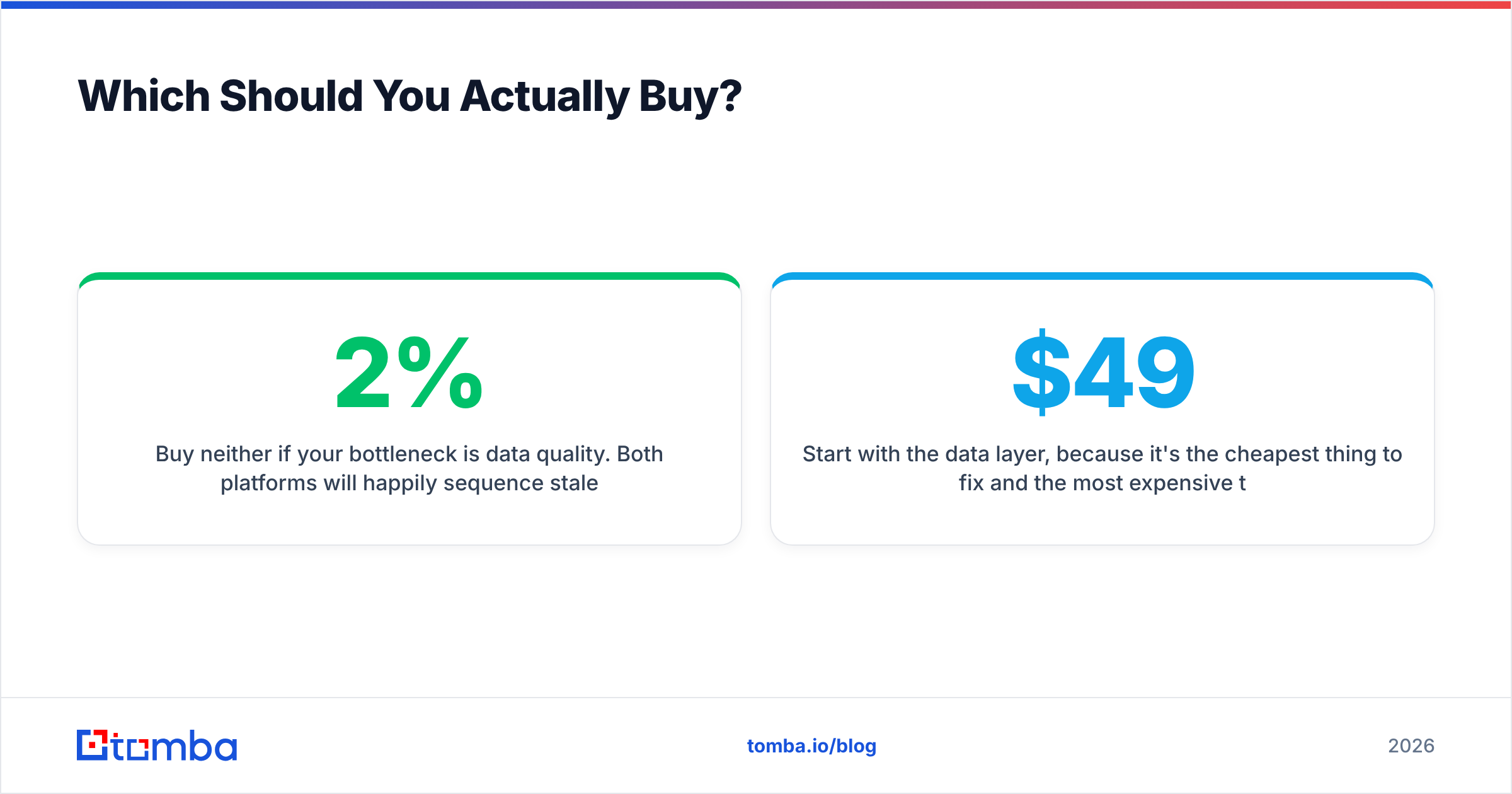
Buy neither if your bottleneck is data quality. Both platforms will happily sequence stale addresses into a spam folder. Fix the input first — verify before you send, enrich before you write, and keep your bounce rate under 2%. Most "our outbound doesn't work" diagnoses resolve to that one number.
Start with the data layer, because it's the cheapest thing to fix and the most expensive thing to get wrong. Run your current list through the Tomba Email Finder — the free tier gives you 25 searches a month, Starter is $49/mo, and Growth is $99/mo — and see how many of the contacts you were about to sequence are still real. Then decide whether you need an agent, a seat, or just a better list.
Related guides#
// get started
Find, verify and enrich your first contacts today
Start on the free plan with 25 searches a month, then scale when your team is ready.
Free plan · No credit card required · GDPR & CCPA
// about the author