Joint Sales Calls: How to Run a Two-Rep Call That Closes
A second person on the call either doubles your credibility or doubles the confusion. Here's when a joint sales call is worth the headcount, who to bring, how to split roles, and the metrics that prove it worked.
TL;DR
- A joint sales call puts two sellers on the same meeting with clearly split jobs — not two people improvising the same pitch.
- Bring a second person when the deal has a new persona, a technical blocker, a pricing escalation, or a rep who needs live coaching. Skip it for discovery on a $4k deal.
- The single biggest failure mode is role collision: both people answering the same question, the buyer watching an internal negotiation.
- Prep is 20 minutes, not two hours: shared doc, one owner, one objective, one silent observer rule, and an agreed handoff phrase.
- Measure joint calls against solo calls on next-meeting rate and cycle length, not on "how it felt." If the lift is under 10 points, you're burning a second salary.
What is a joint sales call?#
A joint sales call is any customer-facing meeting where two or more people from your side attend with assigned, non-overlapping roles. The classic version is a manager riding along with an account executive. The modern version is broader: an AE plus a solutions engineer, an SDR plus the AE they booked for, a partner rep plus your rep on a co-sell, or a CRO dropping into a stalled enterprise cycle.
The word that matters in that definition is assigned. Two people on a Zoom is not a joint call — it's a crowd. A joint sales call has a lead, a support role, a stated objective, and a plan for who speaks when. Everything in this guide exists to enforce that distinction.
The reason joint calls keep coming back despite the obvious cost — two salaries for one meeting — is that B2B buying groups have grown. Gartner's research on B2B buying behavior has tracked buying committees in the six-to-ten-person range for years. When the other side of the table brings a practitioner, a security reviewer, and a budget holder, sending one generalist to cover all three concerns is a structural mismatch. A second seller with a different specialty fixes the mismatch directly.
When is a joint sales call actually worth it?#
Not often enough to be your default. The honest filter is: does the second person unlock something the first person cannot, in this specific meeting?
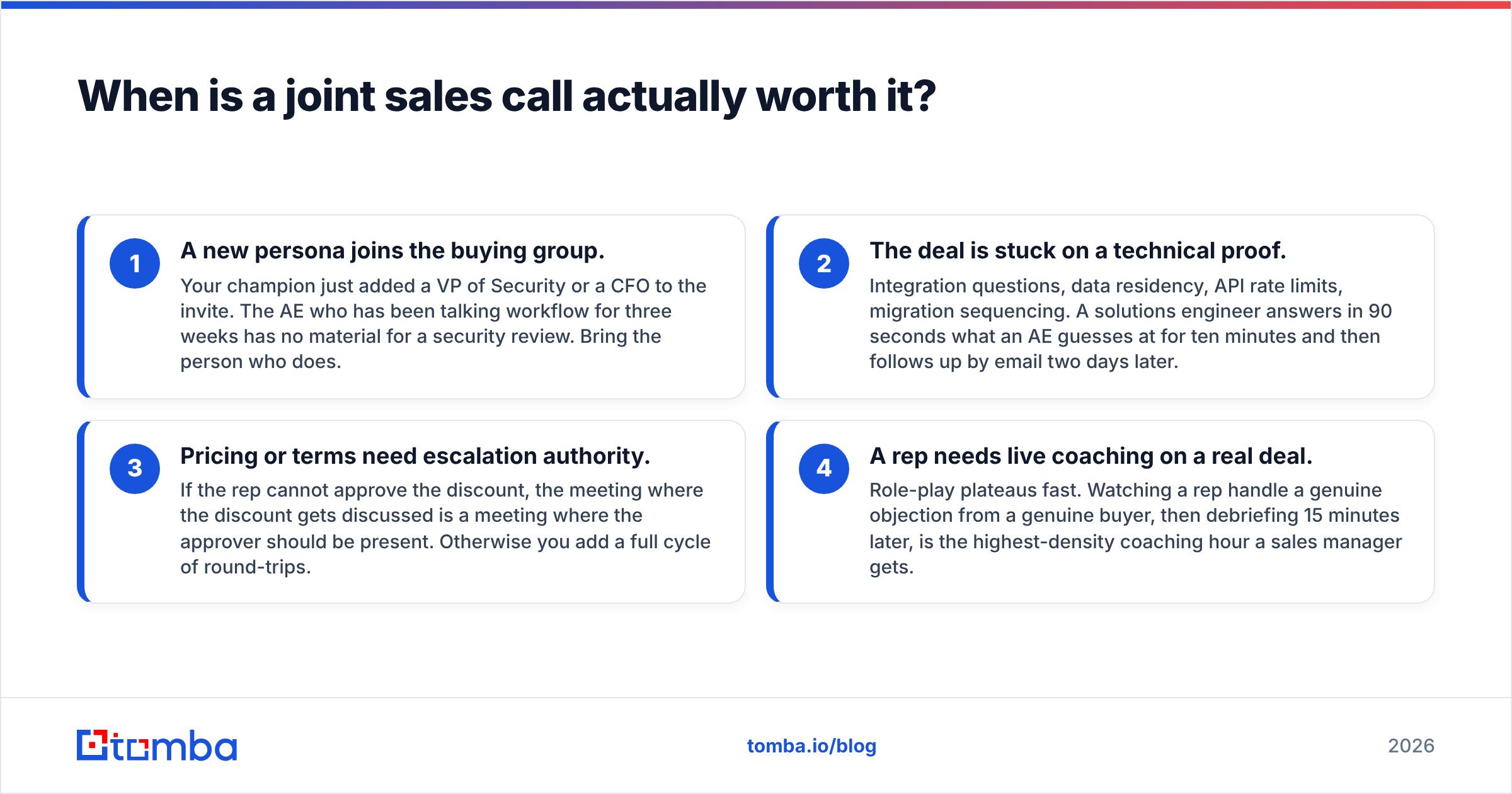
Four situations clear that bar consistently:
- A new persona joins the buying group. Your champion just added a VP of Security or a CFO to the invite. The AE who has been talking workflow for three weeks has no material for a security review. Bring the person who does.
- The deal is stuck on a technical proof. Integration questions, data residency, API rate limits, migration sequencing. A solutions engineer answers in 90 seconds what an AE guesses at for ten minutes and then follows up by email two days later.
- Pricing or terms need escalation authority. If the rep cannot approve the discount, the meeting where the discount gets discussed is a meeting where the approver should be present. Otherwise you add a full cycle of round-trips.
- A rep needs live coaching on a real deal. Role-play plateaus fast. Watching a rep handle a genuine objection from a genuine buyer, then debriefing 15 minutes later, is the highest-density coaching hour a sales manager gets.
And two situations where a joint sales call is waste: routine discovery on a small deal, and any call where the second person is attending "just to listen" without a debrief scheduled. If there's no debrief, it was a spectator, not a participant.
Who should join the call, and what do they actually do?#
Different second seats solve different problems. Picking the wrong one is why joint calls get a bad reputation.
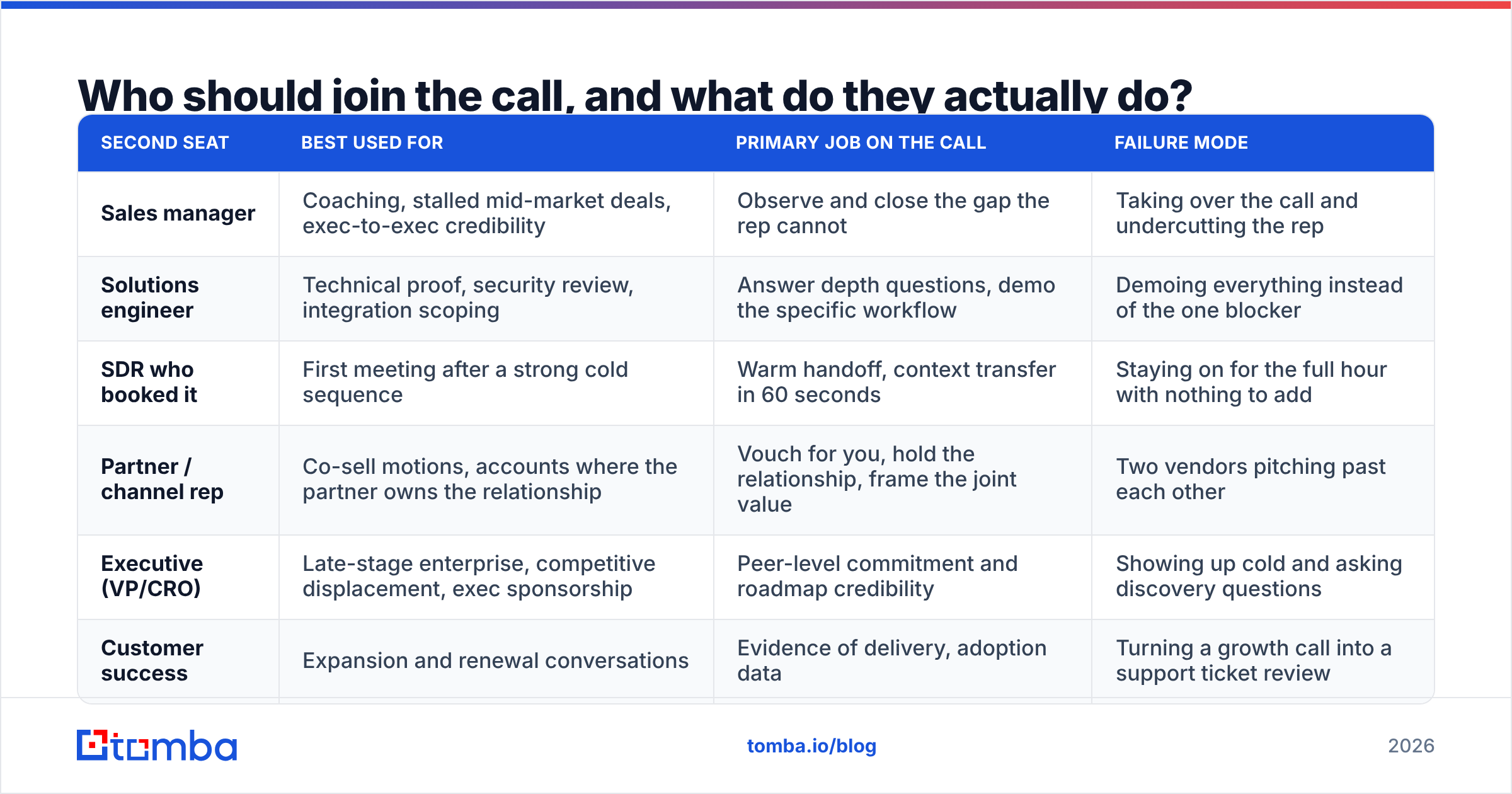
| Second seat | Best used for | Primary job on the call | Failure mode |
|---|---|---|---|
| Sales manager | Coaching, stalled mid-market deals, exec-to-exec credibility | Observe and close the gap the rep cannot | Taking over the call and undercutting the rep |
| Solutions engineer | Technical proof, security review, integration scoping | Answer depth questions, demo the specific workflow | Demoing everything instead of the one blocker |
| SDR who booked it | First meeting after a strong cold sequence | Warm handoff, context transfer in 60 seconds | Staying on for the full hour with nothing to add |
| Partner / channel rep | Co-sell motions, accounts where the partner owns the relationship | Vouch for you, hold the relationship, frame the joint value | Two vendors pitching past each other |
| Executive (VP/CRO) | Late-stage enterprise, competitive displacement, exec sponsorship | Peer-level commitment and roadmap credibility | Showing up cold and asking discovery questions |
| Customer success | Expansion and renewal conversations | Evidence of delivery, adoption data | Turning a growth call into a support ticket review |
The pattern across the table: the second seat should have a different job, not a louder version of the same one. If you can't name what the second person does that the first can't, you've found your answer — run it solo.
How do you prep a joint sales call in 20 minutes?#
Most joint calls fail before anyone joins the meeting. Prep is short but non-negotiable, and it lives in one shared doc both people can see.
- Name the owner. One person runs the call. They open, they steer, they close, they own the follow-up. The other person is support regardless of seniority. A manager who outranks the rep is still the support role unless explicitly agreed otherwise.
- Write one objective, in one sentence. "Get the security lead to agree to a 30-day sandbox" is an objective. "Build the relationship" is not.
- Map the attendee list before the call. Know every name, title, and likely concern on the buyer side. If your calendar invite has three unknown attendees, that's the prep work — pull their role and company context ahead of time. Tools like contact enrichment turn a bare email address on an invite into a title, seniority, and department in seconds, which is the difference between a targeted question and a wasted one.
- Agree on the handoff phrase. A literal sentence, decided in advance: "Priya, you've done this migration three times — walk them through it." The buyer hears an intentional handoff. Without it, you get the awkward "do you want to take this?" cross-talk that signals the two of you didn't plan.
- Set the silence rule. The support role does not speak until handed the ball or until 30 seconds of dead air. Write it down. It's the rule most often broken and the one that does the most damage.
- Decide the debrief slot. 15 minutes, same day, on the calendar before the call starts. If it isn't booked, it won't happen, and the coaching value evaporates.
Twenty minutes of this beats an hour of deck polishing. HubSpot's sales enablement resources make the same point in a different way: structured pre-call planning correlates more strongly with meeting outcomes than call length or deck quality.
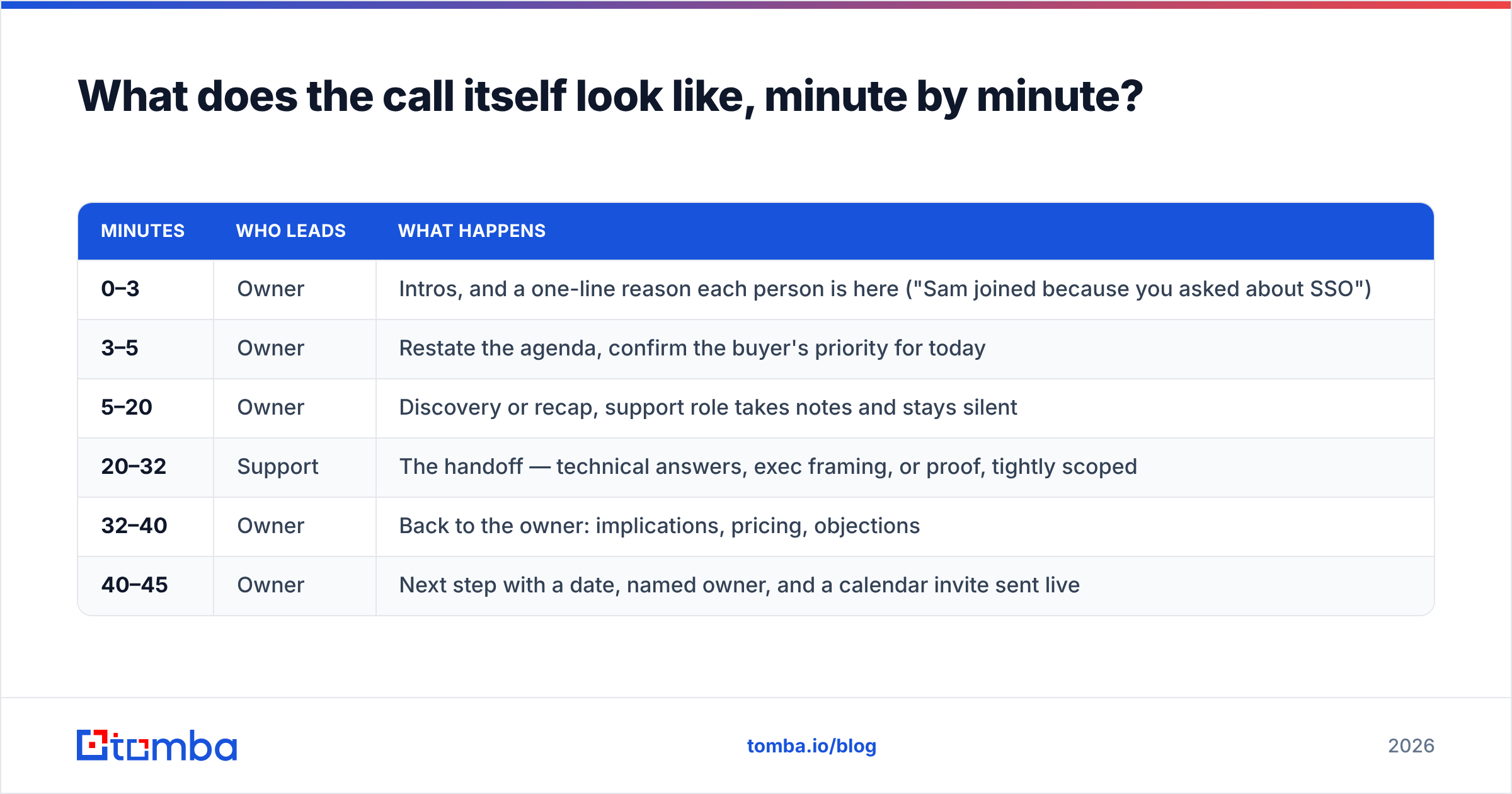
What does the call itself look like, minute by minute?#
A workable default for a 45-minute joint sales call:
| Minutes | Who leads | What happens |
|---|---|---|
| 0–3 | Owner | Intros, and a one-line reason each person is here ("Sam joined because you asked about SSO") |
| 3–5 | Owner | Restate the agenda, confirm the buyer's priority for today |
| 5–20 | Owner | Discovery or recap, support role takes notes and stays silent |
| 20–32 | Support | The handoff — technical answers, exec framing, or proof, tightly scoped |
| 32–40 | Owner | Back to the owner: implications, pricing, objections |
| 40–45 | Owner | Next step with a date, named owner, and a calendar invite sent live |
The three-minute intro matters more than it looks. Telling the buyer why the second person is on the call — before they wonder — converts a possible "are they ganging up on me?" reaction into "they brought the right specialist." That single sentence is the cheapest trust you'll buy all week.
What are the most common joint sales call mistakes?#
- Role collision. Both people answer the same question, slightly differently. The buyer now has two versions of the truth and less confidence than before the call.
- The manager takeover. A manager who jumps in to "save" a call teaches the rep nothing and tells the buyer the rep isn't the real decision-maker. Ride-alongs where the manager speaks more than 25% of the time are almost always coaching failures.
- No debrief. The call happened, both calendars got billed, nobody wrote down what to do differently. This is the most common one and the most expensive.
- Internal disagreement in front of the buyer. Negotiating scope or price with your own colleague live on the call is a credibility event you don't recover from in that cycle.
- Wrong second seat. Sending an executive to a discovery call, or a solutions engineer to a pure relationship conversation. Right intention, wrong specialty.
- Attendee blind spots. Showing up without knowing who's in the room. If a stakeholder joins whose name you've never seen, you spend the first ten minutes doing research you should have done in advance — and that's the segment of the call where attention is highest.
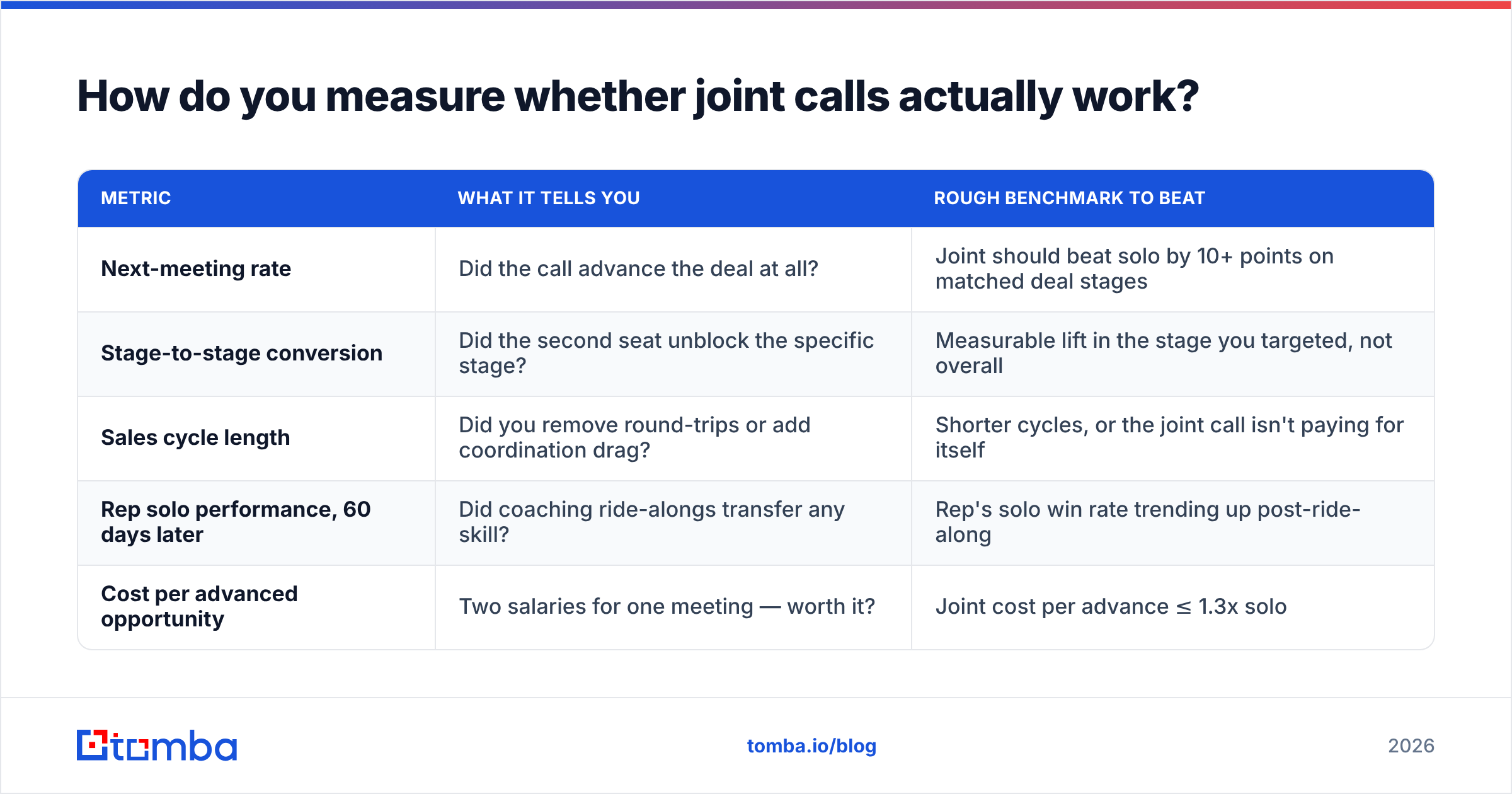
How do you measure whether joint calls actually work?#
Feelings are not evidence. Track joint calls as a cohort against comparable solo calls and look at four numbers.
| Metric | What it tells you | Rough benchmark to beat |
|---|---|---|
| Next-meeting rate | Did the call advance the deal at all? | Joint should beat solo by 10+ points on matched deal stages |
| Stage-to-stage conversion | Did the second seat unblock the specific stage? | Measurable lift in the stage you targeted, not overall |
| Sales cycle length | Did you remove round-trips or add coordination drag? | Shorter cycles, or the joint call isn't paying for itself |
| Rep solo performance, 60 days later | Did coaching ride-alongs transfer any skill? | Rep's solo win rate trending up post-ride-along |
| Cost per advanced opportunity | Two salaries for one meeting — worth it? | Joint cost per advance ≤ 1.3x solo |
The fourth row is the one teams skip and the one that decides whether the program survives a budget review. Salesforce's State of Sales research consistently finds reps spend a minority of their week actually selling; pulling a second seller into a meeting doubles that cost for a single hour. If the advance rate doesn't move, you've just halved two people's capacity.
One practical note on measurement: run joint calls on a deliberate subset — say, every deal over a threshold in a given stage — for one quarter. Randomising by deal size, not by rep preference, is what makes the comparison honest. Reps naturally pull backup into their best deals, which flatters the joint-call numbers.
How do joint calls change across deal sizes and motions?#
SMB velocity motions rarely justify a second seat outside of coaching. The economics don't work at a $6k ACV when the call costs two hours of loaded salary. Use ride-alongs there purely as an enablement tool, batched — a manager sits on four calls in a morning and debriefs all four at lunch.
Mid-market is where joint calls earn the most. Deals are big enough to justify the cost, committees are big enough to need specialists, and the technical evaluation is real but not so long that it becomes its own workstream.
Enterprise flips the model: joint calls stop being an exception and become the default. Multi-threading a nine-person buying committee means a permanent pod — AE, SE, exec sponsor, sometimes a customer reference. Here the discipline shifts from "should we bring someone" to "who is not needed on this call," because unnecessary attendees slow enterprise cycles as much as missing ones do.
Across all three, the input that gates everything is contact data. You cannot multi-thread a committee you can't reach. When a champion mentions a security lead or a finance approver you don't have contact details for, the fastest path is to look them up directly by name and company rather than waiting for a warm intro that may never come — that's what an email finder and a phone finder are for in a joint-call workflow. Get the second stakeholder on the invite, then decide which of your people should sit across from them.
What's the fastest way to start?#
Pick one stage in your pipeline where deals stall most often. Look at your last ten losses in that stage and ask what a second person would have unlocked — technical proof, pricing authority, or exec credibility. That answer picks your second seat. Run joint calls on every qualifying deal at that stage for a quarter, with the 20-minute prep doc and the mandatory 15-minute debrief, then compare the cohort to your historical baseline.
If the numbers move, expand. If they don't, you've learned something cheap: the blocker in that stage wasn't a missing person, it was a missing message.
Before you can run a joint sales call, you need every member of the buying committee on the invite — with the right title, the right email, and the right phone number. Tomba Email Finder finds verified professional email addresses by name and company domain, so when your champion mentions the VP of Security who needs to be in the room, you reach them the same day instead of waiting a week for an intro. Start on the free tier with 25 searches a month; paid plans begin at $49/mo. Full Tomba pricing is here.
Related guides#
// get started
Find, verify and enrich your first contacts today
Start on the free plan with 25 searches a month, then scale when your team is ready.
Free plan · No credit card required · GDPR & CCPA
Get the Tomba newsletter
Product and data updates
// about the author