Kaspr Pricing 2026: Plans, Credits, and Hidden Costs
Kaspr sells contact data by the seat, not by the record. Here is what each plan actually unlocks, where the credit math breaks down, and when a credit-based tool costs less.
TL;DR
- Kaspr prices per user per seat, not per record. That single design choice drives almost every cost surprise teams report.
- There is a genuinely usable free plan, but it is capped at single-digit phone credits per month — it is a trial, not a workflow.
- Paid tiers are commonly listed around €49, €79, and €99 per user per month on annual billing, with the top tier requiring a multi-license minimum.
- Credits are split by type (phone, direct email, export), so "1,000 credits" never means 1,000 usable contacts.
- If you need volume email discovery across many domains rather than one-by-one LinkedIn lookups, credit-based pricing — Tomba's Starter is $49/mo flat with no seat minimum — usually lands cheaper per verified contact.
What is Kaspr and who is it built for?#
Kaspr is a B2B contact data tool that lives mostly inside LinkedIn. You install the Chrome extension, open a profile or a Sales Navigator list, and Kaspr reveals mobile numbers, direct emails, and company data for those people. It was acquired by Cognism in 2022 and now functions as the lighter, self-serve end of that product family — Cognism sells enterprise-priced data platforms, Kaspr sells seats to SDRs and founders who want phone numbers today.
That positioning matters for the pricing conversation. Kaspr is optimized for a rep working a list of people they have already identified on LinkedIn. It is not optimized for "give me every contactable person at these 400 companies." Both are valid prospecting motions, but they have very different cost curves, and Kaspr's per-seat model only makes sense for one of them.
The core deliverable is the mobile number. Kaspr's email coverage is decent, but reps buy it for direct dials, which is why the credit system treats phone lookups as the scarce, expensive resource.
How much does Kaspr cost in 2026?#
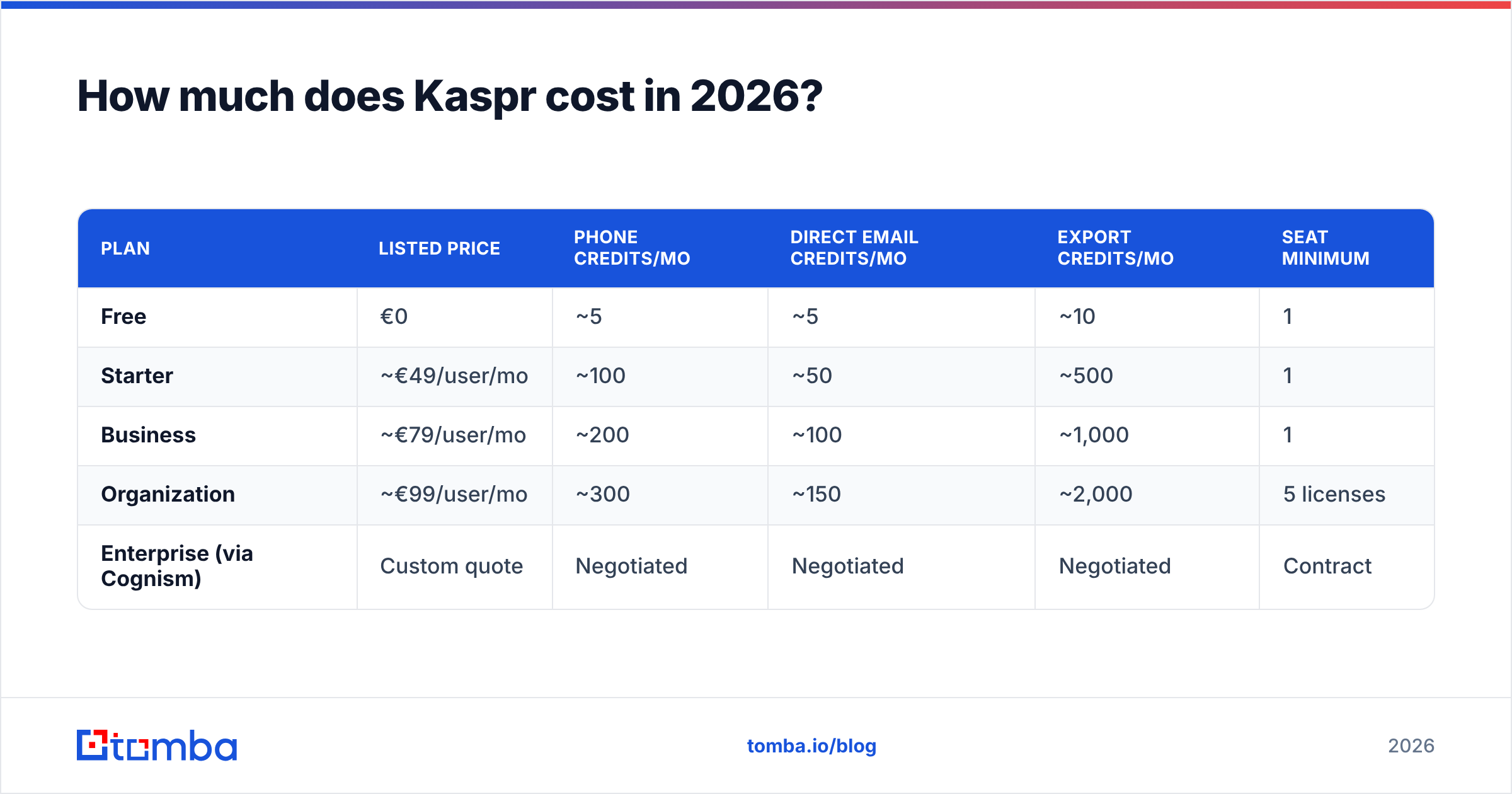
Kaspr publishes four tiers: Free, Starter, Business, and Organization. Pricing is listed in euros, quoted per user per month, and the headline numbers assume annual commitment — monthly billing carries a premium, as it does with nearly every tool in this category.
The figures below reflect what Kaspr has publicly listed at the time of writing. Vendor pricing changes without notice, so confirm current numbers on kaspr.io/pricing before you budget against them.
| Plan | Listed price | Phone credits/mo | Direct email credits/mo | Export credits/mo | Seat minimum |
|---|---|---|---|---|---|
| Free | €0 | ~5 | ~5 | ~10 | 1 |
| Starter | ~€49/user/mo | ~100 | ~50 | ~500 | 1 |
| Business | ~€79/user/mo | ~200 | ~100 | ~1,000 | 1 |
| Organization | ~€99/user/mo | ~300 | ~150 | ~2,000 | 5 licenses |
| Enterprise (via Cognism) | Custom quote | Negotiated | Negotiated | Negotiated | Contract |
Two details do most of the damage to naive budget math.
First, the Organization tier's license minimum. At five seats, you are looking at roughly €495/month — around €5,900/year — before anyone has made a call. Teams that want Organization-tier features but only have two reps end up paying for three empty chairs.
Second, unlimited B2B emails are not unlimited direct emails. Kaspr distinguishes between generic company-pattern emails (plentiful) and verified personal work emails (metered). If your sequences depend on the second category, the ceiling is the direct email credit line, not the marketing copy.

What do Kaspr's credit types actually mean?#
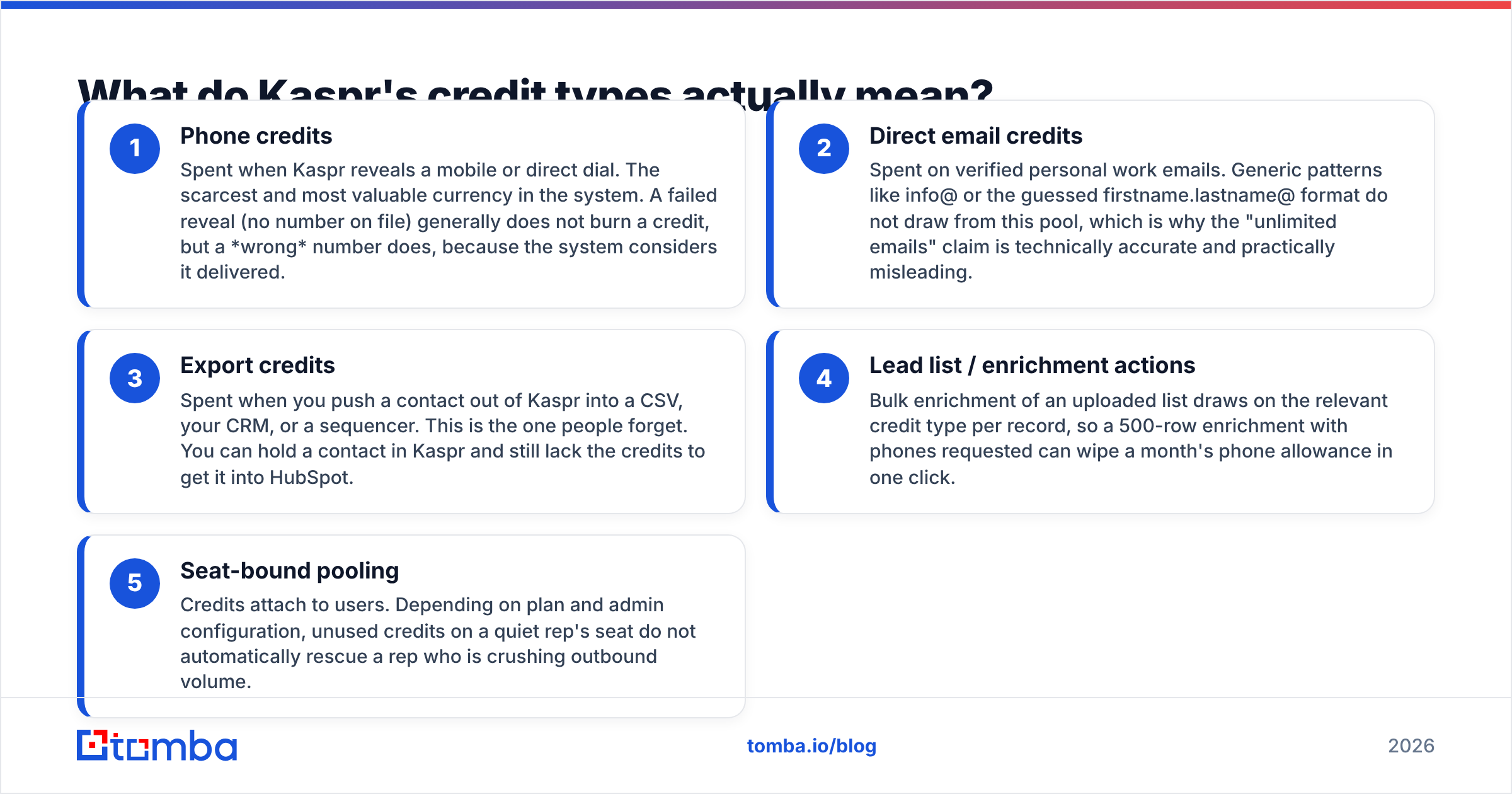
This is the part of Kaspr pricing that generates the most support tickets, so it is worth spelling out plainly. Kaspr does not have one credit balance. It has several, and they do not convert into each other.
- Phone credits — Spent when Kaspr reveals a mobile or direct dial. The scarcest and most valuable currency in the system. A failed reveal (no number on file) generally does not burn a credit, but a wrong number does, because the system considers it delivered.
- Direct email credits — Spent on verified personal work emails. Generic patterns like info@ or the guessed firstname.lastname@ format do not draw from this pool, which is why the "unlimited emails" claim is technically accurate and practically misleading.
- Export credits — Spent when you push a contact out of Kaspr into a CSV, your CRM, or a sequencer. This is the one people forget. You can hold a contact in Kaspr and still lack the credits to get it into HubSpot.
- Lead list / enrichment actions — Bulk enrichment of an uploaded list draws on the relevant credit type per record, so a 500-row enrichment with phones requested can wipe a month's phone allowance in one click.
- Seat-bound pooling — Credits attach to users. Depending on plan and admin configuration, unused credits on a quiet rep's seat do not automatically rescue a rep who is crushing outbound volume.
The practical translation: a "200 credit" plan is not a 200-contact plan. If a fully usable contact for your motion means a mobile number, a verified email, and a CRM export, one contact can consume three separate credits from three separate buckets.
Is Kaspr's data accurate enough to justify the price?#
Accuracy is where per-seat pricing gets defensible or indefensible. If a €79 seat produces 200 mobile numbers that connect, that is cheap. If a third of them ring a former employer, the effective cost per usable contact triples.
Kaspr's phone data is community-contributed and partner-sourced, which produces a recognizable pattern in reviews on G2: strong coverage in Western Europe — especially France, the UK, Benelux, and DACH — and thinner, staler coverage in North America and APAC. If your ICP sits in Paris or Amsterdam, Kaspr is one of the better-value phone sources available. If you are calling into US mid-market, test a sample before you commit to annual seats.
Email accuracy follows a different curve. Pattern-based emails are easy for any vendor to produce; the differentiator is whether the tool verifies them against the receiving mail server before handing them over. That verification step is what separates a 5% bounce rate from a 25% one, and bounce rate is what eventually decides your email deliverability — the cost that never appears on any pricing page.

Before you buy any plan, run the same 25 known-good contacts through the free tier, then check the returned addresses in a separate email verifier. Anything that comes back risky or catch-all should be discounted from your effective coverage number. Do this and the real cost per usable contact often looks very different from the advertised one.
How does Kaspr pricing compare to the alternatives?#
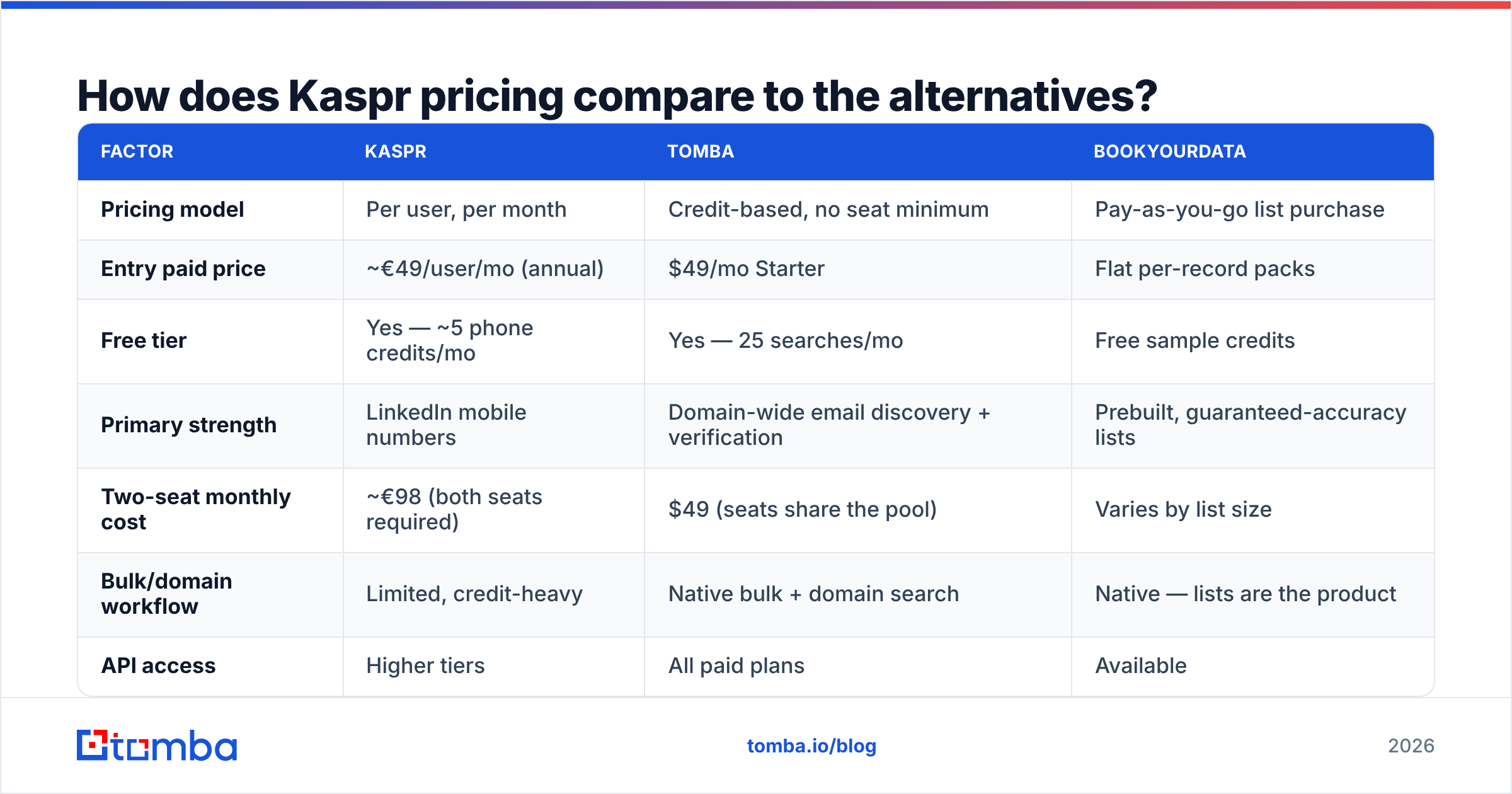
Per-seat and per-credit models are not directly comparable until you fix a unit. Below, the unit is one verified, exportable contact per month for a two-person outbound team.
| Factor | Kaspr | Tomba | BookYourData |
|---|---|---|---|
| Pricing model | Per user, per month | Credit-based, no seat minimum | Pay-as-you-go list purchase |
| Entry paid price | ~€49/user/mo (annual) | $49/mo Starter | Flat per-record packs |
| Free tier | Yes — ~5 phone credits/mo | Yes — 25 searches/mo | Free sample credits |
| Primary strength | LinkedIn mobile numbers | Domain-wide email discovery + verification | Prebuilt, guaranteed-accuracy lists |
| Two-seat monthly cost | ~€98 (both seats required) | $49 (seats share the pool) | Varies by list size |
| Bulk/domain workflow | Limited, credit-heavy | Native bulk + domain search | Native — lists are the product |
| API access | Higher tiers | All paid plans | Available |
| Best fit | EU-focused SDRs calling from LinkedIn | Teams needing verified emails at volume | Teams that want a clean list without tooling |

Read that two-seat row carefully, because it is the whole argument. Under a per-seat model, adding a second rep doubles your bill whether or not they double your usage. Under a credit model, the second rep is free and you only pay when consumption actually rises. For a team of five where two people do 80% of the prospecting, per-seat pricing subsidizes idle licenses.
BookYourData solves the problem from the other direction and does it well: you buy the records outright with an accuracy guarantee attached, no subscription, no seat math. If your need is a defined list for a defined campaign rather than continuous day-to-day lookups, that model is often the cleanest procurement path of the three.
Where Tomba fits is the continuous-discovery middle: domain search across a target account list, verification built into the same credit, and Tomba pricing that starts at $49/mo on Starter, $99/mo on Growth, and $249/mo on Pro — with the free tier at 25 searches a month for testing before you commit.
When is Kaspr worth paying for?#
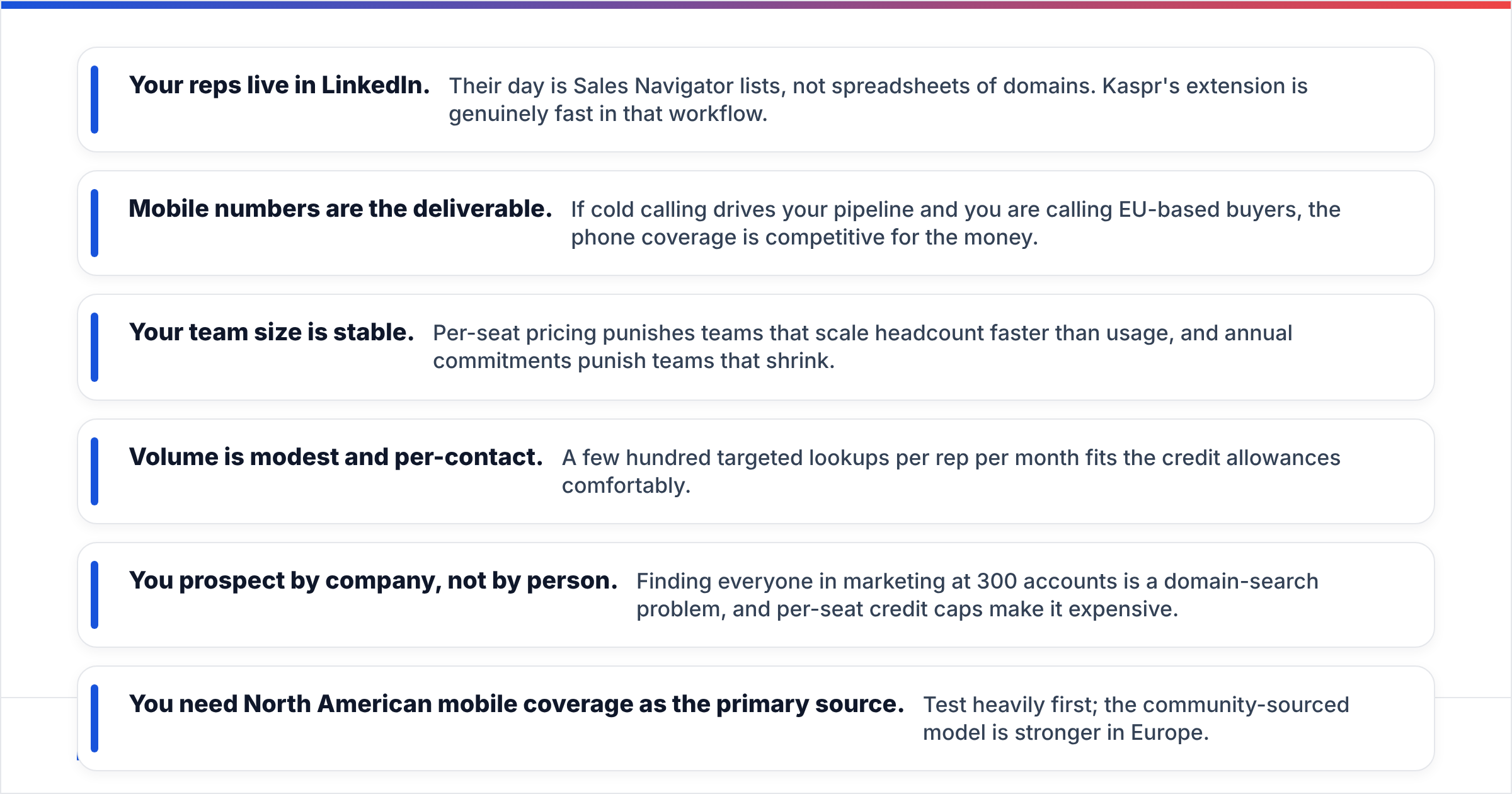
Kaspr earns its price in a specific, real scenario. Buy it if most of these are true:
- Your reps live in LinkedIn. Their day is Sales Navigator lists, not spreadsheets of domains. Kaspr's extension is genuinely fast in that workflow.
- Mobile numbers are the deliverable. If cold calling drives your pipeline and you are calling EU-based buyers, the phone coverage is competitive for the money.
- Your team size is stable. Per-seat pricing punishes teams that scale headcount faster than usage, and annual commitments punish teams that shrink.
- Volume is modest and per-contact. A few hundred targeted lookups per rep per month fits the credit allowances comfortably.
Skip it, or pair it with something else, if:
- You prospect by company, not by person. Finding everyone in marketing at 300 accounts is a domain-search problem, and per-seat credit caps make it expensive.
- You need North American mobile coverage as the primary source. Test heavily first; the community-sourced model is stronger in Europe.
- You have more licensed seats than active prospectors. You are paying for empty chairs.
- Email is your main channel. You will hit the direct email credit ceiling well before you hit the phone one, and you will still need separate verification.
A common, sensible setup: keep one or two Kaspr seats for the reps who actually dial, and run email discovery on a credit-based tool that the whole team shares. You stop buying phone credits for people who never call, and you stop rationing email lookups across seats. Teams working from LinkedIn profiles can use a LinkedIn finder for the email side and keep Kaspr purely for dials.
What hidden costs should you budget for?#
Four line items never appear in the plan comparison and all four are real.
Annual lock-in. The advertised per-seat price assumes a twelve-month commitment. Monthly billing costs more, and mid-year seat reductions typically are not refundable. Budget for the full term, not the month you are in.
Export credit exhaustion. Data you cannot move is data you cannot use. Teams routinely burn phone credits on reveals, then discover they are out of export credits with three weeks left in the cycle.
Verification you still have to do. No contact-data vendor's output should go straight into a sequencer. Whatever tool you buy, a verification pass before send is the difference between a protected domain and a burned one. That is either a second subscription or a feature you get bundled — but it is never free.
Onboarding drag. Per-seat tools create per-seat admin: provisioning, credit allocation arguments, and the monthly conversation about who gets the extra allowance. Credit-pool models have none of that overhead, which is worth something even if it never shows up as a line item.
What is the verdict on Kaspr pricing?#
Kaspr is fairly priced for what it is: a fast LinkedIn-native dialer's tool with strong European mobile coverage, sold by the seat. The Free plan is a legitimate way to test it. Starter at roughly €49/user/month is reasonable for a single rep who calls every day. The friction starts at Organization, where the five-license minimum turns a tool decision into a procurement decision, and at any point where your prospecting shifts from person-by-person to account-by-account.
The honest framing is not "Kaspr versus everyone." It is "does my outbound motion match a per-seat model?" If your team dials EU prospects from LinkedIn all day, yes. If your team needs verified work emails across hundreds of domains and shares that work across people who are not all full-time prospectors, a credit-based model will almost always cost less per usable contact — and it will not charge you for the seats that sit idle.
Run the test before you sign anything: take 50 real target contacts, pull them through Kaspr's free tier and one credit-based alternative, verify both outputs, and compare cost per contact that actually reaches an inbox or a phone. That number, not the pricing page, is your answer.
Ready to see the other side of the math? If email is your primary channel and you are tired of paying per seat for credits your team does not evenly use, start with the Tomba Email Finder. The free tier gives you 25 searches a month — enough to run the 50-contact test above — and paid plans start at $49/month with verification built in and no seat minimums. Find the emails, verify them in the same workflow, and let your budget scale with usage instead of headcount.
Related guides#
// get started
Find, verify and enrich your first contacts today
Start on the free plan with 25 searches a month, then scale when your team is ready.
Free plan · No credit card required · GDPR & CCPA
// about the author