Kaspr vs Lead411: Which B2B Contact Data Tool Wins in 2026?
Kaspr is a LinkedIn-first phone and email scraper. Lead411 is a US-heavy database with intent data. We compare coverage, pricing, and accuracy to show which one fits your outbound motion.
TL;DR
- Kaspr is a LinkedIn-first contact revealer. You install a Chrome extension, open a profile or a Sales Navigator list, and it surfaces mobile numbers and emails. Strong in Europe, weak as a standalone database.
- Lead411 is a searchable US-centric B2B database with Bombora-powered intent signals and "growth trigger" alerts. Stronger for territory building, weaker for one-off LinkedIn lookups.
- Pricing splits them cleanly: Kaspr starts free with limited credits and scales per seat; Lead411's paid plans are annual-leaning and land higher per user, with export caps that bite.
- Neither is a verification engine. Both ship bounce-prone addresses at volume, so budget for a separate email verifier regardless of which you pick.
- Pick Kaspr if your pipeline starts on LinkedIn and you sell into EMEA. Pick Lead411 if you build lists by filter and care about intent. Pick neither if you mostly need clean, API-accessible email data at low cost.
What is Kaspr and who actually uses it?#
Kaspr is a contact-enrichment tool built around a browser extension. You browse LinkedIn, Sales Navigator, or Recruiter, and Kaspr pulls a sidebar with the prospect's mobile number, direct dial, and work email. It was acquired by Cognism in 2022, which gave it access to a larger phone-verified data pool and an EU-first compliance posture.
The typical Kaspr user is an SDR or founder doing manual, high-intent prospecting. You are not building a 50,000-row list — you are working through 40 profiles a day, saving them to lists, and pushing them into a sequencer. Kaspr's workflow assumes LinkedIn is the source of truth and the tool is the decoder ring.
That design has a hard ceiling. If you close LinkedIn, Kaspr's utility drops sharply. There is a web app with saved lists and basic outreach automation (LinkedIn connection requests, follow-up messages), but it is not a filterable database you can query by revenue band, tech stack, or hiring signal.

What is Lead411 and how is it different?#
Lead411 is a traditional B2B database and sales-intelligence platform, founded well before the LinkedIn-scraper wave. You log in, apply filters — industry, headcount, revenue, location, title, technology used — and export contacts. It has been a fixture on G2's sales intelligence category for years.
Its two real differentiators:
- Bombora intent data. Lead411 resells Bombora topic surges, so you can filter companies actively researching "CRM migration" or "endpoint security" in the last 30 days. That is a genuinely different input than "this person has this title."
- Growth intent triggers. Funding rounds, hiring spikes, executive changes, and IPO signals get surfaced as alerts. If your ICP is "Series B companies that just hired a VP of Sales," Lead411 gets you there faster than a LinkedIn extension will.
The trade-off is geography and freshness. Lead411's coverage is heavily North American. European and APAC records thin out fast, and the phone data is more office-line than verified mobile. It is a list-building tool wearing a sales-intelligence badge.
Kaspr vs Lead411: how do they compare head-to-head?#
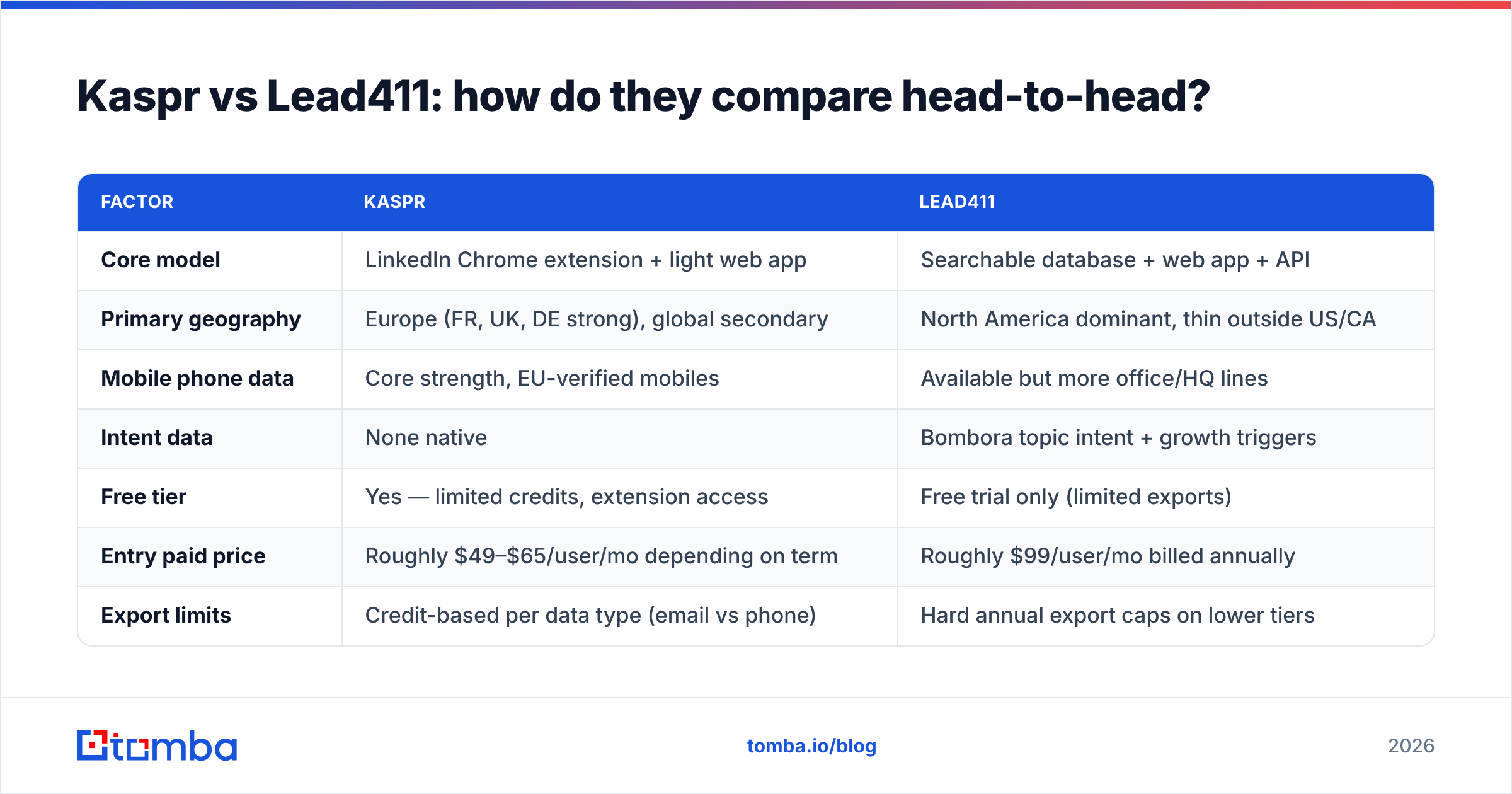
Here is the side-by-side that matters when you are actually deciding.
| Factor | Kaspr | Lead411 |
|---|---|---|
| Core model | LinkedIn Chrome extension + light web app | Searchable database + web app + API |
| Primary geography | Europe (FR, UK, DE strong), global secondary | North America dominant, thin outside US/CA |
| Mobile phone data | Core strength, EU-verified mobiles | Available but more office/HQ lines |
| Intent data | None native | Bombora topic intent + growth triggers |
| Free tier | Yes — limited credits, extension access | Free trial only (limited exports) |
| Entry paid price | Roughly $49–$65/user/mo depending on term | Roughly $99/user/mo billed annually |
| Export limits | Credit-based per data type (email vs phone) | Hard annual export caps on lower tiers |
| Bulk list building | Weak — profile-by-profile workflow | Strong — filter, select, export |
| CRM integrations | HubSpot, Pipedrive, Salesforce, Lemlist, Zapier | Salesforce, HubSpot, Outreach, Salesloft, Zoho |
| API access | Limited, higher tiers | Yes, on request/higher tiers |
| Best for | SDRs living in Sales Navigator, EMEA outbound | US territory planning, ABM, intent-led outbound |
Two lines in that table decide most evaluations. First, geography — if more than a third of your ICP sits outside North America, Lead411's match rate will disappoint you no matter how good the intent layer looks in the demo. Second, workflow — Kaspr has no meaningful bulk path. Reviewers on Capterra consistently flag the same thing: great for one-at-a-time, painful at scale.
Which one has better data accuracy?#
Neither vendor publishes an independently audited accuracy figure, and you should be skeptical of any that appears in a sales deck. What we can say from how each system sources data:
- Kaspr aggregates from user contributions (the extension shares data both ways), partner sources, and Cognism's verified phone pool. Mobile accuracy in France, the UK, and the Benelux is genuinely good. Email accuracy is mid — plenty of pattern-guessed addresses that never got SMTP-checked.
- Lead411 relies on crawled and licensed firmographic data plus a human research layer. Company-level data holds up well. Contact-level email accuracy degrades on smaller companies and on anyone who changed jobs in the last quarter.
The practical consequence is identical in both cases: you cannot send to a raw export. A 10–20% invalid rate on a cold list will damage your sender reputation inside two weeks, and no amount of warmup undoes a sustained hard-bounce pattern.
Run every export through a verification pass before it touches a sequencer. Catch-alls deserve special handling — a catch-all verifier distinguishes "domain accepts everything" from "this mailbox actually exists," which a standard syntax-plus-MX check cannot do.
What do Kaspr and Lead411 actually cost?#
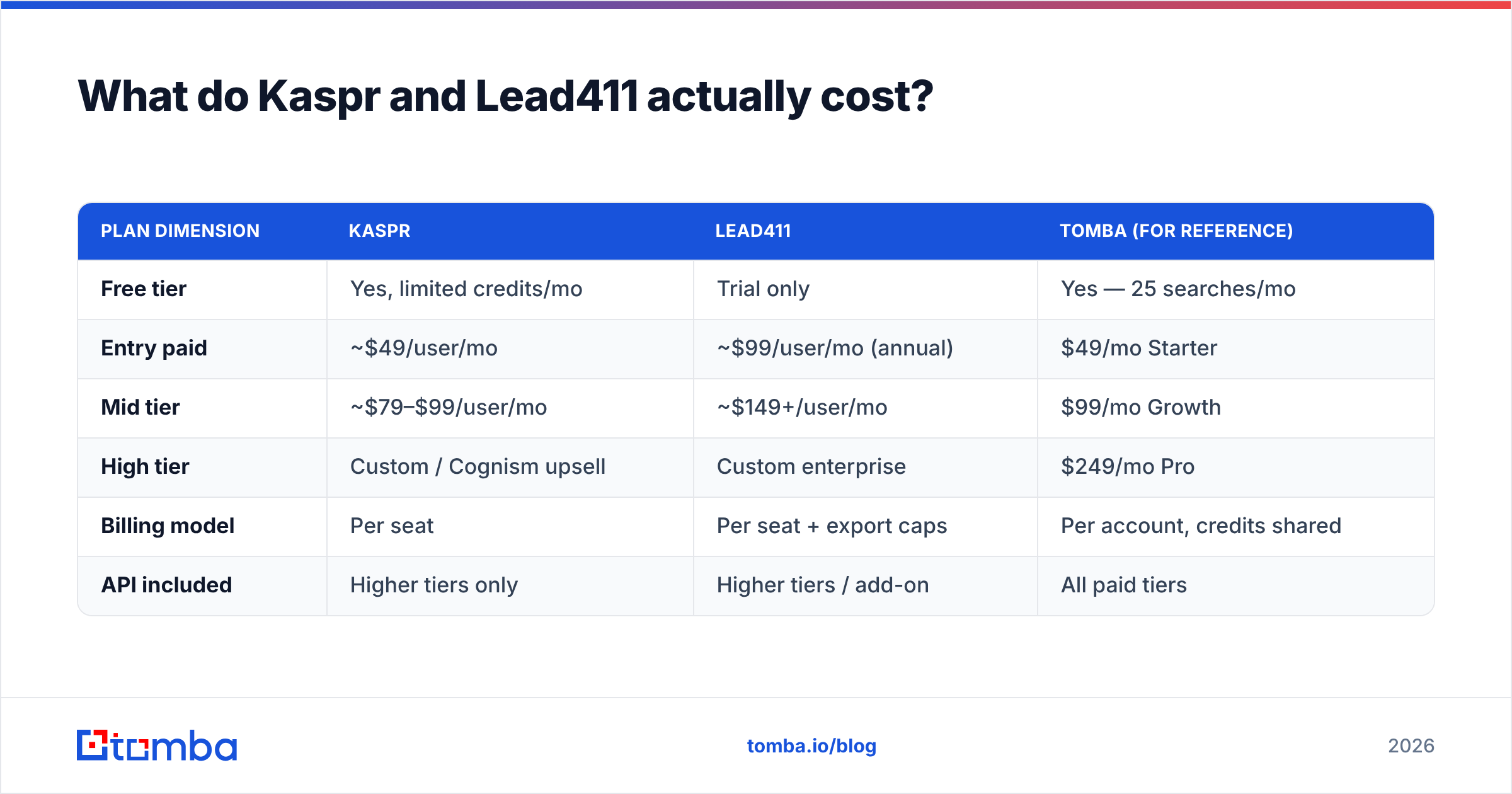
Pricing on both sides is quote-adjacent, so treat published numbers as starting points and expect annual-commitment pressure.
| Plan dimension | Kaspr | Lead411 | Tomba (for reference) |
|---|---|---|---|
| Free tier | Yes, limited credits/mo | Trial only | Yes — 25 searches/mo |
| Entry paid | ~$49/user/mo | ~$99/user/mo (annual) | $49/mo Starter |
| Mid tier | ~$79–$99/user/mo | ~$149+/user/mo | $99/mo Growth |
| High tier | Custom / Cognism upsell | Custom enterprise | $249/mo Pro |
| Billing model | Per seat | Per seat + export caps | Per account, credits shared |
| API included | Higher tiers only | Higher tiers / add-on | All paid tiers |
Three cost traps to check before signing:
- Per-seat math. Both tools price per user. A five-person SDR team on Lead411's entry tier is a five-figure annual line item before you have sent a single email. Account-level credit pools (how Tomba pricing works) behave very differently at team scale.
- Split credit types. Kaspr charges separately for phone credits, email credits, and export credits. Your "1,200 credits" is not 1,200 complete contacts.
- Annual export ceilings. Lead411's lower tiers cap total yearly exports. Hit it in month seven and you are negotiating an upgrade from a weak position.

When should you pick Kaspr over Lead411?#
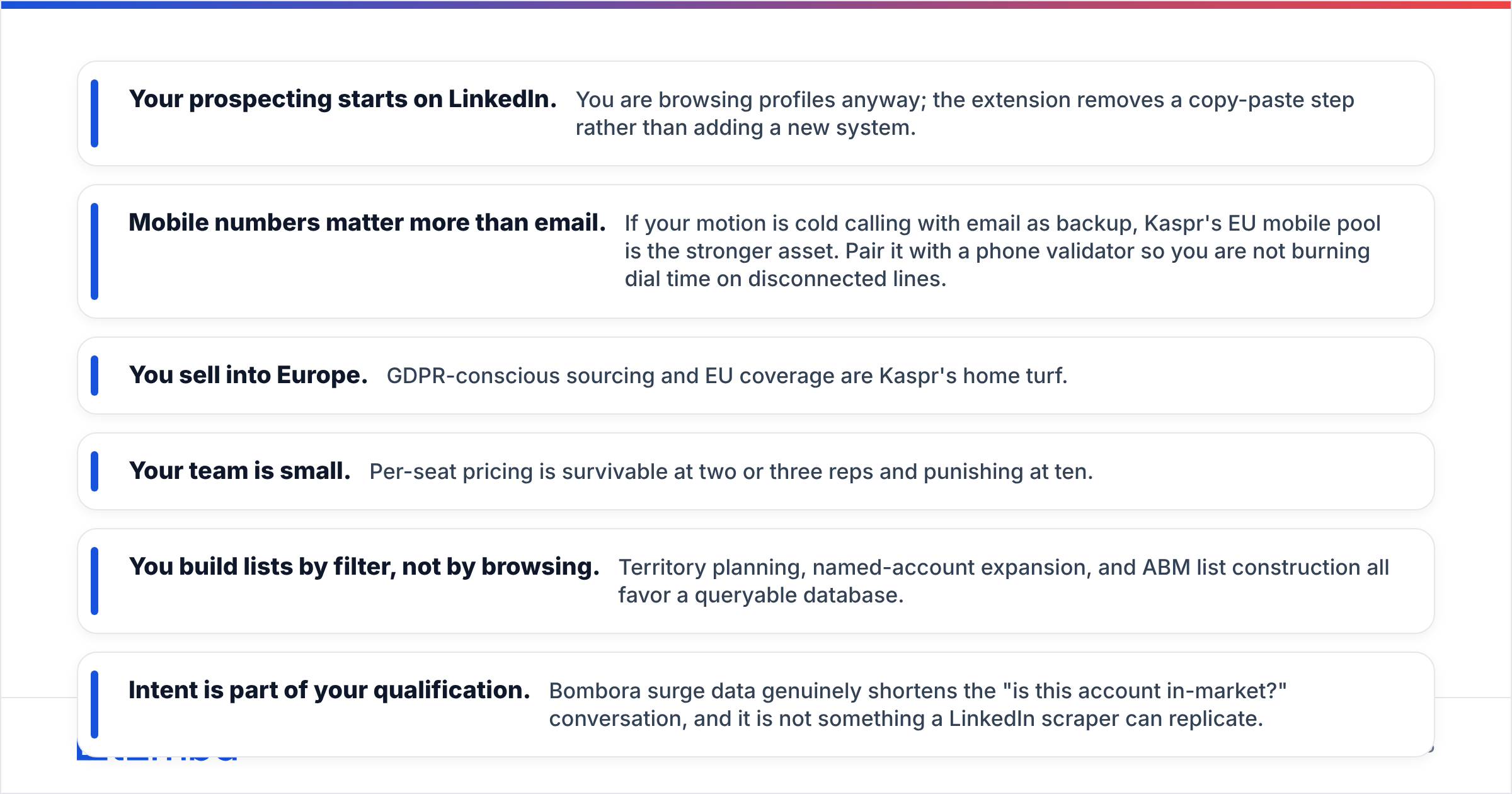
Choose Kaspr when all of these are true:
- Your prospecting starts on LinkedIn. You are browsing profiles anyway; the extension removes a copy-paste step rather than adding a new system.
- Mobile numbers matter more than email. If your motion is cold calling with email as backup, Kaspr's EU mobile pool is the stronger asset. Pair it with a phone validator so you are not burning dial time on disconnected lines.
- You sell into Europe. GDPR-conscious sourcing and EU coverage are Kaspr's home turf.
- Your team is small. Per-seat pricing is survivable at two or three reps and punishing at ten.
Choose Lead411 when:
- You build lists by filter, not by browsing. Territory planning, named-account expansion, and ABM list construction all favor a queryable database.
- Intent is part of your qualification. Bombora surge data genuinely shortens the "is this account in-market?" conversation, and it is not something a LinkedIn scraper can replicate.
- Your ICP is US-based. This is where Lead411's coverage is legitimately competitive with much more expensive platforms.
- You need trigger alerts. Funding and hiring signals routed into Slack or your CRM create timely outreach reasons that generic lists do not.
If you are evaluating Lead411 mainly because Apollo or ZoomInfo quoted you too high, also look at the broader Apollo alternative landscape before committing — the "database plus intent" category has a lot of overlapping options at very different price points.
How do you build a stack that beats either one alone?#
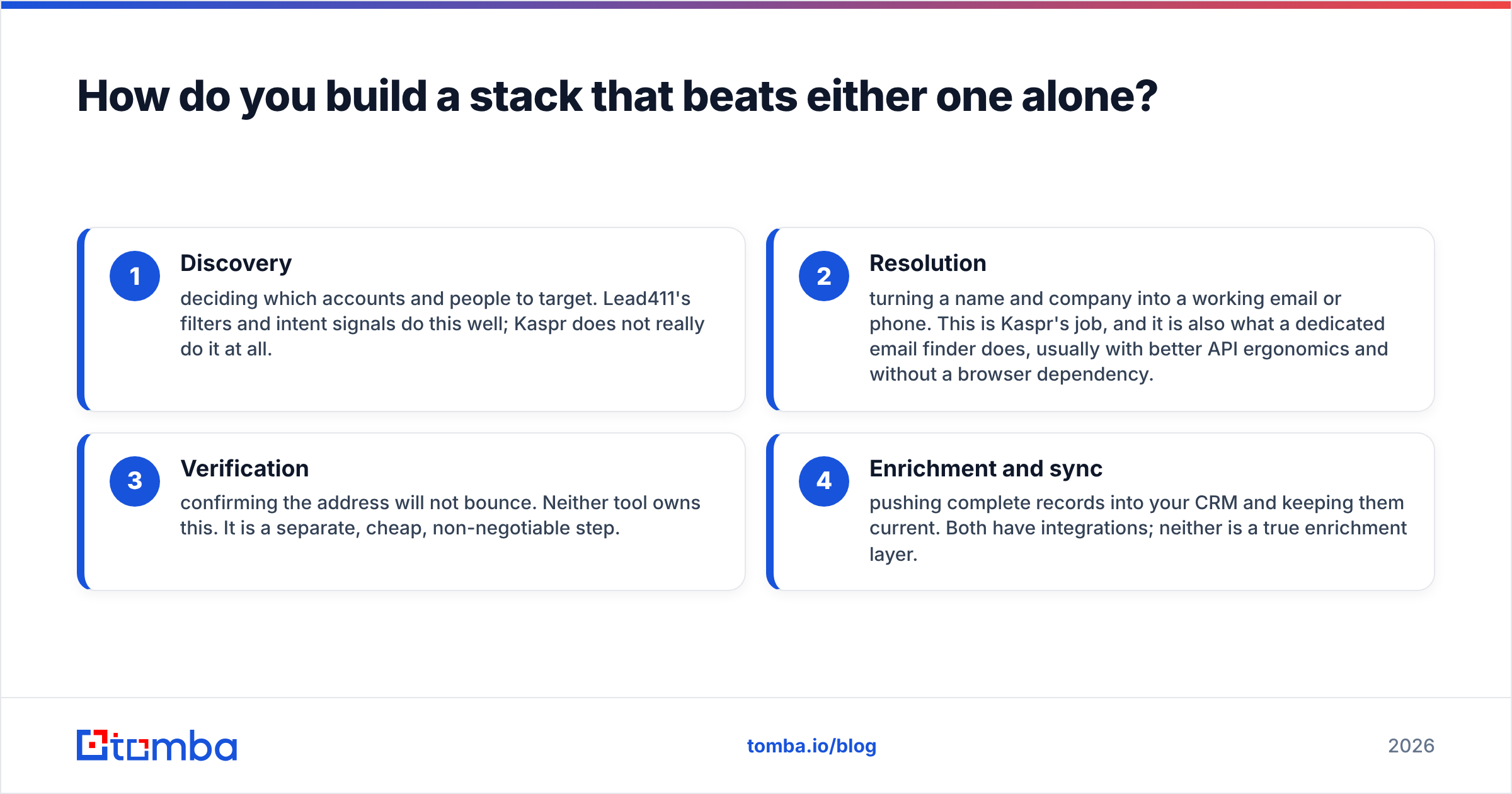
The honest answer for most teams in 2026 is that neither tool is the whole stack. Contact data has unbundled into four jobs, and the tools that try to do all four do at least two of them badly.
- Discovery — deciding which accounts and people to target. Lead411's filters and intent signals do this well; Kaspr does not really do it at all.
- Resolution — turning a name and company into a working email or phone. This is Kaspr's job, and it is also what a dedicated email finder does, usually with better API ergonomics and without a browser dependency.
- Verification — confirming the address will not bounce. Neither tool owns this. It is a separate, cheap, non-negotiable step.
- Enrichment and sync — pushing complete records into your CRM and keeping them current. Both have integrations; neither is a true enrichment layer.
A pragmatic split looks like this: use one discovery source (Lead411, Sales Navigator, or your own ICP research), resolve contacts through an API you can script against, verify everything before send, and push the survivors into the CRM automatically. That stack costs less than most all-in-one seats and each piece is replaceable.
For the resolution layer specifically, an API-first approach changes what is possible. Instead of a rep clicking through profiles, you can run a bulk email finder against a CSV of 5,000 company-and-name pairs overnight, verify the output, and hand your team a clean list by morning. That workflow does not exist in Kaspr, and Lead411's export caps make it expensive.
It is also worth knowing the rest of the field. BookYourData takes a different and well-regarded approach — pay-as-you-go, prepaid B2B lists with a bounce guarantee — which suits teams that want a one-time list purchase rather than a subscription. If your buying pattern is "I need 3,000 verified contacts this quarter, not a seat license," that model is worth pricing out alongside both tools here.
What does the verdict look like?#
For LinkedIn-native EMEA outbound: Kaspr. It is the faster path from profile to phone number, and the free tier lets you test match rates on your actual ICP before paying anything.
For US territory building with intent: Lead411. The Bombora layer and growth triggers are real differentiators that a scraper cannot match, and the database is genuinely usable for filter-driven list construction.
For everything else — and for teams who want data in a pipeline, not a browser — neither. If your bottleneck is "I have a list of companies and names, I need verified emails at volume, and I need it through an API," a purpose-built finder-plus-verifier stack beats both on cost per usable contact.
Whichever way you go, three rules hold:
- Test on your own ICP, not their demo list. Every vendor demos on accounts where they have great coverage.
- Measure cost per verified contact, not cost per credit. A cheap credit that returns a bouncing address costs you more than an expensive one that lands.
- Keep verification outside the data vendor. Asking a vendor to grade its own data quality is a conflict of interest, not a feature.
Start by checking match rate on 100 real target accounts. If a tool can't resolve 70%+ of them, no pricing tier fixes that.
Ready to test resolution quality on your own list? Run a sample of your target accounts through the Tomba Email Finder — the free tier gives you 25 searches a month with no card, paid plans start at $49/mo with account-level credits instead of per-seat pricing, and every tier includes API access so you can wire lookups directly into your enrichment pipeline instead of clicking through a browser extension.
Related guides#
// get started
Find, verify and enrich your first contacts today
Start on the free plan with 25 searches a month, then scale when your team is ready.
Free plan · No credit card required · GDPR & CCPA
Get the Tomba newsletter
Product and data updates
// about the author