Kaspr vs LimeLeads (2026): Which Lead Data Tool Wins?
Kaspr pulls phone numbers and emails off LinkedIn profiles. LimeLeads sells searchable B2B lists you export as CSV. They solve different problems, and picking the wrong one burns a quarter of outbound budget. Here is the honest breakdown.
TL;DR
- Kaspr is a LinkedIn-first extension. You browse a profile or a Sales Navigator list, click, and it reveals mobile numbers and emails. Nothing happens without LinkedIn in front of you.
- LimeLeads is a static list database. You filter by industry, title, geography and headcount, then export a CSV. No browser extension, no live enrichment loop.
- They are not really competitors. Kaspr wins for SDRs who call; LimeLeads wins for marketers who need volume lists fast and cheap.
- Both leave a verification gap. Neither is a substitute for a dedicated email verifier before you load a sequence, and both price per seat or per credit in ways that punish teams that scale.
- Our pick for email-led outbound: an API-first finder plus verifier (Tomba starts at $49/mo after a free tier) usually beats both on cost-per-valid-contact, with Kaspr kept as a phone-only add-on.
What exactly are Kaspr and LimeLeads?#
They are two different species of B2B data tool that happen to end up in the same shortlist.
Kaspr is a Chrome extension owned by Cognism. It sits on top of LinkedIn, LinkedIn Sales Navigator and LinkedIn Recruiter. When you open a profile, Kaspr surfaces mobile phone numbers, direct emails and company details in a side panel, and pushes them to your CRM or sequencer. Its reputation is built on European mobile coverage — it is one of the few tools where a French, German or UK mobile number is a realistic expectation rather than a lottery ticket.
LimeLeads is a self-serve B2B contact database. You log into a web app, apply filters, preview the list, spend credits to unlock rows, and download a CSV. There is no LinkedIn layer and no live lookup. The value proposition is speed and price: you can go from "I need 2,000 US logistics managers" to a downloadable file in about ten minutes.
Here is the practical difference in how each one enters your workflow:
- Trigger point. Kaspr activates when you find a person. LimeLeads activates when you define a segment. One is bottom-up, one is top-down.
- Data freshness model. Kaspr resolves contact data at the moment of the click, drawing on a community-contributed and partner-sourced pool. LimeLeads serves rows that were compiled earlier and sit in an index until refreshed.
- Primary data type. Kaspr's differentiator is the mobile number. LimeLeads' differentiator is the breadth of firmographic filters on business emails.
- Output destination. Kaspr pushes to HubSpot, Salesforce, Pipedrive, lemlist and Zapier. LimeLeads mostly hands you a file you import somewhere else.
- Seat economics. Kaspr is licensed per user, so a five-rep team pays five times. LimeLeads is credit-based, so one account can serve a whole team.
- Compliance posture. Both publish GDPR/CCPA positions; Kaspr leans harder on it because European mobile data invites the question.
If you internalise only one line from this post: Kaspr is a discovery tool, LimeLeads is a supply tool. Comparing them on a single score is how teams end up buying the wrong one.

How do Kaspr and LimeLeads compare head-to-head?#
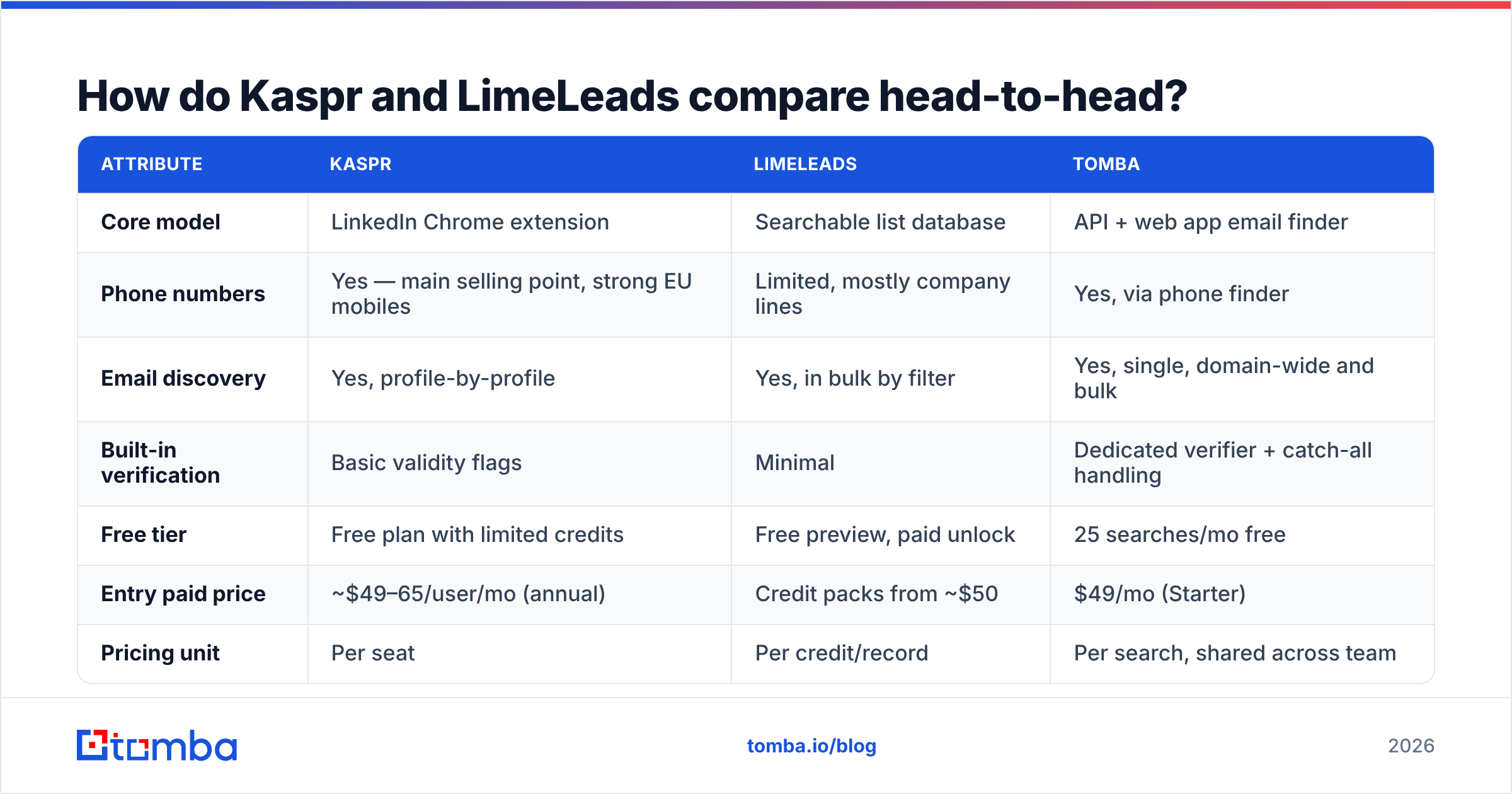
The table below is the version you can paste into a procurement doc. Prices are list prices at the time of writing and move often — confirm on each vendor's page before you sign.
| Attribute | Kaspr | LimeLeads | Tomba |
|---|---|---|---|
| Core model | LinkedIn Chrome extension | Searchable list database | API + web app email finder |
| Phone numbers | Yes — main selling point, strong EU mobiles | Limited, mostly company lines | Yes, via phone finder |
| Email discovery | Yes, profile-by-profile | Yes, in bulk by filter | Yes, single, domain-wide and bulk |
| Built-in verification | Basic validity flags | Minimal | Dedicated verifier + catch-all handling |
| Free tier | Free plan with limited credits | Free preview, paid unlock | 25 searches/mo free |
| Entry paid price | ~$49–65/user/mo (annual) | Credit packs from ~$50 | $49/mo (Starter) |
| Pricing unit | Per seat | Per credit/record | Per search, shared across team |
| Works without LinkedIn | No | Yes | Yes |
| API access | Limited | Limited | Full REST API, CLI, MCP |
| Best for | SDRs who cold call | Volume list building | Email-led outbound at scale |

Two things jump out. First, the pricing unit differs more than the pricing number — a $49 seat and a $50 credit pack look similar until you multiply by six reps. Second, neither tool treats verification as a first-class product, which is the single biggest driver of bounce rate on the sequences you will build from this data.
Which one has better data accuracy?#
Neither wins outright; they fail in different places.
Kaspr's accuracy is highest on people who are active on LinkedIn in Western Europe. Because resolution happens live against a profile you can see, you get a natural sanity check: the name, title and company in front of you either match the returned record or they do not. The weakness is coverage gaps — plenty of profiles return an email but no mobile, or a personal Gmail address you should not use for B2B outreach. Kaspr also inherits LinkedIn's scraping limits, so high-volume days can hit throttling.
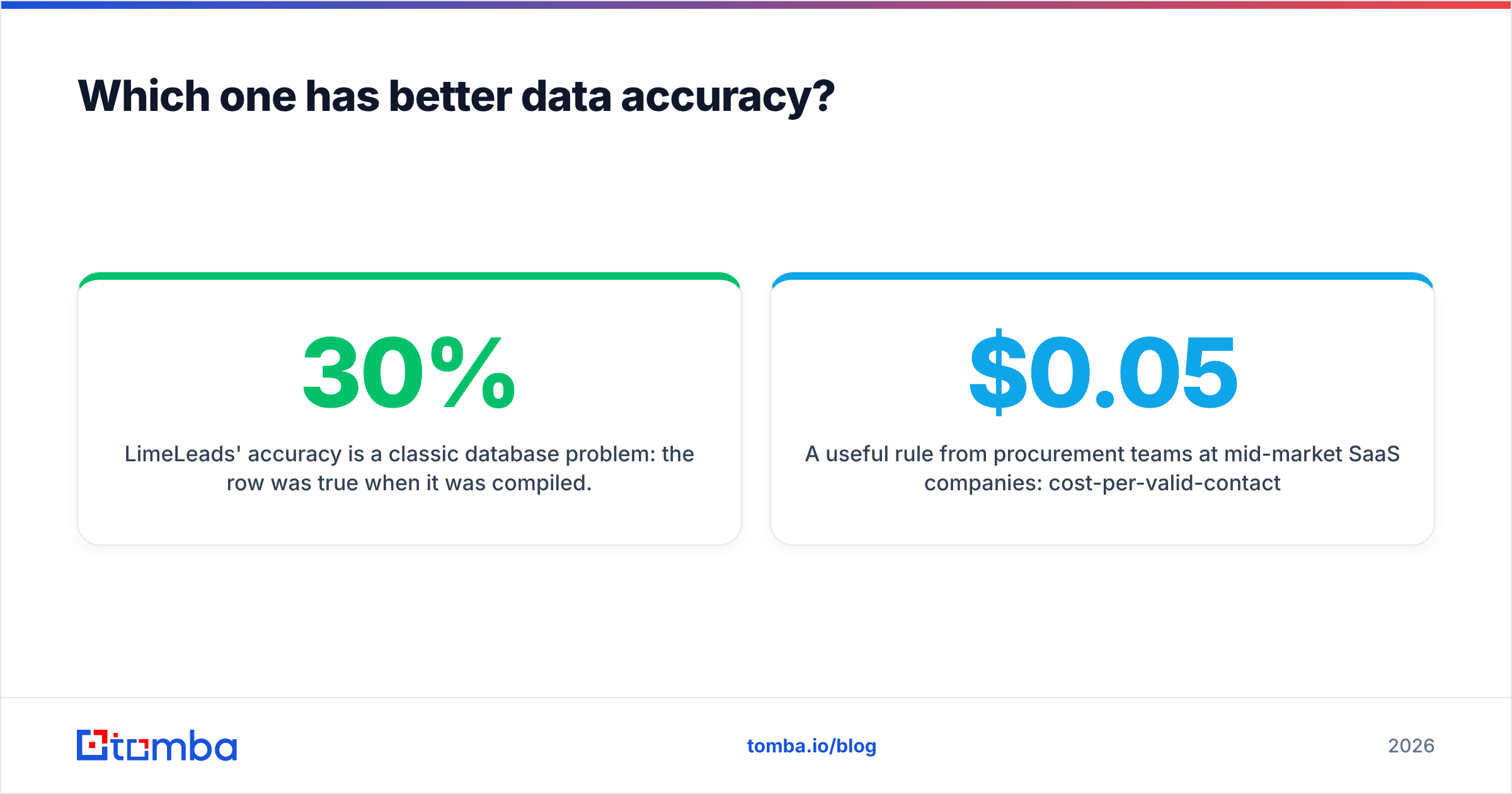
LimeLeads' accuracy is a classic database problem: the row was true when it was compiled. In a market where roughly a quarter to a third of B2B contacts change jobs annually, a list that has not been refreshed in twelve months is structurally 20–30% wrong before you send anything. Vendor-reported accuracy figures in this category (85–95%) are almost always measured against syntax and domain checks, not against "this person still works there."

Two due-diligence steps are non-negotiable regardless of which vendor you pick:
- Run a paid pilot on your own ICP, not their demo segment. Pull 200 records from each tool for the same filter set, then push both through the same email verifier and compare valid rates. A 10-point difference in valid rate is worth more than any feature on the spec sheet.
- Ask when the record was last verified, not when it was created. If the vendor cannot answer per-record, assume the worst case. LimeLeads also had a publicly reported data exposure incident in 2020, so if you operate under strict security review, ask for their current SOC/ISO documentation in writing.
A useful rule from procurement teams at mid-market SaaS companies: cost-per-valid-contact is the only metric that matters. A $0.05 record at 60% deliverability is more expensive than a $0.10 record at 95%.
How does pricing really compare?#
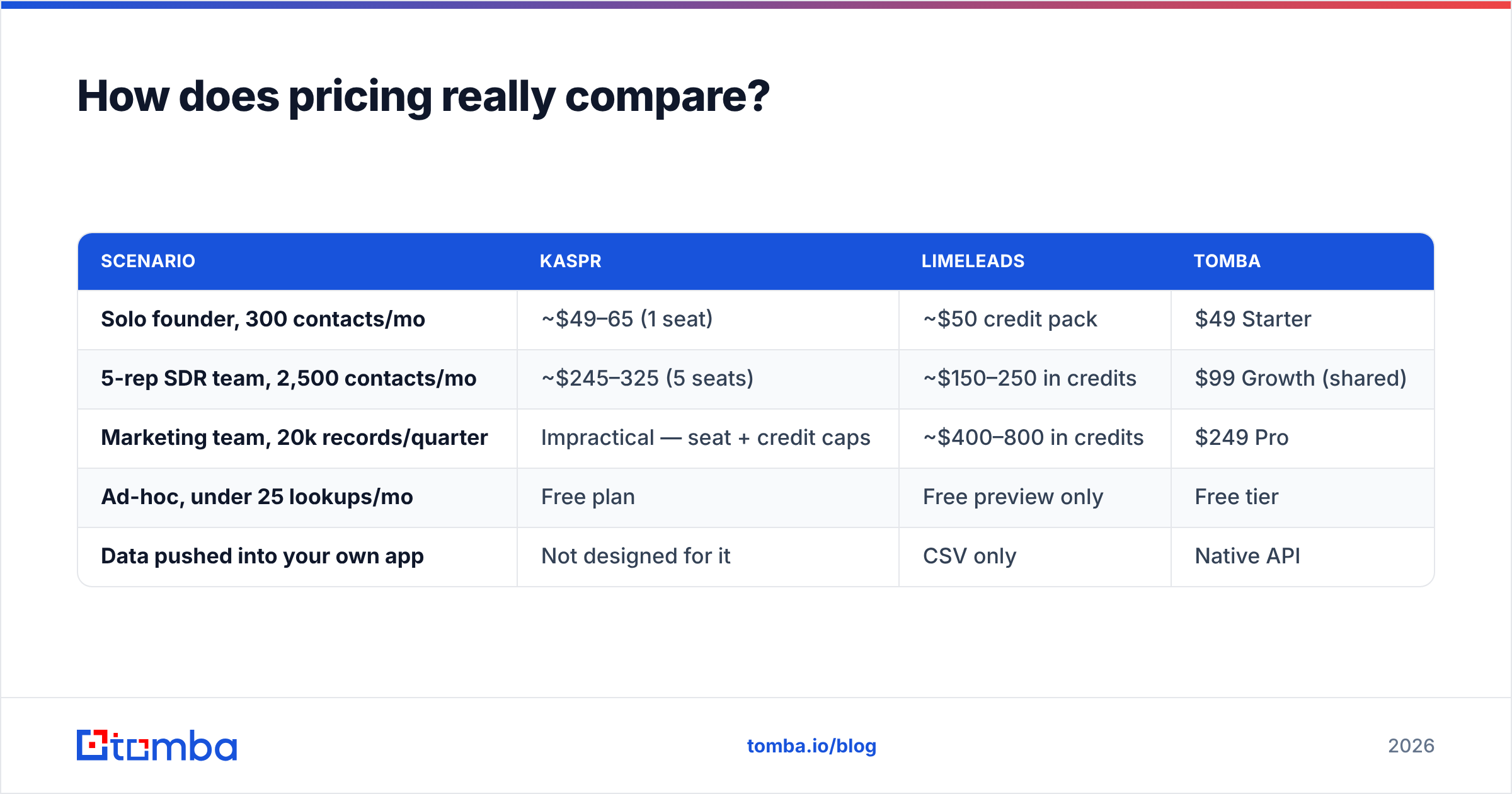
| Scenario | Kaspr | LimeLeads | Tomba |
|---|---|---|---|
| Solo founder, 300 contacts/mo | ~$49–65 (1 seat) | ~$50 credit pack | $49 Starter |
| 5-rep SDR team, 2,500 contacts/mo | ~$245–325 (5 seats) | ~$150–250 in credits | $99 Growth (shared) |
| Marketing team, 20k records/quarter | Impractical — seat + credit caps | ~$400–800 in credits | $249 Pro |
| Ad-hoc, under 25 lookups/mo | Free plan | Free preview only | Free tier |
| Data pushed into your own app | Not designed for it | CSV only | Native API |
The seat model is where Kaspr gets expensive. It is fair — each rep gets their own extension and their own credits — but it means your data cost scales linearly with headcount even when your contact volume does not. LimeLeads avoids that trap, but credit packs expire and unused volume is money burned.
If you want a like-for-like reference point, the published Tomba pricing tiers (Free 25 searches, Starter $49, Growth $99, Pro $249, Enterprise custom) are account-level rather than seat-level, which is why the five-rep scenario diverges so sharply in the table above.

Who should choose Kaspr?#
Pick Kaspr if three or more of these are true:
- Your motion is phone-first. You run calls, not just sequences, and a mobile number is worth more to you than ten emails.
- You sell into Europe. EU mobile coverage is Kaspr's genuine moat and very few competitors match it.
- Your reps live inside Sales Navigator. The extension fits the existing habit instead of fighting it.
- You have a small, stable team. Three seats is fine. Fifteen seats is a budget conversation.
- You already use Cognism or plan to. The shared ownership makes the upgrade path cleaner.
Do not pick Kaspr if you need bulk lists, if your reps do not use LinkedIn daily, or if you need contact data inside a product or automation rather than inside a browser.
Who should choose LimeLeads?#
Pick LimeLeads if:
- You need volume more than precision. Webinar invites, event promotion, broad awareness campaigns where a 10% miss rate is survivable.
- Budget is the hard constraint. For pure cost-per-row, list databases at this tier undercut most enrichment platforms.
- You want no seat math. One login, shared credits, no per-rep licensing.
- Your ICP is US SMB. That is where this class of database is densest.
Do not pick LimeLeads if you need mobile numbers, if you need real-time lookups, or if your compliance team requires per-record provenance and recency timestamps.
It is worth saying plainly: both tools are legitimate products with real users. The failure mode is not "bad vendor," it is buying a list tool when you needed a discovery tool.
What are the alternatives worth shortlisting?#
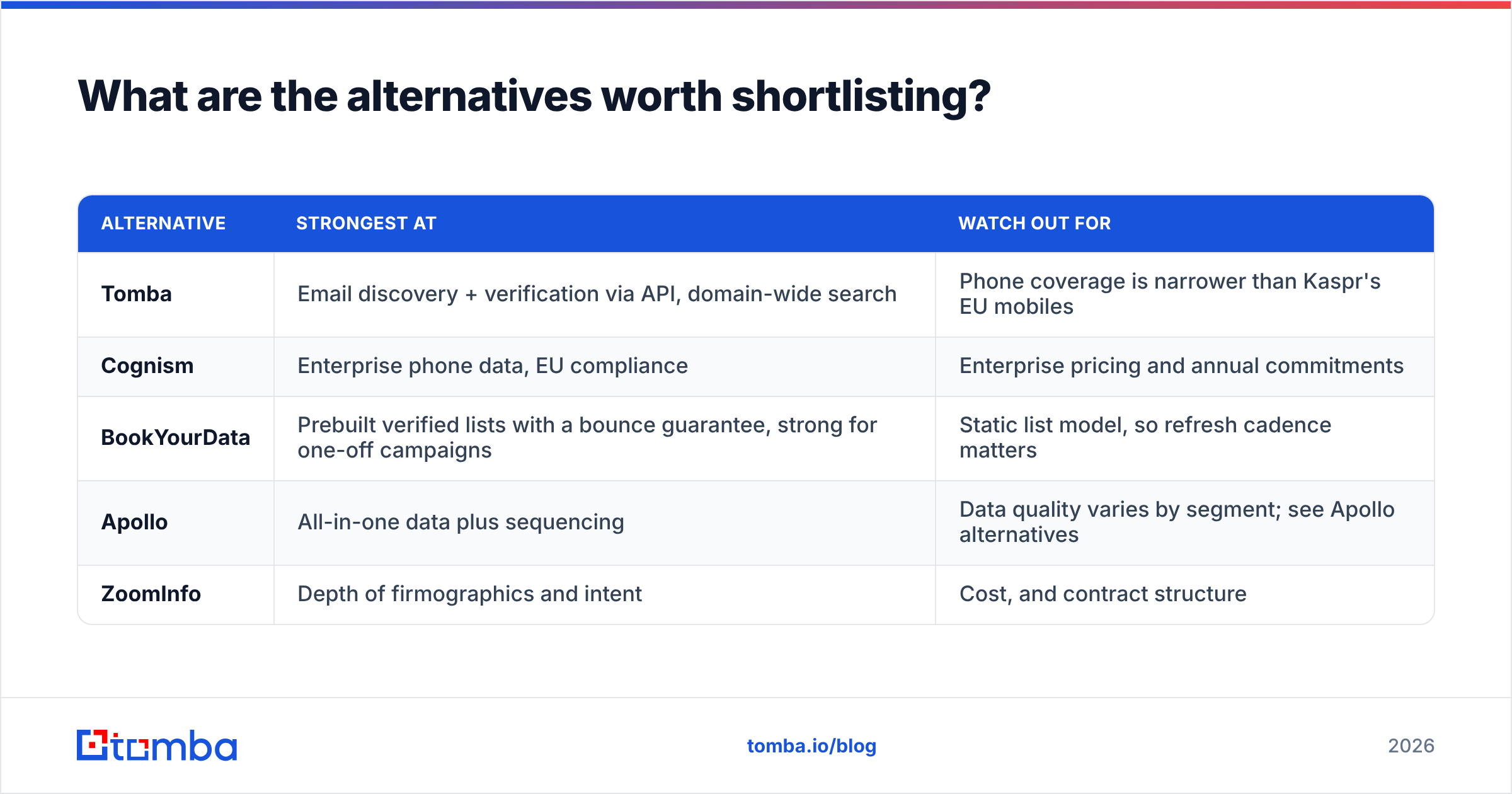
Most teams evaluating Kaspr vs LimeLeads are actually asking a broader question: what is the cheapest reliable way to get verified B2B contacts into my sequencer? That opens the field.
| Alternative | Strongest at | Watch out for |
|---|---|---|
| Tomba | Email discovery + verification via API, domain-wide search | Phone coverage is narrower than Kaspr's EU mobiles |
| Cognism | Enterprise phone data, EU compliance | Enterprise pricing and annual commitments |
| BookYourData | Prebuilt verified lists with a bounce guarantee, strong for one-off campaigns | Static list model, so refresh cadence matters |
| Apollo | All-in-one data plus sequencing | Data quality varies by segment; see Apollo alternatives |
| ZoomInfo | Depth of firmographics and intent | Cost, and contract structure |
Cross-check any shortlist against independent review volume on G2 before you commit — vendor case studies are marketing, review distributions are data.
How should you actually build the stack?#
The teams that get this right stop treating it as a single-vendor decision and split the job into three layers.
- Discovery layer — how you identify the person. LinkedIn plus an extension, an ICP filter in a database, or a domain-level sweep. A domain search that returns every public email pattern at a company is often faster than clicking through profiles one at a time.
- Resolution layer — how you turn a name and a company into a usable address or number. This is where an email finder with a documented API earns its keep, because you can run it inside your CRM, your spreadsheet, or a nightly job instead of by hand.
- Validation layer — how you avoid sending to dead mailboxes. Verification is not optional. A 5% bounce rate is enough to damage sender reputation and drag your whole domain down, and catch-all domains need their own handling rather than a blanket "accept" or "reject."
Layered this way, "Kaspr vs LimeLeads" becomes a much smaller question. Kaspr can own phones. A database can own broad lists. An API-first finder and verifier owns the part that determines whether your emails land — and that part should never be outsourced to whichever vendor happened to win the discovery-layer bake-off.
One last operational note: whatever you buy, dedupe on import. Teams routinely pay twice for the same contact because Kaspr exported it in March and a list vendor sold it again in June. A bulk email finder workflow with deduplication built in pays for itself on the first quarter's list.
The verdict#
If you call, buy Kaspr. If you blast, buy LimeLeads. If you sequence, buy neither as your primary.
Kaspr is a well-built extension with genuinely differentiated European mobile data, and it is the right answer for a phone-heavy SDR team of modest size. LimeLeads is a cheap, fast way to get a large list into a spreadsheet, and it is the right answer for marketers who need coverage more than precision. Neither is designed to be the backbone of an email-led outbound program, because neither treats verification and API access as core product.
If your revenue comes from email, start with the layer that decides whether email works at all. Run your target domains through the Tomba Email Finder — 25 free searches, $49/mo when you outgrow them, and a verifier attached so the addresses you find are the addresses that actually deliver. Keep Kaspr on one seat for the calls. That combination costs less than either vendor's team plan and fails in fewer places.
Related guides#
Ready to find emails that actually work?
Join 150,000+ professionals who stopped guessing and started sending. Free credits on signup — no credit card required.
Get the Tomba newsletter
Practical outbound tactics and product updates — once every two weeks.
About the author