Kaspr vs ReachStream (2026): Which B2B Data Tool Wins?
Kaspr pulls contact data live off LinkedIn profiles. ReachStream sells you pre-built B2B lists. They solve different problems — here is the honest breakdown of pricing, data quality, and which one your team should actually buy in 2026.
TL;DR
- Kaspr is a LinkedIn-first extension. You work a profile or a Sales Navigator list, click, and it reveals mobile numbers and emails one contact at a time. Data is pulled at request time, not from a static file.
- ReachStream is a list-first database. You filter by industry, title, geography, and company size, then download or sync the resulting contact set. No browser extension workflow required.
- Pricing models are not comparable head to head. Kaspr charges per user per month with credit buckets; ReachStream charges for volume of contacts. Cost per usable record is the only fair metric.
- Kaspr wins on phone numbers and freshness. ReachStream wins on bulk volume and price per record for broad campaigns.
- Neither is a great API-first option. If you need programmatic enrichment inside a product or a data pipeline, look at a dedicated email finder with a documented API instead.
If you are comparing Kaspr vs ReachStream, you are almost certainly asking the wrong first question. The real question is whether your outbound motion is account-by-account (research a person, find their mobile, call them) or volume-first (pull 20,000 matching contacts, run a sequence, see what sticks). Kaspr is built for the first. ReachStream is built for the second. Picking the wrong shape costs more than picking the wrong vendor.
What is Kaspr and who is it for?#
Kaspr is a contact-data tool that lives primarily as a Chrome extension on top of LinkedIn. Open a profile, LinkedIn Sales Navigator search, a group, or an event attendee list, and Kaspr surfaces a side panel with the person's business email and — its main selling point — direct dial and mobile numbers.
Kaspr was acquired by Cognism in 2022 and now sits as the lighter, self-serve, SMB-facing product in that portfolio. That matters for two reasons. First, it inherits data infrastructure and compliance processes from a larger parent (GDPR handling, do-not-call list screening in some regions). Second, it is positioned deliberately below Cognism on price and features, so certain enterprise capabilities are kept out of it on purpose.
Kaspr's shape in practice:
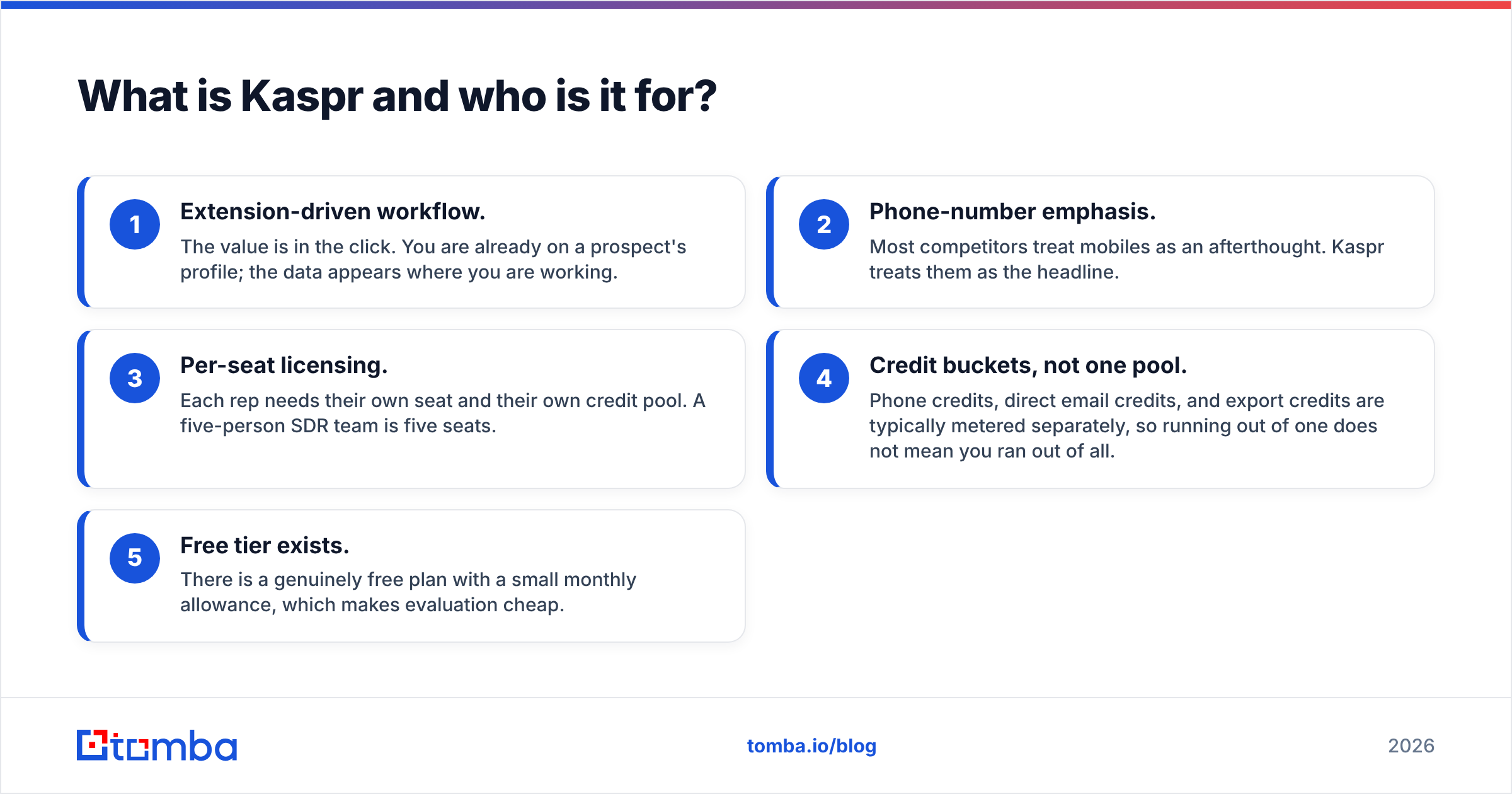
- Extension-driven workflow. The value is in the click. You are already on a prospect's profile; the data appears where you are working.
- Phone-number emphasis. Most competitors treat mobiles as an afterthought. Kaspr treats them as the headline.
- Per-seat licensing. Each rep needs their own seat and their own credit pool. A five-person SDR team is five seats.
- Credit buckets, not one pool. Phone credits, direct email credits, and export credits are typically metered separately, so running out of one does not mean you ran out of all.
- Free tier exists. There is a genuinely free plan with a small monthly allowance, which makes evaluation cheap.
That last point is worth taking seriously during a trial. You can validate Kaspr's coverage on your actual ICP before spending anything.
What is ReachStream and who is it for?#
ReachStream is a B2B contact and company database. You do not "look people up" one at a time as your primary motion; you build a segment. Filter by job function, seniority, industry (usually SIC/NAICS-style categories), employee count, revenue band, and location, then export the matching records as a file or push them into your CRM or sequencer.
The company markets a database in the range of 100M+ contact records and tens of millions of company profiles, spanning healthcare, technology, manufacturing, and other verticals. It also sells custom list-building as a service — you describe the audience, their team assembles it.
ReachStream's shape in practice:
- Volume economics. Pricing is oriented around how many contacts you take, not how many seats you have. One ops person can pull lists for the whole team.
- Static snapshots. A downloaded list is accurate as of the moment it was generated. It decays from that second onward.
- Vertical depth. Healthcare and specialized industry segments are a recurring strength in user reviews on G2.
- Less real-time workflow. There is no meaningful "I'm on this LinkedIn profile right now, give me the mobile" motion.
If your team runs 10,000-contact sequences per quarter and measures success at the campaign level, that shape fits. If your AEs each work 40 named accounts and need a phone number for one specific VP today, it does not.
How do Kaspr and ReachStream compare feature by feature?#
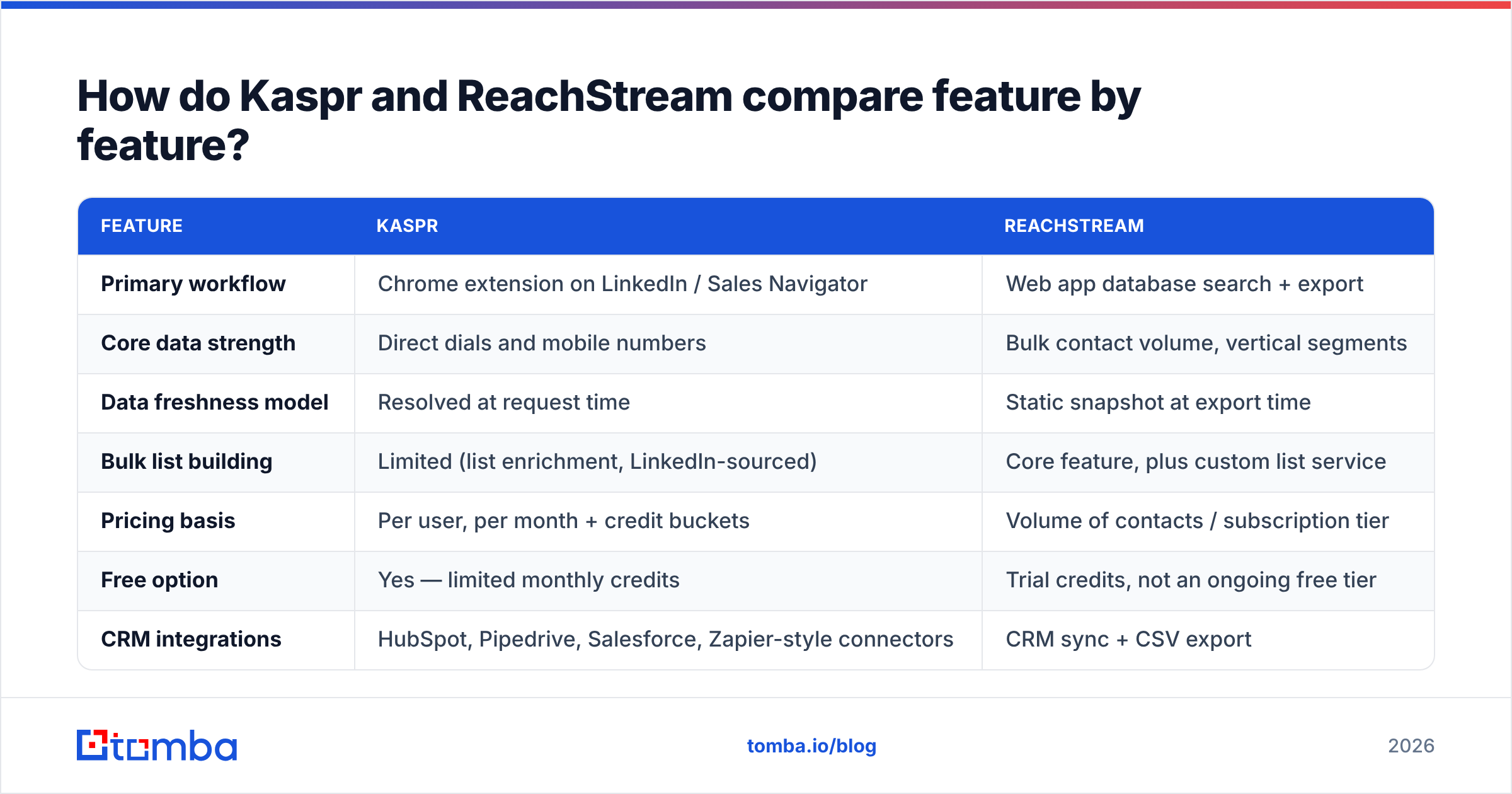
| Feature | Kaspr | ReachStream |
|---|---|---|
| Primary workflow | Chrome extension on LinkedIn / Sales Navigator | Web app database search + export |
| Core data strength | Direct dials and mobile numbers | Bulk contact volume, vertical segments |
| Data freshness model | Resolved at request time | Static snapshot at export time |
| Bulk list building | Limited (list enrichment, LinkedIn-sourced) | Core feature, plus custom list service |
| Pricing basis | Per user, per month + credit buckets | Volume of contacts / subscription tier |
| Free option | Yes — limited monthly credits | Trial credits, not an ongoing free tier |
| CRM integrations | HubSpot, Pipedrive, Salesforce, Zapier-style connectors | CRM sync + CSV export |
| Email verification | Basic validation on reveal | Claimed verification pass before delivery |
| Public API | Limited / not the main product surface | Available on higher tiers |
| Best fit | SDRs doing account-based prospecting | Ops teams building campaign lists |

The table makes the split obvious. These two products barely overlap except in the one column that matters to a buyer with a budget: they both end with a contact record in your CRM.
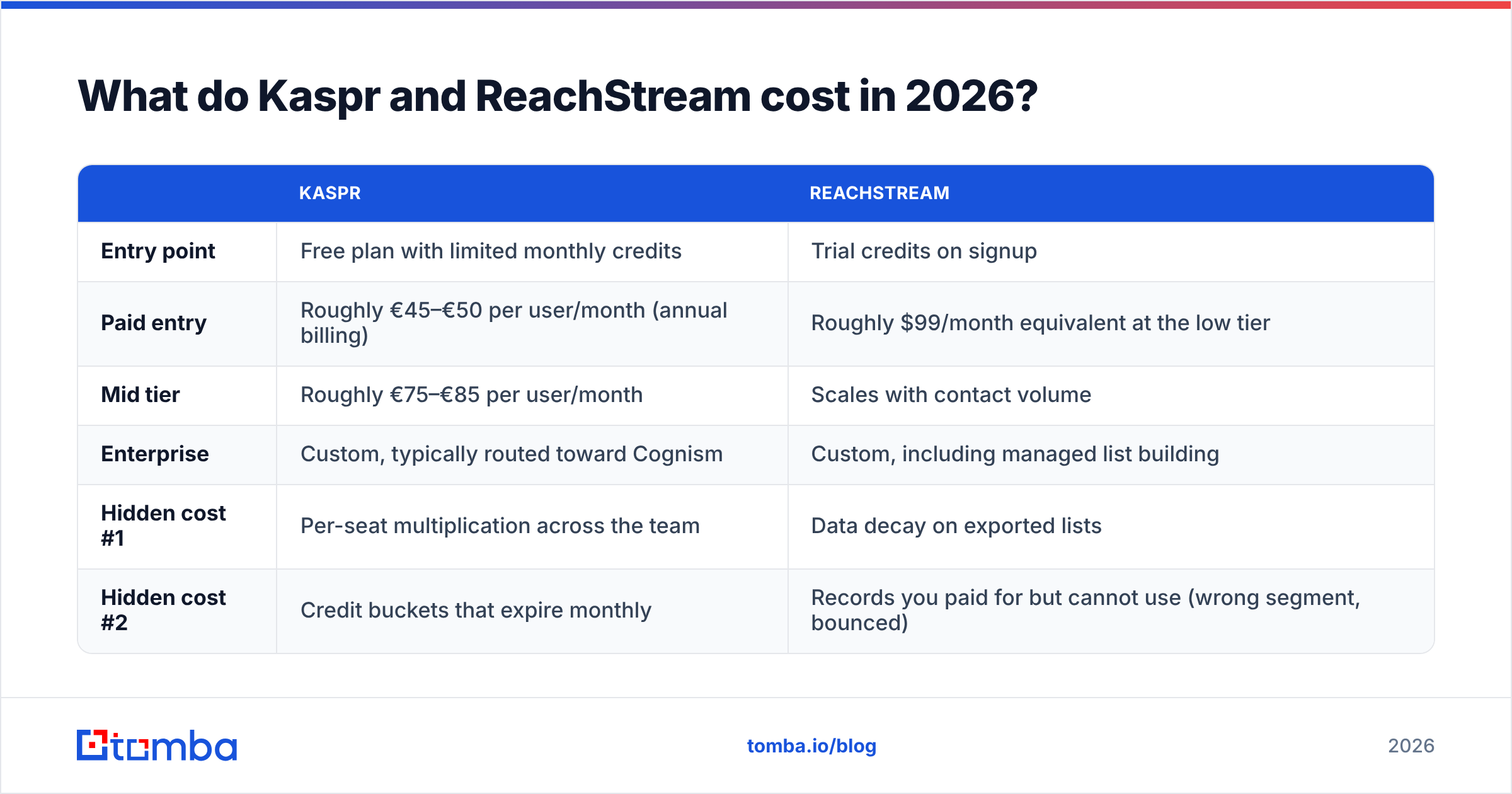
What do Kaspr and ReachStream cost in 2026?#
Both vendors have moved pricing around over the past two years, and ReachStream in particular quotes a lot of deals rather than publishing every tier. Treat the figures below as the published shape at the time of writing, not a contract.
| Kaspr | ReachStream | |
|---|---|---|
| Entry point | Free plan with limited monthly credits | Trial credits on signup |
| Paid entry | Roughly €45–€50 per user/month (annual billing) | Roughly $99/month equivalent at the low tier |
| Mid tier | Roughly €75–€85 per user/month | Scales with contact volume |
| Enterprise | Custom, typically routed toward Cognism | Custom, including managed list building |
| Hidden cost #1 | Per-seat multiplication across the team | Data decay on exported lists |
| Hidden cost #2 | Credit buckets that expire monthly | Records you paid for but cannot use (wrong segment, bounced) |
The per-seat multiplication is the thing buyers underestimate with Kaspr. At around €79 per user per month, a six-rep SDR pod is roughly €474 per month before anyone has considered whether each rep will actually burn their credits. Utilization on per-seat data tools is routinely under 50% — you are paying for the seat whether or not the rep logs in.
ReachStream's equivalent trap is the opposite: you buy volume cheaply, and then discover that 30% of the segment was never a real fit and another slice has bounced. Price per record looks great. Price per meeting booked is what your CFO will eventually ask about.
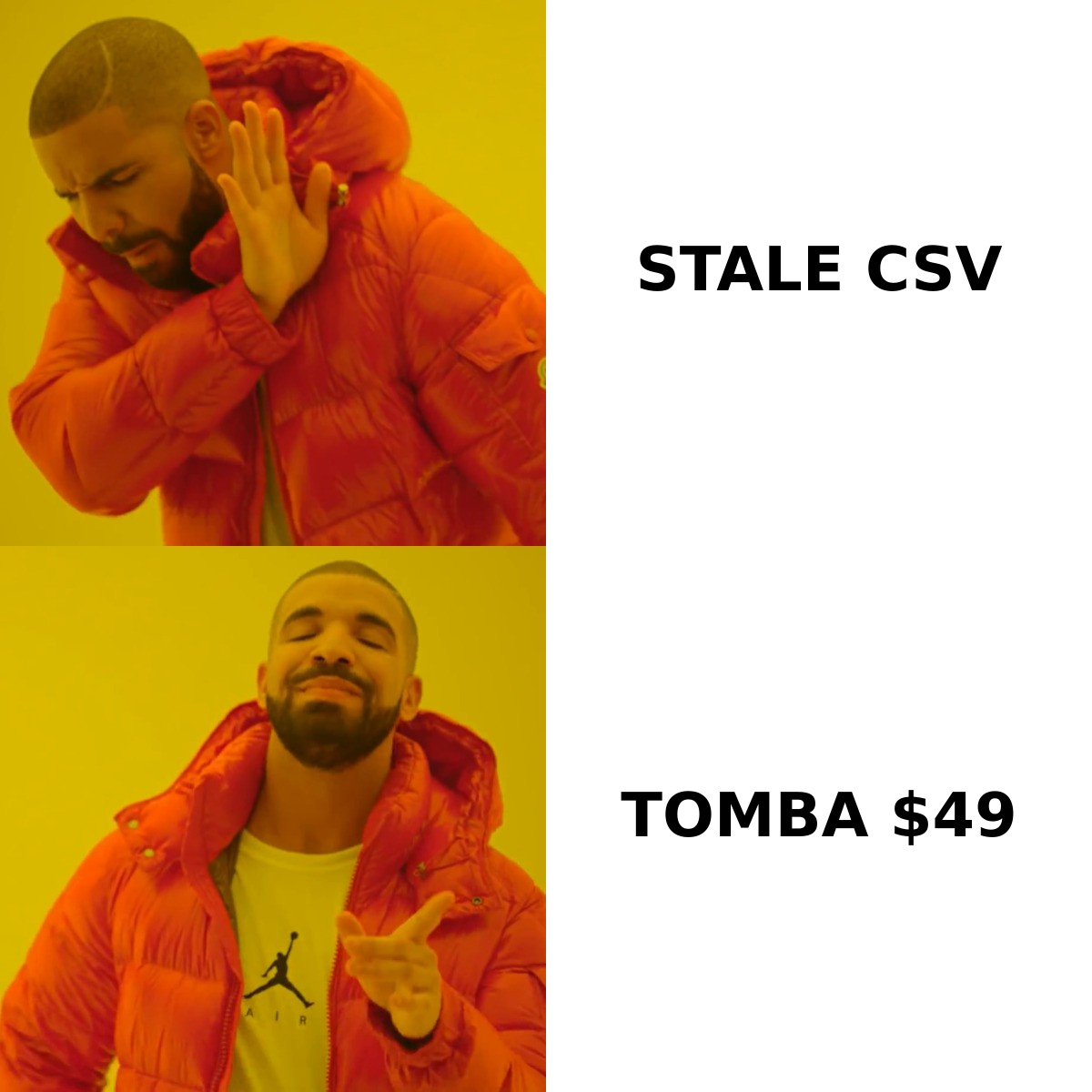
For reference on how a third model prices, Tomba's plans run a free tier at 25 searches per month, Starter at $49/mo, Growth at $99/mo, and Pro at $249/mo — credit-based rather than per-seat, which removes the seat-multiplication problem entirely for small teams.
Which has better data accuracy?#
Accuracy claims in this category are close to meaningless when quoted by the vendor. Everyone says 95%+. What differs is what they are measuring and when.

Three practical distinctions matter more than any published percentage:
- Resolution timing. Kaspr resolves when you click. ReachStream resolved when the record was added to the database, which could be months before your export. B2B contact data decays at roughly 22–30% per year, concentrated in job changes. A record pulled today beats a record pulled in Q1 almost regardless of source quality.
- Verification depth. "Verified" can mean syntax + MX record check, or it can mean a full SMTP handshake with catch-all handling. The difference shows up as bounce rate, not as a number on a pricing page. If your provider cannot tell you how it handles catch-all domains, assume it does not — run exports through a separate email verifier before they touch your sending domain.
- Phone-number provenance. Kaspr's mobile coverage is genuinely strong in Europe, weaker in parts of APAC and LATAM. ReachStream's phone data skews toward company switchboards rather than direct dials in many segments. If cold calling is the motion, test both on 50 real records from your ICP before signing anything.
The honest test is the same for both: pull 100 contacts from your actual target segment, verify them independently, and call ten of them. A weekend of work will tell you more than every review site combined.

Is Kaspr better than ReachStream for cold outreach?#
For cold calling, Kaspr. The mobile-number coverage and the profile-by-profile workflow are built for a rep who needs a person on the phone this afternoon. ReachStream will hand you a lot of numbers, but a meaningful share will be main lines.
For cold email at volume, ReachStream has the better unit economics — provided you add a verification step. Downloading 15,000 contacts and blasting them without a bounce-check is how sending domains die. Run the list through validation, segment hard, and the cost per delivered, relevant email lands well below a per-seat tool.
For LinkedIn-led sequences, Kaspr again, because the source of truth is the profile you are already looking at. If that is your motion, a dedicated LinkedIn finder covers the same job and typically without a per-seat license.
There is a fourth case neither tool handles well: programmatic enrichment. If you want to enrich signups in real time, hydrate a data warehouse, or run enrichment inside your own product, you need a documented, rate-limited, well-supported API — not a Chrome extension and not a CSV pipeline. That is a different product category.
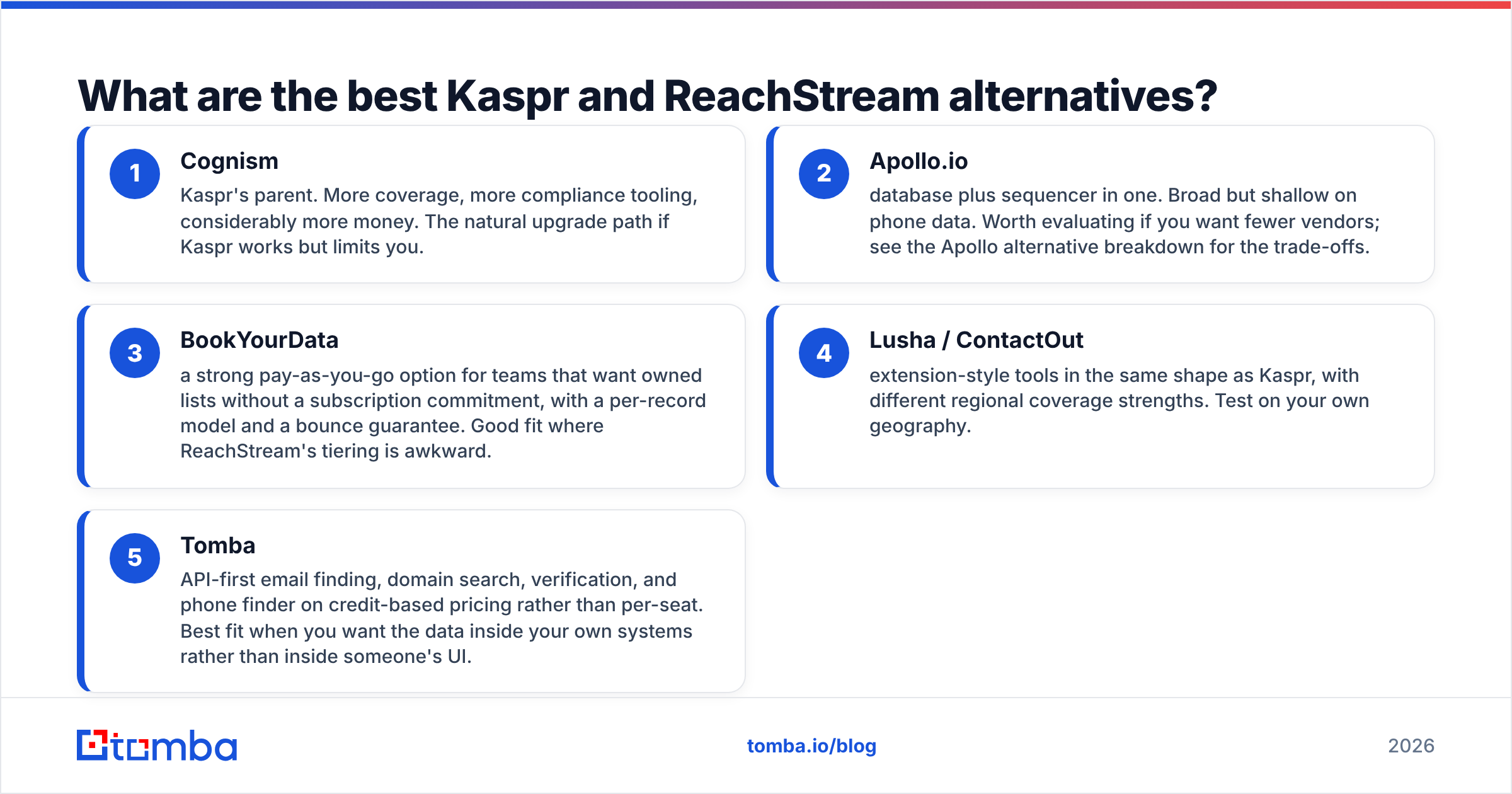
What are the best Kaspr and ReachStream alternatives?#
Neither tool is the only shape available, and the alternatives are worth a look before you commit to an annual contract:
- Cognism — Kaspr's parent. More coverage, more compliance tooling, considerably more money. The natural upgrade path if Kaspr works but limits you.
- Apollo.io — database plus sequencer in one. Broad but shallow on phone data. Worth evaluating if you want fewer vendors; see the Apollo alternative breakdown for the trade-offs.
- BookYourData — a strong pay-as-you-go option for teams that want owned lists without a subscription commitment, with a per-record model and a bounce guarantee. Good fit where ReachStream's tiering is awkward.
- Lusha / ContactOut — extension-style tools in the same shape as Kaspr, with different regional coverage strengths. Test on your own geography.
- Tomba — API-first email finding, domain search, verification, and phone finder on credit-based pricing rather than per-seat. Best fit when you want the data inside your own systems rather than inside someone's UI.
The decision tree is short. Per-rep manual prospecting with heavy calling: Kaspr. Ops-led bulk list building: ReachStream or BookYourData. Data inside your product, CRM, or warehouse: an API-first provider.
How should you run the evaluation?#
Do not compare feature lists. Compare outcomes on your own ICP:
- Pick 100 accounts you genuinely want to sell to.
- Run the same 100 through each tool's free tier or trial.
- Measure match rate (how many returned a contact), verified rate (how many survive independent verification), and connect rate (for phone data, how many actually reach a human).
- Divide total cost by number of connects, not number of records.
That last number is the only one that survives a QBR. Vendors quote match rate because it is the flattering one; connect rate is the one your pipeline is built on.
The bottom line#
Kaspr and ReachStream are not really competitors — they are two answers to two different questions. Kaspr is the right buy for an SDR team that works LinkedIn daily and needs mobile numbers. ReachStream is the right buy for an ops function that builds segments and hands them to a sequencer. Buying the wrong one is not a quality problem, it is a shape problem, and no amount of onboarding fixes it.
If the answer to "where does this data need to live?" is in our own systems, on demand, without a seat license per rep, then neither tool is the right fit. Start with the Tomba Email Finder — free tier covers 25 searches a month so you can test coverage on your real ICP before spending anything, Starter is $49/mo, and every result is reachable through the same API that powers the app. Pull 100 of your target accounts through it this week and compare the verified match rate against whatever quote is sitting in your inbox.
Related guides#
Ready to find emails that actually work?
Join 150,000+ professionals who stopped guessing and started sending. Free credits on signup — no credit card required.
Get the Tomba newsletter
Practical outbound tactics and product updates — once every two weeks.
About the author