Kaspr vs UpLead 2026: Which B2B Contact Data Tool Wins?
Kaspr scrapes LinkedIn for mobile numbers. UpLead sells a verified 160M-record database. They solve different problems — here's which one actually fits your outbound motion, and what both cost at scale.
TL;DR
- Kaspr is a LinkedIn-first contact revealer. You install a Chrome extension, browse a profile or Sales Navigator list, and it surfaces mobile numbers and emails. It is strongest on European mobile data and weakest anywhere you are not actively browsing LinkedIn.
- UpLead is a searchable B2B database. You filter by industry, headcount, tech stack, and intent, then export verified emails. It is strongest for building repeatable ICP lists and weakest on direct dials outside North America.
- They are not really competitors. Kaspr answers "who is this person I am looking at?" UpLead answers "who are the 400 people matching this profile?"
- Pricing splits hard at scale. Kaspr's per-seat credit model punishes teams; UpLead's per-credit export model punishes broad, low-precision searches.
- Most teams over-buy. If you only need verified work emails at volume, a focused email finder with a real API costs a fraction of either — and plugs into the enrichment step you were going to build anyway.
You are probably here because someone on your team said "we need better contact data" and two names came back from Google. Fair enough. But kaspr vs uplead is a slightly wrong question, because the two tools sit at different points in the prospecting pipeline. This piece breaks down what each one actually does, where the data comes from, what it costs when your team grows past three seats, and when a lighter-weight option beats both.
What is Kaspr and who is it built for?#
Kaspr is a Chrome extension and web app that reveals contact details for LinkedIn profiles. It was acquired by Cognism in 2022 and now runs largely as Cognism's self-serve, SMB-facing arm. The workflow is browser-native: open a LinkedIn profile, Sales Navigator search, or group member list, click the Kaspr widget, and it returns phone numbers, work emails, and sometimes personal emails.
The core pitch is mobile numbers. Kaspr leans on a contributory network — users share their own address books and the pool grows — plus partner data and its parent company's compliance apparatus. In practice, that means strong European coverage (France, UK, DACH, Benelux) and decent GDPR posture, including notification workflows that most US-first vendors skip.
Where it gets awkward: Kaspr is fundamentally tied to you being on LinkedIn. There is an API and a bulk enrichment upload, but the product's gravity is the extension. If your motion is "SDR works a Sales Navigator list all day," that's fine. If your motion is "RevOps enriches 8,000 CRM records overnight," you are using the tool against the grain.

Kaspr also caps what a single seat can pull. Credits are per-user and do not pool freely across the team on lower tiers, which creates a familiar problem: your best SDR runs dry on the 18th while two quiet seats sit on unused balances.
What is UpLead and how does its database work?#
UpLead is a search-and-export B2B contact database. As of 2026 it markets roughly 160M+ contacts across 200+ countries, with a filter set covering job title, seniority, department, industry, company headcount, revenue, location, technologies used, and buyer intent signals sourced through a partnership with Bombora.
The differentiator UpLead pushes hardest is real-time email verification at export. Instead of selling you a static list and hoping, it runs an SMTP-level check the moment you export and does not charge a credit for a record it cannot verify. That policy alone removes the worst failure mode of database tools — paying for 2,000 rows and discovering 600 bounce.
The tradeoff is the classic database tradeoff: coverage is a function of how well your ICP overlaps with the vendor's data-collection bias. UpLead is noticeably stronger on US mid-market and enterprise than on, say, a 40-person agency in Lyon. Direct-dial coverage exists but is thinner than mobile-specialist vendors, and "mobile number" in a database export is frequently a company switchboard.
One more structural point: UpLead is a list-building tool. It does not do sequencing, it does not do dialing, and its CRM integrations are export-oriented rather than continuous sync. You will still need an outbound platform downstream.
Kaspr vs UpLead: how do they compare head to head?#
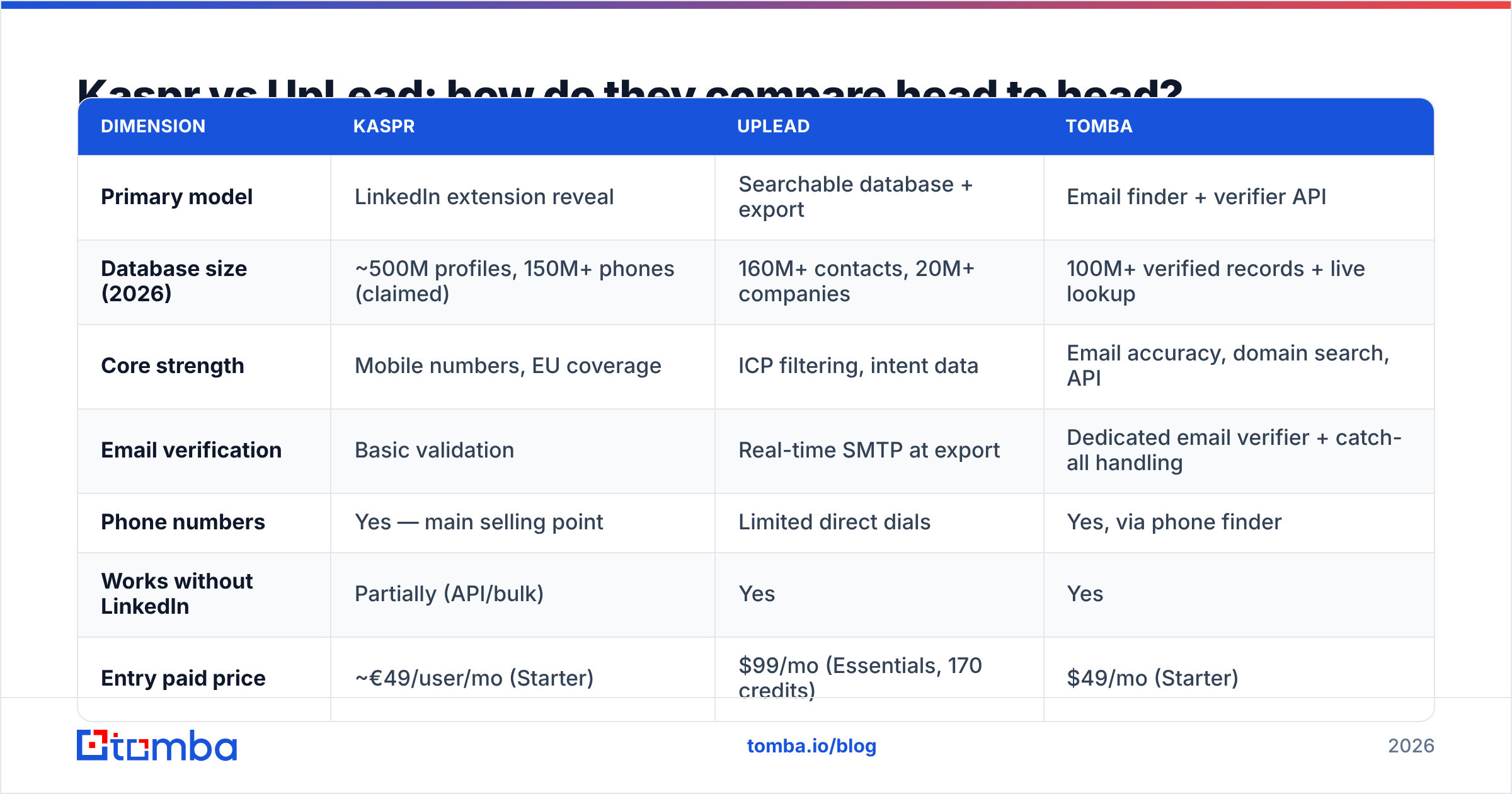
Here is the side-by-side, with a third column for the focused email-finder approach so you can see where the money actually goes.
| Dimension | Kaspr | UpLead | Tomba |
|---|---|---|---|
| Primary model | LinkedIn extension reveal | Searchable database + export | Email finder + verifier API |
| Database size (2026) | ~500M profiles, 150M+ phones (claimed) | 160M+ contacts, 20M+ companies | 100M+ verified records + live lookup |
| Core strength | Mobile numbers, EU coverage | ICP filtering, intent data | Email accuracy, domain search, API |
| Email verification | Basic validation | Real-time SMTP at export | Dedicated email verifier + catch-all handling |
| Phone numbers | Yes — main selling point | Limited direct dials | Yes, via phone finder |
| Works without LinkedIn | Partially (API/bulk) | Yes | Yes |
| Entry paid price | ~€49/user/mo (Starter) | $99/mo (Essentials, 170 credits) | $49/mo (Starter) |
| Free tier | Limited free credits | 5 test credits | 25 searches/mo |
| Credit pooling | Per-seat on lower tiers | Team-level | Team-level |
| Bulk enrichment | CSV upload | CSV upload | Bulk + API + CLI |
| Best fit | SDRs living in Sales Navigator | RevOps building ICP lists | Engineering-led enrichment, email-first outbound |
Prices are list prices as published by each vendor and shift with annual commitments — check current Tomba pricing and each vendor's own page before you budget.
Three things jump out of that table.
First, the unit of purchase differs. Kaspr sells seats. UpLead sells credits. If you have eight SDRs who each need occasional reveals, Kaspr's seat math gets expensive fast. If you have one ops person building lists for eight SDRs, UpLead's credit math is efficient.
Second, "credit" means different things. In Kaspr, revealing a phone and revealing an email are often separate credit pools with separate monthly caps. In UpLead, one credit is one contact export including all available fields. Comparing headline credit counts between the two is meaningless without reading the fine print.
Third, neither is a complete outbound stack. Both are data layers. You still need sequencing, deliverability infrastructure, and a CRM that does not rot.
Which one has better data accuracy?#
Depends entirely on what you are measuring, and anyone giving you a single accuracy number is selling something.
For work emails: UpLead wins on paper because of the verify-at-export policy. Its effective bounce rate on exported records typically lands in the low single digits, and the no-charge-on-unverified rule means you are not paying for the misses. Kaspr's email data is serviceable but validation is lighter, so you should still run exports through an independent verification pass before loading a sequence.
For mobile numbers: Kaspr wins, and it is not close in Europe. Contributory address-book data is messy and ethically debated, but it produces direct dials that database-only vendors simply do not have. If your team dials EU prospects, this is the single strongest argument for Kaspr.
For company firmographics: UpLead wins. Technographic filters, revenue bands, and intent signals are database-native features. Kaspr does not meaningfully compete here.
For catch-all domains: Both struggle, and this is where most teams silently lose 15-30% of their addressable list. A domain configured as catch-all accepts every address at the SMTP layer, so standard verification returns "unknown" and cautious vendors drop the record. Purpose-built catch-all verification uses pattern confidence and secondary signals to score those addresses instead of discarding them — worth checking whichever vendor you pick, because "we exclude catch-alls" quietly shrinks your TAM.
A practical accuracy test that takes forty minutes: pull the same 100 target contacts from both tools, load them into a spreadsheet, dedupe, and check overlap. You will usually find 40-60% overlap, and the non-overlapping records tell you far more about fit than any G2 review does. You can sanity-check both vendors' review distributions on G2 before you run the test.
How does pricing really compare at team scale?#
Sticker prices mislead here. Model it at your actual headcount.
Scenario A — four SDRs working LinkedIn daily, 300 reveals each per month.
- Kaspr: four seats on a mid tier. Roughly €400-600/month depending on plan and whether you need phone credits topped up. Seat-based means this scales linearly and unforgivingly.
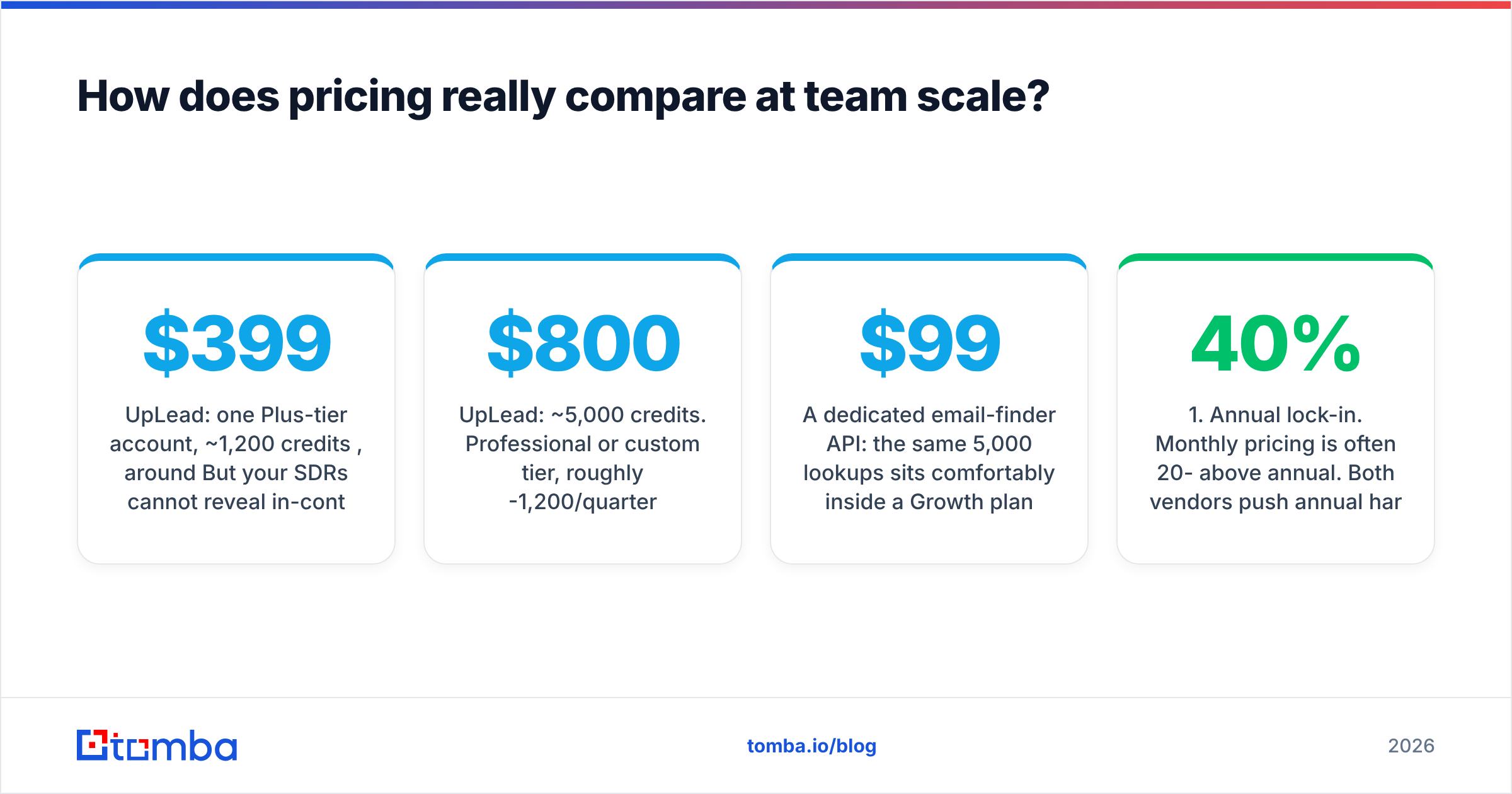
- UpLead: one Plus-tier account, ~1,200 credits/month, around $399/month. But your SDRs cannot reveal in-context on a LinkedIn profile — they work from pre-built lists.
Scenario B — one RevOps person enriching 5,000 CRM records per quarter.
- Kaspr: bulk upload works but the pricing is not designed for this. You will negotiate.
- UpLead: ~5,000 credits. Professional or custom tier, roughly $800-1,200/quarter.
- A dedicated email-finder API: the same 5,000 lookups sits comfortably inside a Growth plan at $99/month, because you are only paying for the one field you actually need.
That last line is the uncomfortable one. A large share of teams buy a full contact-intelligence platform, then use it for a single job: turn a name plus a domain into a verified work email. If that describes you, you are paying a 5-10x premium for filters you never open.

Hidden costs to check on both:
- Annual lock-in. Monthly pricing is often 20-40% above annual. Both vendors push annual hard.
- Credit rollover. Unused credits typically expire monthly. Bursty usage patterns waste a lot.
- Seat minimums. Higher tiers frequently require 3+ seats even if you need one.
- API access gating. API keys are usually reserved for upper tiers on both platforms — a real problem if you planned to automate.
- Export limits. Some plans cap records per export, which turns a 10,000-row list build into a tedious afternoon.
When should you choose Kaspr over UpLead?#
Pick Kaspr when at least two of these are true:
- Your team cold calls. Mobile numbers are the product. Nothing else on this page matches it.
- Your ICP is European. France, UK, Germany, Netherlands, Belgium — Kaspr's density is real there.
- Your SDRs live in Sales Navigator. The in-context reveal removes a tab-switch from every single prospect, and that compounds across a day.
- You need GDPR paperwork you can show a lawyer. Cognism ownership brings notification workflows and a documented compliance posture.
Pick UpLead when:
- You build lists, not one-off reveals. Filtering 160M records by tech stack and headcount is a different job than clicking profiles.
- Your ICP is US-centric. Coverage density follows the data-collection bias, and UpLead's is North American.
- Bounce rate is a board metric. Verify-at-export with no charge for misses is genuinely good policy.
- You want intent signals without buying a separate Bombora contract.
Pick neither when your actual need is "verified work emails at volume, wired into our own systems." At that point you are shopping for infrastructure, not a UI. A dedicated email finder with a documented email finder API, a CLI, and a domain search endpoint does the job for a fraction of the cost, and your engineers can wire it into the enrichment pipeline in an afternoon instead of maintaining CSV round-trips.
What about deliverability after you get the data?#
Buying accurate data is step one; not burning your domain with it is step two, and the two are related more tightly than most teams assume.
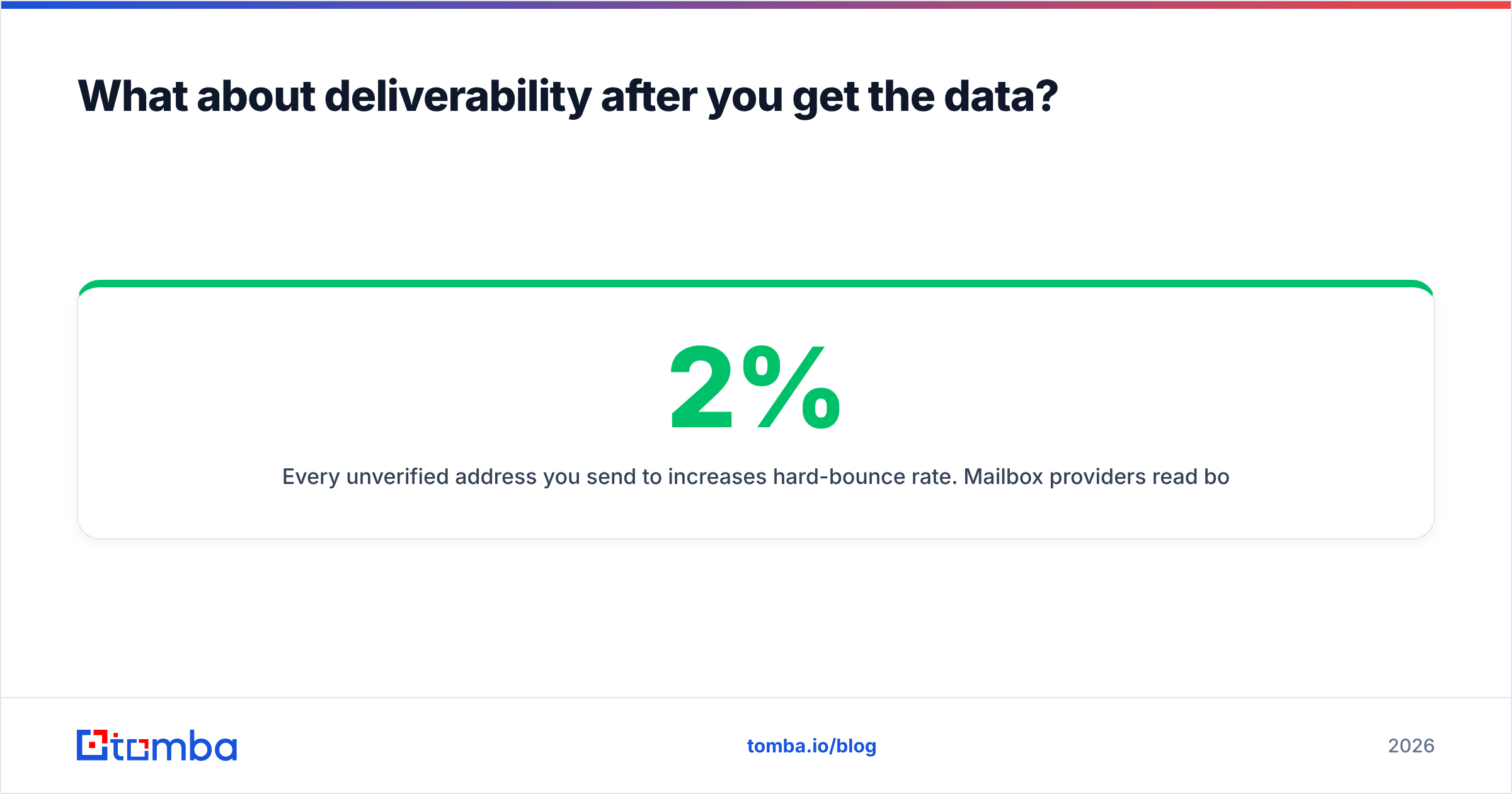
Every unverified address you send to increases hard-bounce rate. Mailbox providers read bounce rate as a spam signal. Cross roughly 2% and your sender reputation starts degrading; cross 5% and you are in real trouble. This is why the verification policy differences above matter more than the raw database-size claims — a 160M-record database that bounces at 8% is worth less than a 60M-record database that bounces at 1.5%.
Practical sequence regardless of vendor:
- Export from your data tool of choice.
- Re-verify independently with a second provider. Vendors grade their own homework; a neutral email verification pass catches what they missed.
- Segment catch-alls into a separate, lower-volume send rather than dropping them or blasting them.
- Warm the sending domain before volume ramps, and monitor Postmaster data weekly.
- Suppress anything that bounces once, permanently, across every tool.
Google's own sender guidelines are the authoritative reference here and are worth reading in full if you send more than 5,000 messages a day to Gmail addresses. HubSpot's email deliverability research covers the marketing-side benchmarks.
Are there better alternatives to both in 2026?#
Yes, depending on the job.
- For mobile-heavy calling: Cognism (Kaspr's parent) at enterprise scale, or Lusha for a lighter US-leaning option.
- For broad database + sequencing in one: Apollo.io bundles data and outreach, though data quality is more variable than UpLead's. If that is the direction you are heading, compare an Apollo alternative first — bundled tools tend to be mediocre at both halves.
- For pre-verified, purchase-once B2B lists: BookYourData is a solid option if you prefer buying a clean list outright over renting database access, with pay-as-you-go pricing and a strong verification guarantee. Different commercial model, genuinely useful for one-off campaigns.
- For email-first outbound at engineering scale: a focused finder-plus-verifier stack. This is where Tomba sits — email finder, verifier, domain search, catch-all handling, phone finder, and data enrichment behind one API, with a free tier of 25 searches/month and Starter at $49/month.
The honest framing: Kaspr and UpLead are both good at the thing they were built for. Neither was built to be your enrichment infrastructure, and both get expensive when you try to make them that.
How should you run the evaluation?#
Do not read more comparison posts, including this one. Run the test.
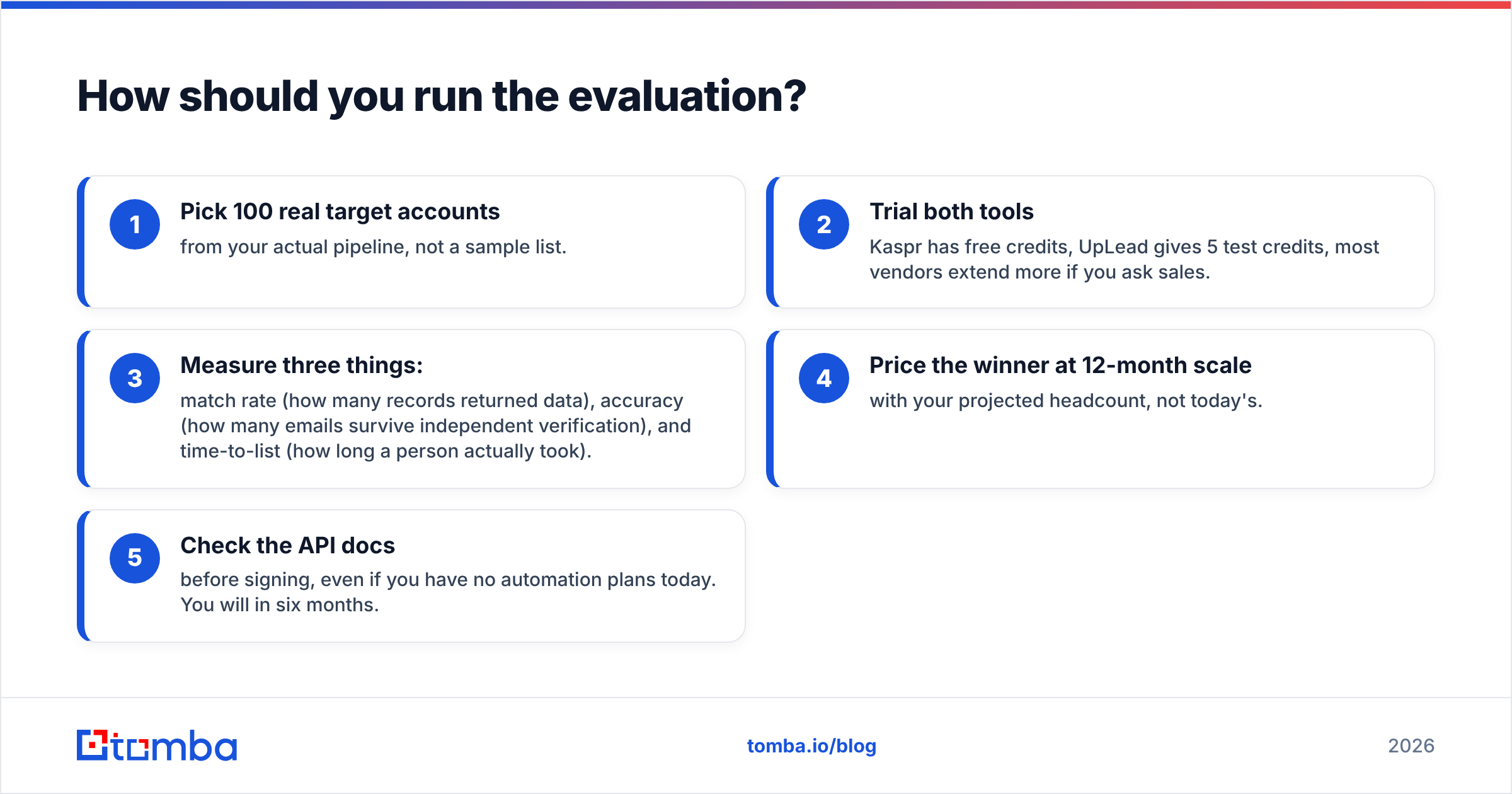
- Pick 100 real target accounts from your actual pipeline, not a sample list.
- Trial both tools — Kaspr has free credits, UpLead gives 5 test credits, most vendors extend more if you ask sales.
- Measure three things: match rate (how many records returned data), accuracy (how many emails survive independent verification), and time-to-list (how long a person actually took).
- Price the winner at 12-month scale with your projected headcount, not today's.
- Check the API docs before signing, even if you have no automation plans today. You will in six months.
Most teams that run this honestly discover their real gap is not "we need more contacts." It is "we need the contacts we already have to be accurate and reachable." Those are different purchases.
Start with the layer everything else depends on. If verified work emails are the bottleneck — and for most email-led outbound teams they are — the Tomba Email Finder finds them by name, domain, or company, verifies them before they hit your sequence, and exposes the whole thing through an API your team can automate against. Free tier is 25 searches a month with no card, Starter is $49/month, and you can test it against the same 100 accounts you are trialing Kaspr and UpLead with. Run all three, compare the match rates, and let the data pick.
Related guides#
// get started
Find, verify and enrich your first contacts today
Start on the free plan with 25 searches a month, then scale when your team is ready.
Free plan · No credit card required · GDPR & CCPA
// about the author