Key Account Program: How to Build One That Actually Works
Most key account programs are just a spreadsheet of your biggest logos with a new name. Here's how tiering, coverage models, account plans, and the right metrics turn one into real retention and expansion revenue.
TL;DR
- A key account program is a formal operating system for your highest-value customers: named tiers, dedicated coverage, written account plans, and executive sponsorship. It is not a renamed list of your biggest logos.
- Revenue size alone is a bad tiering input. Strategic fit, growth headroom, reference value, and switching cost matter more.
- The three failure modes are: too many accounts in Tier 1, account plans nobody updates, and metrics borrowed from new-business sales (quota attainment instead of net revenue retention).
- Budget roughly 8-15 accounts per key account manager if the plans are real. Past 20, coverage collapses back into reactive firefighting.
- Start with 10 accounts and a 90-day pilot, not a company-wide rollout. Measure NRR, multi-threading depth, and executive meeting count before you scale.
What is a key account program?#
A key account program is the set of rules, people, and rituals your company uses to manage a small group of customers differently from everyone else. Different coverage, different planning cadence, different metrics, different escalation path.
Think of it like a hospital triage system. Everyone who walks in gets treated, but the small number of patients whose condition can change fast get a dedicated team, continuous monitoring, and a named physician who owns the outcome. Nobody argues that's unfair to the person with a sprained wrist. Key account management works the same way: you are allocating scarce senior attention to the accounts where attention changes the outcome most.
Formally, key account management emerged in the 1980s as suppliers realized that a handful of buyers drove a disproportionate share of profit and that transactional selling was destroying those relationships. The modern version adds data: usage telemetry, org-chart mapping, and buying-committee tracking that earlier generations did manually.
Here's the distinction that matters. Account management is a role. A key account program is a system — it survives when the individual key account manager leaves.

How is a key account program different from regular account management?#
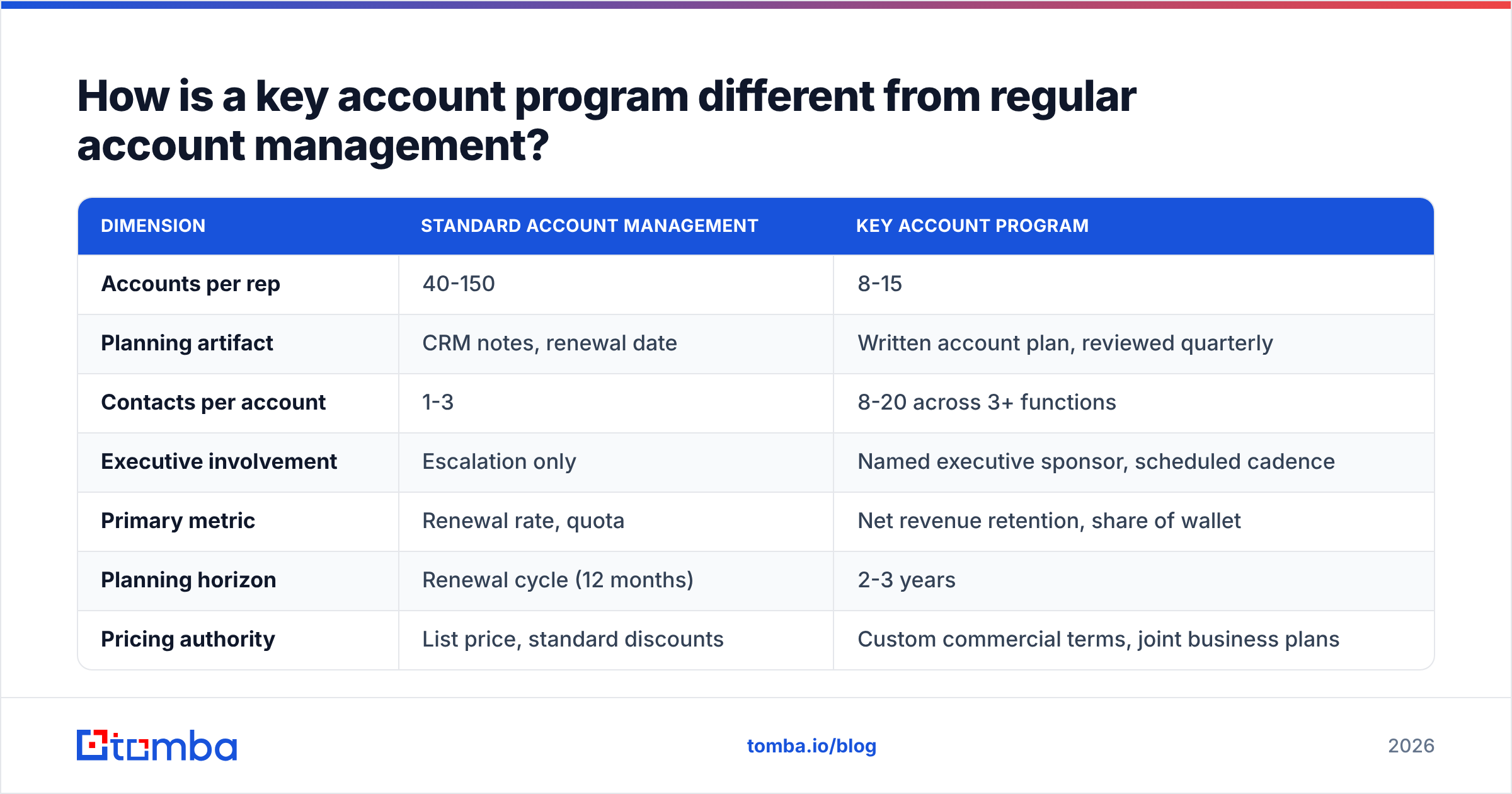
The gap is structural, not just effort. Regular account management is reactive and renewal-driven. A key account program is proactive and expansion-driven, with governance attached.
| Dimension | Standard account management | Key account program |
|---|---|---|
| Accounts per rep | 40-150 | 8-15 |
| Planning artifact | CRM notes, renewal date | Written account plan, reviewed quarterly |
| Contacts per account | 1-3 | 8-20 across 3+ functions |
| Executive involvement | Escalation only | Named executive sponsor, scheduled cadence |
| Primary metric | Renewal rate, quota | Net revenue retention, share of wallet |
| Planning horizon | Renewal cycle (12 months) | 2-3 years |
| Pricing authority | List price, standard discounts | Custom commercial terms, joint business plans |
| Churn warning time | 30-60 days | 6-9 months |
The last row is the one that pays for the program. Standard coverage discovers a churn risk when the buyer stops answering emails. A working key account program discovers it when the third-line champion leaves and nobody has a relationship with the replacement — six months earlier, while you can still act.
Which accounts actually belong in the program?#
This is where most programs break before they start. Revenue rank is the easy input, so teams sort by ARR descending and draw a line. That gives you a list of your biggest customers, some of whom are maxed out, low-margin, and one reorg away from leaving anyway.
Score candidates on five dimensions instead:
- Growth headroom — What percentage of their potential spend do you currently hold? An account at 15% share of wallet is a better key account than one at 90%, even if the second is larger today.
- Strategic fit — Does their roadmap pull your roadmap somewhere useful? Accounts that push you into adjacent markets earn their slot even at modest revenue.
- Reference and network value — Will their logo, case study, or CIO's word of mouth open doors in a segment you're targeting? Some accounts are worth more as proof than as revenue.
- Switching cost and stickiness — Deep integration, custom workflows, and regulatory dependencies mean investment compounds. Low-switching-cost accounts consume the same attention and leave anyway.
- Relationship viability — Do they want a partnership? Some large buyers explicitly want a transactional vendor relationship. Forcing a joint business plan on them wastes both sides' time.
Score each 1-5, weight growth headroom and strategic fit highest, and cap Tier 1 at a number you can genuinely staff. If you have four key account managers, you have somewhere between 32 and 60 Tier 1 accounts — not 200.
Then run the honest test: if this account called with a crisis at 4 p.m. on a Friday, would a named person at your company pick up, and would they already know the account's history? If the answer is no, it isn't a key account yet. It's an aspiration.
What does a key account plan contain?#
A key account plan is not a slide deck for QBRs. It's a working document, and if it isn't changing between quarters, the program is decorative.
The minimum viable plan has six parts:
- Account map — Org chart with buying roles marked: economic buyer, champion, technical evaluator, blocker, and coach. Include relationship strength (owned / known / unknown) and who at your company owns each.
- Current-state value — Products in use, adoption metrics, realized outcomes with the customer's own numbers, open support debt.
- Whitespace analysis — Products not owned, business units not penetrated, geographies not served. Quantified, not vibes.
- Customer's priorities — Their stated strategic initiatives for the next 12-24 months, pulled from earnings calls, annual reports, and executive conversations. Your growth plan has to connect to theirs.
- Risk register — Champion departure risk, competitive activity, contract terms, budget pressure, upcoming reorgs. With mitigation owners.
- Action plan — Five to eight concrete moves for the next quarter with named owners and dates. Not "deepen relationship." Instead: "secure introduction to VP Engineering in EMEA division by March 14, via current champion."
The account map is the piece teams skip and then regret. Multi-threading is the single most reliable predictor of retention in enterprise accounts, and it's the thing that decays silently. People change jobs. If your only relationship at a $2M account was one director who just moved to a competitor, you're going to find out the expensive way.
Keeping that map current means continuously re-finding contact data as people move. Tools like the Tomba Email Finder and a LinkedIn finder let the key account team rebuild coverage when a champion leaves, and data enrichment can flag title changes across the buying committee before they turn into a renewal surprise. A stale CRM record is the most common cause of a "sudden" churn that was actually visible for months.
Who staffs a key account program?#
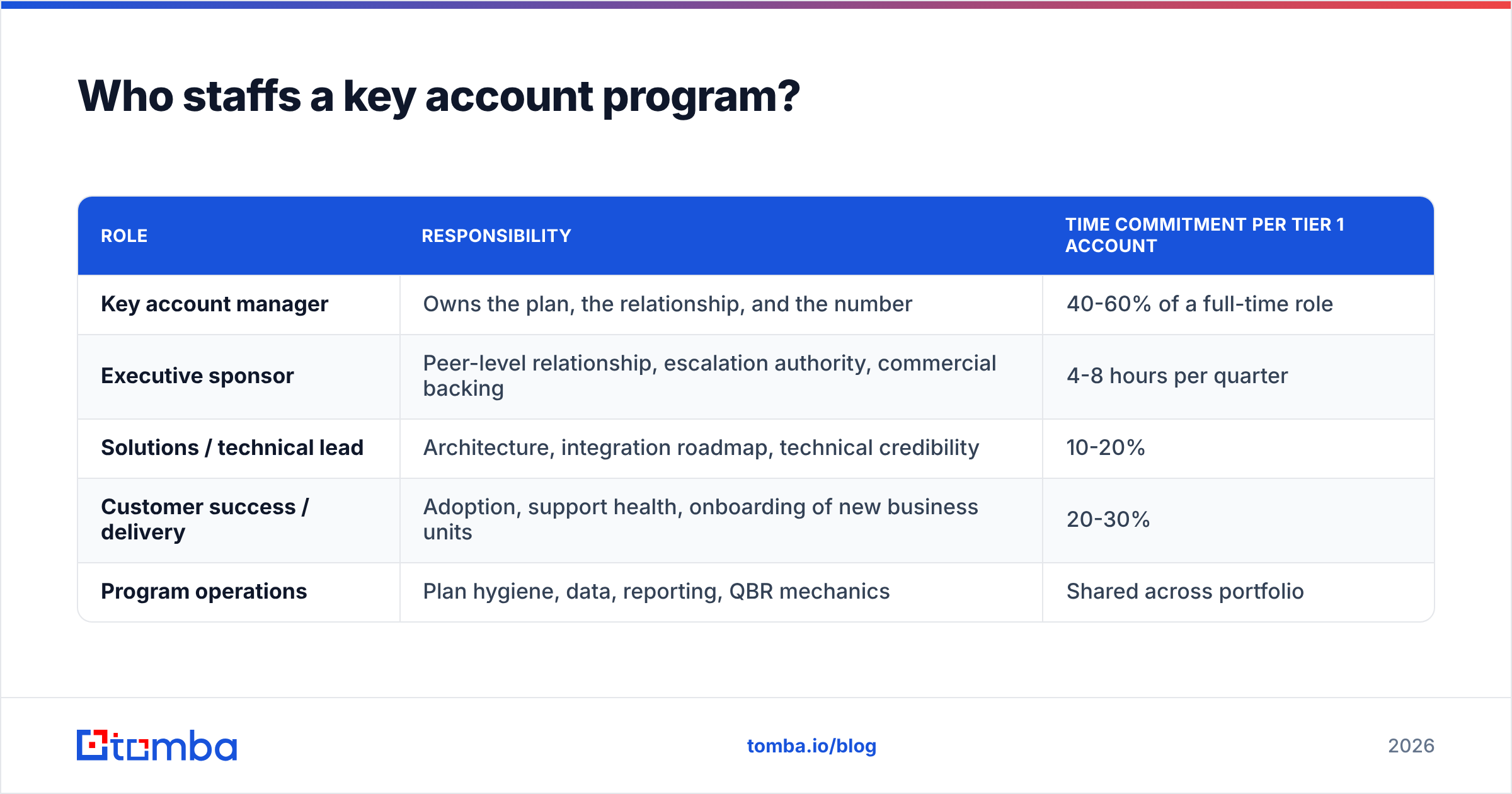
The most common structural mistake is naming a key account manager and calling it a program. One person cannot deliver technical depth, commercial negotiation, executive peer relationships, and delivery oversight to a global account.
| Role | Responsibility | Time commitment per Tier 1 account |
|---|---|---|
| Key account manager | Owns the plan, the relationship, and the number | 40-60% of a full-time role |
| Executive sponsor | Peer-level relationship, escalation authority, commercial backing | 4-8 hours per quarter |
| Solutions / technical lead | Architecture, integration roadmap, technical credibility | 10-20% |
| Customer success / delivery | Adoption, support health, onboarding of new business units | 20-30% |
| Program operations | Plan hygiene, data, reporting, QBR mechanics | Shared across portfolio |
Executive sponsorship is the component that gets assigned and then quietly abandoned. Make it real by putting a specific number of sponsor-led meetings per account per year into the sponsor's own objectives. Gartner's sales research has consistently found that executive-to-executive alignment correlates with larger deal sizes and faster expansion cycles, but only when the cadence is scheduled rather than crisis-driven.

Which metrics prove a key account program is working?#
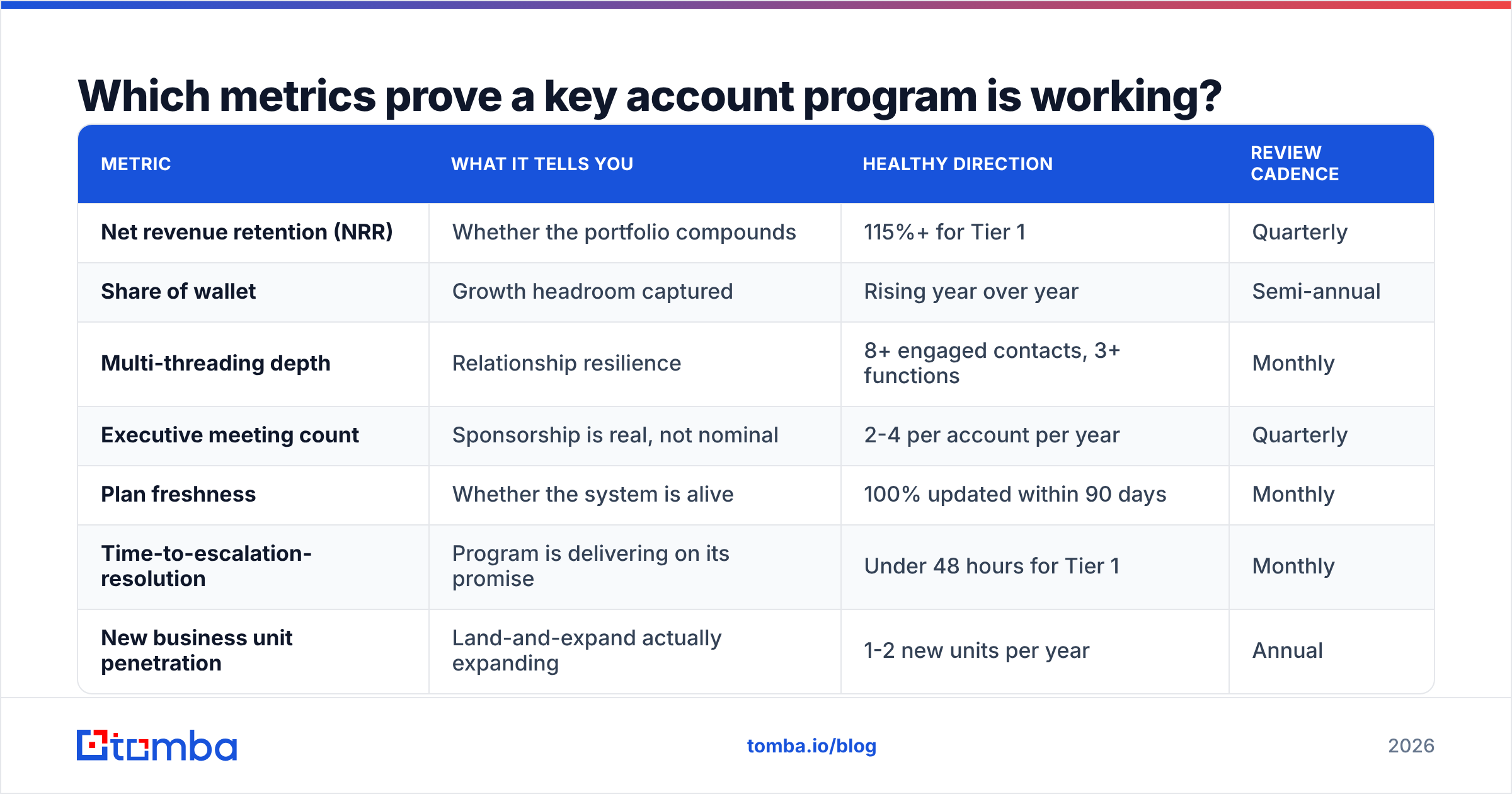
Do not measure key account managers with new-business metrics. Quota attainment on a set of existing accounts rewards the wrong behavior — it pushes toward one large upsell rather than durable account growth.
| Metric | What it tells you | Healthy direction | Review cadence |
|---|---|---|---|
| Net revenue retention (NRR) | Whether the portfolio compounds | 115%+ for Tier 1 | Quarterly |
| Share of wallet | Growth headroom captured | Rising year over year | Semi-annual |
| Multi-threading depth | Relationship resilience | 8+ engaged contacts, 3+ functions | Monthly |
| Executive meeting count | Sponsorship is real, not nominal | 2-4 per account per year | Quarterly |
| Plan freshness | Whether the system is alive | 100% updated within 90 days | Monthly |
| Time-to-escalation-resolution | Program is delivering on its promise | Under 48 hours for Tier 1 | Monthly |
| New business unit penetration | Land-and-expand actually expanding | 1-2 new units per year | Annual |
Two leading indicators deserve special attention. Multi-threading depth and plan freshness both predict outcomes six to nine months ahead. NRR tells you what already happened. If you only report lagging metrics, your QBRs become post-mortems.
For a broader view of how RevOps teams instrument this, HubSpot's sales research library is a reasonable free starting point, and vendor communities on G2 surface which account-planning tools teams actually keep after year one.
What tooling does a key account program need?#
Less than vendors would like you to believe, and different from what new-business teams need.
- CRM with account hierarchy — Non-negotiable. If you can't model parent/child relationships across business units and geographies, your whitespace analysis is fiction.
- Contact and org data — For mapping buying committees and re-finding people after job changes. A B2B database plus on-demand lookup covers most needs; providers like Tomba and BookYourData both serve this layer well, with different strengths in coverage depth versus list-building workflows.
- Usage and product telemetry — Adoption by business unit is your earliest churn signal and your best expansion trigger.
- A shared account plan surface — A living document everyone can edit. A wiki page beats an expensive platform nobody opens.
- Relationship intelligence — Automated detection of contact job changes and engagement decay across the account.
Resist buying a dedicated account-planning platform in year one. Run the program in your existing CRM and a shared doc. If the ritual holds for four quarters and the constraint is genuinely tooling, buy then. Most programs die from lack of discipline, not lack of software.
How do you launch a key account program in 90 days?#
Days 1-30: select and baseline. Score candidates against the five dimensions above. Pick 8-12 accounts — deliberately fewer than you think you can handle. Baseline current ARR, share of wallet, contact count, and named relationships for each. Name the key account manager and executive sponsor per account in writing.
Days 31-60: build the plans. One plan per account, built with the customer where possible. Joint planning sessions with your top accounts almost always surface whitespace you didn't know existed, and they convert the relationship from vendor to partner faster than any QBR deck. Fill relationship gaps: for every buying role with no owned relationship, assign a person and a date.
Days 61-90: run the cadence and instrument it. Weekly internal account standups, monthly plan updates, first executive sponsor meetings scheduled. Build the metrics dashboard. Report multi-threading depth and plan freshness from week one, because those are the habits that decide whether the program survives.
At day 90, review honestly. Did plans get updated without nagging? Did sponsors show up? Did contact coverage increase? If two of three are no, fix the operating rhythm before adding a single account.
Is a key account program worth it for your company?#
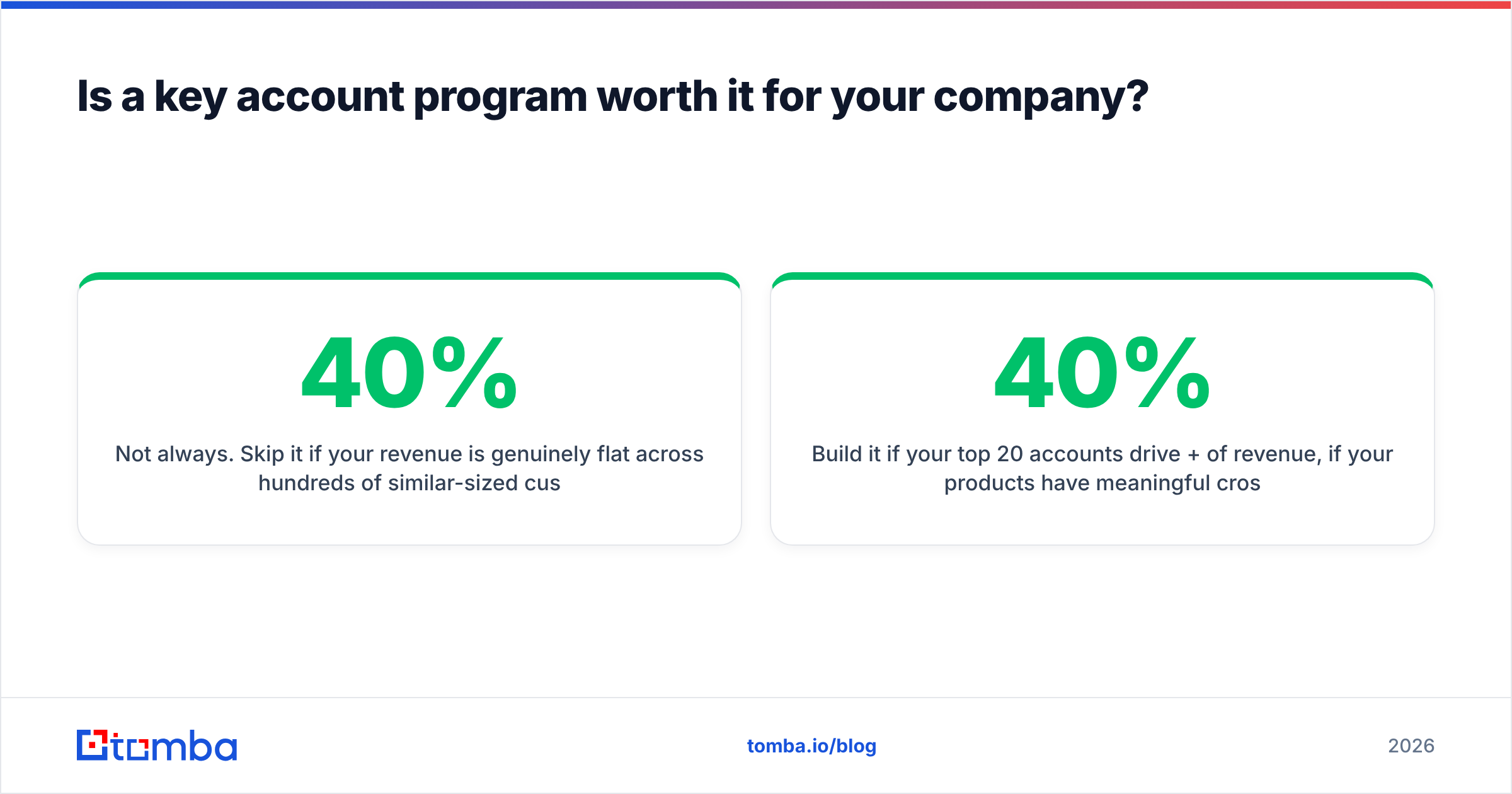
Not always. Skip it if your revenue is genuinely flat across hundreds of similar-sized customers, if your product has near-zero expansion surface, or if your average contract value can't support 40% of a senior salary per account. In those cases, scaled customer success beats named coverage.
Build it if your top 20 accounts drive 40%+ of revenue, if your products have meaningful cross-sell surface, or if your largest customers are multi-business-unit organizations where you've penetrated one division out of eight. That last scenario is the highest-ROI version of a key account program that exists — the demand is already proven, you just don't have coverage.
The honest math: a key account program costs roughly 1.5-2x standard coverage per account. It's worth it when the accounts have enough headroom that a few points of share-of-wallet gain cover the difference. Run that calculation per account before you promote anyone into Tier 1.
Where does contact data fit into all of this?#
Everything above depends on one unglamorous input: knowing who the people are and how to reach them. Account maps decay at roughly 20-30% per year as contacts change roles. A plan built on last year's org chart is a plan for a company that no longer exists.
That's the gap Tomba Email Finder closes for key account teams — finding and re-verifying business emails across every division of your largest accounts, so multi-threading survives reorgs instead of collapsing with them. Start on the free tier (25 searches per month) to rebuild the map for one Tier 1 account, or check Tomba pricing if you're covering a full portfolio: Starter is $49/mo, Growth $99/mo, and Pro $249/mo for teams running enrichment at scale. Map the account before the champion leaves, not after.
Related guides#
// get started
Find, verify and enrich your first contacts today
Start on the free plan with 25 searches a month, then scale when your team is ready.
Free plan · No credit card required · GDPR & CCPA
// about the author