9 Best Keyplay Alternatives in 2026 (Tested & Compared)
Keyplay is strong at ICP scoring and account lists, but it stops short of contacts, signals depth, or budget flexibility for some teams. Here are nine alternatives compared on scoring, data coverage, and real pricing.
TL;DR
- Keyplay picks accounts. It builds and scores target lists against your ICP. It is not a contact database, not a sequencer, and not a full GTM suite.
- Most teams who shop for Keyplay alternatives want one of three things: contact data on the accounts, a lower entry price, or deeper intent and visitor signals.
- Clay and Apollo replace the most ground. Ocean.io and BookYourData compete on list building and data volume. Koala, Warmly, and Common Room compete on timing, not fit.
- Cannot reach anyone at the accounts you scored? You need an email finding layer, not another scoring tool. That is where Tomba fits, at $49/mo.
- Budget check: tools in Keyplay's class cost four figures a year. Keyplay alternatives stacked from point tools can run under $150/mo.
What does Keyplay actually do?#
Keyplay scores and picks B2B accounts. You describe your ideal customer. Keyplay maps that against its company data. You get a ranked account list with signals on each row: hiring, tech stack, headcount growth, funding, and custom "Keyplay Signals" you define. It also pushes scored accounts to your CRM, so RevOps can route them.
Keyplay is good at one thing: a narrow ICP. Old-school tools make you filter by SIC code and headcount band. Keyplay lets you describe a segment in plain words. Then it finds look-alikes with a model. Say you sell to "firms with a mobile field crew". For that team, fit beats raw record count.
Here is what Keyplay is not. It is not a contact database. It tells you which firms to chase. It will not hand you the VP of Ops and her email. It will not send the email either. That one gap drives most of the hunt for Keyplay alternatives.
Why do teams look for Keyplay alternatives?#
Five reasons come up again and again in G2 reviews and in the buying calls we hear about:
- No contact layer. You pick the accounts. Then you need a second vendor for emails and phones. Two tools, two bills, two data problems.
- Price floor. Keyplay is quote-based and aimed at funded SaaS teams. A two-rep team testing a new segment cannot sign a year-long deal.
- Narrow signals. Keyplay reads company traits and tech stack. Want visitor ID, product usage, or community buzz? That is a whole other class of tool.
- Coverage gaps. Cover is deepest for US and West EU tech firms. Other fields and APAC accounts thin out fast.
- Rigid workflow. Teams who live in Clay or a warehouse want to own the scoring math. They do not want a vendor's black box.

What should you compare in Keyplay alternatives?#
Do not shop on record counts. Judge Keyplay alternatives on six things:
Scoring, or just listing? A filter panel is not a model. Most cheap tools only filter. Decide if you need one.
Contact coverage. Ask for a hit rate on your segment, not a global one. "95% accurate" on 40% cover still leaves most of your list dark.
Fresh checks. Any list you buy needs a new check before you send. Ask when the vendor last checked it.
Signal speed. Job posts refresh weekly. Visitor data is live. Funding is event based. Match the pace to your sales cycle.
Price shape. Per seat, per credit, and per record each break at scale. Per seat hurts teams with light users. Per credit hurts bulk runs.
API access. Is your GTM motion code-driven? A UI-only tool is a dead end. Ask if the API is a real product.
What are the best Keyplay alternatives in 2026?#
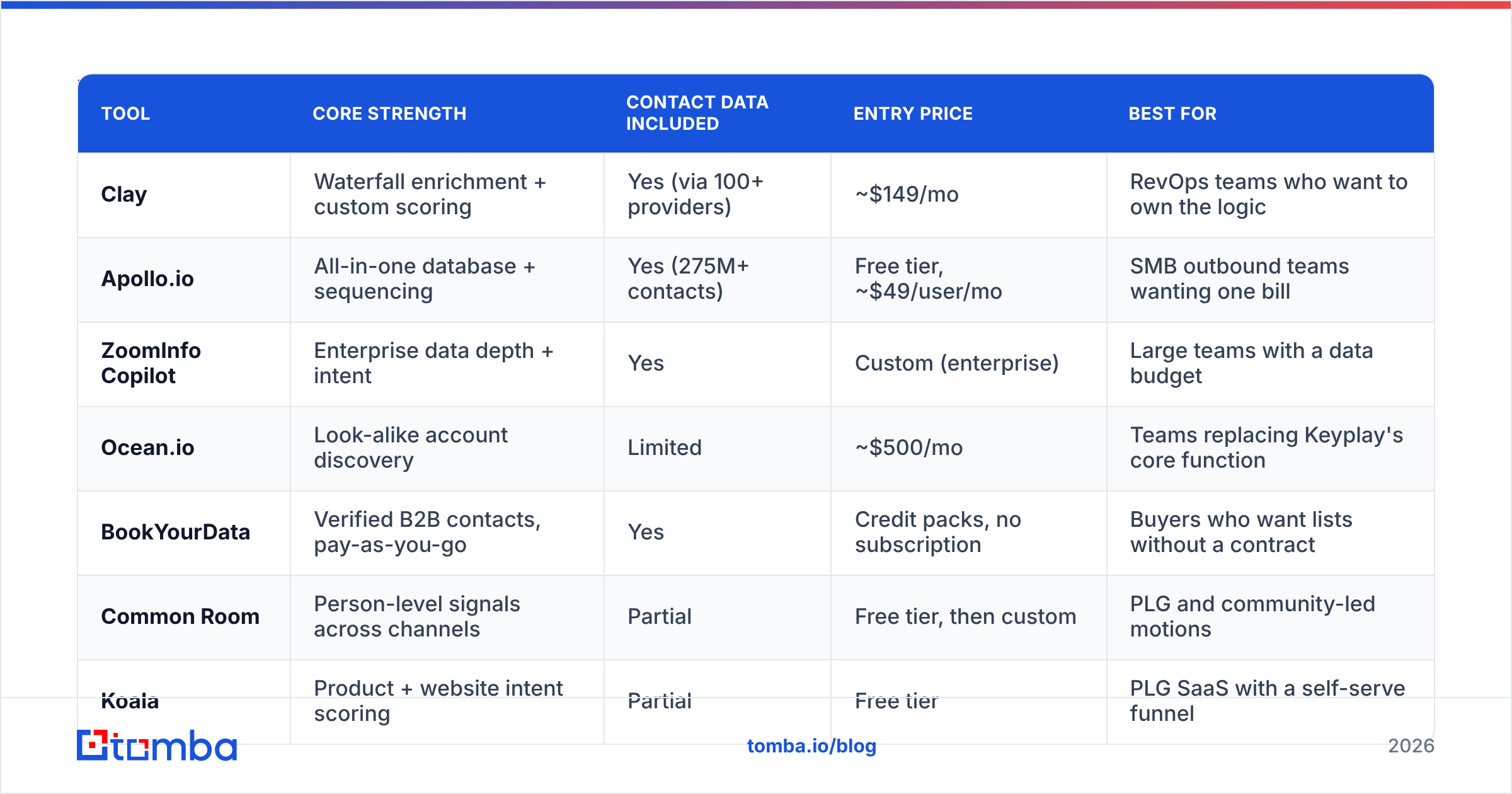
| Tool | Core strength | Contact data included | Entry price | Best for |
|---|---|---|---|---|
| Clay | Waterfall data + custom scoring | Yes (via 100+ sources) | ~$149/mo | RevOps teams who want to own the logic |
| Apollo.io | All-in-one database + sequencing | Yes (275M+ contacts) | Free tier, ~$49/user/mo | SMB teams who want one bill |
| ZoomInfo Copilot | Deep data + intent | Yes | Custom (enterprise) | Large teams with a data budget |
| Ocean.io | Look-alike account search | Limited | ~$500/mo | Teams swapping out Keyplay's core job |
| BookYourData | Checked B2B contacts, pay as you go | Yes | Credit packs, no plan | Buyers who want lists without a contract |
| Common Room | Person-level signals across channels | Partial | Free tier, then custom | PLG and community-led teams |
| Koala | Product + website intent scoring | Partial | Free tier | PLG SaaS with a self-serve funnel |
| Warmly | Puts a name on site visitors | Yes (on known visitors) | Free tier, then ~$700/mo | Inbound-heavy teams |
| Tomba | Email finding, checks, data fill | Yes | Free tier, $49/mo Starter | Filling the contact gap cheaply |
The Keyplay alternatives above show list prices at the time of writing. Quote-based vendors shift terms often, so confirm before you sign.
Is Clay the strongest Keyplay replacement?#
Clay tops most lists of Keyplay alternatives. For sharp teams it earns that spot, with one caveat about who runs it.
Clay works like a smart spreadsheet. You load or scrape a list of firms. Then you chain data sources, AI agents, and your own scoring math across the rows. You can rebuild Keyplay's model here. Pull headcount trend, job post keywords, tech stack, and funding. Then write a formula or an AI prompt that spits out a 0–100 fit score.
The upside over Keyplay is real. You own the scoring math, so it moves when your ICP moves. You fill in contacts in the same table, so you pick accounts and find people in one pass. And you can push the output anywhere.
The cost is just as real. Clay needs an operator, someone who likes to build and tend tables. Credit burn is hard to guess in month one. Teams often blow a Starter plan in two weeks of play. And the AI columns that make Clay feel like magic burn credits fastest.
Pick Clay if you have a RevOps person with time. Skip it if you want a list handed to you.
How does Apollo compare on account selection?#
Apollo is the other trade-off: less scoring smarts, far more in the box.
You get a big contact and company database, buying-intent topics, a Chrome plugin, a sequencer, a dialer, and light CRM tools. All of it sits in one plan from about $49 per user per month. For a five-rep team, that bundle is worth a lot. One vendor, one login, one data model.
Apollo loses to Keyplay on precision. Its account search is a filter panel: industry, size, place, tech, keywords. No model learns from the deals you won. If your ICP is hard to put into filters, you end up with a big, so-so list rather than a small, sharp one.
Data quality is the other gripe. Apollo's contact records go stale in some segments. Its intent signals point the way, but they are not precise. Many teams pull volume from Apollo, then re-check it all with a dedicated email verifier before they send. Our Apollo alternative breakdown digs into that data quality question.
Pick Apollo if you want one tool and a filter panel is enough. Skip it if list precision is the whole point.
What about ZoomInfo, Ocean.io, and BookYourData?#
These three Keyplay alternatives attack the job from three angles.
ZoomInfo Copilot is the big-budget answer. It has the deepest company and contact data on the market. Its intent feed, via Bombora, is strong. And the org charts hold up when you sell a seven-figure deal into a firm of 20,000 people. It is also the priciest pick here by a wide margin. Expect a yearly contract, seat minimums, and a heavy sales cycle. Read ZoomInfo's own product pages, then budget 3x what you expect.
Ocean.io is the closest like-for-like swap for Keyplay's core job. Feed it your best customers. It returns look-alike firms based on website text, not just company traits. That catches firms a SIC-code filter misses. It is a handy trait if your buyers have no clean industry label. Contact data is thinner than Keyplay's partners give you. The UI is plainer, too. But the account picks hold up.
BookYourData takes the retail angle. It sells checked B2B lists in credit packs. No plan to sign, and a bounce guarantee on what it ships. It is a different shape of product. You buy the data instead of renting a scoring model. That suits teams who know their segment and just need clean contacts to load. For one quarter's push into one vertical, credit packs often beat a year-long contract on total cost. It pairs with a scoring tool rather than replacing one.

Which signal-based tools replace Keyplay's signals?#
Keyplay's signals are about fit. Koala, Common Room, and Warmly are about timing. Most teams run them next to a scoring tool. Still, plenty buy them as Keyplay alternatives, since timing signals pay off faster.
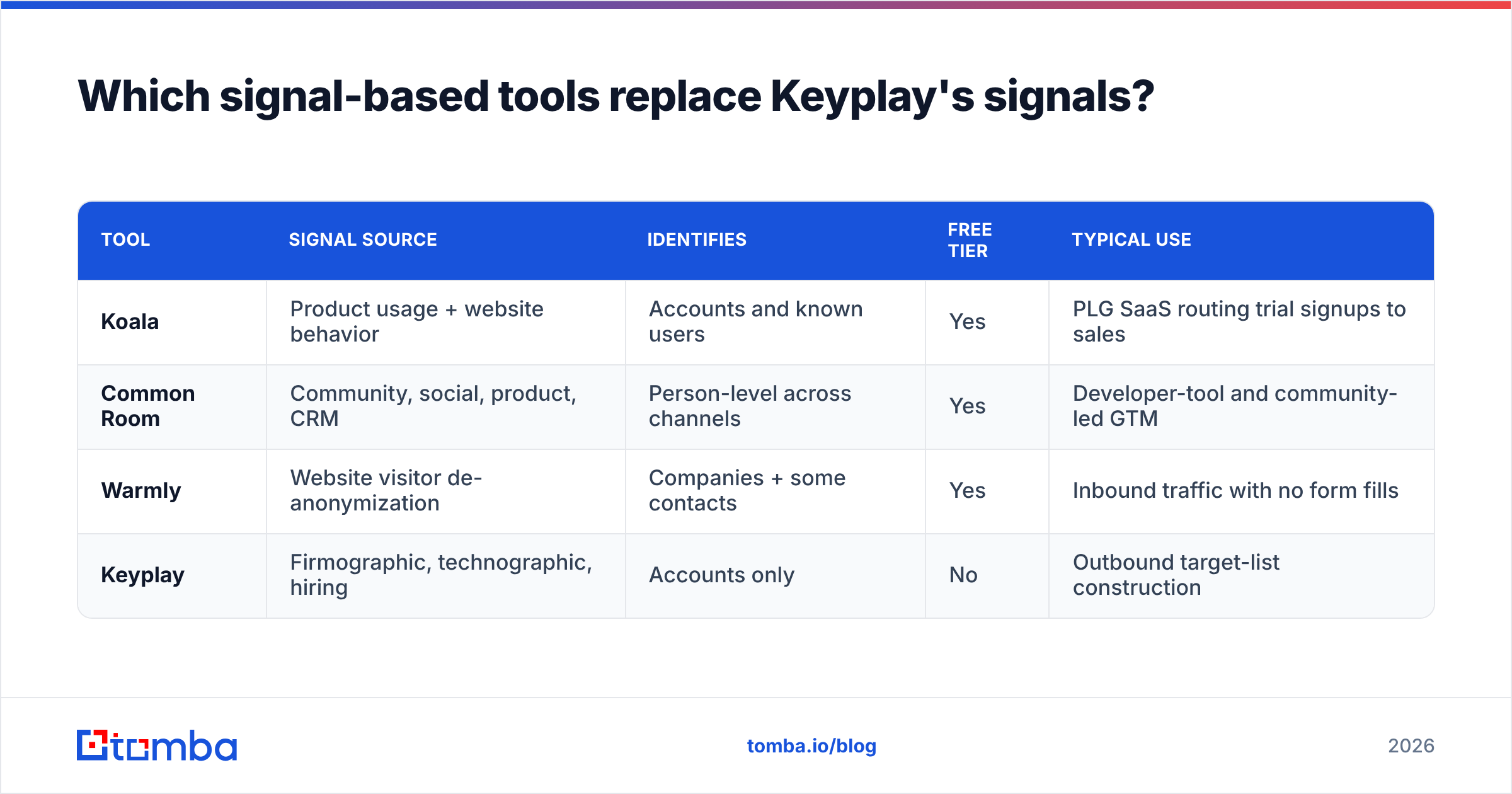
| Tool | Signal source | Identifies | Free tier | Typical use |
|---|---|---|---|---|
| Koala | Product usage + website behavior | Accounts and known users | Yes | PLG SaaS routing trial signups to sales |
| Common Room | Community, social, product, CRM | Person-level across channels | Yes | Dev-tool and community-led GTM |
| Warmly | Puts a name on site visitors | Companies + some contacts | Yes | Inbound traffic with no form fills |
| Keyplay | Company traits, tech stack, hiring | Accounts only | No | Outbound target-list building |
The honest read: with real inbound traffic or a self-serve product, a timing tool builds pipeline faster than a better-scored list. With neither, timing tools have nothing to watch. If you are early, with no traffic and no free product, fit scoring is the right buy.
Where does Tomba fit in this comparison?#
Tomba is not an account scoring tool, and we will not pretend it is. It solves the step after the one Keyplay solves.
Here is the gap. You use Keyplay, Ocean.io, or Clay to get 400 well-scored accounts. Now you need 1,200 checked emails at those firms. Keyplay does not have them. So you buy a second platform at enterprise rates, or you find the emails by domain at credit rates.
That second path is what Tomba does:
- Domain search — feed it a domain. Get the emails it finds, plus names, job titles, a score, and the firm's email pattern.
- Email Finder — feed it a first name, last name, and domain. Get the checked address.
- Verification — SMTP-level checks, catch-all handling included, so bounce rates stay low before you send.
- Data enrichment — add company and contact fields to the accounts your scoring tool picked.
- Tomba API — the same calls in code. That matters if your lists live in a warehouse or a Clay table.
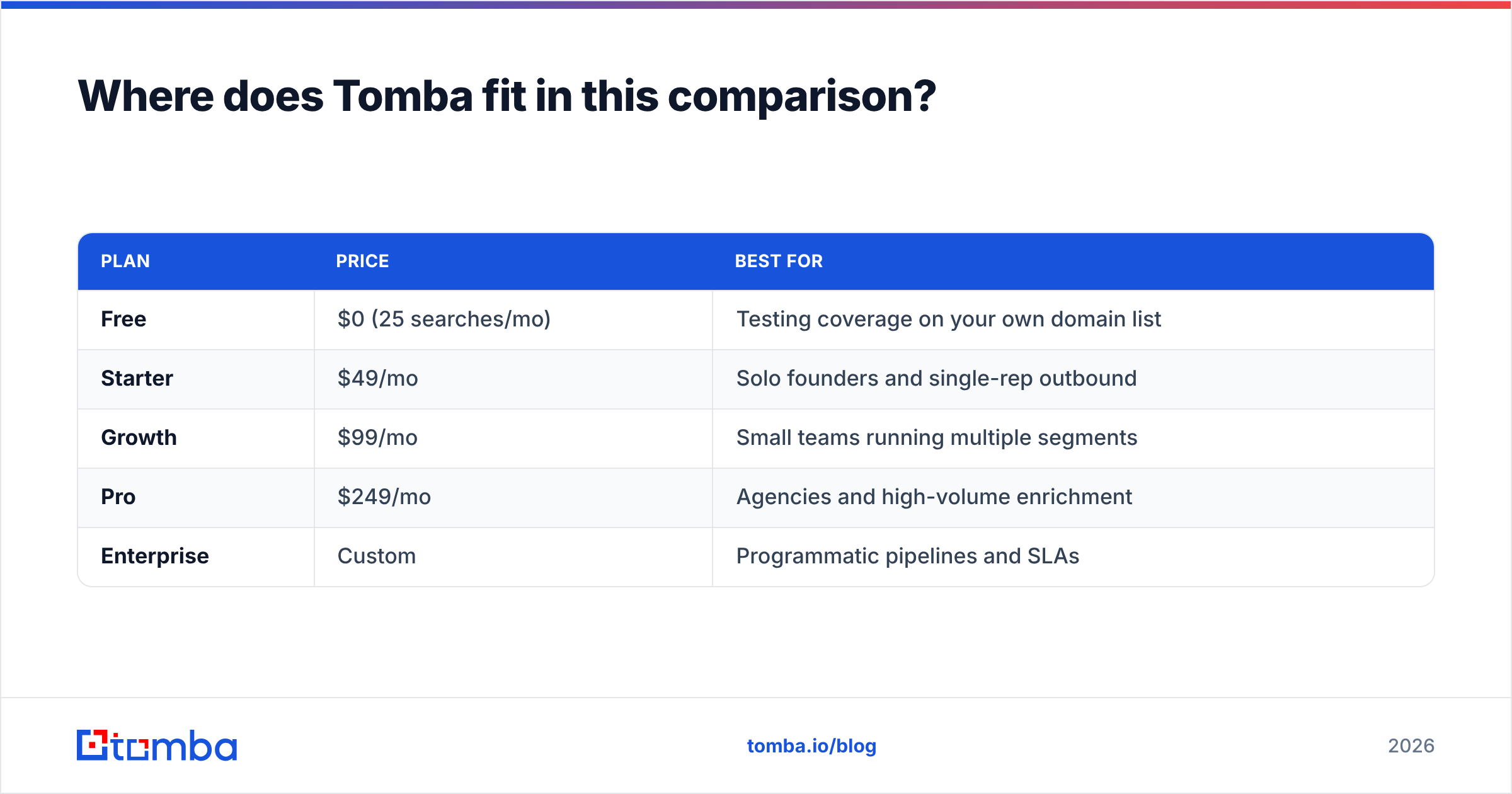
| Plan | Price | Best for |
|---|---|---|
| Free | $0 (25 searches/mo) | Testing coverage on your own domain list |
| Starter | $49/mo | Solo founders and single-rep outbound |
| Growth | $99/mo | Small teams running multiple segments |
| Pro | $249/mo | Agencies and high-volume data work |
| Enterprise | Custom | Coded pipelines and SLAs |
Tomba pricing is public. That alone sets it apart from most of this category. A lean stack looks like this: Ocean.io or Clay to pick accounts, Tomba for contacts and checks, plus a cheap sequencer. The bill lands well under one enterprise contract.
Which of these Keyplay alternatives should you choose?#
Match the tool to your real constraint, not to the feature list:
- You want Keyplay's scoring for less → Ocean.io. Closest match, look-alike search that works.
- You want to own the scoring math → Clay. Highest ceiling, needs an operator, watch the credit burn.
- You want one tool for it all → Apollo. Weakest precision, best bundle, cheapest seat.
- You have big deals and a big budget → ZoomInfo. Nothing else matches the org charts.
- You know your segment and just need contacts → BookYourData for a shipped list. Tomba if you would rather search by domain yourself.
- You have inbound traffic or a free product → Koala, Warmly, or Common Room. Timing beats fit when you can watch behavior.
- Your problem is reach, not targeting → an email finding layer. This one is misread the most.
One last tip: run a bake-off before you sign. Take 50 accounts you already won. Strip them from each tool. See which vendor surfaces look-alikes you would chase. Then take 50 target accounts. Measure hit rate and bounce rate on the emails each tool returns. Two afternoons of tests beat two quarters of regret. Keyplay's own product documentation is clear about its scope. Hold every tool on this list to the same bar.
Ready to close the contact gap?#
Most Keyplay alternatives stop at the account list. If yours is picked and you still cannot reach a soul, start with the layer that fixes that. Tomba Email Finder turns a domain and a name into a checked, sendable email address. The free tier gives you 25 searches, so you can test hit rate on your own list first. Run it on 25 scored accounts this week. If the coverage holds, Starter is $49/mo, and you just dodged an enterprise contract.
Related guides#
// get started
Find, verify and enrich your first contacts today
Start on the free plan with 25 searches a month, then scale when your team is ready.
Free plan · No credit card required · GDPR & CCPA
Get the Tomba newsletter
Product and data updates
// about the author