Kipplo vs Pubrio: Which B2B Lead Data Tool Wins in 2026?
Kipplo and Pubrio both promise verified B2B contacts, but they solve different problems. Here is how they compare on coverage, verification, workflow fit, and real cost per usable email.
TL;DR
- Kipplo and Pubrio are both B2B contact-data platforms, but they are not the same shape of product: one leans toward AI-assisted prospecting and list building, the other toward broader go-to-market intelligence around the contact record.
- Neither publishes an independently audited accuracy figure, so treat every "98% accurate" claim on either site as marketing until you test it on your own domains.
- The decision almost never comes down to features. It comes down to coverage in your specific ICP, whether the tool verifies before it charges you, and what a usable email actually costs after bounces.
- If you need a full GTM suite with intent-style signals, the platform play makes sense. If you mostly need correct addresses at volume, a dedicated finder plus verifier is cheaper and more predictable.
- Run the 200-contact bake-off in this post before you commit to an annual plan. It takes an afternoon and it is the only test that matters.
What are Kipplo and Pubrio?#
Both tools sit in the same crowded shelf: B2B contact databases that sell you business email addresses, company records, and some layer of enrichment on top.
Pubrio positions itself as an AI-driven go-to-market platform — contact and company search, enrichment, and prospecting workflows bundled together, aimed at teams that want lead discovery and outreach prep in one place. Kipplo is the leaner of the two in positioning: contact finding and list building, sold to founders and small sales teams who want to go from "here's my ICP" to "here's a CSV" without learning a suite.
That difference matters more than any feature grid. A suite wants to own your prospecting motion. A finder wants to be a fast, boring utility inside whatever motion you already have.
Here is the honest framing most comparison posts skip: neither vendor is large enough to have deep third-party review coverage, and both iterate their plans frequently. So the useful question is not "which is better" in the abstract. It is "which one covers my segment, and what does a verified, deliverable address cost me once I subtract the junk?"

How do Kipplo and Pubrio compare head-to-head?#
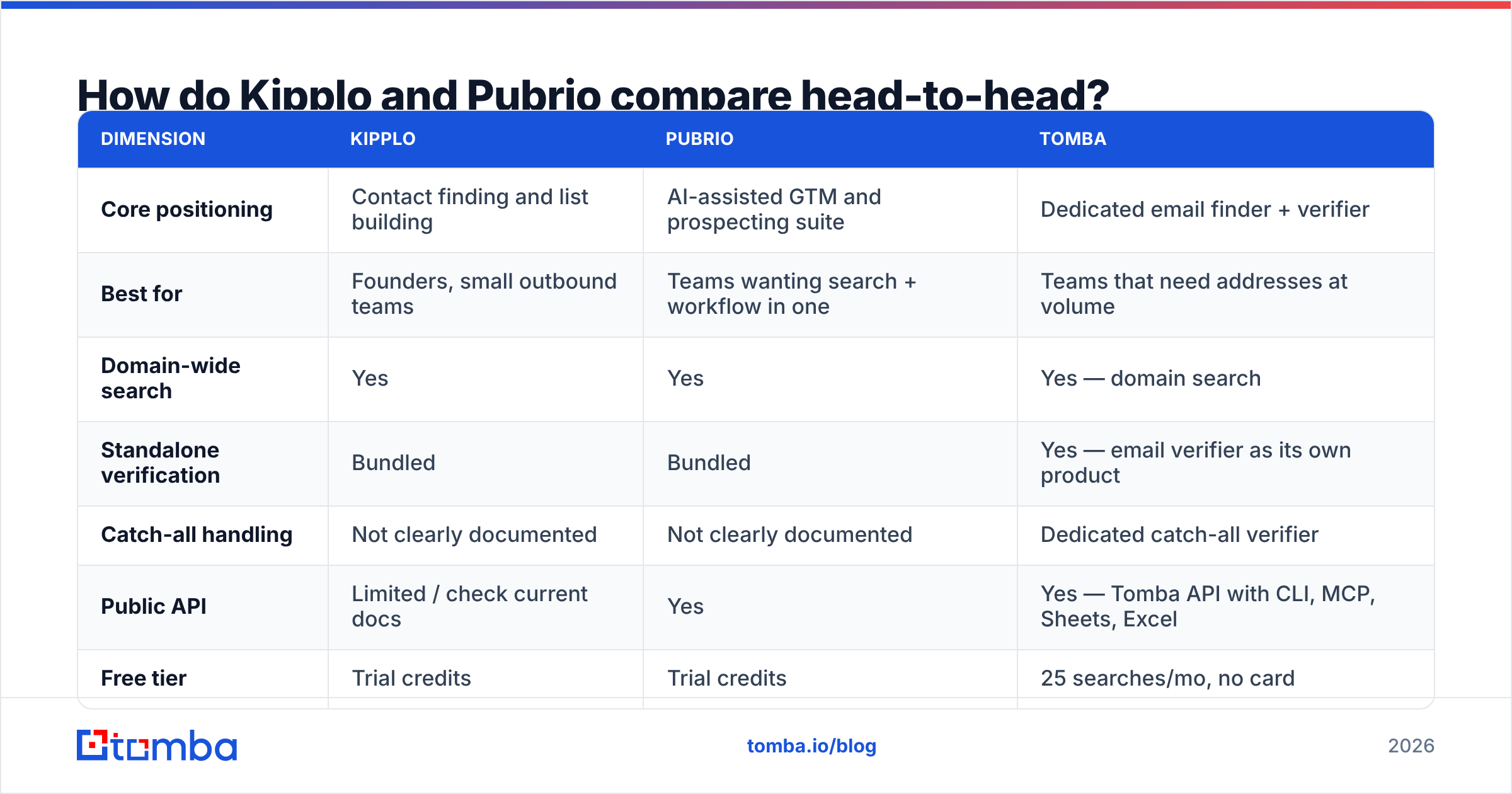
Feature parity across this category is high. Everyone has a search, everyone has a Chrome extension, everyone claims verification. What separates them is where the data comes from, how aggressively it is re-checked, and whether the pricing model punishes you for bad rows.
| Dimension | Kipplo | Pubrio | Tomba |
|---|---|---|---|
| Core positioning | Contact finding and list building | AI-assisted GTM and prospecting suite | Dedicated email finder + verifier |
| Best for | Founders, small outbound teams | Teams wanting search + workflow in one | Teams that need addresses at volume |
| Domain-wide search | Yes | Yes | Yes — domain search |
| Standalone verification | Bundled | Bundled | Yes — email verifier as its own product |
| Catch-all handling | Not clearly documented | Not clearly documented | Dedicated catch-all verifier |
| Public API | Limited / check current docs | Yes | Yes — Tomba API with CLI, MCP, Sheets, Excel |
| Free tier | Trial credits | Trial credits | 25 searches/mo, no card |
| Entry paid plan | Published on vendor site | Published on vendor site | $49/mo Starter |
| Pricing transparency | Moderate | Moderate | Full tier list at Tomba pricing |
Two rows in that table do the most work.
Catch-all handling. A catch-all domain accepts every address at the SMTP level, so a naive verifier returns "valid" for asdfgh@company.com. If a vendor cannot tell you how it treats catch-alls, you are buying an unknown bounce rate. Enterprise domains are disproportionately catch-all, which means this gap hits exactly the accounts you care most about.
Standalone verification. When verification is a bundled afterthought, it tends to be a syntax-and-MX check dressed up as validation. When it is a shipped product with its own pricing and API, it has been built to survive scrutiny.
Which one has better data accuracy?#
Nobody can answer this for you from the outside, and you should distrust any post that claims to.
What you can do is measure it. Data accuracy in this category is not a property of the vendor, it is a property of the intersection between the vendor's sources and your ICP. A tool that is excellent on US SaaS mid-market can be thin on German manufacturing or Gulf-region enterprises, and vice versa.

Here is the bake-off, and it is genuinely an afternoon of work:
- Pull 200 real target contacts. Not a random sample — 200 people you would actually email this quarter, spread across your top three account tiers.
- Run the same list through each trial. Kipplo, Pubrio, and a control like a dedicated email finder. Same names, same domains, same day.
- Record match rate, not confidence score. How many rows came back with an address at all? Vendors inflate coverage by returning pattern guesses with a confidence label attached.
- Verify every result with a neutral third party. Do not let a vendor grade its own homework. Push all three outputs through one independent email verification pass and compare.
- Segment the failures. Are the misses concentrated in one region, one company size, one industry? That pattern tells you more than the headline percentage.
- Compute cost per verified address. Credits consumed divided by rows that survived step four. This is the only price that matters.
Most teams are shocked by step six. A tool with a 70% match rate and a 30% bounce rate on those matches delivers 49 usable contacts per 100 attempts. At that point the sticker price of the plan is almost irrelevant.
How does pricing really compare?#
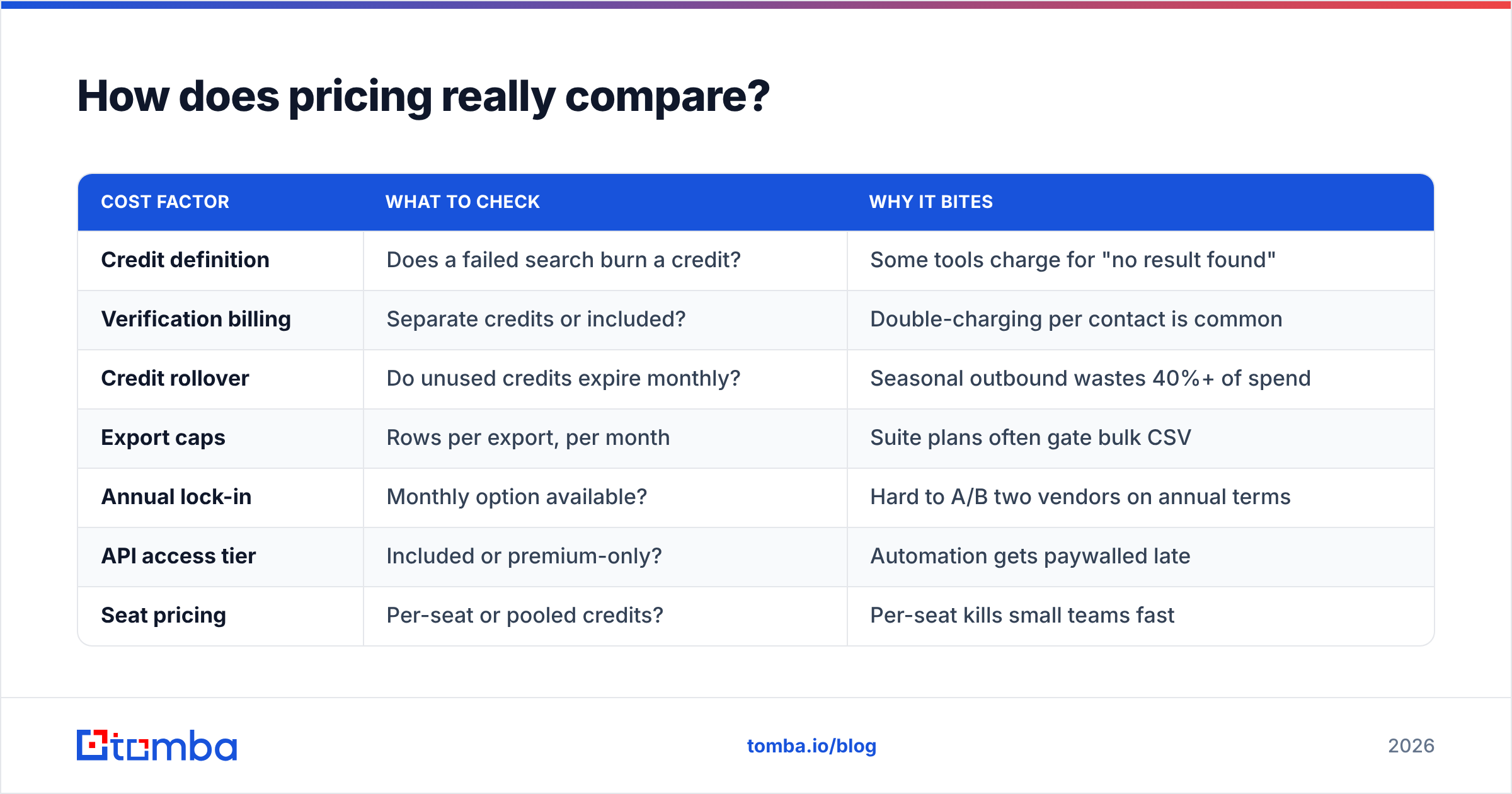
Both Kipplo and Pubrio publish tiered plans that change often enough that quoting numbers here would be stale before you read it. Check their pricing pages directly. What does not change is the structure of how these products bill you, and structure is where the surprises live.
| Cost factor | What to check | Why it bites |
|---|---|---|
| Credit definition | Does a failed search burn a credit? | Some tools charge for "no result found" |
| Verification billing | Separate credits or included? | Double-charging per contact is common |
| Credit rollover | Do unused credits expire monthly? | Seasonal outbound wastes 40%+ of spend |
| Export caps | Rows per export, per month | Suite plans often gate bulk CSV |
| Annual lock-in | Monthly option available? | Hard to A/B two vendors on annual terms |
| API access tier | Included or premium-only? | Automation gets paywalled late |
| Seat pricing | Per-seat or pooled credits? | Per-seat kills small teams fast |
For reference, Tomba's structure is deliberately flat: a free tier at 25 searches per month, Starter at $49/mo, Growth at $99/mo, Pro at $249/mo, and custom Enterprise. The API is not a premium upsell, and bulk email finder runs on the same credit pool rather than a separate SKU.

The pattern worth internalizing: suite pricing is rational when you use the suite. If you buy Pubrio's GTM workflow and then only use the contact search, you are paying a platform premium for a utility function. If you buy a lightweight finder and then need sequencing, intent, and CRM sync, you will end up stitching four tools together and paying more in aggregate. Neither outcome is a vendor's fault — it is a scoping mistake on the buyer's side.
Which tool fits which team?#
Map the tool to the motion, not to the feature list.
- Solo founder doing 50 emails a week. You need a free or cheap tier, a browser extension, and nothing else. Kipplo's leaner positioning suits this, as does a free-tier finder. A GTM suite is overkill and you will not touch 80% of it.
- Two-to-five person SDR team, outbound-led. Volume matters and so does verification. You want pooled credits, a clean CSV export, and a verifier you trust. This is where cost-per-verified-address decides the winner.
- RevOps team building a data layer. You need an API, predictable rate limits, and enrichment that writes back to the CRM. Check whether API access sits behind the top tier before you architect anything. Tools like data enrichment endpoints and a proper HubSpot integration matter more than UI polish here.
- Agency running campaigns for multiple clients. Seat pricing and export caps will make or break your margin. Pooled-credit models beat per-seat models almost every time.
- Enterprise buying a GTM platform. Pubrio's broader surface area is the relevant comparison — but at that spend level you are really comparing against ZoomInfo, Apollo, and Clearbit, and you should be running a formal bake-off with procurement involved. Third-party review volume on G2 is thin for both Kipplo and Pubrio, so lean on trials, not reviews.
One more option worth knowing: if your problem is "I need a clean, verified list right now" rather than "I need a search tool," a purpose-built list vendor like BookYourData solves a genuinely different job — pre-verified contact lists with a bounce guarantee, bought once instead of subscribed to. It is a respectable answer for one-off campaigns where you do not want a platform at all.

Is deliverability the real differentiator?#
Yes, and it is the part of the Kipplo vs Pubrio question that neither vendor's marketing page frames correctly.
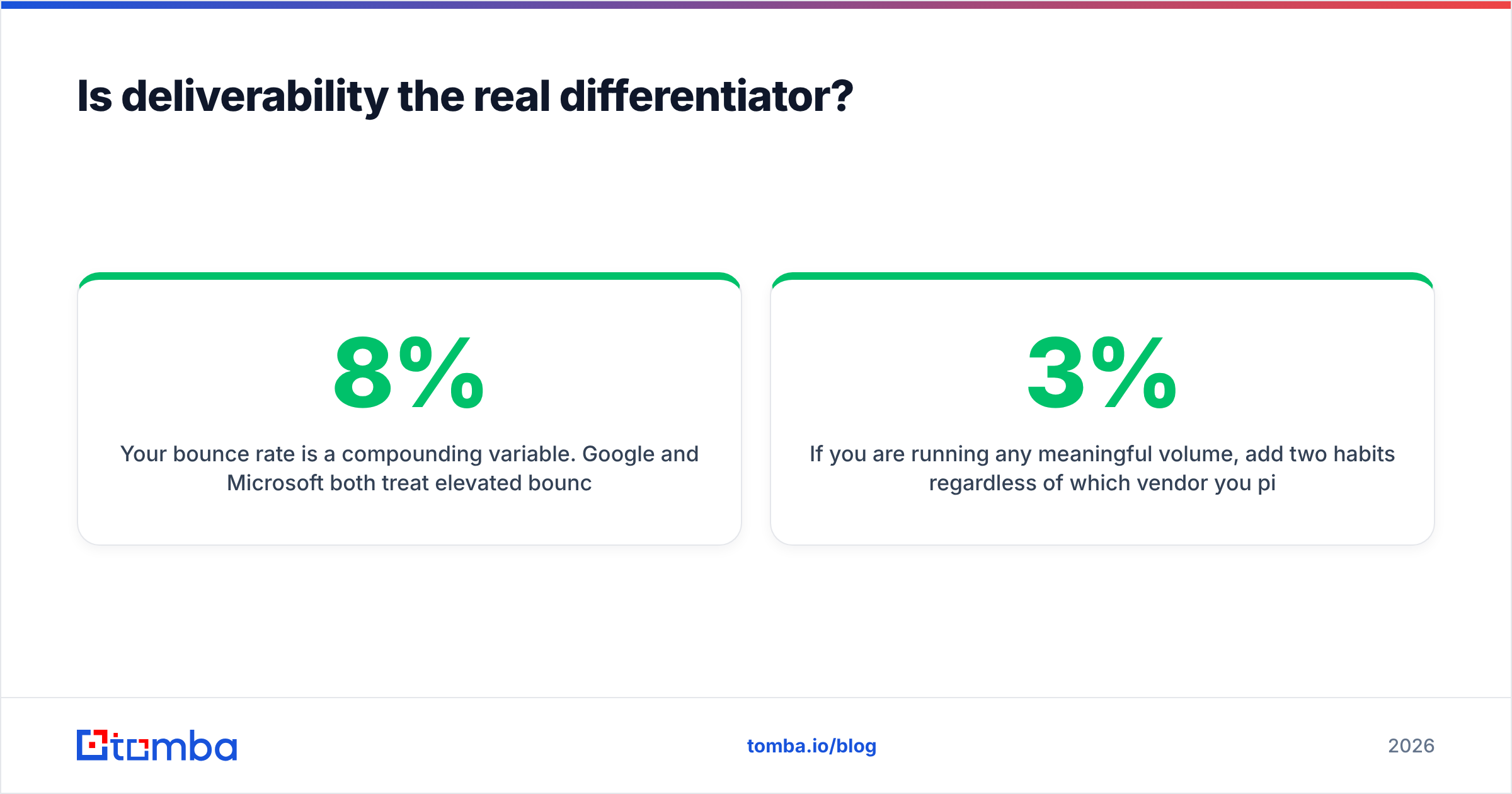
Your bounce rate is a compounding variable. Google and Microsoft both treat elevated bounce and complaint rates as spam signals, and Google's own bulk sender guidelines are explicit that senders must keep invalid recipients low. A list with 8% invalid addresses does not just waste 8% of your sends — it degrades sender reputation for the other 92%, which quietly drops your reply rate across every campaign for weeks.
That is why "which tool has more contacts" is the wrong headline metric. More contacts with worse hygiene is a net negative. The right metric is verified-deliverable contacts per dollar, and the right process is: find, verify with an independent check, suppress catch-alls you cannot confirm, then send.
If you are running any meaningful volume, add two habits regardless of which vendor you pick. Re-verify any list older than 60 days, because B2B data decays roughly 2-3% per month as people change jobs. And keep a free email checker open for spot-checking individual high-value prospects before you put them in a sequence.
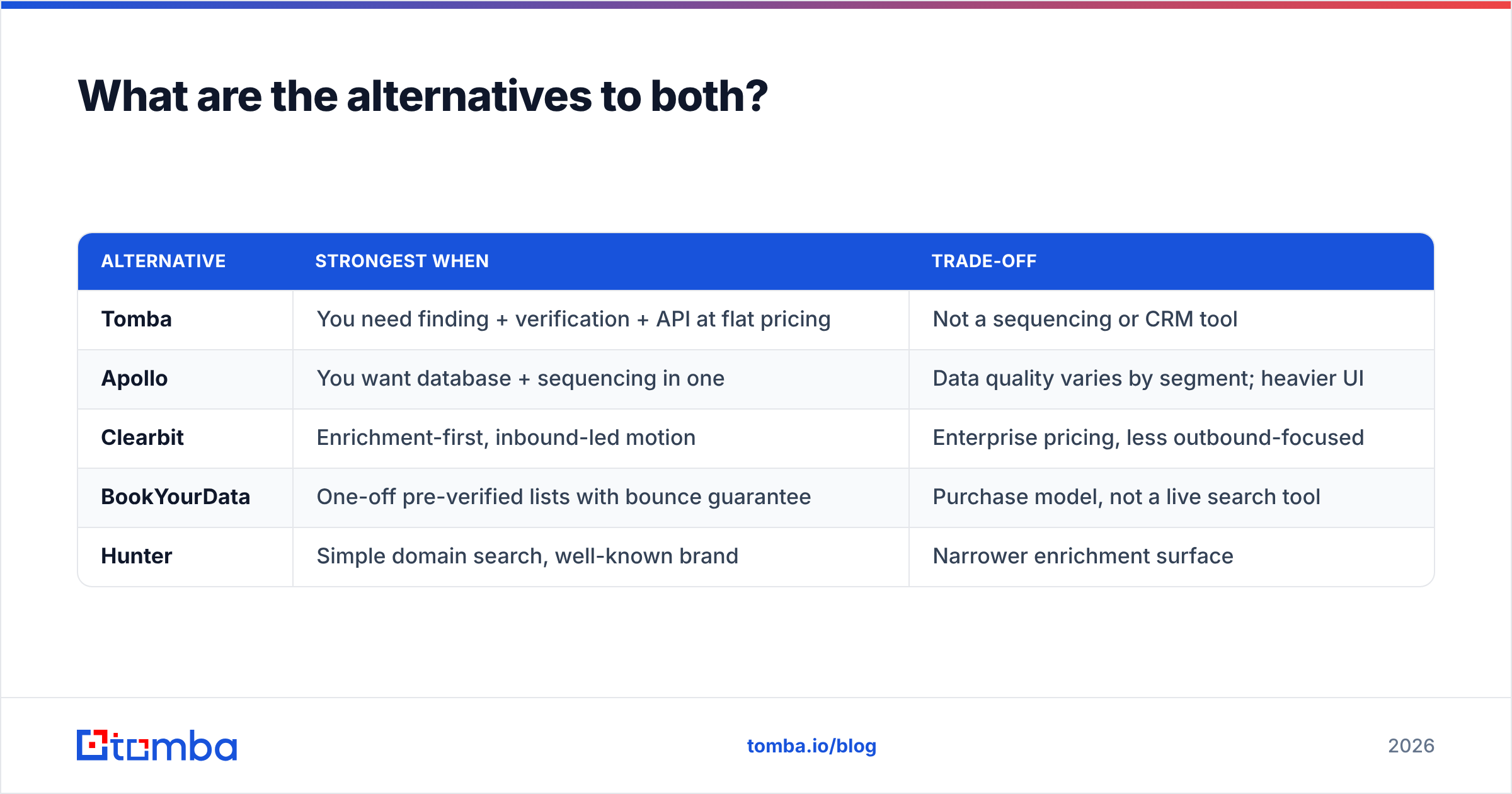
What are the alternatives to both?#
If your trials of both tools come back mediocre on your ICP, widen the field before you settle:
| Alternative | Strongest when | Trade-off |
|---|---|---|
| Tomba | You need finding + verification + API at flat pricing | Not a sequencing or CRM tool |
| Apollo | You want database + sequencing in one | Data quality varies by segment; heavier UI |
| Clearbit | Enrichment-first, inbound-led motion | Enterprise pricing, less outbound-focused |
| BookYourData | One-off pre-verified lists with bounce guarantee | Purchase model, not a live search tool |
| Hunter | Simple domain search, well-known brand | Narrower enrichment surface |
Useful starting points if you go down this road: Apollo alternatives and Clearbit alternatives both break down where each platform's data actually holds up. And if you want the vendor-neutral view of how these categories are defined, Gartner's sales intelligence coverage is a reasonable orientation layer, though it skews toward enterprise suites.
What's the verdict on Kipplo vs Pubrio?#
Pick Pubrio if you want a broader GTM surface and you will genuinely use the workflow layer — the platform premium only pays off when the platform is the product you needed. Pick Kipplo if you want something lighter and your job is mostly "get me contacts for this ICP" without adopting a new system of record.
But do not pick either on marketing copy. Run the 200-contact test, verify the outputs with a neutral third party, and compare cost per usable address. In nearly every bake-off we have seen teams run, the ranking after that test looks different from the ranking after the demo calls — and the gap is almost always verification quality, not database size.
If what you actually need is correct addresses at volume rather than another platform to administer, start with the Tomba Email Finder. The free tier gives you 25 searches a month with no card, which is enough to run a real sample against your own ICP before you spend anything. Starter is $49/mo when you are ready to scale, verification runs on the same credit pool, and the API, CLI, Sheets, and Excel connectors are included rather than gated behind an enterprise tier. Test it alongside Kipplo and Pubrio in the same afternoon and let your own bounce rate decide.
Related guides#
Ready to find emails that actually work?
Join 150,000+ professionals who stopped guessing and started sending. Free credits on signup — no credit card required.
Get the Tomba newsletter
Practical outbound tactics and product updates — once every two weeks.
About the author