Kitt AI vs Apollo.io: Which Sales Tool Wins in 2026?
Kitt AI runs the conversation. Apollo.io owns the database. Here's an honest 2026 breakdown of pricing, data quality, and which one actually belongs in your outbound stack.
Kitt AI vs Apollo.io is a strange matchup. One tool talks to your leads. The other one finds them. This 2026 breakdown covers price, data quality, and the job each tool is built to do.
TL;DR
- Kitt AI and Apollo.io are not real rivals. Kitt AI sits in the AI agent layer. Apollo.io sits in the data and outreach layer. Most Kitt AI vs Apollo.io shortlists end with teams buying one of each.
- Apollo.io is the safer default. You get contact data, sequences, and CRM sync in one plan. Prices start free and reach about $119 per user per month on annual billing.
- Kitt AI-style tools win when reps run out of hours, not when they run out of lists. They do not replace your data source.
- Neither tool fixes the thing that kills outbound: old, unchecked email addresses. That fix is cheaper than both.
- If you mainly need accurate B2B emails, a finder plus a verifier costs less than either mid tier.
Which "Kitt AI" are we actually comparing?#
Start with the name, because it is contested. Kitt.ai was a voice-AI toolkit company. It built Snowboy hotword detection and ChatFlow. Baidu bought it in 2017, and that product line is now dead. The Kitt AI people search for in 2026 is different. It is the new class of AI sales agents. These tools place calls, answer calls, qualify inbound leads, book meetings, and draft replies. No rep sits on the line.
That gap changes the whole comparison. Score a voice agent against Apollo.io on database size and Apollo wins by default. You learn nothing. The fair frame is simple: Kitt AI runs the conversation. Apollo.io feeds the pipeline that creates the conversation. Any Kitt AI vs Apollo.io review that skips this point is comparing a car engine to a fuel supply.
Check the vendor site before you buy. Confirm which Kitt you are looking at. Ask what it does on a live call. Ask if pricing is per seat, per minute, or per booked meeting. AI agent vendors move fast and publish little. Treat any number on a third-party blog, this one included, as a starting point to verify.
What does Apollo.io actually do?#
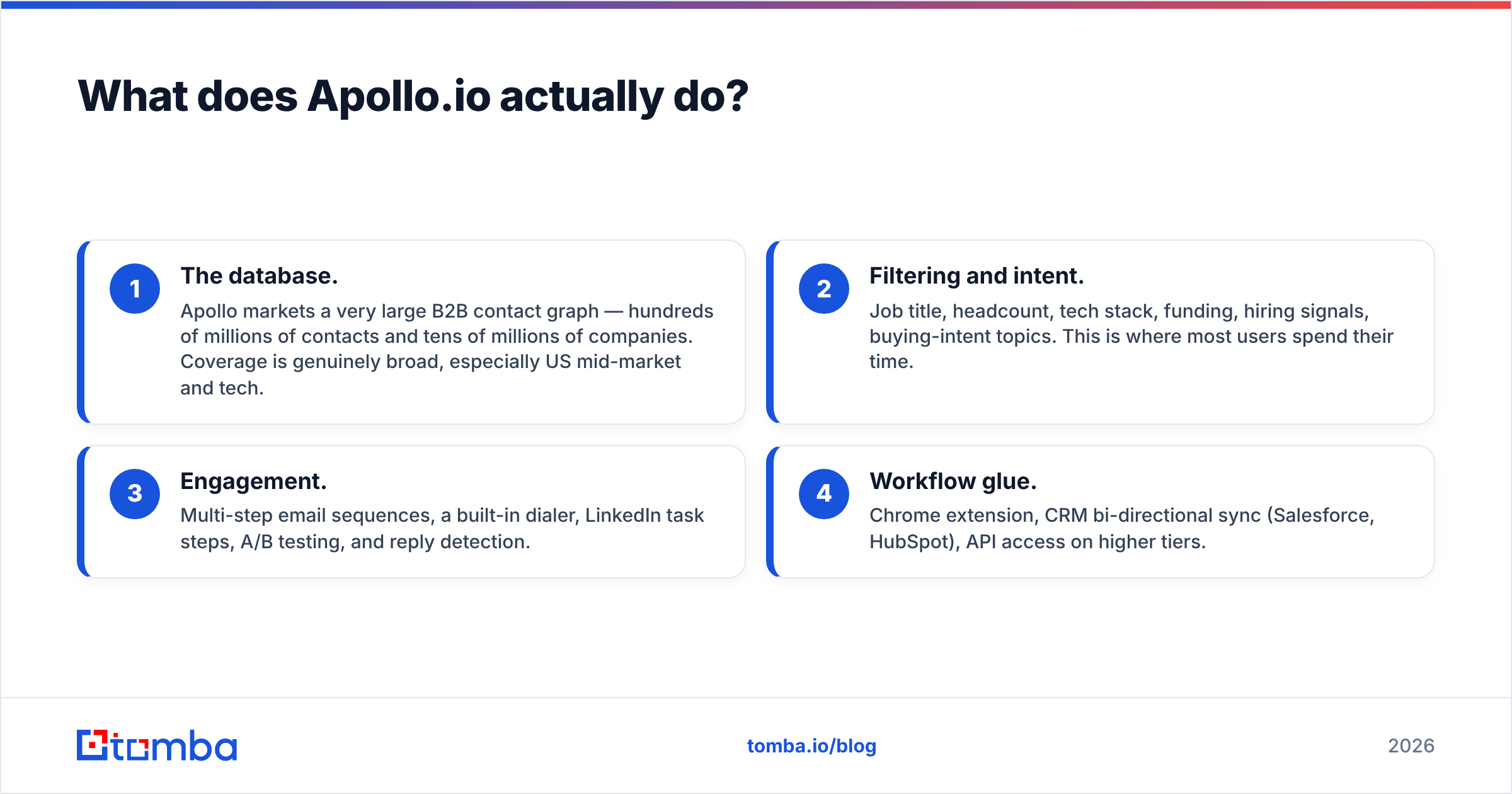
Apollo.io is a sales intelligence and outreach platform. The pitch is consolidation. One login covers the contact database, the filters, the sequencer, the dialer, CRM sync, and basic reports.
The four pillars:
- The database. Apollo claims a very large B2B contact graph. That means hundreds of millions of contacts and tens of millions of companies. Coverage is broad, above all in US mid-market and tech.
- Filters and intent. Job title, headcount, tech stack, funding, hiring signals, and buying intent. Most users spend their time here.
- Outreach. Multi-step email sequences, a built-in dialer, LinkedIn steps, A/B tests, and reply detection.
- Workflow glue. A Chrome extension, two-way CRM sync with Salesforce and HubSpot, and API access on higher tiers.
The trade-off is breadth over depth. Apollo does eight things at a 7 out of 10. It does not do one thing at a 10. Teams that outgrow it leave for a specialist tool, not for another all-in-one.
What does Kitt AI actually do?#
An AI sales agent fills a newer, narrower slot. It does not hand your reps a list. It takes the rep out of part of the job:
- Inbound triage. It answers a form fill or a call in seconds, asks a few qualifying questions, then routes or books.
- Outbound calls. It dials a list, runs the opener, handles pushback, and passes the call to a human when interest is real.
- Follow-up drafts. It writes and sends replies based on the call transcript.
- Meeting admin. Calendar checks, confirmations, reschedules, and no-show recovery.
Here is what it does not do. It does not build your ICP list. It does not verify email addresses. It does not enrich a CSV of 4,000 company domains. It eats data. It does not make data.
That one line settles most Kitt AI vs Apollo.io debates. If you are weighing the agent as a swap for the platform, you are pricing an engine against a fuel supply.
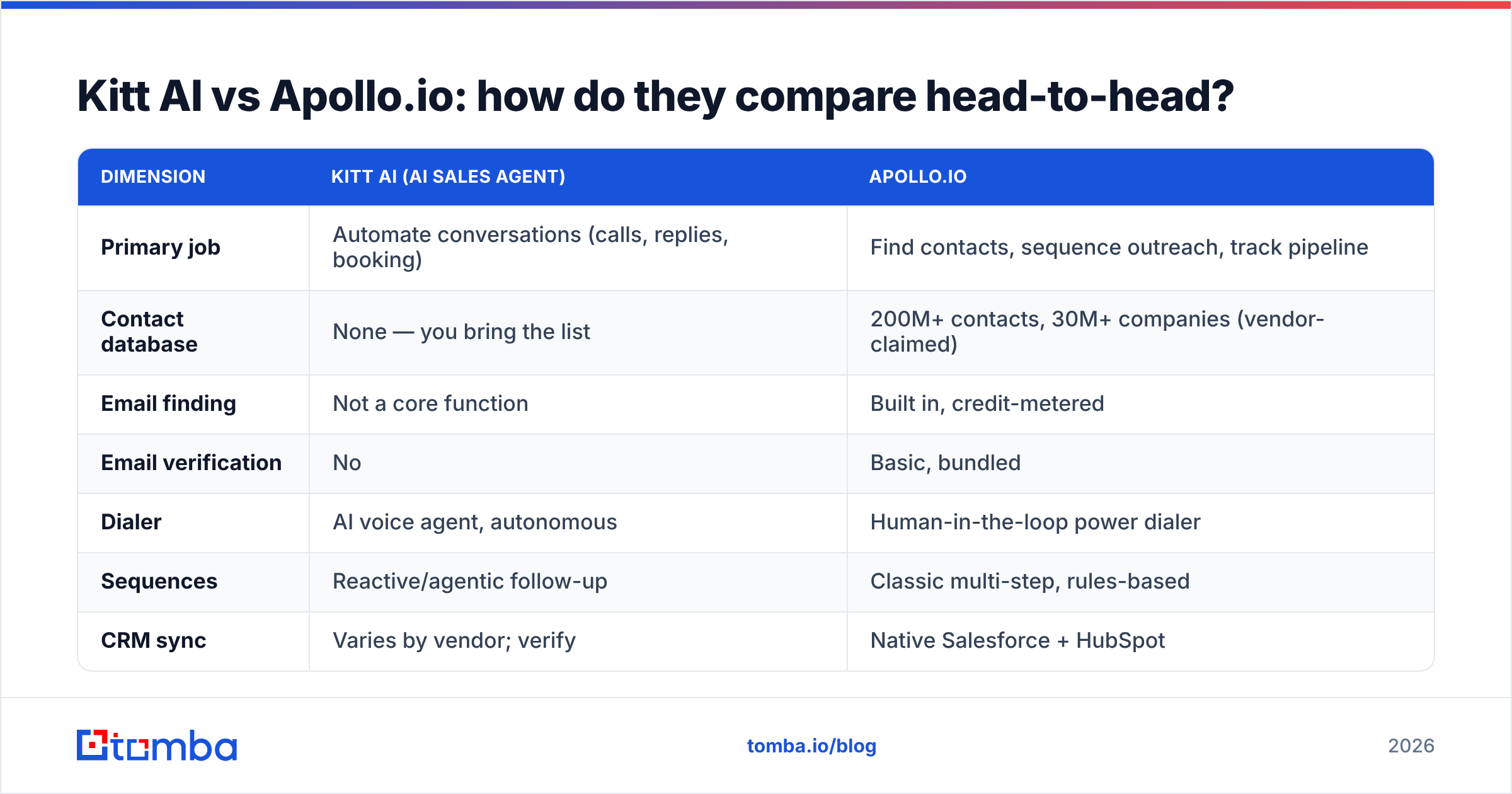
Kitt AI vs Apollo.io: how do they compare head-to-head?#
| Dimension | Kitt AI (AI sales agent) | Apollo.io |
|---|---|---|
| Primary job | Automate conversations (calls, replies, booking) | Find contacts, sequence outreach, track pipeline |
| Contact database | None — you bring the list | 200M+ contacts, 30M+ companies (vendor-claimed) |
| Email finding | Not a core function | Built in, credit-metered |
| Email verification | No | Basic, bundled |
| Dialer | AI voice agent, autonomous | Human-in-the-loop power dialer |
| Sequences | Reactive/agentic follow-up | Classic multi-step, rules-based |
| CRM sync | Varies by vendor; verify | Native Salesforce + HubSpot |
| Pricing model | Usually usage-based (minutes/meetings), often quote-only | Per-user/month, published |
| Entry cost | Typically quote-gated | Free tier available |
| Ramp time | Days to weeks (script + voice tuning) | Hours |
| Best for | Teams drowning in call volume or inbound speed-to-lead | Teams that need lists + outreach in one place |
The pattern holds across every agent-versus-platform matchup in 2026. The agent multiplies volume you already have. The platform creates the volume. Buying the multiplier first is the most common budget mistake we see.
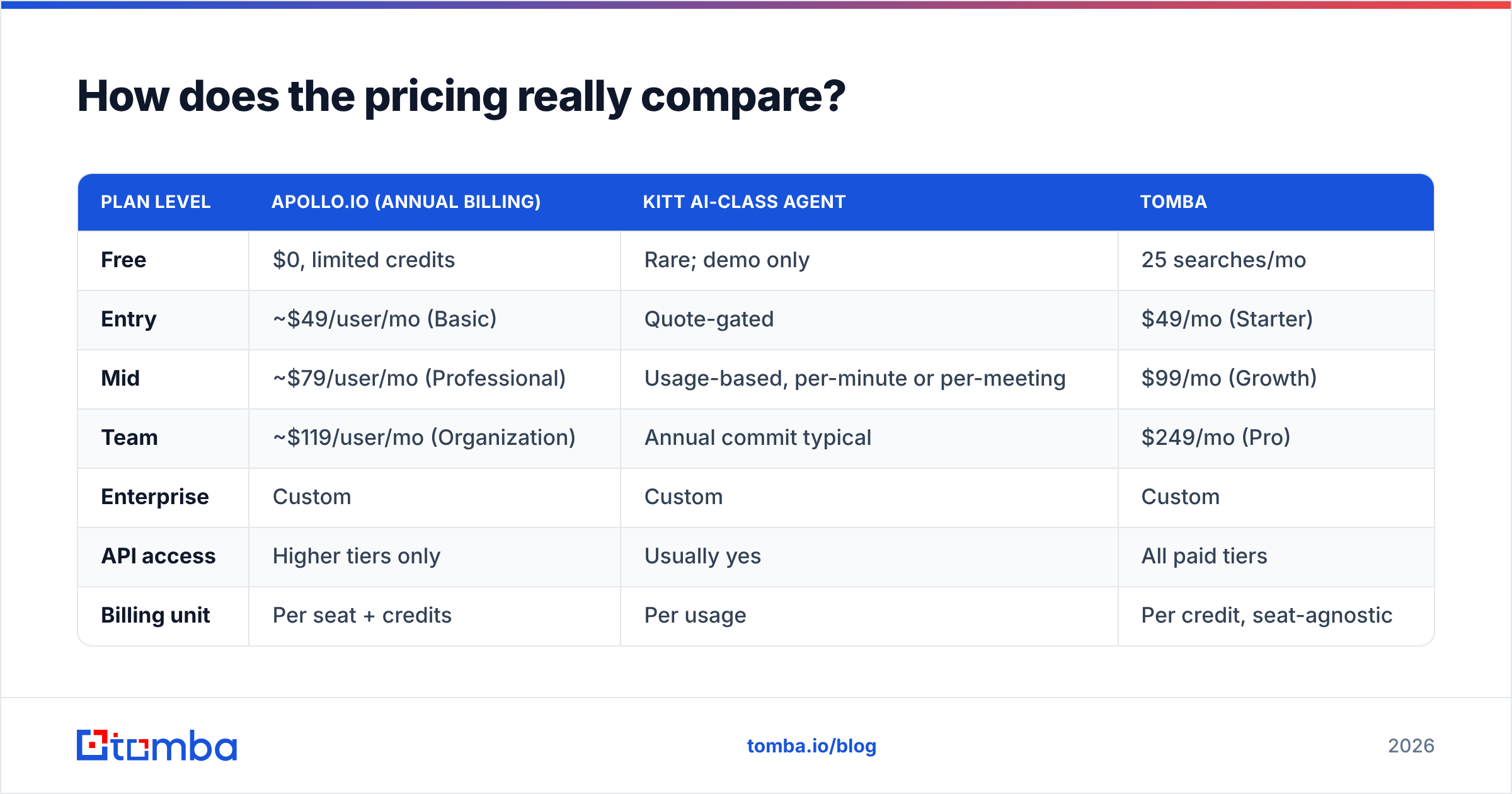
How does the pricing really compare?#
Apollo publishes its prices, so it is easy to benchmark. Kitt AI-class tools usually do not. That makes total cost hard to predict. Usage billing also has a habit of shocking finance in month three.
| Plan level | Apollo.io (annual billing) | Kitt AI-class agent | Tomba |
|---|---|---|---|
| Free | $0, limited credits | Rare; demo only | 25 searches/mo |
| Entry | ~$49/user/mo (Basic) | Quote-gated | $49/mo (Starter) |
| Mid | ~$79/user/mo (Professional) | Usage-based, per-minute or per-meeting | $99/mo (Growth) |
| Team | ~$119/user/mo (Organization) | Annual commit typical | $249/mo (Pro) |
| Enterprise | Custom | Custom | Custom |
| API access | Higher tiers only | Usually yes | All paid tiers |
| Billing unit | Per seat + credits | Per usage | Per credit, seat-agnostic |
Two notes on this table. First, Apollo's monthly billing costs a lot more than annual. Check Apollo's own pricing page before you budget, since tiers and credit limits change. Second, seat pricing punishes growing teams, and usage pricing punishes success. Run your Kitt AI vs Apollo.io cost model against a 12-month headcount plan, not against this quarter.
For a like-for-like look at seat pricing versus credit pricing, our Apollo alternative breakdown runs the same math across eight vendors.
Is data quality the real deciding factor?#
Yes. And both sides are weak here, in different ways.
Apollo's scale is real. But scale and accuracy are not the same thing. Big scraped databases decay by design. Roughly 25% to 30% of B2B contact data goes stale each year as people change jobs. On G2's AI sales assistant category, the same complaint repeats for every all-in-one tool. Great filters. Mixed email accuracy. Credits burned on bounces.
AI agents make that worse. An agent that calls a dead number wastes more than a credit. It burns minutes. It hurts your sender reputation. It also fills your transcripts with noise, which makes the agent's own model worse over time.
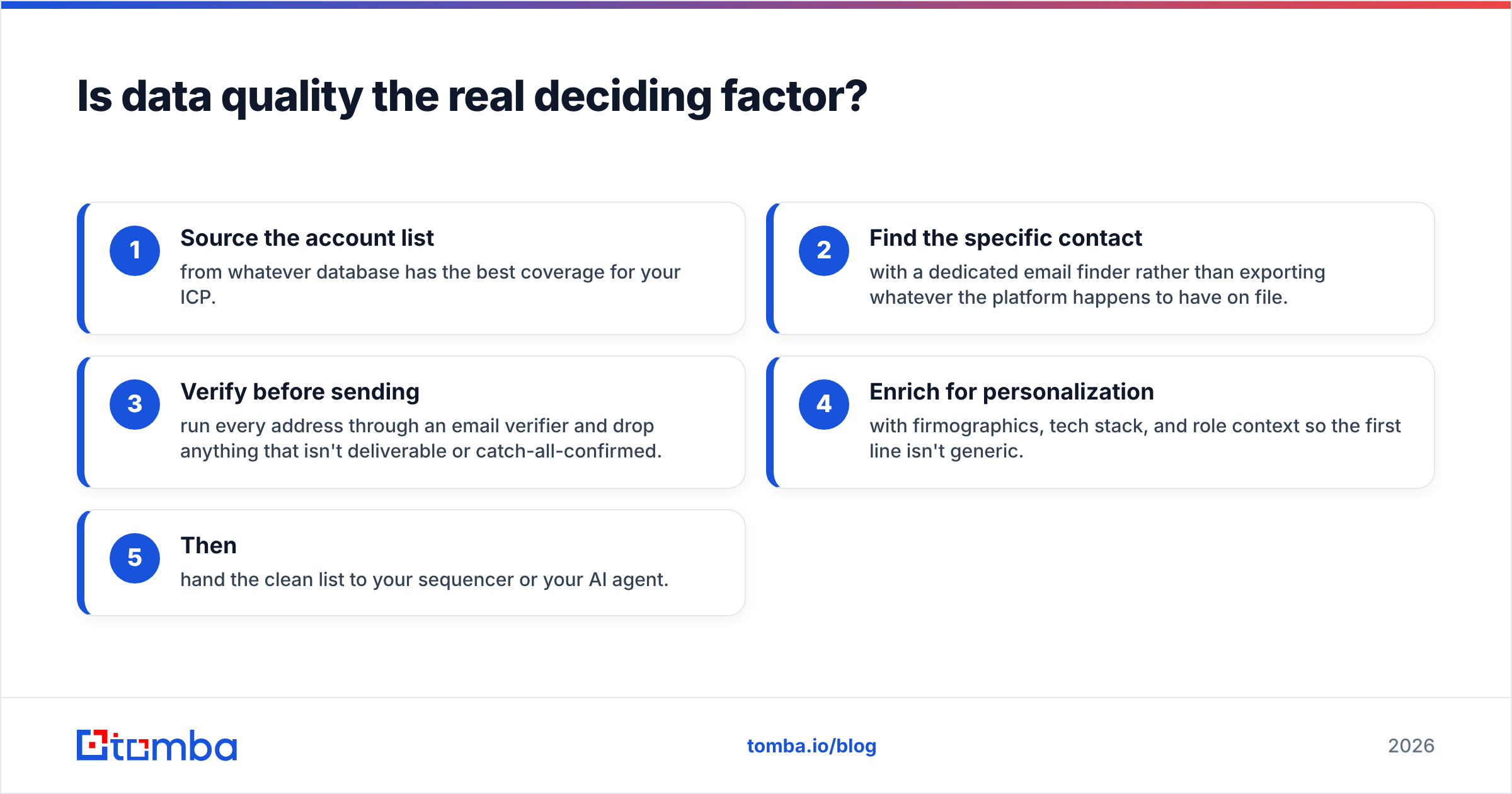
Here is the order that works:
- Build the account list from whatever database covers your ICP best.
- Find the person with a dedicated email finder instead of exporting whatever the platform has on file.
- Verify before you send. Run every address through an email verifier. Drop anything that is not deliverable.
- Enrich for context. Add company size, tech stack, and role, so the first line is not generic.
- Then hand the clean list to your sequencer or your AI agent.
Steps 2 and 3 cost a fraction of one all-in-one seat. They lift every metric after them. Skip them, and you will decide that AI SDRs do not work. The real cause is that 22% of the list was dead on arrival. Most Kitt AI vs Apollo.io reviews leave this part out.
Which one should you buy?#
Buy Apollo.io if:
- You have fewer than 20 reps and no data vendor yet.
- You want lists, sequences, and reports in one place, and 7 out of 10 on each is fine.
- You want a free tier to test before you spend.
- You run Salesforce or HubSpot and want sync that works on day one.
Buy a Kitt AI-style agent if:
- You already have more leads than your reps can call.
- Speed to lead is your real bottleneck, and inbound sits for hours before first contact.
- You run high-volume, low-price deals where a 30-second qualifying call pays for itself.
- You can live with usage billing and have someone to own script tuning.
Buy neither yet if:
- Your bounce rate is above 3%. Fix the data first. No tool downstream survives a bad list.
- You cannot write a five-filter search for your ICP. Both tools will happily help you reach the wrong people faster.
For most teams under 50 reps, the honest Kitt AI vs Apollo.io answer is Apollo.io plus a real data layer. Add an agent in year two, once call volume earns it. Other tools worth a look include BookYourData for verified lists and standalone verifiers for deliverability. The market has unbundled, and unbundled stacks usually cost less than a row of all-in-one seats.
What does a lean 2026 stack look like instead?#
Strip both products down to the jobs they really do. The replacement stack is short:
- Account list: a database or a filtered export. Apollo works here. So do cheaper tools.
- Contact resolution: a finder that returns a confidence score, not a guess. Guessed addresses at scale get your domain blocked.
- Verification: SMTP checks and catch-all handling before anything enters a sequence.
- Enrichment: role, seniority, tech stack, and recent company news via data enrichment, so personalization can run on autopilot.
- Delivery: any sequencer or AI agent you like. This layer is now a commodity.
- Automation: an API or CLI, so the stack runs nightly instead of by hand on Tuesday.
Teams on this setup spend less than one Apollo Organization seat on data. They also get better email response rates, because the list is smaller, cleaner, and better targeted. HubSpot's sales research has made the same point for years. List quality beats list size.
The verdict#
Apollo.io wins the Kitt AI vs Apollo.io head-to-head on breadth, clear pricing, and speed to value. It is the right default when you need one tool to do most things and want to see the price before a sales call. Kitt AI-class agents win on a narrower point. They buy back rep hours once you already have volume. The two are complements, not swaps. Any Kitt AI vs Apollo.io verdict that crowns a single winner is comparing categories, not products.
Neither one fixes the input. If your emails bounce, your agent talks to voicemail and your sequences burn your domain.
Start there. Run your current list through Tomba's Email Finder. You get verified, source-linked addresses by domain, name, or company. There are 25 free searches a month, and paid plans start at $49 per month. Clean the data first. Then decide whether you need the platform, the agent, or both.
Related guides#
// get started
Find, verify and enrich your first contacts today
Start on the free plan with 25 searches a month, then scale when your team is ready.
Free plan · No credit card required · GDPR & CCPA
// about the author