Klaviyo Deliverability Certificate: Is It Worth It in 2026?
Klaviyo's free deliverability certificate takes about an hour and hands you a LinkedIn badge. Here is what the exam actually tests, what it leaves out, and whether it moves your inbox placement at all.
TL;DR
- The Klaviyo Deliverability Certificate is a free, self-paced Klaviyo Academy course plus a multiple-choice exam. Budget roughly an hour, not a weekend.
- It is genuinely good on the fundamentals most ecommerce marketers get wrong: engagement-based sending, sunset flows, authentication, and reading Klaviyo's own deliverability reporting.
- It is weak on everything upstream of your list: where addresses come from, how to keep bad ones out, and what to do when you send outside Klaviyo.
- The badge carries real weight in the Klaviyo partner and agency ecosystem, and close to zero weight anywhere else.
- Take it if you run Klaviyo daily or you are selling Klaviyo services. Skip it if you are a cold outbound sender — the curriculum assumes permission-based lists and will not map to your problems.
What is the Klaviyo Deliverability Certificate?#
It is a free credential from Klaviyo Academy, the company's training arm. You work through a short course on inbox placement, then pass a multiple-choice exam. Pass, and you get a shareable certificate you can drop on LinkedIn and an entry in your Klaviyo Academy transcript.
Think of it like a food-handler's card for email. It does not make you a chef. It proves you know not to leave the chicken out.
The certificate sits inside a wider Academy catalog — email marketing, SMS, flows, segmentation, reporting, and the broader Klaviyo Product Certification track. Deliverability is one of the shorter ones, which is part of why people take it first. Klaviyo periodically re-cuts these courses, so treat any exact question count or passing threshold you read online (including here) as approximate and check the Academy page before you sit down. In practice, expect a short multiple-choice exam, a pass bar around 80%, and retakes allowed.
Nothing about the exam is proctored. Nobody is watching. That tells you most of what you need to know about how the wider market values it — and also why you should not fake your way through it, because the value is in the material, not the PDF.
What does the certificate actually cover?#
The curriculum is narrower than "deliverability" sounds. It is deliverability as practiced inside Klaviyo by an ecommerce sender. That is a real specialization, and the course is honest about it.
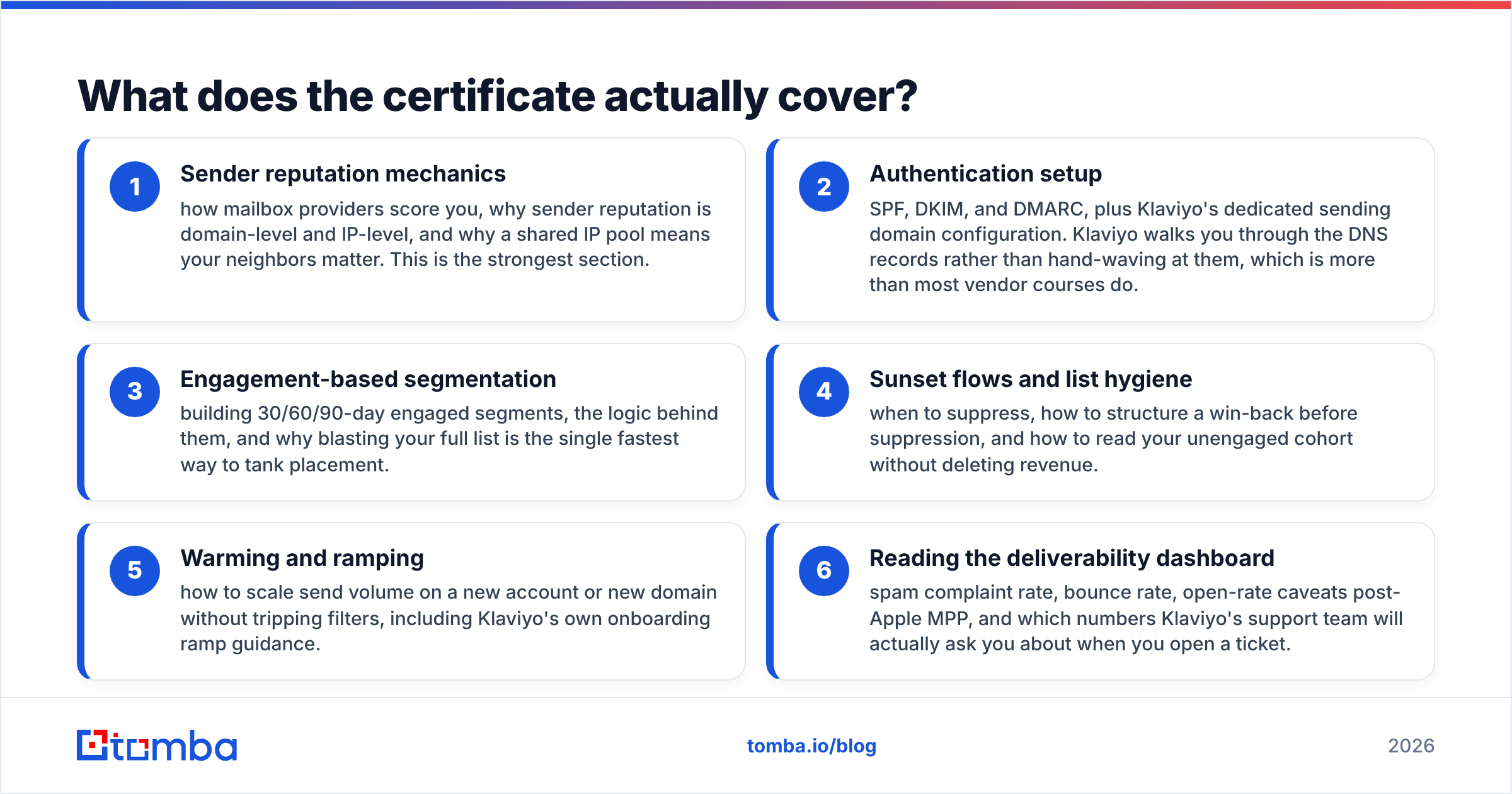
- Sender reputation mechanics — how mailbox providers score you, why sender reputation is domain-level and IP-level, and why a shared IP pool means your neighbors matter. This is the strongest section.
- Authentication setup — SPF, DKIM, and DMARC, plus Klaviyo's dedicated sending domain configuration. Klaviyo walks you through the DNS records rather than hand-waving at them, which is more than most vendor courses do.
- Engagement-based segmentation — building 30/60/90-day engaged segments, the logic behind them, and why blasting your full list is the single fastest way to tank placement.
- Sunset flows and list hygiene — when to suppress, how to structure a win-back before suppression, and how to read your unengaged cohort without deleting revenue.
- Warming and ramping — how to scale send volume on a new account or new domain without tripping filters, including Klaviyo's own onboarding ramp guidance.
- Reading the deliverability dashboard — spam complaint rate, bounce rate, open-rate caveats post-Apple MPP, and which numbers Klaviyo's support team will actually ask you about when you open a ticket.
That list is the honest core. If you can execute all six, you are ahead of most in-house ecommerce marketers.

How hard is the exam and how long does it take?#
Not hard. That is not an insult — it is the design goal.
The course video and reading material run under an hour if you do not skip. The exam is scenario-flavored multiple choice: "Your complaint rate jumped to 0.4% after a campaign to your full list — what do you do first?" If you have managed a real Klaviyo account for three months, you will recognize most answers by instinct.
Where people fail is the authentication section. Marketers who have never opened a DNS panel guess on the SPF record and DKIM questions. If that is you, spend twenty extra minutes on those modules and run your own domain through an SPF checker before the exam so the concepts are concrete rather than memorized.
Retakes are permitted, so the real cost of failure is embarrassment and thirty minutes.
How does it compare to other deliverability certifications?#
Here is the honest landscape. Most "deliverability certifications" are vendor education programs — they teach the discipline through the lens of one platform. That is fine as long as you know it going in.
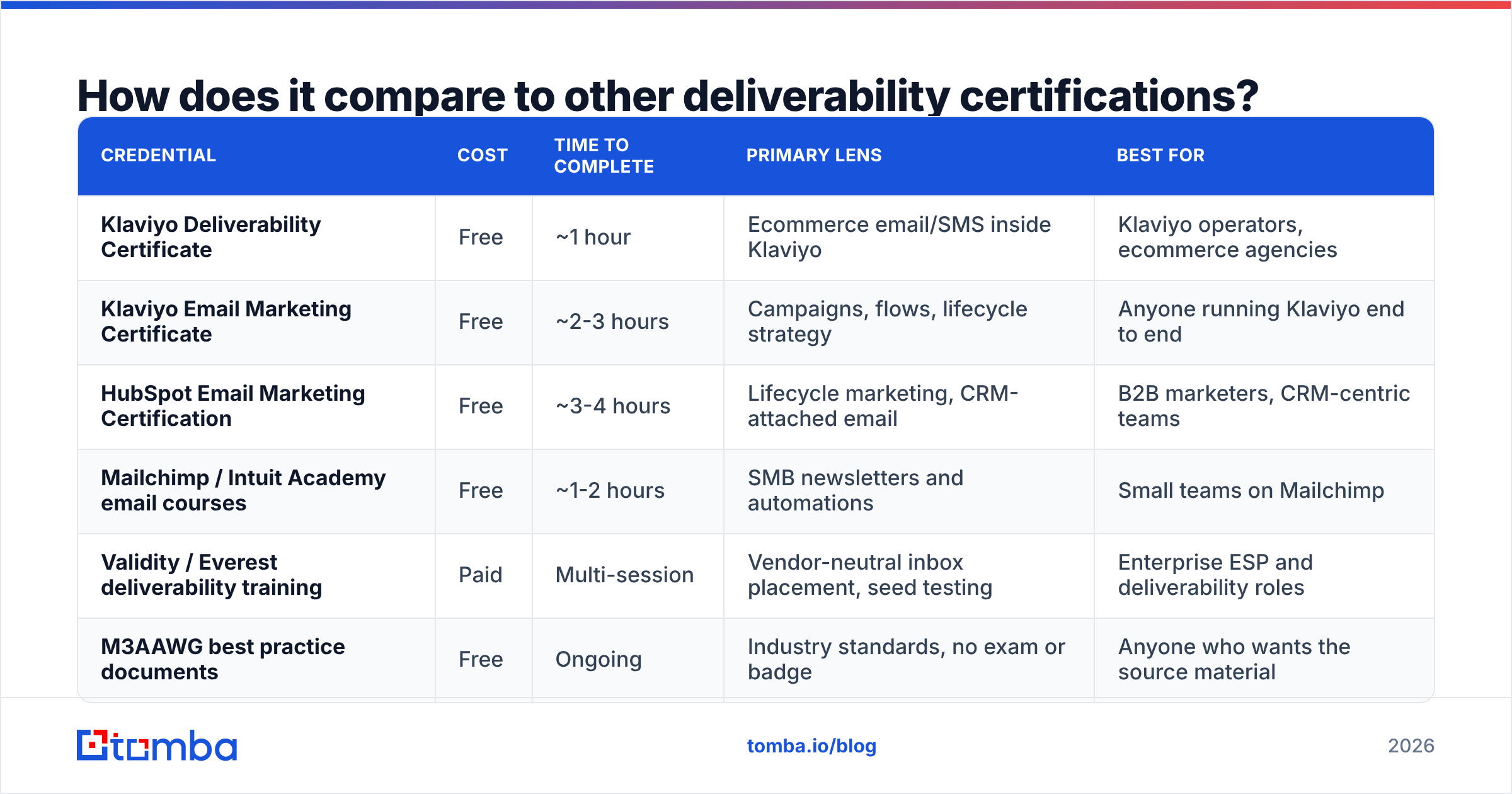
| Credential | Cost | Time to complete | Primary lens | Best for |
|---|---|---|---|---|
| Klaviyo Deliverability Certificate | Free | ~1 hour | Ecommerce email/SMS inside Klaviyo | Klaviyo operators, ecommerce agencies |
| Klaviyo Email Marketing Certificate | Free | ~2-3 hours | Campaigns, flows, lifecycle strategy | Anyone running Klaviyo end to end |
| HubSpot Email Marketing Certification | Free | ~3-4 hours | Lifecycle marketing, CRM-attached email | B2B marketers, CRM-centric teams |
| Mailchimp / Intuit Academy email courses | Free | ~1-2 hours | SMB newsletters and automations | Small teams on Mailchimp |
| Validity / Everest deliverability training | Paid | Multi-session | Vendor-neutral inbox placement, seed testing | Enterprise ESP and deliverability roles |
| M3AAWG best practice documents | Free | Ongoing | Industry standards, no exam or badge | Anyone who wants the source material |
Two things fall out of that table.
First, if your goal is a job title with "deliverability" in it, the Klaviyo certificate is a starter, not a finisher. Serious deliverability roles look for vendor-neutral depth — seed list testing, blocklist remediation, feedback loop management, postmaster tool fluency. Klaviyo's course touches those; it does not train them.
Second, if your goal is to stop your Black Friday campaign from landing in Promotions purgatory, the Klaviyo certificate is better targeted than the broader HubSpot or Mailchimp courses, because it is specific about the platform you actually send from. Specific beats comprehensive when you have one hour.
You can sanity-check how practitioners rate the platform itself on G2's Klaviyo reviews — deliverability comes up constantly in both directions, which is a decent argument for learning the tooling properly.
Is the Klaviyo Deliverability Certificate worth it?#
Yes, with a narrow definition of "worth it."
Worth it if:
- You manage one or more Klaviyo accounts and have never formally learned why your unengaged segment is poison.
- You work at an agency. Klaviyo's partner program rewards certified staff, and prospects on sales calls do ask.
- You are junior and need something on a résumé that signals you know what DMARC stands for.
- You are about to migrate a list into Klaviyo and want to avoid the classic first-send reputation crater.
Not worth it if:
- You already run deliverability professionally. You will learn nothing in the first forty minutes and be annoyed by the last twenty.
- You send cold outbound. The entire curriculum assumes opted-in, transactional-adjacent ecommerce lists. Its advice — "segment by engagement, suppress the rest" — is correct there and only partly transferable to prospecting, where you have no engagement history to segment on yet.
- You want a credential that hiring managers outside ecommerce recognize. They mostly will not.
The certificate's real return is not the badge. It is that it forces a marketer to sit still for an hour and confront the fact that email deliverability is a list-quality problem wearing a technical costume.
What does the certificate leave out?#
This is the section that matters most, because the gaps are where campaigns actually die.
Data acquisition. Klaviyo's course starts at "you have a list." It says almost nothing about how addresses enter that list, beyond a nod to double opt-in on forms. In practice, a huge share of deliverability incidents trace back to one import: a purchased file, a scraped set, an old CRM export, a trade-show spreadsheet where someone wrote their email in handwriting a scanner misread. None of the engagement segmentation in the world saves you from a list that was 12% invalid on day one.
Pre-send verification. The course covers bounce rate as a symptom to monitor. It spends little time on preventing bounces before the first send. That is backwards for anyone importing data. Running an import through an email verifier before it touches your sending platform is cheaper than repairing a burned domain, and it is the one step that reliably keeps hard bounces under the thresholds the course tells you to watch.
Catch-all and role-account handling. Ecommerce lists are mostly consumer domains, so Klaviyo can skate past this. B2B senders cannot. A B2B list is full of info@, sales@, and catch-all domains that accept everything and deliver nothing. If that is your world, you need a catch-all verifier in the workflow, and the certificate will not tell you so.
Multi-channel reality. Most teams do not send only from Klaviyo. They send lifecycle email from Klaviyo, sales email from a mailbox provider, and transactional from somewhere else — all on the same root domain, all sharing one domain reputation. The certificate optimizes one of those three and leaves the interaction unaddressed.
Blocklist remediation. Getting listed on Spamhaus or a similar blocklist is covered at the "this is bad" level. The actual delisting workflow — identify the listing, fix the cause, document it, request removal, wait — is out of scope. Keep a blacklist checker bookmarked and learn that process elsewhere.

How do you turn the certificate into actual inbox placement?#
The exam gives you a mental model. Here is the operating checklist that converts it into results.
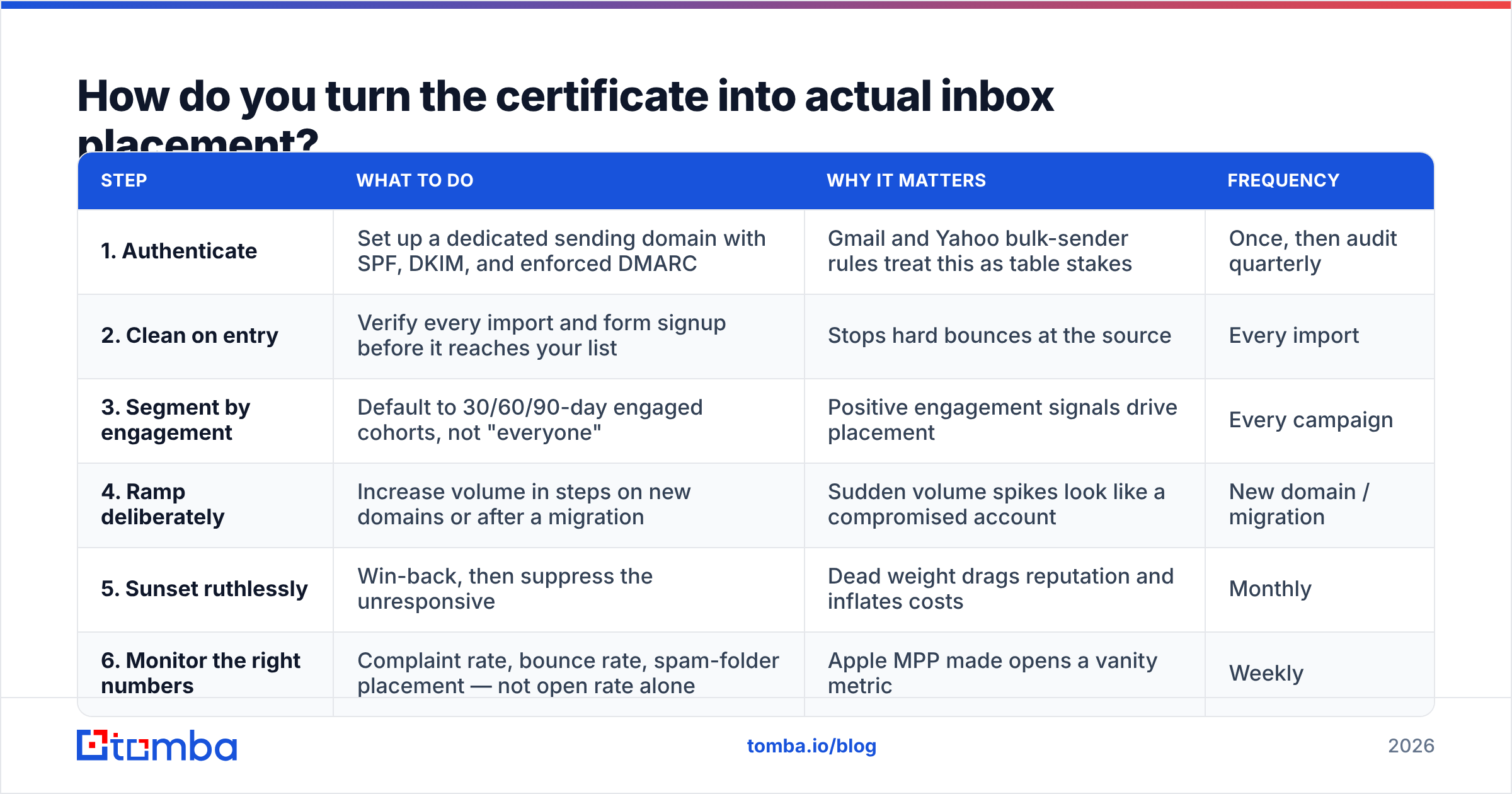
| Step | What to do | Why it matters | Frequency |
|---|---|---|---|
| 1. Authenticate | Set up a dedicated sending domain with SPF, DKIM, and enforced DMARC | Gmail and Yahoo bulk-sender rules treat this as table stakes | Once, then audit quarterly |
| 2. Clean on entry | Verify every import and form signup before it reaches your list | Stops hard bounces at the source | Every import |
| 3. Segment by engagement | Default to 30/60/90-day engaged cohorts, not "everyone" | Positive engagement signals drive placement | Every campaign |
| 4. Ramp deliberately | Increase volume in steps on new domains or after a migration | Sudden volume spikes look like a compromised account | New domain / migration |
| 5. Sunset ruthlessly | Win-back, then suppress the unresponsive | Dead weight drags reputation and inflates costs | Monthly |
| 6. Monitor the right numbers | Complaint rate, bounce rate, spam-folder placement — not open rate alone | Apple MPP made opens a vanity metric | Weekly |
Step 2 is the one the certificate under-weights and the one with the highest return. If you are pulling contacts from a new source — a partner list, a conference roster, a market you just expanded into — the sequence should be: find, verify, then import. Not import, then discover.
For volume ramping specifically, a warmup calculator gives you a concrete daily schedule instead of the course's general advice to "increase gradually."
Should you take the other Klaviyo certificates too?#
If you are going for the badge collection, order matters. Deliverability first, because it is short and it changes how you build everything else. Then Email Marketing, then Flows and Segmentation, then the Product Certification if you are agency-side and need the partner credit.
The diminishing returns arrive fast. By the third certificate you are mostly re-reading Klaviyo's documentation with a quiz attached. That is fine — vendor documentation is genuinely good and most people never read it — but be honest about what you are buying with your afternoon.
One caveat worth stating plainly: every vendor certification teaches you the vendor's opinion. Klaviyo's opinion about deliverability happens to be mainstream and mostly correct. Other platforms' courses are not always as careful. Cross-read with vendor-neutral sources — M3AAWG documents, mailbox provider postmaster guidelines, and your own send data — before treating any single course as gospel.
The bottom line#
The Klaviyo Deliverability Certificate is an hour well spent for anyone who operates Klaviyo, and an hour wasted for anyone who already does deliverability for a living. It teaches the right fundamentals, it is free, and it is honest about its own scope. The badge is worth something inside the Klaviyo ecosystem and not much outside it — which is a perfectly reasonable trade for sixty minutes.
What it will not fix is the list you feed it. Engagement segmentation cannot rescue addresses that were never valid, and a sunset flow cannot un-send to a spam trap. If your deliverability problem started with a bad import, the certificate diagnoses the symptom and leaves the cause alone.
That is where the work actually begins. Build your lists from verified, first-party sourcing rather than bought files — use the Tomba Email Finder to find real, current professional addresses by domain or name, verify them before they ever hit your sending platform, and then let everything the certificate taught you do its job. Free tier gives you 25 searches a month to test the workflow; paid plans start at $49/mo on Tomba pricing when you are ready to run it at scale. Clean input first, clever segmentation second — in that order, every time.
Related guides#
// get started
Find, verify and enrich your first contacts today
Start on the free plan with 25 searches a month, then scale when your team is ready.
Free plan · No credit card required · GDPR & CCPA
Get the Tomba newsletter
Product and data updates
// about the author