Klue Pricing Reviews Pros and Cons: A 2026 Buyer's Guide
Klue doesn't publish a price list, so buyers negotiate blind. Here's what teams actually pay in 2026, what reviewers praise and complain about, and when a cheaper competitive-intel stack does the same job.
Klue is a competitive intel tool with no public price tag. This guide puts Klue pricing reviews pros and cons in one place. You get the quote ranges buyers report, the praise and the gripes from real users, and the point where a cheaper stack does the same job.
TL;DR
- Klue is a competitive enablement platform — it collects competitor intel and pushes it to reps as battlecards inside Salesforce, Slack, and Teams. It is not a lead database and not a prospecting tool.
- Klue does not publish pricing. Buyers who share numbers on procurement marketplaces and review sites typically land in the $18,000–$60,000+ per year range, driven by seat count, competitor count, and add-ons like win-loss.
- Reviewers consistently praise the Slack/CRM delivery and the AI summarization. The most common complaints are price, the amount of curation work required, and thin intel on niche or private competitors.
When it pays off:
- Klue earns its cost when you have a named set of 5–15 competitors, a full-time or half-time competitive intel owner, and enough deal volume that a 2-point win-rate lift pays the invoice.
- If you are under ~30 reps, or your real bottleneck is finding and reaching the right buyers rather than positioning against rivals, a lightweight intel setup plus a solid contact-data stack will beat a five-figure Klue contract.
What Is Klue and Who Actually Buys It?#
Klue is a competitive enablement platform. Think of it as a newsroom for your competitors. Web crawlers, review scrapers, pricing-page monitors, and field notes from reps are the reporters. Your competitive intel manager is the editor. The output is a short, opinionated brief for the people who need it — your sellers.
The core object is the battlecard: a one-screen answer to "we're up against Competitor X, what do I say?" Klue's differentiator has never been collecting the intel, because plenty of tools crawl press releases. It is the delivery layer. Cards surface inside Salesforce opportunity records. They land in Slack when a competitor name comes up. They sit in the Chrome extension while a rep writes an email.
The buyer profile is narrow and worth being blunt about. Klue is bought by:
- Product marketing leaders at companies with 100+ employees who own competitive positioning and are tired of maintaining battlecards in Google Docs nobody opens.
- Enablement teams that need measurable proof that content is consumed — Klue reports card views, and that reporting is often what justifies the renewal internally.
- Sales leaders in crowded categories (martech, HR tech, cybersecurity, fintech) where 60%+ of deals are competitive and losing on "we didn't know they'd bundled that feature" is a recurring post-mortem line.
If none of those three describe you, Klue is over-scoped for your problem. You can read the official product framing on klue.com. The volume of category-specific reviews on G2 is a decent proxy for how enterprise-weighted the customer base is.
How Much Does Klue Cost in 2026?#
Klue publishes no price list, no per-seat rate, and no free tier. Every deal goes through a demo and a quote. That is a deliberate choice. It lets the vendor price to your company size and your competitive pain rather than to a public anchor. It is also the single most common complaint in buyer forums.
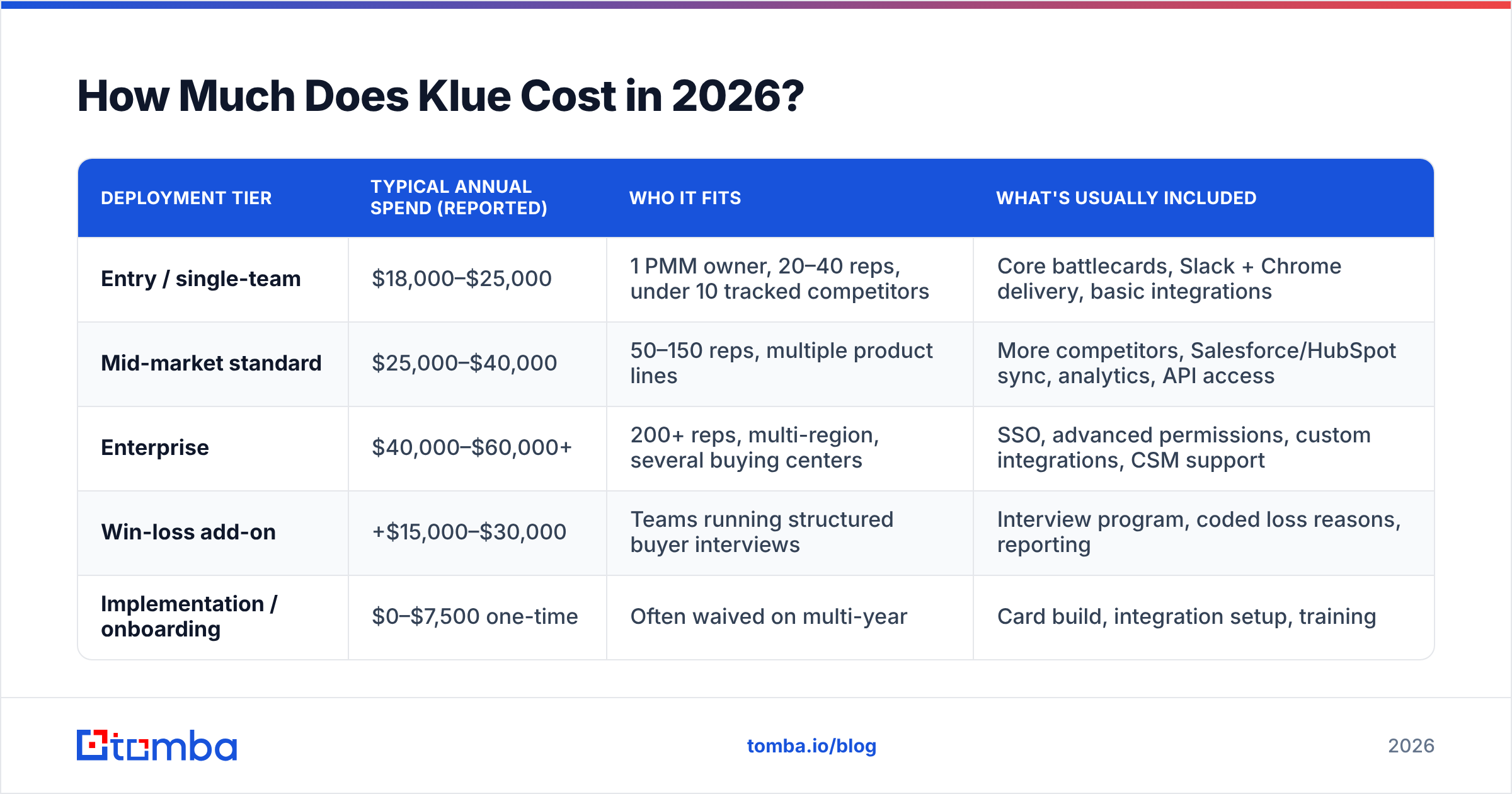
The numbers below are reported ranges compiled from buyer-shared contract data on procurement marketplaces and review-site pricing sections, not official vendor rates. Treat them as a negotiating anchor, not a quote. Your real number will move with seat count, contract length, and how badly you need the add-ons.
| Deployment tier | Typical annual spend (reported) | Who it fits | What's usually included |
|---|---|---|---|
| Entry / single-team | $18,000–$25,000 | 1 PMM owner, 20–40 reps, under 10 tracked competitors | Core battlecards, Slack + Chrome delivery, basic integrations |
| Mid-market standard | $25,000–$40,000 | 50–150 reps, multiple product lines | More competitors, Salesforce/HubSpot sync, analytics, API access |
| Enterprise | $40,000–$60,000+ | 200+ reps, multi-region, several buying centers | SSO, advanced permissions, custom integrations, CSM support |
| Win-loss add-on | +$15,000–$30,000 | Teams running structured buyer interviews | Interview program, coded loss reasons, reporting |
| Implementation / onboarding | $0–$7,500 one-time | Often waived on multi-year | Card build, integration setup, training |
Three pricing mechanics matter more than the headline number:
- Seats are usually unlimited or near-unlimited on higher tiers. Klue's value story depends on every rep seeing cards, so per-seat gating is light. Your price is driven by company size and competitor count instead.
- Multi-year discounts are real and large. Two- and three-year commitments commonly cut 15–25% off the annual rate. That is also how you get locked in before you know whether reps actually use it.
- Renewal uplift is the sting. Year-two increases of 7–15% are routinely reported. Negotiate a capped uplift clause in year one, or you will be having an uncomfortable meeting later.

What Drives Your Klue Quote Up or Down?#
Before you take a call, know which levers the rep is pulling. Three of them account for most of the variance between a $20K quote and a $50K quote:
- Headcount, not seat count. Klue sizes on company revenue and employee count. A 300-person company with 40 sellers will quote higher than a 60-person company with 40 sellers. Have your real numbers ready. Scope the contract to the selling org where you can.
- Number of tracked competitors. Entry packages often cap at 5–10. Each expansion block adds cost. Be ruthless here. Most teams genuinely lose to three rivals, not fifteen. Track the three that show up in your closed-lost data.
- Add-on modules. Win-loss interviews, consumer/market intel, and advanced analytics are priced separately. The win-loss module is the most common budget surprise. It can nearly double a small contract.
Two more levers are easy to miss:
- Integration depth. Slack and Chrome are standard. Deep Salesforce object mapping, Highspot/Seismic sync, and API-based pipelines usually sit on higher tiers.
- Timing. Klue, like most enterprise SaaS, has quarter-end and fiscal-year-end flexibility. A quote taken in week two of a quarter and a quote taken in the last week are not the same quote.
What Do Klue Reviews Actually Say?#
Klue pricing reviews pros and cons look different once you read past the star rating. Aggregate scores sit in the strong-but-not-flawless band — roughly 4.6/5 across several hundred reviews on G2 and similar territory on Capterra. That is high. But review-site scores for enablement tools skew upward, because the reviewer is usually the champion who bought the tool. Read the 3-star reviews. That is where the truth lives.
What reviewers consistently praise:
- Delivery where reps already are. The Slack alert and the CRM card are the features that show up in nearly every positive review. Content nobody has to go find gets used.
- AI summarization quality. Klue compresses long competitor updates into a usable two-line "so what." That has improved sharply over the last two release cycles and is now a real differentiator rather than a checkbox.
- Consumption analytics. Being able to show leadership that 78% of reps opened the new card is how PMMs defend their headcount. Few competitors report this as cleanly.
- Onboarding and CSM support. Implementation reviews are unusually positive for an enterprise tool.
What reviewers consistently complain about:
- Price and price opacity. The most frequent criticism by a wide margin. Smaller teams describe sticker shock relative to the size of the problem.
- Curation burden. Klue surfaces raw signal, but a human still has to decide what matters and write the card. Teams without a dedicated owner report cards going stale inside a quarter, and stale cards destroy rep trust fast.
- Noise on broad competitors. If you track a giant like Microsoft or Salesforce, the alert firehose needs heavy tuning.
- Thin coverage of private and niche competitors. Public-source crawling can't see what isn't published. If your top rival is a 40-person private company, your best intel still comes from your own reps and from win-loss calls.
- Search inside the card library. Multiple reviewers note that finding a specific card in a large library is clunkier than it should be.

How Does Klue Compare to Crayon, Kompyte, and AlphaSense?#
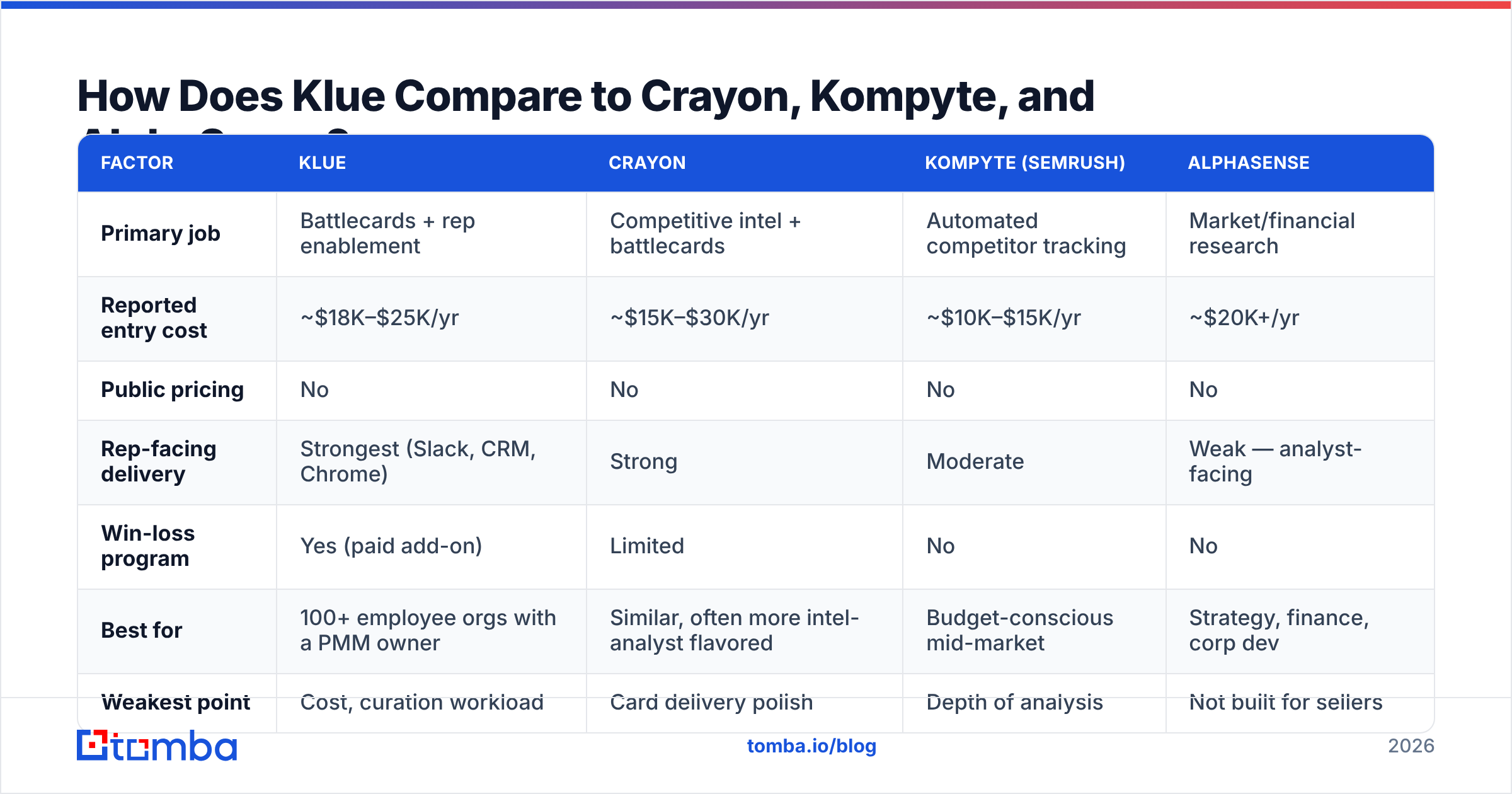
Klue's closest head-to-head is Crayon. Kompyte (now part of Semrush) competes on price. AlphaSense plays a different game entirely: market and financial research, not sales enablement.
| Factor | Klue | Crayon | Kompyte (Semrush) | AlphaSense |
|---|---|---|---|---|
| Primary job | Battlecards + rep enablement | Competitive intel + battlecards | Automated competitor tracking | Market/financial research |
| Reported entry cost | ~$18K–$25K/yr | ~$15K–$30K/yr | ~$10K–$15K/yr | ~$20K+/yr |
| Public pricing | No | No | No | No |
| Rep-facing delivery | Strongest (Slack, CRM, Chrome) | Strong | Moderate | Weak — analyst-facing |
| Win-loss program | Yes (paid add-on) | Limited | No | No |
| Best for | 100+ employee orgs with a PMM owner | Similar, often more intel-analyst flavored | Budget-conscious mid-market | Strategy, finance, corp dev |
| Weakest point | Cost, curation workload | Card delivery polish | Depth of analysis | Not built for sellers |
The practical decision rule is short. If the person who will own this tool sits in product marketing and their output is rep-facing cards, Klue and Crayon are the shortlist, and the choice comes down to quote and integration fit. If the owner sits in strategy or corp dev, you want AlphaSense and should not be in a Klue evaluation at all. If you have no owner, buy neither. You will pay five figures for a library that decays.
Is Klue Worth It for Your Team?#
The Klue pricing reviews pros and cons debate ends in simple math. Run the numbers before the demo, not after.
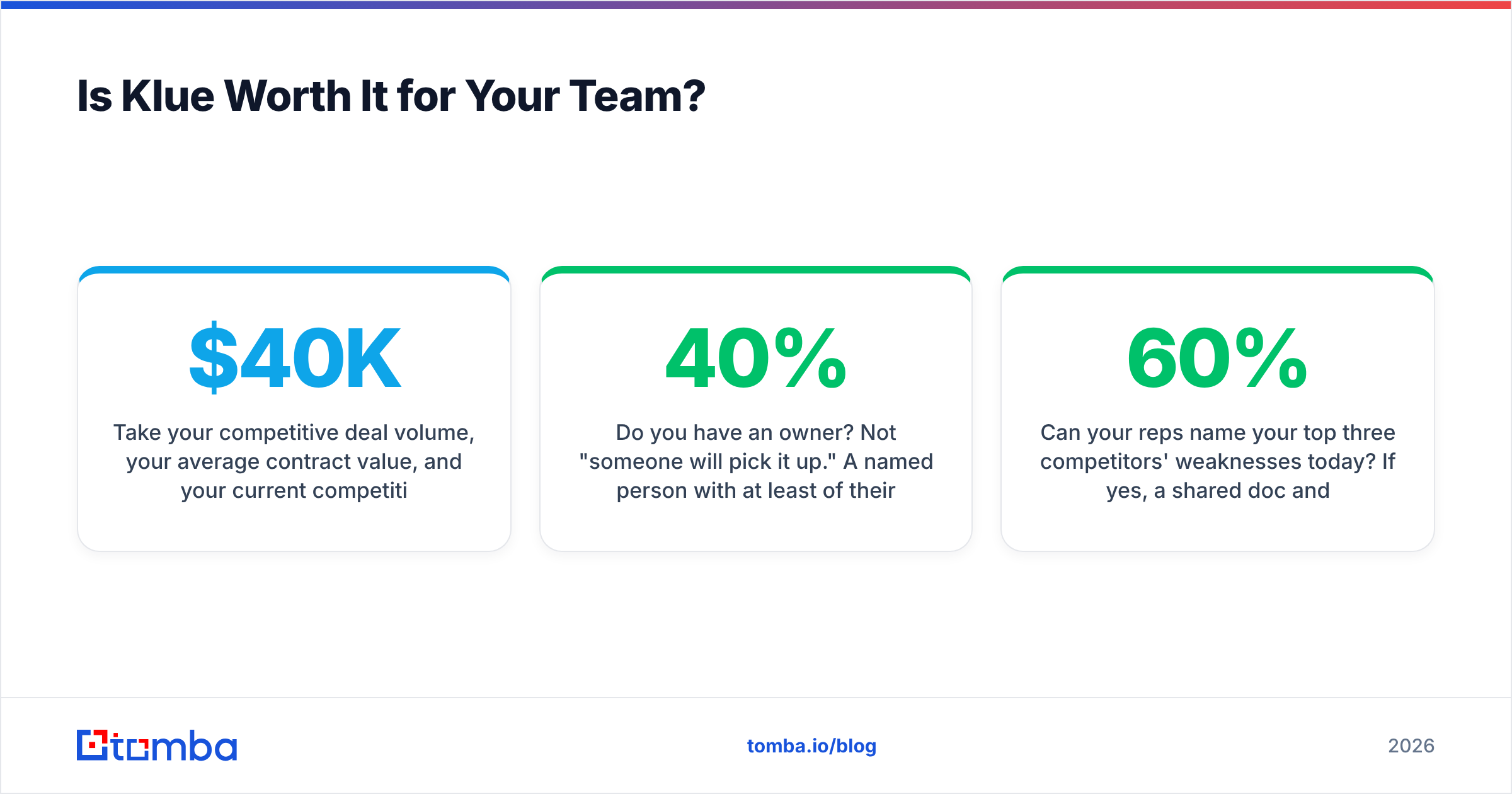
Take your competitive deal volume, your average contract value, and your current competitive win rate. Say you run 200 competitive deals a year at $40K ACV and a 35% win rate. That is $2.8M won. A 2-point win-rate lift is $160K in new revenue, so a $35K contract clears comfortably. Now say you run 40 competitive deals at $12K ACV. The same 2 points is $9,600, and no amount of vendor ROI slideware fixes that gap.
Then apply three qualifying filters:
- Do you have an owner? Not "someone will pick it up." A named person with at least 40% of their week allocated to competitive intel. Without this, Klue fails — and it fails expensively, because the tool did its job and nobody edited the output.
- Do you lose deals to competitors, or to no-decision? Pull your last 100 closed-lost records. If the dominant reason is budget, timing, or status quo, competitive intel is not your constraint. Pipeline volume and qualification are.
- Can your reps name your top three competitors' weaknesses today? If yes, a shared doc and a monthly 30-minute review may capture 60% of the value for 0% of the cost. Buy Klue when the doc has already failed at your scale, not before.
What Should You Do Before Signing a Klue Contract?#
- Get the quote before the deep-dive demo. Ask for indicative pricing on the first call with your headcount and competitor count. If the rep defers twice, that's a signal about how the rest of the negotiation goes.
- Scope competitors down. Start with your true top five. Expansion later is a smaller fight than a downgrade at renewal.
- Cap the renewal uplift in writing. Target 5% or less, and get it in the order form, not in an email.
Then protect the budget itself:
- Negotiate a usage-based out. If rep card-view rates fall below an agreed threshold in the first two quarters, you get a rescope. Vendors confident in adoption will engage with this.
- Unbundle win-loss for year one. Run 10 loss interviews yourself first. If the insight is genuinely better than what your CRM already tells you, add the module in year two with leverage.
- Check the data you already own. Your CRM, your website visitor data, and your closed-lost notes contain most of your competitive picture already. Tools like website visitor reveal surface which competitor-adjacent accounts are researching you — often the same signal at a fraction of the cost.
What's the Cheaper Alternative Stack?#
For teams under roughly 30 reps, a workable substitute costs a low four figures a year. You need competitor alerts from free monitoring tools, a structured battlecard template your PMM refreshes monthly, a recurring 20-minute competitive segment in your sales meeting, and disciplined closed-lost coding in your CRM.
The part most teams under-invest in is the one that actually moves revenue: knowing who to talk to at the accounts your competitors already serve. Competitive intel tells you what to say. It does not tell you the VP of Ops' email address at the 40 accounts up for renewal with your rival next quarter. That is a contact-data problem, and it is far cheaper to solve than a five-figure enablement contract. Pair displacement-target lists with data enrichment and a verified B2B database. That combination costs a fraction of a Klue seat block and produces pipeline you can measure in weeks, not quarters.
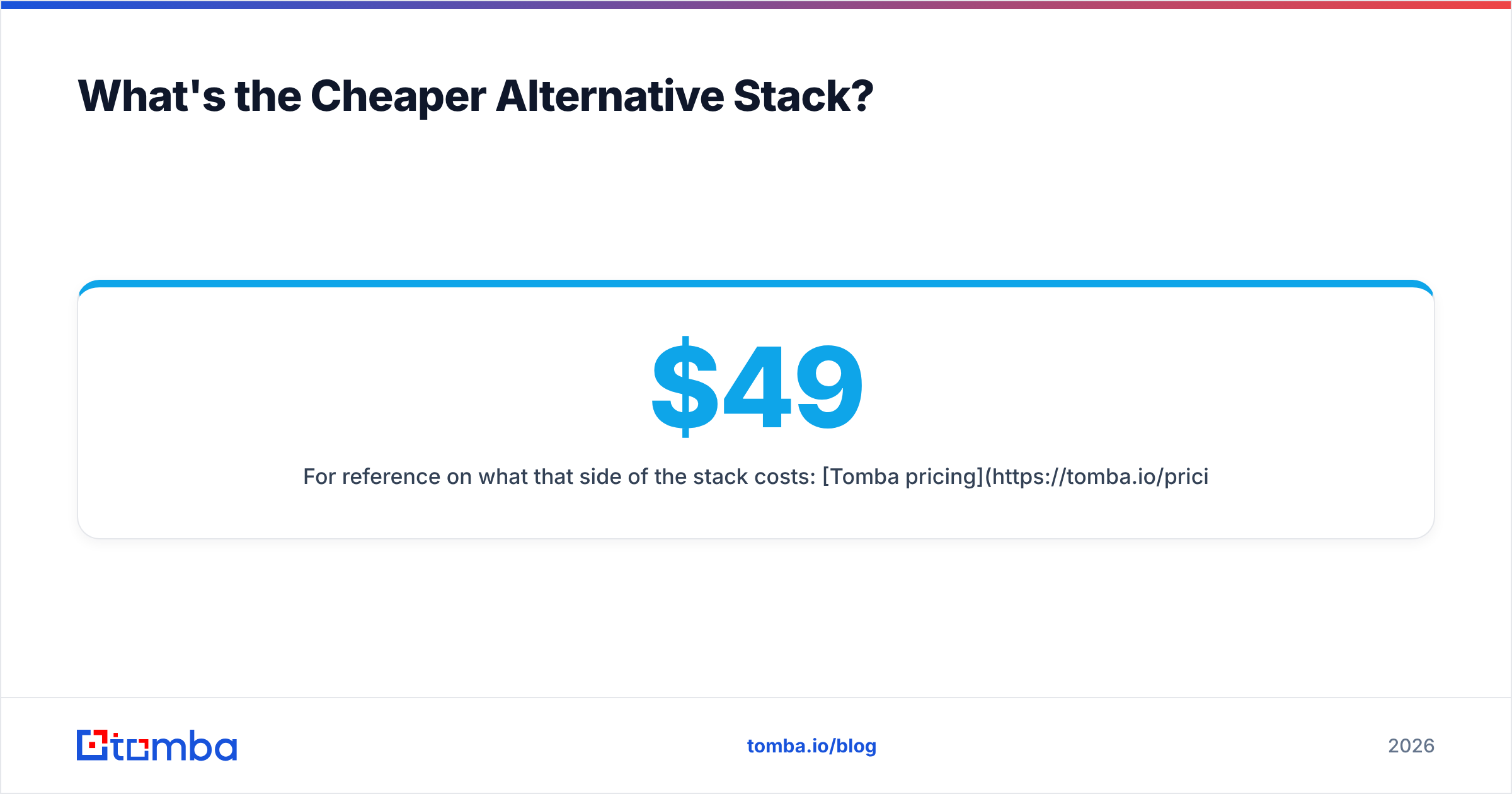
For reference on what that side of the stack costs: Tomba pricing starts with a free tier at 25 searches per month, Starter at $49/mo, Growth at $99/mo, and Pro at $249/mo — annual spend that rounds to a rounding error against any competitive enablement contract.
Klue Pricing Reviews Pros and Cons: The Bottom Line#
Klue is a genuinely good product sold at an enterprise price to a specific buyer. If you have a named competitive intel owner, a crowded category, and enough competitive deal volume that two points of win rate is real money, it earns its invoice, and reviewers will tell you the same. If you're evaluating it because competitive losses feel frequent, go count them first. Most teams that do discover their problem is pipeline coverage, not positioning.
And if that's where you land, start at the top of the funnel. Build your displacement target list, then use the Tomba Email Finder to turn those company names into verified, reachable decision-makers — free for your first 25 searches, no demo call and no annual contract required.
Related guides#
// get started
Find, verify and enrich your first contacts today
Start on the free plan with 25 searches a month, then scale when your team is ready.
Free plan · No credit card required · GDPR & CCPA
// about the author