Klyck Alternatives: 9 Sales Enablement Tools Compared
Klyck is a solid content-and-playbook hub, but it is not the only option — and for some teams it is not the cheapest or the fastest to roll out. Here is an honest comparison of 9 Klyck alternatives.
TL;DR
- Klyck is a sales enablement and content management platform built around a searchable content hub, guided playbooks, and buyer-facing pages. It works best for mid-market teams with a large, messy content library.
- Most teams shopping for Klyck alternatives want one of four things: deeper analytics, a cheaper per-seat price, faster rollout, or tighter CRM coupling.
- Highspot and Seismic are the enterprise-grade replacements. Paperflite, Enablix, and Dock are the lighter, cheaper ones. Guru is the answer if your real problem is knowledge, not decks.
- Enablement software only multiplies pipeline you already have. If reps are running out of accounts to talk to, a content hub will not fix that — a contact data layer will.
- Budget realistically: most enablement platforms land between $25 and $85 per seat per month, with a 4–12 week rollout and an implementation fee that nobody puts on the pricing page.
What is Klyck and who is it actually for?#
Klyck is a sales enablement platform that stores your sales and marketing content in one searchable library, wraps it in guided playbooks, and lets reps share it with buyers through trackable links or microsites. Think of it as a filing cabinet that also tells the rep which drawer to open for a mid-funnel manufacturing prospect — and then reports back on which pages the buyer actually read.
The sweet spot for Klyck is a 20–150 person revenue team with a content problem that has gotten out of hand: 400 PDFs on a shared drive, four versions of the same pricing sheet, and a marketing team that cannot tell which asset closed anything. Klyck's strength is organization — tagging, filtering, and "content pages" that bundle related assets into something a rep can send in one link. Manufacturing, industrial, and distribution companies show up often in its customer base, which tracks: those are catalog-heavy businesses drowning in spec sheets.
Where it gets challenged is the two ends of the market. Enterprise buyers with 500+ reps want the coaching, training, and revenue-intelligence layers that Highspot and Seismic bolt on. Small teams look at the per-seat cost and realize they mostly needed a better-organized Google Drive with link tracking.
Why do teams look for Klyck alternatives?#
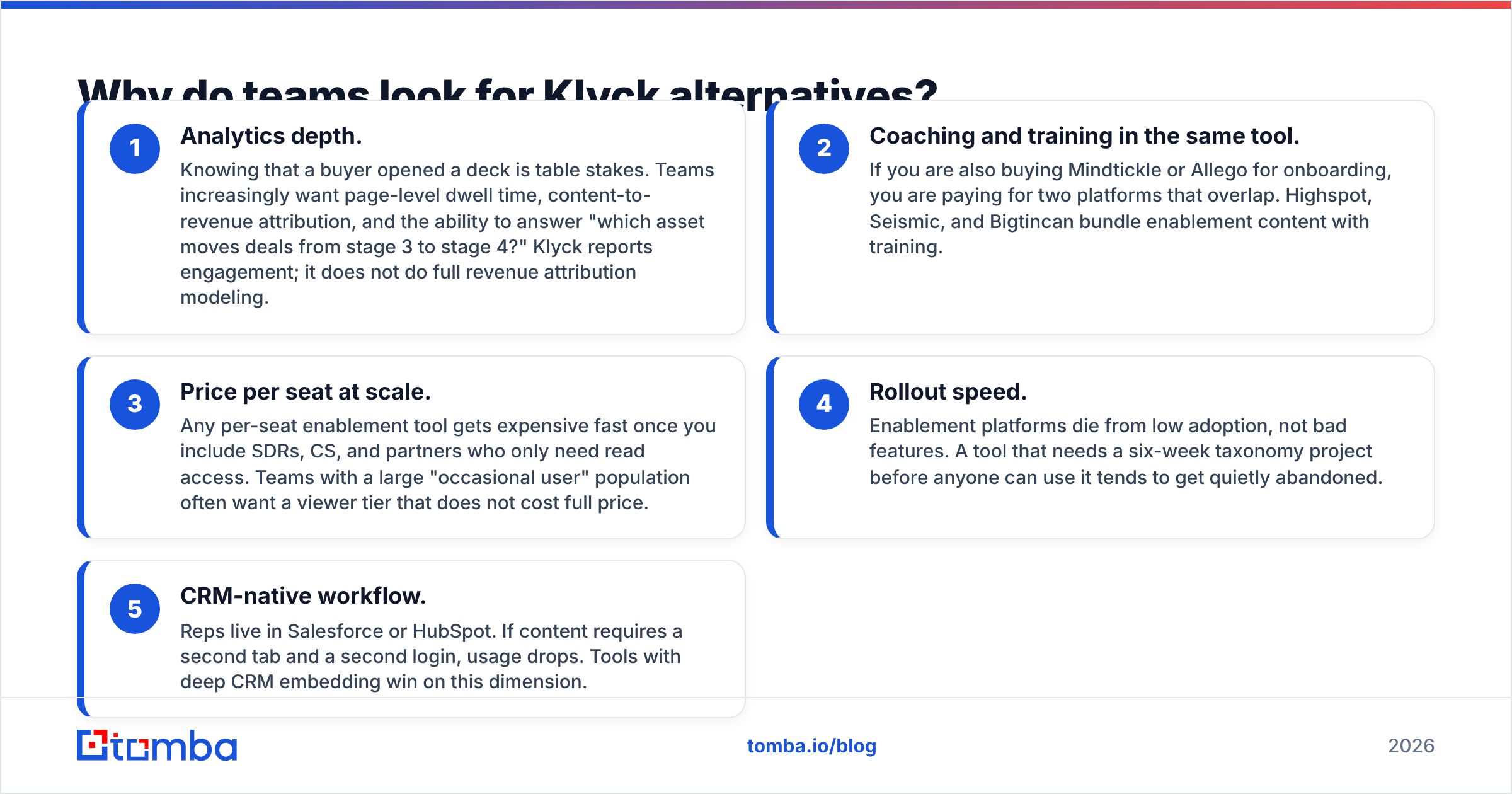
From what shows up in review threads on G2 and in actual evaluation calls, the reasons cluster into five buckets:
- Analytics depth. Knowing that a buyer opened a deck is table stakes. Teams increasingly want page-level dwell time, content-to-revenue attribution, and the ability to answer "which asset moves deals from stage 3 to stage 4?" Klyck reports engagement; it does not do full revenue attribution modeling.
- Coaching and training in the same tool. If you are also buying Mindtickle or Allego for onboarding, you are paying for two platforms that overlap. Highspot, Seismic, and Bigtincan bundle enablement content with training.
- Price per seat at scale. Any per-seat enablement tool gets expensive fast once you include SDRs, CS, and partners who only need read access. Teams with a large "occasional user" population often want a viewer tier that does not cost full price.
- Rollout speed. Enablement platforms die from low adoption, not bad features. A tool that needs a six-week taxonomy project before anyone can use it tends to get quietly abandoned.
- CRM-native workflow. Reps live in Salesforce or HubSpot. If content requires a second tab and a second login, usage drops. Tools with deep CRM embedding win on this dimension.
What are the best Klyck alternatives in 2026?#
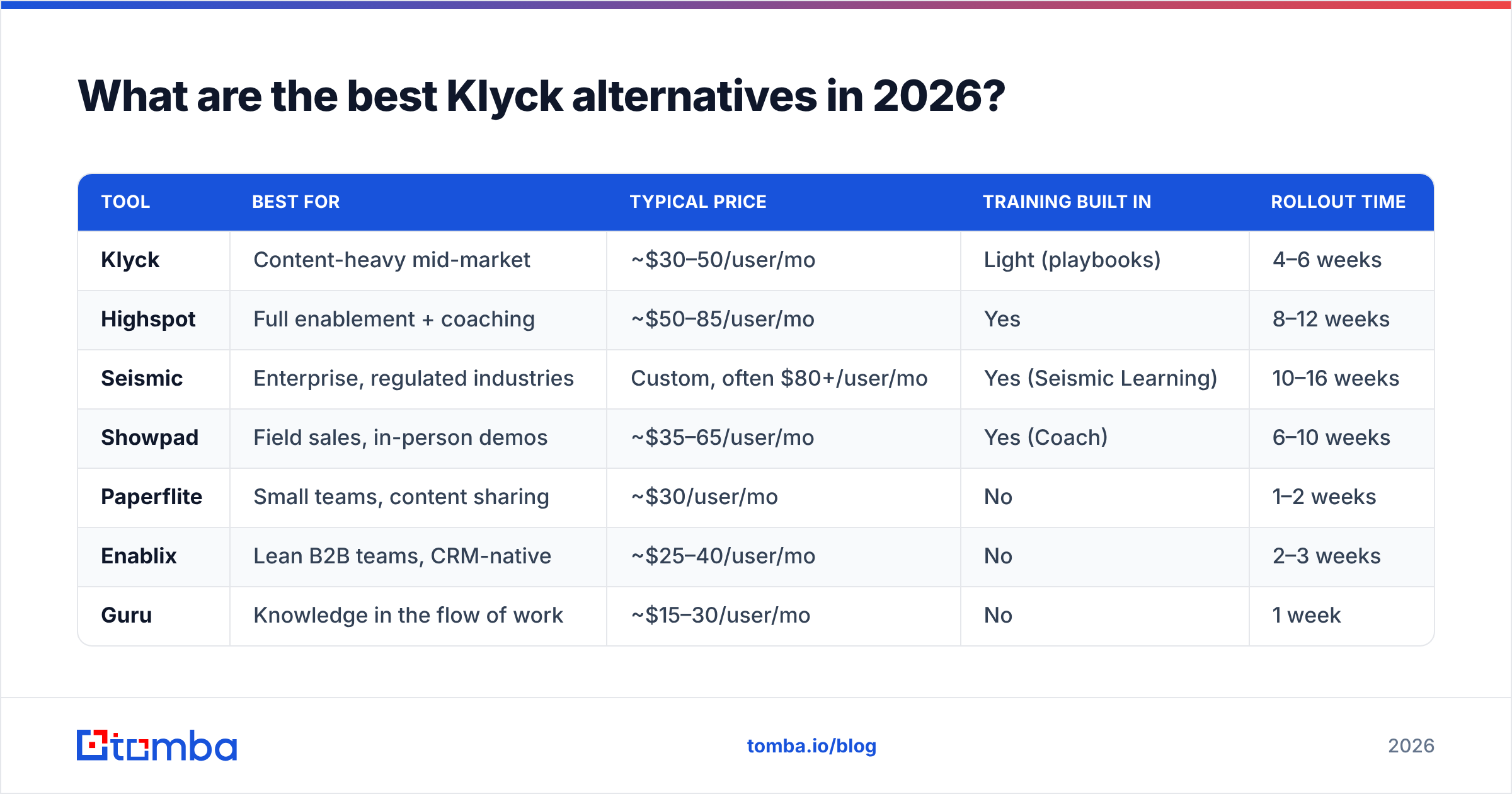
Here is the head-to-head. Prices are list or widely reported ranges — every vendor in the upper tier negotiates, and most quote annually.
| Tool | Best for | Typical price | Training built in | Rollout time |
|---|---|---|---|---|
| Klyck | Content-heavy mid-market | ~$30–50/user/mo | Light (playbooks) | 4–6 weeks |
| Highspot | Full enablement + coaching | ~$50–85/user/mo | Yes | 8–12 weeks |
| Seismic | Enterprise, regulated industries | Custom, often $80+/user/mo | Yes (Seismic Learning) | 10–16 weeks |
| Showpad | Field sales, in-person demos | ~$35–65/user/mo | Yes (Coach) | 6–10 weeks |
| Paperflite | Small teams, content sharing | ~$30/user/mo | No | 1–2 weeks |
| Enablix | Lean B2B teams, CRM-native | ~$25–40/user/mo | No | 2–3 weeks |
| Guru | Knowledge in the flow of work | ~$15–30/user/mo | No | 1 week |
| Dock | Buyer-facing digital sales rooms | ~$49/user/mo | No | 1–2 weeks |
| Mediafly | Interactive value selling / ROI tools | Custom | Partial | 8–12 weeks |
| Bigtincan | Mobile-first, retail and field | ~$39–60/user/mo | Yes | 6–10 weeks |
Highspot — the default enterprise upgrade#
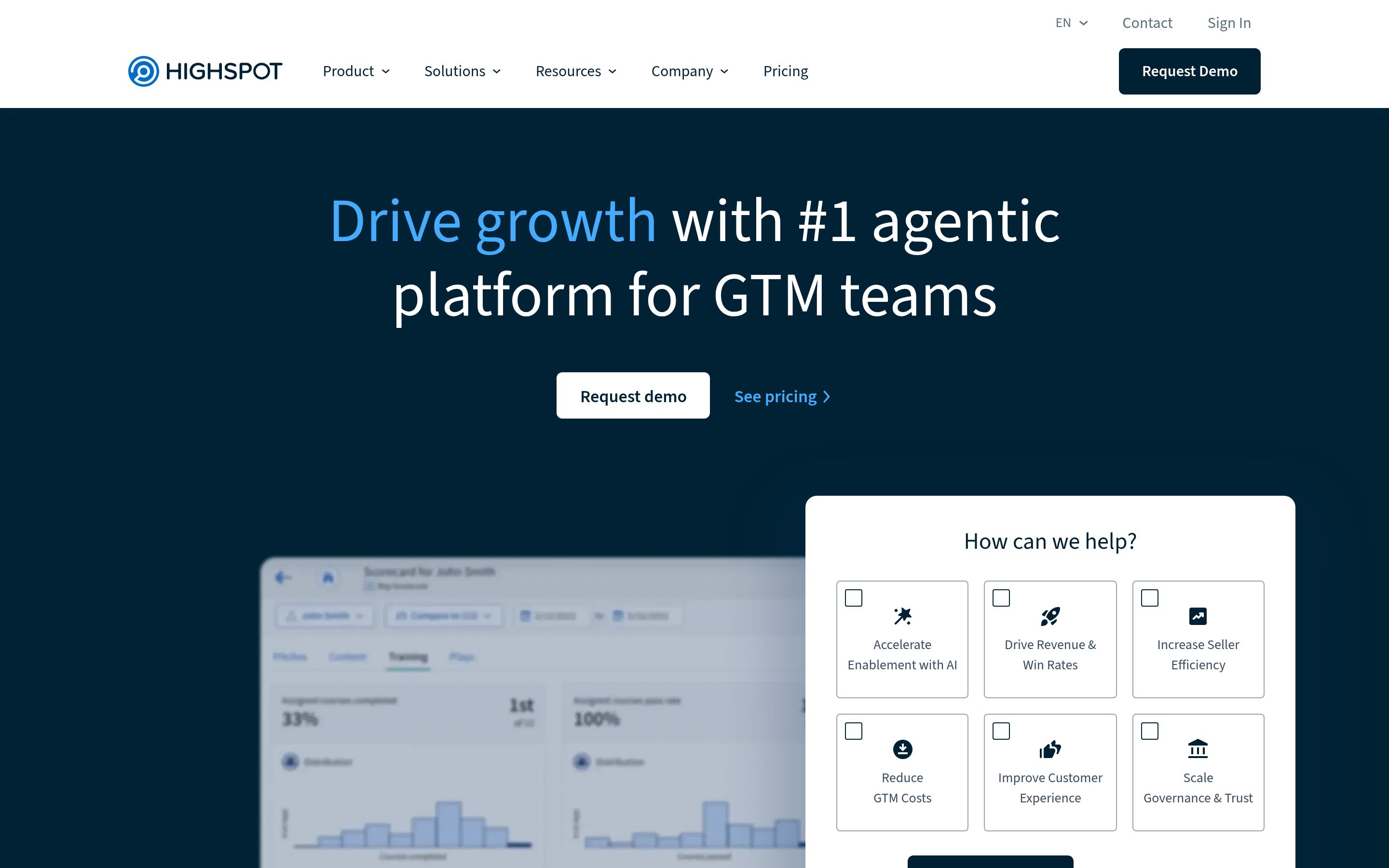
Highspot is what most teams compare Klyck against when they have budget. It combines a content hub, guided selling "plays," coaching, and genuinely good analytics that tie content usage back to deal outcomes. The AI layer surfaces the right asset inside Salesforce or Outlook without a context switch.
The trade-off is cost and weight. Highspot expects a dedicated enablement owner. Without one, you buy a Ferrari and drive it to the mailbox.
Seismic — the compliance-grade option#

Seismic is the heaviest tool on this list and the right call if you are in financial services, insurance, or pharma where every asset needs approval workflows, expiry dates, and an audit trail. LiveDocs — Seismic's dynamic document assembly — is legitimately differentiated: it builds personalized pitch decks from live data rather than templates.
If your compliance team is not part of the buying committee, Seismic is probably overkill.
Showpad — built for people who sell in person#
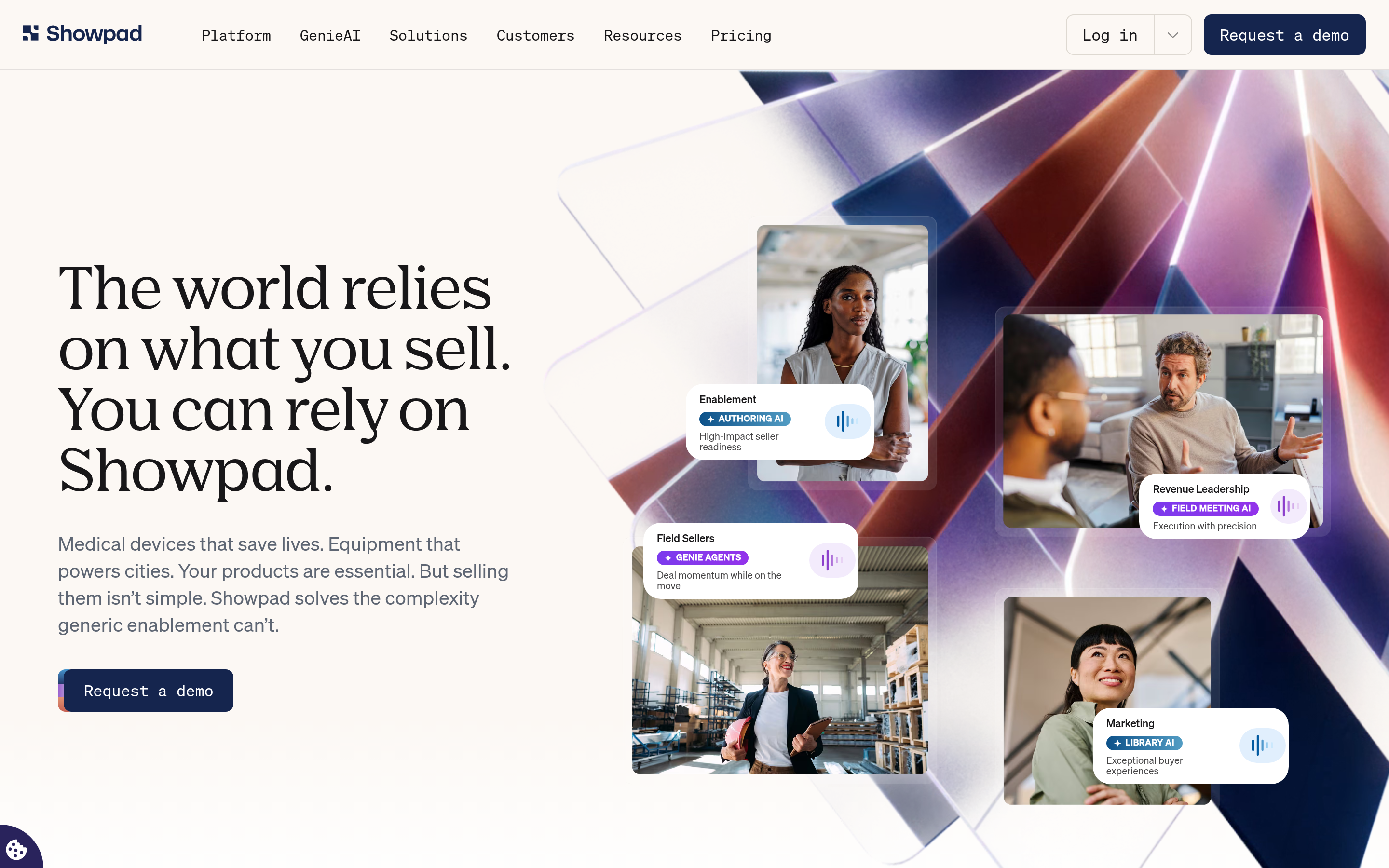
Showpad's offline mode and demo-friendly interface make it the pick for field sales, medical devices, and manufacturing reps who present on a tablet in a warehouse with bad Wi-Fi. Its coaching module is solid without being a full LMS.
Paperflite and Enablix — the lightweight middle#
These two are the honest answer for teams of 10–40 who looked at Klyck and thought "this is more platform than we need." Paperflite is excellent at content collections and buyer-side tracking with almost no setup. Enablix is unusually good at CRM-native recommendations for its price point and integrates cleanly with HubSpot-centric stacks.
Guru — when the real problem is knowledge, not decks#
If your reps are not losing deals because they lack a case study, but because they cannot remember the competitive positioning against a specific rival, Guru is a better buy. It lives in the browser and in Slack, surfaces verified answers where work happens, and costs a fraction of a full enablement suite. It is not a content library in the Klyck sense — it is an institutional memory.
Dock and Mediafly — the buyer-facing specialists#
Dock focuses on digital sales rooms and mutual action plans: one link per deal that holds the proposal, the security docs, the timeline, and the stakeholders. Mediafly goes the other direction into interactive value selling — ROI calculators and TCO tools that make a business case tangible during the call.
How should you choose between them?#
Score the shortlist on these six dimensions before you look at a single demo:
- Who owns this after purchase? No dedicated owner means buy the lightest tool on the list. Adoption, not features, decides the outcome.
- What percentage of users are occasional? If more than half your seats are CS, partners, or execs who open content twice a month, prioritize vendors with a cheap viewer tier — that single line item can halve the contract.
- Do you need training in the same platform? Only bundle if you are genuinely replacing an LMS. Otherwise you pay for a module nobody logs into.
- How deep does the CRM integration go? "Has a Salesforce integration" spans everything from a logged activity to a fully embedded content panel inside the opportunity record. Ask for a screen share, not a checkbox.
- What does implementation cost? Enterprise vendors routinely add a one-time fee of $5,000–$25,000 for migration and taxonomy work. Get it in writing during evaluation, not at contract.
- Can you export your content and your analytics? Content lock-in is real. Confirm bulk export exists before you migrate 900 assets in.
Does better content actually fix a pipeline problem?#
This is the part most enablement evaluations skip, and it is worth being blunt about: enablement software is a multiplier, not a generator. It makes each conversation better. It does not create more conversations.
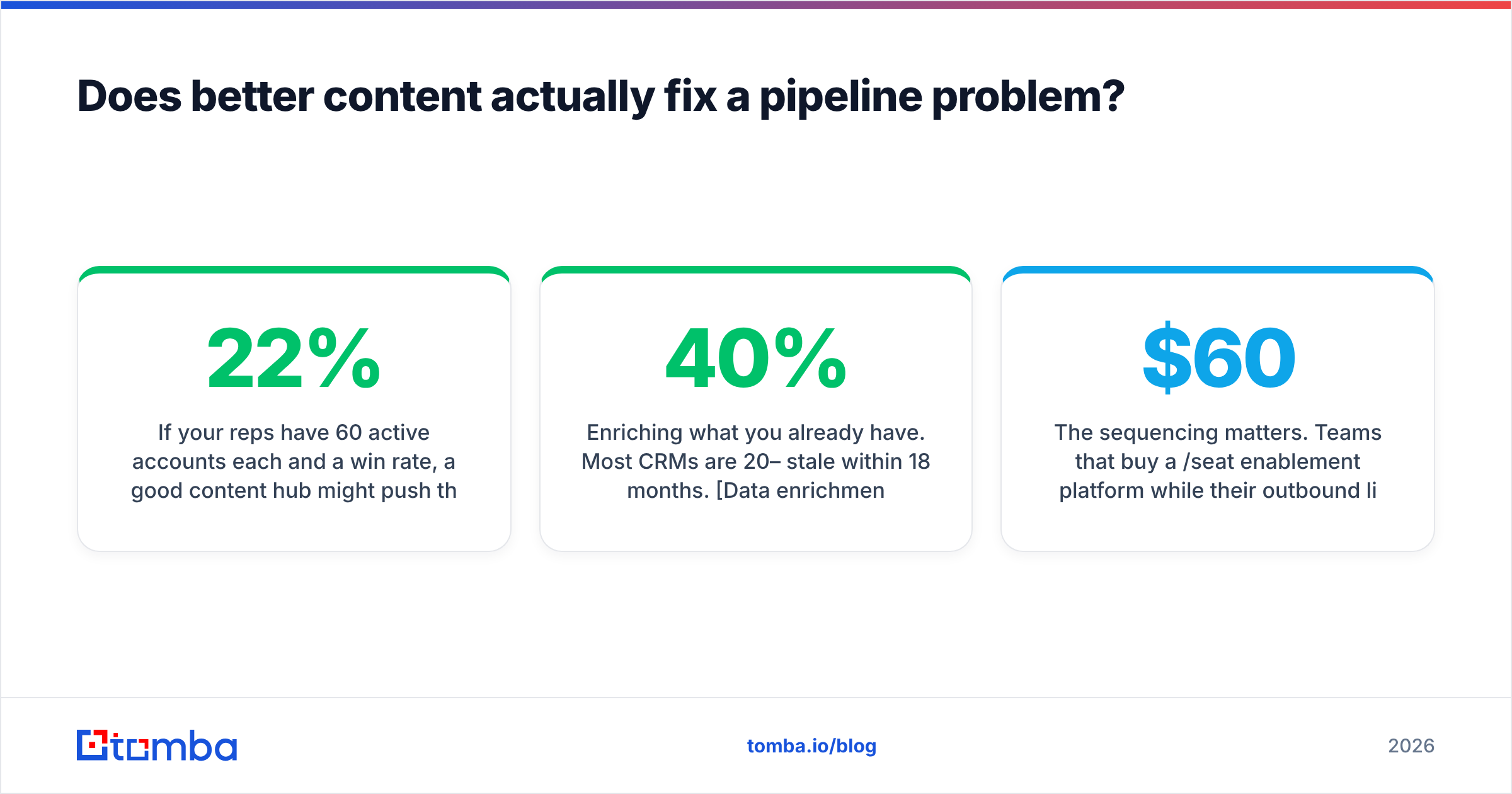
If your reps have 60 active accounts each and a 22% win rate, a good content hub might push that to 26%. Real money. But if your reps have 12 active accounts each, no amount of content organization changes the arithmetic. The bottleneck is upstream — you do not have enough of the right people to talk to.
That upstream layer is contact data. Before a playbook matters, someone has to reach a verified decision-maker at a company that fits your ICP. In practice that means three things working:
- Finding the right contact. An email finder that returns a deliverable address for a named person at a named domain, or a domain search that maps out who works in the relevant department at a target account.
- Verifying before you send. Bounces do not just waste a send — they damage the sending domain the rest of your team depends on. An email verifier run before import keeps the list clean.
- Enriching what you already have. Most CRMs are 20–40% stale within 18 months. Data enrichment fills in job titles, company size, and missing contact details so segmentation and routing actually work.
The sequencing matters. Teams that buy a $60/seat enablement platform while their outbound list is 30% invalid are optimizing the wrong half of the funnel. Fix the data layer first — it is usually an order of magnitude cheaper — then buy the multiplier.
What does this cost across a year?#
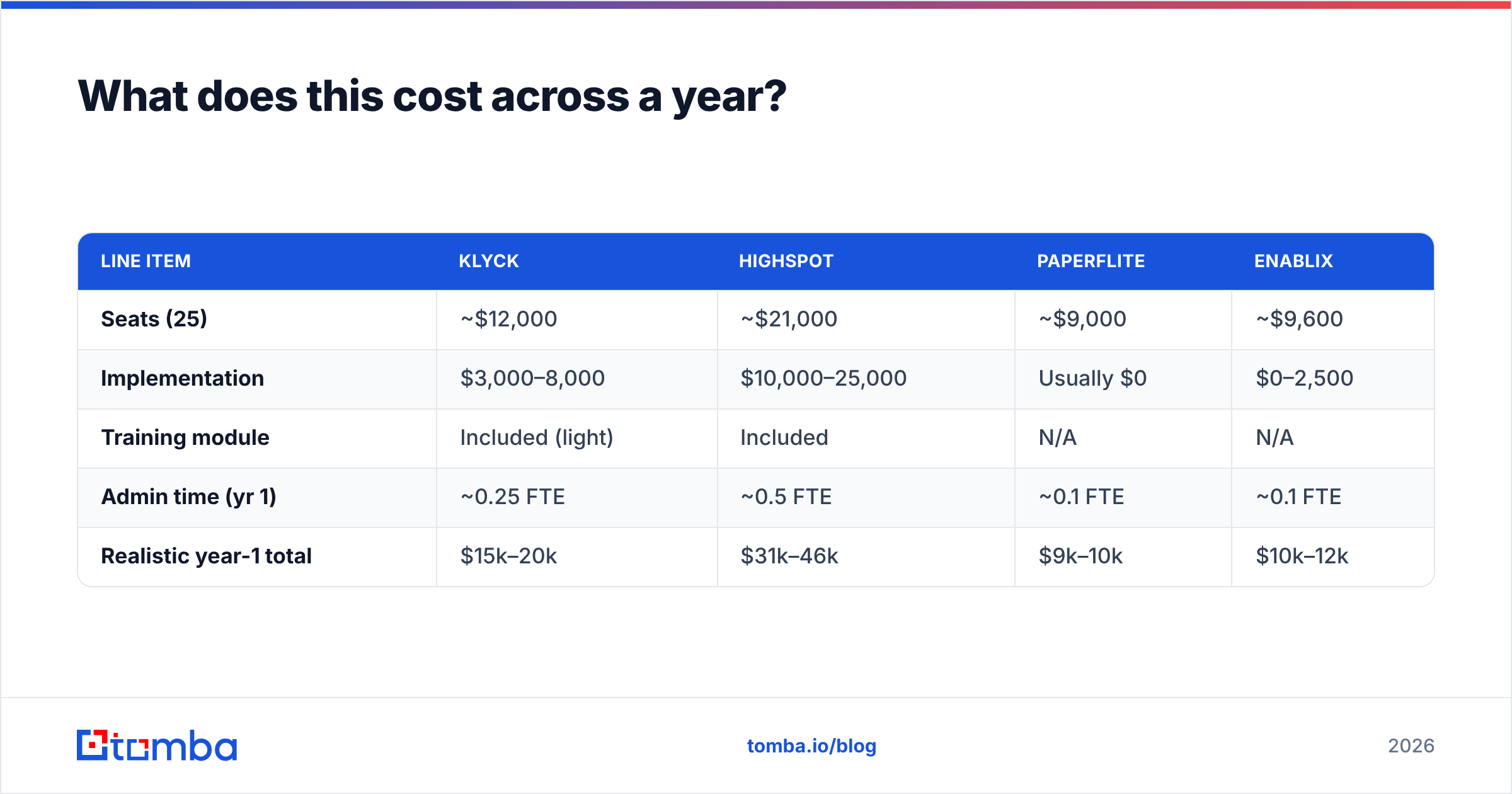
Here is a realistic 25-seat annual comparison, including the fees vendors do not advertise:
| Line item | Klyck | Highspot | Paperflite | Enablix |
|---|---|---|---|---|
| Seats (25) | ~$12,000 | ~$21,000 | ~$9,000 | ~$9,600 |
| Implementation | $3,000–8,000 | $10,000–25,000 | Usually $0 | $0–2,500 |
| Training module | Included (light) | Included | N/A | N/A |
| Admin time (yr 1) | ~0.25 FTE | ~0.5 FTE | ~0.1 FTE | ~0.1 FTE |
| Realistic year-1 total | $15k–20k | $31k–46k | $9k–10k | $10k–12k |
For context, a contact data layer that feeds the whole motion is a rounding error against those numbers. Tomba pricing starts with a free tier at 25 searches per month, Starter at $49/mo, Growth at $99/mo, and Pro at $249/mo — a full year of Growth costs less than two seats of most enablement platforms.
Which Klyck alternative should you pick?#
Short version:
- You want everything in one platform and have an enablement owner → Highspot.
- You are in a regulated industry with approval workflows → Seismic.
- Your reps present in person, often offline → Showpad.
- You want 80% of the value at 40% of the price → Paperflite or Enablix.
- Your problem is answers, not assets → Guru.
- You want buyer-facing deal rooms above all else → Dock.
- You need interactive ROI and value-selling tools → Mediafly.
- Klyck already fits and the content library is your main pain → stay. Switching costs are real, and Klyck's tagging and content-page model is genuinely good at what it does.
Frequently asked questions#
Is there a free Klyck alternative? Guru and Notion-based setups have free or near-free tiers that cover basic content organization. None of the true enablement platforms offer a meaningful free plan — expect a trial at best.
How long does migration take? Plan for 2–4 weeks of content audit before the platform work starts. Most teams discover 30–50% of their library is stale and should not migrate at all, which is the best outcome of the exercise.
Do these tools integrate with HubSpot and Salesforce? All of them claim to. Depth varies enormously. Test the actual rep workflow — sending a tracked link from inside a deal record — during the trial, not after.
Should I buy enablement software before outbound tooling? Generally no. Enablement improves conversion on existing pipeline; data and prospecting tools create the pipeline. Fix volume and list quality first.
Before you spend $20,000 on a content hub, make sure your reps have someone to send that content to. Tomba's Email Finder returns verified, deliverable addresses for decision-makers at your target accounts — by name, by domain, or in bulk — so the playbooks you are about to buy have a real audience. Start free with 25 searches a month, no card required, and see how much of your pipeline gap is actually a data gap.
Related guides#
Ready to find emails that actually work?
Join 150,000+ professionals who stopped guessing and started sending. Free credits on signup — no credit card required.
Get the Tomba newsletter
Practical outbound tactics and product updates — once every two weeks.
About the author