7 Best Kuration Alternatives in 2026: Tested & Compared
Kuration AI turns research prompts into lead lists, but credit burn, export limits, and unverified emails send plenty of teams looking elsewhere. Here are 7 Kuration alternatives compared on data accuracy, pricing, and speed to usable contacts.

TL;DR
- Kuration AI is a research agent that builds and enriches lead lists from prompts. It is strong at qualification and weak at being the last mile: you still need verified, deliverable contact data.
- The best Kuration alternative depends on which half of the job you actually care about — research and scoring (Clay, Ocean.io), or contact data you can send to (Tomba, BookYourData, Findymail).
- Credit math beats sticker price. A $29 plan that burns 4–6 credits per enriched row costs more per usable contact than a $49 plan with flat per-email pricing.
- Tomba starts at $49/mo for Starter with a free 25-search tier, an email verifier built in, and an API most teams wire up in an afternoon.
- If you only need clean lists once a quarter, a pay-as-you-go provider like BookYourData avoids subscription waste entirely.
What is Kuration AI, and why are people looking for alternatives?#
Kuration AI is an AI research agent for lead lists. You describe your ideal customer, point it at a source list or a search, and chain "curation" steps — visit the site, check for a job posting, classify the business model, score the fit — until the rows that survive are the ones worth contacting. Think of it as hiring a very fast intern to open 2,000 browser tabs and take notes in a spreadsheet.
That framing is also where the friction starts. An intern who reads 2,000 websites is useful. An intern who reads 2,000 websites and then hands you a column of guessed email addresses is a liability, because the cost of a bad address is not zero — it is a bounce against your sending domain.
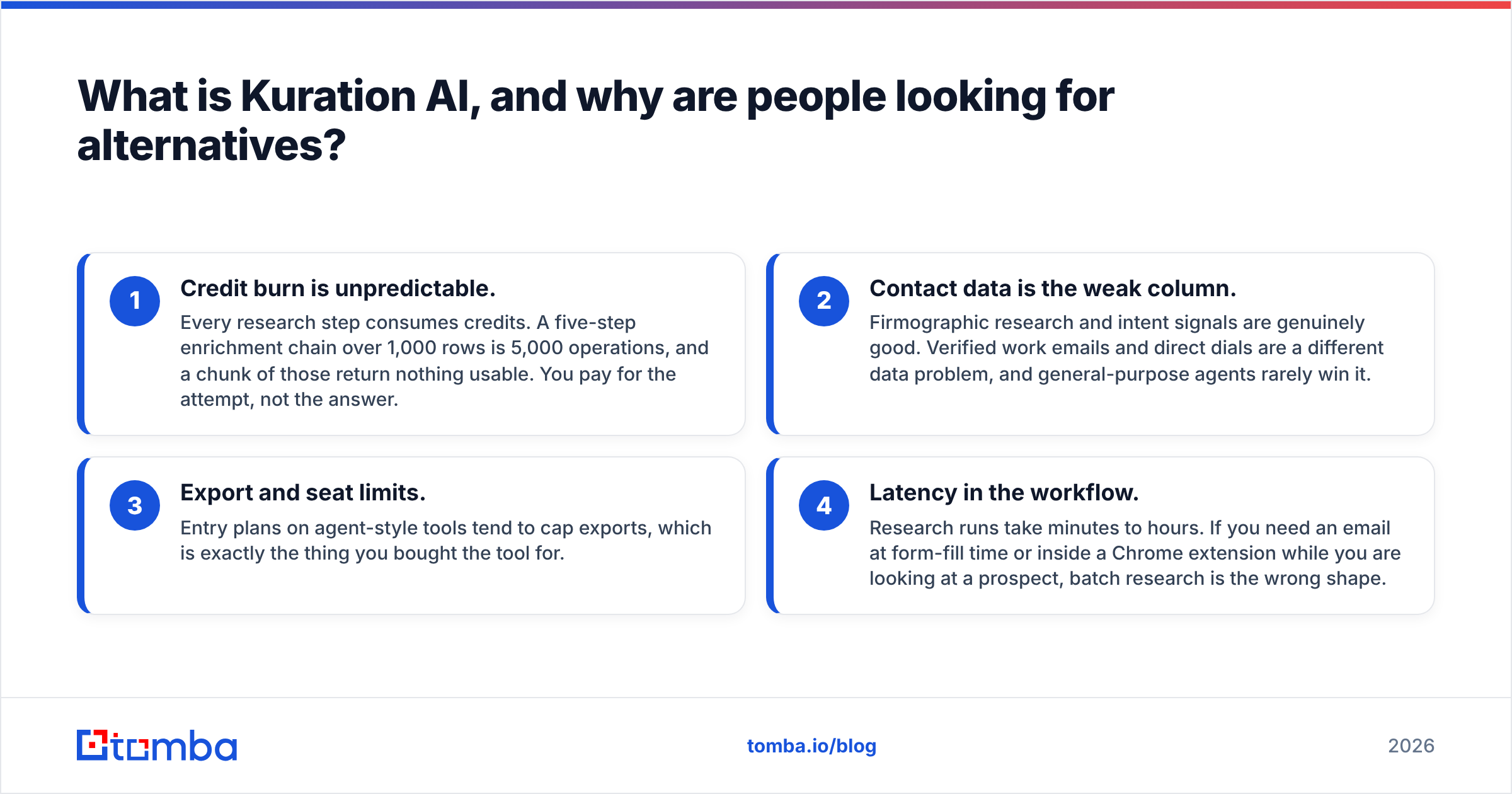
The four reasons teams start shopping for Kuration alternatives, in the order we hear them:
- Credit burn is unpredictable. Every research step consumes credits. A five-step enrichment chain over 1,000 rows is 5,000 operations, and a chunk of those return nothing usable. You pay for the attempt, not the answer.
- Contact data is the weak column. Firmographic research and intent signals are genuinely good. Verified work emails and direct dials are a different data problem, and general-purpose agents rarely win it.
- Export and seat limits. Entry plans on agent-style tools tend to cap exports, which is exactly the thing you bought the tool for.
- Latency in the workflow. Research runs take minutes to hours. If you need an email at form-fill time or inside a Chrome extension while you are looking at a prospect, batch research is the wrong shape.
None of that makes Kuration bad. It makes it a specialist. The question is whether you are paying agent prices for a job a cheaper, faster specialist already does.

What should you look for in a Kuration alternative?#
Before you compare logos, decide which of these five things you are actually buying. Most disappointment in this category comes from buying a research tool when you needed a data tool, or the reverse.
- Data source, not data volume. "300M contacts" is a marketing number. Ask where records come from and how often they are re-checked. Tomba publishes its data sources for this reason — a database that was scraped once in 2023 and never touched again decays at roughly 25–30% per year as people change jobs.
- Verification as a first-class step, not an add-on. SMTP checks, catch-all handling, role-account detection, and disposable filtering should run before a record reaches your CSV — not as a separate paid tool you bolt on afterwards.
- Unit economics you can forecast. Flat per-email or per-credit pricing beats variable multi-step credit burn when you need to budget. Work out your cost per verified, deliverable contact, not per API call.
- Coverage for your ICP. Every provider has geographic and segment blind spots. European SMB coverage, APAC mid-market, and non-English domains vary wildly. Test 100 of your accounts before committing.
- Workflow fit. Chrome extension, Google Sheets, CRM sync, or raw API — pick the surface your team will actually use. A brilliant tool nobody opens is worse than a mediocre one inside HubSpot.
- Compliance posture. GDPR/CCPA handling, opt-out processing, and a documented DPA. If a vendor cannot answer this in one email, that is your answer.
What are the best Kuration alternatives in 2026?#
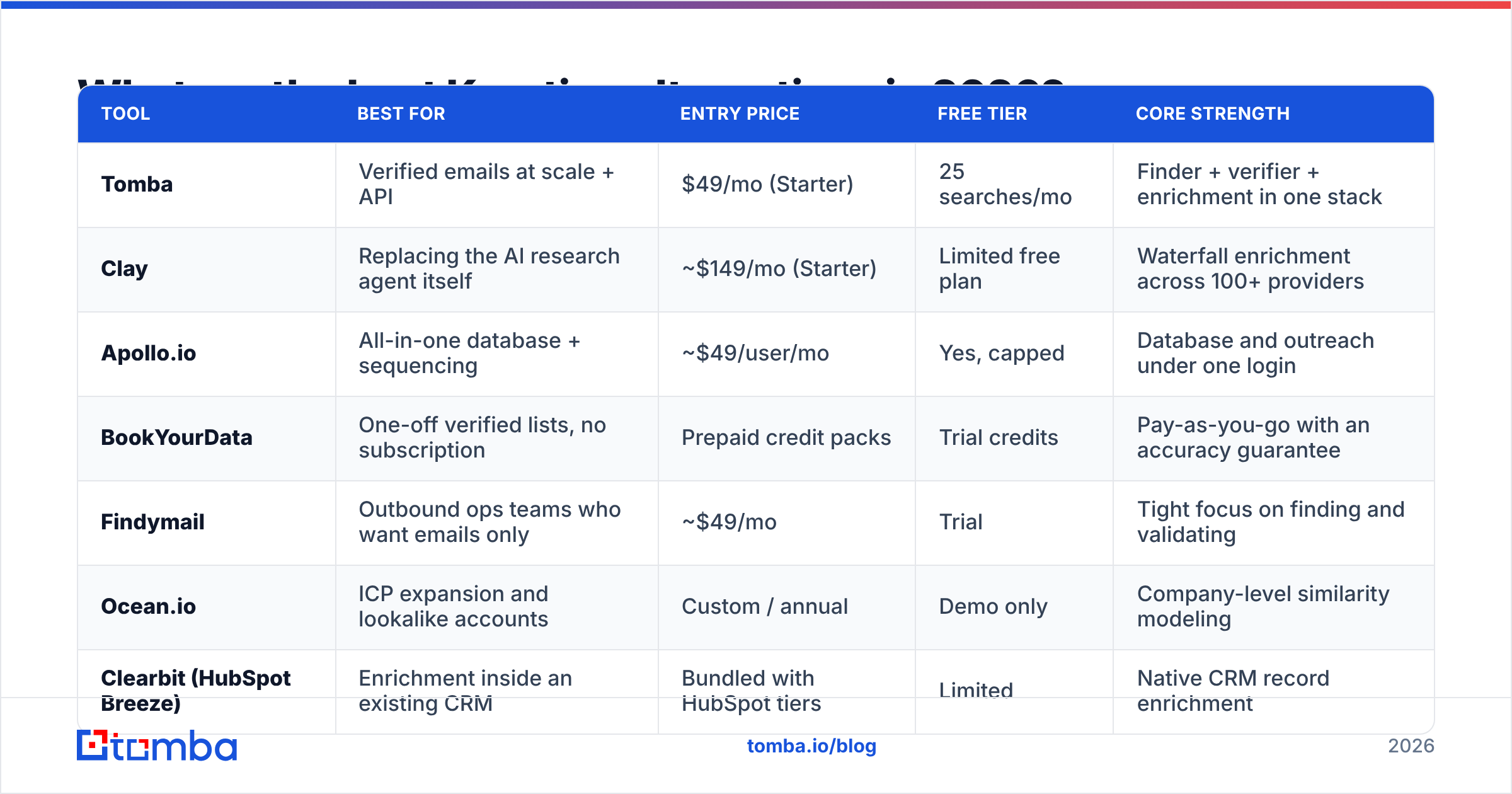
Here is the short list, grouped by what each one replaces. Pricing reflects publicly listed plans at the time of writing — credit-based vendors change terms often, so confirm on their own pricing pages before you buy.
| Tool | Best for | Entry price | Free tier | Core strength |
|---|---|---|---|---|
| Tomba | Verified emails at scale + API | $49/mo (Starter) | 25 searches/mo | Finder + verifier + enrichment in one stack |
| Clay | Replacing the AI research agent itself | ~$149/mo (Starter) | Limited free plan | Waterfall enrichment across 100+ providers |
| Apollo.io | All-in-one database + sequencing | ~$49/user/mo | Yes, capped | Database and outreach under one login |
| BookYourData | One-off verified lists, no subscription | Prepaid credit packs | Trial credits | Pay-as-you-go with an accuracy guarantee |
| Findymail | Outbound ops teams who want emails only | ~$49/mo | Trial | Tight focus on finding and validating |
| Ocean.io | ICP expansion and lookalike accounts | Custom / annual | Demo only | Company-level similarity modeling |
| Clearbit (HubSpot Breeze) | Enrichment inside an existing CRM | Bundled with HubSpot tiers | Limited | Native CRM record enrichment |
Tomba — best for verified contact data and API access#
Tomba solves the column Kuration is weakest at: turning a company and a name into a real, deliverable address. The email finder resolves patterns per domain, the verifier runs SMTP and catch-all checks, and data enrichment fills in the firmographic fields around the contact.
Pricing is flat and legible: Free (25 searches/mo), Starter $49/mo, Growth $99/mo, Pro $249/mo, Enterprise custom. See Tomba pricing for current credit allocations. There is a REST email finder API, a CLI, an MCP server, and Sheets/Excel add-ins, so it slots into whatever you already run.
Pick it if: you want research done elsewhere (or by humans) and need the contact layer to be right. Skip it if: you wanted the agent to do the qualifying too — Tomba is data infrastructure, not a research copilot.
Clay — the closest thing to a direct replacement#
Clay is the most honest head-to-head swap for Kuration. Same spreadsheet-as-workflow model, same AI research columns, but with a deeper provider waterfall: if provider A misses an email, it falls through to B, then C, and you only pay when one hits. That waterfall is the single most useful idea in this category.
The trade-off is cost and learning curve. Starter sits around $149/mo and serious usage climbs fast. Clay is a platform, and platforms need an owner. If nobody on your team will spend a week learning it, you will underuse it.
Apollo.io — database and outreach in one login#
Apollo bundles a large B2B database with sequencing, dialer, and basic CRM features. For a small team that wants one invoice instead of four, that consolidation is real value. Coverage in North American tech is strong; EU SMB and non-English markets are noticeably thinner, and email accuracy varies by segment enough that most teams run a verification pass anyway. See the Apollo alternative breakdown if you want the detailed trade-offs, and check current user reviews on G2 before committing to an annual contract.
BookYourData — pay-as-you-go without the subscription#
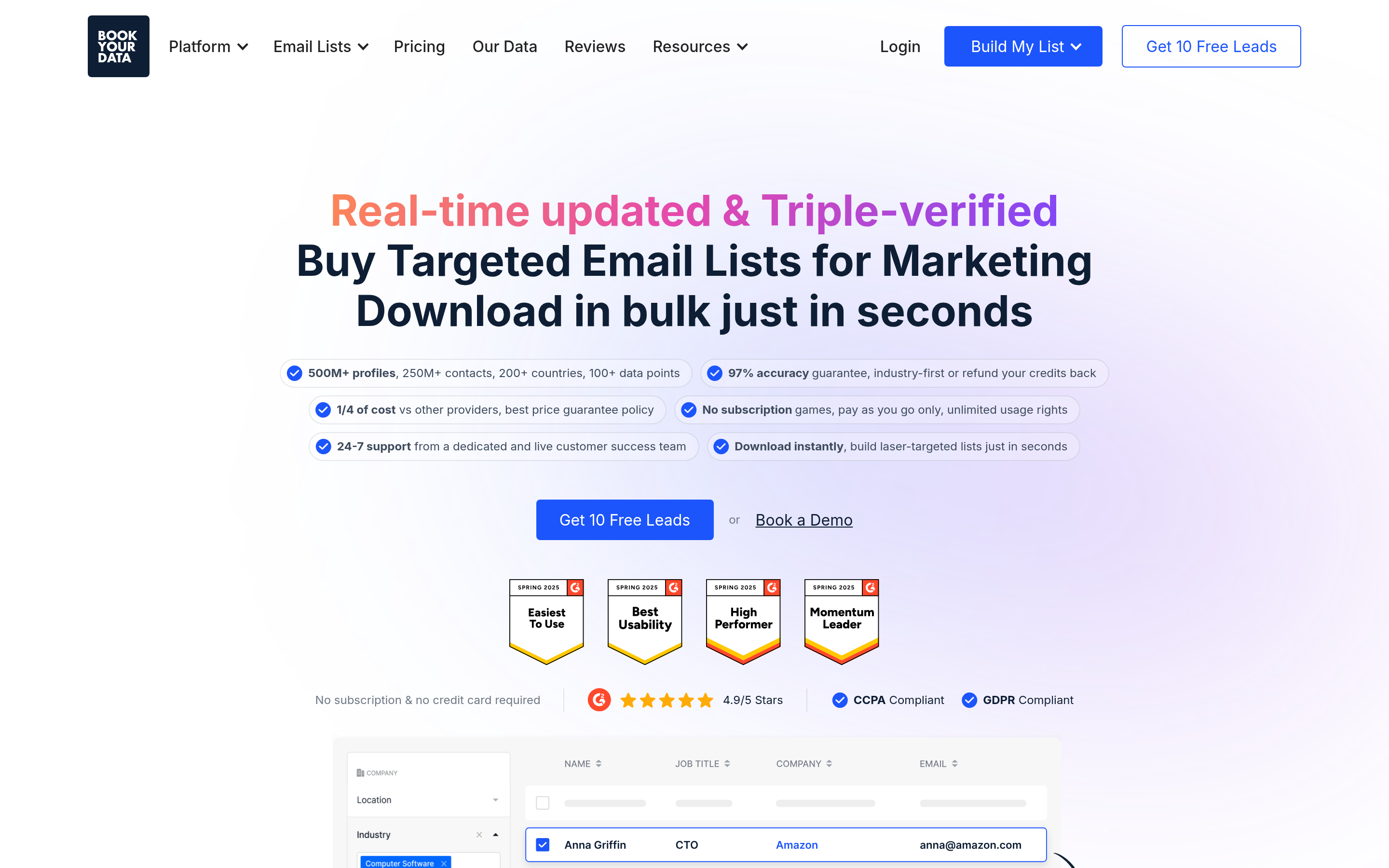
BookYourData takes the opposite approach to everything else on this list: you buy credits, you build a list with filters, you download it, you leave. No monthly commitment, and the company backs its records with a stated accuracy guarantee and credit refunds for bounces. For teams that run two campaigns a quarter rather than continuous outbound, that model removes a lot of waste — you are not paying for a seat in the months you do not prospect. It is a genuinely good fit for event lists, ABM pilots, and territory launches.
Findymail — narrow scope, done well#
Findymail does email finding and validation and deliberately not much else. If your complaint about Kuration is "I just wanted the emails," this is the shortest path. It integrates with common sequencers and keeps bounce rates low by refusing to guess. The Findymail alternative comparison covers where it lands against Tomba on volume pricing.
Ocean.io — for ICP expansion, not contact lookup#
Ocean.io answers a different question: which companies look like my best customers? It models company similarity from web and firmographic signals and returns lookalike accounts. Pair it with a contact-data provider and you have the two halves of what Kuration tries to do alone. Pricing is annual and quote-based, which puts it out of reach for most small teams.
Clearbit / HubSpot Breeze Intelligence — enrichment where your records live#
Now folded into HubSpot as Breeze Intelligence, this is enrichment that happens inside the CRM rather than in a separate tab. If you are already a HubSpot shop, the frictionless part matters more than the raw match rate. If you are not, it is not a reason to migrate. The Clearbit alternative page covers the post-acquisition changes in more detail.
How accurate is the data from each option?#
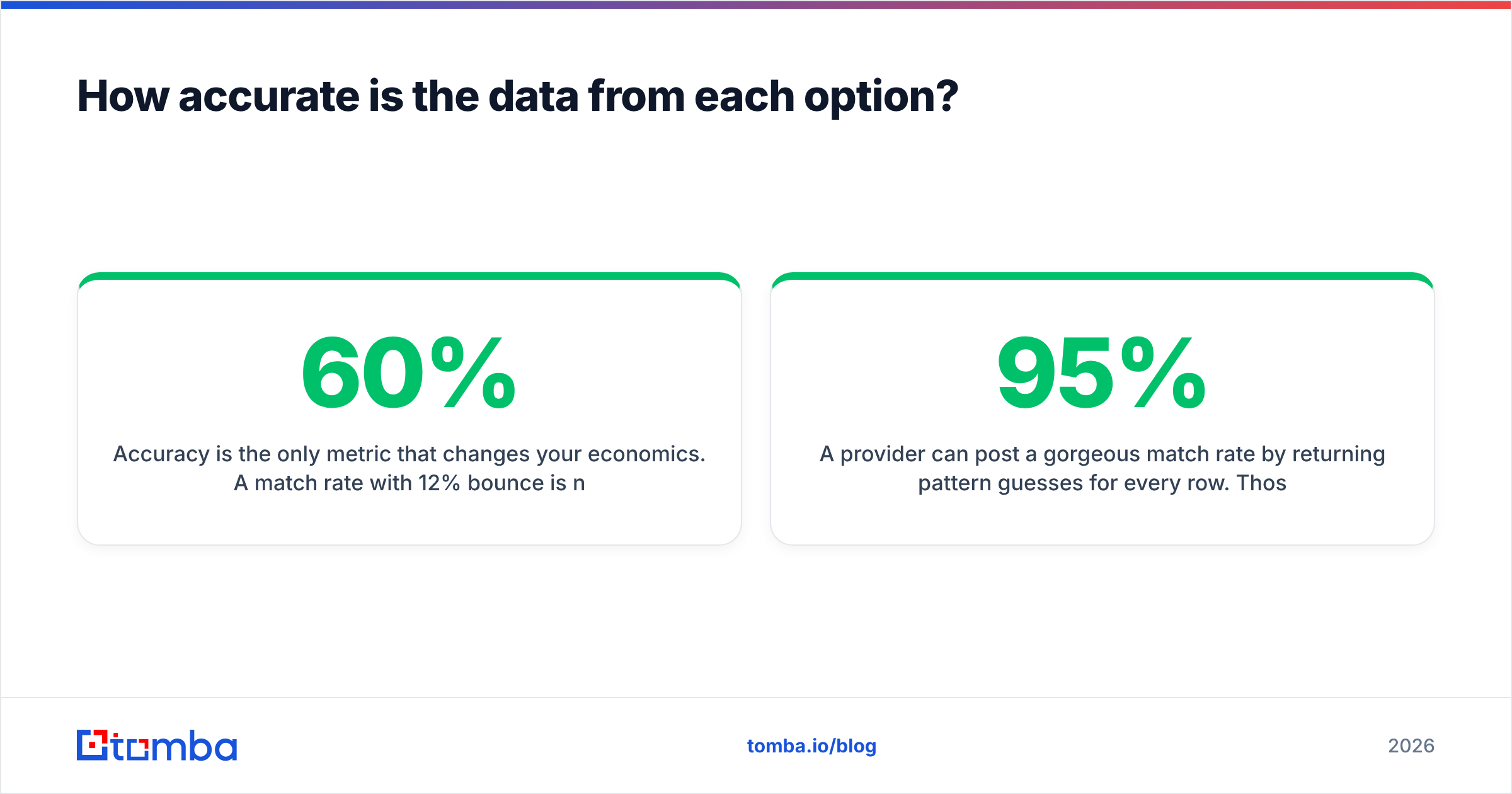
Accuracy is the only metric that changes your economics. A 60% match rate with 12% bounce is not cheaper than an 80% match rate with 2% bounce — it is dramatically more expensive once you price in domain reputation damage.

Two numbers matter, and vendors love to blur them together:
- Match rate — of 1,000 input rows, how many came back with an address at all?
- Deliverability rate — of those addresses, how many actually accept mail?
A provider can post a gorgeous 95% match rate by returning pattern guesses for every row. Those guesses bounce. Always benchmark both on your own list, and always run a verification pass regardless of who supplied the data. Catch-all domains are the classic trap: they accept everything at SMTP time and tell you nothing, which is why a dedicated catch-all verifier is worth having in the chain.

How do the costs actually compare?#
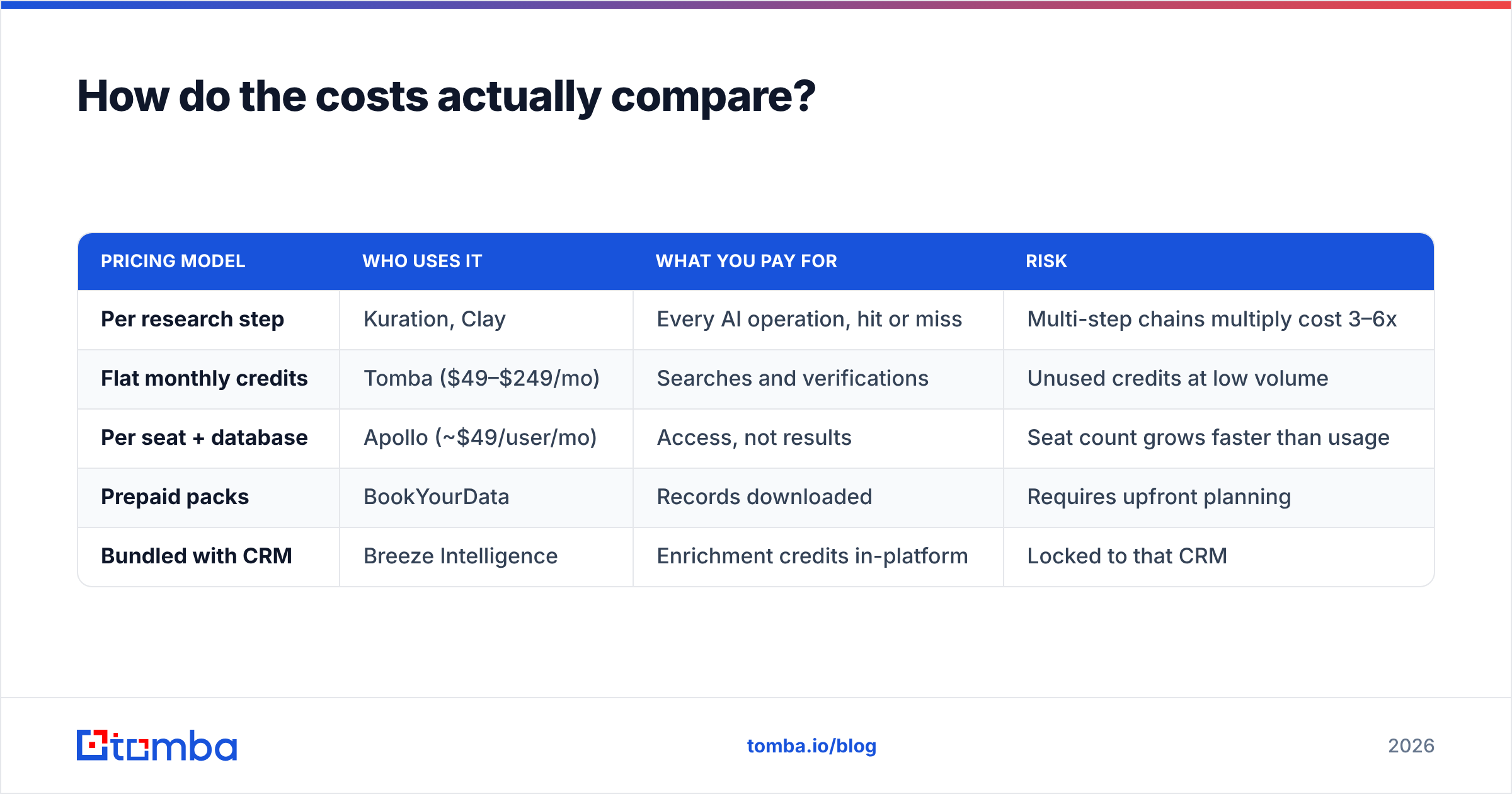
Sticker price hides the real number. Here is the same job — 5,000 enriched, contactable rows per month — priced by model type.

| Pricing model | Who uses it | What you pay for | Risk |
|---|---|---|---|
| Per research step | Kuration, Clay | Every AI operation, hit or miss | Multi-step chains multiply cost 3–6x |
| Flat monthly credits | Tomba ($49–$249/mo) | Searches and verifications | Unused credits at low volume |
| Per seat + database | Apollo (~$49/user/mo) | Access, not results | Seat count grows faster than usage |
| Prepaid packs | BookYourData | Records downloaded | Requires upfront planning |
| Bundled with CRM | Breeze Intelligence | Enrichment credits in-platform | Locked to that CRM |
The practical rule: if your enrichment chain is more than three steps deep, per-step pricing will beat you. If it is one or two steps — find the email, verify it — flat credit pricing wins by a wide margin. Run bulk email finding against a sample of 500 rows from each candidate and divide total spend by verified, deliverable contacts. That single number ends most of these debates.
Which Kuration alternative should you pick?#
- You want the agent, but better and deeper: Clay. Budget for the learning curve and an internal owner.
- You want accurate emails and a clean API: Tomba. Flat pricing, verification built in, no research layer to pay for.
- You want one tool for data and sending: Apollo. Accept segment-dependent accuracy and verify before you send.
- You prospect in bursts, not continuously: BookYourData. Prepaid credits, no idle subscription.
- You need account discovery, not contacts: Ocean.io, paired with a contact-data provider.
- You live inside HubSpot: Breeze Intelligence, and stop shopping.
A note on stacking: the most effective setups we see are not single-tool. They use a research layer for qualification and a dedicated data layer for contacts, connected by integrations rather than manual CSV shuttling. Kuration can absolutely stay in that stack — it just should not be the thing supplying your email column.
Ready to fix the contact-data layer?#
If you have decided the research half was fine and the email half was the problem, start there. Tomba Email Finder resolves work emails by domain, name, or company, verifies them before they reach your list, and exposes the whole thing through an API, CLI, Chrome extension, and Google Sheets add-on. The free tier gives you 25 searches a month to benchmark against your own accounts — enough to prove the match rate on your ICP before you spend anything. Starter is $49/mo when you are ready to scale, with no per-step credit math to reverse-engineer.
Benchmark it against whatever you are using now on the same 100 rows. Whichever way that test goes, you will finally have the number that matters.
Related guides#
// get started
Find, verify and enrich your first contacts today
Start on the free plan with 25 searches a month, then scale when your team is ready.
Free plan · No credit card required · GDPR & CCPA
Get the Tomba newsletter
Product and data updates
// about the author