Labnify vs Apollo.io: Which Tool Fits Your Outbound Stack?
Labnify vs Apollo.io is not a fair fight: one sends email, the other finds the people to email. Here is the honest head-to-head on pricing, data quality, and deliverability — and which one belongs in your 2026 outbound stack.
Labnify vs Apollo.io is not really a fair fight, because the two tools do different jobs. Labnify sends email. Apollo.io finds the people to email. Here is how they compare on data, price, and deliverability — and which one your 2026 stack actually needs.
TL;DR
- They are not the same category. Labnify is email-sending infrastructure: an SMTP relay and mailer built for high-volume campaigns. Apollo.io is a sales platform with a contact database, sequences, and a dialer.
- Pick Labnify if you already have lists and your problem is send volume, cost per email, or juggling SMTP providers.
- Pick Apollo.io if your problem is finding contacts and you want prospecting, sequences, and CRM sync in one login.
- Neither one fixes bad data. Apollo gives you a lot of contacts, but accuracy swings by region and job level. Labnify will happily deliver a bounce at scale.
- The realistic stack for most teams: a finder and verifier for data quality, then a sender (Labnify, or Apollo's own sequences) for delivery. Mixing categories beats forcing one tool to do both.
What exactly are Labnify and Apollo.io?#
Start here, because half the "Labnify vs Apollo.io" comparisons online treat the two as direct rivals. They overlap in one place: getting cold email into an inbox. Everywhere else they split apart.
- Labnify is a sending layer. It sells itself as a mailer and SMTP relay for bulk and cold outreach. The pitch is high send volume at a flat, predictable cost instead of per-email metering. You bring your own domains, your own warmed mailboxes, and your own list. Check labnify.com for the current feature set and limits, since sending products change quotas often.
- Apollo.io is a go-to-market platform. The core is a contact and company database — Apollo advertises north of 200 million contacts — wrapped in filters, list building, sequences, a dialer, meeting scheduling, and two-way CRM sync. Sending is one feature of Apollo, not the product.
Data is what really separates them.
- Apollo sells access to contacts. Labnify sells throughput. Ask Labnify who you should email at Siemens and it has no answer. Ask Apollo to send 300k emails this month on your own SMTP and the answer gets messy.
- The legal surface differs too. A database vendor carries GDPR and CCPA risk around how it sourced contacts. A sending tool carries risk around consent, suppression lists, and unsubscribe links. You inherit both when you run outbound.
- Pricing is built differently. Apollo charges per seat and caps credits. Labnify charges for sending capacity. Comparing "$X/mo vs $Y/mo" without adjusting for seats and volume gives you a meaningless number.
Once you see the split, the real question stops being "which one is better" and becomes "which part of my funnel is actually broken?"
Labnify vs Apollo.io: how do they compare feature by feature?#
Here is the side-by-side. The third column shows what a dedicated data tool adds, because most teams end up running two of the three.
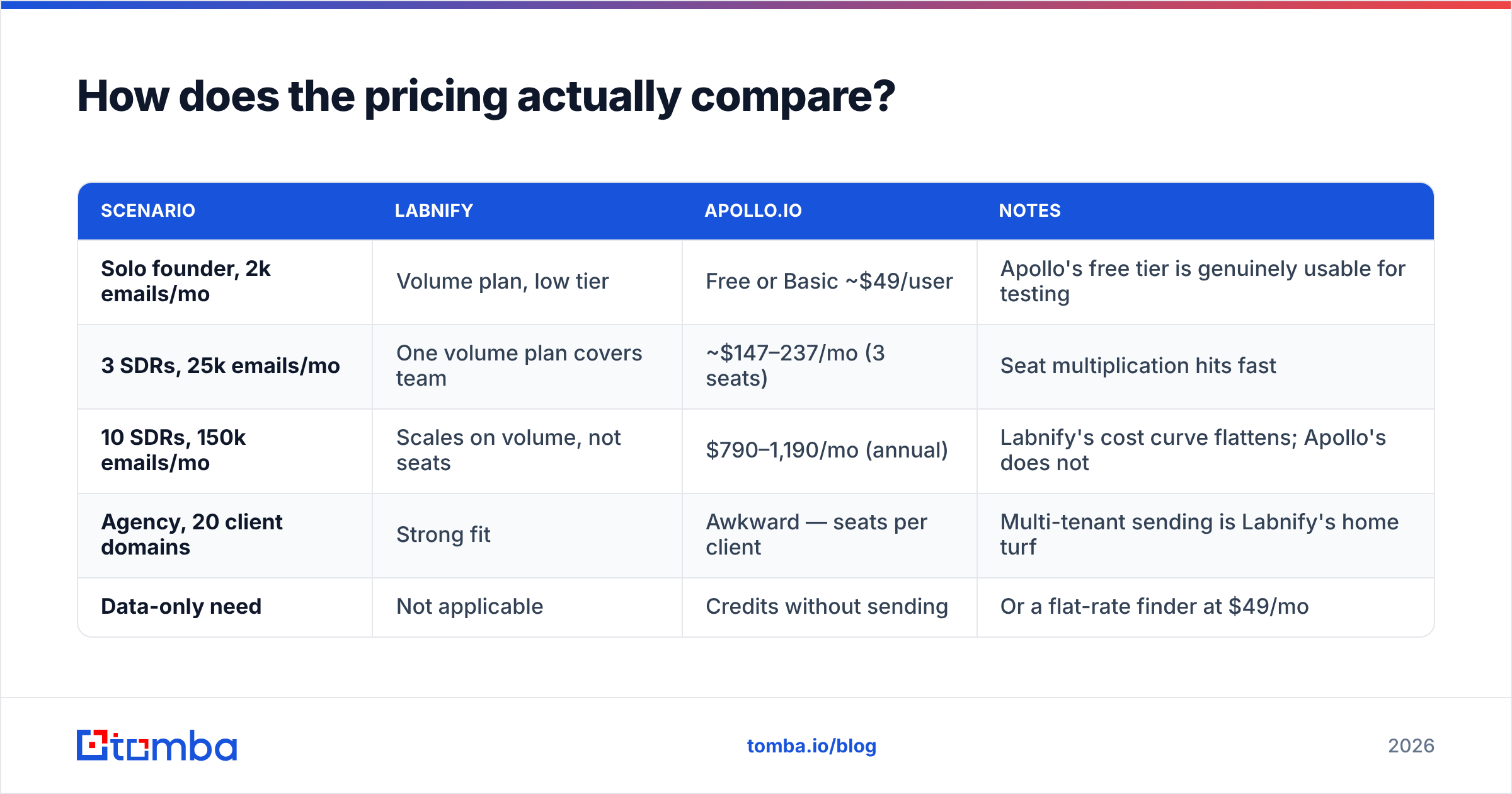
| Capability | Labnify | Apollo.io | Dedicated finder (e.g. Tomba) |
|---|---|---|---|
| Contact database | None — bring your own list | 200M+ contacts, 60+ filters | Live search by domain, name, or company |
| Email verification | Basic list hygiene | Bundled, credit-metered | Core product, catch-all handling included |
| Sending / SMTP relay | Core product, high volume | Built-in sequences, mailbox limits apply | Not a sender — feeds your sender |
| Sequences & cadences | Campaign sending, lighter automation | Multi-step, A/B testing, conditional branches | No |
| Dialer / phone data | No | Yes, on higher tiers | Phone finder + validator |
| CRM sync | Via integrations | Native HubSpot, Salesforce, Pipedrive | Native + API/Zapier |
| API access | Yes (sending API) | Yes, credit-gated | Yes, full REST API |
| Free tier | Trial-style | Yes, limited credits | 25 searches/mo |
| Entry paid price | Volume-based; check vendor | ~$49/user/mo (annual) | $49/mo flat |
| Best at | Cheap, high-volume delivery | Finding + engaging in one place | Accuracy and verification |
Two things jump out of that table. First, Apollo is the only one that tries to own the whole chain, and that is exactly why each link is weaker than a specialist. Second, Labnify has no answer for the "where does the list come from" column. A Labnify-centred stack always needs a second vendor.

Is Apollo.io's data good enough to skip a separate finder?#
Sometimes. Usually not. Apollo's database is genuinely broad. For US mid-market job titles that are active on LinkedIn, it is often good enough to build a first list in an afternoon. That is a real edge, and it is why Apollo became a default for SDR teams.
The trouble starts at the edges, and the edges hold most of your market:
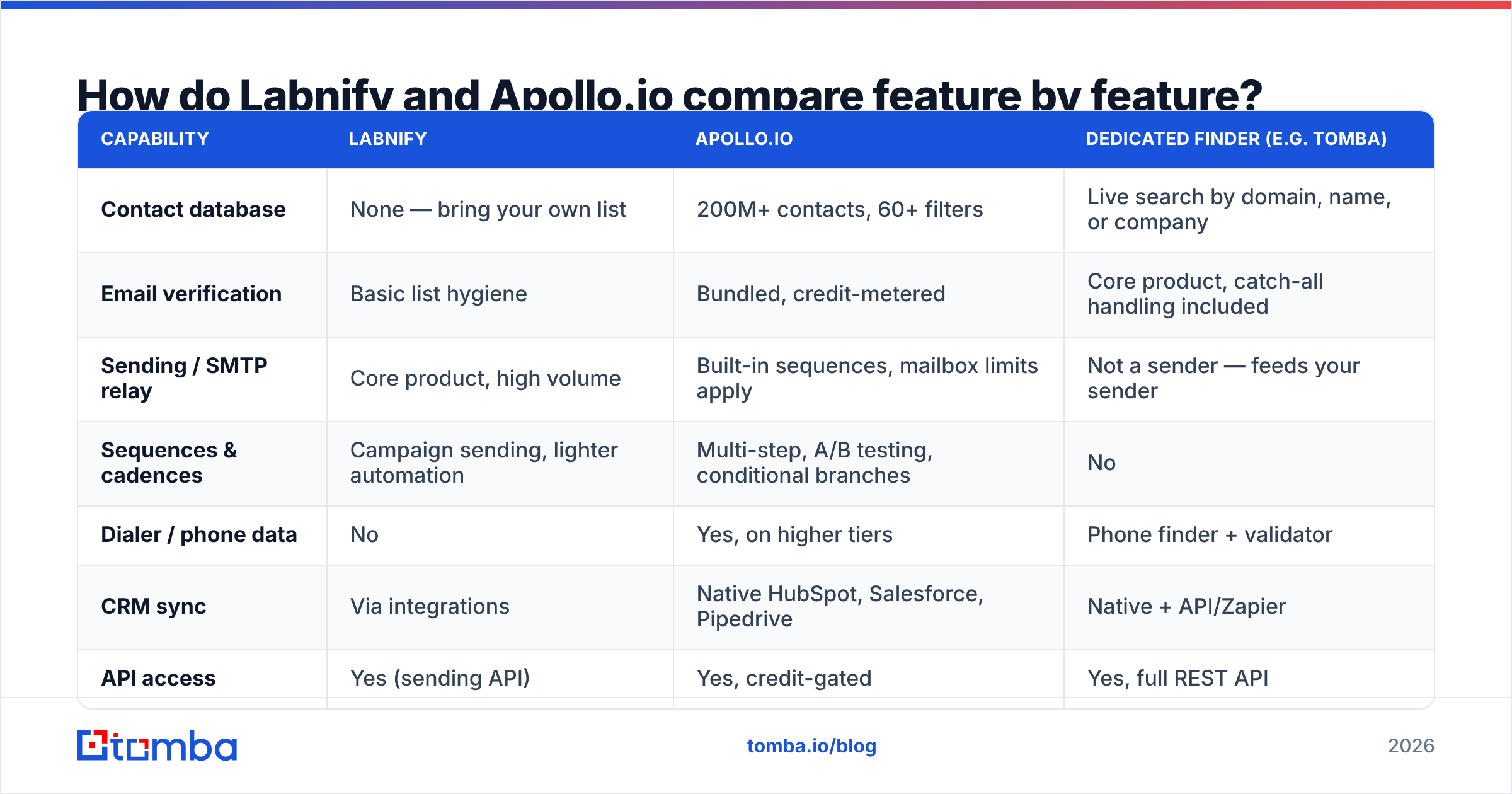
- Stale records after job changes. A record reflects the last time a profile was crawled or contributed. In fast-moving companies, a six-month-old record is a 30–40% coin flip on whether the person still holds the role.
- Thin coverage outside the US. EMEA and APAC mid-market data is weaker than the headline contact count suggests, especially outside tech.
- Guessed patterns sold as findings. Pattern addresses like first.last@domain are cheap to make and often right. But "often" is doing heavy lifting when your domain reputation is at stake.
The last two problems are about catch-all domains and credit metering.
- Catch-all guesswork. Many B2B domains accept every address at the SMTP layer. Tools that call these "valid" are guessing. Tools that call them "unknown" are honest but useless, unless they run a real catch-all verifier.
- Credit maths. Export credits are the meter. Teams burn credits on records they then re-verify somewhere else, so they pay twice for one contact.
The practical fix is boring. Whatever database you pull from, run the list through an independent email verifier before it reaches your sender. It costs a fraction of a bounced campaign. It is also the highest-ROI step in the whole pipeline. If you are weighing Apollo on data quality alone, the Apollo alternative breakdown goes deeper on coverage and credit maths.
Labnify vs Apollo.io pricing: how does it really compare?#
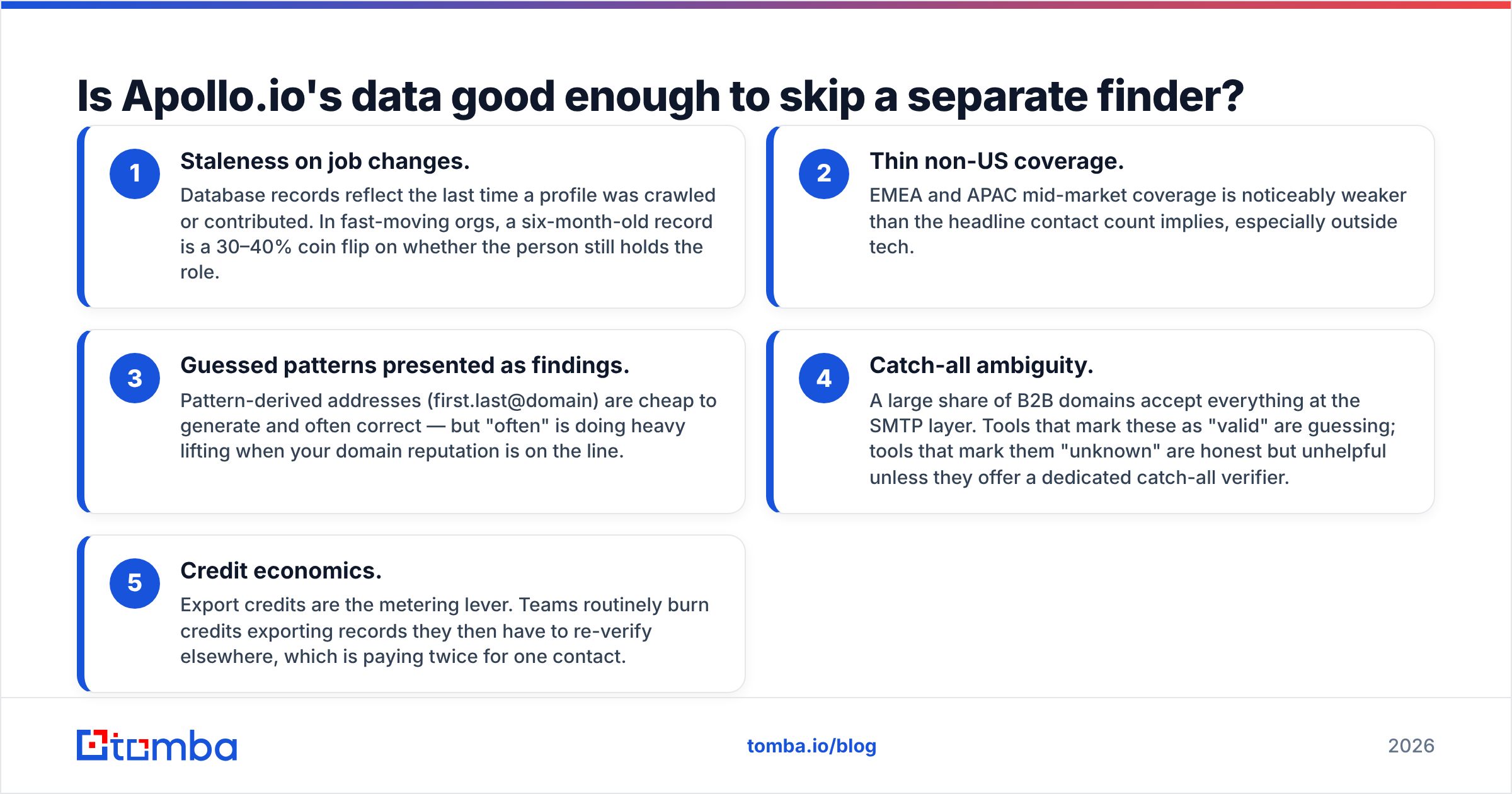
Normalise before you compare. Apollo charges per seat and meters credits. Labnify charges for volume. A three-person team and a thirty-person team get very different value from the same headline number.
| Scenario | Labnify | Apollo.io | Notes |
|---|---|---|---|
| Solo founder, 2k emails/mo | Volume plan, low tier | Free or Basic ~$49/user | Apollo's free tier is genuinely usable for testing |
| 3 SDRs, 25k emails/mo | One volume plan covers team | ~$147–237/mo (3 seats) | Seat multiplication hits fast |
| 10 SDRs, 150k emails/mo | Scales on volume, not seats | $790–1,190/mo (annual) | Labnify's cost curve flattens; Apollo's does not |
| Agency, 20 client domains | Strong fit | Awkward — seats per client | Multi-tenant sending is Labnify's home turf |
| Data-only need | Not applicable | Credits without sending | Or a flat-rate finder at $49/mo |
Apollo's published tiers sit at Free, Basic ($49/user/mo), Professional ($79/user/mo), and Organization (~$119/user/mo) on annual billing. Always check Apollo's own pricing page, because credit allowances move more often than the dollar figures do. Labnify does not publish a matching per-seat number. That is a plus if you have a big team and a nuisance if you want a quick spreadsheet.
A flat-rate data layer sits outside both models. Tomba pricing runs a free tier at 25 searches/mo, Starter at $49/mo, Growth at $99/mo, and Pro at $249/mo. It is priced on searches, not seats, which matters when five people need the same 5,000 contacts.
Which one wins on deliverability?#
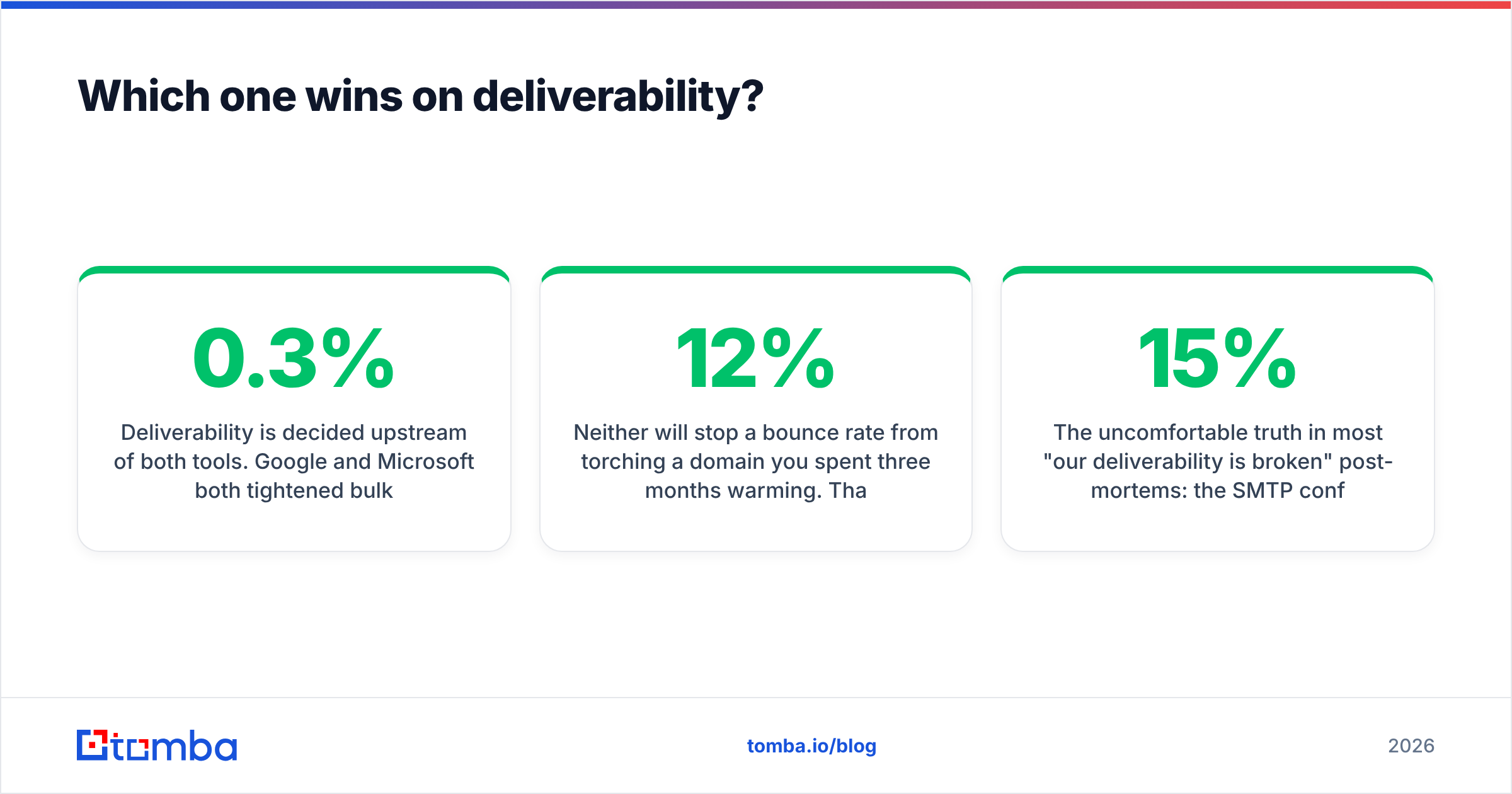
Labnify wins on sending mechanics. Apollo wins on convenience. In the Labnify vs Apollo.io matchup, neither wins the thing that decides whether you land in the inbox.
Deliverability is settled upstream of both tools. Google and Microsoft both tightened their rules for bulk senders: authenticated domains, one-click unsubscribe, and a spam complaint rate under 0.3%, per Google's bulk sender guidelines. None of that is a feature you can buy. It follows from list quality and sending habits.
What each tool brings:
- Labnify hands you control of the sending layer: your own domains, your own IP posture, fine-grained throttling, and campaign isolation so one bad list does not poison the rest. That control pays off if you understand sender reputation.
- Apollo connects your mailbox, sets sane defaults, and guides warmup. But you still live inside Google Workspace or Microsoft 365 daily limits. Fine at 200 emails a day per mailbox. Not fine at 20,000 a day.
- Neither will stop a 12% bounce rate from burning a domain you spent three months warming. Your list sets that number, and your data source sets your list.
Here is the uncomfortable part of most "our deliverability is broken" post-mortems. The SMTP setup was fine. The list had 15% dead addresses and 20% catch-alls marked as valid, and the sending tool delivered every one of them.
Who should choose Labnify?#
Choose Labnify when send volume is your constraint and data is already solved:
- Agencies running many client domains. Multi-tenant sending at a flat cost beats stacking per-seat licences across accounts.
- Teams that outgrew Google Workspace limits. If you add mailboxes just to raise a daily ceiling, you have an infrastructure problem, not a prospecting one.
- Anyone tired of metering. Per-email pricing gets punishing at scale. Volume pricing is easier to forecast.
- Developer-led stacks. If your list building already lives in scripts and an email finder API, you want a sending API, not another UI.
Do not choose Labnify if you have no list and no plan to get one. It will not help you.
Who should choose Apollo.io?#
Choose Apollo when discovery and engagement matter more than send volume:
- Small SDR teams starting from zero. One login, list to sequence in an hour. That speed is worth real money in month one.
- Managers who need pipeline visibility. Sequence analytics, call recordings, and CRM sync in one place beat stitching four dashboards together.
- US-centric mid-market motions. Coverage is strongest exactly here.
- Teams that want a dialer. Labnify does not do phones. If calls are part of the motion, Apollo covers ground Labnify never will.
Do not choose Apollo if you are an agency with twenty client domains, or if your ICP sits where the database thins out. G2's Apollo.io reviews are worth skimming for the recurring data-accuracy complaints before you sign an annual contract.
Can you run Labnify and Apollo together?#
The Labnify vs Apollo.io question assumes you must pick one. You can run both, but it is usually redundant. Paying Apollo per seat for a database and then sending through Labnify means you ignore Apollo's sequencer, which is a big chunk of what you pay for. If you go that route, the cleaner build is:
- Source contacts from a flat-rate finder rather than a per-seat platform.
- Verify every address independently, with explicit catch-all handling.
- Enrich with firmographics and phone data where the motion needs it.
- Send through the dedicated infrastructure layer.
- Sync outcomes back to the CRM.
That stack costs less than Apollo Organization seats for most teams under fifteen people. Each layer can also be swapped without rebuilding the others. The lock-in argument for all-in-one platforms only holds while every part is at least adequate.
Labnify vs Apollo.io: what's the verdict?#
There is no single winner, because there is no single job. Labnify wins the sending contest: more volume, a better cost curve at scale, and a much better fit for agencies. Apollo wins the "I need contacts and a workflow today" contest, and its free tier makes that claim easy to test yourself.
Neither one wins on data accuracy. That is the variable with the biggest effect on reply rate. A 95%-accurate list through an average sender beats a 75%-accurate list through a perfect one, every time.
Fix the list first. Start with Tomba Email Finder. It finds and verifies addresses by domain, name, or company, with catch-all detection built in and a free tier of 25 searches/mo. Benchmark it against an Apollo export before you renew anything. Then send through whichever engine fits your volume. That order is what actually moves reply rates.
Related guides#
// get started
Find, verify and enrich your first contacts today
Start on the free plan with 25 searches a month, then scale when your team is ready.
Free plan · No credit card required · GDPR & CCPA
Get the Tomba newsletter
Product and data updates
// about the author