Labnify vs Saleshandy: Which Cold Email Platform Wins in 2026?
Labnify sells sending infrastructure. Saleshandy sells an outreach suite. They are not the same product, and picking wrong costs you a quarter of pipeline. Here is the honest breakdown.
TL;DR
- Labnify is infrastructure-first. It exists to get high volumes of cold email delivered — sending accounts, warmup, rotation, deliverability controls. It is not trying to be your CRM.
- Saleshandy is a sequencer-first outreach suite. Multi-step sequences, unified inbox, reply detection, a built-in lead finder, and team reporting in one login.
- Volume changes the answer. Under ~20,000 emails a month with one or two SDRs, Saleshandy is usually the cheaper and faster setup. Above that — agencies, multi-domain senders, lead-gen shops — Labnify's per-volume economics start to win.
- Neither fixes bad data. Both platforms will happily send to a list that bounces at 12% and burn your domains doing it. Verification sits upstream of both.
- Pricing moves. Treat every number below as directional and confirm on the vendor's own pricing page before you sign anything.
What are Labnify and Saleshandy, exactly?#
They get compared because both show up when you search "cold email tool," but they solve different halves of the same problem.
Labnify positions itself around sending infrastructure. The pitch is volume without the deliverability collapse: connect or provision sending accounts, warm them, rotate across them, throttle per-inbox sends, and push large campaigns through without every message landing in Promotions. If you have ever run a lead-gen agency and spent your Monday morning inside a spreadsheet of 40 sending domains, you know exactly which pain this is aimed at.
Saleshandy is an outreach platform in the Lemlist/Instantly/Reply category. You build a sequence, you plug in a list, you get a unified inbox, you get reply sentiment and sequence-level analytics, and there is a built-in B2B lead database with credit-based email lookups. Warmup is bundled. The whole thing is designed so one rep can run campaigns without a RevOps person babysitting the setup.
Here is the cleanest way to think about it. Labnify is the truck and the road. Saleshandy is the truck, the road, a dispatcher, and a clipboard for the driver. Fewer parts is not automatically better — it depends on whether you already own a dispatcher.
The four questions that actually decide this:
- How many emails per month? Under 20k, sequencer economics dominate. Over 50k, infrastructure economics dominate.
- How many sending domains? One or two, any tool works. Fifteen or more, rotation and per-inbox controls stop being a nice-to-have.
- Where does your data come from? If you already run a dedicated email finder and enrichment stack, Saleshandy's bundled lead credits are redundant spend.
- Who operates it? A solo founder wants one login. An agency ops lead wants API access and granular control.
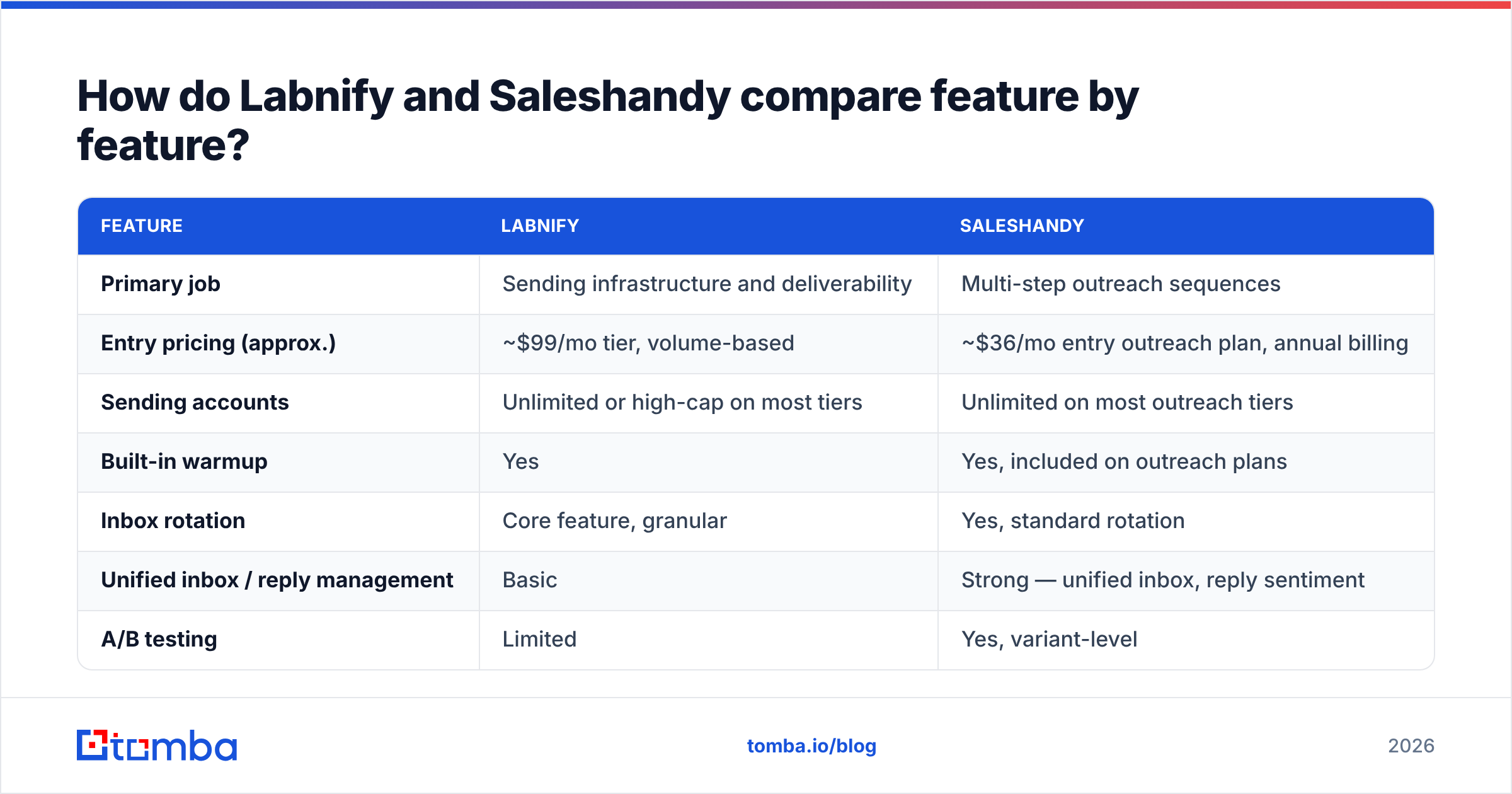
How do Labnify and Saleshandy compare feature by feature?#
| Feature | Labnify | Saleshandy |
|---|---|---|
| Primary job | Sending infrastructure and deliverability | Multi-step outreach sequences |
| Entry pricing (approx.) | ~$99/mo tier, volume-based | ~$36/mo entry outreach plan, annual billing |
| Sending accounts | Unlimited or high-cap on most tiers | Unlimited on most outreach tiers |
| Built-in warmup | Yes | Yes, included on outreach plans |
| Inbox rotation | Core feature, granular | Yes, standard rotation |
| Unified inbox / reply management | Basic | Strong — unified inbox, reply sentiment |
| A/B testing | Limited | Yes, variant-level |
| Built-in lead database | No | Yes, credit-based lead finder |
| Email verification | Basic / relies on upstream | Built-in verification credits |
| CRM integrations | Fewer, API-leaning | HubSpot, Pipedrive, Salesforce, Zapier |
| API access | Yes, developer-friendly | Yes, on higher tiers |
| Best fit | Agencies, high-volume senders, lead-gen shops | SDR teams, SMB sales, founders doing outbound |
| Learning curve | Higher — you configure more | Lower — opinionated defaults |
Read that table twice and one thing stands out: the overlap is real but shallow. Both send, both warm up, both rotate. The divergence is everything around sending — Saleshandy invests in the rep's daily workflow, Labnify invests in the pipes.
A practical example. Say you run a 3-person SDR team at a Series A SaaS company, doing 8,000 emails a month across two domains. Saleshandy gives you a unified inbox so your reps stop bouncing between six Gmail tabs, sequence analytics your manager can actually read in a Monday pipeline review, and CRM sync so nothing gets re-keyed. Labnify would send those 8,000 emails perfectly well and then leave your reps to manage replies somewhere else.
Flip it. You run an appointment-setting agency with 22 clients, 140 sending domains, and 400,000 emails a month. Now Saleshandy's per-seat, per-credit model starts compounding into real money, and the workflow features matter less because your team lives in a Slack channel and a Google Sheet anyway. Labnify's volume-oriented pricing and per-inbox control is the better shape.
Which one costs less at 10,000 emails a month?#
Short answer: Saleshandy, usually — but only if you don't need its lead credits.
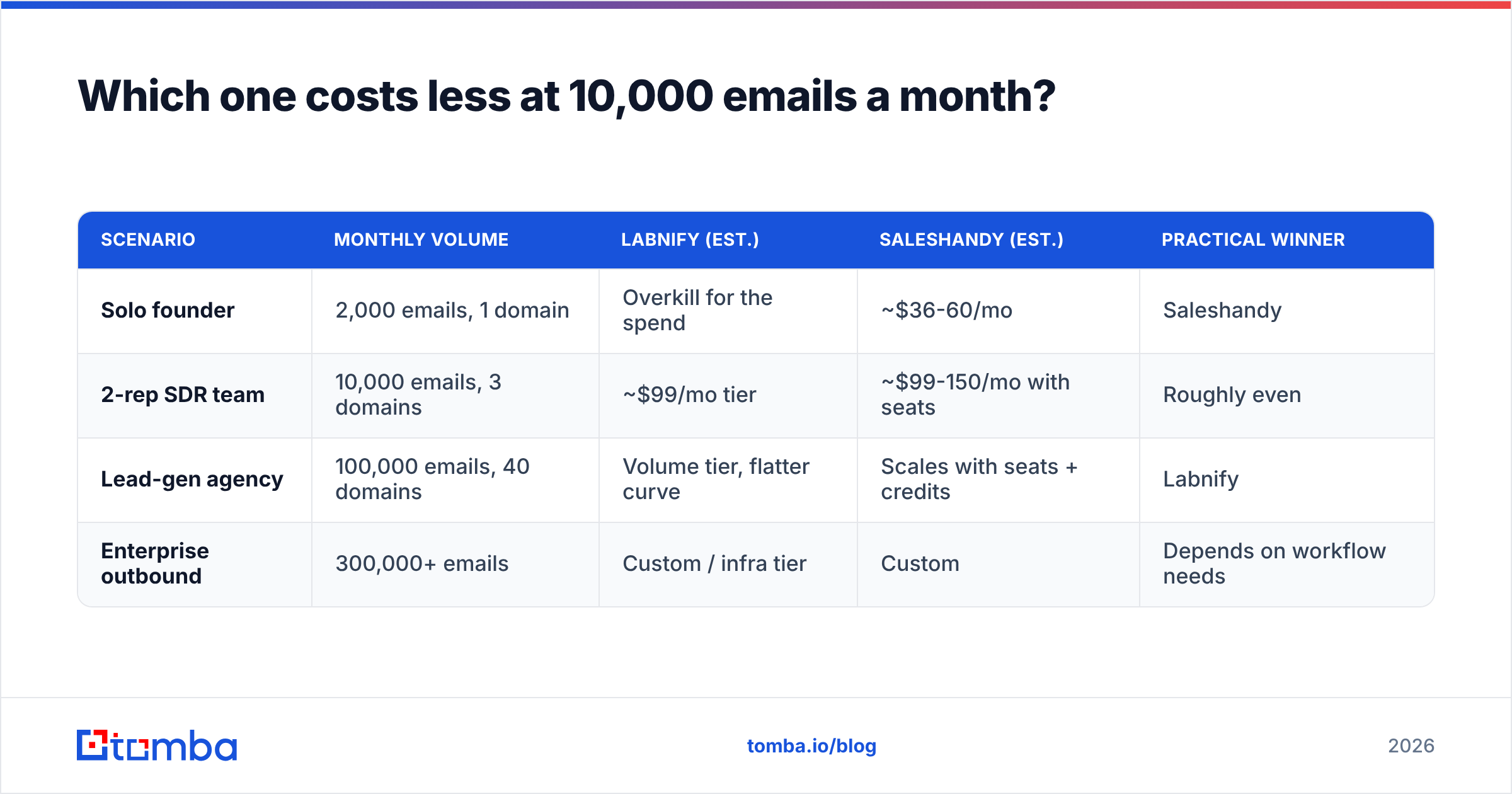
Cold email pricing is deliberately hard to compare because vendors meter different things. Saleshandy meters seats, email credits, and lead-finder credits. Labnify meters sending volume and accounts. A like-for-like comparison has to fix the workload first.
| Scenario | Monthly volume | Labnify (est.) | Saleshandy (est.) | Practical winner |
|---|---|---|---|---|
| Solo founder | 2,000 emails, 1 domain | Overkill for the spend | ~$36-60/mo | Saleshandy |
| 2-rep SDR team | 10,000 emails, 3 domains | ~$99/mo tier | ~$99-150/mo with seats | Roughly even |
| Lead-gen agency | 100,000 emails, 40 domains | Volume tier, flatter curve | Scales with seats + credits | Labnify |
| Enterprise outbound | 300,000+ emails | Custom / infra tier | Custom | Depends on workflow needs |
Two caveats that matter more than the numbers.
First, lifetime and promotional deals distort everything. Labnify has run AppSumo-style lifetime offers. If you caught one, your cost basis is not comparable to anyone paying list price, and no blog post can model that for you.
Second, credits are the hidden line item. A Saleshandy plan that looks like $99/month turns into $180/month the moment you burn through lead credits mid-campaign and top up. This is not a Saleshandy-specific trick — it is how the whole category prices — but it is where teams get surprised. Model your credit consumption before you commit annually.
Is Labnify better for deliverability?#
Labnify gives you more levers. Whether that produces better deliverability depends entirely on whether you pull them correctly.
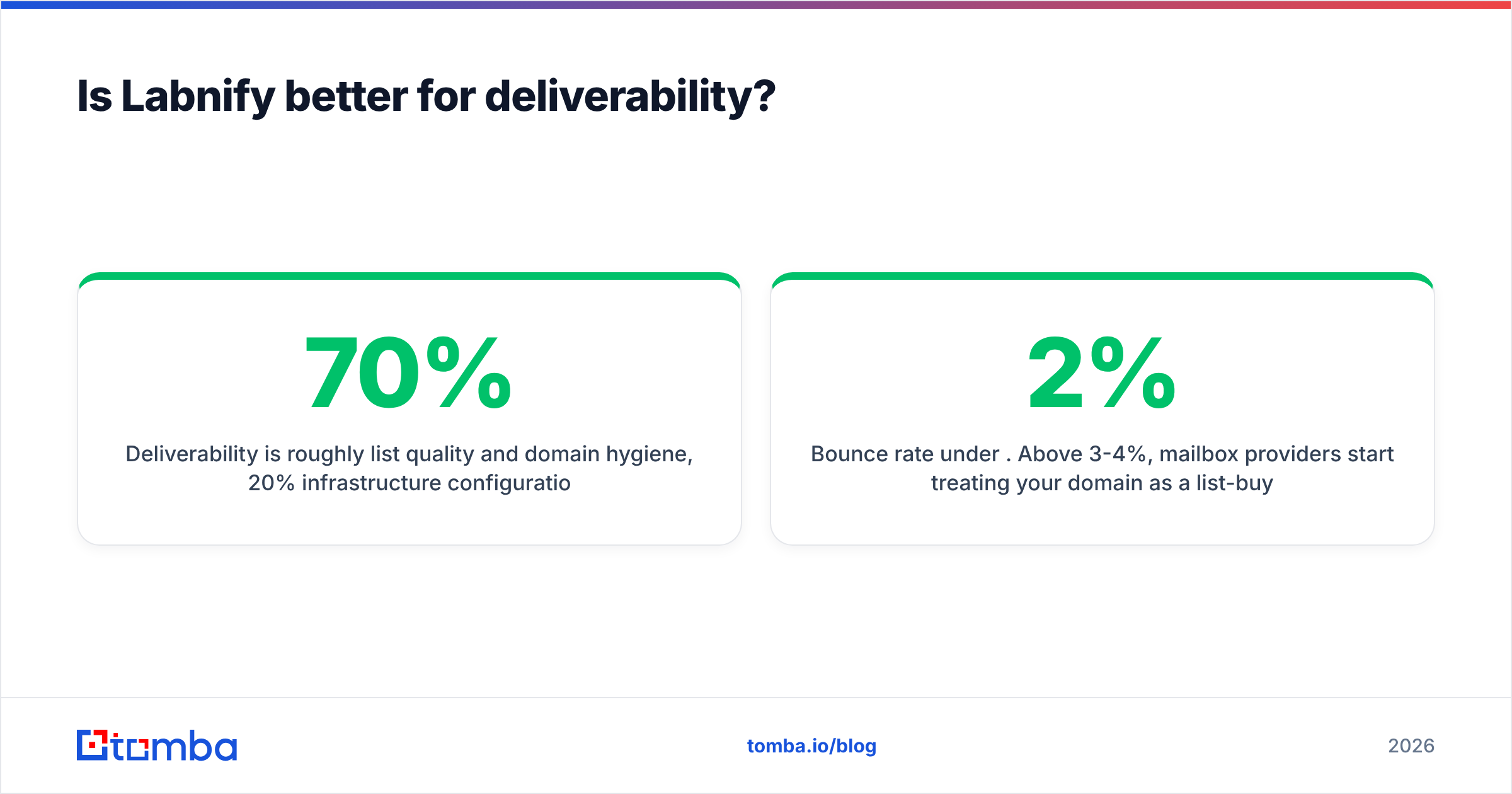
Deliverability is roughly 70% list quality and domain hygiene, 20% infrastructure configuration, and 10% copy. Both tools handle the 20% competently. Labnify simply exposes more of it: finer per-inbox daily caps, more aggressive rotation logic, more granular ramp schedules. Saleshandy makes reasonable decisions for you and hides the dials.
If you don't know what your per-inbox daily send limit should be during week three of warmup, more dials will hurt you, not help you. Run the math with a warmup calculator before you touch either platform's settings, and read up on how email deliverability actually gets scored by receiving servers.
The deliverability checklist neither tool does for you:
- SPF, DKIM, and DMARC on every sending domain. Google and Yahoo's bulk-sender requirements made this non-optional, and a misconfigured record will sink a campaign no matter which platform sends it. Google's Postmaster Tools documentation is the source of truth here, not your vendor's onboarding video.
- Bounce rate under 2%. Above 3-4%, mailbox providers start treating your domain as a list-buyer. This is a data problem, not a sending problem.
- Separate domains from your primary. Never send cold volume from the domain that carries your invoices and support tickets.
- Ramp, don't sprint. Two to four weeks of warmup per new inbox, then a graduated increase. Both platforms support this; neither forces it.
- Real reply handling. A campaign that generates replies nobody answers within 24 hours trains your team to distrust the channel.
Anyone telling you a specific sending tool "guarantees inbox placement" is selling something. The tool is a multiplier on your list quality, in both directions.
Does Saleshandy's lead finder replace a dedicated email finder?#
For most teams, no — it supplements one.
Bundled lead databases inside sequencers exist to reduce setup friction, and they genuinely do. You search a title and a company size, you push contacts straight into a sequence, and you are live in fifteen minutes. That convenience is worth something.
The tradeoff shows up in coverage and freshness. Sequencer-bundled databases tend to be strongest on US mid-market tech companies and weakest on everything else — European SMBs, non-English-speaking markets, niche verticals, and recently-changed roles. When your ICP drifts away from the database's center of gravity, match rates fall and you are paying credits for contacts you can't use.
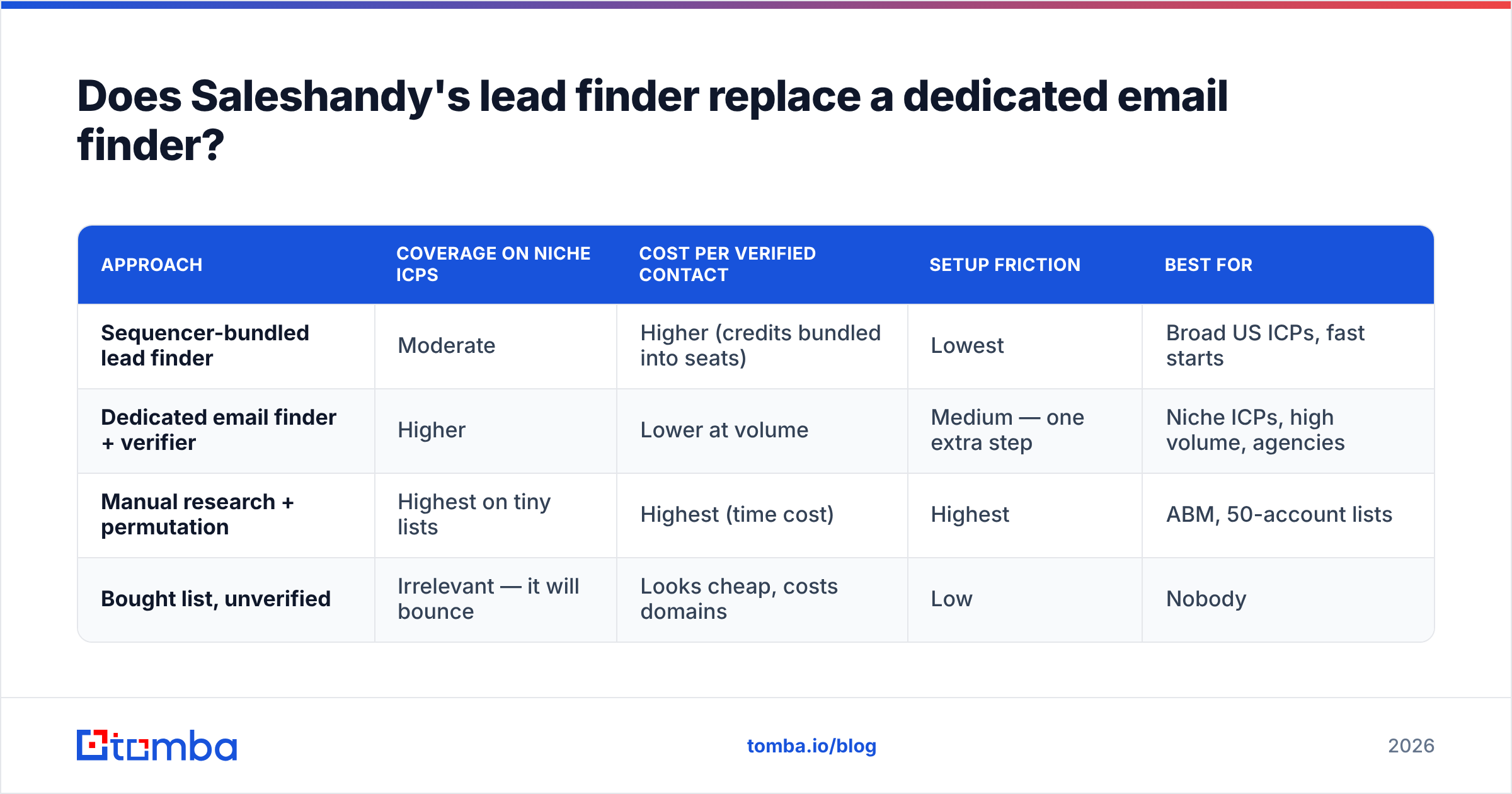
| Approach | Coverage on niche ICPs | Cost per verified contact | Setup friction | Best for |
|---|---|---|---|---|
| Sequencer-bundled lead finder | Moderate | Higher (credits bundled into seats) | Lowest | Broad US ICPs, fast starts |
| Dedicated email finder + verifier | Higher | Lower at volume | Medium — one extra step | Niche ICPs, high volume, agencies |
| Manual research + permutation | Highest on tiny lists | Highest (time cost) | Highest | ABM, 50-account lists |
| Bought list, unverified | Irrelevant — it will bounce | Looks cheap, costs domains | Low | Nobody |
The pattern that works for most outbound teams is to separate data sourcing from data sending. Build the list with a dedicated tool, run every address through an email verifier before import, then let Labnify or Saleshandy do the one job they are good at. That also means switching sequencers later costs you a migration, not your entire contact database — which is a strategic point worth more than any single feature comparison.
For domain-level prospecting, a domain search pass gives you every discoverable address at a target company along with the format pattern, which is frequently faster than searching a database person by person.
Which one should you pick?#
Pick based on your constraint, not your feature wishlist.
Choose Labnify if:
- You send more than 50,000 emails a month. The volume economics tilt clearly in your favor above this line.
- You manage 15+ sending domains. Granular rotation and per-inbox control stop being cosmetic at this scale.
- You're an agency or lead-gen shop. You already have process and people; you need pipes, not training wheels.
- You want API-level control. Building your own layer on top of a sending engine is a legitimate architecture.
Choose Saleshandy if:
- You have reps, not ops engineers. The unified inbox and sequence analytics save real hours every week.
- You need CRM sync out of the box. HubSpot, Pipedrive, and Salesforce connections without middleware.
- You're under 20,000 emails a month. The entry tiers are genuinely affordable at this volume.
- You want one login. Fewer tools is a real operational advantage for small teams.
- You're new to cold email. Opinionated defaults protect you from yourself in month one.
Choose neither if your list bounces above 5%. Fix that first. Both vendors have solid ratings on G2, and neither review score will save a campaign built on scraped, unverified contacts.
A reasonable third path: run Saleshandy for your core SDR team and evaluate Labnify separately for a high-volume experimental channel. These are not mutually exclusive purchases, and running a 30-day parallel test on the same ICP with the same copy will teach you more than any comparison table — including this one.
What should you do before you commit to either?#
Fix the input before you optimize the output.
The failure mode we see constantly: a team spends three weeks choosing between two sending platforms, signs an annual contract, imports a list they exported from a scraper six months ago, and watches their bounce rate hit 14% in week one. The platform gets blamed. The platform was fine.
Before you sign anything, run your existing list through verification and measure the real deliverable percentage. If 30% of your contacts are dead, your effective cost per sent email just went up 43% — and that's a bigger number than the gap between any two vendors on this page. Build the list with a dedicated email finder, verify it, dedupe it, then choose your sender.
Start free with the Tomba Email Finder — 25 searches a month on the free tier, no card required, with verification built into every result so you know what's deliverable before it reaches Labnify, Saleshandy, or whatever you send with next. Paid plans start at $49/month for Starter and $99/month for Growth; see the full Tomba pricing breakdown for bulk and API limits. Your sequencer decides how the email gets delivered. Your data decides whether it should have been sent at all.
Related guides#
// get started
Find, verify and enrich your first contacts today
Start on the free plan with 25 searches a month, then scale when your team is ready.
Free plan · No credit card required · GDPR & CCPA
// about the author