Labnify vs SignalHire: Which Outbound Tool Should You Buy?
Labnify and SignalHire get compared constantly, but they solve opposite halves of the outbound problem. Here's the honest breakdown of what each one does, what it costs, and which you actually need first.
TL;DR — Labnify vs SignalHire in 30 seconds
The short answer on Labnify vs SignalHire: they fix different problems.
- Labnify and SignalHire are not real rivals. Labnify is cold email sending infrastructure. SignalHire is a contact data tool with a recruiting bias. Buying one does not remove the need for the other.
- Are your emails landing in spam? Labnify, or any sender built for deliverability, is the fix. Do you have nobody to email yet? SignalHire, or a dedicated email finder, is the fix.
- SignalHire bundles mobile numbers with a LinkedIn extension. That is why recruiters love it. Its weak spots: per-credit cost at sales volume, and a B2B email set that trails specialist finders.
Two more points settle the rest of the Labnify vs SignalHire debate:
- Labnify sells unlimited-style sending on Gmail-grade infrastructure. Warmup is baked in. That is a real category. But it is a distribution buy, not a data buy.
- Most teams overspend by buying one all-in-one tool per problem. Try a cheaper pattern. Use one finder for data, one sending platform for distribution, and a CRM that both write into.
Labnify vs SignalHire: what does each tool actually do?#
Start here. The "Labnify vs SignalHire" search usually comes from someone who saw both in the same G2 grid. They assume the two overlap. They barely do.
Labnify is a cold email sending and deliverability platform. Call it a mailer. Its whole job sits downstream of your list. It connects sending accounts, rotates them, warms them, and caps volume. It handles bounces. It keeps mail out of the promotions tab and the spam folder. Think of it as the delivery truck fleet.
SignalHire is a contact discovery tool. You search or open a profile, spend a credit, and get back an email address. Often you get a direct phone number too. It grew up serving recruiters who source candidates, then moved toward sales teams. Think of it as the address book.
A delivery truck with no addresses delivers nothing. An address book with no trucks sends nothing. That one idea settles most of the "which one should I buy" question. You can decide before you compare a single feature.
The confusion comes from category drift. Senders keep bolting on a lead database. Data tools keep bolting on a sequencer. Both moves produce a weak copy of the other guy's core product. In outbound tooling, depth beats breadth. It is not close.
Labnify vs SignalHire: how do they compare head-to-head?#
Here is the honest side-by-side. Treat pricing as directional. Both vendors change plans, so check their own pages before you commit budget.
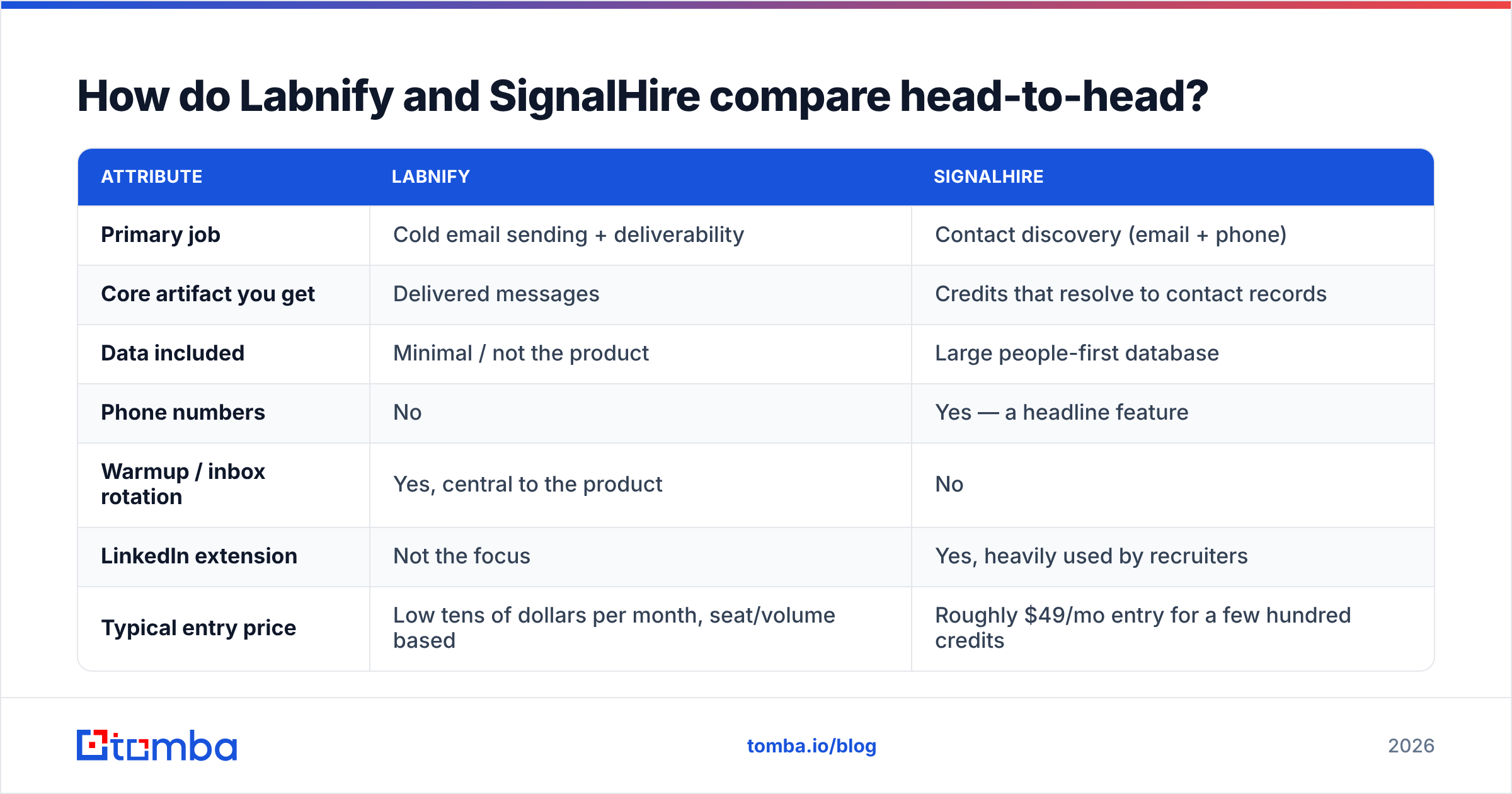
| Attribute | Labnify | SignalHire |
|---|---|---|
| Primary job | Cold email sending + deliverability | Contact discovery (email + phone) |
| Core artifact you get | Delivered messages | Credits that resolve to contact records |
| Data included | Minimal / not the product | Large people-first database |
| Phone numbers | No | Yes — a headline feature |
| Warmup / inbox rotation | Yes, central to the product | No |
| LinkedIn extension | Not the focus | Yes, heavily used by recruiters |
| Typical entry price | Low tens of dollars per month, seat/volume based | Roughly $49/mo entry for a few hundred credits |
| Who buys it | Agencies, founders, outbound teams | Recruiters, sourcers, some SDR teams |
| Replaces an email finder? | No | Partially |
| Replaces a sending tool? | No | No |
Two rows matter more than the rest. Look at "Replaces an email finder?" and "Replaces a sending tool?" SignalHire does not replace a sender. Labnify does not replace your data source. That is the whole article in two cells.
What does Labnify actually do well?#
You have a list, and nobody sees your emails. Then this is the half of Labnify vs SignalHire that matters.
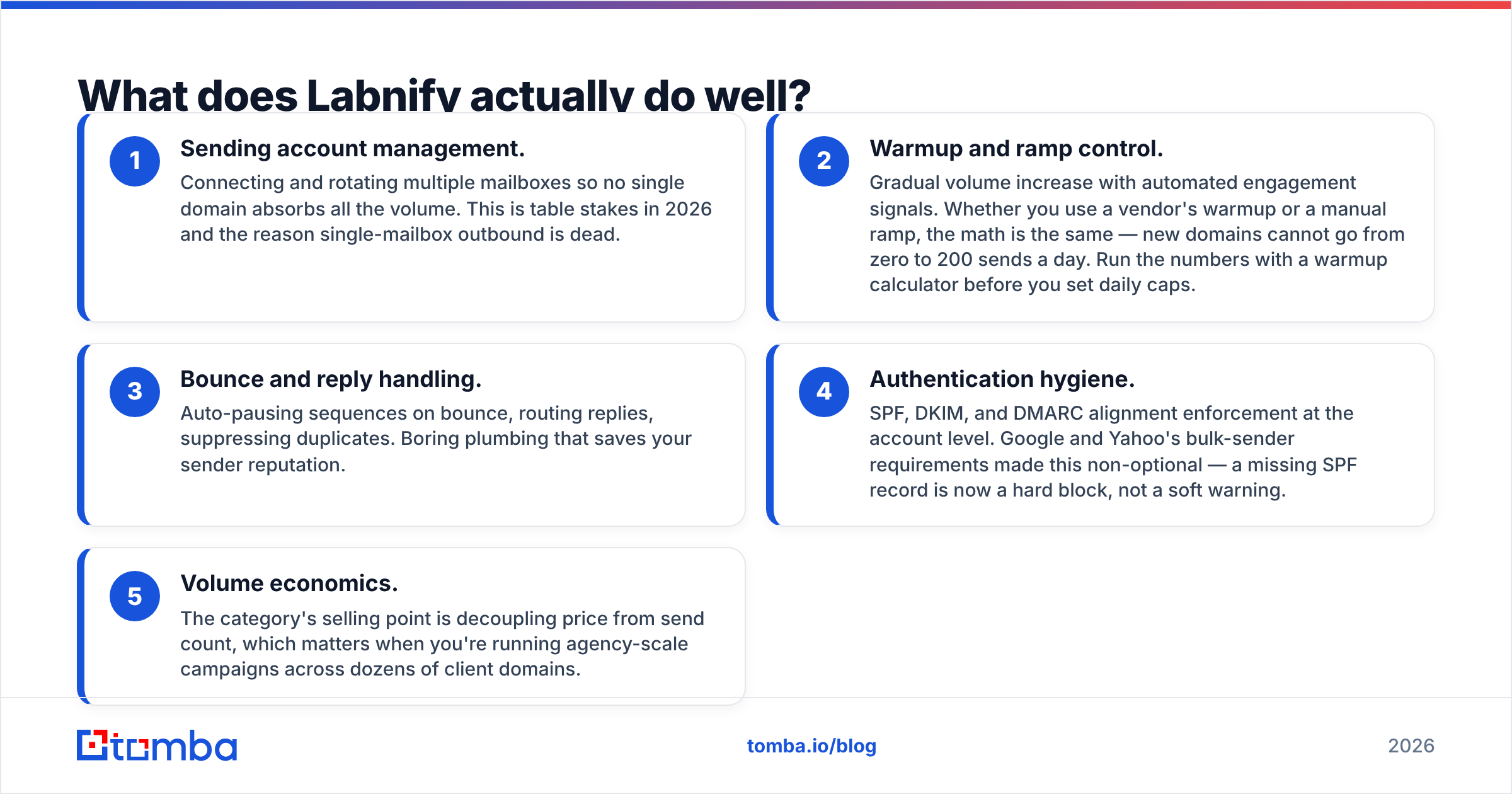
- Sending account management. It connects and rotates several mailboxes. No single domain absorbs all the volume. This is table stakes in 2026, and it is why single-mailbox outbound is dead.
- Warmup and ramp control. Volume climbs slowly, with automated engagement signals. Vendor warmup or manual ramp, the math is the same. A new domain cannot jump from zero to 200 sends a day. Run the numbers with a warmup calculator before you set daily caps.
- Bounce and reply handling. Sequences pause on a bounce. Replies get routed. Duplicates get suppressed. It is boring plumbing, and it saves your sender reputation.
Two more items round out the list:
- Authentication hygiene. It enforces SPF, DKIM, and DMARC alignment at the account level. Google and Yahoo made this non-optional for bulk senders. A missing SPF record is now a hard block, not a soft warning.
- Volume economics. The category sells price that is decoupled from send count. That matters at agency scale, across dozens of client domains.
What Labnify does not do is tell you that jane.doe@company.com exists. You still have to source and verify that address somewhere else. Feed a sender an unverified list, and your own bounce rate cancels out every deliverability feature it has.
What does SignalHire actually do well?#
SignalHire earns its name in three places.
- Phone numbers bundled with email. Most email-first tools charge extra for mobile numbers, or skip them. SignalHire treats the full contact card as one unit. That is what a recruiter calling candidates needs.
- The browser extension workflow. You source from LinkedIn profile by profile, reveal contacts inline, and push them to a list. It is fast, tactile, and hard to beat one person at a time.
- ATS-adjacent features. Candidate pipelines and team sharing show its recruiting roots.
The trade-offs are just as clear. A credit burns on every reveal, useful or not. So the cost per valid contact runs higher than the sticker price. Coverage favors people with a big public footprint. That means strong results in tech and North America. It means thinner results for mid-market European manufacturers, or anyone who skips LinkedIn. Bulk work also feels clumsy next to tools built for list-building first.
How accurate is the contact data, really?#
Accuracy decides whether any of this works. It is also the number vendors are loosest about.
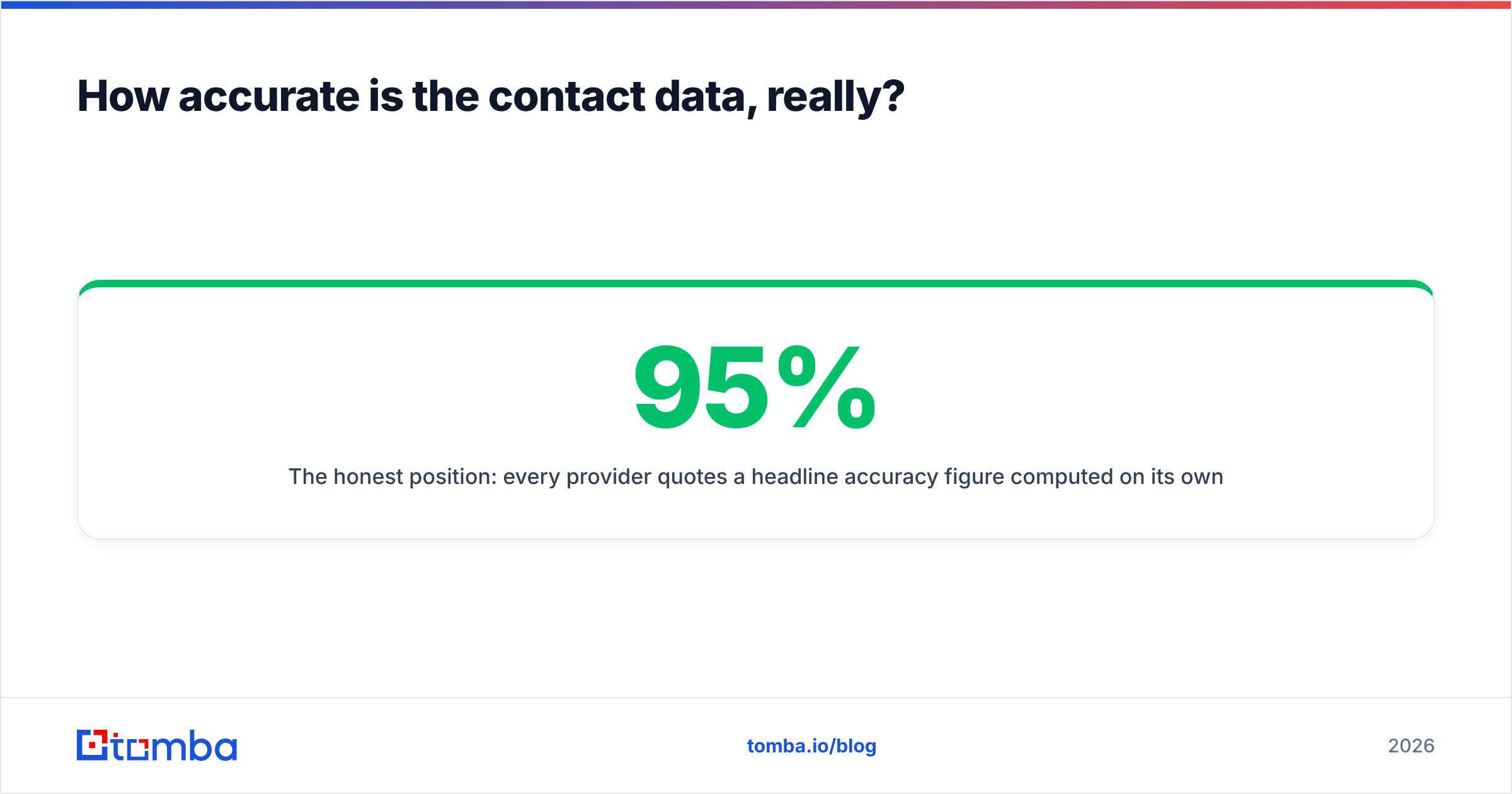
Here is the honest position. Every provider quotes a headline accuracy figure from its own sample. None of them compare directly. A "95% accurate" claim means nothing without the denominator. Is that 95% of returned results, or 95% of attempted lookups? Say one tool returns an address for 40% of your list at 95% accuracy. A tool that returns 70% at 90% still hands you more usable contacts.
Run your own test. Take 100 real targets from your ICP, not a generic list. Push them through each tool. Measure three things:
- Coverage rate — how many returned any address at all.
- Verified rate — of those, how many pass an independent email verifier. Never trust a tool's own verdict on its own data.
- Bounce rate in production — the only number that costs you money.
That third number is where credit-based people-search tools slip behind specialist finders. People-first databases optimize for finding a person. Email-first tools optimize for the address resolving. Those are different goals, and they produce different SMTP results.
One note on catch-all domains. Many enterprise domains accept all mail at the gateway. No verifier can confirm a single mailbox there by SMTP alone. Tools that mark every catch-all "valid" inflate their stats. Tools that mark them all "invalid" throw away good leads. A catch-all verifier that scores them by probability is the only sane middle path. Check how each vendor on your shortlist handles this before you trust headline percentages.
Labnify vs SignalHire: what does each one cost in practice?#
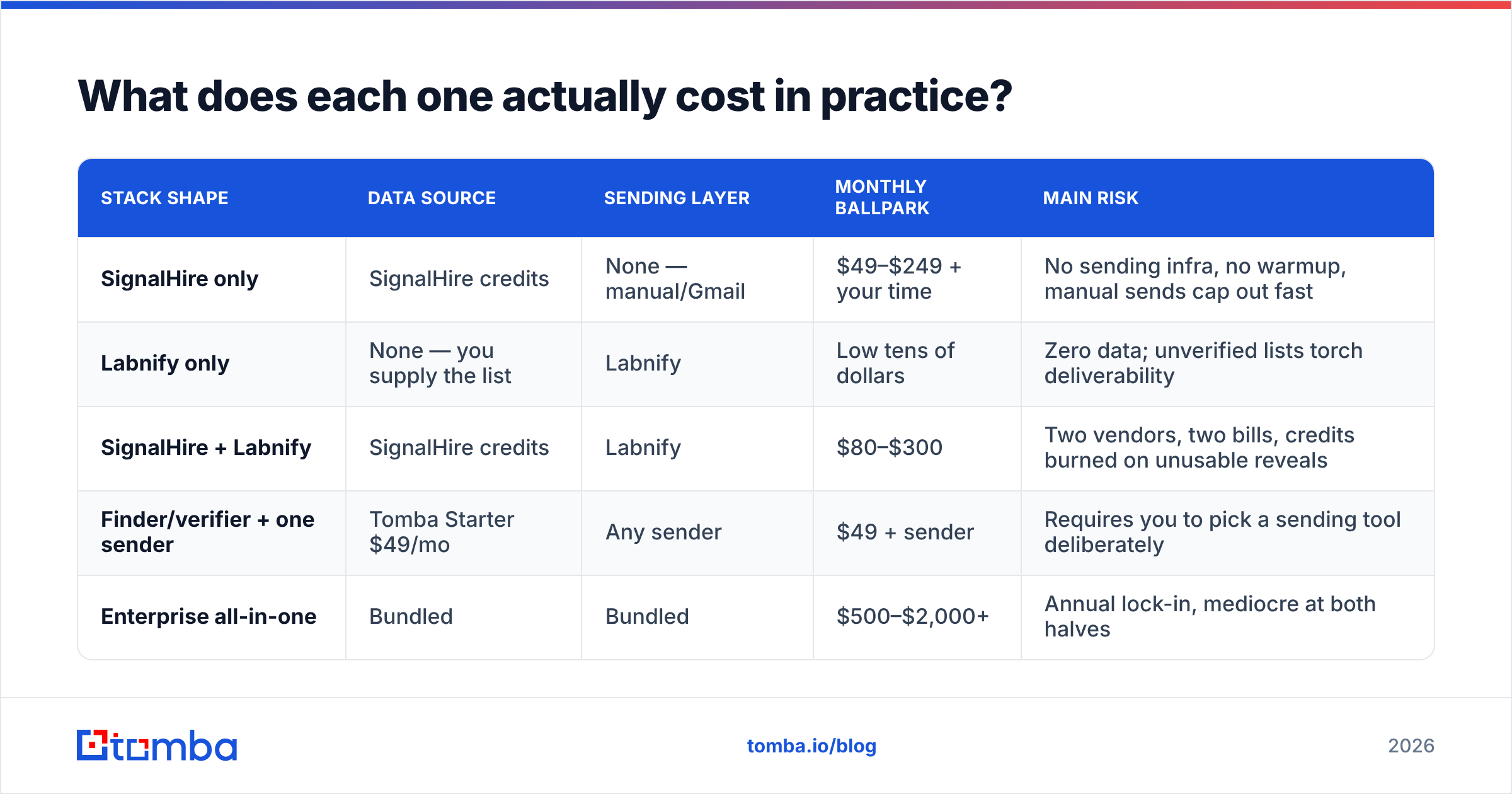
Sticker price is the wrong metric. Cost per contacted prospect is the right one. Here is how a 2,000-contact month prices out across common stack shapes.
| Stack shape | Data source | Sending layer | Monthly ballpark | Main risk |
|---|---|---|---|---|
| SignalHire only | SignalHire credits | None — manual/Gmail | $49–$249 + your time | No sending infra, no warmup, manual sends cap out fast |
| Labnify only | None — you supply the list | Labnify | Low tens of dollars | Zero data; unverified lists torch deliverability |
| SignalHire + Labnify | SignalHire credits | Labnify | $80–$300 | Two vendors, two bills, credits burned on unusable reveals |
| Finder/verifier + one sender | Tomba Starter $49/mo | Any sender | $49 + sender | Requires you to pick a sending tool deliberately |
| Enterprise all-in-one | Bundled | Bundled | $500–$2,000+ | Annual lock-in, mediocre at both halves |
Two things fall out of that table. First, the "SignalHire + Labnify" row is the honest answer for anyone weighing Labnify vs SignalHire. You probably need both halves, not one of them. Second, the data half drives the price swing. Credit models punish a low hit-rate twice: once for the wasted credit, once for the bounce.
For reference, Tomba's pricing starts with a free tier at 25 searches a month. Starter is $49/mo, Growth is $99/mo, Pro is $249/mo, and Enterprise is custom. Verification comes included rather than sold as a separate credit pool. Whatever you pick, check that verification is not a second line item. That is the most common hidden cost in this category.
Labnify vs SignalHire: which is better for cold outbound?#
Neither one, on its own. Here is the decision tree that maps to reality.
Choose SignalHire if: you source people one profile at a time on LinkedIn. Phone numbers matter as much as email. Your send volume is low enough that Gmail plus a light sequencer covers distribution. Recruiters: this is your tool, and the comparison ends here.
Choose Labnify if: you already have a validated list. Maybe it came from a data provider, a partner, an export, or your own scraping. Your measurable problem is inbox placement. Open rates under 20% on a clean list point to distribution, not data.
Choose a dedicated finder plus a sending tool if: you run repeatable outbound at SDR volume. This is the common case. It is also where a two-tool comparison tricks people into buying half a stack.

Here is why that matters financially. All-in-one tools that claim both halves tend to charge enterprise prices for an average database and an average sequencer. Review sites like G2 make this visible. Read past the star rating into the "what do you dislike" sections. The complaints cluster in a pattern: stale data on the sending tools, weak deliverability on the data tools. Predictable, in both directions.
What should your 2026 outbound stack look like?#
Four layers. Each one owned by a tool that is genuinely good at that layer.
- Targeting — a clear ICP with named accounts, not a filter set you re-tune every week.
- Data — an email finder plus verification, ideally in one product so verification is not a second bill. Add a phone finder only if you really run a calling motion. Otherwise it is shelfware.
- Distribution — one sending platform with warmup, rotation, and authentication checks. Labnify fits here. So do several others.
- Record-keeping — your CRM, with enrichment writing into it automatically, not by monthly CSV import.
The first failure mode: buying a tool that spans layers 2 and 3, then finding it weak at one. The second: stacking three data vendors because no single one hits acceptable coverage. At that point you pay enterprise money for a stack held together with spreadsheets.
Specialists exist at both ends, and many are very good at their niche. BookYourData, for example, sells pre-verified lists pay-as-you-go. That suits teams who want data without a subscription commitment. It is a different shape from credit-based people search, and a fair fit for one-off campaigns. The point is not that one vendor wins everything. Buy each layer from someone who treats it as their main product.
Labnify vs SignalHire: so which one wins?#
If you want one verdict: SignalHire wins for recruiters. Labnify wins for high-volume senders. Neither wins for a sales team building outbound from scratch. That team needs a data layer and a sending layer. Labnify vs SignalHire only ever offered one of each.
Before you sign anything, run the 100-contact test on your real ICP. It takes an afternoon and a trial credit pack. It gives you a coverage-and-bounce number that beats every claim on every pricing page, including the ones in this article.
Fixing the data half first? Start with Tomba Email Finder. Search by domain, name, or company. Verification is built into the same lookup, not sold as a second credit pool. Pull results through the API, the Chrome extension, Google Sheets, or bulk CSV. The free tier gives you 25 searches a month. That is enough to run the accuracy test on your own list before you pick whose sending infrastructure to feed.
Related guides#
// get started
Find, verify and enrich your first contacts today
Start on the free plan with 25 searches a month, then scale when your team is ready.
Free plan · No credit card required · GDPR & CCPA
// about the author