LakeB2B vs Apollo.io: Which B2B Data Provider Wins in 2026?
One sells you a static contact list. The other rents you a platform with a database attached. Here is how LakeB2B and Apollo.io actually compare on data accuracy, pricing, contracts, and compliance in 2026.
LakeB2B vs Apollo.io is not a like-for-like fight. One sells you a list. The other rents you a platform with a database attached. Here is how they compare on data, price, and risk.
TL;DR
- LakeB2B and Apollo.io are not the same category of product. LakeB2B sells custom-built contact lists and appended data, usually on a quote and a contract. Apollo.io sells seat-based access to a self-serve database plus a sequencer and dialer.
- Apollo wins on transparency and speed. Public pricing, a free tier, instant signup, and a Chrome extension. You can be prospecting in ten minutes.
- LakeB2B wins on hard-to-source niches. Healthcare NPI data, manufacturing SIC segments, and international lists where self-serve databases thin out fast.
- Both have the same core weakness: staleness. A list is a snapshot, and Apollo's community-contributed records decay too. Whichever you pick, verify before you send.
- The cheapest path for most teams is neither. Use a targeted email finder with per-record verification instead of paying for millions of contacts you will never email.
What are LakeB2B and Apollo.io, really?#
LakeB2B is a data vendor. You tell a salesperson what you want — "IT decision-makers at US hospitals with 500+ beds". They build the file and deliver it as a CSV or a CRM push. Pricing is per record, with a minimum order. They also append and enrich lists you already own, and they will run the email campaign for you. Think of it as a tailor: you send measurements, they cut the cloth.
Apollo.io is a platform. You buy seats, log in, and filter a shared database of a few hundred million contacts yourself. Apollo layers sequencing, a dialer, a LinkedIn extension, meeting scheduling, and basic CRM sync on top. Think of it as a department store: the racks are already stocked, you walk the aisles.
That one structural difference drives almost everything else below. A tailor charges more per garment and takes longer. A department store is faster and cheaper, but you get whatever is on the rack.
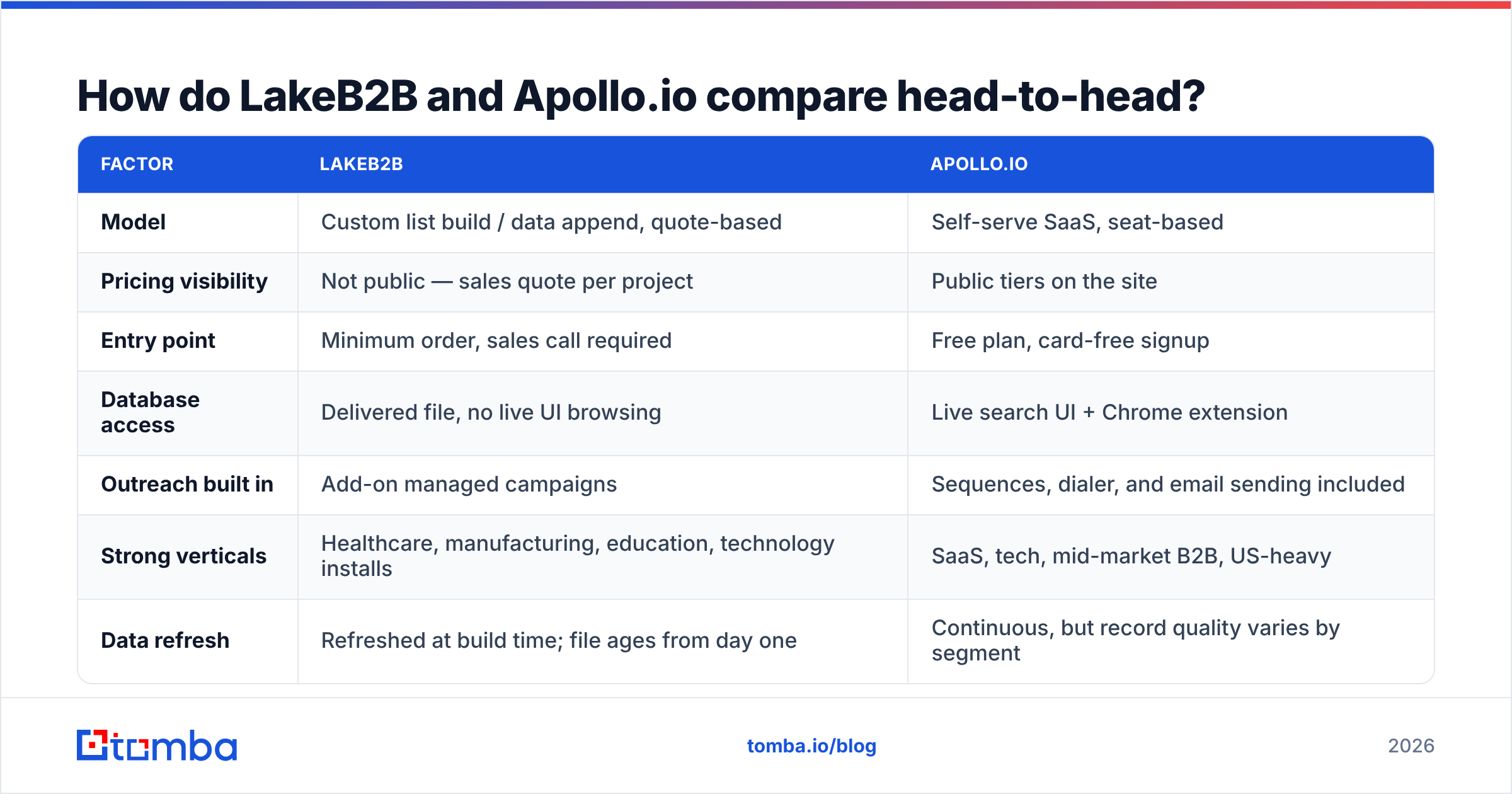
LakeB2B vs Apollo.io: how do they compare head-to-head?#
| Factor | LakeB2B | Apollo.io |
|---|---|---|
| Model | Custom list build / data append, quote-based | Self-serve SaaS, seat-based |
| Pricing visibility | Not public — sales quote per project | Public tiers on the site |
| Entry point | Minimum order, sales call required | Free plan, card-free signup |
| Database access | Delivered file, no live UI browsing | Live search UI + Chrome extension |
| Outreach built in | Add-on managed campaigns | Sequences, dialer, and email sending included |
| Strong verticals | Healthcare, manufacturing, education, technology installs | SaaS, tech, mid-market B2B, US-heavy |
| Data refresh | Refreshed at build time; file ages from day one | Continuous, but record quality varies by segment |
| Verification | Vendor-side, claims vary by order | Built-in credits, accuracy varies by tier |
| Contract | Annual or per-project agreements typical | Monthly or annual, self-cancel |
| Best for | Niche, hard-to-source segments and large one-off pulls | Fast-moving SDR teams that want tooling plus data |
The honest summary: if you can find your ICP inside Apollo's filters, Apollo is the faster and cheaper route. If your ICP is invisible to Apollo — regional distributors, niche medical specialties, non-English markets — then a list vendor is not an overpriced alternative. It is the only option.
How accurate is the data from each one?#
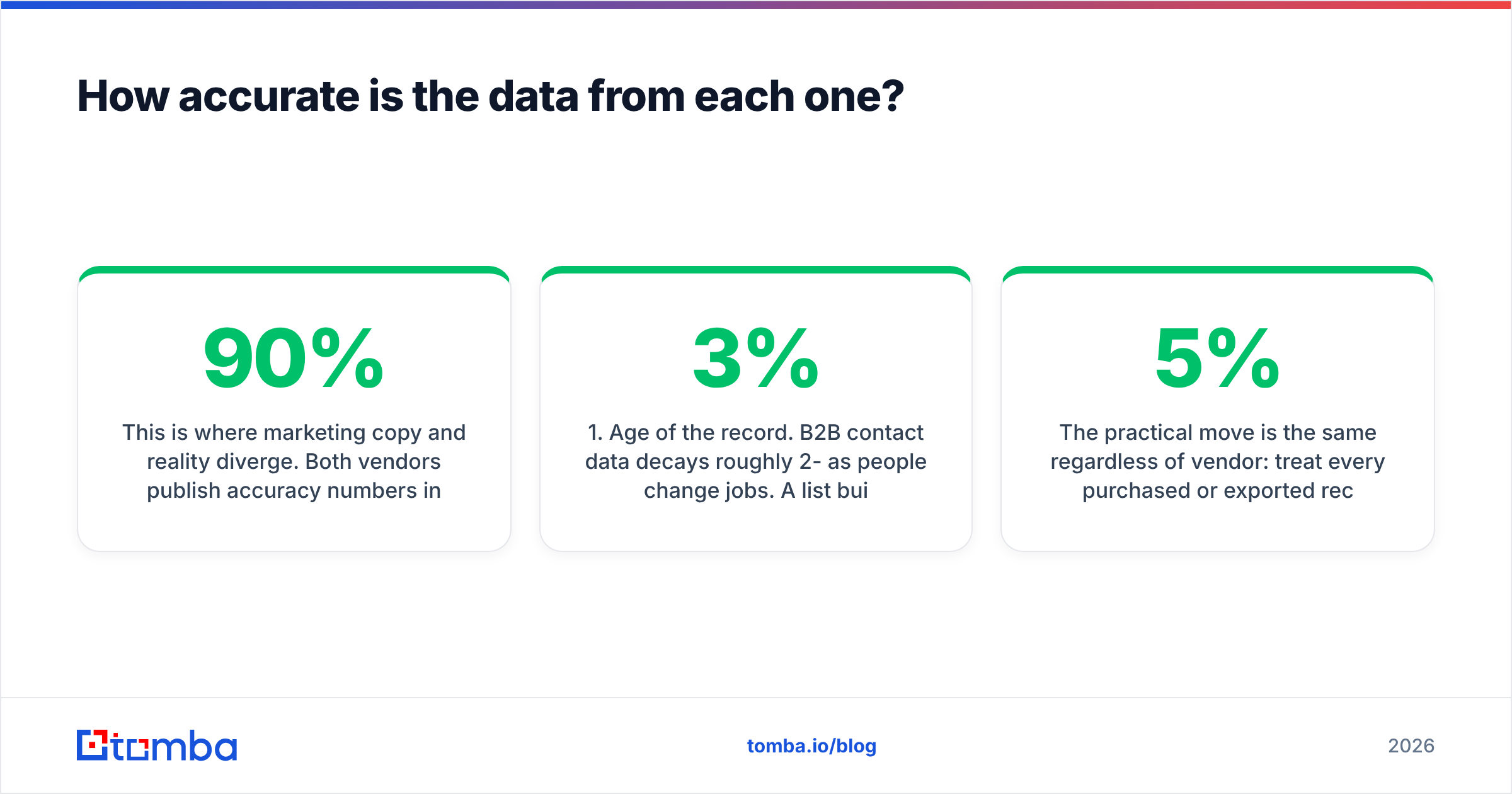
This is where marketing copy and reality diverge. Both vendors publish accuracy numbers above 90%. Neither number means what you think it means.

Five things decide whether a record lands in an inbox:
- Age of the record. B2B contact data decays 2-3% per month as people change jobs. A list built in January is much worse by June. Nobody re-delivers it for free.
- Verification method. Syntax checks and MX lookups prove almost nothing. SMTP-level validation is what separates a real address from a guess. Ask which one was used.
- Catch-all handling. Many enterprise domains accept every address at the gateway. If a vendor counts those as "valid," its accuracy number is inflated. A catch-all verifier settles it.
- Segment depth. Accuracy is not uniform. Apollo is strong on US software firms and thin on Portuguese logistics. LakeB2B's healthcare data is its flagship for a reason.
- Who contributed the record. Apollo's database is partly built by users who sync their mailboxes. That creates breadth. It also creates stale aliases and role accounts.
The practical move is the same for either vendor. Treat every purchased or exported record as unverified until you run it through your own email verifier. A 3-5% bounce rate keeps your domain healthy. A 15% bounce rate can cost you months of sender reputation repair.
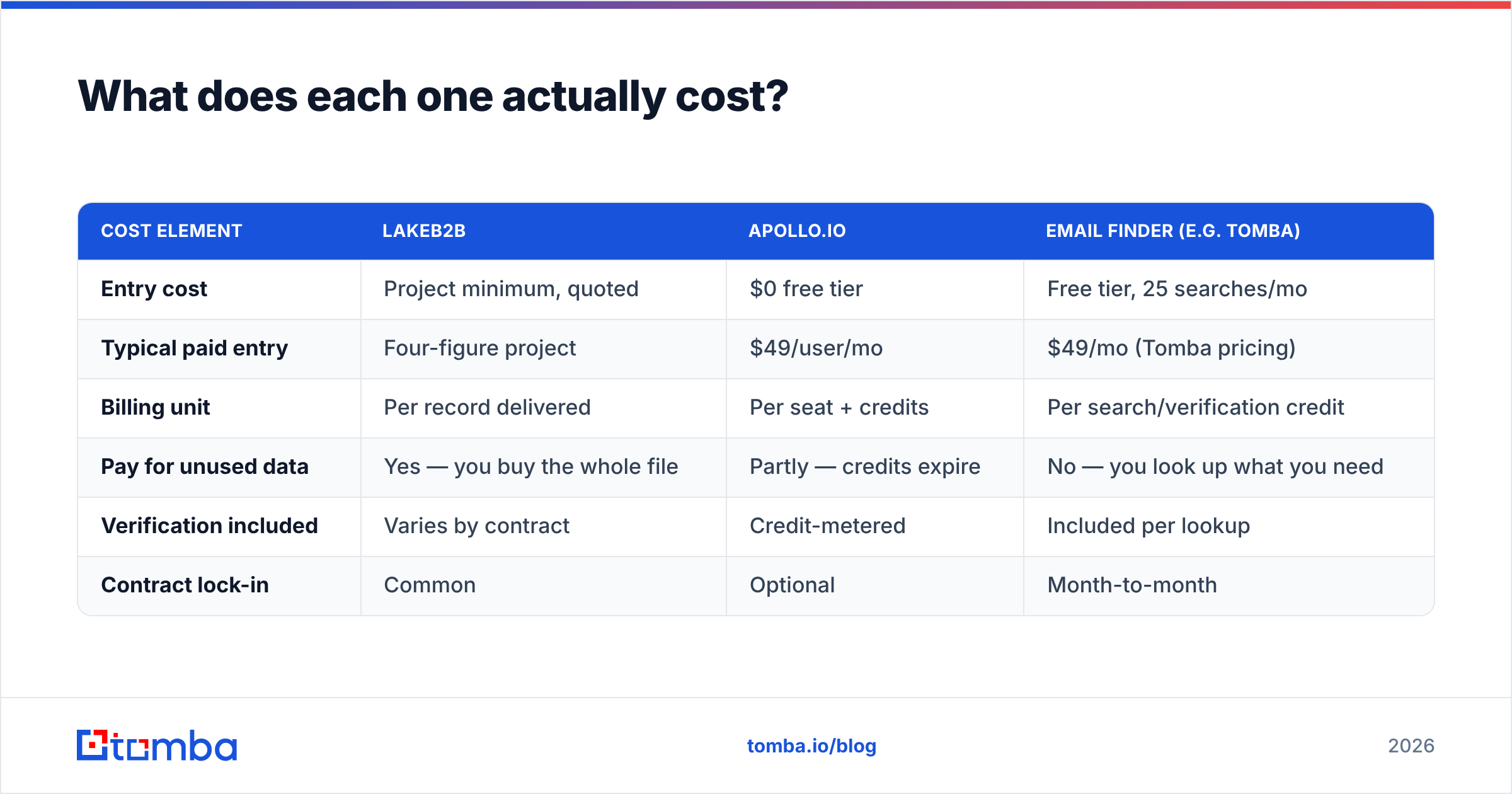
What does each one actually cost?#
On price, LakeB2B vs Apollo.io is a sales quote against a published tier.
Apollo publishes its tiers. At the time of writing: Free ($0, limited monthly credits), Basic around $49/user/month billed annually, Professional around $79/user/month, and Organization around $119/user/month with a seat minimum. Check Apollo's pricing page before you budget. Tiers and credit limits change often.
LakeB2B does not publish rates. Quotes are per record, with a project minimum. Buyers report anywhere from a few cents to over a dollar per contact. The price moves with how narrow the segment is and how many fields you want appended. Custom healthcare or technographic builds sit at the high end.
| Cost element | LakeB2B | Apollo.io | Email finder (e.g. Tomba) |
|---|---|---|---|
| Entry cost | Project minimum, quoted | $0 free tier | Free tier, 25 searches/mo |
| Typical paid entry | Four-figure project | $49/user/mo | $49/mo (Tomba pricing) |
| Billing unit | Per record delivered | Per seat + credits | Per search/verification credit |
| Pay for unused data | Yes — you buy the whole file | Partly — credits expire | No — you look up what you need |
| Verification included | Varies by contract | Credit-metered | Included per lookup |
| Contract lock-in | Common | Optional | Month-to-month |
The cost difference that matters is not the sticker price. It is the waste. Buy a 20,000-record list where 6,000 people have changed roles, and you paid for 6,000 bounces plus a reputation hit. Seat-based platforms hide the same problem: you pay $79 a month for a seat that exports 300 contacts, and 80 of them were never going to reply.
Who should choose LakeB2B?#
Pick LakeB2B when the data genuinely does not exist in a self-serve tool:
- Regulated or specialty verticals. Healthcare practitioner data keyed to specialty, license, or facility type is LakeB2B's strongest territory and is poorly covered by generalist databases.
- Firmographic long tail. Small regional manufacturers, distributors, and service businesses that never appear in tech-centric databases.
- International coverage outside the usual suspects. APAC and MEA segments where Apollo's coverage thins noticeably.
- One-time large pulls. If you need 50,000 records once for an event or an ABM launch, a per-record purchase can beat a year of seats.
- Append projects. You already have 30,000 company names and need phone, title, and email attached. That is a data-services job, not a prospecting-tool job.
Negotiate four things before you sign: a replacement clause for bounced records, a documented verification method, written GDPR/CCPA provenance, and a paid sample of 200-500 records. Verify that sample yourself before you place the full order.
Who should choose Apollo.io?#
Pick Apollo when speed and workflow matter more than depth:
- SDR teams that want one login. Search, sequence, dial, log to CRM. Fewer tools means fewer handoffs.
- US and Western European B2B tech. Apollo's sweet spot. Filters on headcount, funding, tech stack, and job change alerts are genuinely useful here.
- Teams testing ICPs. Being able to filter, count, and export in an afternoon is worth a lot when you do not yet know who your buyer is.
- Budget certainty. A known monthly number beats a quote cycle.
Where Apollo frustrates people: credit limits that bite right when a campaign is working, and export caps on lower tiers. Deliverability suffers too when everyone in your category emails the same Apollo-sourced list. If you have hit those walls, the Apollo alternative comparison covers the workarounds.

Is a database even the right purchase?#
Here is the uncomfortable question neither vendor will ask you: how many contacts do you actually need this quarter?
Most outbound teams sending 100-300 emails a day need roughly 6,000-8,000 verified contacts per quarter. Both vendors are priced on the assumption that you want hundreds of millions. You are paying for reach you will never use.
The alternative is demand-driven sourcing. You pick the target accounts first. Then you resolve only the contacts you need, and you verify each one at the moment of use. That is what an email finder does. Run a domain search on an account to see who works there and what the email pattern is. Resolve the people who match your ICP, verify, and send. Nothing ages in a CSV, because nothing sits in a CSV.
A third lane exists too. BookYourData is a well-regarded pay-as-you-go list vendor with a bounce guarantee and no contract. It sits between LakeB2B's project model and Apollo's seat model, and it fits if you specifically want a file rather than an API.
How do you test either one before committing?#
Do not buy on a demo. Run the same evaluation on both, on your own ICP:
- Define one narrow segment. Example: heads of operations at US logistics firms with 200-1,000 employees. Use the same segment for every vendor.
- Pull 200 records from each. Apollo's free tier covers this. Expect to pay LakeB2B for a sample.
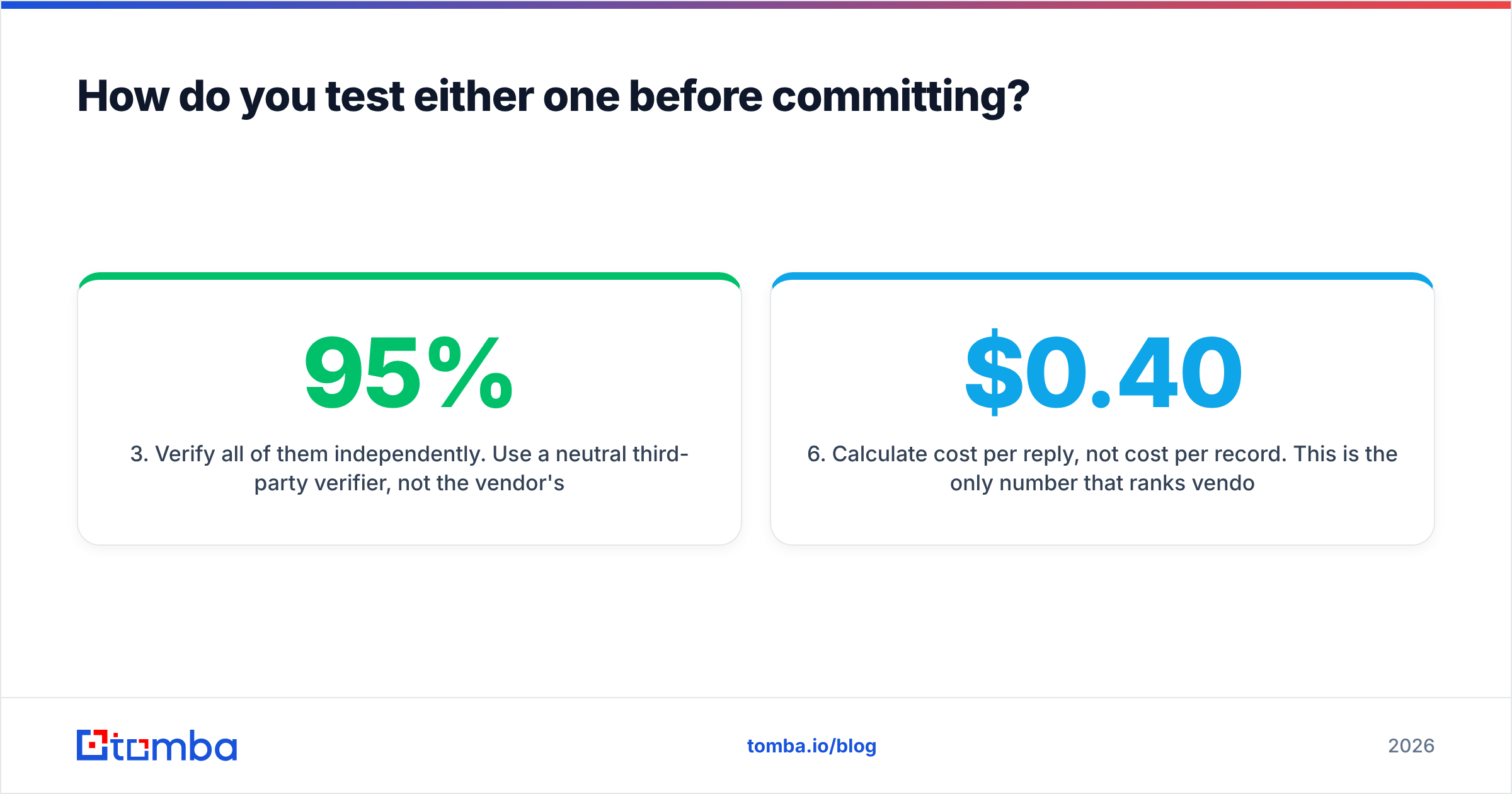
- Verify them independently. Use a neutral verifier, not the vendor's own. Record valid, invalid, catch-all, and unknown rates separately. Lumping catch-alls in with valid is how vendors reach 95%.
- Spot-check 25 records by hand. Open LinkedIn. Is the person still in that role? Title drift is invisible to verifiers and kills personalization.
- Send a 100-contact pilot. Same copy, same sending domain, staggered by a week. Compare bounce rate, reply rate, and spam complaints.
- Calculate cost per reply, not cost per record. That is the only number that ranks vendors honestly. A $0.40 record that replies beats a $0.05 record that bounces.
Independent review data on G2 helps you spot support and billing complaints. Ignore the aggregate accuracy scores there. They average across segments that have nothing to do with yours.
So which one wins?#
LakeB2B vs Apollo.io has no single winner. It depends on where your buyers live.
For most self-serve B2B teams in tech and services, Apollo.io wins. Public pricing, a real free tier, and outreach tooling in one login remove a lot of friction. The data is good enough in its core segments.
For teams whose buyers sit in healthcare, manufacturing, education, or thin international markets, LakeB2B wins. Apollo simply cannot produce those records. A custom build with a negotiated replacement clause is a fair purchase.
And for teams paying for volume they never touch, the answer is neither. Source on demand, verify at the point of use, and keep your B2B database spend in line with what you actually send.
Ready to stop paying for records you will never email? Start with the Tomba Email Finder — resolve verified business emails by name and domain. SMTP-level verification and catch-all detection are built into every lookup. The free tier gives you 25 searches a month with no card, and paid plans start at $49/month. Run it against the same 200-contact test you give LakeB2B and Apollo, and let the bounce rate settle the argument.
Related guides#
// get started
Find, verify and enrich your first contacts today
Start on the free plan with 25 searches a month, then scale when your team is ready.
Free plan · No credit card required · GDPR & CCPA
// about the author