LakeB2B vs ZoomInfo: Which B2B Data Provider Wins in 2026?
LakeB2B sells curated contact lists. ZoomInfo sells a live GTM platform. They cost wildly different amounts and fail in different ways — here's the honest breakdown before you sign anything.
TL;DR
- LakeB2B is a list vendor. You buy a curated, filtered contact file (often by industry or specialty — healthcare, education, technology) and own the records. Pricing is per-record and quote-based.
- ZoomInfo is a GTM platform. You rent access to a continuously refreshed database plus intent data, workflows, conversation intelligence and CRM sync. Annual contracts typically start in the five figures.
- They are not really competitors for the same budget line. The real question is whether you need a list or a system.
- Both have a shared weakness: the email addresses inside decay. Roughly 25-30% of B2B contact data goes stale every year regardless of who sold it to you.
- The cheapest workable stack for most teams under 50 seats is a targeted list or platform export plus a separate real-time verification and enrichment layer — which is where a tool like Tomba's email verifier earns its keep at a fraction of either contract.
What is LakeB2B, exactly?#
LakeB2B is a B2B data provider that sells contact and company lists, usually assembled to spec. You tell them the segment — "IT directors at US hospitals with 500+ beds," "procurement leads in German manufacturing" — and they deliver a file, typically with a claimed accuracy guarantee and a replacement policy for bounces.
Their positioning leans hard on vertical depth. Healthcare, education, technology and life sciences are the segments they market most aggressively, including specialty-level physician data that horizontal providers rarely carry. If your ICP is "cardiologists at independent practices," a generalist database will underserve you and a specialist vendor probably will not.
The commercial model matters more than the feature list. You are buying a snapshot. Once the CSV lands, it is yours — no seat limits, no credit meter, no platform to log into. It also starts decaying the moment it is delivered.
Three practical consequences:
- Pricing is opaque and negotiable. There is no public price page. Cost per record varies by segment rarity, volume and how many fields you want appended.
- Quality varies by segment. Custom-built lists in a vendor's core verticals are usually better than the same vendor's spillover into segments they do not specialize in.
- You carry the compliance burden. Buying a list does not transfer lawful-basis obligations to you cleanly. Under GDPR, legitimate interest for B2B outreach is arguable but not automatic, and CAN-SPAM still requires working opt-outs on every send.
What is ZoomInfo, and what are you actually paying for?#
ZoomInfo (now trading as ZoomInfo Technologies) is the incumbent in B2B data. It is not a list seller — it is a subscription platform where the database is one module among several.
What you get at the high end:
- A continuously updated contact and company database with direct dials, mobile numbers and firmographics
- Intent signals (via its Bombora-derived and proprietary signal layer) showing which accounts are researching your category
- Workflows and enrichment that push data into Salesforce, HubSpot or Dynamics on a schedule
- Conversation intelligence (Chorus) and engagement tooling (Engage) as paid add-ons
- Websights for de-anonymizing site traffic
What you are actually paying for is recency and plumbing. The value is not that ZoomInfo has contacts — everyone has contacts. It is that records are re-verified on a rolling basis and pushed into your CRM without a human touching a CSV.
The friction is equally well documented on review sites. Read the ZoomInfo reviews on G2 and you will see the same three complaints repeatedly: annual contracts with auto-renewal clauses, credit limits that bite mid-quarter, and pricing that scales faster than seat count. Entry points commonly land around $15,000-$25,000/year for a small team, and genuinely multi-module deployments run six figures.
LakeB2B vs ZoomInfo: how do they compare head-to-head?#
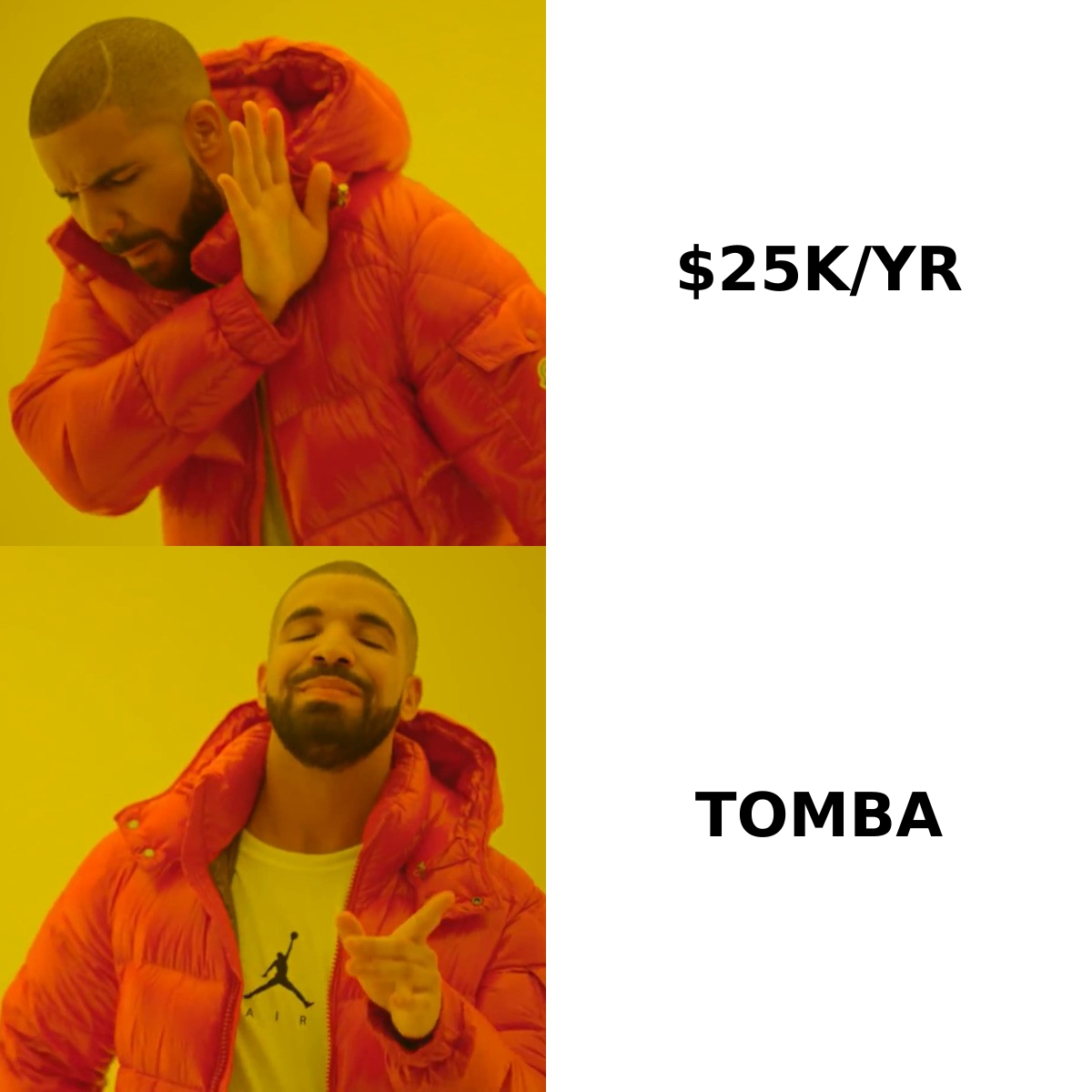
| Dimension | LakeB2B | ZoomInfo |
|---|---|---|
| Model | One-time list purchase (own the data) | Annual SaaS subscription (rent access) |
| Typical entry cost | Quote-based; often $2K-$10K per campaign list | ~$15K-$25K/yr for a small team; 6 figures at enterprise |
| Contract | Per-project, no lock-in | 12-month minimum, auto-renew common |
| Data freshness | Snapshot at delivery date | Rolling re-verification |
| Vertical depth | Strong in healthcare, education, life sciences | Broad horizontal coverage, strongest in tech/US |
| Intent data | Limited / add-on | Core product (Intent, Websights) |
| CRM sync | Manual import | Native Salesforce/HubSpot/Dynamics enrichment |
| Credit limits | N/A — you own the file | Yes, per-seat and per-export caps |
| Phone/direct dials | Available on request | Large direct-dial and mobile inventory |
| Best for | One-off campaigns into a niche vertical | Continuous outbound motion at scale |
| Worst for | Always-on outbound needing fresh data | Teams testing a single vertical on a small budget |
The table makes the decision clearer than any feature-by-feature argument: these tools answer different questions. LakeB2B answers "how do I reach 8,000 radiology administrators next quarter?" ZoomInfo answers "how do I keep 30 reps supplied with fresh, CRM-synced accounts every single day, forever?"
Buying ZoomInfo for the first question is overpaying by an order of magnitude. Buying a static list for the second guarantees you will be emailing dead addresses by month four.
Which one has more accurate data?#
Neither has a defensible accuracy claim you should take at face value — and that is not a knock on either vendor, it is the nature of the asset.
B2B contact data decays for structural reasons. People change jobs. Job-change rates in tech and SaaS sales roles run high enough that a meaningful slice of any database is wrong within a quarter. Companies get acquired and migrate domains. Mail servers switch to catch-all configurations that make SMTP verification ambiguous.
Here is how to evaluate accuracy claims from either vendor without taking their word for it:
- Demand a sample before you sign. 200-500 records from your actual target segment, not a curated demo set. Any vendor who refuses is telling you something.
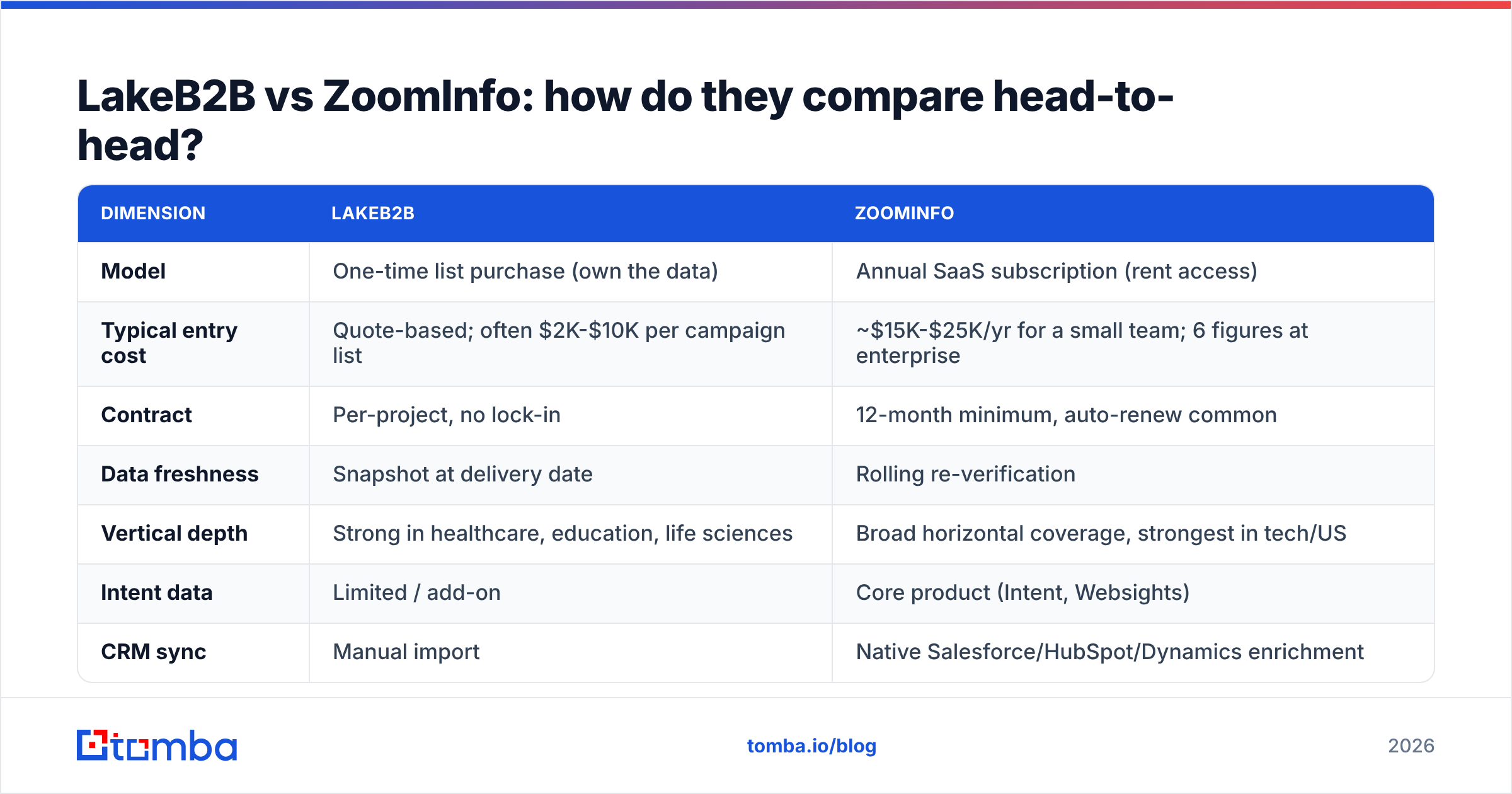
- Verify the sample independently. Run it through a third-party verifier and measure the real deliverable rate. A 95% claim that tests at 78% is a negotiating lever.
- Check the catch-all rate separately. Catch-all domains accept everything at SMTP time and bounce later. A list that is 40% catch-all is far riskier than its "valid" percentage suggests — use a dedicated catch-all verifier to size the exposure.
- Ask for the collection date, not the "last updated" date. Vendors refresh metadata without re-verifying the email. Those are different operations.
- Test job-title precision, not just email validity. A deliverable email attached to someone who left the role 14 months ago is a worse outcome than a bounce, because it pollutes your reply-rate data.
- Model the replacement policy. "We replace bounces" sounds generous until you read that it covers hard bounces only, within 30 days, at the vendor's discretion.
The honest summary: ZoomInfo's rolling re-verification gives it a structural freshness advantage over any static file, including LakeB2B's. But ZoomInfo's own records are not verified at the moment you export them either — they are verified on a cycle. That gap is why serious outbound teams run a verification pass on everything, regardless of source.

What does each one actually cost in 2026?#
Neither publishes pricing, which tells you both are sold by humans with quotas and both expect negotiation.
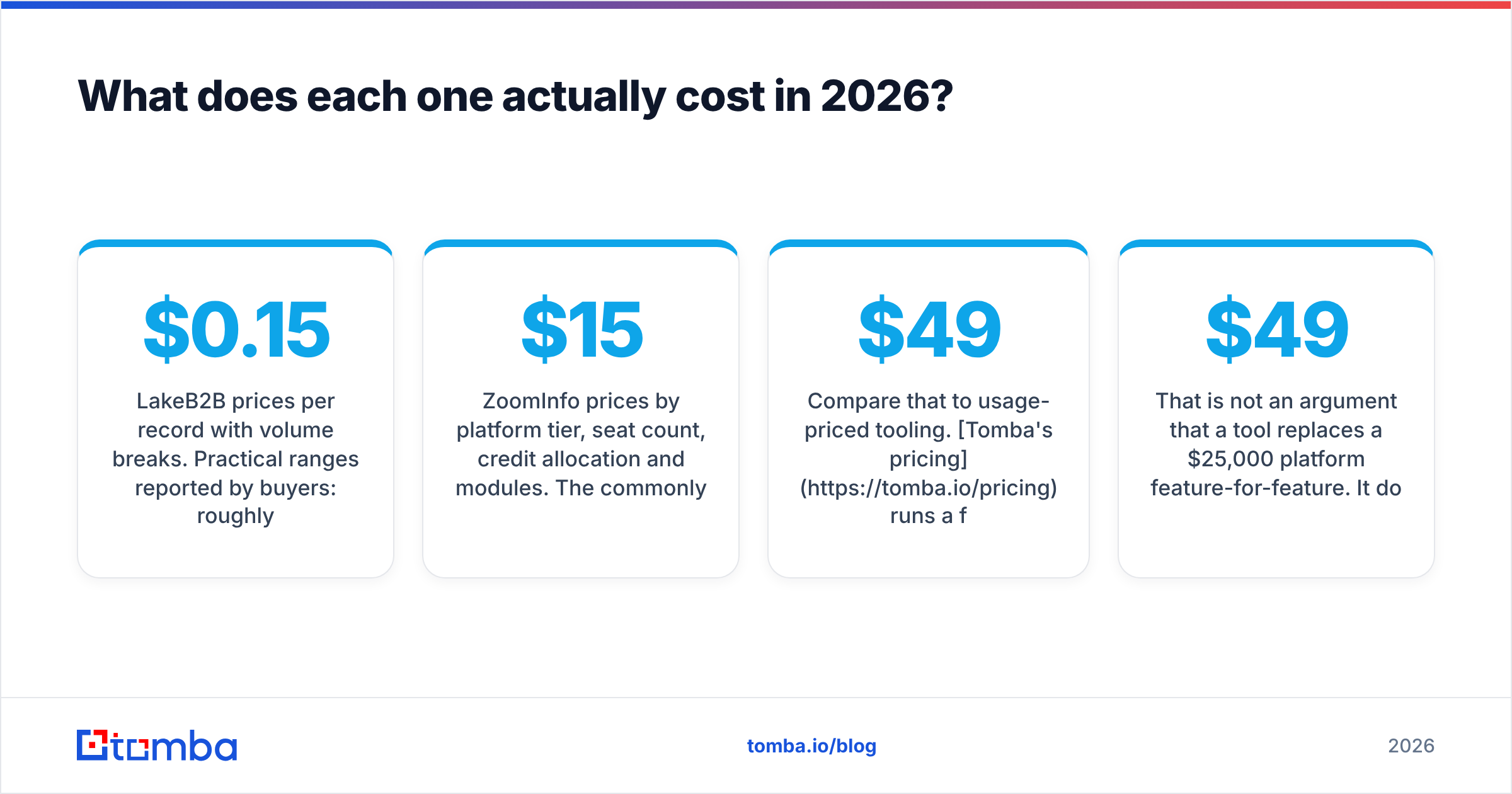
LakeB2B prices per record with volume breaks. Practical ranges reported by buyers: roughly $0.15-$0.60 per contact depending on segment rarity and appended fields, with campaign minimums. A 10,000-record healthcare list with direct dials and firmographics realistically lands in the $3,000-$6,000 range. There is no recurring cost — and no recurring refresh either.
ZoomInfo prices by platform tier, seat count, credit allocation and modules. The commonly cited floor is around $15,000/year for a small Sales tier, but that figure hides the real cost drivers:
- Credits. Export credits are metered. Teams routinely burn their annual allocation in seven months and pay for an overage package.
- Modules. Intent, Engage, Chorus, Websights and Data-as-a-Service each carry separate line items.
- Seats. Adding reps mid-contract is priced at list, not at your negotiated rate.
- Auto-renewal. The clause is standard. Diary the non-renewal window the day you sign.
Compare that to usage-priced tooling. Tomba's pricing runs a free tier at 25 searches/month, Starter at $49/month, Growth at $99/month and Pro at $249/month. Pro for a full year is roughly $3,000 — about a fifth of a ZoomInfo entry contract, and in the same band as a single mid-sized LakeB2B list purchase that you would need to repurchase every quarter to stay current.
That is not an argument that a $49/month tool replaces a $25,000 platform feature-for-feature. It does not. It is an argument that most teams buy the expensive option to solve a problem the cheap option already solves, then never use the intent module they were sold on.
How do the alternatives stack up?#
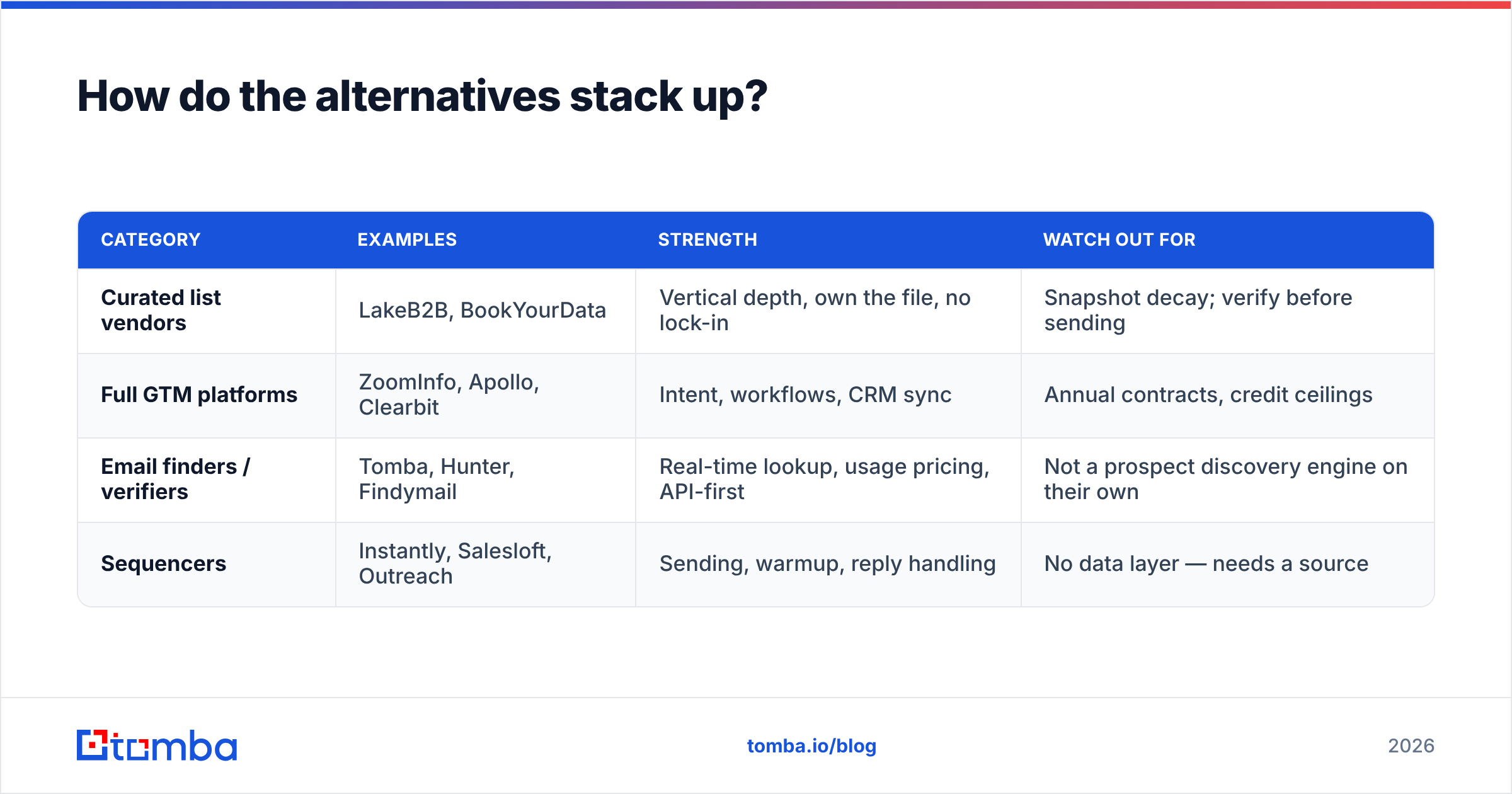
The LakeB2B vs ZoomInfo framing is narrower than most buyers realize. The market splits into four distinct categories, and mixing them is usually cheaper than buying one big thing.
| Category | Examples | Strength | Watch out for |
|---|---|---|---|
| Curated list vendors | LakeB2B, BookYourData | Vertical depth, own the file, no lock-in | Snapshot decay; verify before sending |
| Full GTM platforms | ZoomInfo, Apollo, Clearbit | Intent, workflows, CRM sync | Annual contracts, credit ceilings |
| Email finders / verifiers | Tomba, Hunter, Findymail | Real-time lookup, usage pricing, API-first | Not a prospect discovery engine on their own |
| Sequencers | Instantly, Salesloft, Outreach | Sending, warmup, reply handling | No data layer — needs a source |
BookYourData deserves a specific mention as a LakeB2B peer: pay-as-you-go pricing, self-serve list building and a stated bounce guarantee make it a genuinely different buying experience from quote-based list vendors, and it removes the "wait three days for a quote" friction that slows list purchases down.
On the platform side, if ZoomInfo's contract terms are the sticking point rather than its data, look at an Apollo alternative or a Clearbit alternative before you assume the whole category is priced the same way. Several carry monthly billing.
And if what you actually need is a verified email attached to a name you already have — from LinkedIn, from a conference list, from an inbound form — that is a lookup problem, not a database problem. A domain search across a target account returns the reachable contacts and the company's email pattern in one call, and a bulk email finder handles the same job across a spreadsheet of accounts without a seat license.
Which should you buy?#
Work through this in order.
Buy LakeB2B if: you run campaign-based outbound into a specialized vertical, you need records a horizontal database genuinely does not carry, you want to own the file outright, and you can budget a re-purchase or re-verification cycle every few months.
Buy ZoomInfo if: you have 10+ reps prospecting daily, intent data will change what they do (not just what they report), you need CRM enrichment running on a schedule without human intervention, and a five-figure annual line item is already approved.
Buy neither — yet — if: you are under 10 reps, still testing ICPs, or your current problem is "our emails bounce" rather than "we cannot find enough accounts." In that case, a targeted list or a lightweight finder plus rigorous verification will outperform an enterprise contract you use at 20% capacity.
The combination most teams land on after a full cycle: a list or platform for discovery, a real-time finder and verifier for accuracy at send time, and a sequencer for delivery. Each layer is priced independently, each is replaceable, and none of them lock you into a renewal you regret.
One more operational note regardless of which you choose: verification is not a one-time step. Re-verify any segment older than 60 days before it enters a sequence. Bounce rates above 3% put your sender reputation at risk, and a damaged sending domain costs more to fix than any data contract costs to cancel.
What are the common mistakes buyers make here?#
- Comparing price-per-record to price-per-seat. They are not commensurable. Model a full year of your actual usage for both, including refresh cycles.
- Skipping the sample test. Every vendor's accuracy claim is measured on their terms. Measure it on yours.
- Ignoring the renewal clause. Auto-renewal with a 60- or 90-day notice window is standard in this category. Calendar it.
- Assuming purchased data is compliant data. Vendor compliance and your lawful basis for outreach are separate questions. Document yours.
- Buying intent data before fixing deliverability. Intent signals into a domain that lands in spam produce nothing. Fix the plumbing first.
The bottom line#
LakeB2B and ZoomInfo are not really rivals — they are answers to different questions at wildly different price points. LakeB2B wins on vertical depth, ownership and cost for campaign-based work in specialized industries. ZoomInfo wins on freshness, intent and CRM automation for teams running continuous outbound at scale. Both ship data that starts decaying immediately, and neither removes your obligation to verify before you send.
If your real bottleneck is finding and confirming reachable addresses rather than buying a database, start with the Tomba Email Finder. The free tier gives you 25 searches a month to test accuracy against your own ICP, Starter is $49/month, and there is no annual contract to negotiate your way out of. Run it head-to-head against a vendor sample before you sign anything with a renewal clause — the comparison will cost you nothing and may save you a five-figure line item.
Related guides#
// get started
Find, verify and enrich your first contacts today
Start on the free plan with 25 searches a month, then scale when your team is ready.
Free plan · No credit card required · GDPR & CCPA
// about the author