9 Best Lavender Alternatives in 2026: Tested and Ranked
Lavender popularized the AI email coach, but per-seat pricing and a narrow scope push a lot of teams to look elsewhere. Here are nine Lavender alternatives compared on price, scope, and what they actually fix.
TL;DR
- Lavender is an AI email coach: it scores your draft, nudges you on length and reading level, and pulls light personalization context. It does not find contacts, verify them, or send campaigns.
- Most teams searching for Lavender alternatives are hitting one of three walls: per-seat pricing that scales badly, a scope that stops at the draft, or the realization that their reply-rate problem is a data problem, not a copy problem.
- The nine alternatives below split into three buckets: AI writing coaches (Twain, Regie.ai, Smartwriter), sequence platforms with AI built in (Instantly, Saleshandy, Apollo), and data-first stacks (Tomba, Clay, BookYourData).
- If your bounce rate is over 3%, no AI coach will save the campaign. Fix contact accuracy first, then optimize copy.
- Cheapest real switch: a free AI writing tool plus verified data. Most complete switch: a data platform with an AI writer attached.
What does Lavender actually do?#
Lavender is a Chrome extension and AI email coach that sits inside Gmail, Outlook, and most sequencers. As you type, it scores the email out of 100, flags long sentences, warns you when the reading level creeps above middle school, and surfaces a "personalization assistant" panel with company news, social posts, and prospect context.
Think of it like a spellchecker that went to sales bootcamp. It doesn't write the outreach strategy, doesn't know who you should be emailing, and doesn't care whether the address you typed exists. It grades the sentence in front of it.
That narrow focus is also the reason it works. Reps who use it write shorter emails. Shorter emails get read. The official Lavender site leans hard on that positioning, and the reviews on G2 mostly back it up: people like the coaching, and they complain about the price per seat and the ceiling on what it can do.
Why do teams look for Lavender alternatives?#
Four recurring reasons, in rough order of how often they come up:
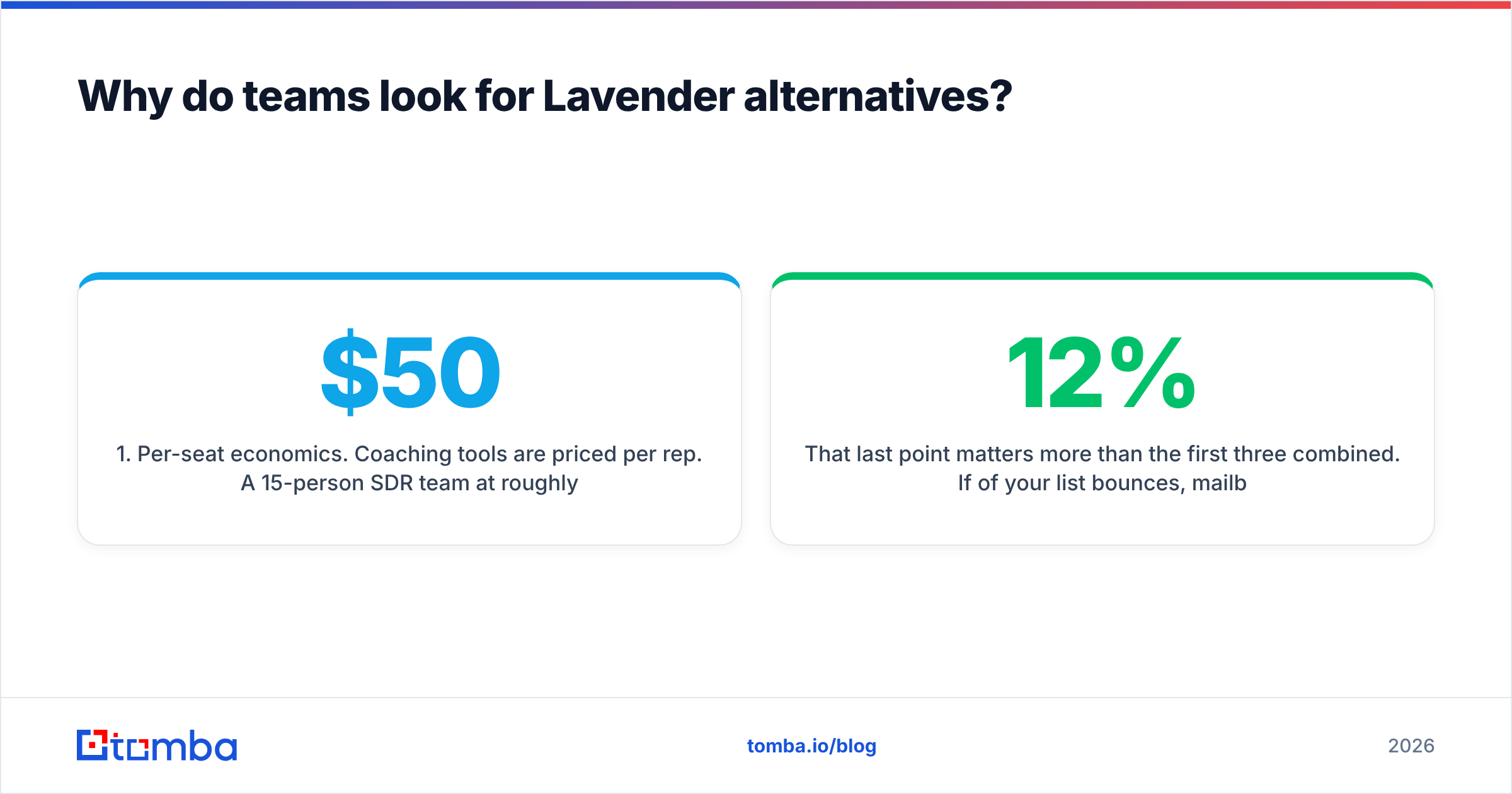
- Per-seat economics. Coaching tools are priced per rep. A 15-person SDR team at roughly $50 per seat is $750/month for a browser extension that never touches your data layer. That budget buys a full prospecting stack elsewhere.
- The scope stops at the draft. Lavender improves the email you already decided to send to a person you already found. Everything upstream — sourcing, verification, enrichment, segmentation — is someone else's job, and you're paying for that separately.
- Score-chasing beats judgment. Teams report reps optimizing for a 90+ score instead of for the prospect. You end up with a fleet of identical, perfectly readable, utterly forgettable emails.
- Deliverability isn't in scope. A 95-scored email sent to a stale list still bounces. Coaching tools don't check whether the mailbox exists, whether the domain is catch-all, or whether your sender reputation is already underwater.
That last point matters more than the first three combined. If 12% of your list bounces, mailbox providers throttle you long before your prose gets a chance to underperform.

What should you compare before switching?#
Before you look at a single pricing page, decide which layer you're actually buying. Most buyers conflate these and end up with two tools that overlap and one gap nobody covers.
- Sourcing — where the contact comes from. Job title search, domain search, LinkedIn scraping, or a static purchased list.
- Verification — whether the address resolves. SMTP checks, catch-all handling, bounce-rate guarantees. This is where campaigns live or die.
- Enrichment — what you know about the person beyond their email. Firmographics, tech stack, funding, headcount changes.
- Composition — the actual copy. Templates, AI generation, coaching, tone matching. This is Lavender's entire territory.
- Sending and sequencing — inbox rotation, warmup, throttling, reply detection, A/B testing.
- Measurement — reply rate, meetings booked, not open rate (which has been effectively unreliable since Apple Mail Privacy Protection).
Lavender covers exactly item 4 and part of item 3. Every alternative below covers a different slice, which is why a straight "which is better" question has no honest answer until you say which layer is broken.
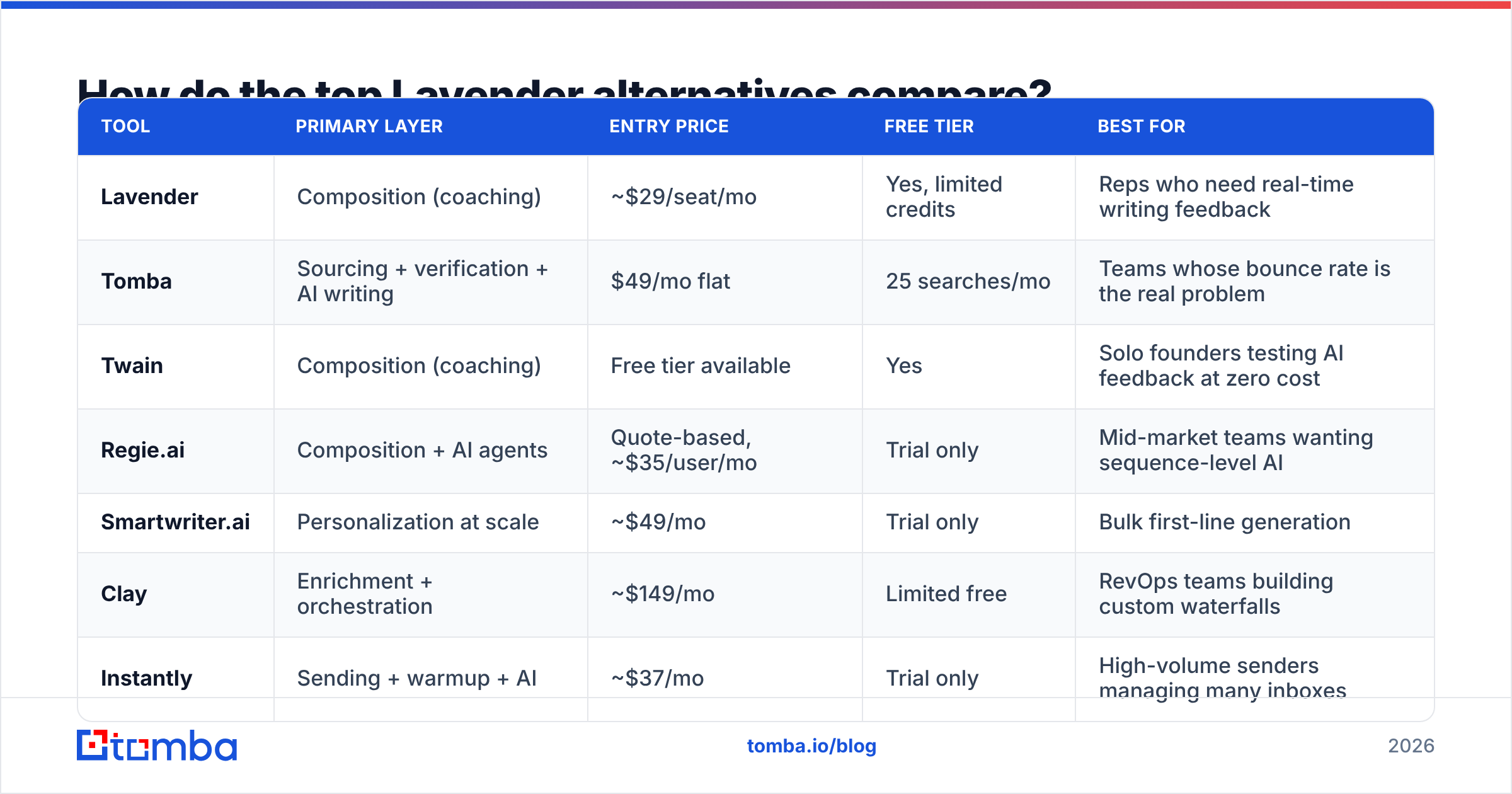
How do the top Lavender alternatives compare?#
Pricing below is published list pricing at the time of writing. Vendors change tiers often — verify on their pages before you buy.
| Tool | Primary layer | Entry price | Free tier | Best for |
|---|---|---|---|---|
| Lavender | Composition (coaching) | ~$29/seat/mo | Yes, limited credits | Reps who need real-time writing feedback |
| Tomba | Sourcing + verification + AI writing | $49/mo flat | 25 searches/mo | Teams whose bounce rate is the real problem |
| Twain | Composition (coaching) | Free tier available | Yes | Solo founders testing AI feedback at zero cost |
| Regie.ai | Composition + AI agents | Quote-based, ~$35/user/mo | Trial only | Mid-market teams wanting sequence-level AI |
| Smartwriter.ai | Personalization at scale | ~$49/mo | Trial only | Bulk first-line generation |
| Clay | Enrichment + orchestration | ~$149/mo | Limited free | RevOps teams building custom waterfalls |
| Instantly | Sending + warmup + AI | ~$37/mo | Trial only | High-volume senders managing many inboxes |
| Saleshandy | Sequencing + verification | ~$36/mo | Trial only | SMB teams wanting sequencing plus list hygiene |
| Apollo.io | All-in-one database + engagement | ~$49/user/mo | Yes, capped | Teams consolidating data and sending in one seat |
| BookYourData | Verified B2B contact data | Pay-as-you-go credits | Sample credits | Buyers who want prepaid, accuracy-guaranteed lists |
Tomba — fix the data, then the copy#
Tomba is not an email coach, and pitching it as a like-for-like Lavender swap would be dishonest. It's the layer underneath. The email finder resolves contacts by name, domain, or company; the email verifier checks them before you send; and the free cold email AI writer handles composition for teams that don't want a second per-seat subscription.
The pricing model is the practical differentiator. Tomba is flat-rate by credits, not per seat: Free at 25 searches/month, Starter at $49/mo, Growth at $99/mo, Pro at $249/mo. Add three reps and your bill doesn't move. See Tomba pricing for the current credit allocations.
Where it wins: bounce rates, list hygiene, API and bulk workflows, cost predictability. Where it doesn't: there's no in-Gmail real-time scoring overlay. If live coaching is the thing you're buying, this isn't it.
Twain — the free coaching alternative#

Twain is the closest philosophical match to Lavender and the easiest budget decision: paste a draft, get feedback on openers, questions, and calls to action. No browser overlay, no personalization panel, no team analytics.
For a founder writing 20 emails a week, Twain plus verified data does about 80% of what a paid coaching seat does for 0% of the cost. For a 20-rep team that needs manager visibility into who's improving, it's too thin.
Regie.ai — coaching plus autonomous agents#
Regie.ai moved past drafting into AI sales agents that source, write, and sequence. It's the most ambitious option on this list and the one most likely to overlap with tools you already own. Pricing is quote-based, which in practice means it lands mid-market and up.
Buy it if you want one vendor owning composition and cadence. Skip it if you already run Outreach or Salesloft — you'll pay twice for the same orchestration.
Smartwriter.ai — personalization at volume#
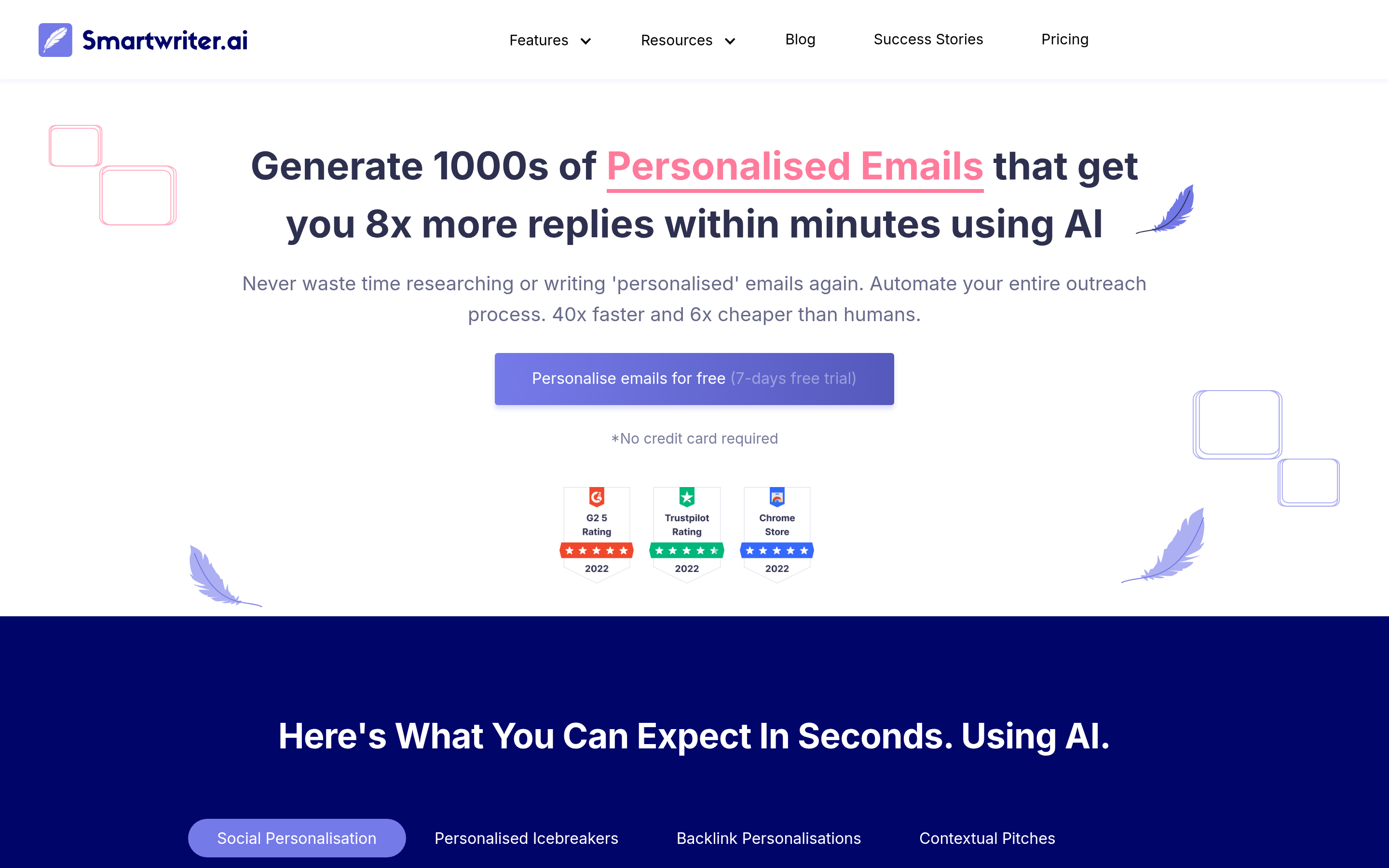
Smartwriter generates personalized first lines in bulk from LinkedIn profiles, recent posts, and site content. It's a throughput tool, not a coaching tool: you're not improving one email, you're generating 500 opening lines.
Quality is inconsistent enough that you need a human review pass. Treated as a first draft generator rather than a finished-copy engine, it earns its keep.
Clay — the RevOps power tool#
Clay is a spreadsheet-shaped orchestration layer that chains dozens of data providers into waterfall enrichment, then runs AI prompts over every row. It can replicate a good chunk of Lavender's personalization research, plus enrichment Lavender never attempts.
The catch is real: Clay expects you to build the system. Credits burn fast, and teams without a dedicated ops person routinely underuse it. Budget onboarding time, not just license cost.
Instantly and Saleshandy — sequencers with AI attached#
Both are sending platforms first. Instantly is built around inbox rotation and warmup at volume; Saleshandy pairs sequencing with built-in list verification. Each ships an AI writing assistant that's adequate rather than excellent.
If your stack is missing a sender, either is a better purchase than a coaching seat — a great email that lands in spam is worth nothing. Read up on email deliverability before you pick, because inbox management is where these tools earn their money.
Apollo.io — consolidation play#
Apollo bundles a contact database, sequencing, dialer, and AI writing into one per-seat subscription. Breadth is the pitch. The tradeoffs are well documented: data accuracy varies by segment, and costs climb quickly as seats and credits scale. If you're evaluating it head-to-head, the Apollo alternative breakdown covers where each side lands.
BookYourData — prepaid verified lists#
BookYourData sells verified B2B contact data on a pay-as-you-go model with an accuracy guarantee, rather than a subscription. For teams that run campaigns in bursts — a quarterly push, an event follow-up, a new-market test — prepaid credits beat a monthly seat you forget to cancel. It's a data purchase, not a coaching replacement, and it pairs well with any free writing tool.

Is an AI email coach even the right purchase?#
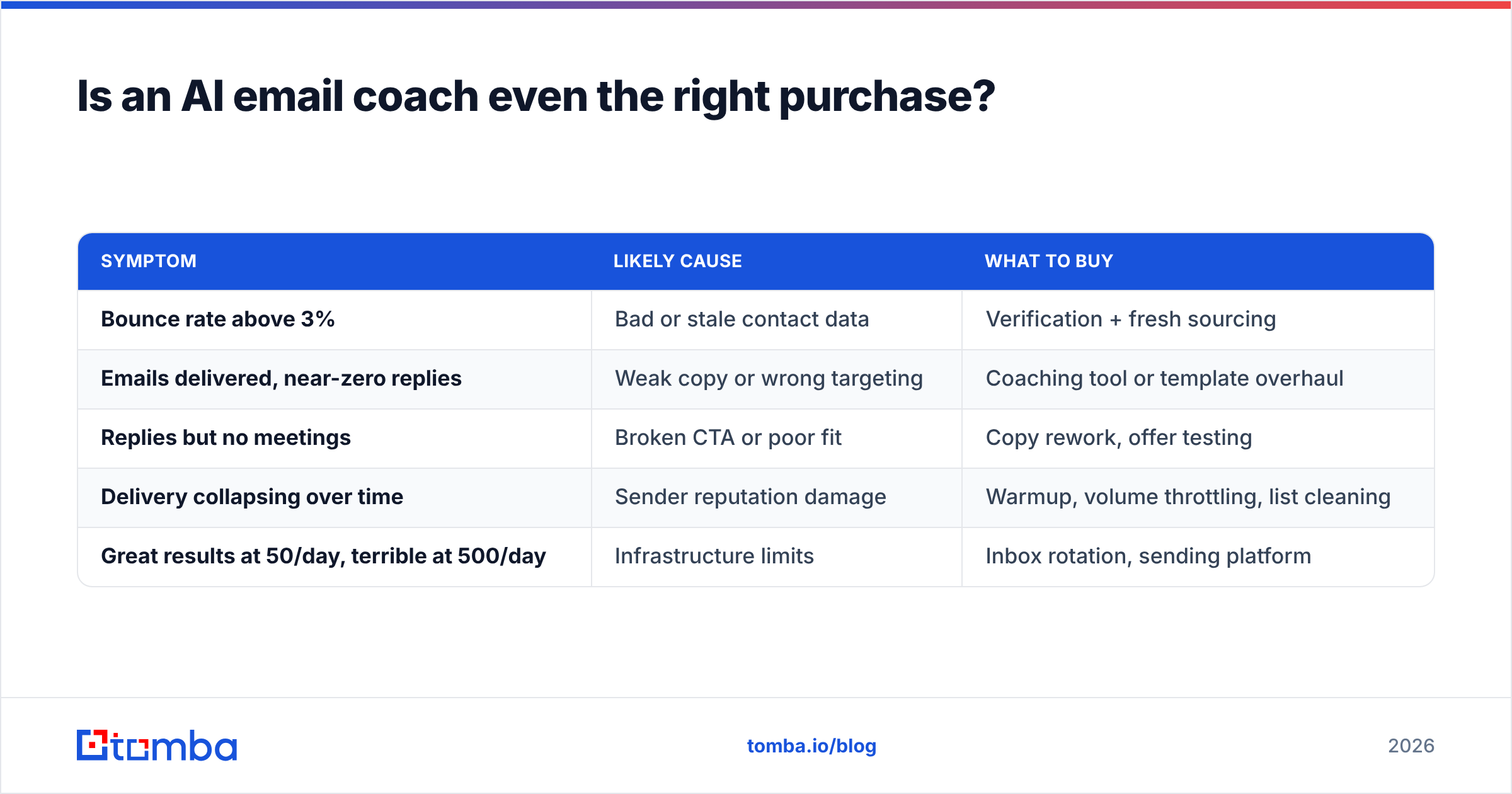
Run this diagnostic before spending anything.
| Symptom | Likely cause | What to buy |
|---|---|---|
| Bounce rate above 3% | Bad or stale contact data | Verification + fresh sourcing |
| Emails delivered, near-zero replies | Weak copy or wrong targeting | Coaching tool or template overhaul |
| Replies but no meetings | Broken CTA or poor fit | Copy rework, offer testing |
| Delivery collapsing over time | Sender reputation damage | Warmup, volume throttling, list cleaning |
| Great results at 50/day, terrible at 500/day | Infrastructure limits | Inbox rotation, sending platform |
Only one row of that table points to a Lavender-shaped purchase. The other four point upstream or downstream. Teams routinely buy coaching seats to solve a bounce problem and then conclude that "cold email doesn't work anymore."
There's a second-order effect worth naming: catch-all domains. A meaningful slice of B2B domains accept everything at the SMTP layer and silently discard invalid addresses later. Standard verification marks them "unknown," reps send anyway, and the damage shows up two weeks later as a reputation dip. A dedicated catch-all verifier is a boring purchase that quietly protects everything else you paid for.
Which Lavender alternative fits your situation?#
- Solo founder, under 100 emails/month: Twain (free) plus Tomba's free tier. Total cost: $0. Revisit at volume.
- Small team, bounce rate is the bottleneck: Tomba Starter at $49/mo flat. Verify the list, then reuse your existing templates.
- SDR team of 5–20 with clean data: keep a few Lavender seats for ramping reps, drop them for tenured ones. Coaching has diminishing returns after month three.
- RevOps-led org with engineering support: Clay for orchestration, a dedicated data source underneath it, API-driven verification in the pipeline.
- Burst campaigns, no monthly subscription appetite: BookYourData credits plus a free AI writer.
- Consolidating three tools into one: Apollo or Regie.ai, with a hard look at per-seat math at your headcount.
For a broader view of what "good" looks like across the category, HubSpot's sales blog publishes benchmark data worth calibrating against before you assume your reply rate is a copy problem.
How should you run the switch?#
Give any replacement a 30-day structured trial, not a vibes check.
- Freeze your variables. Same list, same offer, same send volume. Change one layer at a time or you'll learn nothing.
- Baseline first. Record bounce rate, delivery rate, reply rate, and meetings booked for two weeks before switching.
- Test the data layer before the copy layer. Verification improvements show up in days; copy improvements take weeks of volume to reach significance.
- Measure replies, not opens. Open tracking is unreliable, and pixel loading correlates with spam filtering more than with human interest.
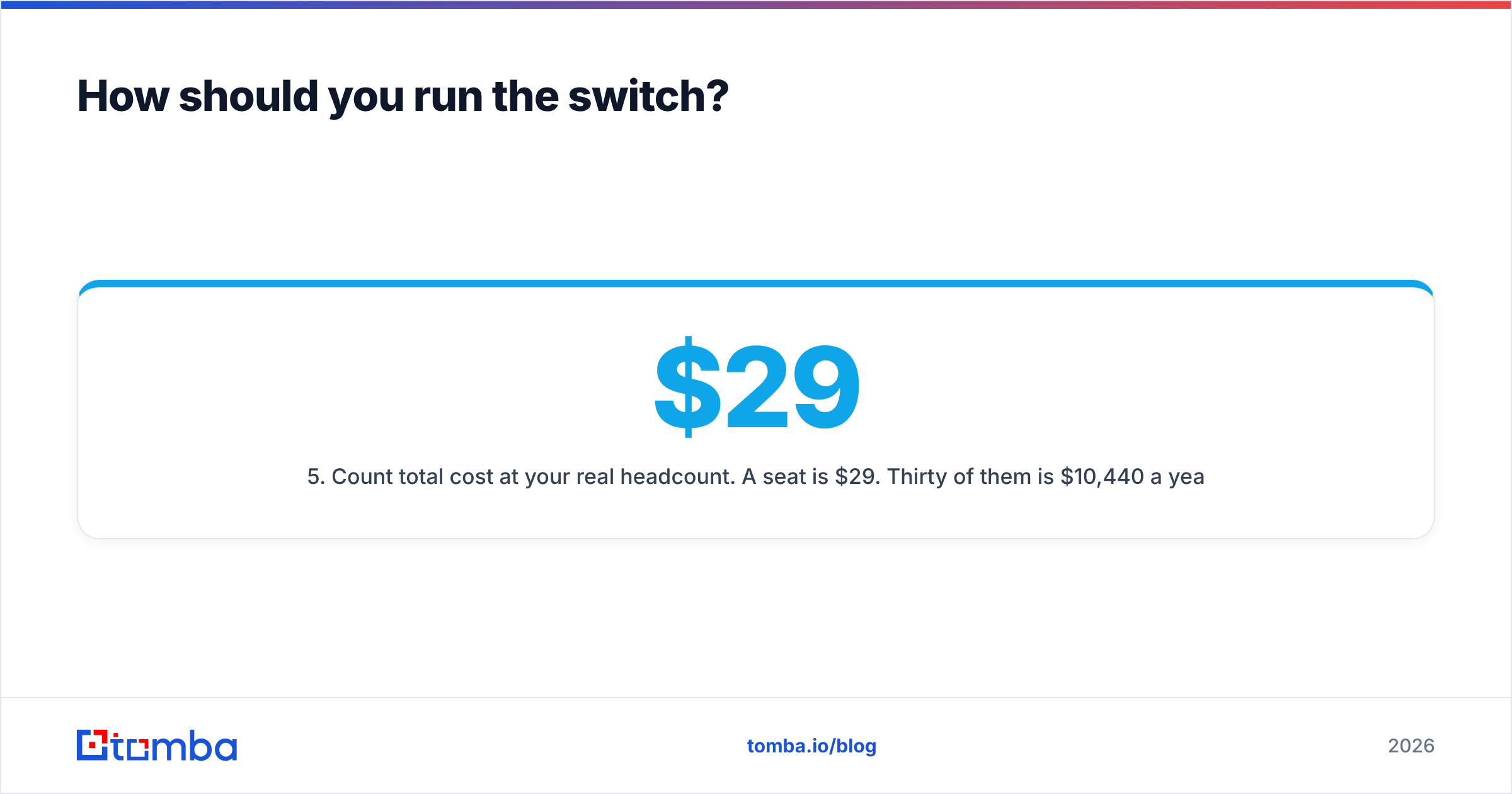
- Count total cost at your real headcount. A $29 seat is $29. Thirty of them is $10,440 a year.
Most teams that run this honestly discover the same thing: their copy was fine, their list was not.
Ready to fix the layer underneath?#
If your reply rate stalled and you've already rewritten the email four times, the next rewrite won't help. Start with Tomba Email Finder — find verified, current contacts by name, domain, or company, check them before you send, and keep flat-rate pricing that doesn't punish you for hiring. The free tier gives you 25 searches a month, which is enough to test your current list against reality. Do that first, then decide whether you still need a coaching seat.
Related guides#
Ready to find emails that actually work?
Join 150,000+ professionals who stopped guessing and started sending. Free credits on signup — no credit card required.
Get the Tomba newsletter
Practical outbound tactics and product updates — once every two weeks.
About the author