Lead Attribution: How to Track Which Sources Actually Close
Last-click attribution makes your cheapest channel look brilliant and your best one look like a cost center. Here is how the five main lead attribution models actually behave, and how to track outbound without guessing.
TL;DR
- Lead attribution is the process of assigning revenue credit to the touchpoints that produced a lead. Most teams run last-touch by default, which systematically overpays bottom-funnel channels like branded search.
- There is no "correct" model. There is only the model whose bias you understand and can defend in a budget meeting.
- Outbound is the hardest channel to attribute because it generates no click, no UTM, and often no form fill. You fix that with contact-level source stamping, not with more dashboards.
- Attribution quality collapses when contact data is dirty. Duplicate records, missing company domains, and unverified emails break the joins that every model depends on.
- Start with a two-model report (first-touch plus last-touch) before you buy anything multi-touch. If those two disagree wildly, you have a data problem, not a modeling problem.
What is lead attribution?#
Lead attribution is the practice of connecting a closed deal — or a qualified lead — back to the marketing and sales touchpoints that influenced it, then splitting credit across those touchpoints according to a rule you choose.
Think of it like a relay race where only the runner crossing the finish line gets a medal. That is last-touch attribution. The runner who took the baton from a standing start and made up forty meters gets nothing. Technically, the finisher did cross the line. Practically, you just learned nothing useful about who to train.
In B2B, the relay is long. Gartner and most enterprise analysts put the typical buying group at six to ten people, each with their own research path. A single opportunity might touch a webinar, three blog posts, a cold email, a G2 category page, a LinkedIn comment thread, and a branded search — across nine months. Attribution is the accounting layer you build over that mess.
The formal discipline goes back to advertising's attribution modeling work, but B2B has a specific complication that consumer marketing does not: the account, not the person, is the buying unit. Your model has to roll individual contact touchpoints up to an account before it can say anything honest about pipeline.
Here is the anatomy of any attribution system, regardless of which vendor sells it to you:
- Touchpoint capture — every recorded interaction (page view, form fill, email reply, meeting booked, ad click) stamped with a source, medium, campaign, and timestamp.
- Identity resolution — stitching anonymous sessions to a known contact, and that contact to an account. This is where most implementations quietly fail.
- The crediting rule — the actual model: first-touch, last-touch, linear, time-decay, U-shaped, W-shaped, or algorithmic.
- The revenue join — connecting credited touchpoints to a CRM opportunity with an amount and a close date.
- The reporting surface — the dashboard your CFO sees. This should be the last thing you build, not the first.
Skip step two and you get a beautiful dashboard built on sand.
Which lead attribution model should you actually use?#
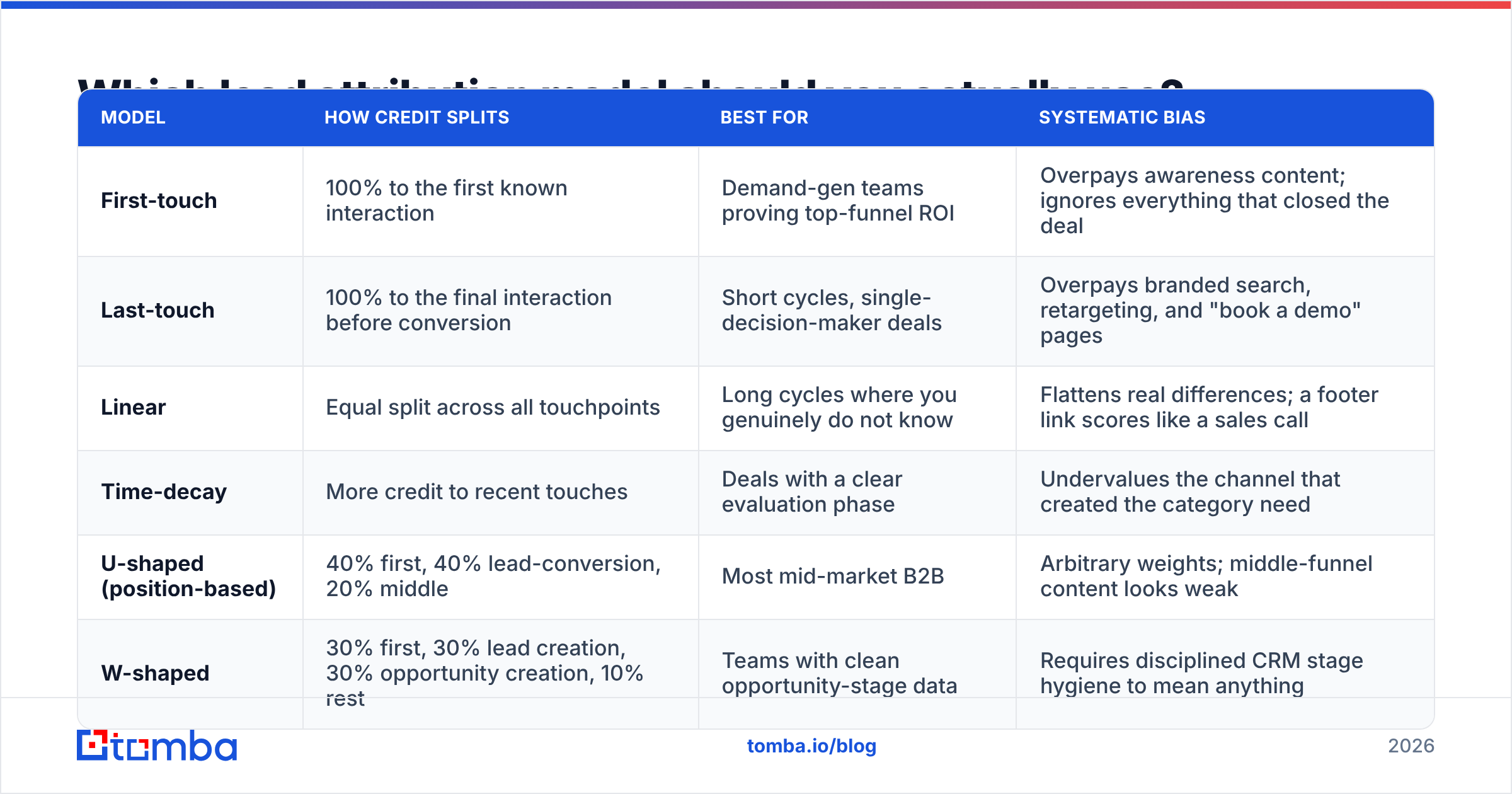
Every model is a bet about where influence concentrates. Pick the one whose bet matches your sales motion.
| Model | How credit splits | Best for | Systematic bias |
|---|---|---|---|
| First-touch | 100% to the first known interaction | Demand-gen teams proving top-funnel ROI | Overpays awareness content; ignores everything that closed the deal |
| Last-touch | 100% to the final interaction before conversion | Short cycles, single-decision-maker deals | Overpays branded search, retargeting, and "book a demo" pages |
| Linear | Equal split across all touchpoints | Long cycles where you genuinely do not know | Flattens real differences; a footer link scores like a sales call |
| Time-decay | More credit to recent touches | Deals with a clear evaluation phase | Undervalues the channel that created the category need |
| U-shaped (position-based) | 40% first, 40% lead-conversion, 20% middle | Most mid-market B2B | Arbitrary weights; middle-funnel content looks weak |
| W-shaped | 30% first, 30% lead creation, 30% opportunity creation, 10% rest | Teams with clean opportunity-stage data | Requires disciplined CRM stage hygiene to mean anything |
The practical advice: run first-touch and last-touch side by side for a quarter before you touch anything more sophisticated. If a channel ranks top-three in both, it is real. If it ranks first in one and twelfth in the other, that is your investigation queue.
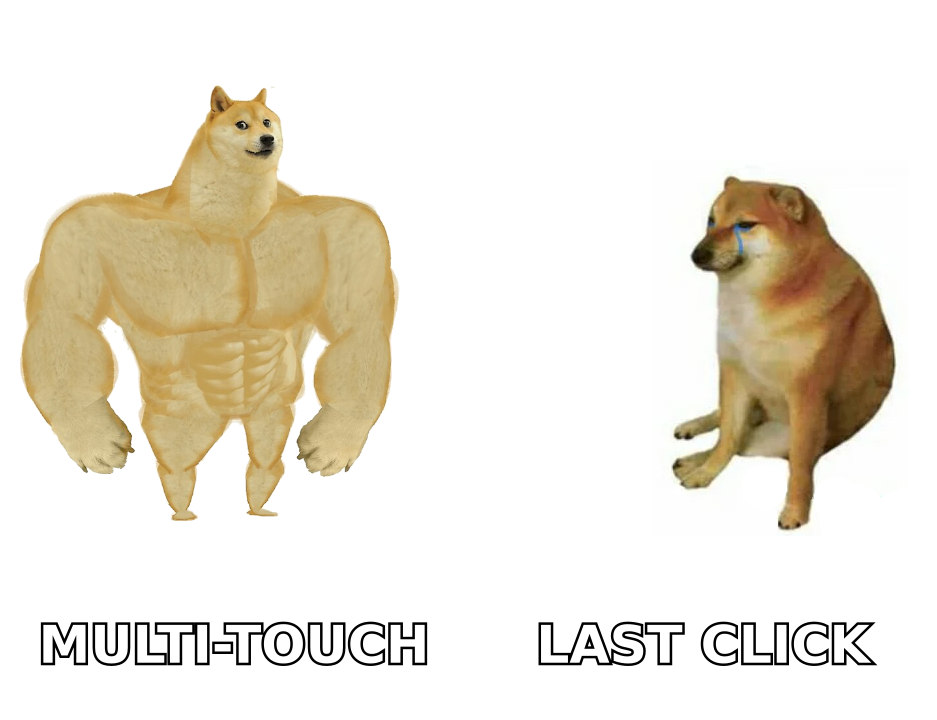
Multi-touch models are not automatically better. They are better when your touchpoint capture is complete. A W-shaped model running on data that misses every cold email and every LinkedIn DM is not more accurate than last-touch — it is confidently wrong across more line items.
Why does outbound break most lead attribution models?#
Because outbound produces no click.
Every attribution system in existence was designed around the web session: someone lands on a page with a utm_source parameter, drops a cookie, fills a form, and the chain is intact. Outbound inverts that. A rep finds a prospect, sends an email, the prospect replies, and a meeting appears on the calendar. There was never a session to tag.
What actually happens in most CRMs is worse than "untracked." The prospect, having replied to a cold email, later Googles your brand name and clicks through to the pricing page before the demo. Last-touch then credits organic branded search with a deal that a rep sourced from scratch. Marketing looks efficient, outbound looks expensive, and next quarter's budget moves in exactly the wrong direction.
Three fixes, in order of how much they matter:
- Stamp the source at contact creation, not at conversion. The moment a rep or an enrichment job creates a contact record, write an immutable
original_sourcefield. Nothing downstream should ever overwrite it. This one field resolves the majority of outbound misattribution. - Treat the reply as a touchpoint. Email replies, connection accepts, and answered calls belong in the touchpoint table alongside page views. If your sequencer writes activity to the CRM, you already have this data — it is just not joined to the model.
- Separate sourced from influenced. Report both. "Outbound sourced $1.2M and influenced $3.4M" is a sentence a CFO can act on. A single blended number is not.
Vendors like HubSpot and Salesforce both ship native multi-touch reporting now, and both handle web touchpoints well. Both still depend entirely on you getting the contact-level source field right at creation time. That is a data-operations problem, not a licensing one.
How does data quality decide whether attribution works at all?#
Attribution is a join. Joins fail on dirty keys.
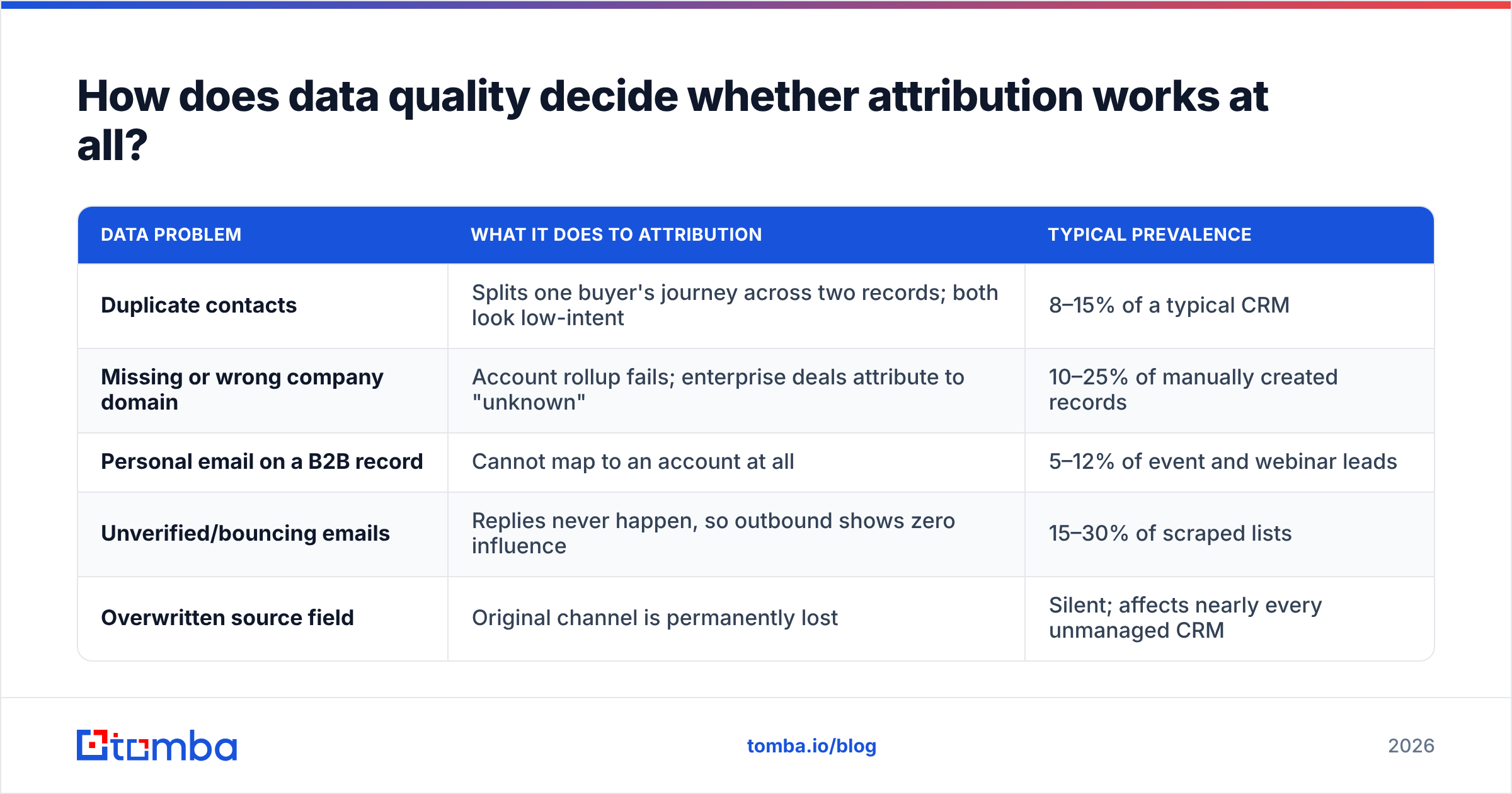
Consider what has to be true for a single deal to attribute correctly: the anonymous visitor cookie must stitch to a known email, that email must match exactly one contact record, that contact must be associated with the right account, and the account's domain must match the domain in your ad platform's company-level reporting. Break any link and the touchpoint orphans.
The common failure modes, ranked by how much damage they do:
| Data problem | What it does to attribution | Typical prevalence |
|---|---|---|
| Duplicate contacts | Splits one buyer's journey across two records; both look low-intent | 8–15% of a typical CRM |
| Missing or wrong company domain | Account rollup fails; enterprise deals attribute to "unknown" | 10–25% of manually created records |
| Personal email on a B2B record | Cannot map to an account at all | 5–12% of event and webinar leads |
| Unverified/bouncing emails | Replies never happen, so outbound shows zero influence | 15–30% of scraped lists |
| Overwritten source field | Original channel is permanently lost | Silent; affects nearly every unmanaged CRM |
This is why attribution projects so often stall in month two. The model is fine. The data underneath it is not. Running contact enrichment on inbound and event leads before they hit the CRM fixes the domain and account-rollup problems at the point of entry, which is dramatically cheaper than a retroactive cleanup. Running an email verifier on outbound lists before sequencing fixes the other half — you cannot attribute a reply that never had a chance to arrive.

A blunt heuristic: if more than 10% of your closed-won deals attribute to "direct," "none," or "unknown," stop building dashboards and go fix identity resolution. Nothing you model on top of that will survive scrutiny.
What should a lead attribution stack look like in 2026?#
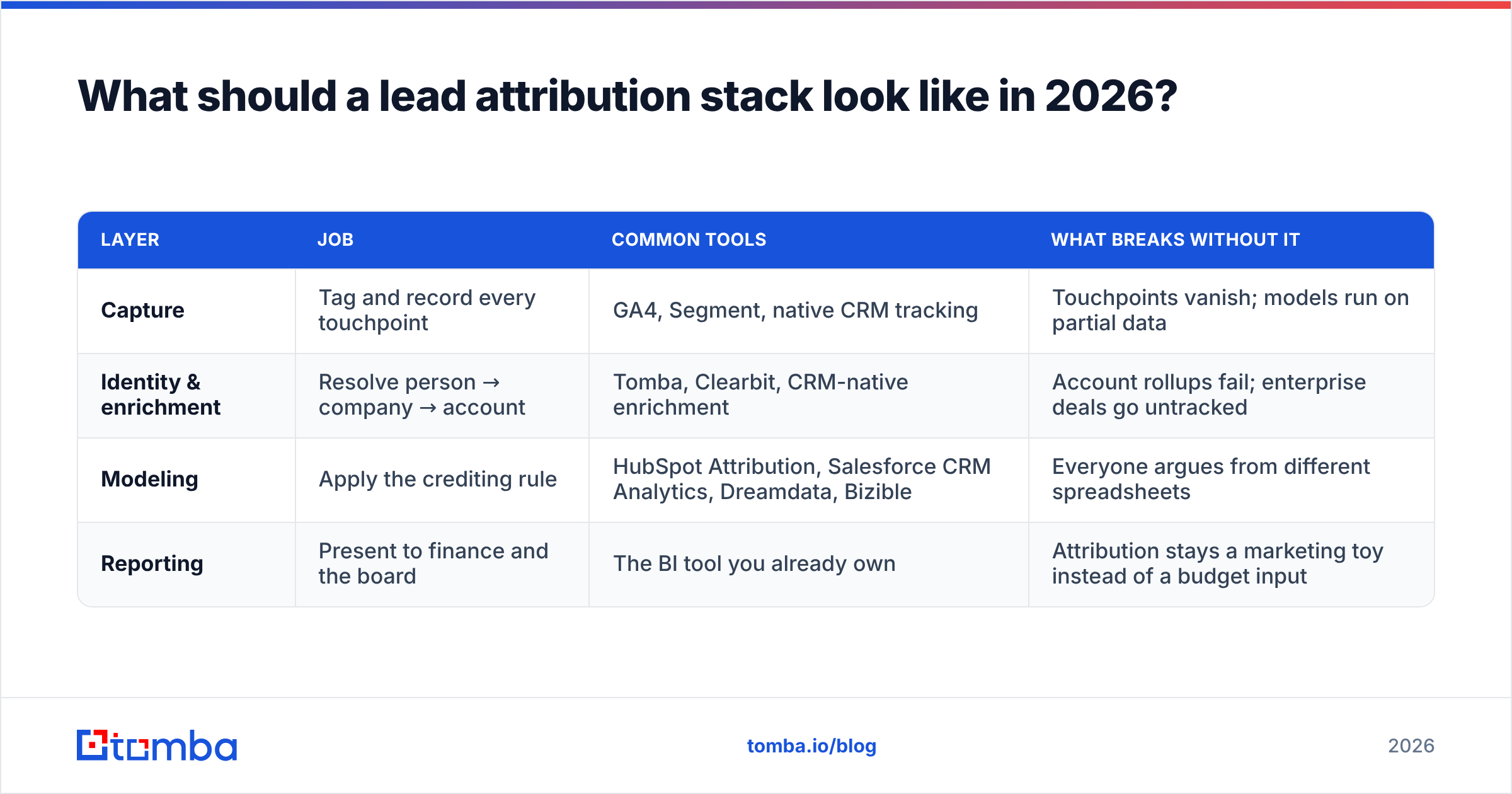
You need four layers. Most teams over-buy at the top and under-invest at the bottom.
| Layer | Job | Common tools | What breaks without it |
|---|---|---|---|
| Capture | Tag and record every touchpoint | GA4, Segment, native CRM tracking | Touchpoints vanish; models run on partial data |
| Identity & enrichment | Resolve person → company → account | Tomba, Clearbit, CRM-native enrichment | Account rollups fail; enterprise deals go untracked |
| Modeling | Apply the crediting rule | HubSpot Attribution, Salesforce CRM Analytics, Dreamdata, Bizible | Everyone argues from different spreadsheets |
| Reporting | Present to finance and the board | The BI tool you already own | Attribution stays a marketing toy instead of a budget input |
Two practical notes. First, you do not need a dedicated attribution vendor until you are past roughly $5M ARR or running more than five meaningful channels — before that, native CRM reporting plus disciplined source stamping gets you 80% of the value. Second, check the G2 attribution category before shortlisting; the segment has consolidated heavily and several tools that rank well in blog posts no longer exist as independent products.
On the enrichment layer specifically: cost matters more than feature lists, because enrichment runs on volume. Tomba pricing starts free at 25 searches a month, with Starter at $49/mo and Growth at $99/mo, and the Tomba API lets you enrich at the point of record creation rather than in nightly batches. Enriching on creation is what keeps the source field and the account domain correct from the first write.
How do you report attribution without losing the room?#
Three rules, learned the hard way.
Show two models, never one. Presenting a single number invites the question "why that model?" and you will lose that argument. Presenting first-touch next to last-touch reframes the conversation around the gap, which is where the insight lives anyway.
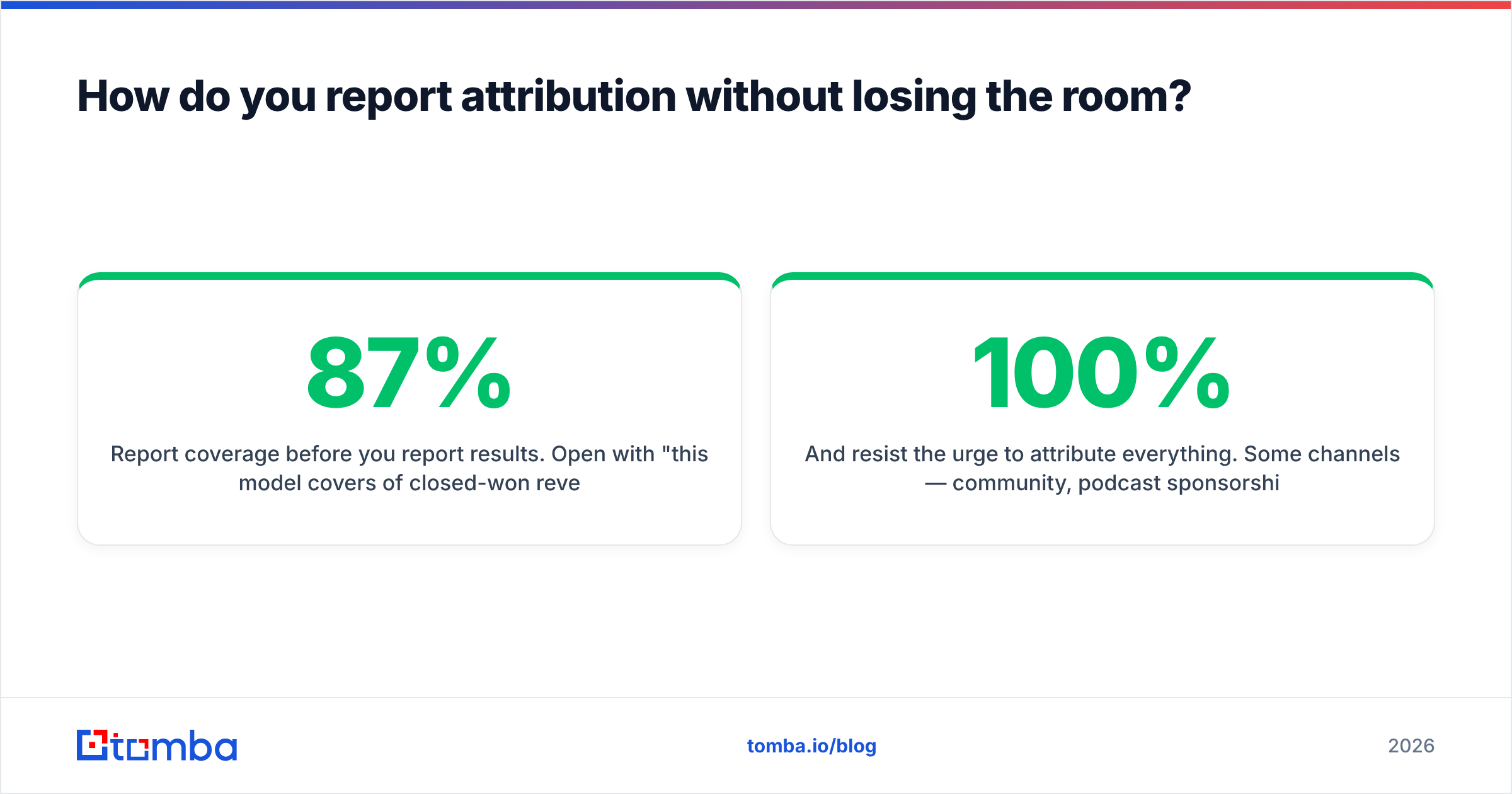
Report coverage before you report results. Open with "this model covers 87% of closed-won revenue; 13% is unattributed." Finance trusts a stated error bar far more than a suspiciously complete pie chart.
Separate the leading and lagging views. Attribution on closed-won revenue is lagging by your entire sales cycle — for a nine-month cycle, you are reporting on decisions made last year. Pair it with a leading indicator: attributed pipeline created this quarter. Budget decisions should key off the leading view; efficiency post-mortems off the lagging one.
And resist the urge to attribute everything. Some channels — community, podcast sponsorships, analyst relations, executive LinkedIn presence — resist measurement by design. Attribute what is attributable, budget the rest as a stated bet, and say so out loud. That is more credible than a model that claims 100% coverage.
What is the fastest path to attribution you can trust?#
Sequence it like this, over about six weeks:
- Week 1 — Audit. Count what percentage of closed-won deals have a populated, plausible original source. That number is your baseline.
- Week 2 — Lock the source field. Make
original_sourcewrite-once at contact creation. Add validation that rejects blank values. - Week 3 — Fix identity keys. Deduplicate contacts, enrich missing company domains, verify email validity on active outbound lists.
- Week 4 — Wire outbound touchpoints. Ensure sequencer replies, meetings booked, and call connects land in the CRM activity table.
- Week 5 — Build the two-model report. First-touch and last-touch, with a stated coverage percentage.
- Week 6 — Decide whether you need more. If the two models broadly agree and coverage is above 85%, you are done. If not, the gap tells you exactly which channel's tracking to fix next.
Notice that five of the six weeks are data work and one is modeling. That ratio is not an accident — it is the whole lesson.
Get the data layer right first#
Attribution models are only as honest as the contact records they run on. If your outbound lists bounce, your event leads carry personal Gmail addresses, and half your accounts are missing a company domain, no crediting rule — however sophisticated — will produce a number your CFO should act on.
Start at the bottom of the stack. Use the Tomba Email Finder to build outbound lists with verified, work-domain addresses that map cleanly to accounts from the first touch, and enrich inbound records at creation so the account rollup never breaks. The free tier covers 25 searches a month if you want to test the workflow on a single campaign before committing. Clean keys first, clever models second.
Related guides#
// get started
Find, verify and enrich your first contacts today
Start on the free plan with 25 searches a month, then scale when your team is ready.
Free plan · No credit card required · GDPR & CCPA
// about the author