Lead Carrot vs Apollo.io: Which B2B Lead Tool Wins in 2026?
Lead Carrot sells curated local-business lists. Apollo.io sells a 275M-contact database plus a sequencer. They solve different problems — here's which one your pipeline actually needs, and what each really costs.
Lead Carrot vs Apollo.io is a fight most teams pick too fast. One tool sells local business lists. The other sells a huge contact database plus a sales engine. This guide shows which one fits your work.
TL;DR
- Lead Carrot hands you lists of small local firms. Pick a trade and a city, get a CSV. Flat monthly price. No email sender built in.
- Apollo.io is a full sales platform. It holds about 275 million contacts. It also runs email steps, calls, and CRM sync.
- The Lead Carrot vs Apollo.io match-up is not apples to apples. They solve different jobs.
- Lead Carrot wins on speed for local lists. Apollo wins on job-title filters and one-tab outreach.
- Both share one flaw. Bulk data goes stale fast. Bounce tests often put big lists in the 70-85% valid range.
- Best setup for 2026: one tool to find leads, a second tool to check each email. Stop paying for bounces.
What is Lead Carrot and who is it for?#
Lead Carrot is a lead-list service for local and small-business selling. You log in and pick a trade: roofers, dentists, gyms, law firms. Then you pick a place. It gives you a list with the business name, site, phone, address, social links, and often an email. The pitch targets agencies. Web shops, SEO freelancers, and consultants use it to get 500 local firms to call this week.
The appeal is how simple it is. No credit math. No eight-step filter builder. No sales call before you see the tool. You pick a trade, you get a list, you export a CSV. For a solo seller who builds sites for HVAC firms in three metros, that is the whole job.
The limits come from that same simple design. Lead Carrot data sits at the business level, not the person level. You often get info@ or contact@, not the owner's own address. There is no job-title filter like the one Apollo or ZoomInfo offers. The records are not built around people in roles. Much of the data comes from web and directory scraping, so freshness swings by trade. A trade crawled last month looks great. One crawled years ago does not.

What is Apollo.io and what does it actually include?#
Apollo.io is a go-to-market platform. The database is the headline. Apollo claims more than 275 million contacts and 70 million companies. But the tool is really four parts bolted together:
- Search — filter by title, seniority, team, headcount, revenue, tech stack, place, and funding.
- Signals — intent topics, job-change alerts, and site-visitor tracking on higher plans.
- Outreach — email steps, a built-in dialer, LinkedIn tasks, and A/B tests.
- Sync — two-way HubSpot and Salesforce sync, scoring, and reports.
That range is the draw and the cost. Apollo is a system you adopt, not a list you buy. Teams that win with it give one person the keys. That person builds saved searches, keeps steps clean, and fixes sync rules. Teams that treat it as a CSV export tool pay far too much.
Apollo pulls a lot of data from a shared network. Users install the plug-in, and contact data flows both ways. That gives huge reach. It also drives the well-known accuracy gripes on G2. A record that was true in 2023 can be junk in 2026, because nobody checked it after the person moved jobs.
Lead Carrot vs Apollo.io: how do they compare head to head?#
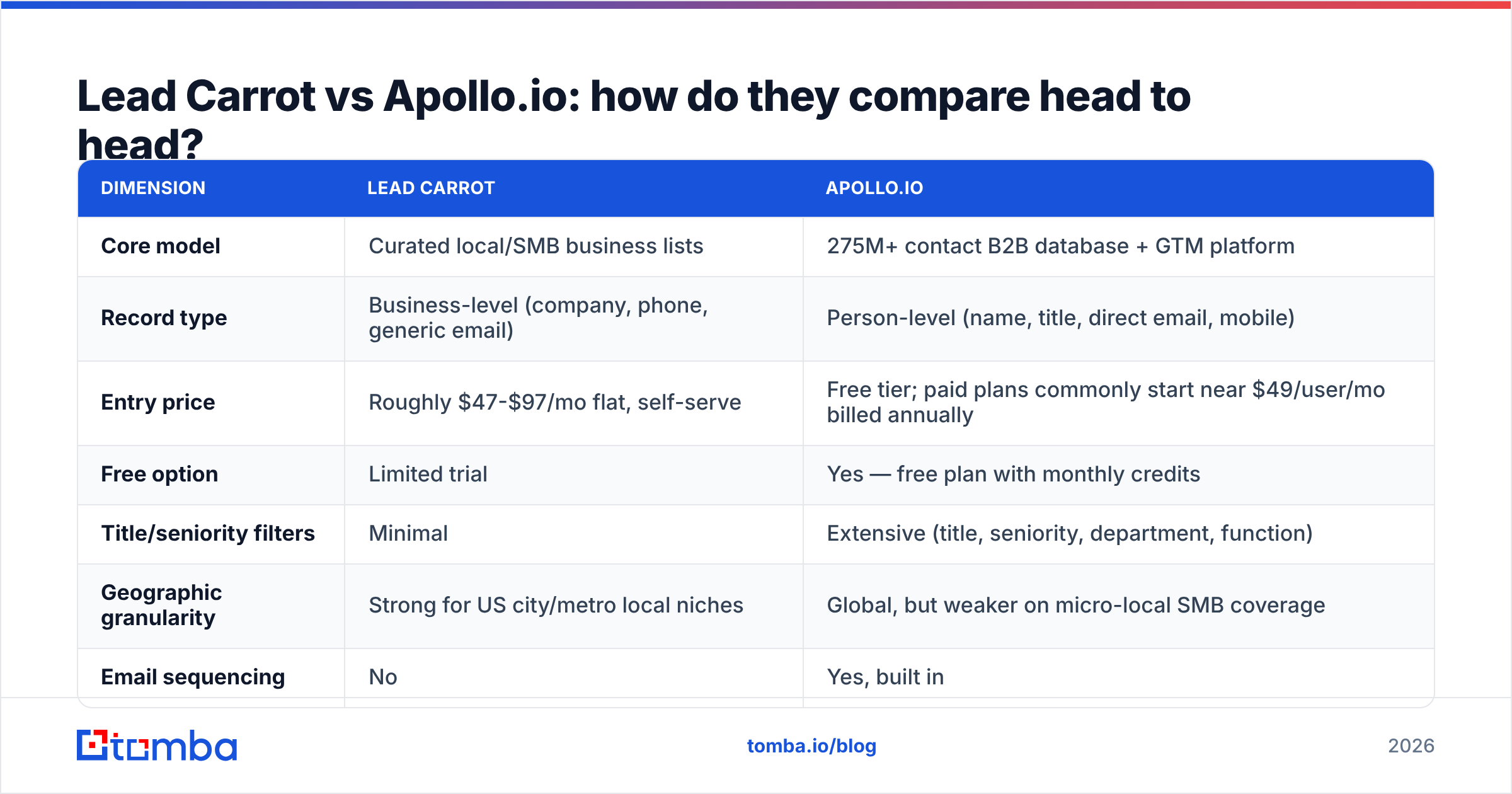
Here is the Lead Carrot vs Apollo.io split, side by side.
| Dimension | Lead Carrot | Apollo.io |
|---|---|---|
| Core model | Curated local/SMB business lists | 275M+ contact B2B database + GTM platform |
| Record type | Business-level (company, phone, generic email) | Person-level (name, title, direct email, mobile) |
| Entry price | Roughly $47-$97/mo flat, self-serve | Free tier; paid plans commonly start near $49/user/mo billed annually |
| Free option | Limited trial | Yes — free plan with monthly credits |
| Title/seniority filters | Minimal | Extensive (title, seniority, department, function) |
| Geographic granularity | Strong for US city/metro local niches | Global, but weaker on micro-local SMB coverage |
| Email sequencing | No | Yes, built in |
| Dialer / phone | Phone numbers included, no dialer | Numbers plus native dialer on paid tiers |
| CRM sync | CSV export | Native HubSpot, Salesforce, Pipedrive |
| API | Limited | Yes, rate-limited by plan |
| Verification | Not a core feature | Basic; most teams still run an external verifier |
| Best fit | Agencies selling to local SMBs | B2B SaaS, services, and sales teams targeting roles |
| Worst fit | Targeting a VP of Engineering at a 900-person company | Cold-calling 400 independent dentists in Ohio |
The table makes the point. The "versus" framing is mostly wrong. If your buyer is a type of business in a place, Lead Carrot fits. If your buyer is a person in a role, Apollo fits. Pick the wrong side and you lose far more than the price gap.
Which one has better data accuracy?#
Data accuracy is where the Lead Carrot vs Apollo.io call really bites. Neither one wins. Both need help.
Big B2B databases go stale on a clock. Contact data churns about 25-30% a year. People switch jobs. Firms rebrand. Domains move. Mailboxes get shut off. No vendor can recheck 275 million records all the time at a price you would pay. So they ship scores, not promises. Apollo's own screen says as much. It marks an email verified, guessed, or missing. That is an honest way to admit a big slice is a guess.
Lead Carrot fails a different way. Its records skew to small firms with thin websites. So the email you get is often a role address: info@, office@, frontdesk@. Role mail does not bounce. It gets ignored, or a front-desk worker deletes it. Your bounce rate looks fine and your reply rate is zero. That hides the problem, which is worse.
The fix for both is the same. Treat the database as a way to find leads. Add a checking step before mail leaves your domain. Running a list through an email verifier is the best-paying step in cold outbound. Bounces above about 3% start to hurt sender reputation, and that damage is slow to undo.
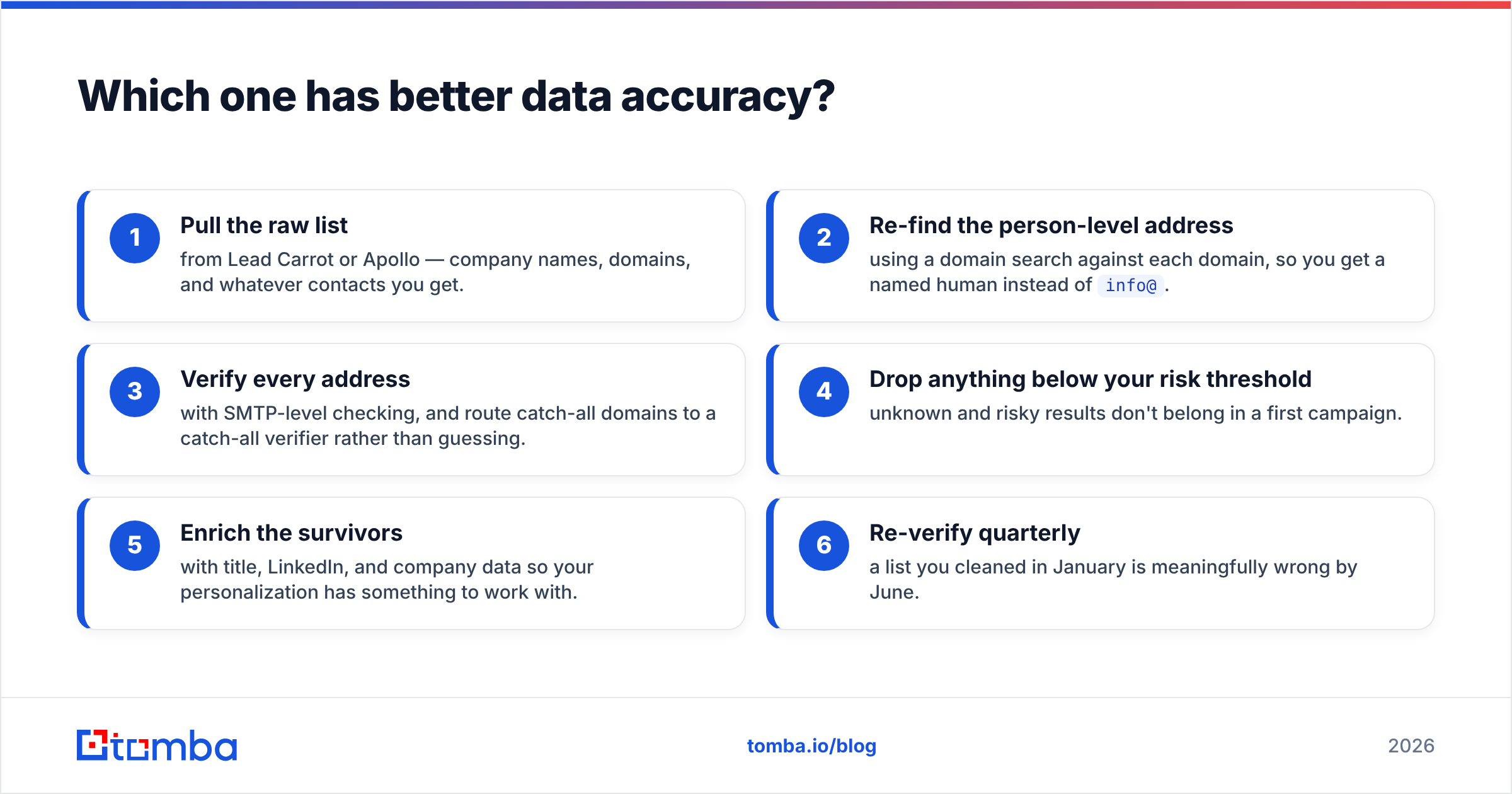
A simple flow that works with either tool:
- Pull the raw list from Lead Carrot or Apollo. Take names, domains, and any contacts.
- Find the real person with a domain search on each domain. You want a named human, not
info@. - Check every address at the mail-server level. Send catch-all domains to a catch-all verifier.
- Drop the risky ones. Unknown and risky results do not belong in a first send.
- Add detail to the rest: title, LinkedIn, company data. Your pitch needs something to work with.
- Recheck every quarter. A list you cleaned in January is wrong by June.
How does pricing really compare?#
Lead Carrot charges a flat monthly fee with roomy export limits. That is easy to plan. An agency can bill it straight to a client retainer. There is no credit math to model.
Apollo charges per seat, per month, plus credits. Credit types differ by plan: email, mobile, and export. This is where the bill surprises teams. The list price is not the real cost. Annual discounts vanish if you pay monthly. Mobile numbers eat a smaller, separate pool. Export caps slow bulk list building. And every rep needs a seat to do real work.
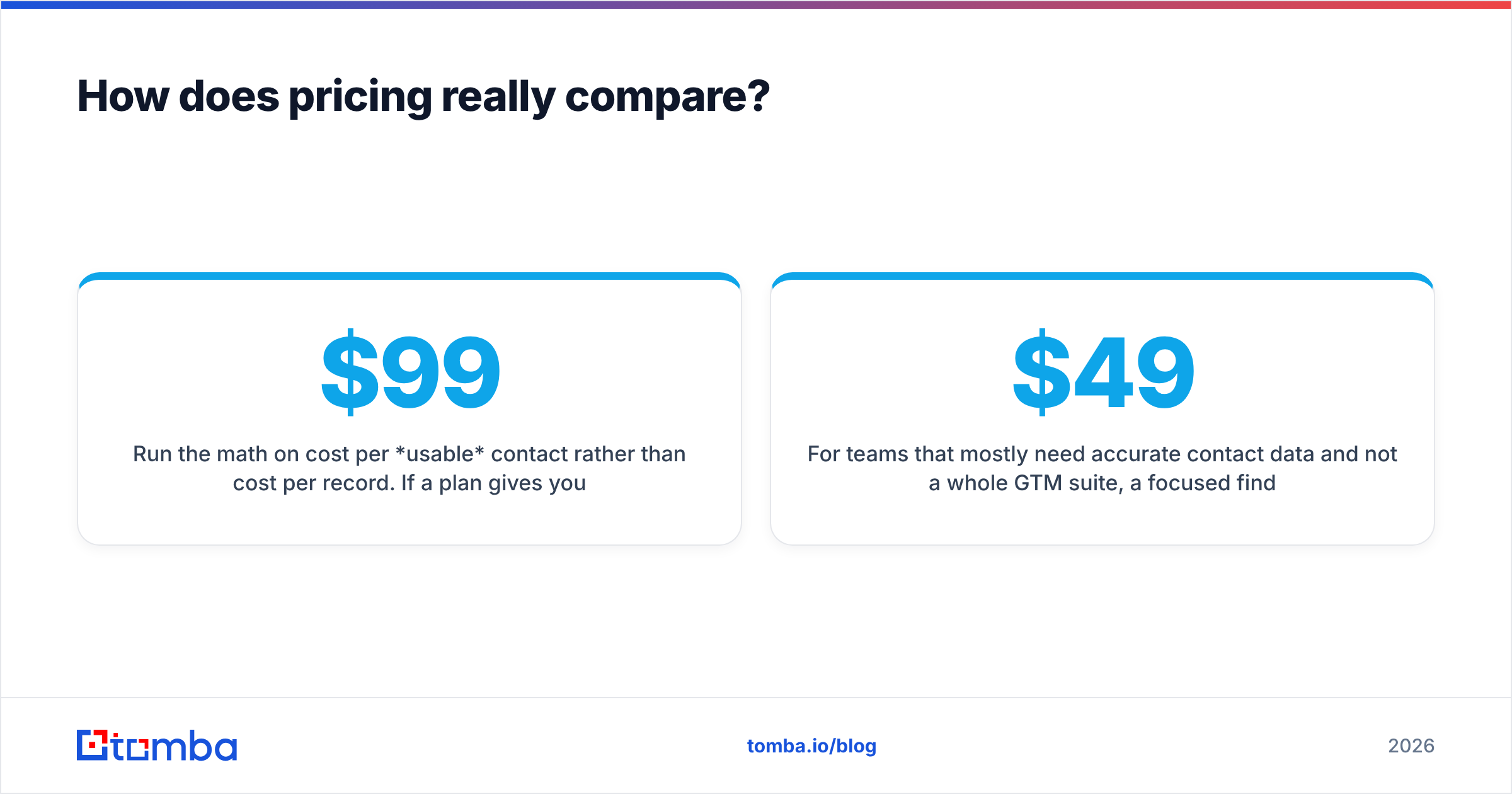
Do the math on cost per usable contact, not cost per record. Say a plan gives you 10,000 exports for $99. If 22% bounce or are role mail, you bought 7,800 usable contacts, not 10,000. That switch often flips which tool looks cheap. In the Lead Carrot vs Apollo.io price fight, the winner turns on that one number.

Some teams just need good contact data, not a whole suite. A focused finder is far cheaper. Tomba pricing starts with a free tier at 25 searches a month. Starter is $49/mo, Growth is $99/mo, and Pro is $249/mo, with custom plans on request. Every plan includes checking, rather than selling it as its own credit type. If your problem is "I have 4,000 domains and need the right person at each," that is a finder job, not a platform job.
What are the honest alternatives to both?#
The Lead Carrot vs Apollo.io choice is often a false binary. A different shape of tool may fit your motion better.
- Apollo alternatives — if seat pricing or data quality bugs you, the Apollo alternative field has tools that split the database from the sender. You can pay for one without the other.
- BookYourData — buy checked B2B lists outright instead of renting a search screen. It states an accuracy promise and sells pay-as-you-go. That suits teams who pull big lists now and then.
- Finder plus verifier — pair any source with a specialist layer. Most veteran outbound teams land here. It splits "where leads come from" from "are these addresses real."
- Local scrapers — for pure local work, a Google Maps scraper plus a bulk email finder can match Lead Carrot's output for less. You just do more setup by hand.
Agencies that like Lead Carrot's "buy a list, go" model but need job titles should look at BookYourData first. It is the closest upgrade path.
Analyst coverage says the same thing. Gartner's sales intelligence reviews and the G2 sales intelligence grid show one pattern. Buyers rate platforms high on reach and low on accuracy. Nobody has fixed both at once. So the market rewards stacking tools.
When should you pick Lead Carrot?#
In the Lead Carrot vs Apollo.io call, pick Lead Carrot if most of these hold:
- Your buyer is local. You sell to one trade in set cities or metros.
- You sell to owners. Firms have under ~50 staff and no org chart to climb.
- Phone comes first. You plan to call, so a good number beats an email.
- You are a one- to three-person shop. Flat pricing saves real money at that size.
- You do not need a sender. You mail from another tool, or you just call.
If you pick it, plan for enrichment. Take the domains and find the owner's real address instead of mailing info@. A bulk email finder run over the export turns a directory list into a prospect list.
When should you pick Apollo.io?#
In the same Lead Carrot vs Apollo.io call, pick Apollo if most of these hold:
- Your buyer is a role. You need "Director of RevOps at 200-1,000 staff SaaS firms in DACH." No local directory will ever give you that.
- You have two or more reps. Per-seat cost stings less when one tool replaces three.
- You want one home for outbound. Steps, calls, and CRM sync in one place has real value.
- You will set it up properly. Someone owns saved searches, step hygiene, and sync rules.
- Intent data drives your motion. Job-change and intent flags pay off if you act fast.
If you pick it, still check your list. Apollo's "verified" tag is a score, not a live test at export time. Running exports through an email verifier is the gap between a 1% bounce send and a 9% one.
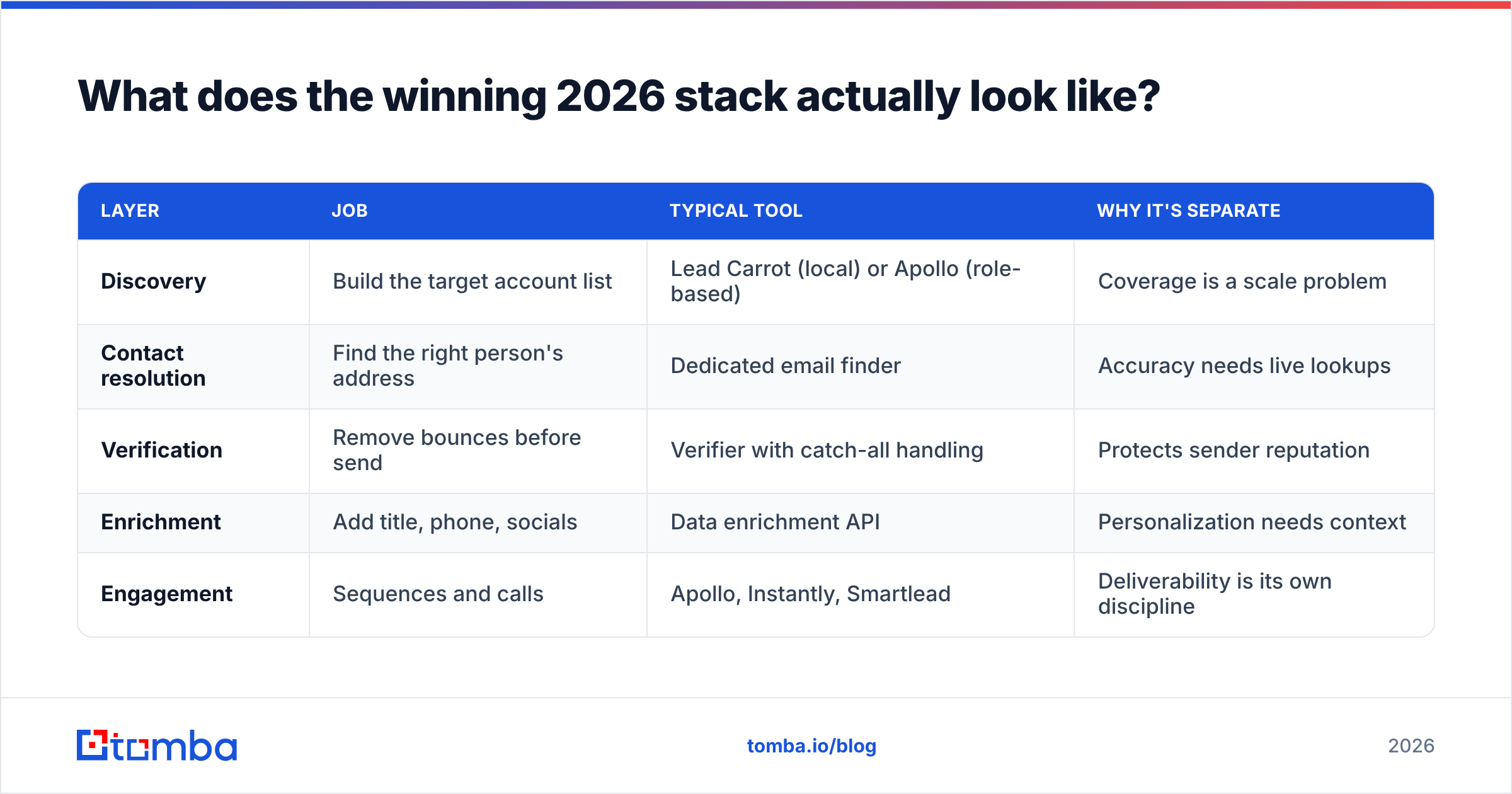
What does the winning 2026 stack actually look like?#
The Lead Carrot vs Apollo.io debate ends once you see outbound as layers.
| Layer | Job | Typical tool | Why it's separate |
|---|---|---|---|
| Discovery | Build the target account list | Lead Carrot (local) or Apollo (role-based) | Coverage is a scale problem |
| Contact resolution | Find the right person's address | Dedicated email finder | Accuracy needs live lookups |
| Verification | Remove bounces before send | Verifier with catch-all handling | Protects sender reputation |
| Enrichment | Add title, phone, socials | Data enrichment API | Personalization needs context |
| Engagement | Sequences and calls | Apollo, Instantly, Smartlead | Deliverability is its own discipline |
This layering keeps winning for one reason: money. Find-tools get paid for holding the most records. Check-tools get paid for holding the fewest wrong ones. Those goals pull apart. One vendor chasing both will always cut a corner on one side. Buy them apart and each layer does its own job well.
The counter-case is fair. More tools means more wiring, more bills, and more ways a flow can break. If you send a few hundred emails a month, one platform beats a three-tool stack. The crossover sits where bounce costs pass tool costs. For most teams that lands between 1,000 and 3,000 sends a month.
Frequently asked questions#
Is Lead Carrot cheaper than Apollo.io? Per month, usually yes, above all for one user. Per usable contact, it depends on whether role mail counts as usable for you. For email, it rarely does.
Can Apollo.io find local small businesses? It can show them, but coverage thins out fast. Many small firms have no real website or LinkedIn page. Lead Carrot's directory data is denser in that segment.
Do I need a separate verifier with either tool? Yes, if you care about inbox placement. Neither runs a live mail-server check at the moment you export. That gap is where bounces come from.
Lead Carrot vs Apollo.io: which is better for agencies? Lead Carrot suits agencies selling local services. Apollo suits agencies selling to mid-market and up. Many agencies run both, plus a finder layer for contact lookup.
Where should you start?#
Start by naming your buyer in one sentence. Does that sentence hold a city and a trade? Trial Lead Carrot. Does it hold a job title and a company profile? Trial Apollo's free plan. If it holds both, you run two motions. Stop asking one tool to cover them.
Then fix the layer neither tool owns. Take the list you build and run it through the Tomba Email Finder. You get real, named, checked addresses from the domains you collected. The free tier gives you 25 searches a month, enough to test the gap on your own data. Compare bounce rates on 100 raw records against 100 Tomba-resolved ones. That number settles the Lead Carrot vs Apollo.io argument better than any post can.
Related guides#
// get started
Find, verify and enrich your first contacts today
Start on the free plan with 25 searches a month, then scale when your team is ready.
Free plan · No credit card required · GDPR & CCPA
Get the Tomba newsletter
Product and data updates
// about the author