Lead Conversion Meaning: Definition, Formula, and Benchmarks
Lead conversion is the moment a lead becomes a paying customer — but most teams measure it wrong. Here's the real definition, the formula, 2026 benchmarks, and the data problems that quietly wreck your rate.
TL;DR
- Lead conversion is the point at which a lead completes the action that moves it to the next defined stage — most commonly, becoming a paying customer. The word only means something once you say which two stages you are measuring between.
- The formula is simple:
(conversions ÷ total leads) × 100. The hard part is agreeing on the denominator. - Median B2B lead-to-customer conversion sits around 2–4%, but MQL-to-SQL runs 25–40% and SQL-to-close runs 15–30%. Comparing your number to the wrong benchmark is the most common self-inflicted wound in reporting.
- Bad contact data is a silent conversion killer. A 30% bounce rate does not just waste sends — it deflates every downstream rate and makes good campaigns look broken.
- Fix the definition first, the data second, the messaging third. In that order.
What is the lead conversion meaning, exactly?#
Lead conversion is the transition of a lead from one lifecycle stage to the next as a result of a specific, agreed-upon action.
That is the honest definition, and the vagueness is the point. Ask five revenue teams what "conversion" means and you get five answers: a form fill, a demo booked, an opportunity created, a signed contract. All five are legitimate. None of them are interchangeable.
Most confusion about the lead conversion meaning comes from collapsing a multi-step funnel into a single word. In practice you are always measuring a pair of stages:
- Visitor → Lead — an anonymous person gives you contact details. This is lead capture, not lead conversion, though plenty of dashboards label it that way.
- Lead → MQL — the lead meets a scoring threshold your marketing team defined. See the definition of a marketing qualified lead if your team has never written one down.
- MQL → SQL — sales accepts the lead as worth working. This is the handoff where most pipelines leak.
- SQL → Opportunity — a real deal with a real amount and close date exists in the CRM.
- Opportunity → Customer — money changes hands. When an executive says "conversion rate," this is usually what they mean.
When someone asks for "our lead conversion rate," your first response should be a question: from which stage to which stage, over what time window? Without that, the number is decoration.

How do you calculate the lead conversion rate?#
Divide conversions by total leads in the same cohort, then multiply by 100.
Lead Conversion Rate = (Number of Leads Converted ÷ Total Leads) × 100If 1,000 leads entered your funnel in Q1 and 34 became customers, your lead-to-customer rate is 3.4%. Easy arithmetic, three easy ways to get it wrong:
1. Mismatched time windows. You count leads generated in January against deals closed in January. If your sales cycle is 90 days, most of those January closes came from October leads. You are dividing two unrelated numbers. Fix: use cohort tracking — follow the January leads forward until they close or die.
2. An inflated denominator. Every scraped list upload, every duplicate, every info@ catch-all address counts as a "lead." Your rate craters and nobody can explain why. Fix: define what qualifies as a countable lead before it enters the system, and deduplicate the list before import.
3. Double-counting conversions. A lead books a demo, no-shows, rebooks, and closes. Some reports count that as three conversions. Fix: one lead, one conversion per stage transition, ever.
What is a good lead conversion rate in 2026?#
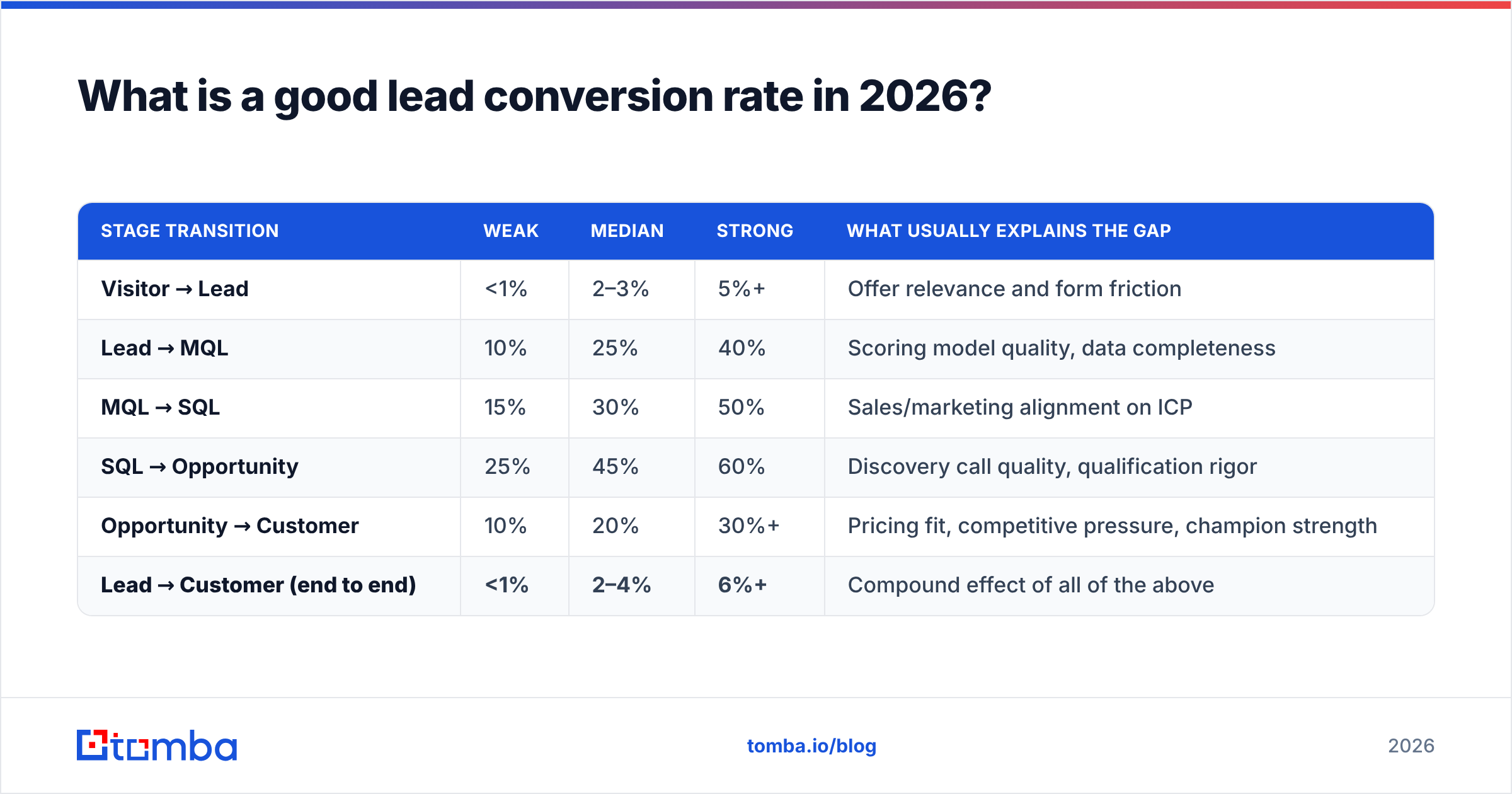
It depends entirely on the stage pair and the channel. Here is what the current spread looks like across common B2B stage transitions, drawn from aggregated vendor benchmark reporting and G2 category data:
| Stage transition | Weak | Median | Strong | What usually explains the gap |
|---|---|---|---|---|
| Visitor → Lead | <1% | 2–3% | 5%+ | Offer relevance and form friction |
| Lead → MQL | 10% | 25% | 40% | Scoring model quality, data completeness |
| MQL → SQL | 15% | 30% | 50% | Sales/marketing alignment on ICP |
| SQL → Opportunity | 25% | 45% | 60% | Discovery call quality, qualification rigor |
| Opportunity → Customer | 10% | 20% | 30%+ | Pricing fit, competitive pressure, champion strength |
| Lead → Customer (end to end) | <1% | 2–4% | 6%+ | Compound effect of all of the above |
Two things fall out of this table. First, end-to-end rates look terrible compared to individual stage rates — that is arithmetic, not failure. A funnel with five healthy 40% transitions still produces a 1% end-to-end rate. Second, the biggest absolute gains usually live in the middle of the funnel, not at the top. Doubling MQL→SQL from 25% to 50% does more for revenue than a 20% bump in traffic.
Channel matters too. Inbound demo requests convert several times better than cold outbound, and referrals beat both. If your board benchmark mixes channels, split it.
Why does contact data quality decide your conversion rate?#
Because every stage below the top inherits the errors from the stage above.
Here is the chain of damage from a single bad email address. It bounces. Your bounce rate climbs. Your sender reputation degrades. Mailbox providers start filtering your good messages to spam. Your reply rate falls across the board — including for the valid contacts in the same send. Your MQL count drops. Your sales team, seeing fewer leads, loosens qualification to hit activity targets. SQL→Opportunity conversion falls. Six weeks later someone asks why "conversion is down" and the answer is buried in a bounce log nobody opened.
Think of it like a water pipe with a pinhole at the top. The leak is tiny, but every joint downstream loses pressure, and you diagnose the problem at the faucet.
Concrete numbers on what data hygiene changes:
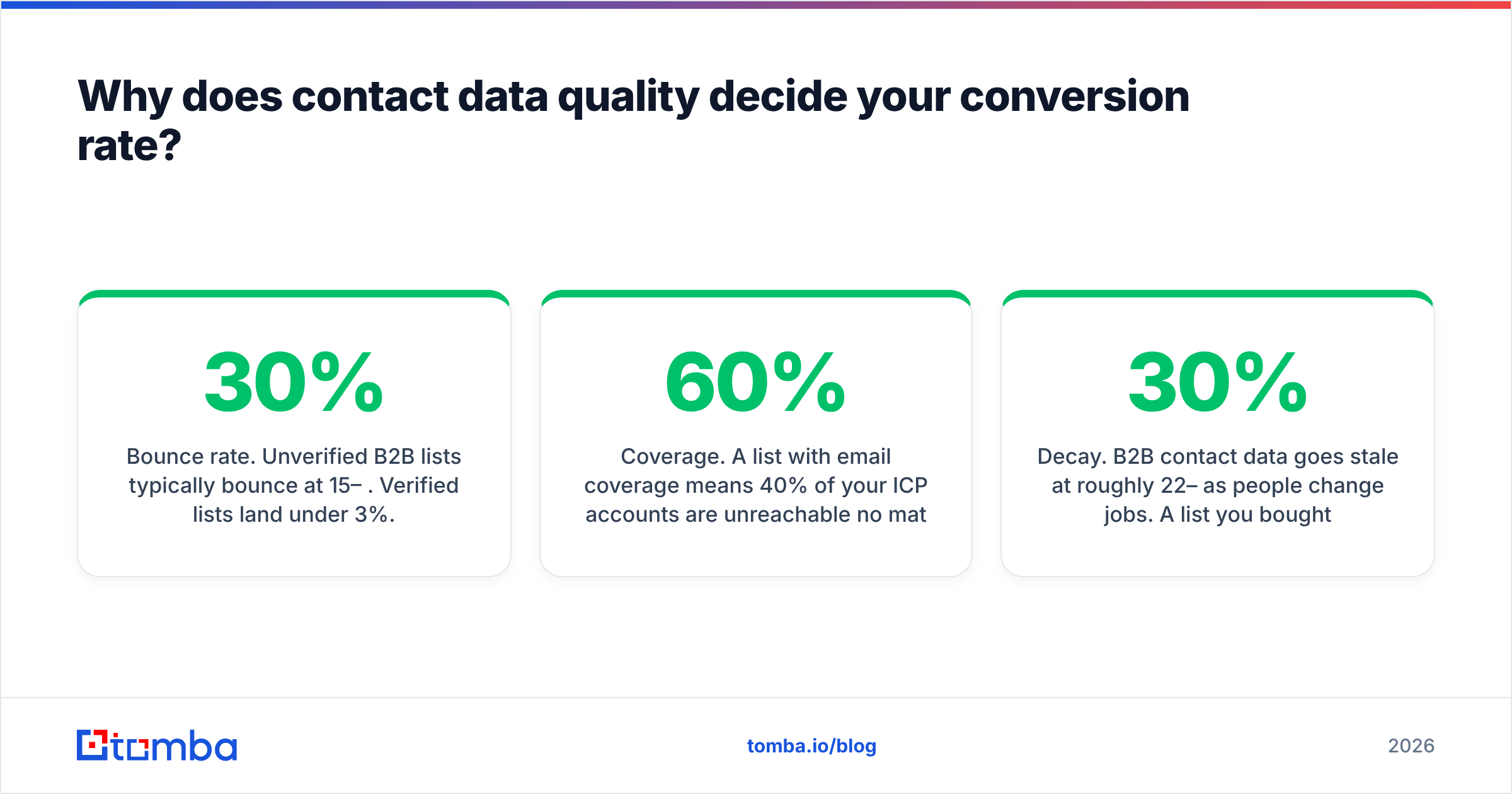
- Bounce rate. Unverified B2B lists typically bounce at 15–30%. Verified lists land under 3%. Mailbox providers start throttling well before 5%.
- Coverage. A list with 60% email coverage means 40% of your ICP accounts are unreachable no matter how good your copy is.
- Role accounts.
info@,sales@, andsupport@addresses inflate your lead count and convert at a fraction of named-contact rates. Filter them out of the denominator. - Decay. B2B contact data goes stale at roughly 22–30% per year as people change jobs. A list you bought 18 months ago is half fiction.
Running new contacts through an email verifier before they enter the CRM is the cheapest conversion-rate improvement available to most teams, because it costs cents per record and fixes a problem that compounds. For domains that accept everything at the SMTP layer, a dedicated catch-all verifier separates deliverable addresses from the ones that silently vanish.

How is lead conversion different from related metrics?#
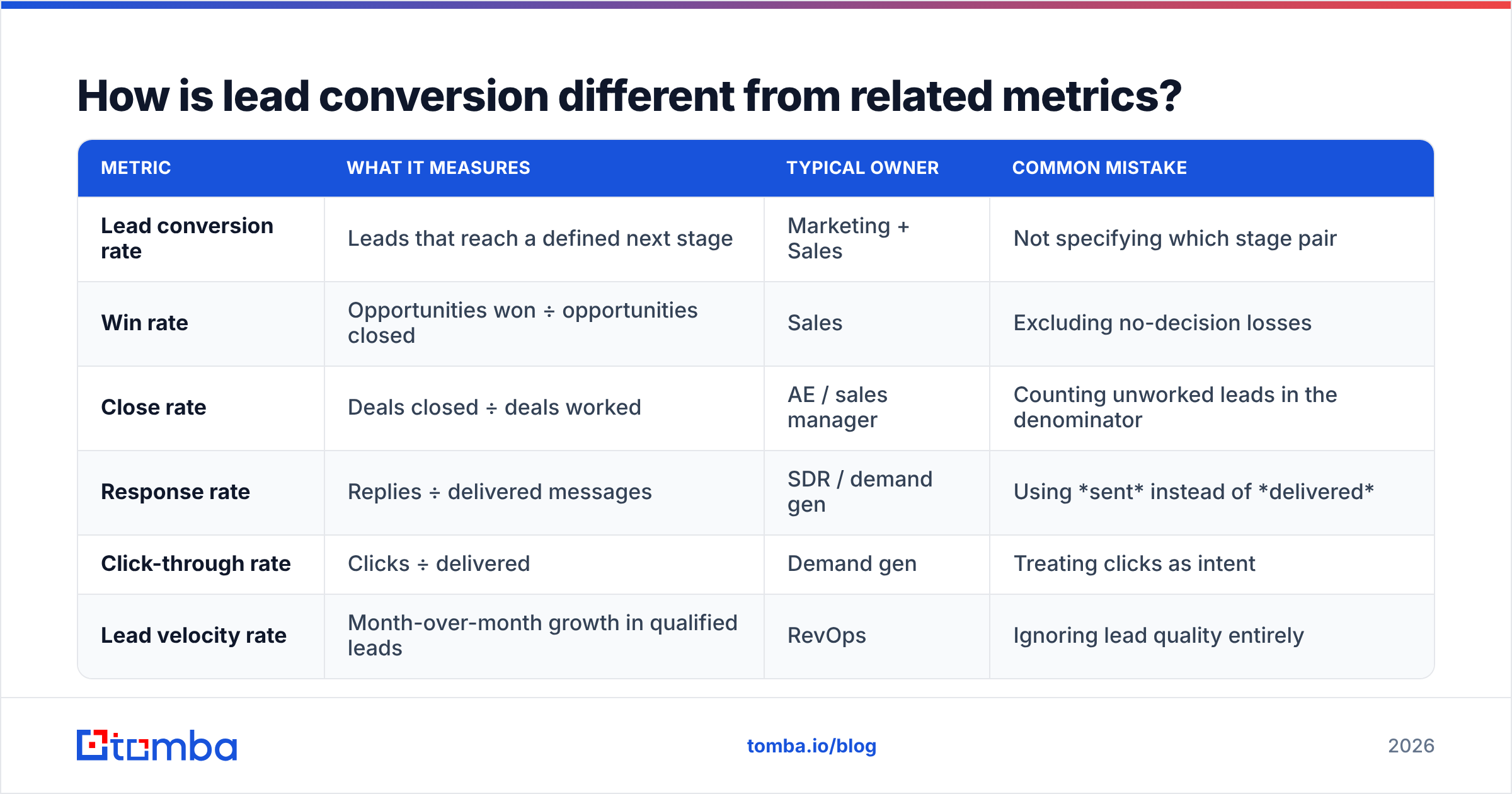
The terms get used interchangeably in meetings and they should not be. Here is the disambiguation table worth pinning in your revenue wiki:
| Metric | What it measures | Typical owner | Common mistake |
|---|---|---|---|
| Lead conversion rate | Leads that reach a defined next stage | Marketing + Sales | Not specifying which stage pair |
| Win rate | Opportunities won ÷ opportunities closed | Sales | Excluding no-decision losses |
| Close rate | Deals closed ÷ deals worked | AE / sales manager | Counting unworked leads in the denominator |
| Response rate | Replies ÷ delivered messages | SDR / demand gen | Using sent instead of delivered |
| Click-through rate | Clicks ÷ delivered | Demand gen | Treating clicks as intent |
| Lead velocity rate | Month-over-month growth in qualified leads | RevOps | Ignoring lead quality entirely |
Win rate and lead conversion rate move independently. A team can raise win rate by disqualifying aggressively — which lowers lead conversion rate while raising revenue per rep. If your compensation plan rewards one and your dashboard tracks the other, you will get behavior nobody asked for.
What actually moves the lead conversion rate?#
Five levers, ranked by the return most teams see per hour invested:
- Tighten the ICP definition. The fastest way to raise conversion is to stop generating leads that were never going to buy. Write down firmographic and technographic criteria, then enforce them at capture time rather than at qualification time.
- Verify and enrich at the point of entry. Append company size, industry, role seniority, and a verified email before the lead hits the routing rules. Incomplete records get scored low and routed wrong. Data enrichment at import turns a name and a domain into a routable record.
- Cut speed-to-lead. Response time is the single most studied variable in lead conversion, and the curve is brutal — contact attempts within the first five minutes dramatically outperform attempts made an hour later. HubSpot's research on sales follow-up is consistent on this across years of data.
- Fix the MQL→SQL handoff. Hold a monthly meeting where sales grades a random sample of 20 MQLs as accept/reject with reasons. Feed the reasons back into the scoring model. This one ritual routinely moves the transition 10+ points.
- Instrument the drop-offs, not just the totals. A single end-to-end rate tells you nothing about where to intervene. Stage-by-stage rates tell you exactly which meeting to schedule.
Notice that four of the five are operational, not creative. Rewriting your email copy is worth doing, but it is the fifth lever, not the first — and it cannot compensate for sending to addresses that do not exist.
How do you build a conversion-ready lead list?#
Start from accounts, not from contacts. Define the account list against your ICP, then find the right people inside those accounts, then verify before you touch the CRM.
A workable sequence:
- Build the account list. Filter by industry, headcount, funding stage, and tech stack. Ten well-chosen accounts beat a thousand random ones.
- Find the decision-makers. Use domain search to pull every known contact at a target company, then narrow to the two or three roles that matter for your deal.
- Fill the gaps. Where you have a name and company but no address, a bulk email finder resolves the rest in one pass instead of one-by-one guesswork.
- Verify everything. Route the whole list through verification and drop anything that is not deliverable. Keep the catch-alls in a separate bucket with lower send volume.
- Enrich before routing. Attach firmographics so your scoring model has something to score.
- Track the cohort. Tag the batch with a source and date so you can measure its conversion rate independently three months from now.
For teams evaluating data providers, the honest landscape includes several credible options with different strengths. BookYourData is a solid pick when you want a pre-built, guaranteed-accuracy list you can buy outright — useful for teams without the time to build lists themselves. Tools like Apollo bundle data with a sequencer, which suits teams that want one login. Tomba sits in the find-and-verify layer: strong per-domain coverage and verification, with an API for teams that want to wire it into their own pipeline rather than work in someone else's UI.
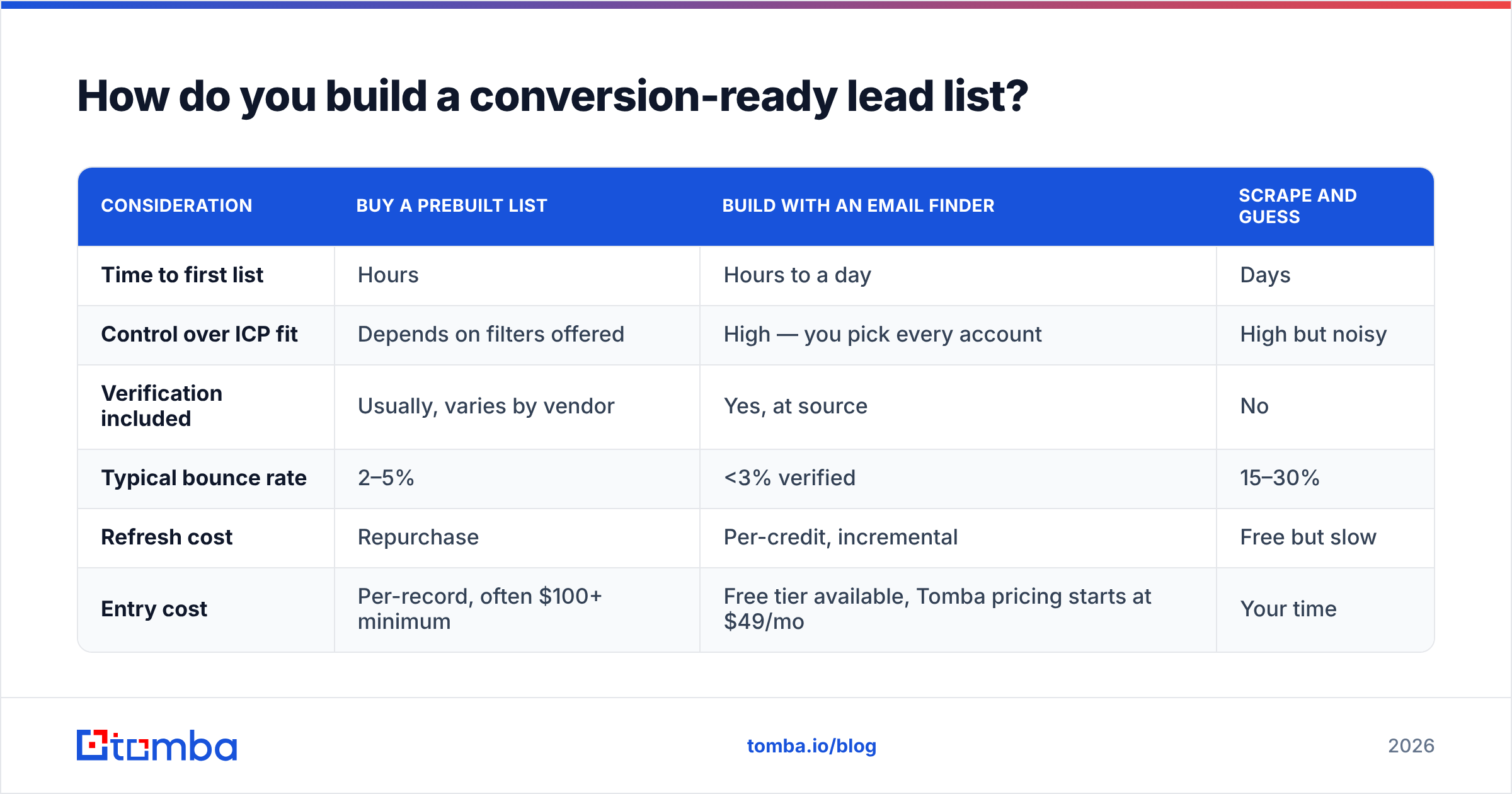
Here is the practical comparison for the data step specifically:
| Consideration | Buy a prebuilt list | Build with an email finder | Scrape and guess |
|---|---|---|---|
| Time to first list | Hours | Hours to a day | Days |
| Control over ICP fit | Depends on filters offered | High — you pick every account | High but noisy |
| Verification included | Usually, varies by vendor | Yes, at source | No |
| Typical bounce rate | 2–5% | <3% verified | 15–30% |
| Refresh cost | Repurchase | Per-credit, incremental | Free but slow |
| Entry cost | Per-record, often $100+ minimum | Free tier available, Tomba pricing starts at $49/mo | Your time |
There is no universally right column. If you need 5,000 contacts in a defined vertical tomorrow, buying is rational. If you are running account-based outbound against 200 named accounts, building is cheaper and cleaner.
What should you measure weekly?#
Keep the dashboard short. Four numbers, reviewed every Monday:
- Leads by source, with bounce rate attached. A source with high volume and high bounce is negative-value — it is degrading deliverability for every other source.
- MQL→SQL acceptance rate, with rejection reasons. The reasons matter more than the rate.
- Median speed-to-lead in minutes. Not average; averages hide the tail.
- Cohort conversion at 30/60/90 days. One line per monthly cohort. Trends show up here months before they show up in a quarterly total.
If you can only track one, track the cohort curve. It is the only view that ties the lead conversion meaning back to money at a specific point in time.
Getting started#
The definition is the cheap part. Write down your stage pairs, publish them, and make every dashboard label the transition it measures. Then go fix the denominator — because a conversion rate computed over a list that is 30% undeliverable is measuring your data vendor, not your go-to-market.
If your list is the bottleneck, start there. The Tomba Email Finder resolves verified professional addresses by name and domain, with a free tier of 25 searches a month to test coverage on your own target accounts before you commit. Run 50 of your current leads through it, compare the verification results to what is sitting in your CRM, and you will know within an hour whether your conversion problem is a messaging problem or a data problem.
Related guides#
// get started
Find, verify and enrich your first contacts today
Start on the free plan with 25 searches a month, then scale when your team is ready.
Free plan · No credit card required · GDPR & CCPA
// about the author