Lead Enrichment Tools in 2026: A Buyer's Field Guide
Most lead enrichment tools quote 95% accuracy and deliver far less on your actual ICP. Here's how the categories differ, what coverage really costs, and how to run a 500-record bake-off before you sign.
TL;DR
- "Lead enrichment tools" is not one category. It's four: waterfall aggregators, single-source providers, intent/firmographic platforms, and identity resolution layers. Buying the wrong one is the most common and most expensive mistake.
- Vendor-quoted accuracy (usually 95%+) is measured on their whole database. Your number is the match rate on your ICP, and it's routinely 30-50 points lower.
- The only metric that matters is cost per usable record — matched, verified, and deliverable — not cost per credit.
- Run a 500-row bake-off with a known-good control set before you sign anything. It takes an afternoon and regularly changes the decision.
- For email-first enrichment at SMB and mid-market price points, Tomba starts at $49/mo with a free tier; Clearbit-class platforms start around $20K/yr and solve a different problem.
What are lead enrichment tools, exactly?#
Lead enrichment tools take a thin record — an email, a domain, a LinkedIn URL, a form fill with three fields — and return a fat one: job title, seniority, company size, industry, tech stack, funding, phone, verified email. Think of it like a library's inter-library loan desk. You walk in with a half-remembered book title; the desk's job is to figure out what you actually want and fetch it from whichever branch has it.
The important distinction — the one that determines everything downstream — is where the data comes from.
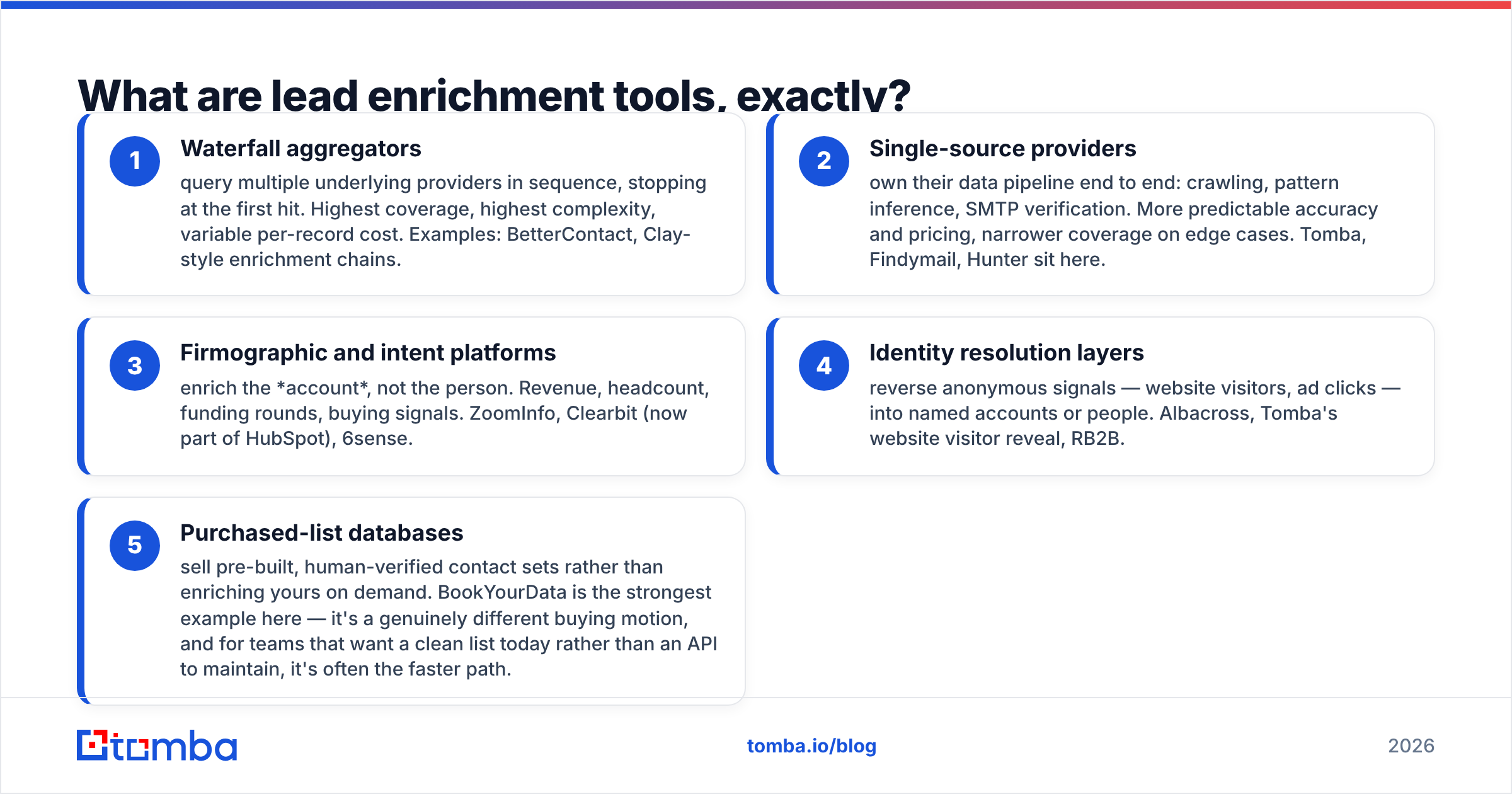
- Waterfall aggregators query multiple underlying providers in sequence, stopping at the first hit. Highest coverage, highest complexity, variable per-record cost. Examples: BetterContact, Clay-style enrichment chains.
- Single-source providers own their data pipeline end to end: crawling, pattern inference, SMTP verification. More predictable accuracy and pricing, narrower coverage on edge cases. Tomba, Findymail, Hunter sit here.
- Firmographic and intent platforms enrich the account, not the person. Revenue, headcount, funding rounds, buying signals. ZoomInfo, Clearbit (now part of HubSpot), 6sense.
- Identity resolution layers reverse anonymous signals — website visitors, ad clicks — into named accounts or people. Albacross, Tomba's website visitor reveal, RB2B.
- Purchased-list databases sell pre-built, human-verified contact sets rather than enriching yours on demand. BookYourData is the strongest example here — it's a genuinely different buying motion, and for teams that want a clean list today rather than an API to maintain, it's often the faster path.
Most teams think they need category 1 and actually need category 2 or 5. If your ICP is "SaaS companies, 50-500 employees, North America and Western Europe, VP+ titles," a good single-source provider will hit 70-85% of it at a fraction of waterfall cost. Waterfall earns its premium on long-tail geographies and non-obvious industries.
Why do vendor accuracy claims never match your results?#
Because you and the vendor are measuring different things.
A vendor computes accuracy as: of the records we returned, what share bounced? That excludes every record they didn't return. A tool that returns 40% of your list with 97% accuracy looks better on a landing page than one returning 85% at 91% accuracy — and is far worse for you.
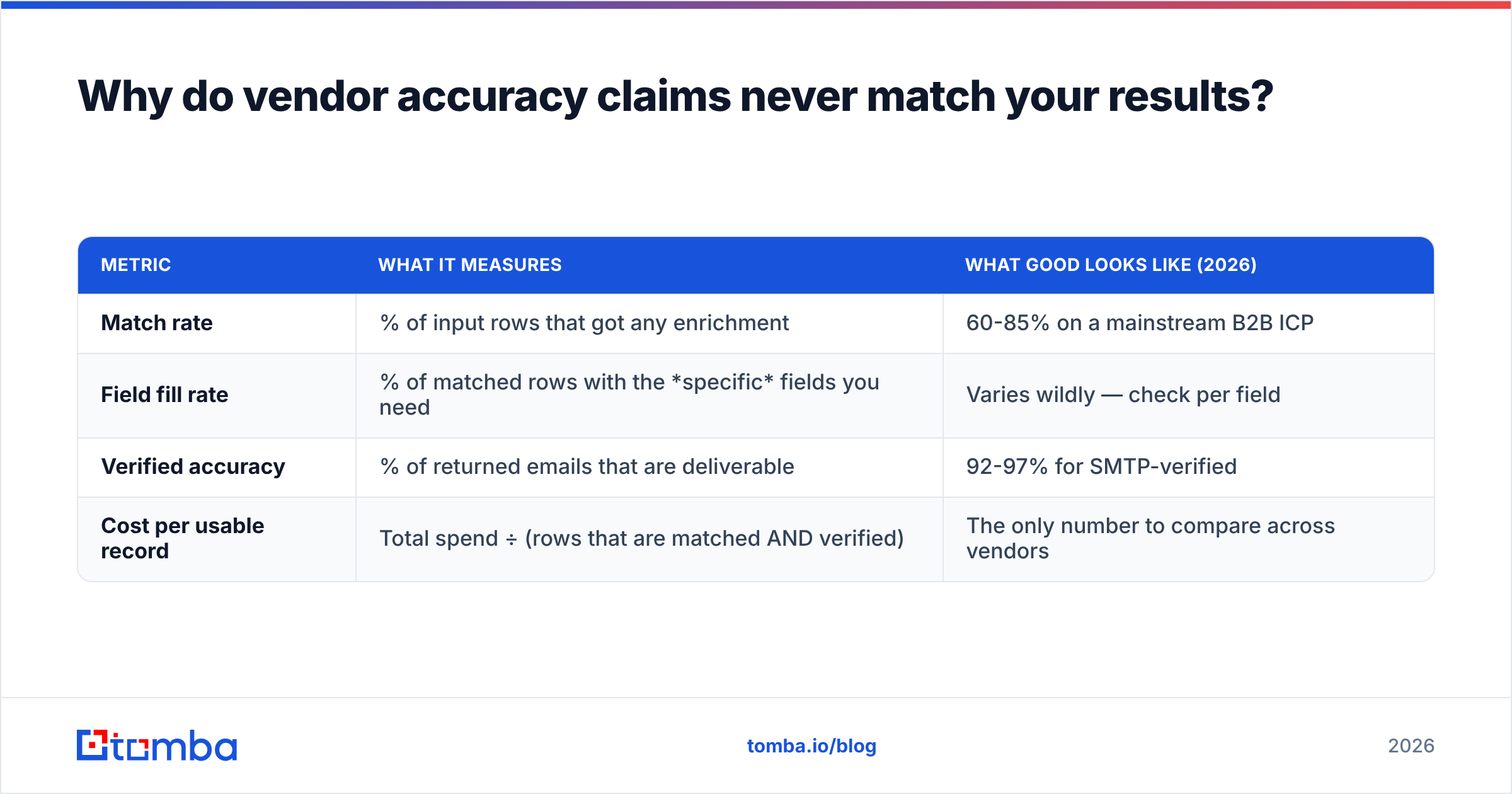
You should be measuring three numbers, always together:
| Metric | What it measures | What good looks like (2026) |
|---|---|---|
| Match rate | % of input rows that got any enrichment | 60-85% on a mainstream B2B ICP |
| Field fill rate | % of matched rows with the specific fields you need | Varies wildly — check per field |
| Verified accuracy | % of returned emails that are deliverable | 92-97% for SMTP-verified |
| Cost per usable record | Total spend ÷ (rows that are matched AND verified) | The only number to compare across vendors |
Run that last row and rankings invert constantly. A $0.02/credit tool with a 35% match rate costs $0.057 per usable record. A $0.04/credit tool at 80% costs $0.05 — cheaper, and you did a third as much list cleanup.

The second trap is catch-all domains. Roughly 15-20% of B2B domains accept mail to any address, so SMTP verification returns "unknown" rather than valid or invalid. Some vendors quietly count those as valid (inflating accuracy), some drop them (deflating match rate), and a few actually resolve them with pattern-confidence scoring. Ask directly how a vendor handles catch-alls; the answer tells you more about their engineering than any G2 badge. Tomba splits this out explicitly through its catch-all verifier, which is the behavior you want — an honest "unknown, 84% pattern confidence" beats a false "valid."
How do the major lead enrichment tools compare?#
Prices below are list prices as published by each vendor in 2026; enterprise deals vary. Verify before you budget.
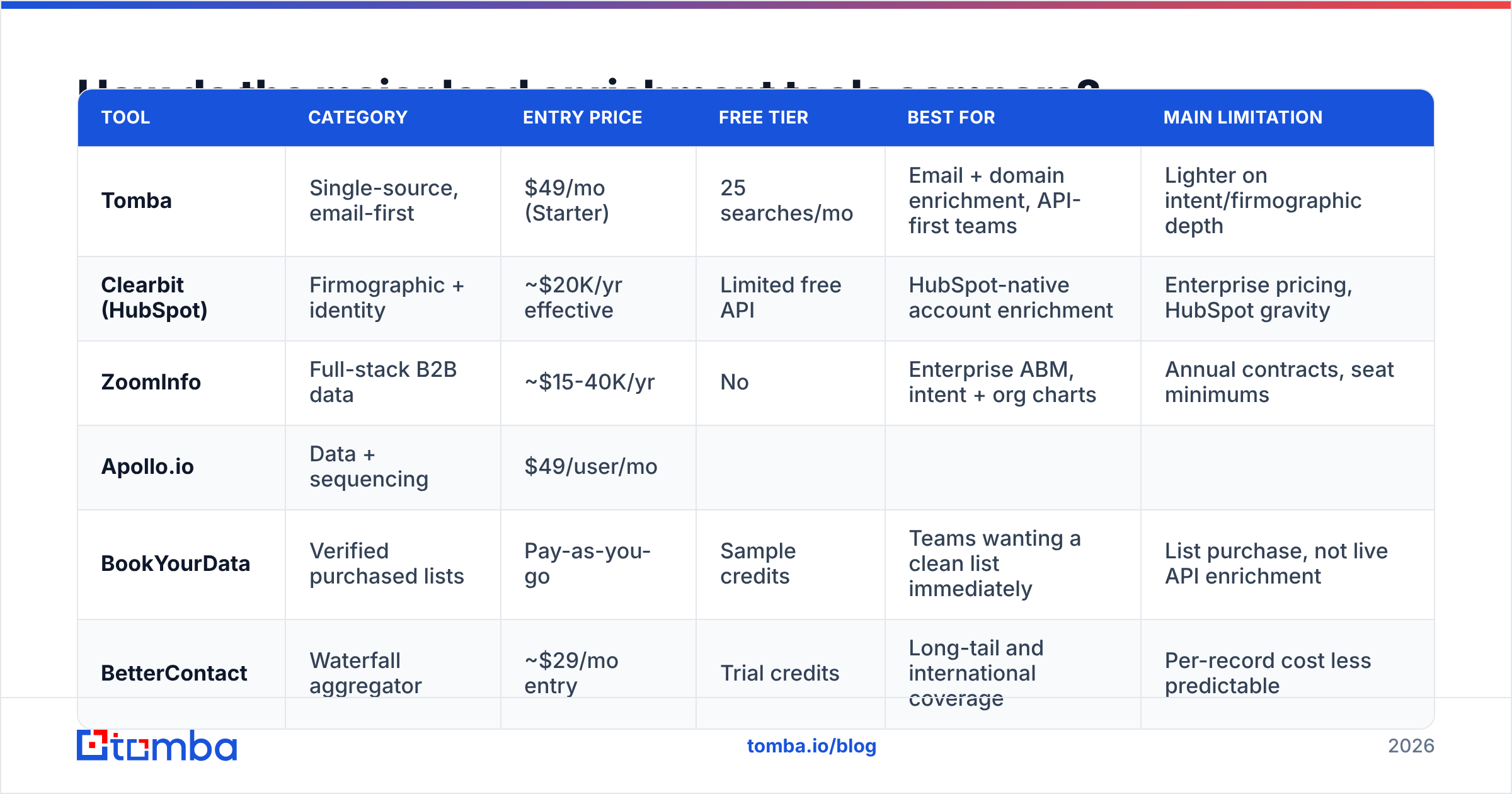
| Tool | Category | Entry price | Free tier | Best for | Main limitation |
|---|---|---|---|---|---|
| Tomba | Single-source, email-first | $49/mo (Starter) | 25 searches/mo | Email + domain enrichment, API-first teams | Lighter on intent/firmographic depth |
| Clearbit (HubSpot) | Firmographic + identity | ~$20K/yr effective | Limited free API | HubSpot-native account enrichment | Enterprise pricing, HubSpot gravity |
| ZoomInfo | Full-stack B2B data | ~$15-40K/yr | No | Enterprise ABM, intent + org charts | Annual contracts, seat minimums |
| Apollo.io | Data + sequencing | $49/user/mo | |||
| Yes, limited | All-in-one SMB outbound | Data quality varies by segment | |||
| BookYourData | Verified purchased lists | Pay-as-you-go | Sample credits | Teams wanting a clean list immediately | List purchase, not live API enrichment |
| --- | --- | --- | --- | --- | --- |
| BetterContact | Waterfall aggregator | ~$29/mo entry | Trial credits | Long-tail and international coverage | Per-record cost less predictable |
A few honest reads on this table.
Apollo and ZoomInfo are not really enrichment tools — they're databases with enrichment attached. You're buying access to their universe. That's great when your ICP sits inside it and painful when it doesn't. Check Apollo's own coverage claims against your ICP rather than against their total record count, and if the seat-based pricing doesn't fit, there's a reasonable case for an Apollo alternative on a credit model.
Clearbit's acquisition by HubSpot reshaped the mid-market. If you're on HubSpot, native enrichment is now hard to beat on integration friction. If you're not, you're paying for an ecosystem you don't use — the Clearbit alternative question is mostly a question about your CRM.
BookYourData occupies a spot most tools ignore. Not every team wants to build an enrichment pipeline. If you need 5,000 verified contacts in a defined segment by Friday, buying a hand-verified list is a legitimate, often faster answer than wiring up an API and a waterfall. Different motion, different risk profile — worth pricing both.
Waterfall tools are a coverage insurance policy. You pay a premium for the tail. If 90% of your list resolves on the first provider anyway, you funded an orchestration layer you didn't need.
What should you actually enrich?#
Enrichment scope creep is real. Teams enable every field, triple their cost, and use four.
Work backwards from the play:
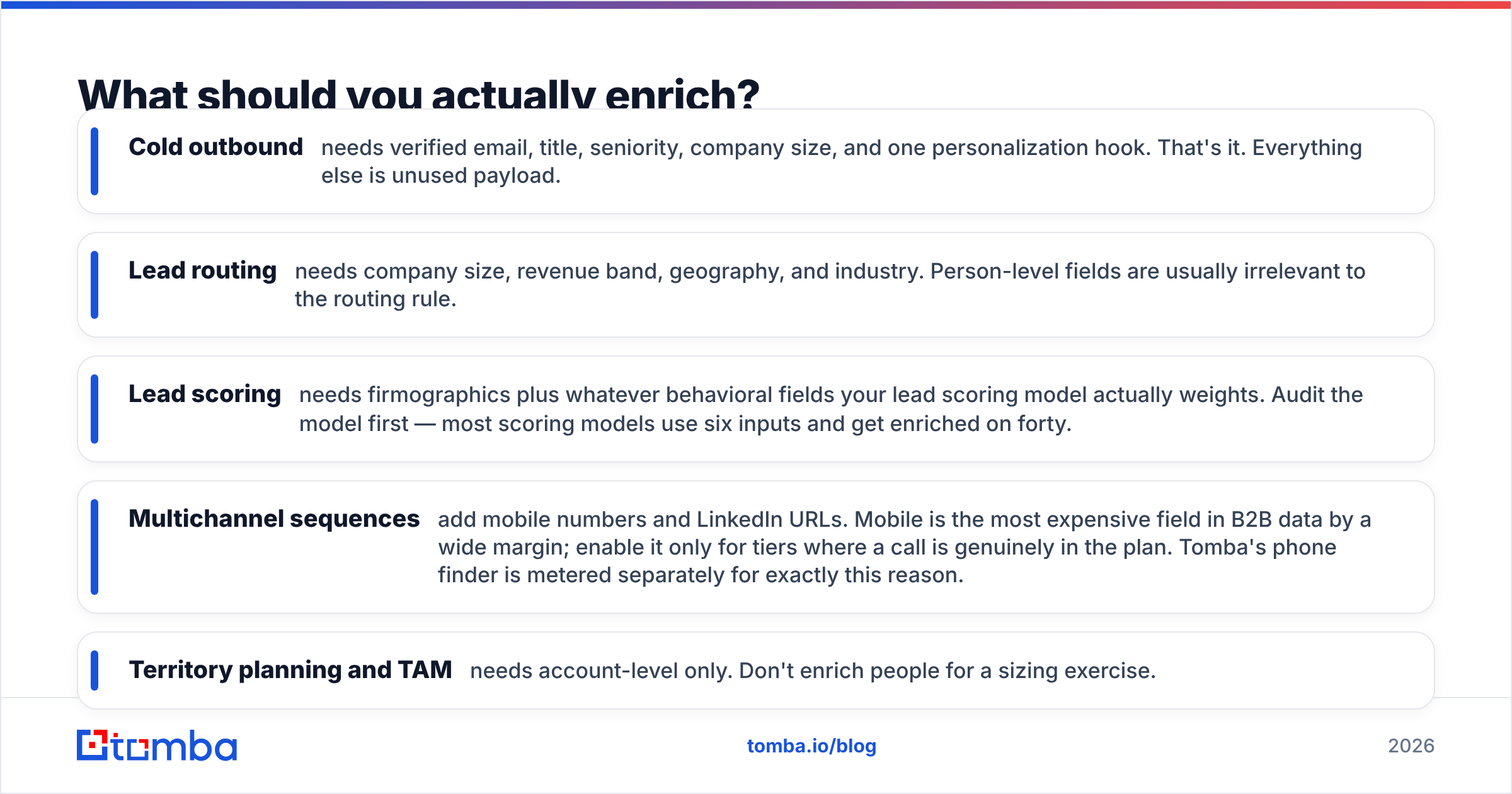
- Cold outbound needs verified email, title, seniority, company size, and one personalization hook. That's it. Everything else is unused payload.
- Lead routing needs company size, revenue band, geography, and industry. Person-level fields are usually irrelevant to the routing rule.
- Lead scoring needs firmographics plus whatever behavioral fields your lead scoring model actually weights. Audit the model first — most scoring models use six inputs and get enriched on forty.
- Multichannel sequences add mobile numbers and LinkedIn URLs. Mobile is the most expensive field in B2B data by a wide margin; enable it only for tiers where a call is genuinely in the plan. Tomba's phone finder is metered separately for exactly this reason.
- Territory planning and TAM needs account-level only. Don't enrich people for a sizing exercise.
The rule: every enriched field should map to a decision, a filter, or a sentence in an email. If it maps to none of those, you're paying to store it and to keep it accurate as it decays.
Speaking of decay — B2B contact data degrades at roughly 25-30% annually, and faster in volatile segments. Gartner's data quality research has been consistent on this for years. That means enrichment isn't a project. It's a subscription to the truth, and your re-enrichment cadence (quarterly for core accounts, at minimum) is as much a buying criterion as the initial match rate.
How do you run a bake-off that actually tells you something?#
This is the highest-leverage afternoon in the whole buying process, and most teams skip it.
Step 1 — build a control set. Take 500 rows from your real pipeline where you already know the correct answer: closed-won accounts, contacts you've emailed successfully, people whose titles you can verify on LinkedIn. Not a random sample of your TAM — a sample of your ICP with known ground truth.
Step 2 — hold out 50 known-bad rows. Bounced addresses, people who've changed jobs, dead domains. A vendor that confidently returns "valid" on your known-bad set is pattern-guessing, not verifying. This single test disqualifies more tools than any other.
Step 3 — run the same file through every finalist. Same columns, same order, same day. Most vendors will give you trial credits for this; if one won't, that's information too.
Step 4 — score four columns. Match rate, field fill for your top three required fields, verified accuracy against your control answers, and false-positive rate on the held-out bad rows.
Step 5 — compute cost per usable record. Total trial spend divided by rows that matched and verified and had your required fields. Compare that number, not the price page.

Step 6 — test the integration, not just the data. Can it write back to your CRM without a middleware tax? Is there a real API with sane rate limits, or a CSV upload pretending to be a product? Does it handle re-enrichment on a schedule, or does someone on your team own a recurring calendar reminder forever? A tool that scores 5 points lower on match rate but writes cleanly into HubSpot or Salesforce usually wins on total cost.
If you want the data-provenance question answered before you test, most credible vendors publish it — Tomba documents its data sources openly, and any vendor that won't explain where records come from in 2026 should worry you for compliance reasons alone.
What about GDPR, CCPA, and the compliance question?#
Short answer: the vendor's compliance posture becomes your compliance posture the moment you import their data.
Three things to verify in writing, not on a trust-badge page:
- Lawful basis for EU contacts. Legitimate interest is the standard basis for B2B outreach, but it requires the vendor to have a documented assessment and a functioning opt-out mechanism. Ask to see it.
- Source transparency. Publicly available business data, opt-in contributed data, and scraped consumer-adjacent data carry very different risk. "Proprietary sources" is not an answer.
- Deletion propagation. If someone opts out, does that flow back to the vendor, or do you re-enrich them into your CRM next quarter? This is the failure mode regulators actually notice.
Teams enriching EU or California contacts at volume should treat this as a gating criterion ahead of match rate. A tool with better coverage and murky provenance is a liability you've paid for.
What's changed in 2026?#
Three shifts worth pricing into a decision made this year.
Waterfall has commoditized. Orchestrating five providers used to be a moat; it's now a feature in half the tools on this list, and the marginal lift over a strong single source has narrowed. Pay the waterfall premium only if your bake-off proves the tail exists in your ICP.
AI-inferred fields are everywhere, and quality is bimodal. Inferred seniority and department mapping are genuinely reliable now. Inferred intent, "likely to buy" scores, and generated personalization hooks range from useful to fabricated. Test inferred fields against your control set with the same rigor as emails — and note that inferred fields often carry no verification at all.
Enrichment moved into the agent layer. More teams call enrichment from scripts, workflows, and LLM agents than from a UI. That makes API ergonomics — rate limits, latency, batch endpoints, a real MCP server — a primary buying criterion rather than a technical footnote. If your enrichment sits behind a login-only dashboard in 2026, it's already legacy.
Deliverability tightened again. Google and Microsoft's bulk-sender enforcement means an unverified list doesn't just waste credits — it damages sender reputation across every domain you send from. Enrichment and verification are now one workflow, not two purchases. Any tool that enriches without verifying is handing you a liability.
Which lead enrichment tool should you pick?#
Pick by constraint, not by feature count:
- Budget under $200/mo, email-first outbound: a single-source provider with transparent verification. Test Tomba, Findymail, Hunter.
- You need a clean list now, not a pipeline: a verified list provider like BookYourData. Faster to value, no engineering time.
- HubSpot-native, mid-market: Clearbit/Breeze native enrichment, unless the ecosystem lock-in bothers you.
- Enterprise ABM with intent: ZoomInfo or 6sense. Budget accordingly; these are six-figure motions at scale.
- Long-tail international ICP: a waterfall aggregator — but only after a bake-off proves the tail.
- Engineering-led, agent-driven pipeline: whichever vendor has the best API documentation and rate limits. That is a real differentiator, not a tiebreaker.
Where to start#
If your bottleneck is finding and verifying business emails at a price that survives an SMB budget — the situation most teams are actually in — start with the Tomba Email Finder. The free tier gives you 25 searches a month, which is enough to run a small control test before spending anything, and Starter is $49/mo with Growth at $99/mo when volume grows. Pair it with the email verifier so nothing reaches your sequencer unverified, and check Tomba pricing against the cost-per-usable-record number from your own bake-off rather than against anyone's landing page. Run the 500-row test first. The data will tell you which tool to buy far better than this article can.
Related guides#
// get started
Find, verify and enrich your first contacts today
Start on the free plan with 25 searches a month, then scale when your team is ready.
Free plan · No credit card required · GDPR & CCPA
// about the author