Lead Generation in 2026: The Complete B2B Playbook
Form fills are down, buying committees are up, and cold lists decay faster than ever. Here's how B2B lead generation actually works in 2026 — channels, costs, benchmarks, and the stack that holds it together.
TL;DR
- Lead generation in 2026 is less about volume and more about routing: the teams winning are the ones who identify intent early, enrich fast, and contact within minutes — not the ones scraping the biggest list.
- Inbound form fills keep falling as buyers self-educate in AI assistants, communities, and peer reviews. Treat the form as one capture point, not the funnel.
- B2B contact data decays roughly 25-30% per year. Whatever channel you pick, verification is a recurring cost, not a one-time purchase.
- Cost per qualified lead varies 10x across channels ($15 outbound email to $400+ paid search in competitive SaaS). Measure pipeline per dollar, not leads per dollar.
- A workable 2026 stack is narrow: one source of contact data, one verification layer, one sequencer, one CRM. Everything else is optional.
What is lead generation in 2026, and what changed?#
Lead generation is the process of turning an unknown person or account into a known, contactable, qualified opportunity. That definition hasn't changed. What changed is every assumption underneath it.
Three shifts matter most:
- Buyers research without touching you. A large share of B2B evaluation now happens in AI assistants, Slack communities, YouTube teardowns, and G2 category pages. By the time someone fills a form, they've often already shortlisted. Your "top of funnel" starts long before your analytics sees it.
- Buying committees grew. Most mid-market B2B deals involve six to ten people. Generating one lead at an account is now a starting point, not a win. The unit of lead generation is the account, and the job is mapping the rest of the committee.
- Gatekeeping got algorithmic. Google and Microsoft's 2024 bulk-sender rules made sloppy outbound genuinely expensive. Send to stale lists and you don't just get low replies — you burn the domain. Data quality moved from "nice to have" to "prerequisite."
The practical consequence: lead generation is now a data and routing problem more than a creative problem. Great copy on a bad list still fails. Mediocre copy on a verified, well-timed list still produces meetings.

Which lead generation channels actually work now?#
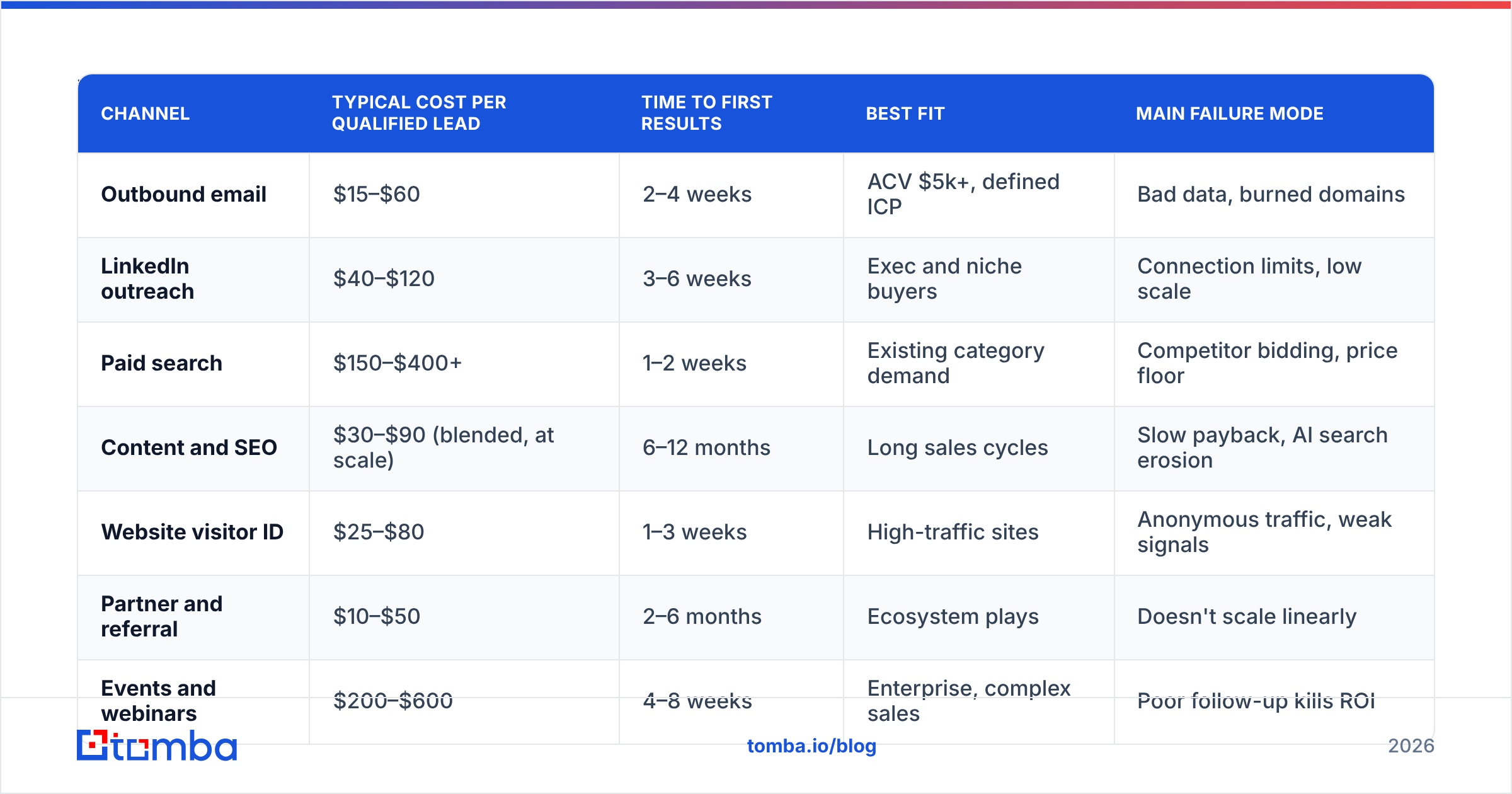
There is no universal ranking — it depends on ACV, sales cycle, and whether you sell to a searchable category. But the cost and behavior profiles are stable enough to plan against.
| Channel | Typical cost per qualified lead | Time to first results | Best fit | Main failure mode |
|---|---|---|---|---|
| Outbound email | $15–$60 | 2–4 weeks | ACV $5k+, defined ICP | Bad data, burned domains |
| LinkedIn outreach | $40–$120 | 3–6 weeks | Exec and niche buyers | Connection limits, low scale |
| Paid search | $150–$400+ | 1–2 weeks | Existing category demand | Competitor bidding, price floor |
| Content and SEO | $30–$90 (blended, at scale) | 6–12 months | Long sales cycles | Slow payback, AI search erosion |
| Website visitor ID | $25–$80 | 1–3 weeks | High-traffic sites | Anonymous traffic, weak signals |
| Partner and referral | $10–$50 | 2–6 months | Ecosystem plays | Doesn't scale linearly |
| Events and webinars | $200–$600 | 4–8 weeks | Enterprise, complex sales | Poor follow-up kills ROI |
| Cold calling | $80–$200 | 1–2 weeks | Urgent pain, SMB | Connect rates below 5% |
Two notes on reading this table. First, the ranges assume competent execution — a badly run outbound program costs infinitely more per qualified lead because it produces zero. Second, cheap channels are cheap partly because they're saturated; the differentiator inside outbound is no longer the channel, it's the targeting.
The highest-leverage move for most teams in 2026 is combining channels on the same account rather than running them in silos. An account that visited your pricing page, has a matching tech stack, and just posted a relevant role should get an email, a LinkedIn touch, and a call in the same week — sequenced, not scattered.
How do you build a lead generation system, step by step?#
Skip the funnel diagram. Here's the operational sequence that actually produces pipeline.
- Define the ICP in filters, not adjectives. "Mid-market SaaS companies that care about compliance" is not an ICP. "US/EU B2B SaaS, 50–500 employees, using Segment or Rudderstack, hiring for a security role in the last 90 days" is — because every clause maps to a filter you can query. If you can't turn your ICP into a query, you don't have one.
- Pick your trigger events. Static lists go stale. Trigger-based lists refresh themselves. Common high-signal triggers: new funding, leadership hires in the buying role, tech-stack changes, job postings that imply your problem, competitor mentions, and website visits. You want a reason to reach out this week, not a reason to exist in a spreadsheet.
- Source contacts for the whole committee. For each target account, find the economic buyer, the champion, and at least one user-level contact. A domain search across the company returns the pattern and the roster far faster than hunting profile by profile.
- Verify before you send. Every address goes through an email verifier before it enters a sequence. Catch-all domains get routed to a separate, lower-volume treatment rather than being dumped into the main send — they're the single biggest source of silent bounces.
- Enrich for personalization inputs. You need three things per contact: role context, account context, and a timing hook. Data enrichment that returns seniority, department, and firmographics gives your copy something concrete to reference beyond the company name.
- Route by speed, not by round-robin fairness. Inbound leads contacted within five minutes convert dramatically better than those contacted in an hour, and the gap has only widened as buyers evaluate multiple vendors in parallel. Build your routing rules around response latency first and territory fairness second.
Each step is boring in isolation. The compounding happens when all six run reliably every week instead of being rebuilt every quarter.
Why does data quality decide the outcome?#
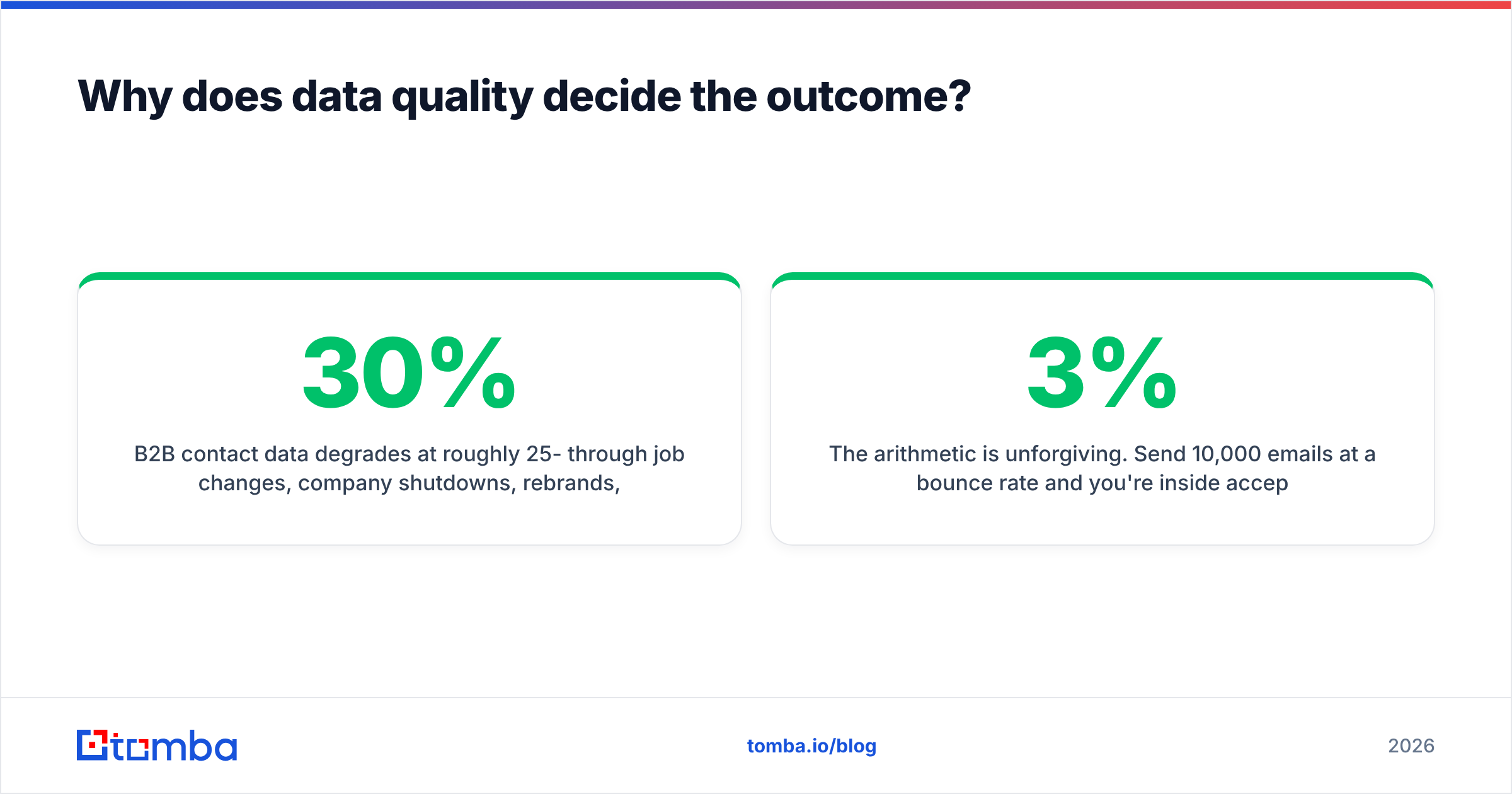
Because every downstream metric inherits it. Your open rate, bounce rate, reply rate, domain reputation, and rep morale are all functions of whether the addresses in your sequence belong to real, currently-employed humans in the right roles.
B2B contact data degrades at roughly 25-30% per year through job changes, company shutdowns, rebrands, and email policy changes. In a volatile hiring market that number skews higher for senior roles — precisely the contacts you care about most. A list you bought in January is meaningfully wrong by July.
The arithmetic is unforgiving. Send 10,000 emails at a 3% bounce rate and you're inside acceptable thresholds. Send the same 10,000 at 12% and mailbox providers start throttling you, your inbox placement drops for the valid addresses too, and your next three campaigns underperform for reasons that have nothing to do with their copy.

Practical rules that hold up:
- Re-verify anything older than 90 days. Not the whole database — just the segment you're about to contact.
- Treat catch-all domains as a separate class. They accept everything at the SMTP layer and tell you nothing. A dedicated catch-all verifier plus lower send volumes to those domains keeps them from poisoning your aggregate stats.
- Suppress aggressively. Unsubscribes, hard bounces, competitor domains, and existing customers should never re-enter a prospecting list. This is a one-time engineering task that saves years of embarrassment.
- Monitor sender reputation as a KPI. Check email deliverability signals weekly, not after a campaign fails.
Which lead generation tools should you actually pay for?#
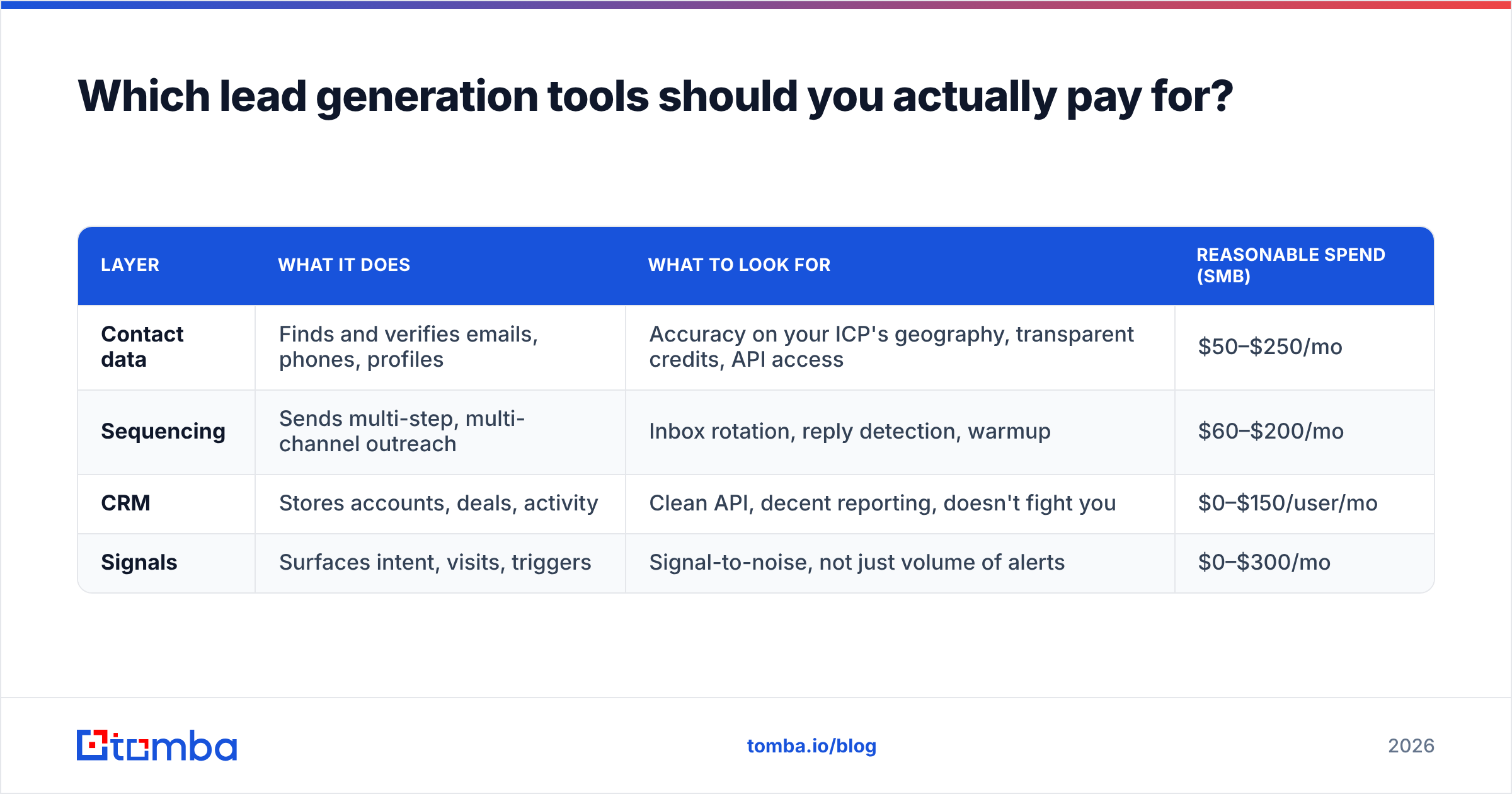
The tool sprawl problem is real. Most teams under 50 people need four categories, and buying more than that usually adds integration debt rather than pipeline.
| Layer | What it does | What to look for | Reasonable spend (SMB) |
|---|---|---|---|
| Contact data | Finds and verifies emails, phones, profiles | Accuracy on your ICP's geography, transparent credits, API access | $50–$250/mo |
| Sequencing | Sends multi-step, multi-channel outreach | Inbox rotation, reply detection, warmup | $60–$200/mo |
| CRM | Stores accounts, deals, activity | Clean API, decent reporting, doesn't fight you | $0–$150/user/mo |
| Signals | Surfaces intent, visits, triggers | Signal-to-noise, not just volume of alerts | $0–$300/mo |
On the contact-data layer specifically, the honest evaluation criterion is accuracy on your segment, not headline database size. A provider with 500M records that's weak in your target region is worse than one with 200M records that nails it. Test with 100 known contacts before committing.
A few reference points across the market:
- Tomba — email finder, verifier, domain search, catch-all handling, phone finder, and enrichment under one API. Tomba pricing runs a free tier at 25 searches/month, Starter at $49/mo, Growth at $99/mo, and Pro at $249/mo, with an Enterprise tier for volume. Strong fit if you want data and verification in the same place instead of stitching two vendors together.
- BookYourData — a pay-as-you-go B2B contact database with strong coverage and accuracy guarantees. Good option when you'd rather buy a defined list outright than run per-search lookups, and the credit model suits teams with lumpy, campaign-driven demand.
- Apollo — large database bundled with a sequencer. Convenient all-in-one; the tradeoff is that you're locked into their data quality for both jobs. See Apollo alternatives if the bundling is the problem.
- Clearbit/HubSpot Breeze — enrichment-first, now folded into the HubSpot ecosystem. Makes sense if you already live in HubSpot.

Accuracy claims in this category deserve skepticism from every vendor, including the ones above. The only number that matters is your own bounce rate on your own list after 30 days of sending. Run the test, keep the receipts.

How should you measure lead generation performance?#
Stop reporting leads. Report pipeline per dollar, by channel, with a lag window that matches your sales cycle.
The metrics worth tracking weekly:
- Qualified lead rate — what percentage of raw leads survive first-touch qualification. Below 20% means your targeting is broken, not your reps.
- Speed to first touch — median minutes from signal to contact. This is the cheapest conversion lever most teams ignore.
- Reply-to-meeting rate — how many replies become booked calls. If replies are high and meetings are low, your offer is wrong, not your list.
- Bounce rate by source — segmented by data provider. This tells you which vendor to renew.
- Cost per opportunity, 90-day lagged — the only channel comparison that survives scrutiny.
Two traps to avoid. First, the MQL as a terminal metric — a lead that marketing celebrates and sales ignores is a reporting artifact, not pipeline. Second, averaging across channels. Blended CAC hides the fact that one channel is subsidizing three broken ones.
Industry analysts including Gartner have been consistent on this point for several cycles: revenue teams that align on account-level pipeline metrics outperform those optimizing lead counts at the channel level. The reason is structural — lead counts reward volume, and volume is the one thing that's become cheapest and least differentiating.
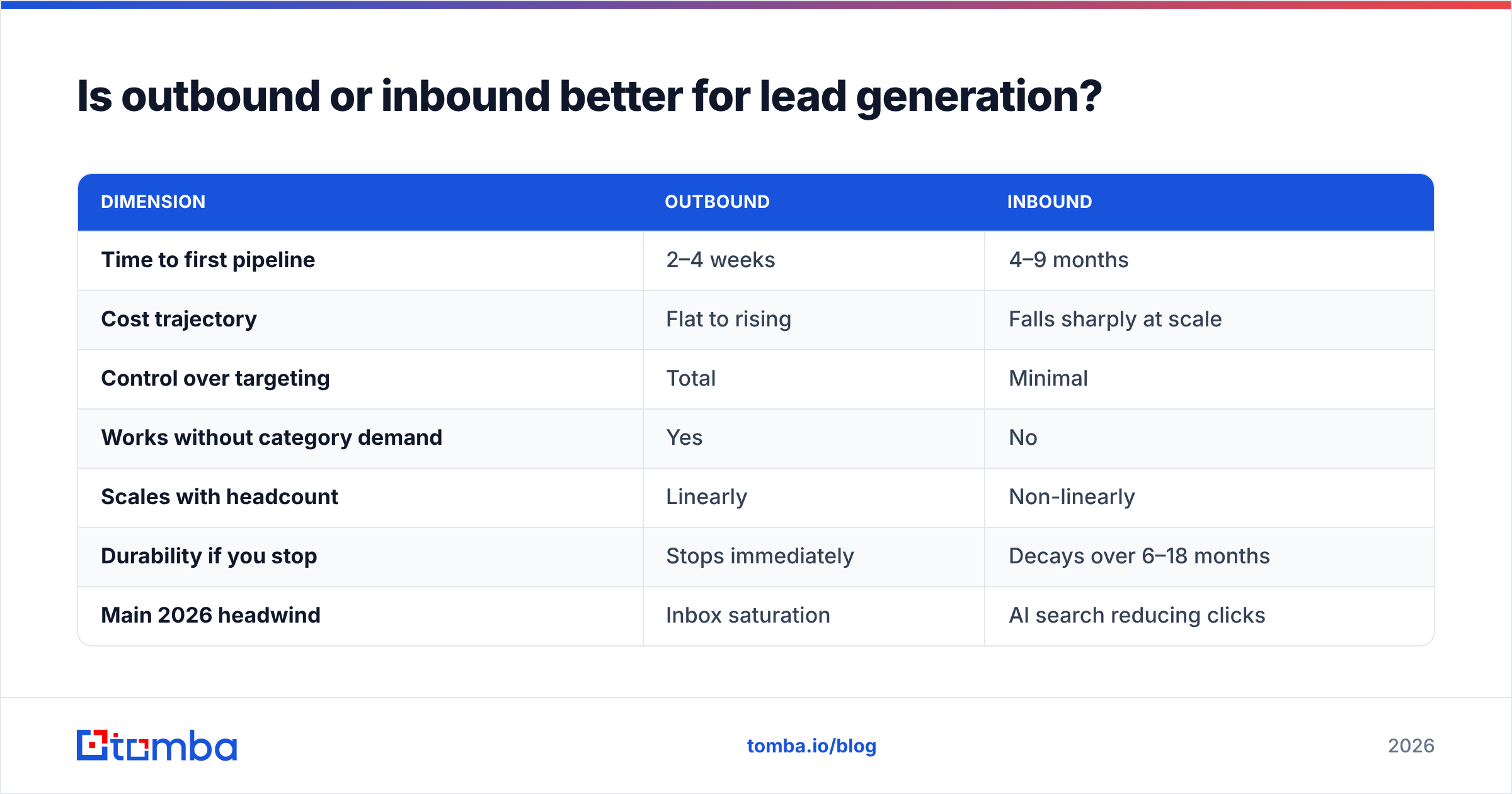
Is outbound or inbound better for lead generation?#
Neither. The question is which one your market structure supports, and most companies need both at different ratios.
| Dimension | Outbound | Inbound |
|---|---|---|
| Time to first pipeline | 2–4 weeks | 4–9 months |
| Cost trajectory | Flat to rising | Falls sharply at scale |
| Control over targeting | Total | Minimal |
| Works without category demand | Yes | No |
| Scales with headcount | Linearly | Non-linearly |
| Durability if you stop | Stops immediately | Decays over 6–18 months |
| Main 2026 headwind | Inbox saturation | AI search reducing clicks |
Use outbound when you know exactly who should buy and they don't know you exist yet — new categories, displacement plays, and narrow ICPs. Use inbound when people are already searching for what you sell and you can credibly rank or get cited.
The blended approach that works: let inbound define your best-fit segments through closed-won analysis, then use outbound to go find every other company that matches that profile. Your inbound is your research function; your outbound is your distribution function.
What does a realistic 90-day plan look like?#
For a team starting close to zero:
Days 1–30 — foundation. Write the ICP as a query. Build a target list of 500 accounts. Set up domain authentication (SPF, DKIM, DMARC) and start mailbox warmup. Source and verify contacts for 200 of those accounts. Do not send yet.
Days 31–60 — first sends. Run a 4-step sequence to 200 verified contacts across two or three mailboxes at conservative volume. Track bounce rate obsessively for the first week — anything over 4% means stop and re-verify. Book meetings, record objections, rewrite based on what actually gets replies.
Days 61–90 — expand what worked. Kill the underperforming segment. Double the volume on the winning one. Layer in a second channel (LinkedIn or phone) on accounts that opened but didn't reply. Start the content engine in parallel, knowing it won't pay back inside the quarter.
The most common failure in this plan is skipping the warmup and verification in month one because it feels like it isn't producing anything. It is. It's producing the deliverability that makes months two and three possible.
Where should you start this week?#
Pick one thing: audit the accuracy of the contact data you're already sending to. Export the last 1,000 addresses you emailed, run them through verification, and look at how many are invalid, catch-all, or role-based. Most teams discover 15-25% of their "active" list shouldn't be receiving mail at all. Fixing that costs nothing in new spend and immediately lifts every metric downstream.
When you're ready to build the list properly, the Tomba Email Finder gets you verified, role-matched contacts by domain, name, or company — with verification, catch-all handling, and enrichment in the same workflow, so your sequence starts from clean data instead of hope. The free tier gives you 25 searches a month to test accuracy on your own ICP before you spend anything, and Starter at $49/mo covers most early outbound programs. Test it against your known-good contacts first. That's the only benchmark that counts.
Related guides#
Ready to find emails that actually work?
Join 150,000+ professionals who stopped guessing and started sending. Free credits on signup — no credit card required.
Get the Tomba newsletter
Practical outbound tactics and product updates — once every two weeks.
About the author