Lead Generation Digital Agency: The 2026 Playbook
Referrals dried up, paid ads got expensive, and your agency still needs 8 qualified calls a month. Here's the channel-by-channel math on what actually fills an agency pipeline in 2026.
TL;DR
- Most agencies do not have a lead problem — they have a concentration problem. One channel (usually referrals) produces 70%+ of pipeline, and when it dips, revenue dips a quarter later.
- The three channels that still reliably book agency sales calls in 2026: targeted outbound to a narrow ICP, partner/white-label referral loops, and bottom-of-funnel content that ranks for "[service] agency for [niche]".
- Cost per booked meeting ranges from roughly $40 (warm partner referral) to $600+ (paid search on competitive agency terms). Know your number before you pick a channel.
- Outbound only works when the list is right. A 12% bounce rate on a cold list will torch your sending domain before you ever learn whether the offer works.
- Pick two channels, run them for 90 days with real volume, and kill anything that can't produce a meeting under your allowable CAC.
Why is lead generation digital agency work so hard?#
Because you sell an invisible, high-trust service. And your buyer has probably been burned before.
Think of it like hiring a contractor to redo your kitchen. Nobody picks on price alone. They ask three friends. They look at photos of finished jobs. And they quietly assume half the bids come from people who will vanish mid-job. B2B services buyers act the same way. That is why agency lead generation works nothing like SaaS lead generation:
- The buying trigger is event-driven, not need-driven. Nobody wakes up wanting a new SEO retainer. They wake up after a bad quarter, a new CMO, a failed in-house hire, or a funding round.
- Your differentiation is unprovable on a landing page. Everyone says "data-driven," "senior team," "no junior work." The claim is free, so it carries no signal.
- Deal sizes justify human outreach. A $6,000/month retainer that lasts 14 months is about $84,000 in revenue. You can afford a lot of manual prospecting per deal. Most agencies spend far too little here.
- Referrals feel free, so nobody builds a system. Until they stop.
- Your own marketing is the last thing that gets staffed. The cobbler's children problem is the top cause of agency revenue cliffs.
So the product playbook (content → free trial → PLG) mostly does not transfer. You need channels that start a conversation, not a signup.

What are the real lead generation channels for agencies in 2026?#
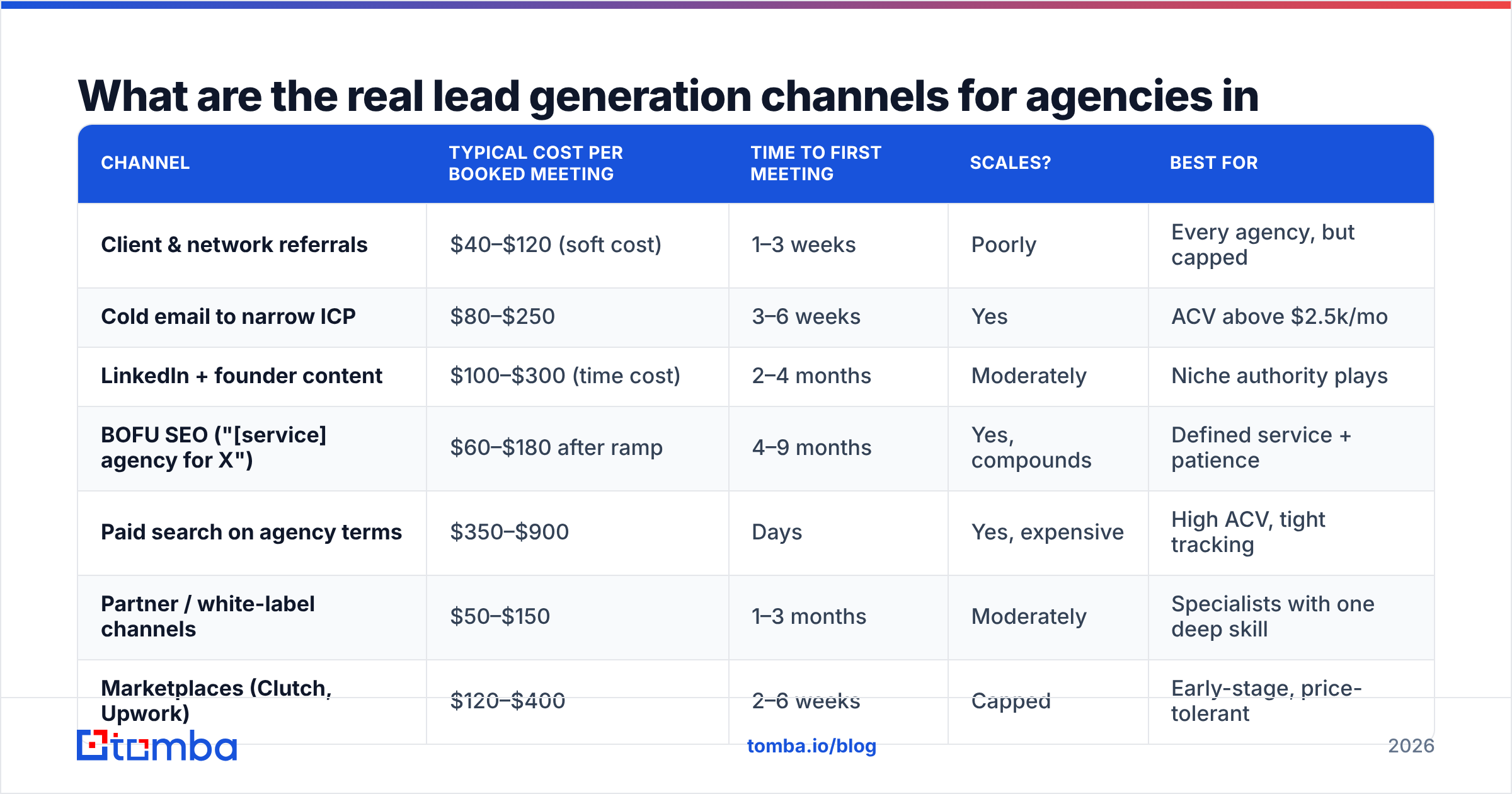
Here is the honest comparison of lead generation digital agency channels. The ranges below come from agency operators and from public data at G2 and HubSpot. Your own numbers will shift with niche and deal size.
| Channel | Typical cost per booked meeting | Time to first meeting | Scales? | Best for |
|---|---|---|---|---|
| Client & network referrals | $40–$120 (soft cost) | 1–3 weeks | Poorly | Every agency, but capped |
| Cold email to narrow ICP | $80–$250 | 3–6 weeks | Yes | ACV above $2.5k/mo |
| LinkedIn + founder content | $100–$300 (time cost) | 2–4 months | Moderately | Niche authority plays |
| BOFU SEO ("[service] agency for X") | $60–$180 after ramp | 4–9 months | Yes, compounds | Defined service + patience |
| Paid search on agency terms | $350–$900 | Days | Yes, expensive | High ACV, tight tracking |
| Partner / white-label channels | $50–$150 | 1–3 months | Moderately | Specialists with one deep skill |
| Marketplaces (Clutch, Upwork) | $120–$400 | 2–6 weeks | Capped | Early-stage, price-tolerant |
| Events & communities | $200–$700 | 1–2 quarters | Poorly | Enterprise ACV, regional plays |
Two readings of that table matter more than the raw numbers.
First, the cheapest channels don't scale and the scalable channels aren't cheap. Referrals give the best cost per meeting you will ever get. You just cannot 3x them on demand. Outbound and BOFU SEO scale, but they need clean lists or six months of runway. A healthy agency runs one of each.
Second, time-to-first-meeting varies by 20x across the table. Need pipeline this quarter? SEO is not the answer, however good the long-term ROI looks. Match the channel to your cash position, not your taste.
How do you build an outbound engine that doesn't get you blacklisted?#
Start with the list, not the copy. Most failed agency outbound programs failed at the data layer. The owner blamed the messaging.
The sequence that works:
1. Define an ICP narrow enough to name 200 companies. "B2B SaaS" is not an ICP. "Series A–B vertical SaaS companies in North America, 30–150 employees, with a marketing team of 2–6 and no in-house SEO lead" is. A narrow ICP lets you write one email that lands for the whole list. That is the entire economics of cold outreach.
2. Build the account list before the contact list. Pull companies by firmographics and technology signals first. If you sell Shopify Plus development, filter on who actually runs Shopify Plus. A website tech stack checker turns "companies that might need us" into "companies we can prove need us."
3. Find the right human, then the email. For a 60-person company, the buyer is usually the Head of Marketing or the founder — not the CMO title you wish existed. Once you know the domain and the name, a domain search returns the company's email pattern and known contacts, and an email finder resolves a specific person.
4. Verify before you send. Always. Agencies skip this step and then spend three months in recovery. Bounce rates above 3% tell mailbox providers you bought a scraped list. Your sender reputation then drops fast, including for the client mail you send from the same domain. Run every list through an email verifier, and send from a separate domain (yourname-agency.com, not youragency.com).
5. Send 40–60 per mailbox per day, not 500. Volume comes from more mailboxes, never from more sends per mailbox.
6. Write the email like a specialist, not a vendor. One structure still works in 2026. One sharp note about their business. One result you got for a company like theirs. One small ask. Under 90 words. No calendar link in email one.
A working example, adapted:
Subject: your pricing page vs. Vendasta's
Noticed your pricing page loads at 4.1s on mobile — Vendasta's is at 1.3s and they're outranking you for "white label reporting."
We rebuilt the front end for [similar company] and their demo requests went from 31 to 74/month in one quarter. Same stack you're on.
Worth me sending over the two-page teardown of your page? No call needed.
That works because you cannot fake it. Someone had to look. Generic tokens ({{first_name}}, I loved your post) now read as spam to any buyer who has seen a few.
How much data quality actually matters for agency outbound#
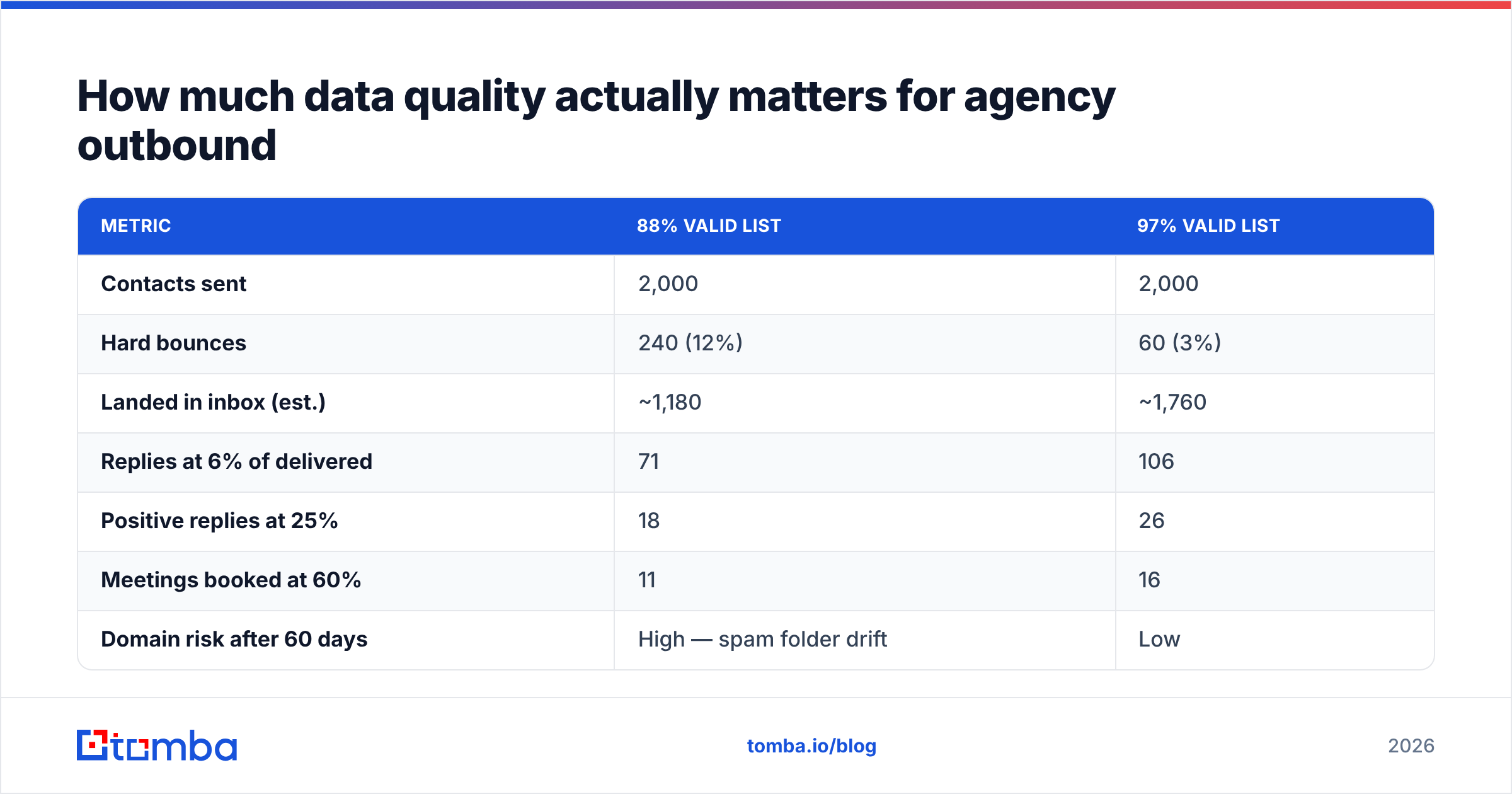
Enough that it's worth putting a number on it. Run the same 2,000-contact campaign at two data quality levels:
| Metric | 88% valid list | 97% valid list |
|---|---|---|
| Contacts sent | 2,000 | 2,000 |
| Hard bounces | 240 (12%) | 60 (3%) |
| Landed in inbox (est.) | ~1,180 | ~1,760 |
| Replies at 6% of delivered | 71 | 106 |
| Positive replies at 25% | 18 | 26 |
| Meetings booked at 60% | 11 | 16 |
| Domain risk after 60 days | High — spam folder drift | Low |
Same copy. Same offer. A 45% difference in meetings, plus one of those two scenarios quietly destroys the domain you also use to email clients.
So the data vendor is not a commodity buy for an agency. The options split into three groups: prepaid lists, real-time finders and verifiers, and all-in-one sales platforms.
| Prepaid list vendors | Real-time finder + verifier | All-in-one sales platform | |
|---|---|---|---|
| Example type | BookYourData, niche list brokers | Tomba, Findymail | Apollo, ZoomInfo |
| Pricing model | Per-record, one-time | Monthly credits ($49–$249) | Seat + credits, often $1k+/yr |
| Data freshness | Snapshot at purchase | Verified at request time | Varies by module |
| Best when | You want a defined list, delivered now | You prospect continuously | You also need dialer + sequencer |
| Agency fit | Good for one-off campaigns and fast starts | Good for ongoing, narrow ICP work | Good for 5+ SDR teams |
| Lock-in | None | Low, monthly | High, annual contracts |
There is no single right answer here. Need 3,000 verified contacts next week, with the filters already decided? A list vendor like BookYourData is a clean, fast path. You buy the records and you are done. Do you prospect every week as targets change? A credit-based finder fits better. Tomba pricing starts free at 25 searches a month, then $49/mo for Starter and $99/mo for Growth. The same credits cover finding, verifying, and enriching. Running a real SDR team with dialers and sequences? The all-in-one platforms earn their cost.
Most agencies under 20 people land on the middle option. The work never stops, and the volumes stay modest.

What kind of content actually generates agency leads?#
Not thought leadership. Not "10 Digital Marketing Trends for 2026."
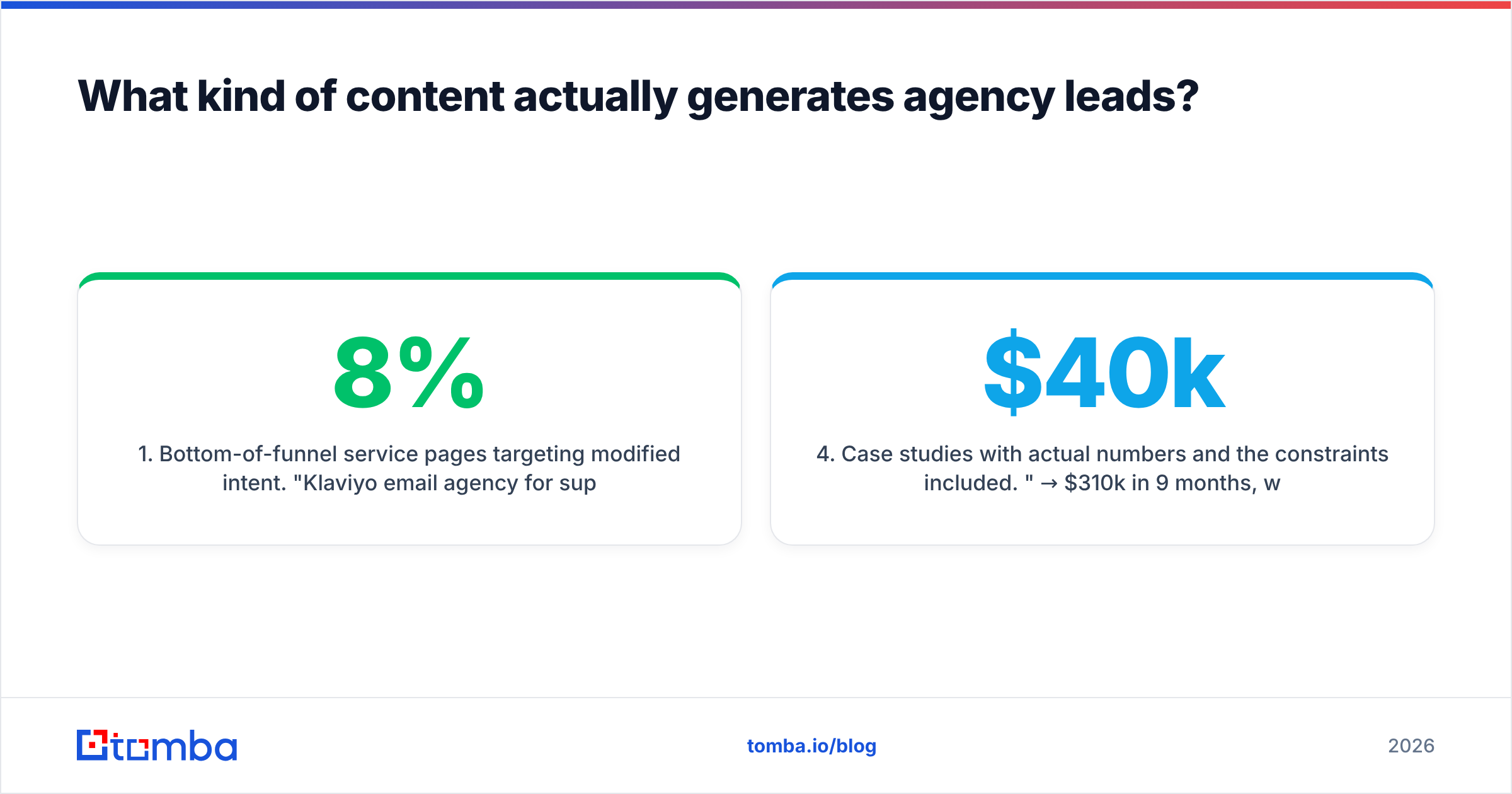
Agency content that produces inbound leads falls into four buckets, ranked by conversion rate:
Two you can ship this month#
- Bottom-of-funnel service pages targeting modified intent. "Klaviyo email agency for supplement brands" converts at 4–8%. "Email marketing tips" converts at 0.2%. Build one page per service × niche combination you can honestly serve. Ten of these beat 100 blog posts.
- Teardowns and audits of real companies. Publish a genuine, specific critique of a named brand's funnel. Two things happen: the brand often replies, and every similar brand recognizes itself in the analysis. It is the highest-leverage format for agencies. Almost nobody does it, because it takes real work.
Two that compound#
- Proprietary benchmark data. If you manage 40 accounts, you are sitting on data nobody else has. "Average CAC across 40 DTC brands in Q2 2026" earns links and gets cited. You cannot buy this advantage; you can only publish it.
- Case studies with actual numbers and the constraints included. "$40k → $310k in 9 months, with a $12k/mo ad budget and no brand recognition" outperforms "we drove significant growth." Include what didn't work. Buyers read skepticism as honesty.
Pair content with two habits. First, capture the traffic you already have. A website visitor reveal tool shows which companies read your service pages without filling in a form. That is a far warmer list than anything cold. Second, build the relationships that get you cited. An author finder gets you the email of the writer covering your niche. That is how digital PR works once you strip away the jargon.
One more thing, plainly. Google's 2025–2026 AI Overview rollout cut traffic to informational queries in most categories. Top-of-funnel posts that once drove agency awareness now get summed up above the fold. Commercial pages ("agency for X," "X agency pricing," "best X agency") held up far better. The searcher there wants a vendor, not an answer. Budget your content that way.
How do you systematize referrals instead of hoping for them?#
Treat referrals like a channel with inputs, not like weather.
Ask better#
- Ask at the peak, not at the end. The best moment to ask is right when a client sees a result they care about. Most agencies ask at renewal instead. That is the lowest-trust moment, because money is on the table.
- Make the ask specific. "Do you know anyone who needs marketing?" produces nothing. "Do you know another head of growth at a Series A fintech dealing with the same attribution mess?" produces a name.
- Build a partner list deliberately. Your best sources are nearby agencies that do not compete: the design shop with no paid team, the dev shop with no writers. Map 30 of them. Find the owner's contact. Make the first call about sending them work.
Then track it like a channel#
- Instrument it. Track referral source on every deal in your CRM. You will find that 3 people drive most of your referral revenue. Then you know exactly who to take to dinner.
- Close the loop visibly. Tell the referrer what happened. People refer again when they learn the last one landed well; silence reads as failure.
What does a realistic 90-day agency lead gen plan look like?#
Pick two channels for your lead generation digital agency plan. One fast, one compounding.
Days 1–15 — Foundation. Write the ICP in one sentence with three quantified filters. Build the account list (aim for 300–500 companies). Set up two sending domains with SPF, DKIM, and DMARC configured — check yours with an SPF checker before you send anything. Warm the mailboxes.
Days 16–30 — Assets. Build one BOFU page per priority service-niche pair. Write three outbound sequences with genuinely different angles (not three variations of the same angle). Produce one teardown of a real, named company in your target niche.
Days 31–60 — Volume. Send at 40–60/mailbox/day. Target 1,200–2,000 first-touch contacts in the window. Publish weekly. Book every meeting you can, including the unqualified ones — early on, conversation volume teaches you more than conversion rate does.
Days 61–90 — Cut and double. By day 60 you will have enough data to see which sequence, which niche, and which offer produced replies. Kill the rest. Reallocate all outbound volume to the winning segment. Expect the winner to be narrower than you expected.
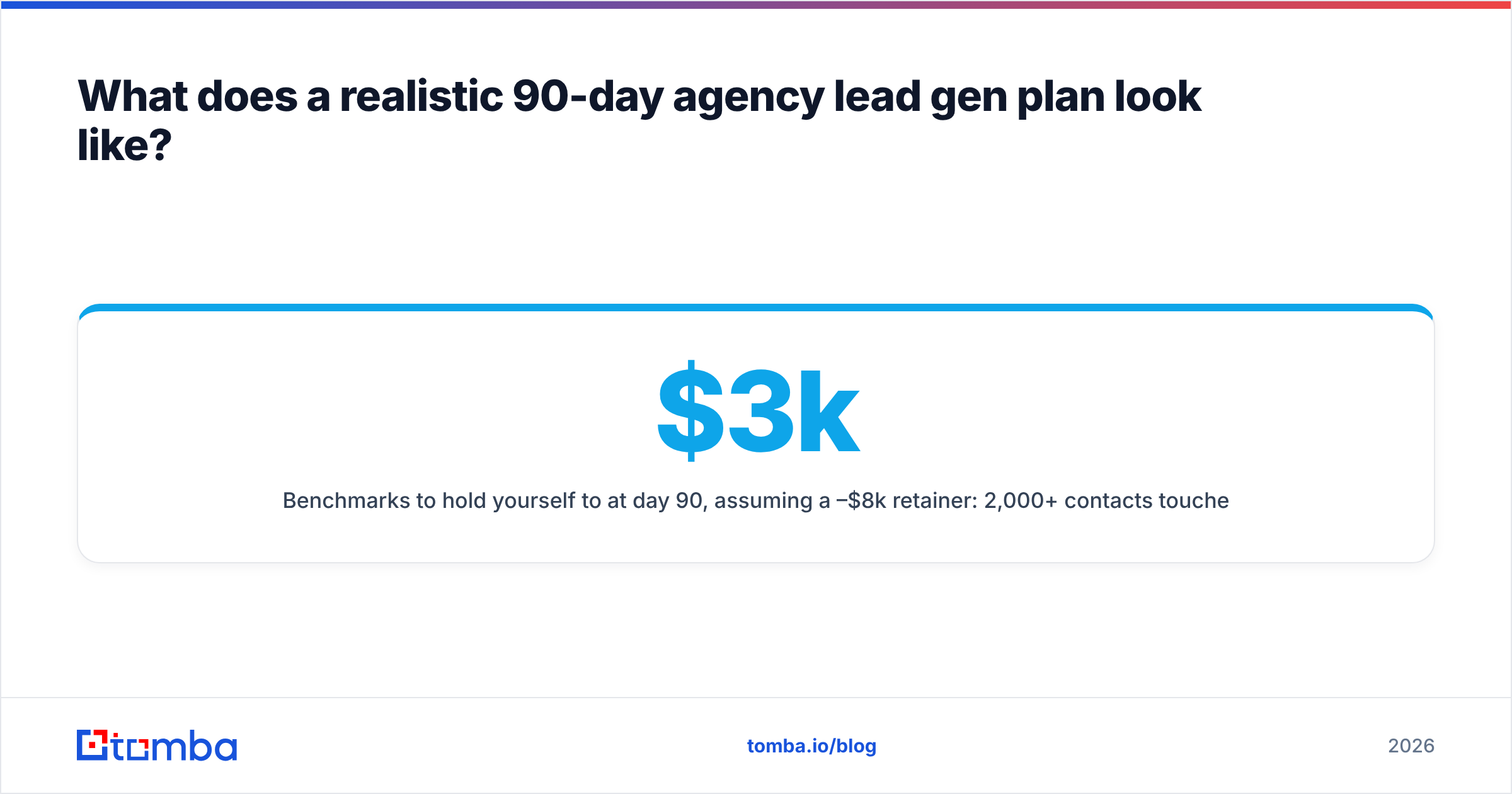
Hold yourself to these day-90 marks on a $3k–$8k/mo retainer: 2,000+ contacts touched, 4–8% reply rate, 12–25 booked meetings, 3–6 proposals, 1–3 closed. Well below that on replies? The problem is the list or the ICP, not the copy. Replies fine but no meetings? The problem is the ask. Meetings fine but no closes? The problem is the offer or the price.
What should you stop doing?#
- Stop buying leads from aggregators that sell the same "form fill" to five agencies. You are in a price race you cannot win.
- Stop sending 200 emails a day from one mailbox. You will be in spam by week three, and you will blame the copy.
- Stop publishing generic top-of-funnel blog content hoping it builds authority. In 2026 it mostly feeds AI summaries.
- Stop running paid search on "digital marketing agency" unless your ACV exceeds $50k. Those clicks are bid up by agencies with far more budget than you.
- Stop treating every inbound as equal. Score them. A marketing qualified lead from a 12-person startup and one from a 400-person manufacturer deserve different response paths.
Ready to build the list?#
Channel choice matters less than the data underneath it. Every lead generation digital agency plan ends at the same question. Do you have a verified, current email for the one person who can say yes?
Start with the Tomba Email Finder. Find and verify contacts at your target accounts by domain, name, or company. The free tier covers 25 searches a month, so you can test your ICP before you spend. Build 200 verified contacts in your narrowest niche. Send a genuinely specific email and see what comes back. That is a real channel test, and you can run it this week.
Related guides#
// get started
Find, verify and enrich your first contacts today
Start on the free plan with 25 searches a month, then scale when your team is ready.
Free plan · No credit card required · GDPR & CCPA
// about the author