Lead Generation for Accountants: The 2026 Playbook
Referrals dry up. Here's how accounting firms actually build a predictable pipeline in 2026 — channel-by-channel economics, compliance limits, and the data stack that makes outbound work.
TL;DR
- Referrals still close the highest percentage of accounting engagements, but they cap out — you cannot forecast a channel you do not control.
- The three channels that actually scale for firms in 2026: local/intent SEO, targeted outbound to a narrow niche, and partner/referral systematization. Paid search works but only for high-ticket advisory.
- Cost per acquired client varies 8x across channels. Outbound to a defined niche runs roughly $180–$600 per client; broad paid search can exceed $2,000 for tax prep.
- Compliance is the constraint most guides skip: AICPA solicitation rules, CAN-SPAM, CASL, and GDPR all shape what your outreach can look like.
- Bad contact data is the silent pipeline killer. If 25% of your list bounces, your domain reputation collapses before your offer ever gets read.
Why Is Lead Generation for Accountants Harder Than for Most B2B Services?#
Accounting sells trust, not software. That changes the math on every channel.
A SaaS company can run a free trial and let the product do the convincing. You cannot. A prospective client is handing you their payroll, their tax exposure, and in many cases their personal financial life. The decision cycle is long, the switching cost feels enormous to them, and the trigger events are seasonal and specific — a funding round, an acquisition, a botched filing, a CFO departure, a January 1 fiscal reset.
Three structural realities shape everything below:
- Trust is the bottleneck, not awareness. Most business owners can name five accounting firms. They switch because of a specific failure or a specific new need, not because they saw an ad.
- The buying window is narrow and recurring. Q4 and Q1 dominate for tax; fiscal year-end drives audit; funding events drive CFO-advisory demand. Miss the window and you wait twelve months.
- Your regulator has opinions about marketing. The AICPA Code of Professional Conduct prohibits solicitation "by the use of coercion, over-reaching, or harassing conduct," and state boards layer their own rules on top. Aggressive tactics that work for an agency will get a CPA firm a complaint.

The firms that build predictable pipeline treat lead generation as an operating system with three layers: a demand-capture layer (people already searching), a demand-creation layer (people who should be searching but aren't yet), and a data layer that connects the two. Most firms build the first, ignore the second, and skip the third entirely.
What Are the Real Channels, and What Do They Actually Cost?#
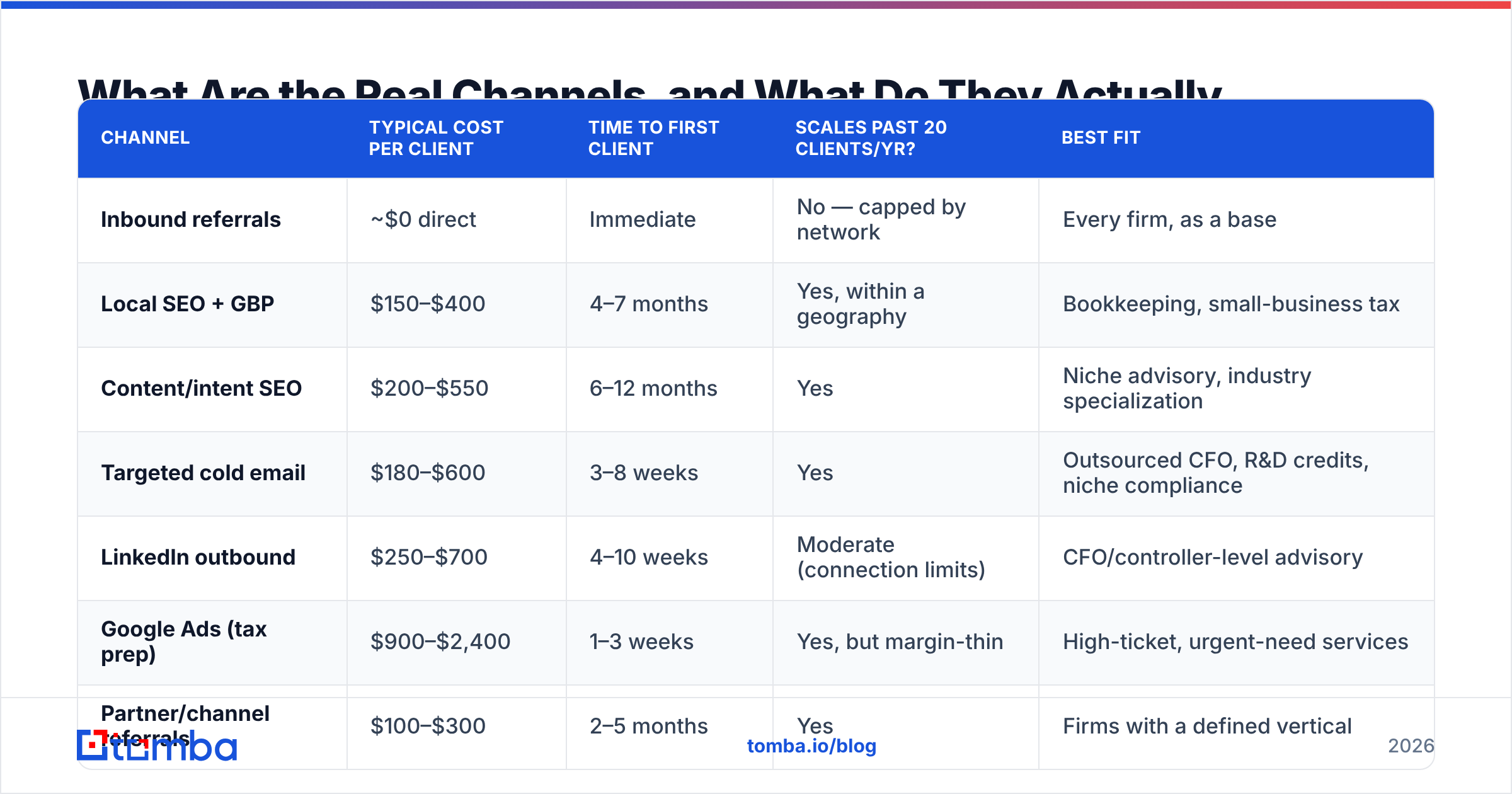
Below is the channel economics table most firms wish they had before spending a year on the wrong one. Figures reflect typical small-to-midsize firm benchmarks in 2026 for a $6,000–$25,000 annual engagement value.
| Channel | Typical cost per client | Time to first client | Scales past 20 clients/yr? | Best fit |
|---|---|---|---|---|
| Inbound referrals | ~$0 direct | Immediate | No — capped by network | Every firm, as a base |
| Local SEO + GBP | $150–$400 | 4–7 months | Yes, within a geography | Bookkeeping, small-business tax |
| Content/intent SEO | $200–$550 | 6–12 months | Yes | Niche advisory, industry specialization |
| Targeted cold email | $180–$600 | 3–8 weeks | Yes | Outsourced CFO, R&D credits, niche compliance |
| LinkedIn outbound | $250–$700 | 4–10 weeks | Moderate (connection limits) | CFO/controller-level advisory |
| Google Ads (tax prep) | $900–$2,400 | 1–3 weeks | Yes, but margin-thin | High-ticket, urgent-need services |
| Partner/channel referrals | $100–$300 | 2–5 months | Yes | Firms with a defined vertical |
| Directories (Clutch, Upwork) | $400–$1,100 | 2–6 weeks | No — price-competitive | Newer firms filling capacity |
Two things jump out. First, cold outbound to a narrow niche is the cheapest scalable channel — but only when "narrow" is real. "SMBs in Texas" is not a niche. "Series A SaaS companies in Austin that just hired their first controller" is.
Second, paid search is the most expensive path for commodity services and the fastest path for urgent ones. If someone googles "IRS audit representation near me," they will hire this week. If they google "accountant near me," they are comparison shopping on price.
How Do You Pick a Niche That Makes Outbound Economically Viable?#
Pick the niche where your existing clients cluster, then check three numbers.
Most firms already have an accidental niche — a handful of dental practices, three construction contractors, a cluster of ecommerce brands. That is your starting point, because you already have case studies, the vocabulary, and the specific pain points.
Then validate:
- Market size — At least 2,000 addressable companies. Fewer than that and you exhaust the list in two quarters. More than 50,000 and your messaging is probably too generic.
- Engagement value — The average annual fee must exceed roughly 10x your fully-loaded cost per acquired client. At $400 CAC you need engagements above $4,000/year to justify the motion.
- Identifiable trigger — There must be an observable event that signals need: a funding announcement, a headcount threshold, an ERP migration, a new-entity filing, an international expansion.
If you cannot name the trigger, you cannot time the outreach, and untimed outreach is just noise.
What Does a Compliant Outbound Motion Look Like in 2026?#
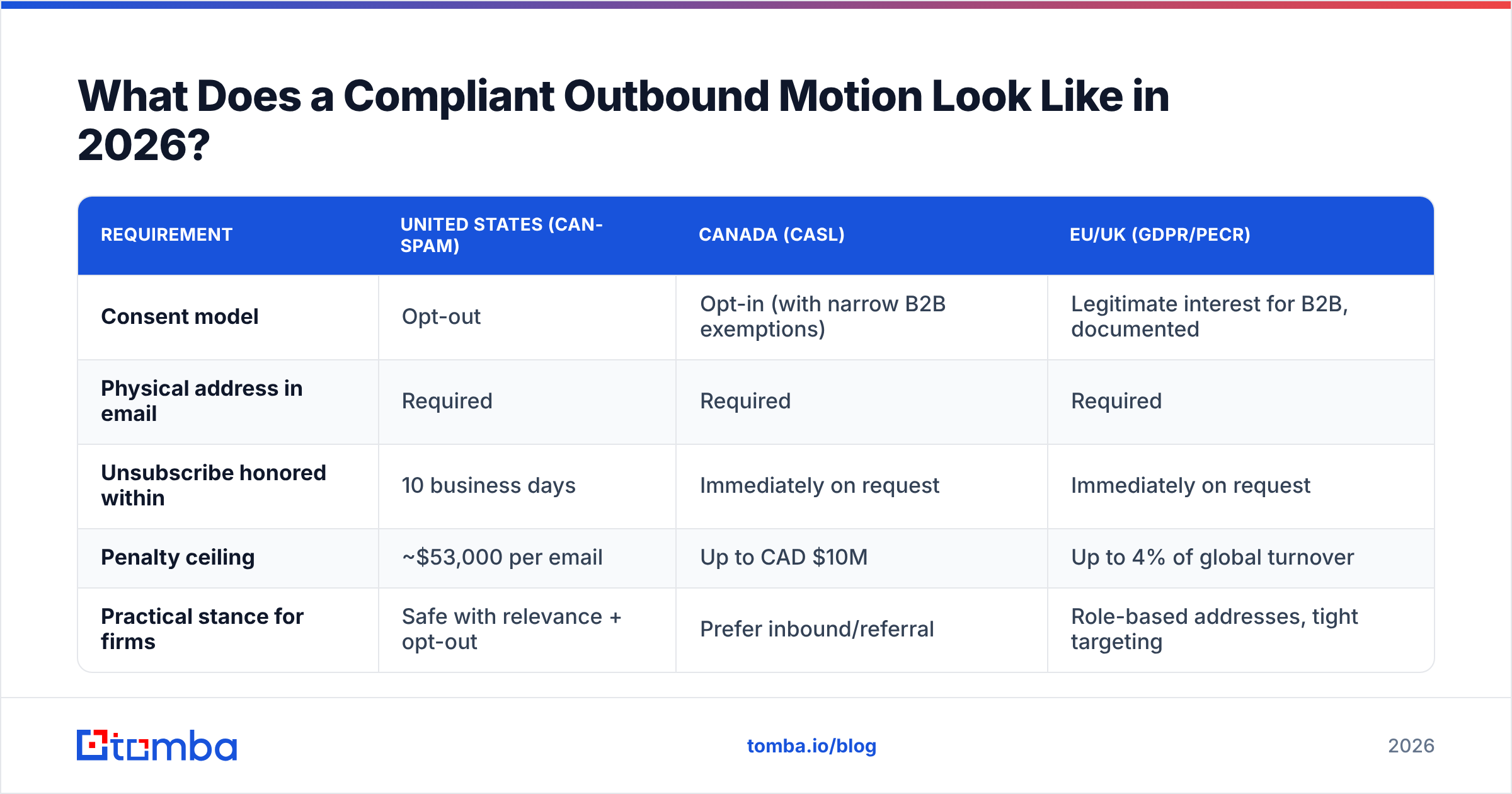
Compliant outbound for accountants means B2B-only, clearly identified, genuinely relevant, and easy to opt out of.
The regulatory floor differs by jurisdiction, and getting this wrong is expensive in a way that other industries do not face — a CAN-SPAM violation costs money, but a state board complaint costs your license standing.
| Requirement | United States (CAN-SPAM) | Canada (CASL) | EU/UK (GDPR/PECR) |
|---|---|---|---|
| Consent model | Opt-out | Opt-in (with narrow B2B exemptions) | Legitimate interest for B2B, documented |
| Physical address in email | Required | Required | Required |
| Unsubscribe honored within | 10 business days | Immediately on request | Immediately on request |
| Penalty ceiling | ~$53,000 per email | Up to CAD $10M | Up to 4% of global turnover |
| Practical stance for firms | Safe with relevance + opt-out | Prefer inbound/referral | Role-based addresses, tight targeting |
Beyond the statute, three professional-practice rules matter:
- No implied guarantees. "We'll cut your tax bill by 30%" is a compliance problem, not a headline.
- Confidentiality in social proof. Naming a client in a cold email without written permission violates AICPA confidentiality rules. Use anonymized specifics: "a 40-person SaaS company in Denver."
- Jurisdictional clarity. If you are not licensed in their state, say what you can and cannot do. State boards care.
The practical upshot: your outbound must be so targeted that it reads like a referral. That is only possible with clean, enriched data — which is where most firms fail.
Why Does Contact Data Quality Decide Whether Outbound Works At All?#
Because deliverability collapses before your offer is ever read.
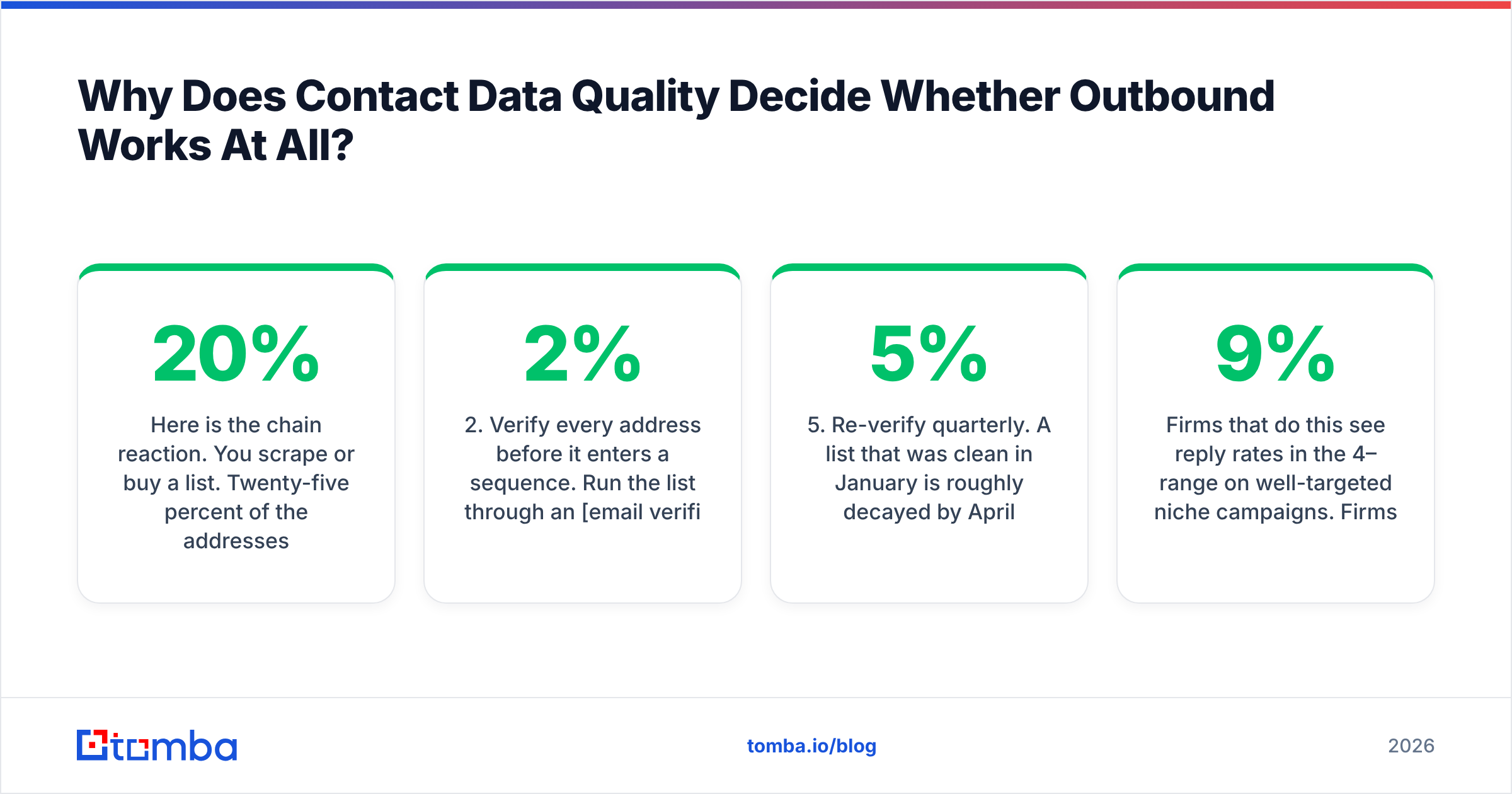
Here is the chain reaction. You scrape or buy a list. Twenty-five percent of the addresses are stale — people leave jobs at roughly 20% per year, and accounting-adjacent roles like controller and finance director churn faster than average. You send 500 emails. 125 bounce. Your bounce rate hits 25%, which is five times the threshold where Google's bulk sender requirements start throttling you. Your domain gets flagged. Now even your client emails land in spam.
The fix is boring and mandatory:
- Build lists from the company outward, not the person inward. Start with a target account list, then find the right role. A domain search across your niche returns the finance and executive contacts at each company, which is far more reliable than guessing formats.
- Verify every address before it enters a sequence. Run the list through an email verifier and drop anything that is not deliverable. Target a sub-2% bounce rate, not sub-5%.
- Handle catch-all domains deliberately. Many mid-market companies run catch-all servers that accept everything, which makes standard verification useless. A dedicated catch-all verifier resolves these instead of leaving them as coin flips.
- Enrich before you write. Headcount, funding stage, tech stack, and location determine whether your message is relevant. Data enrichment turns a name and a domain into a reason to reach out.
- Re-verify quarterly. A list that was clean in January is roughly 5% decayed by April.

Firms that do this see reply rates in the 4–9% range on well-targeted niche campaigns. Firms that skip it see 0.5% and conclude "cold email doesn't work for accounting." The channel was never the problem.
Is Inbound SEO Still Worth It for Accounting Firms?#
Yes — but only for defined-intent queries, not for "accountant" as a keyword.
The generic terms are saturated by directories, national chains, and aggregators with budgets you cannot match. What is not saturated is the long tail of specific, high-intent problems:
- "R&D tax credit for software companies in [state]"
- "revenue recognition ASC 606 for SaaS"
- "1099 vs W-2 for construction subcontractors"
- "first-year audit prep checklist for Series B"
- "sales tax nexus after expanding to [state]"
Each of those attracts maybe 40–300 searches a month. That looks worthless until you notice that a 10% conversion rate on 200 searches is 20 qualified inquiries a year from one page, at an engagement value of $15,000+.
Two structural moves make this work:
Build service-area pages that are genuinely different. Ten near-identical city pages is a thin-content penalty waiting to happen. One deep page per service × industry combination outperforms twenty geography swaps.
Own your Google Business Profile. For local firms this remains the single highest-ROI hour of work. Complete categories, real photos, service list, and a steady cadence of reviews. Google's own guidance is the best source here — most "GBP hacks" content is outdated within a quarter.
Pair inbound with capture. Traffic that does not convert is a vanity metric. A free assessment, a tax-position checklist, or a fee benchmark calculator converts better than a contact form, and gives you an email you can actually verify and route.
How Do You Turn Referrals From Luck Into a System?#
By defining the referral partner profile, then prospecting it like you would a client.
Referrals feel like they happen to you. They do not have to. The firms that scale them treat partner acquisition as its own outbound motion:
- Map the adjacent professions — business attorneys, commercial bankers, wealth managers, fractional CFOs, M&A advisors, insurance brokers, and vertical-specific consultants.
- Find the individuals, not the firms. A regional bank has 40 relationship managers; three of them serve your niche. Use a LinkedIn finder to turn profiles you have identified into verified contact records.
- Lead with give, not ask. Send them a client. Send them a relevant deal. Send them a market note about their vertical. The reciprocity is real and it compounds.
- Make referring easy. A one-page "who we're a good fit for" document that a banker can forward without writing anything is worth more than ten coffee meetings.
- Track it. If you cannot name your top five referral sources by revenue this year, you are not running a system — you are collecting accidents.
- Close the loop. Report back on every referral, even the ones that did not convert. Silence kills referral relationships faster than a bad outcome.
One caution: reciprocal referral arrangements involving compensation trigger disclosure requirements under AICPA rules and many state statutes. Unpaid mutual referral is clean; paid referral fees need documentation and client disclosure.
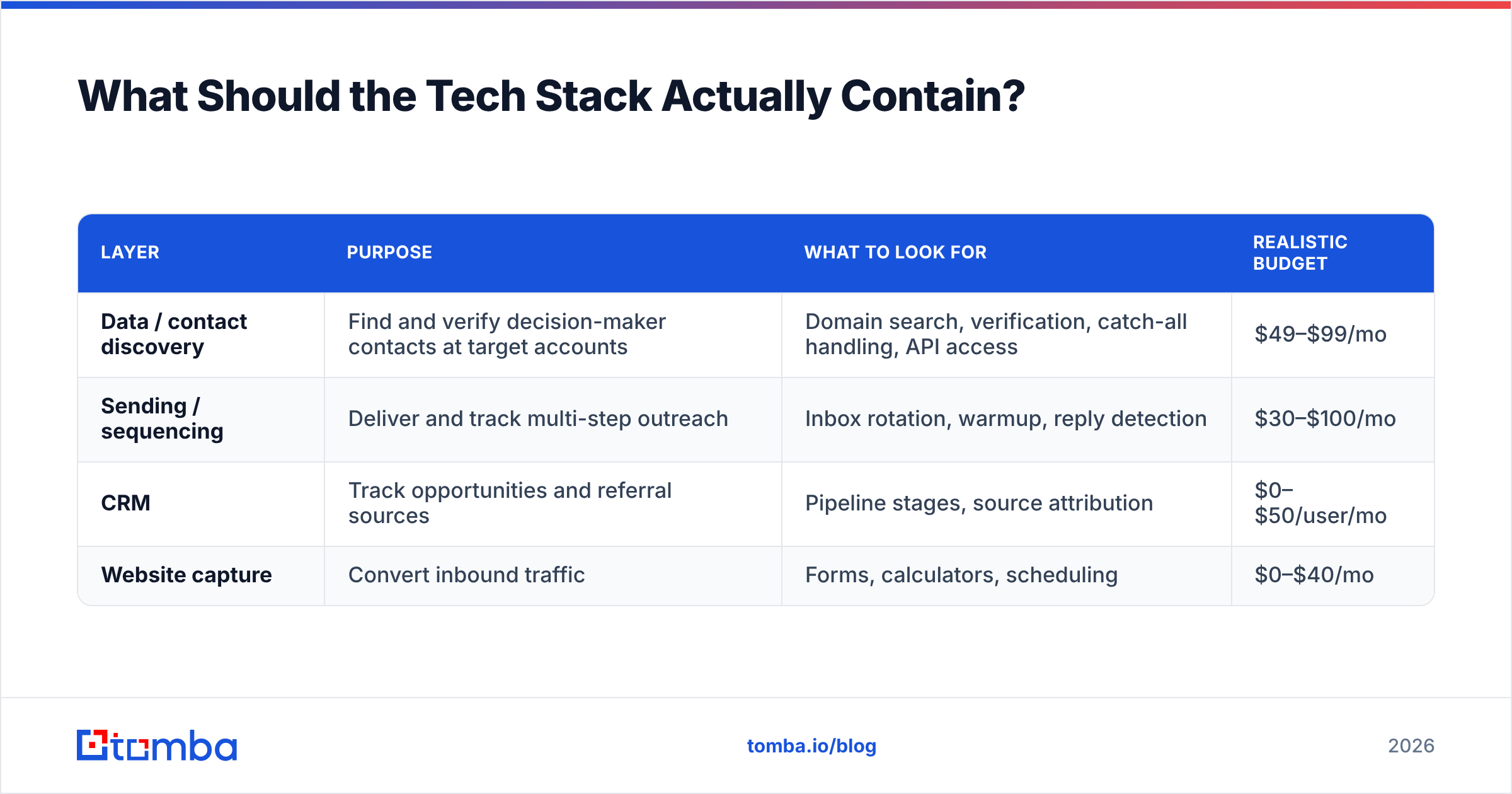
What Should the Tech Stack Actually Contain?#
Fewer tools than vendors want you to buy. A workable stack has four layers.
| Layer | Purpose | What to look for | Realistic budget |
|---|---|---|---|
| Data / contact discovery | Find and verify decision-maker contacts at target accounts | Domain search, verification, catch-all handling, API access | $49–$99/mo |
| Sending / sequencing | Deliver and track multi-step outreach | Inbox rotation, warmup, reply detection | $30–$100/mo |
| CRM | Track opportunities and referral sources | Pipeline stages, source attribution | $0–$50/user/mo |
| Website capture | Convert inbound traffic | Forms, calculators, scheduling | $0–$40/mo |
For the data layer, the practical question is cost per usable contact, not cost per credit. A cheap provider that returns 60% deliverable addresses is more expensive than a precise one at twice the list price, once you account for the deliverability damage.
Tomba pricing starts with a free tier at 25 searches/month, then Starter at $49/mo, Growth at $99/mo, and Pro at $249/mo — which covers most single-office firms running one or two campaigns a quarter. If you are buying pre-built lists instead of building them, providers like BookYourData offer verified B2B records with pay-as-you-go pricing, which suits firms that want a one-time list rather than an ongoing research workflow. Both approaches work; the difference is whether you need a static list or a repeatable process.
For CRM, resist the enterprise pull. HubSpot's free CRM handles a firm doing under 200 opportunities a year without a line item. Upgrade when reporting actually breaks, not before.
What Does a 90-Day Rollout Look Like?#
Sequence matters more than effort. Doing all four channels badly beats nothing, but doing one well beats all four badly.
Days 1–30 — Foundation. Pick the niche using the three-number test. Audit your last 20 clients for the accidental cluster. Write the one-page positioning statement. Fix your Google Business Profile. Set up SPF, DKIM, and DMARC on your sending domain — the free SPF checker takes two minutes and prevents months of deliverability grief.
Days 31–60 — Build the list and the asset. Assemble 300–500 target accounts in the niche. Find and verify contacts. Write one genuinely useful asset: a checklist, a benchmark, a calculator. Publish two long-tail SEO pages against the specific queries your niche actually searches.
Days 61–90 — Run and measure. Launch a 4-touch sequence to 150 contacts, not 500 — you want to learn before you scale. Track reply rate, positive reply rate, and meetings booked, not open rate. Start the partner-referral outreach in parallel. Review at day 90 and kill what did not produce.
The metrics that matter after one quarter: under 2% bounce rate, above 3% reply rate, at least two booked meetings per 100 contacts, and a documented source for every new client. If bounce rate is the number that is off, the problem is data, not messaging — fix that first, because every other metric is downstream of it.
Where Should You Start This Week?#
Start with the list, because every other channel depends on knowing exactly who you are talking to.
Pick the niche where your current clients already cluster. Build a 100-account target list. Then use the Tomba Email Finder to get verified decision-maker contacts at each one — controller, CFO, founder, whoever actually owns the decision for your service. The free tier covers 25 searches so you can test the fit on a slice of your list before committing, and Starter at $49/mo covers a full quarterly campaign for a single-office firm.
The firms that win at lead generation for accountants in 2026 are not the ones with the biggest ad budget. They are the ones who know precisely who they serve, can reach those people reliably, and have a clean enough data foundation that their emails actually arrive. Everything else is downstream of that.
Related guides#
// get started
Find, verify and enrich your first contacts today
Start on the free plan with 25 searches a month, then scale when your team is ready.
Free plan · No credit card required · GDPR & CCPA
// about the author