Lead Generation for Insurance: What Actually Works in 2026
Shared aggregator leads convert under 2%. Here is an honest breakdown of insurance lead sources, real cost-per-acquired-policy math, and the outbound stack that beats buying clicks.
TL;DR
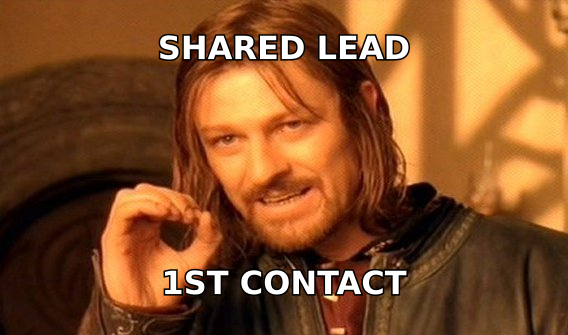
- Shared aggregator leads for insurance close at roughly 1–3%. At $35–$65 per lead, that puts your cost per bound policy somewhere north of $1,500 — before you pay the producer.
- Exclusive and warm-transfer leads cost 3–5x more per lead but usually win on cost-per-policy because contact rates are 4–6x higher.
- Commercial lines (group benefits, BOP, cyber, workers' comp) reward outbound prospecting far more than personal lines, because you can identify the buyer by title and company size.
- The highest-margin channel most agencies ignore: building your own contact list from firmographic filters, then verifying it before you ever hit send.
- Speed-to-lead beats almost every other optimization. Contact inside five minutes and you are roughly 20x more likely to qualify the lead than at 30 minutes.
What is lead generation for insurance, really?#
Lead generation for insurance is the process of identifying people or businesses with an insurable need, capturing enough contact data to reach them, and moving them into a quoting conversation. That is the boring definition. The useful one is narrower: it is the practice of buying or building attention from someone who will actually answer.
Most agency owners conflate two very different motions under one label:
- Inbound demand capture — someone searches "cheap commercial auto insurance Dallas," lands on a comparison site, fills a form, and that form gets sold. You are buying intent that already exists.
- Outbound demand creation — you decide that 40-to-120-employee logistics companies in Ohio are underinsured on cargo, build a list of their operations directors, and start conversations. You are manufacturing intent.
Personal lines has historically lived in bucket one. Commercial lines and group benefits live and die in bucket two. Agencies that lose money usually do so because they run a commercial book on a personal-lines lead strategy — buying generic forms and hoping a $40,000 premium account falls out.
Which insurance lead sources are worth paying for?#
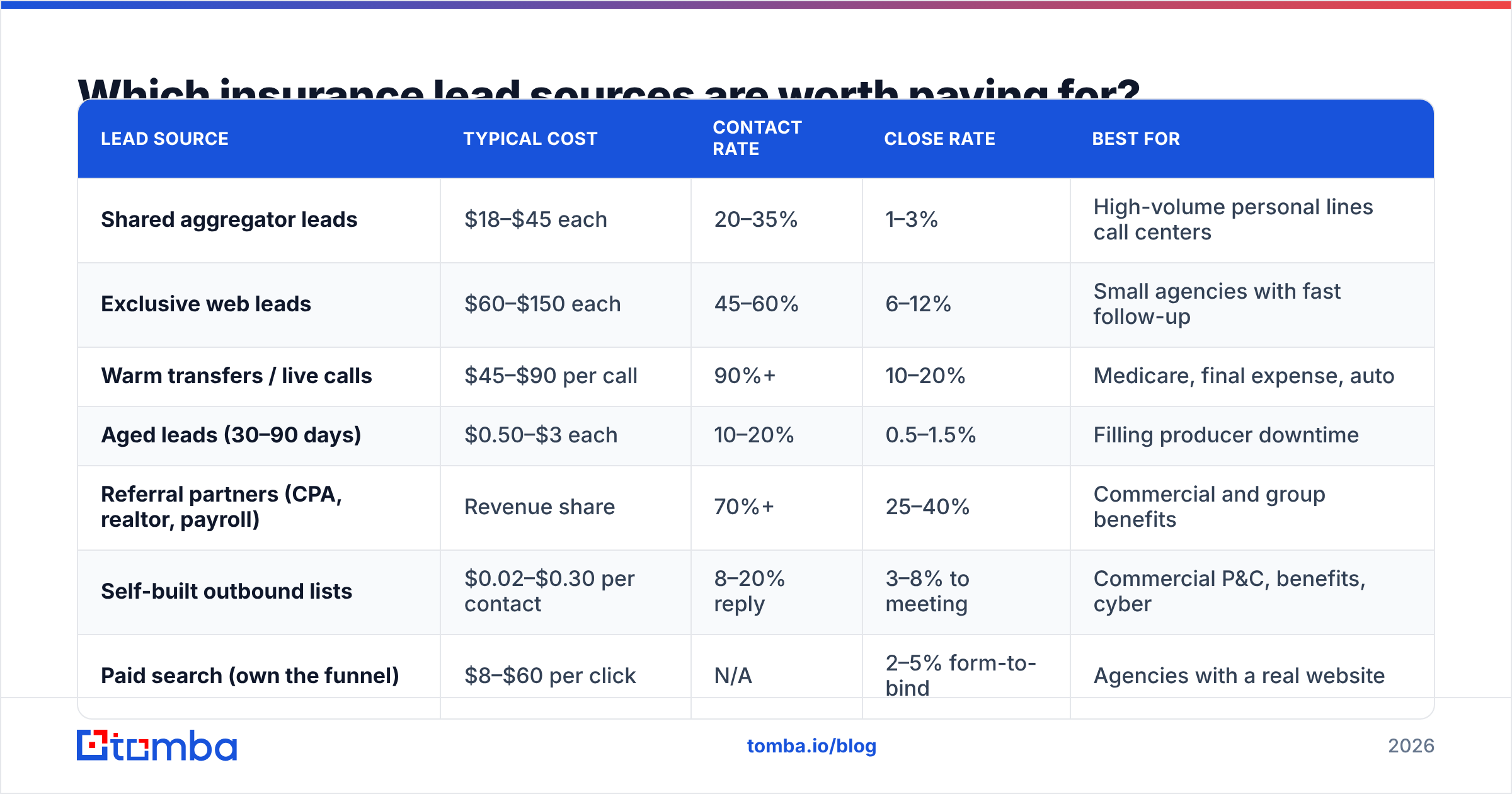
Here is the honest comparison. These are blended industry ranges — your carrier mix, state, and line of business will shift them, sometimes hard.
| Lead source | Typical cost | Contact rate | Close rate | Best for |
|---|---|---|---|---|
| Shared aggregator leads | $18–$45 each | 20–35% | 1–3% | High-volume personal lines call centers |
| Exclusive web leads | $60–$150 each | 45–60% | 6–12% | Small agencies with fast follow-up |
| Warm transfers / live calls | $45–$90 per call | 90%+ | 10–20% | Medicare, final expense, auto |
| Aged leads (30–90 days) | $0.50–$3 each | 10–20% | 0.5–1.5% | Filling producer downtime |
| Referral partners (CPA, realtor, payroll) | Revenue share | 70%+ | 25–40% | Commercial and group benefits |
| Self-built outbound lists | $0.02–$0.30 per contact | 8–20% reply | 3–8% to meeting | Commercial P&C, benefits, cyber |
| Paid search (own the funnel) | $8–$60 per click | N/A | 2–5% form-to-bind | Agencies with a real website |
Two things jump out of that table.
First, the cheapest lead is almost never the cheapest policy. A $22 shared lead closing at 1.5% costs you $1,467 in media per bound policy. A $75 exclusive lead closing at 9% costs $833. The shared lead feels cheaper on the invoice and is nearly twice as expensive in reality.
Second, self-built outbound has a cost structure nothing else matches. When you assemble the list yourself from firmographic criteria and verified contact data, your marginal cost per prospect is pennies. The tradeoff is labor and craft: you need a real hypothesis about who is underinsured and why, plus messaging that does not sound like a quote form wearing a blazer.
How do you build an insurance lead list from scratch?#
This is the part most agencies skip because it sounds technical. It is not. It is five steps.
- Define the insurable trigger, not the demographic. "Manufacturers in Michigan" is a demographic. "Manufacturers in Michigan who just added a second facility" is a trigger — new property, new workers' comp exposure, a renewal conversation that writes itself. Hiring spikes, new licenses, funding rounds, fleet purchases, and SOC 2 pursuits are all triggers.
- Build the company list. Pull companies matching your trigger from a B2B source — state licensing databases, industry association member directories, job board scrapes, or a firmographic filter inside a B2B database. Cap it at 200–400 accounts per campaign so you can actually personalize.
- Identify the right human. For commercial P&C that is usually the owner, CFO, or operations director. For group benefits it is HR leadership or the office manager at sub-50-headcount firms. Titles matter more than seniority — a "Director of People Operations" at a 70-person company is the benefits buyer; the CEO is not.
- Find and verify the contact data. Run the names and domains through an email finder to resolve work addresses, then push everything through an email verifier before it touches your sending platform. Skip this step and you will burn your sending domain inside two weeks.
- Enrich for personalization hooks. Employee count, recent news, tech stack, physical locations. You need one specific, true sentence per account that proves you looked.
That fifth step is what separates a 14% reply rate from a 1% reply rate. "I noticed you opened the Toledo location in March" earns a response. "I help businesses save on insurance" earns a spam complaint.
Why does data accuracy decide your outbound ROI?#
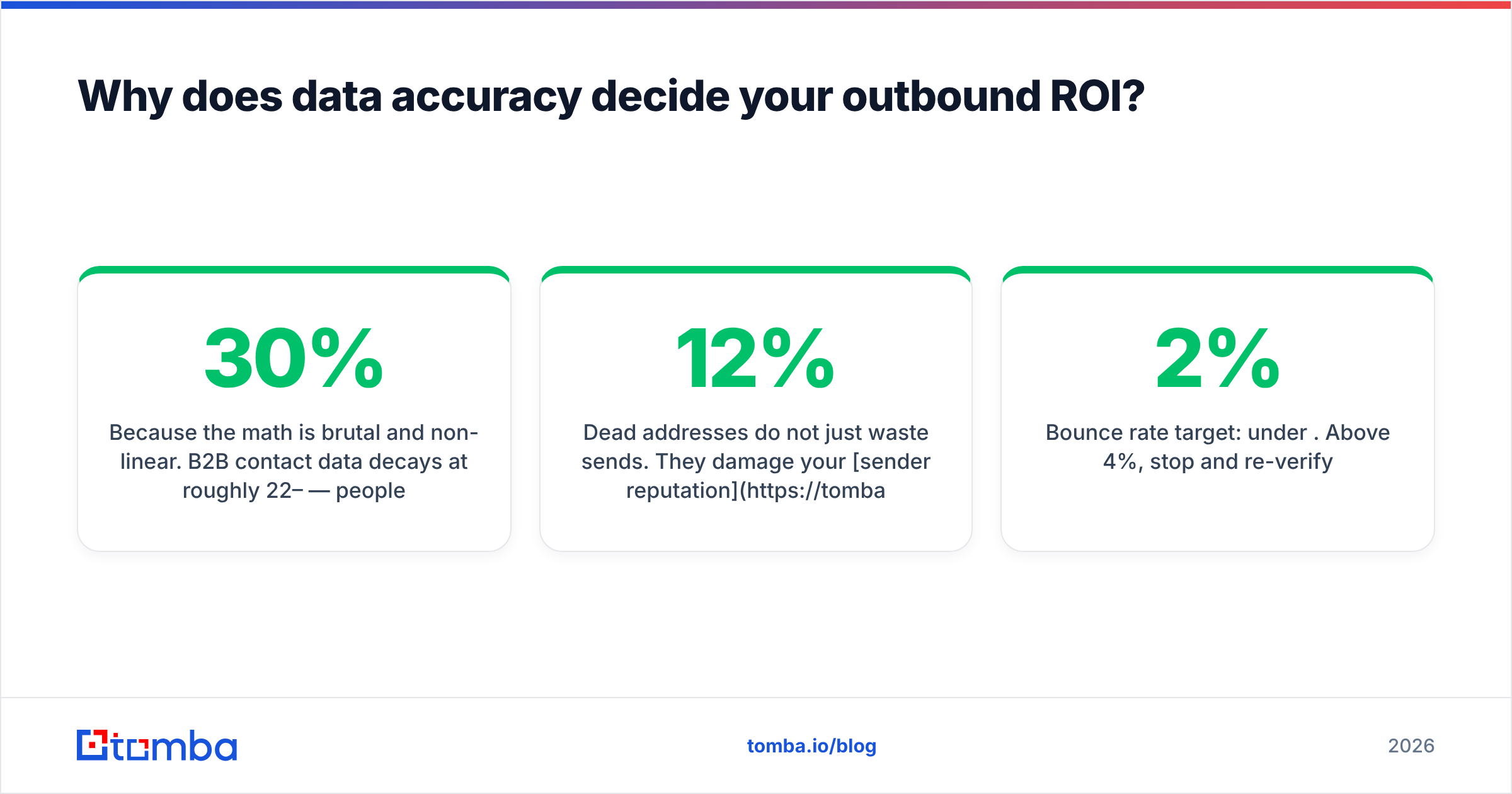
Because the math is brutal and non-linear. B2B contact data decays at roughly 22–30% per year — people change jobs, companies rebrand, domains migrate. If you are working from a list that is 18 months old, close to a third of it is dead on arrival.
Dead addresses do not just waste sends. They damage your sender reputation, which suppresses inbox placement for the good addresses on the same list. A 12% bounce rate on one campaign can quietly cut your deliverability for the next three. Google and Microsoft both tightened bulk-sender requirements in 2024 and have not loosened them since; the guidance in Google's sender policy documentation is the practical floor, and it puts spam complaint rates under 0.3% as a hard expectation.
For insurance specifically, there is a second accuracy problem: catch-all domains are everywhere in this vertical. Agencies, brokerages, TPAs, and mid-market employers run mail servers that accept everything, so a standard verifier returns "unknown" and you are left guessing. Running those through a catch-all verifier rather than blind-sending is the difference between a working list and a reputation problem.
A workable quality bar before any insurance campaign goes out:
- Bounce rate target: under 2%. Above 4%, stop and re-verify.
- Catch-all handling: separate segment, lower daily volume, no aggressive follow-up cadence.
- Role accounts: strip
info@,sales@,claims@— they poison reply-rate data and rarely reach a decision maker. - Duplicate check: same human across two domains after an acquisition is common in this industry; dedupe on person, not address.
- Recency: anything sourced more than nine months ago gets re-verified, not re-sent.
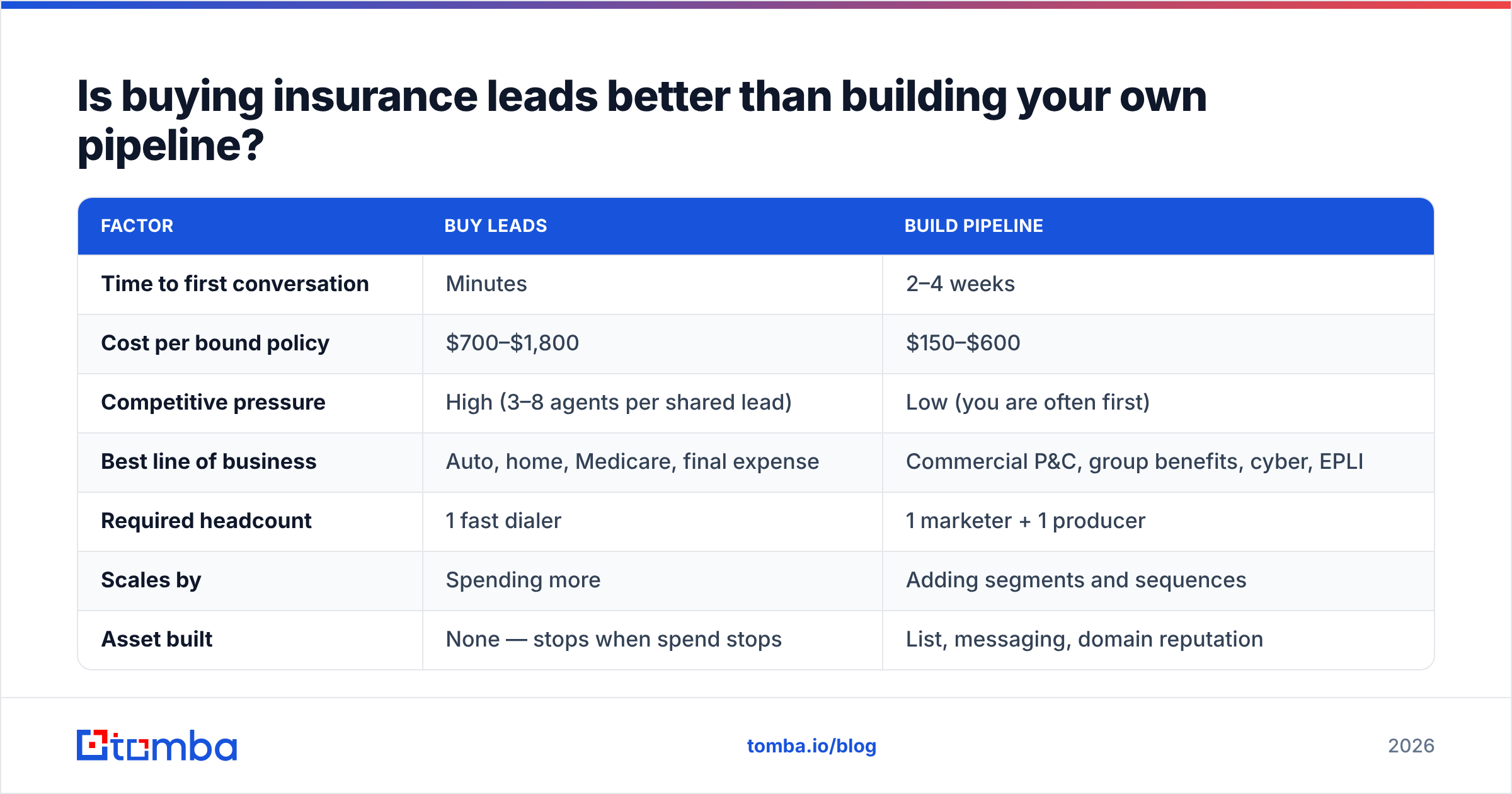
Is buying insurance leads better than building your own pipeline?#
It depends entirely on your line of business and your follow-up capacity. Here is the decision framework.
| Factor | Buy leads | Build pipeline |
|---|---|---|
| Time to first conversation | Minutes | 2–4 weeks |
| Cost per bound policy | $700–$1,800 | $150–$600 |
| Competitive pressure | High (3–8 agents per shared lead) | Low (you are often first) |
| Best line of business | Auto, home, Medicare, final expense | Commercial P&C, group benefits, cyber, EPLI |
| Required headcount | 1 fast dialer | 1 marketer + 1 producer |
| Scales by | Spending more | Adding segments and sequences |
| Asset built | None — stops when spend stops | List, messaging, domain reputation |
| Average premium suited | Under $3,000 | $5,000+ |
The honest answer for most agencies is both, sequenced. Buy leads to keep producers busy and cash flowing while you build the outbound engine. Then shift budget as the outbound cost-per-policy drops below the purchased-lead cost-per-policy — which usually happens somewhere in month three or four if the data quality is right.
What you should not do is buy shared leads forever and call it a growth strategy. You are renting revenue at a price set by someone else, and the aggregators raise that price every year. G2's category data on lead intelligence tools shows the same pattern across verticals: agencies that own their data source carry lower blended acquisition costs.
What does a working insurance outbound sequence look like?#
Five touches over 14 business days, across two channels. Nothing clever, just disciplined.
Touch 1 (Day 1) — Email, trigger-specific. One sentence on the trigger you spotted, one sentence on the exposure it creates, one soft question. Under 90 words. No attachment, no calendar link, no "hope this finds you well."
Touch 2 (Day 3) — LinkedIn view + connect, no pitch. Pure familiarity building. If you use a LinkedIn finder to match profiles to your list in advance, this takes four minutes for 40 prospects instead of an hour.
Touch 3 (Day 6) — Email, proof. A two-line anonymized example: similar company, similar exposure, what the coverage gap cost or saved. Specific numbers beat adjectives.
Touch 4 (Day 10) — Phone. This is where commercial insurance still wins. Reference the emails, do not pretend the call is cold. If you need direct dials rather than the main switchboard, a phone finder cuts the gatekeeper problem substantially.
Touch 5 (Day 14) — Email, permission close. "Sounds like this isn't a priority right now — want me to check back at renewal?" This one converts better than any other single email in insurance outbound, because it gives the prospect an easy yes that is still a yes.
Two rules that matter more than the sequence itself:
- Speed-to-lead on any inbound reply. HubSpot's research on response timing is consistent with what carriers see internally: contact within five minutes and qualification odds multiply. A reply sitting for two hours is a different, much worse lead.
- One campaign, one segment, one message. The moment you write an email that works for both a 12-person dental practice and a 200-truck fleet, you have written an email that works for neither.
How should you measure insurance lead generation performance?#
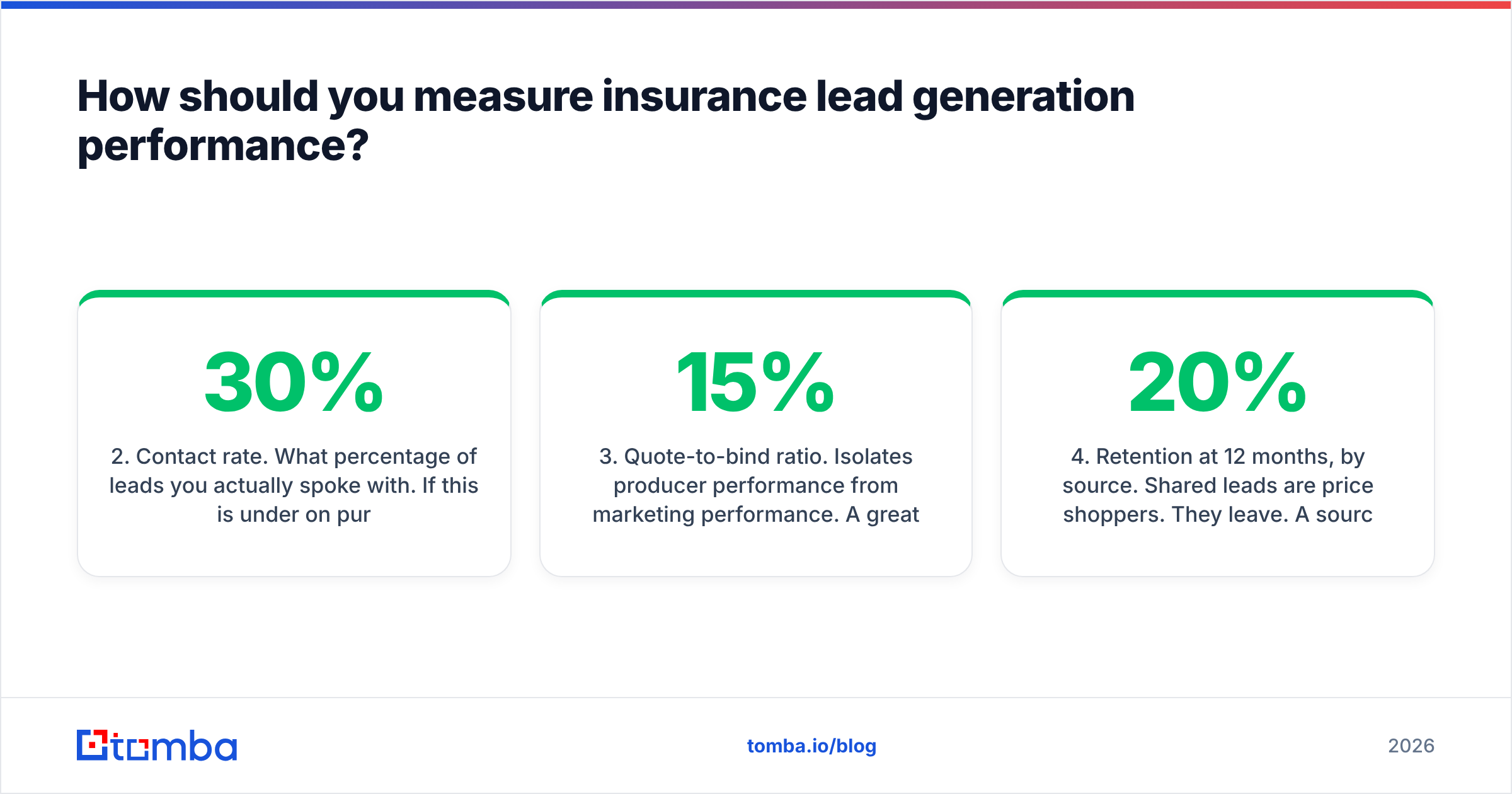
Stop tracking cost per lead. It is the vanity metric of this industry. Track these instead:
- Cost per bound policy, by source. The only number that survives contact with your P&L. Calculate it monthly, per channel, and kill anything above your target CAC for two consecutive months.
- Contact rate. What percentage of leads you actually spoke with. If this is under 30% on purchased leads, your speed-to-lead is broken, not your lead source.
- Quote-to-bind ratio. Isolates producer performance from marketing performance. A great lead source with a 15% bind rate has a sales problem, not a marketing problem.
- Retention at 12 months, by source. Shared leads are price shoppers. They leave. A source with a 20% higher acquisition cost and 30% better retention is the better source, and cost-per-lead reporting will never show you that.
- Deliverability health. Bounce rate, spam complaint rate, inbox placement. For outbound, this is a leading indicator — it degrades weeks before your reply rate does.
Build this into a single monthly view. Most agencies cannot answer "what does a commercial auto policy cost us to acquire from each channel?" and that single gap is why budget gets allocated by habit instead of evidence.
What is the fastest way to start?#
Pick one segment. One line of business, one industry, one company-size band, one state. Build a list of 250 accounts against a specific insurable trigger. Find and verify the decision-maker contacts. Run the five-touch sequence. Measure cost per bound policy against whatever you currently pay your aggregator.
If it wins, scale the segment. If it loses, you learned that for the price of two weeks and a few hundred verified contacts — which is a far cheaper experiment than another quarter of shared-lead invoices.
The data layer is where this lives or dies. Tomba's Email Finder resolves work email addresses by name and domain, with verification built into the same workflow so your list is clean before it reaches your sending platform. The free tier gives you 25 searches a month to test the approach on a single segment; Starter runs $49/mo and Growth $99/mo when you are ready to build lists at volume — full Tomba pricing is public, no sales call required. Build the list once, own it forever, and stop renting your pipeline from someone who sells it to your competitors on the same afternoon.
Related guides#
// get started
Find, verify and enrich your first contacts today
Start on the free plan with 25 searches a month, then scale when your team is ready.
Free plan · No credit card required · GDPR & CCPA
// about the author