Lead Generation for Manufacturing Companies: 2026 Playbook
Manufacturing sales cycles run 6-18 months and buying committees hit 8 people. Here is the channel-by-channel playbook that actually fills an industrial pipeline in 2026.
TL;DR
- Manufacturing buying cycles run 6-18 months with buying committees averaging 6-10 people, so single-channel lead gen almost always underperforms — you need layered touchpoints across search, trade, and direct outreach.
- Trade shows still produce the highest-intent leads in industrial sectors, but the ROI comes from the pre-show and post-show email work, not the booth.
- Technical SEO content (spec sheets, CAD files, tolerance guides, material comparisons) outranks generic blog content for engineer-led searches and compounds for years.
- Cold outbound works in manufacturing when you target by NAICS code, plant location, and equipment installed — not by job title alone.
- Your CRM data decays roughly 25-30% per year in industrial verticals due to plant closures, acquisitions, and retirements, so verification is a recurring cost, not a one-time cleanup.
Manufacturing lead generation breaks most SaaS playbooks. You are not selling a $49/month subscription to a growth marketer who signs up after a free trial. You are selling a $400,000 CNC line, a multi-year contract packaging agreement, or a custom injection-mold tooling program to a committee that includes a plant manager, a quality engineer, a procurement lead, a CFO, and sometimes a corporate sustainability officer who joined the conversation in month nine.
That structural difference changes every tactic downstream. This guide covers what actually generates pipeline for industrial and manufacturing firms in 2026 — channel by channel, with the tradeoffs made explicit.
What makes lead generation for manufacturing companies different?#
Four structural realities drive everything else.
Long, non-linear sales cycles. Gartner's research on B2B buying consistently finds that complex purchases involve buyers looping back through the same stages repeatedly rather than moving linearly down a funnel. In manufacturing, that loop can span quarters. A lead that goes quiet for four months is frequently not dead — it is waiting on a capital budget cycle.
Large, technically skeptical buying committees. The engineer evaluating your tolerances does not care about your case study video. The CFO does not care about your tolerances. You need asset types for both, and you need contact data for both.
Low digital maturity on the buyer side — and often on the seller side. Many industrial firms still route inbound through a generic "Request a Quote" form that lands in a shared inbox checked twice a week. Meanwhile, McKinsey and other analysts have documented that industrial buyers increasingly research independently before contacting sales, which means the form is often the last step, not the first.
Small total addressable markets. If you make aerospace-grade fasteners, your TAM might be 900 companies worldwide. Volume plays fail. Precision plays win.

Which lead generation channels actually work for manufacturers?#
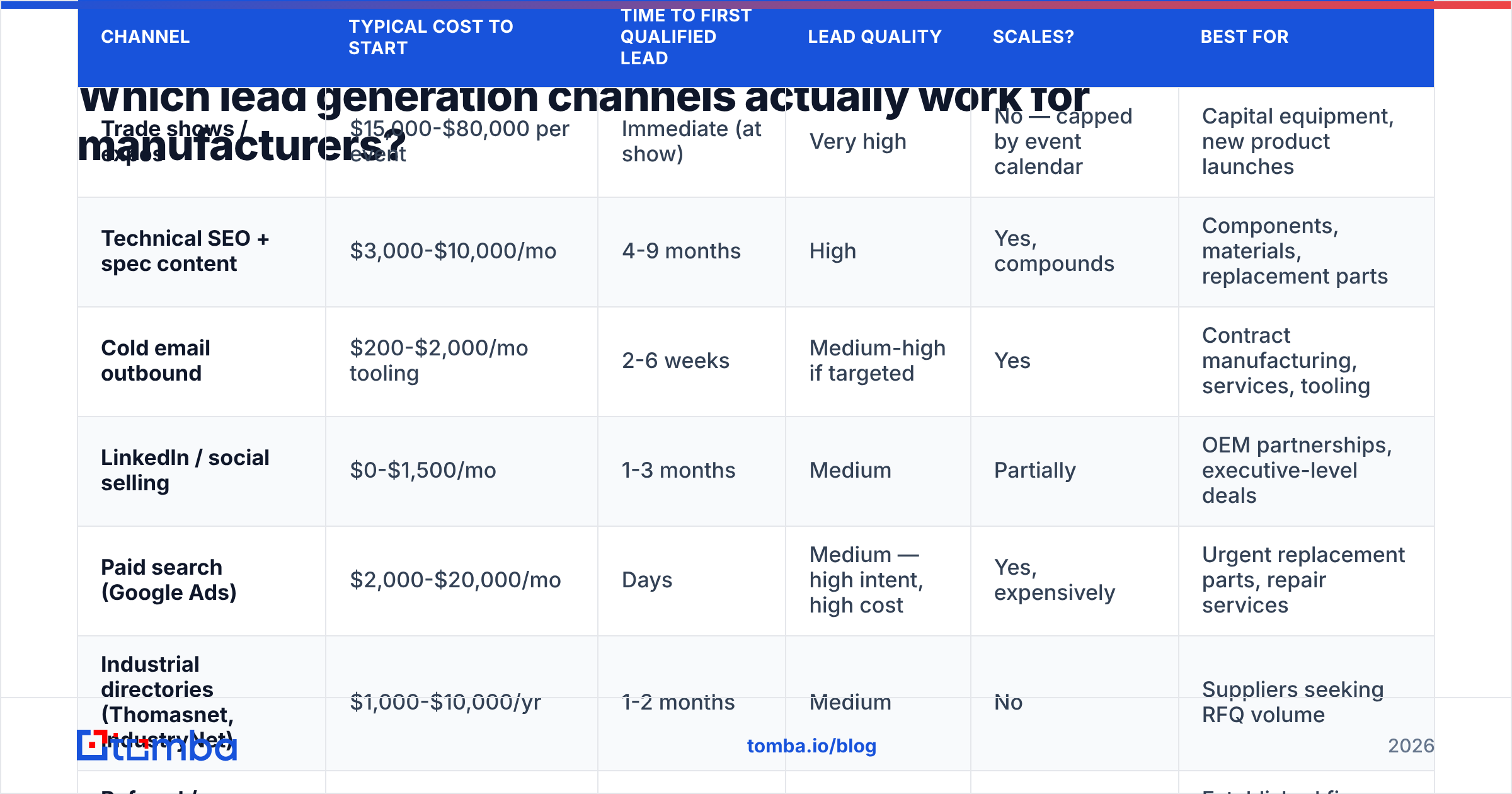
Here is the honest channel comparison, based on how industrial teams typically allocate budget versus what those channels return.
| Channel | Typical cost to start | Time to first qualified lead | Lead quality | Scales? | Best for |
|---|---|---|---|---|---|
| Trade shows / expos | $15,000-$80,000 per event | Immediate (at show) | Very high | No — capped by event calendar | Capital equipment, new product launches |
| Technical SEO + spec content | $3,000-$10,000/mo | 4-9 months | High | Yes, compounds | Components, materials, replacement parts |
| Cold email outbound | $200-$2,000/mo tooling | 2-6 weeks | Medium-high if targeted | Yes | Contract manufacturing, services, tooling |
| LinkedIn / social selling | $0-$1,500/mo | 1-3 months | Medium | Partially | OEM partnerships, executive-level deals |
| Paid search (Google Ads) | $2,000-$20,000/mo | Days | Medium — high intent, high cost | Yes, expensively | Urgent replacement parts, repair services |
| Industrial directories (Thomasnet, IndustryNet) | $1,000-$10,000/yr | 1-2 months | Medium | No | Suppliers seeking RFQ volume |
| Referral / distributor networks | Relationship cost | Varies | Highest | No | Established firms with channel partners |
The pattern most successful industrial teams land on: SEO and directories for inbound capture, trade shows for relationship ignition, cold outbound for account-based expansion, and referrals as the compounding layer on top. The mistake is treating any one of these as a complete program.
Why trade show ROI lives outside the booth#
A $40,000 booth that collects 300 badge scans produces almost nothing if those scans go into a spreadsheet nobody touches until Q3. The teams that win trade shows do three things:
- Pre-show outreach, 3-4 weeks out. Pull the exhibitor and attendee list, find the decision-makers you actually want, and book meetings before you fly out. This is where an email finder earns its keep — attendee lists give you names and companies, rarely working emails.
- Booth qualification, not booth collection. Two real conversations beat 40 badge scans.
- 48-hour follow-up. Response rates on trade show follow-up drop sharply after the first week. Have the sequence written before the show starts.
How do you build a targeted manufacturing prospect list?#
Targeting by job title alone is the single biggest waste of outbound budget in industrial sales. "Plant Manager" at a 40-person job shop and "Plant Manager" at a Tier 1 automotive supplier are entirely different buyers with different budgets and different problems.
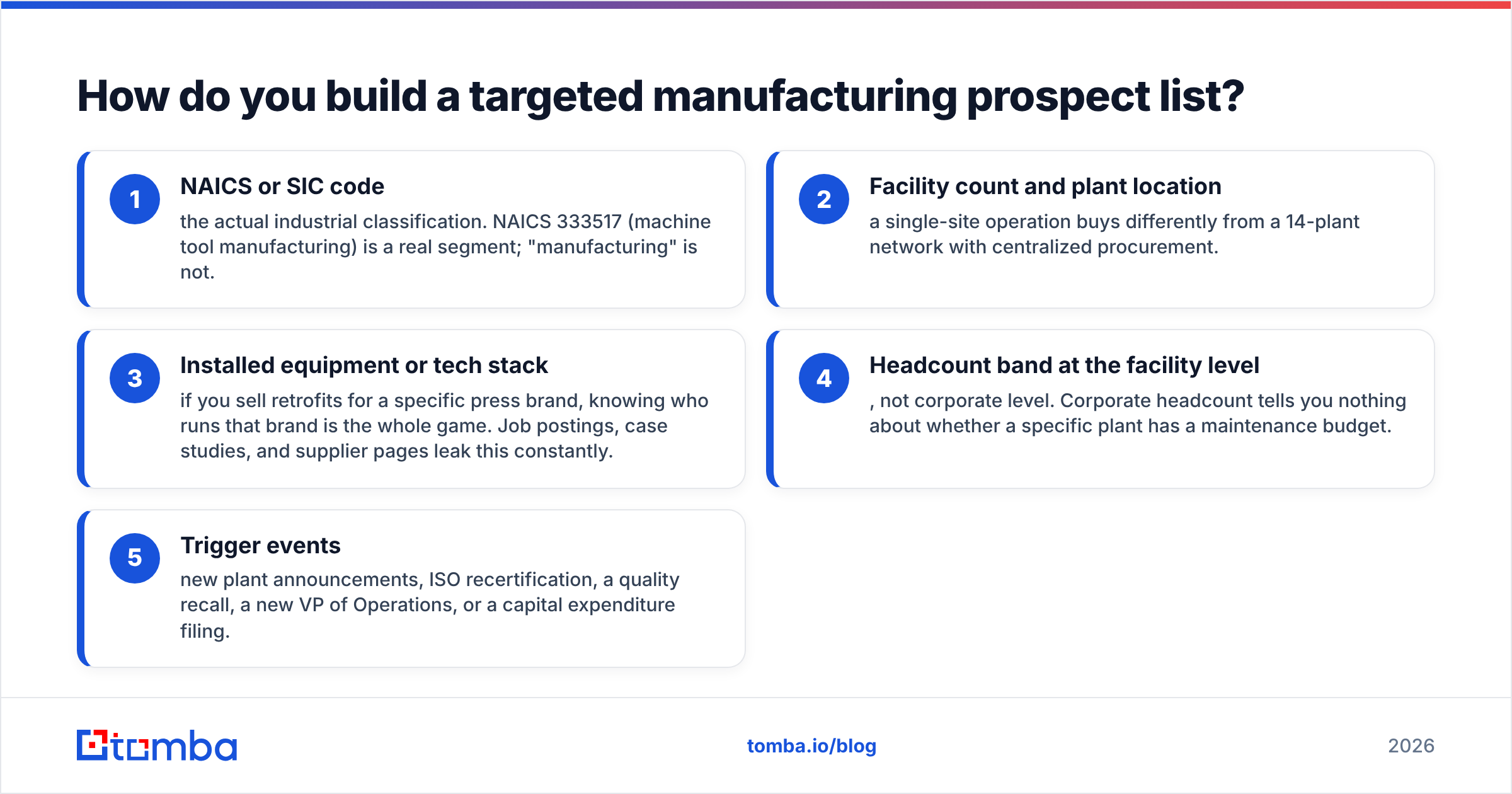
Build your list on these five filters instead:
- NAICS or SIC code — the actual industrial classification. NAICS 333517 (machine tool manufacturing) is a real segment; "manufacturing" is not.
- Facility count and plant location — a single-site operation buys differently from a 14-plant network with centralized procurement.
- Installed equipment or tech stack — if you sell retrofits for a specific press brand, knowing who runs that brand is the whole game. Job postings, case studies, and supplier pages leak this constantly.
- Headcount band at the facility level, not corporate level. Corporate headcount tells you nothing about whether a specific plant has a maintenance budget.
- Trigger events — new plant announcements, ISO recertification, a quality recall, a new VP of Operations, or a capital expenditure filing.
Once the account list exists, the contact data problem starts. Manufacturing contact data is notoriously stale because plants close, get acquired, rebrand, and lose long-tenured staff to retirement. A domain search against a target plant's domain will surface the email pattern and the people publishing under it; from there you can verify emails before anything hits a send queue. Industrial domains also skew heavily toward catch-all configurations, which is why a dedicated catch-all verifier matters more here than in tech verticals — a plain SMTP check will return "valid" for every address on a catch-all domain, including the ones that bounce.
For teams running list-building at volume, purpose-built B2B data providers like BookYourData offer pre-built industrial segments that can shortcut the account-discovery step, and pairing a static list with live verification is generally more reliable than trusting either alone.
Should manufacturers buy leads or build their own pipeline?#
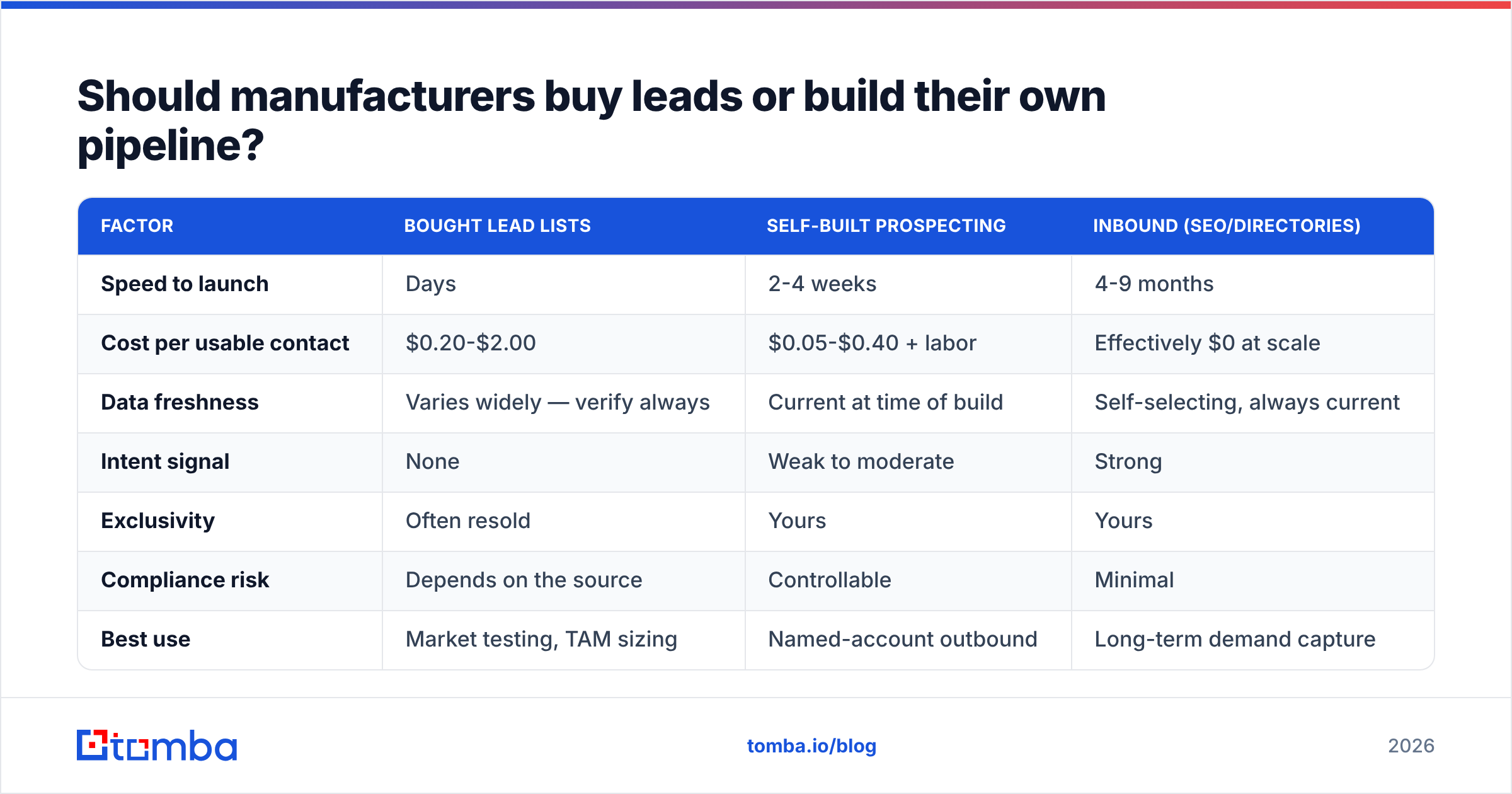
Both, usually — but for different purposes. Here is the tradeoff laid out honestly.
| Factor | Bought lead lists | Self-built prospecting | Inbound (SEO/directories) |
|---|---|---|---|
| Speed to launch | Days | 2-4 weeks | 4-9 months |
| Cost per usable contact | $0.20-$2.00 | $0.05-$0.40 + labor | Effectively $0 at scale |
| Data freshness | Varies widely — verify always | Current at time of build | Self-selecting, always current |
| Intent signal | None | Weak to moderate | Strong |
| Exclusivity | Often resold | Yours | Yours |
| Compliance risk | Depends on the source | Controllable | Minimal |
| Best use | Market testing, TAM sizing | Named-account outbound | Long-term demand capture |
The failure mode with purchased lists is not the purchase — it is skipping verification afterward. Any list, from any vendor, degrades from the moment it is exported. Running it through bulk verify before the first send protects your sender reputation, and for industrial lists specifically, expect to lose 15-25% of records to hard bounces if the data is more than six months old.
What kind of content generates manufacturing leads?#
Engineers do not download "The Ultimate Guide to Digital Transformation." They download things they can use at their desk this afternoon.
- Spec sheets and technical datasheets — gated lightly (email only, no 11-field form).
- CAD files and 3D models — arguably the highest-converting asset type in component manufacturing. An engineer who downloads your CAD model has already designed you into their assembly.
- Material and tolerance comparison tables — these rank well because engineers search exact technical phrases ("6061 vs 7075 yield strength").
- Calculators and sizing tools — load calculators, flow-rate tools, ROI estimators for equipment replacement.
- Failure-mode and troubleshooting guides — captures search traffic from people with an urgent, budgeted problem.
- Plant tour videos and process walkthroughs — builds credibility with procurement teams evaluating manufacturing capability.
The through-line: content that helps someone do their job earns the email address. Content that describes your company does not.
On the distribution side, technical content underperforms when nobody knows it exists. A short outbound sequence that says "we published a tolerance comparison for the alloy you spec — here it is, no form" converts far better than a generic capabilities pitch, and it gives your SDRs a non-salesy first touch.
How do you run cold outbound to industrial buyers without burning your domain?#
Industrial email infrastructure is conservative. Many manufacturers run on-premise Exchange or tightly filtered Microsoft 365 tenants with aggressive spam policies. A sloppy campaign gets you blocked at the tenant level, which means you lose the entire account — every contact at every plant.
Protect the basics first:
- Authenticate properly. SPF, DKIM, and DMARC all aligned. Check your SPF record before you send anything at volume.
- Warm the sending domain. Use a subdomain for outbound so a reputation hit does not affect corporate mail.
- Verify every address. Bounce rate above 3% is where mailbox providers start throttling. Verification is the cheapest deliverability insurance available.
- Keep volume low and relevance high. 30-50 sends per mailbox per day in industrial verticals is plenty when your list is only 900 accounts wide.
- Write like an engineer, not a marketer. Short. Specific. Name the part, the process, or the problem. No superlatives.
A reasonable cadence for manufacturing: email one (specific, technical, 80 words), wait 4 days, email two (proof — a similar plant, similar problem), wait 7 days, phone call, wait 7 days, email three (breakup with a genuinely useful resource attached). Then move the contact to a quarterly nurture. Given 12-month cycles, the quarterly nurture is where most industrial deals actually originate.
Phone still matters here more than in software sales. Plant-level decision makers are frequently not at a desk and not reading email. Pairing verified emails with a phone finder lookup gives your reps a second channel that genuinely converts in this vertical — many industrial buyers will pick up a call they would never answer by email.
How should manufacturers measure lead generation performance?#
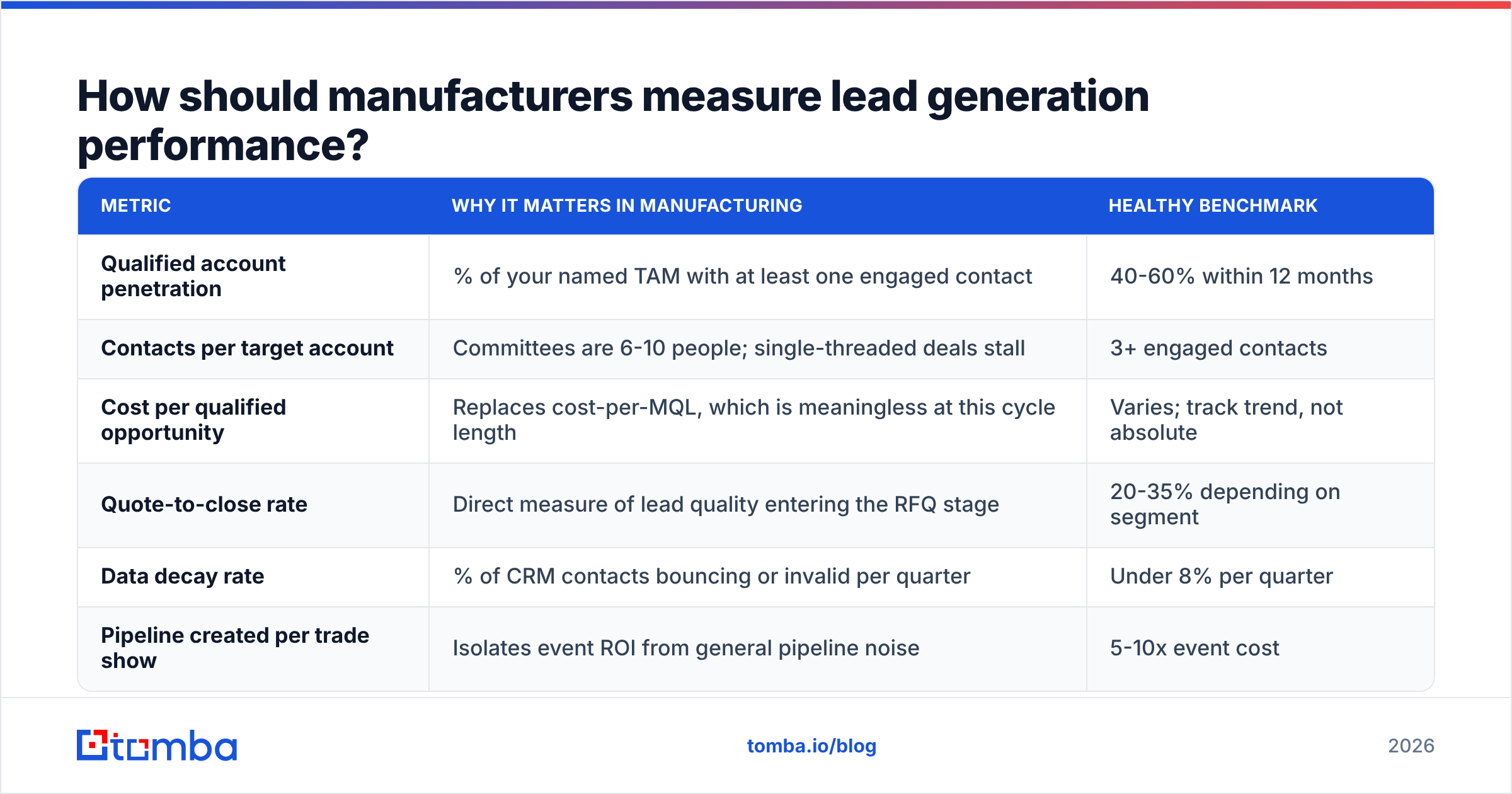
Standard SaaS metrics mislead here. Monthly MQL counts are nearly useless when the cycle is 14 months long. Track these instead:
| Metric | Why it matters in manufacturing | Healthy benchmark |
|---|---|---|
| Qualified account penetration | % of your named TAM with at least one engaged contact | 40-60% within 12 months |
| Contacts per target account | Committees are 6-10 people; single-threaded deals stall | 3+ engaged contacts |
| Cost per qualified opportunity | Replaces cost-per-MQL, which is meaningless at this cycle length | Varies; track trend, not absolute |
| Quote-to-close rate | Direct measure of lead quality entering the RFQ stage | 20-35% depending on segment |
| Data decay rate | % of CRM contacts bouncing or invalid per quarter | Under 8% per quarter |
| Pipeline created per trade show | Isolates event ROI from general pipeline noise | 5-10x event cost |
The two most neglected numbers on that list are contacts per target account and data decay rate. Single-threaded manufacturing deals die when your champion retires or moves plants. Multi-threading is not a nice-to-have; it is survival. And if your data decay rate climbs above 10% per quarter, your outbound performance problem is a data problem wearing a copywriting costume.
For ongoing hygiene, most industrial teams should re-verify the active CRM segment quarterly and enrich new accounts on entry. Running contact enrichment as an automatic step when a new account lands in the CRM — rather than as a periodic cleanup project — keeps rep time on selling instead of data entry.
What does a realistic 90-day manufacturing lead gen plan look like?#
Days 1-30 — Foundation. Define the TAM by NAICS code and facility filters. Build the named account list (aim for 300-900 accounts, not 10,000). Audit and authenticate email infrastructure. Verify and enrich whatever CRM data already exists. Pick one content asset to build.
Days 31-60 — First motion. Launch outbound to the top 150 accounts with 3+ contacts each. Publish the technical asset and submit it to relevant industrial directories. Book pre-show meetings for whatever event is next on the calendar. Start tracking contacts-per-account as a standing metric.
Days 61-90 — Iterate and layer. Review reply rate by segment — usually one NAICS slice dramatically outperforms, and that is where budget should concentrate. Add the phone channel to non-responders. Build the quarterly nurture list from everyone who engaged but did not convert. Start the second content asset based on which search queries actually brought traffic.
Ninety days will not close a capital equipment deal. It will, however, tell you which segment responds, which message lands, and whether your data foundation is solid enough to scale on. That is the correct goal for the first quarter.
For broader context on how industrial marketing budgets are shifting, G2's buyer behavior research and vendor-neutral reviews on Capterra are useful for benchmarking what tools comparable manufacturers are actually running.
Getting the data layer right#
Every tactic in this guide sits on top of one dependency: knowing who to contact and being able to reach them. Trade show lists give you names without emails. Directory leads give you a company without a person. Your own CRM gives you contacts who left the plant in 2023.
Tomba Email Finder handles that layer directly — find professional email addresses by domain, name, or company, verify them before they hit your sequence, and enrich what you already have. The free tier gives you 25 searches per month to test it against your own target list; Starter runs $49/month and Growth $99/month if you need real volume. Full Tomba pricing is public, and the Tomba API lets you wire verification directly into your CRM intake so records are checked on arrival rather than cleaned up a year later.
Start with 50 accounts from your actual target list. If the data holds up there, the rest of the playbook has something solid to stand on.
Related guides#
// get started
Find, verify and enrich your first contacts today
Start on the free plan with 25 searches a month, then scale when your team is ready.
Free plan · No credit card required · GDPR & CCPA
Get the Tomba newsletter
Product and data updates
// about the author