Lead Generation for Professional Services: 2026 Playbook
Law firms, accountants, and consultancies can't buy leads the way SaaS does. Here's the referral-plus-outbound system that actually fills a professional services pipeline in 2026.
TL;DR
- Professional services firms sell trust and expertise, not seats — so the SaaS demand-gen playbook (volume outbound, free trial, PQL scoring) mostly breaks when you copy it directly.
- The firms that grow predictably run three channels at once: a systematized referral engine, expertise-led content that ranks for problem queries, and a narrow, research-heavy outbound motion aimed at a named list of maybe 300 accounts.
- Your real constraint is partner hours, not lead volume. Ten right-fit conversations a month beats 400 MQLs no one has time to call.
- Build the target list yourself (industry associations, filings, funding news, local business journals), then enrich it with verified contact data instead of buying a generic bulk list.
- Measure cost per signed engagement and pipeline-to-close lag, not cost per lead. A 9-month sales cycle punishes anyone optimizing weekly metrics.
Professional services — law, accounting, management consulting, architecture, engineering, IT services, marketing agencies, wealth management — share a structural problem that product companies do not. You sell a capability that lives inside people's heads. The buyer can't test it before purchase. Price is often quoted, not listed. And the person who has to sell it is usually the same person who has to deliver it, at $400 an hour.
That changes everything about how lead generation should work.
What makes lead generation for professional services different?#
Four structural facts drive the whole playbook:
- Trust precedes the pitch. Nobody hires a litigation firm off a cold email alone. The email's job is to get onto a shortlist that gets consulted when the trigger event happens — not to close.
- The buying committee is small but senior. A GC, a CFO, a managing partner, a VP of Engineering. Three to five people, all hard to reach, all with gatekeepers.
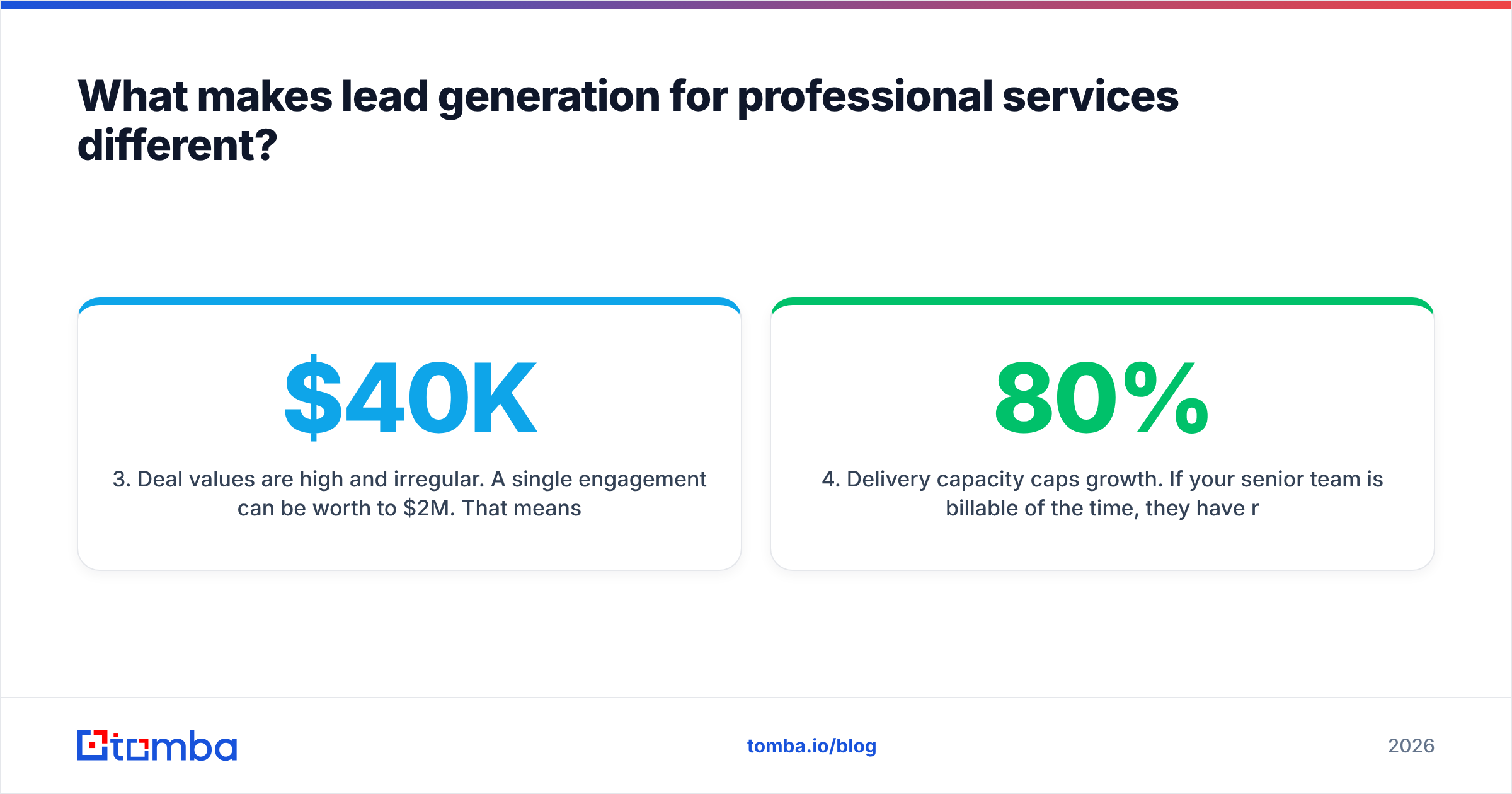
- Deal values are high and irregular. A single engagement can be worth $40K to $2M. That means you can spend far more per lead than a SaaS company — and you should be far pickier about which leads you chase.
- Delivery capacity caps growth. If your senior team is billable 80% of the time, they have roughly six hours a week for business development. Every hour of that spent on an unqualified conversation is lost margin.
Put those together and the conclusion writes itself: you want fewer, better-qualified conversations with people who already have some reason to believe you're credible.

Which channels actually generate professional services leads?#
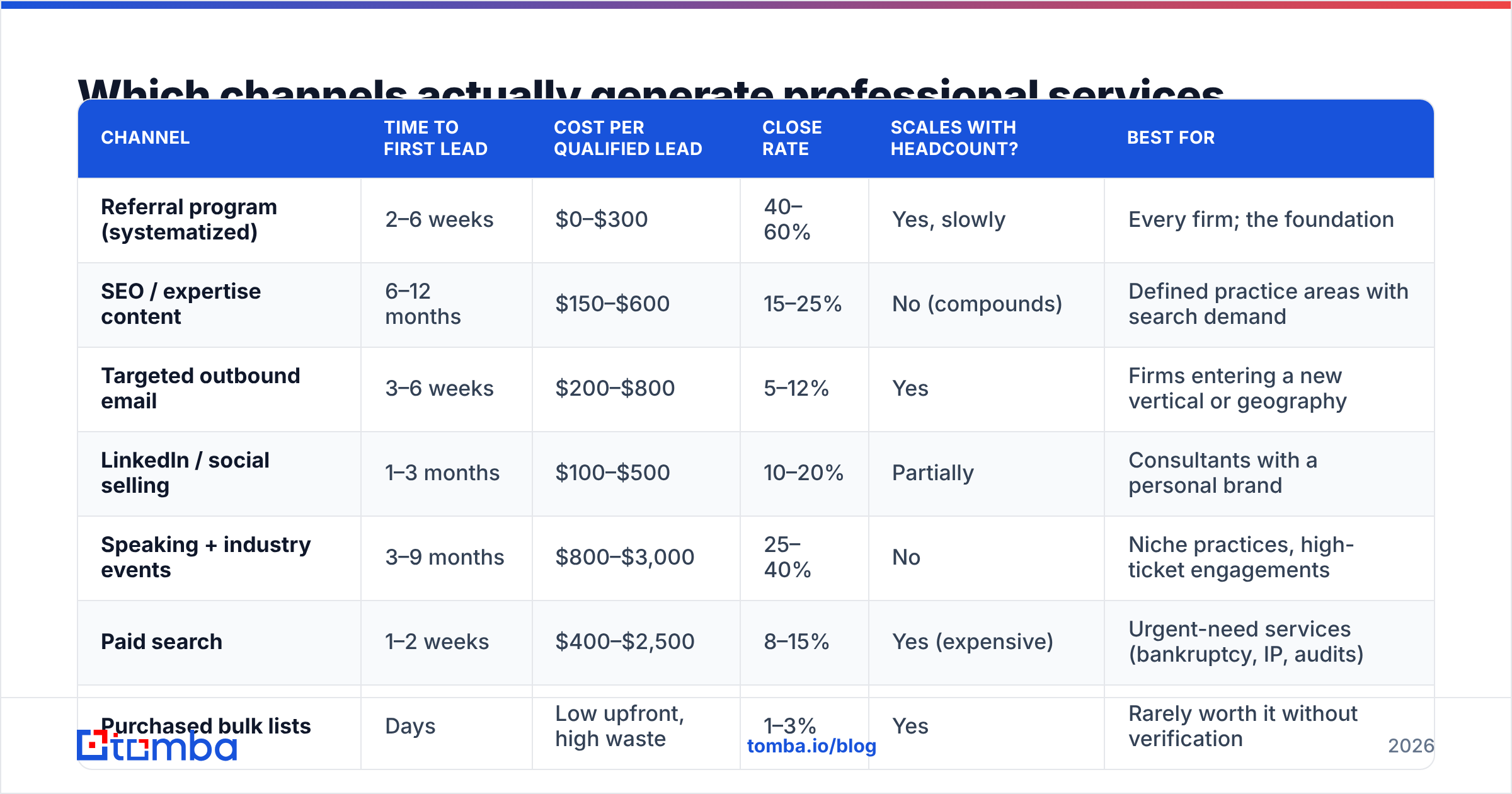
Here's how the main options compare for a typical 20–200 person firm. "Time to first lead" assumes you're starting from nothing.
| Channel | Time to first lead | Cost per qualified lead | Close rate | Scales with headcount? | Best for |
|---|---|---|---|---|---|
| Referral program (systematized) | 2–6 weeks | $0–$300 | 40–60% | Yes, slowly | Every firm; the foundation |
| SEO / expertise content | 6–12 months | $150–$600 | 15–25% | No (compounds) | Defined practice areas with search demand |
| Targeted outbound email | 3–6 weeks | $200–$800 | 5–12% | Yes | Firms entering a new vertical or geography |
| LinkedIn / social selling | 1–3 months | $100–$500 | 10–20% | Partially | Consultants with a personal brand |
| Speaking + industry events | 3–9 months | $800–$3,000 | 25–40% | No | Niche practices, high-ticket engagements |
| Paid search | 1–2 weeks | $400–$2,500 | 8–15% | Yes (expensive) | Urgent-need services (bankruptcy, IP, audits) |
| Purchased bulk lists | Days | Low upfront, high waste | 1–3% | Yes | Rarely worth it without verification |
The pattern: the cheapest channels per lead (referral, content) are the slowest to start, and the fastest channels (paid, outbound) cost the most per lead. Firms that only run one of these end up either starved or overspending. The durable answer is running referral as the base, content as the compounding layer, and outbound as the dial you turn when a specific practice area needs pipeline this quarter.
How do you build a referral engine instead of hoping for referrals?#
Most firms say referrals are their top source and then do absolutely nothing to manage them. That's not a channel — that's weather.
A systematized referral engine has five parts:
- A named referral list. Not "our network." An actual list of 50–150 people: past clients, complementary service providers (the accountants who send work to lawyers and vice versa), bankers, recruiters, former colleagues. Put it in your CRM with owners and last-contact dates.
- A specific ask. "Let us know if you hear of anything" produces nothing. "We're looking to work with Series B SaaS companies doing their first SOC 2 audit" produces a name within a month.
- A give-first cadence. Four touches a year per referral partner, at least two of which deliver something — an intro, a relevant article, a heads-up about their competitor's funding round.
- A tracked loop. Log who referred what, what closed, and what the lifetime value was. Then thank people disproportionately.
- A reciprocity ledger. Track referrals you send out. In professional services, outbound referrals are the single highest-ROI business development activity most partners refuse to do systematically.
The mechanics are unglamorous and the payoff is enormous: referral-sourced engagements in professional services routinely close at 3–5x the rate of any other source, because trust transfers with the introduction.
How should a professional services firm do outbound in 2026?#
Not the way SaaS does it. You are not sending 3,000 emails a week. You're sending 40 — and each one should look like a human wrote it after reading something.
Here's the sequence that works:
Step 1 — Define the trigger, not the persona. Professional services demand is event-driven. New funding round → they need audit and employment counsel. New CFO → budget reset, vendor review. Expansion into a new state → tax nexus and licensing work. Layoffs → severance and restructuring. Build your list around events, not job titles.
Step 2 — Build the account list manually. 200–400 accounts, sourced from places your competitors ignore: state bar and licensing registries, local business journal "fastest growing companies" lists, industry association member directories, SEC and Companies House filings, conference attendee and sponsor lists, and job postings (a company hiring three compliance analysts has a compliance problem).
Step 3 — Find the right contacts and verify them. This is the step firms botch. Scraping a generic contact database gets you a 2022 email for someone who left. Use a domain search to pull the current contact structure at each target company, then run every address through an email verifier before it touches your sending domain. A bounce rate above 3% will damage your sender reputation, and unlike a SaaS company with five sending domains, most firms send from the domain their client emails also arrive on. You cannot afford to burn it.
Step 4 — Write like a professional, not a marketer. Three sentences. Reference the trigger event specifically. State what you'd want to discuss. Offer a 20-minute call, not a "quick sync." No "hope this finds you well." No calendar link in email one.
Step 5 — Follow up four times over five weeks, then stop. Add one piece of value per touch: a relevant regulatory change, a two-paragraph observation about their industry, a case example with the client name redacted. Then move them to the nurture list and re-approach at the next trigger.
Step 6 — Route to the right person internally. A partner's reply-to address gets 3–4x the response rate of a BD coordinator's. Have the partner send; have the BD team do everything else.

What data do you actually need, and where does it come from?#
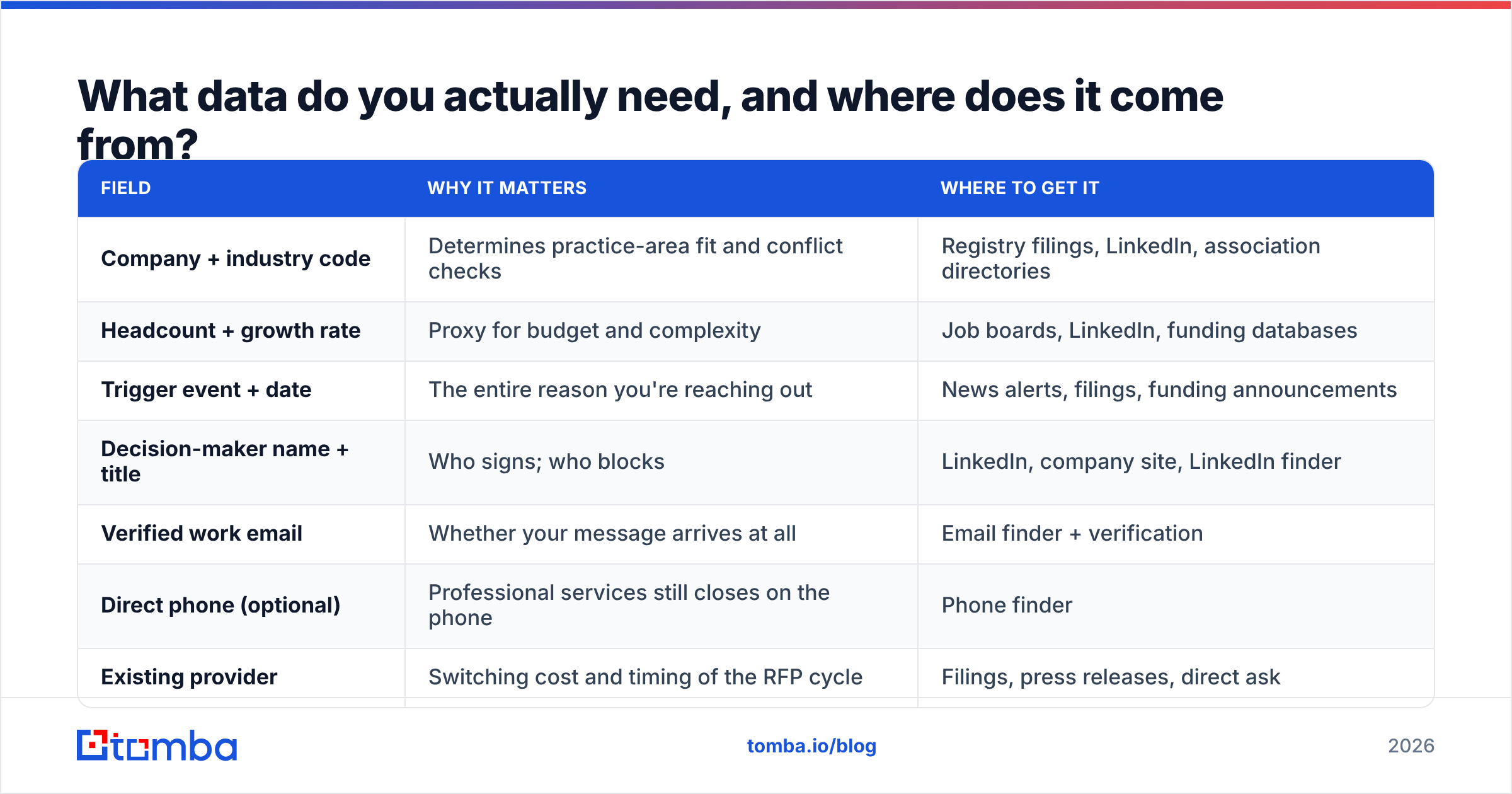
The minimum viable record for a professional services target account:
| Field | Why it matters | Where to get it |
|---|---|---|
| Company + industry code | Determines practice-area fit and conflict checks | Registry filings, LinkedIn, association directories |
| Headcount + growth rate | Proxy for budget and complexity | Job boards, LinkedIn, funding databases |
| Trigger event + date | The entire reason you're reaching out | News alerts, filings, funding announcements |
| Decision-maker name + title | Who signs; who blocks | LinkedIn, company site, LinkedIn finder |
| Verified work email | Whether your message arrives at all | Email finder + verification |
| Direct phone (optional) | Professional services still closes on the phone | Phone finder |
| Existing provider | Switching cost and timing of the RFP cycle | Filings, press releases, direct ask |
| Conflict-check status | Non-negotiable for legal and audit firms | Internal system before any outreach |
That last row is the one non-lawyers forget. If you're a law firm, every name on your outbound list must clear conflicts before the first email. Build the check into your list-building workflow, not after someone replies.
On sourcing: enrichment platforms differ mainly in coverage and freshness, not features. A database with 700M records is useless if the 40 people you care about are stale in it. Test any provider on a sample of 50 accounts you already know the answers for, and measure accuracy on those — not on the vendor's published claims. Both general B2B databases (Apollo, ZoomInfo, BookYourData) and finder-first tools (Tomba, Hunter, Findymail) can work; the deciding factor is which one is accurate on your particular slice of the market. Check independent reviews on G2 before committing to an annual contract, and run the sample test regardless.
What does expertise content look like when it's actually working?#
Content marketing for professional services isn't blogging. It's publishing the specific answer to the specific question a buyer types at 11pm when the problem lands on their desk.
The format that works:
- Regulatory and deadline explainers. "What the 2026 [specific rule] change means for [specific industry]." High intent, low competition, ages into an evergreen asset you refresh annually.
- Cost and process transparency. "What a SOC 2 Type II audit actually costs." Almost no firm publishes this. The ones that do capture the entire consideration-stage search volume for their vertical.
- Decision frameworks. "When to bring litigation in-house vs. outside counsel." Positions you as an advisor before the engagement exists.
- Annotated case studies. Situation, constraint, what you did, measurable outcome. Anonymized if you must, but with real numbers.
- Original data. A survey of 200 CFOs in your niche will out-earn 50 generic blog posts. It also gives your partners something to be quoted about in the trade press.
The distribution half matters as much as the writing. Every piece should go to your referral list, your email nurture, the relevant LinkedIn audience, and — if it's genuinely original — to the three trade journalists who cover your space. You can find the right journalists and their current addresses with an author finder rather than emailing a generic press inbox. HubSpot's ongoing State of Marketing research consistently finds that distribution effort, not production volume, separates content programs that generate pipeline from those that don't.
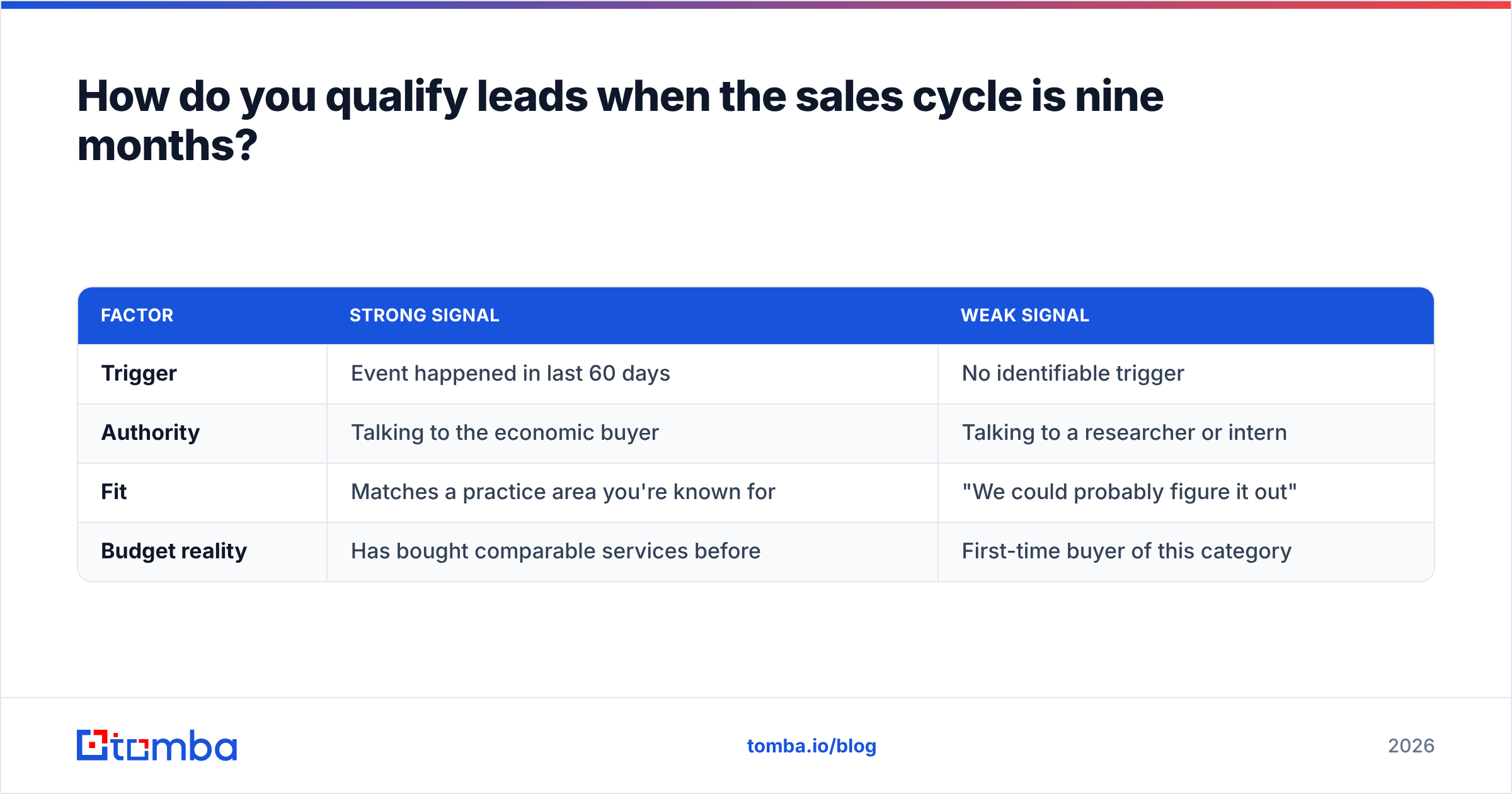
How do you qualify leads when the sales cycle is nine months?#
Use a simple, four-factor score that a partner can apply in 90 seconds:
| Factor | Strong signal | Weak signal |
|---|---|---|
| Trigger | Event happened in last 60 days | No identifiable trigger |
| Authority | Talking to the economic buyer | Talking to a researcher or intern |
| Fit | Matches a practice area you're known for | "We could probably figure it out" |
| Budget reality | Has bought comparable services before | First-time buyer of this category |
Two or more weak signals? Nurture, don't pursue. This is the discipline most firms lack, and it's why partner time evaporates. Track your win rate by source and by score band for two quarters and the pattern will be obvious enough to end the argument internally.
On metrics: stop reporting leads. Report cost per signed engagement, pipeline-to-close lag, source-weighted win rate, and partner hours per closed deal. Those four numbers tell you where to put next quarter's budget. Lead counts tell you nothing when one lead is worth $15K and another is worth $600K.
What does the first 90 days look like?#
If you're starting from referrals-and-luck, this is the order of operations:
Weeks 1–3: Build the referral list. Interview your last 20 clients on how they found you. Define two trigger events you can detect reliably. Pick one practice area to focus everything on — spreading across five at once is the most common failure mode.
Weeks 4–6: Build the 300-account target list for that practice area. Enrich and verify contacts. Clear conflicts. Set up the sending infrastructure properly: SPF, DKIM, DMARC, a separate sending subdomain if volume warrants it, and a realistic warmup ramp. Check your setup with an SPF checker before you send anything.
Weeks 7–10: Launch outbound at 40 emails a week from a partner's address. Publish the first two content pieces. Run the first referral-partner touch cycle.
Weeks 11–13: Review. Which trigger produced replies? Which content piece got shared? Which referral partner actually sent something? Double the thing that worked and kill the thing that didn't. Then repeat with the next practice area.
Ninety days won't produce a full pipeline in a business with a nine-month cycle. It will produce the leading indicators — reply rates, meeting counts, referral flow — that tell you whether the system is going to work before you've spent a year finding out.
Where does this leave you?#
Professional services lead generation rewards patience and precision over volume. The firms that win aren't the ones sending the most emails; they're the ones who defined a narrow enough ideal client that a 40-email week can actually reach most of the market, and who backed that up with contact data accurate enough that the emails arrive.
If you're building that target list now, the data step is where most of the effort leaks. Use Tomba Email Finder to pull verified professional addresses by company domain or by name, run them through verification before they touch your sending domain, and start with the free tier's 25 searches to test accuracy on accounts where you already know the answer. Paid plans start at $49/mo on Starter and $99/mo on Growth — see Tomba pricing for the full breakdown. Build the list once, verify it properly, and spend your partners' hours on conversations instead of bounced mail.
Related guides#
// get started
Find, verify and enrich your first contacts today
Start on the free plan with 25 searches a month, then scale when your team is ready.
Free plan · No credit card required · GDPR & CCPA
// about the author