Lead Generation for Startups: The 2026 No-Fluff Playbook
Most startup lead gen advice assumes a team of five and a $20k/mo budget. This is the version that works with one founder, one list, and a sub-$300 tool stack — with the numbers to back each channel.
TL;DR
- Lead generation for startups is a cost-per-meeting problem, not a tactics problem. Pick channels by payback period, not by what's trendy on LinkedIn.
- Before seed, founder-led outbound plus warm intros beats every paid channel on cost. After ~$1M ARR, content and partnerships start compounding and outbound stops being your only lever.
- Your list quality decides 60-70% of cold email outcomes. A verified 400-contact list beats a scraped 4,000-contact list on replies, deliverability, and sanity.
- Budget roughly $200-$400/month for a functioning data + sending stack at pre-seed. Anything above $1,500/month before product-market fit is usually waste.
- Track meetings booked per 1,000 contacts and cost per qualified meeting. Open rate is theater in 2026 — Apple and Gmail have been inflating it for years.
What does lead generation for startups actually mean in 2026?#
It means buying meetings at a price your runway can survive.
That's the whole discipline. A Series C company can afford a $900 cost per qualified meeting because their ACV is $80k and their sales cycle is predictable. You, at pre-seed, probably cannot afford $200 — and more importantly, you can't afford to spend six weeks finding out.
So the framework is different from what enterprise playbooks teach. Instead of "build a demand gen engine," the startup version is five sequential decisions:
- Define one ICP narrow enough to name 200 companies. If you can't list them by hand, your ICP is a category, not a segment. "B2B SaaS" is a category. "Series A vertical SaaS companies with 10-40 employees using Stripe Billing" is a segment.
- Pick the cheapest channel that reaches that segment. Cheapest in total cost — tools plus your hours. For most pre-seed startups that's cold email or founder-led LinkedIn, not paid ads.
- Build the list yourself for the first 500 contacts. You learn the market by building it. Delegate list-building only after you know what a good-fit account looks like in the data.
- Run 30 days, measure meetings per 1,000 contacts. Not opens. Not clicks. Meetings that happen.
- Double down or kill. One channel at a time until one works. Running four half-funded channels is the most common way startups burn 6 months.
The startups that get this wrong almost always fail at step 1 and then blame step 4. They send 3,000 emails to a fuzzy audience, get nine replies, and conclude "cold email is dead." Cold email isn't dead — their targeting was.

Which lead generation channels work at which stage?#
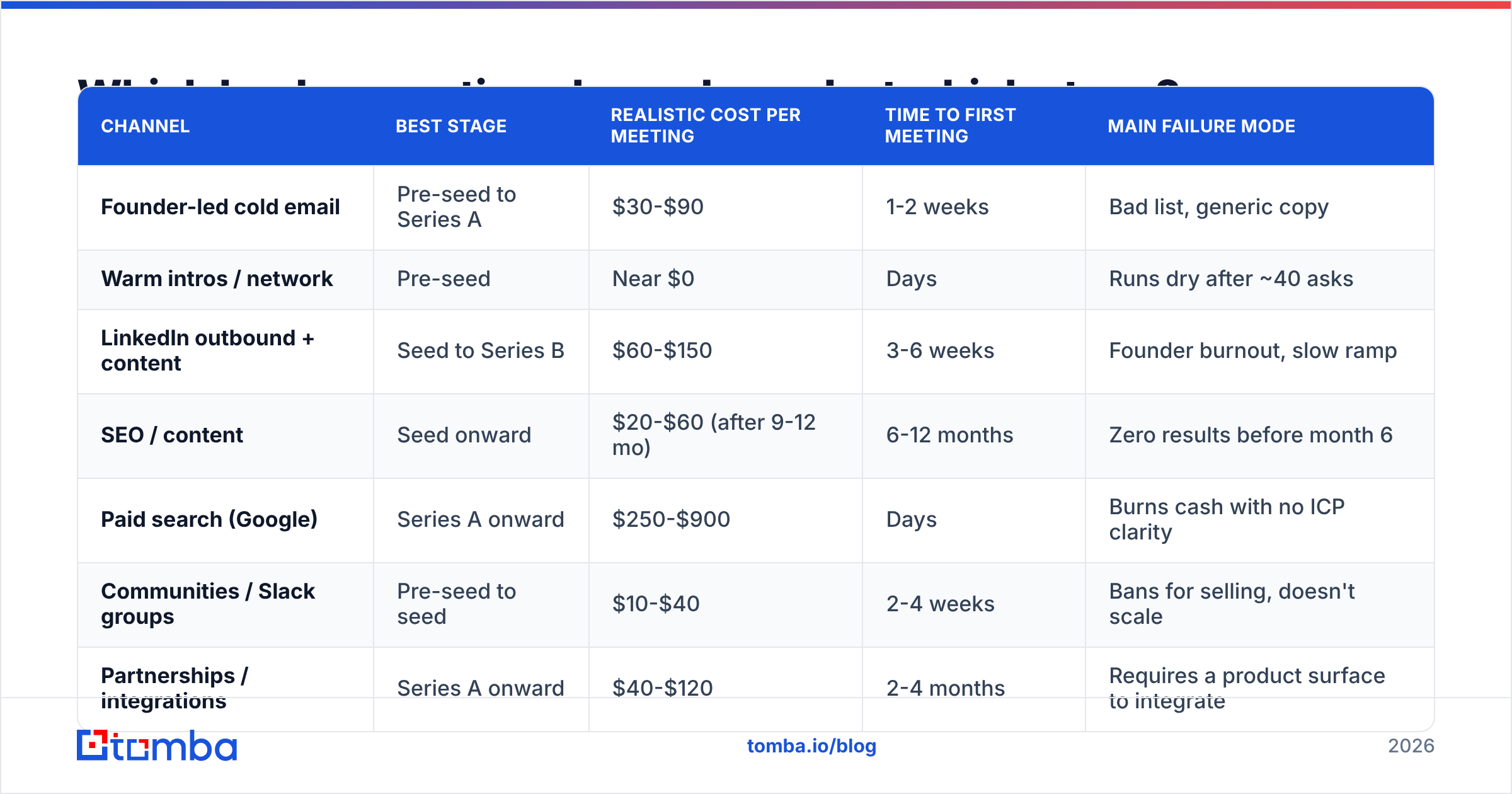
Stage matters more than channel. A tactic that prints meetings at $2M ARR can produce literally zero at pre-seed because you have no brand, no case studies, and no referral surface.
| Channel | Best stage | Realistic cost per meeting | Time to first meeting | Main failure mode |
|---|---|---|---|---|
| Founder-led cold email | Pre-seed to Series A | $30-$90 | 1-2 weeks | Bad list, generic copy |
| Warm intros / network | Pre-seed | Near $0 | Days | Runs dry after ~40 asks |
| LinkedIn outbound + content | Seed to Series B | $60-$150 | 3-6 weeks | Founder burnout, slow ramp |
| SEO / content | Seed onward | $20-$60 (after 9-12 mo) | 6-12 months | Zero results before month 6 |
| Paid search (Google) | Series A onward | $250-$900 | Days | Burns cash with no ICP clarity |
| Communities / Slack groups | Pre-seed to seed | $10-$40 | 2-4 weeks | Bans for selling, doesn't scale |
| Partnerships / integrations | Series A onward | $40-$120 | 2-4 months | Requires a product surface to integrate |
| Events / conferences | Seed onward | $400-$1,200 | Weeks | Expensive, hard to attribute |
Two readings of that table matter.
First: the cheapest channels at your stage are also the slowest to feel productive. Cold email and communities give you meetings in weeks; SEO gives them in quarters. Most startups need both running, but only one needs to be your daily focus.
Second: paid acquisition at pre-seed is almost always a mistake. Not because paid doesn't work — because paid only works when you already know exactly who converts and what message lands. Ads are an amplifier. Amplifying uncertainty is just expensive noise. HubSpot's ongoing state-of-marketing research has shown for several years running that early-stage teams consistently overestimate paid channel efficiency relative to owned outbound.
How do you build a lead list without a data team?#
You build it in three passes: source, find, verify. Most founders do the first and skip the third, which is why their domains get burned in month two.
Pass 1 — Source the companies. Start with a list of accounts, not people. Pull them from an investor portfolio page, a G2 category, a conference attendee list, a job board (companies hiring for the role that implies your problem), or a technology lookup. A website tech stack checker is underrated here: if your product complements Segment, every Segment-using company is a qualified account.
Pass 2 — Find the people. For each account, you need 1-3 named contacts with the right title. This is where a domain search does in seconds what manual research does in ten minutes — you give it a company domain and it returns the email patterns and named contacts for that organization.
Pass 3 — Verify before you send. Every contact runs through an email verifier before it touches your sending tool. This is non-negotiable. A bounce rate above 3% will get your sending domain throttled by Google and Microsoft, and recovering a burned domain takes longer than building a new list.
A concrete workflow for a founder with no ops help:
- Monday: source 100 accounts into a sheet (90 minutes)
- Tuesday: run a bulk lookup for contacts across those accounts (20 minutes with a bulk email finder, 6+ hours manually)
- Wednesday: verify, dedupe, drop anything risky or catch-all-unconfirmed (15 minutes)
- Thursday-Friday: write two sequence variants and load them
That's roughly 400-500 verified contacts a month from one founder working part-time on it. At a 4-6% reply rate and a 35% reply-to-meeting conversion, that's 7-14 meetings a month. Not a growth engine — but enough signal to know whether the message works, and enough pipeline to survive to the next raise.
What should a startup lead gen stack cost?#
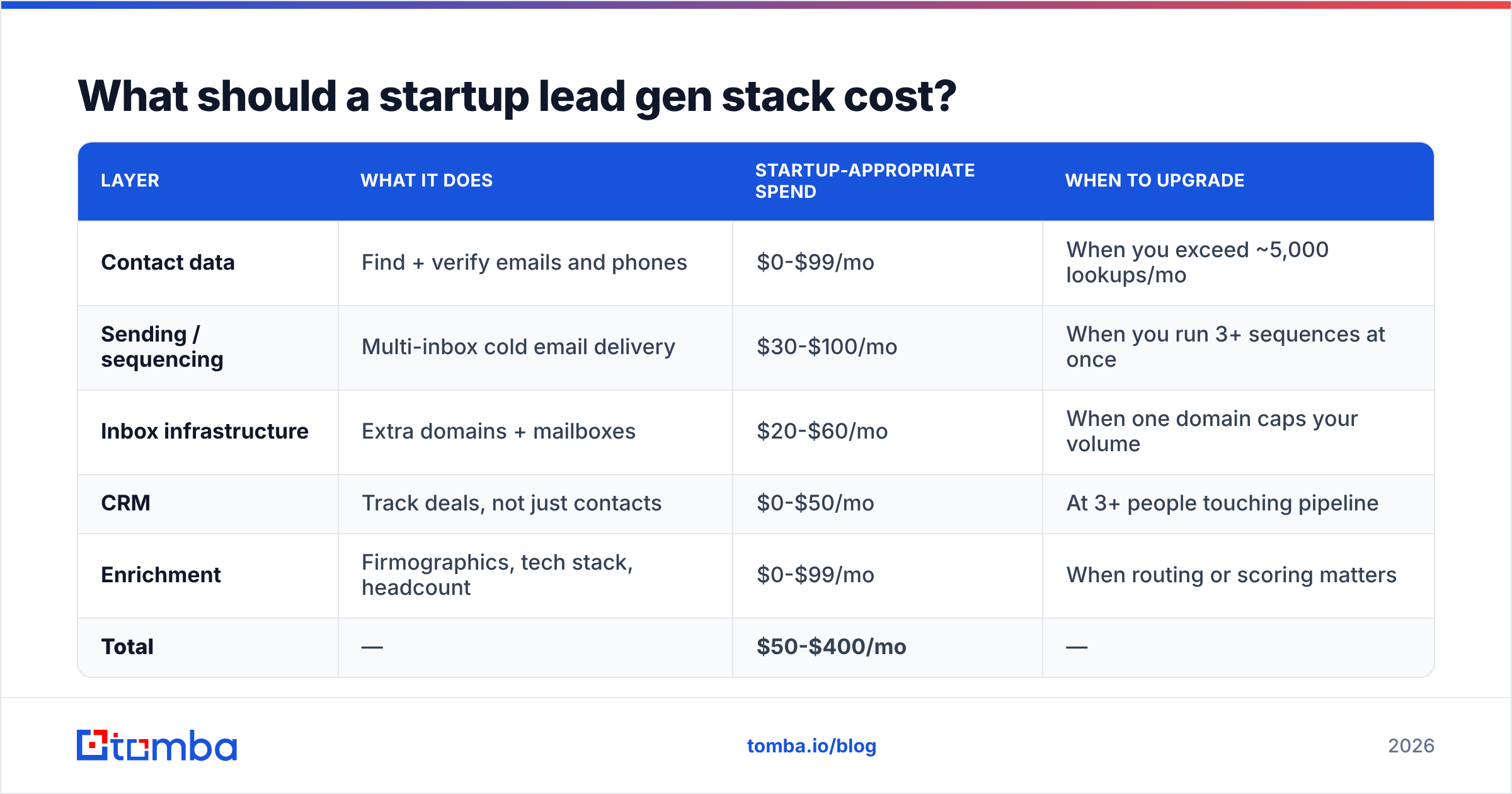
Less than you think. The stack inflation problem is real: founders buy an all-in-one platform at $500+/month when they're sending 300 emails a week.
| Layer | What it does | Startup-appropriate spend | When to upgrade |
|---|---|---|---|
| Contact data | Find + verify emails and phones | $0-$99/mo | When you exceed ~5,000 lookups/mo |
| Sending / sequencing | Multi-inbox cold email delivery | $30-$100/mo | When you run 3+ sequences at once |
| Inbox infrastructure | Extra domains + mailboxes | $20-$60/mo | When one domain caps your volume |
| CRM | Track deals, not just contacts | $0-$50/mo | At 3+ people touching pipeline |
| Enrichment | Firmographics, tech stack, headcount | $0-$99/mo | When routing or scoring matters |
| Total | — | $50-$400/mo | — |
On the data layer specifically, the free tiers matter more at this stage than the enterprise features. Tomba pricing starts with a free tier at 25 searches/month, then Starter at $49/mo, Growth at $99/mo, and Pro at $249/mo. For a pre-seed startup running 400-500 contacts a month, Starter or Growth is the honest recommendation — Pro is for when you've got a dedicated SDR or an automated pipeline hitting the email finder API on a schedule.
Compare that to the standard "buy the platform" path: a seat-based sales engagement suite at $150/seat/month plus a data provider at $500/month minimum commitment, and you're at $800/month before you've sent one email. For a company with 14 months of runway, that's roughly a full month of runway spent on tooling you'll outgrow in a different direction.
Is cold email still worth it for startups in 2026?#
Yes — but the tolerance for sloppiness is gone.
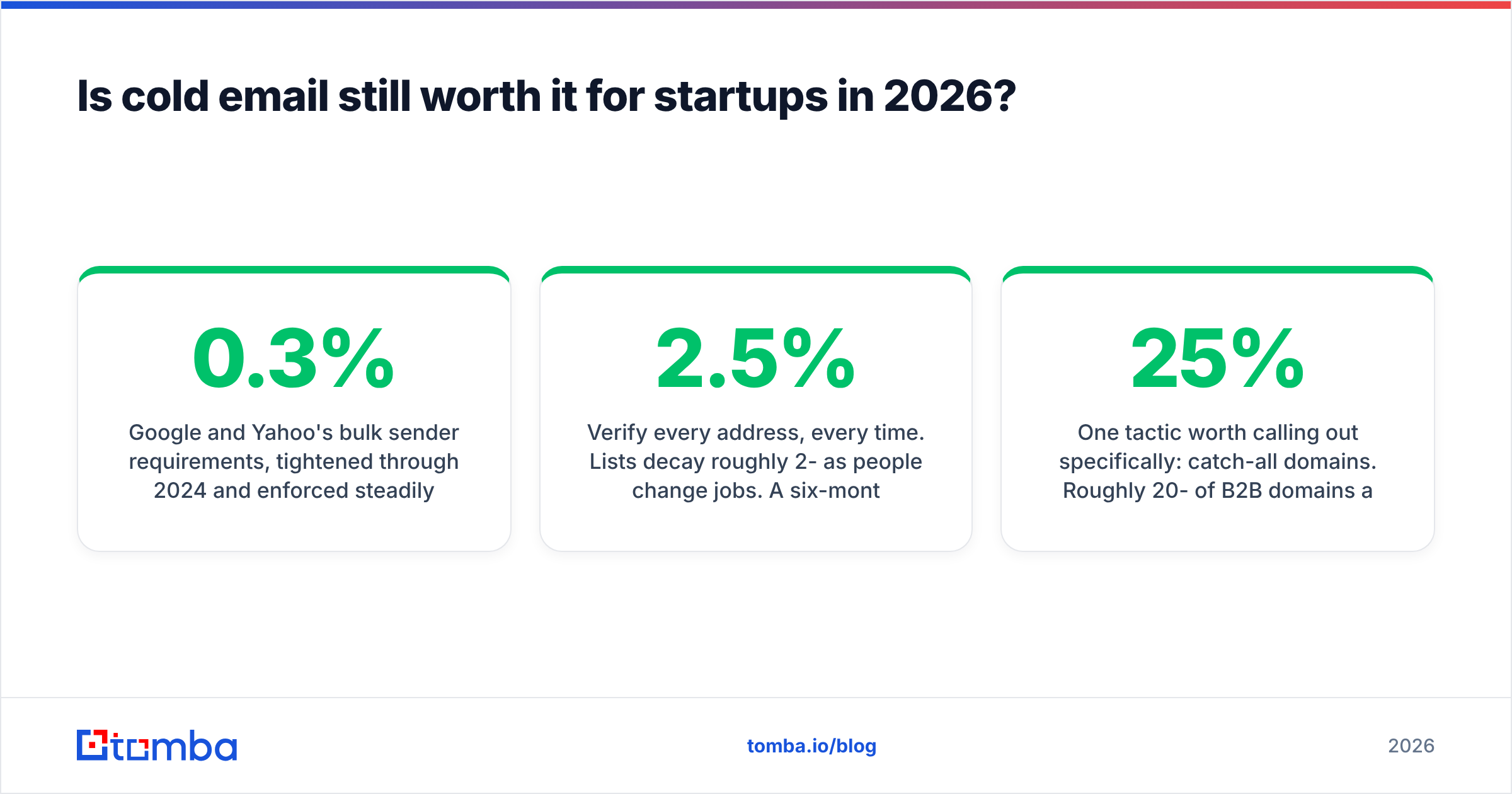
Google and Yahoo's bulk sender requirements, tightened through 2024 and enforced steadily since, killed the spray-and-pray model. You now need authenticated sending (SPF, DKIM, DMARC), a complaint rate under 0.3%, and one-click unsubscribe on anything that looks like bulk. That's not a burden — it's a moat. The founders who set this up correctly get meaningfully better inbox placement than the ones who didn't, because the low-effort competition got filtered out.
The practical 2026 checklist for startup cold email:
- Separate your sending domain from your main domain. Use
getyourcompany.com, notyourcompany.com. If deliverability breaks, your corporate mail survives. - Warm up for 3-4 weeks before real volume. Ramp from 5 to 30 emails per inbox per day. Check your SPF record and DMARC alignment before you start, not after replies go missing.
- Cap at 30-40 sends per inbox per day. More inboxes, not more volume per inbox.
- Verify every address, every time. Lists decay roughly 2-2.5% per month as people change jobs. A six-month-old list is a bounce machine.
- Write for one person. If the email could go to 500 people unchanged, it will perform like it went to 500 people unchanged.
- Measure replies, not opens. Apple Mail Privacy Protection and Gmail image proxying have made open rate directionally useless since 2021. Reply rate and response rate benchmarks are what you tune against.
One tactic worth calling out specifically: catch-all domains. Roughly 20-25% of B2B domains accept all mail, which means standard verification returns "unknown." Most teams either drop these (losing real prospects) or send blindly (taking bounce risk). A catch-all verifier resolves a meaningful share of those, which typically recovers 10-15% of an otherwise-discarded list.
What metrics should a startup actually track?#
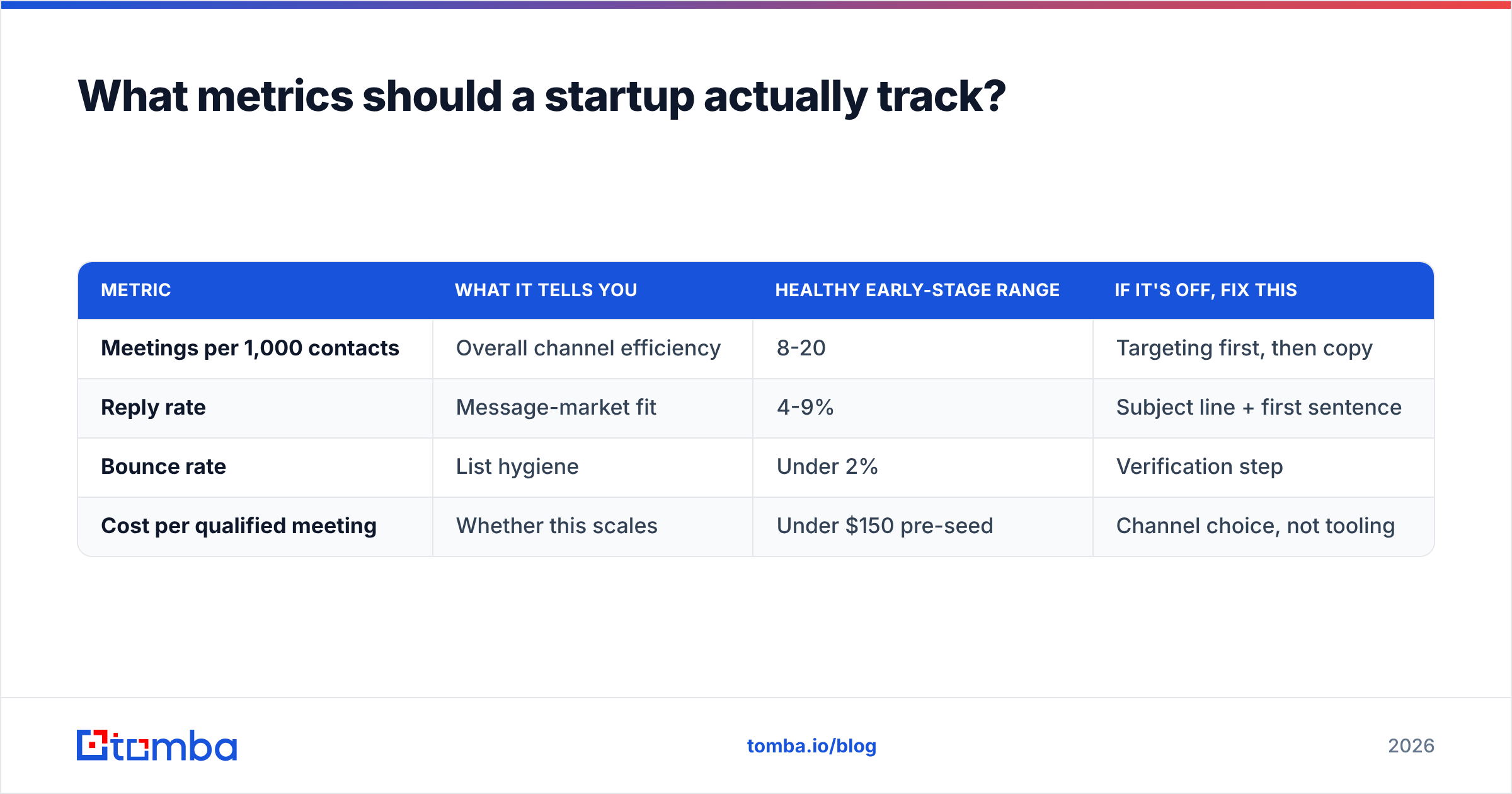
Four numbers. Everything else is a diagnostic, not a goal.
| Metric | What it tells you | Healthy early-stage range | If it's off, fix this |
|---|---|---|---|
| Meetings per 1,000 contacts | Overall channel efficiency | 8-20 | Targeting first, then copy |
| Reply rate | Message-market fit | 4-9% | Subject line + first sentence |
| Bounce rate | List hygiene | Under 2% | Verification step |
| Cost per qualified meeting | Whether this scales | Under $150 pre-seed | Channel choice, not tooling |
The reason these four and not twelve: at your volume, most metrics are noise. If you send 400 emails a month, a 5% reply rate is 20 replies. One good week moves that number by 2 percentage points. You cannot optimize a subject line at that sample size — but you can absolutely tell the difference between 20 replies and 3.
Also worth tracking, even though it's not a metric: why people said no. Ten "we already use X" replies is competitive intel. Ten "what is this" replies means your positioning is broken. Ten silences means your list is wrong. Founders who read their replies closely learn more about the market in a month than they do from a quarter of surveys.
What are the most common startup lead gen mistakes?#
Starting with volume instead of specificity. The instinct when meetings are scarce is to send more. It's almost always wrong. Cut your list by 70%, make it three times more specific, and rewrite for that segment.
Buying a static database and calling it strategy. Purchased lists are a snapshot of a market that's already moved. Tools like BookYourData do this well for teams that genuinely need pre-built volume in a known vertical, and they're a reasonable choice when speed matters more than precision. But a purchased list is an input, not a system — you still need verification on top of it and a re-enrichment cadence beneath it.
Ignoring the second channel until the first one breaks. Cold email works until a domain gets flagged or a market saturates. Start your slow channel (content, community, partnerships) in month one even though it produces nothing for six months, precisely because it produces nothing for six months.
Hiring an SDR too early. An SDR cannot find product-market fit for you. If the founder can't book meetings, a $70k junior rep with no product context definitely can't. The rule of thumb most operators converge on: don't hire your first SDR until the founder has personally booked 20+ meetings through a repeatable script.
Treating enrichment as optional. Knowing headcount, funding stage, and tech stack turns a generic email into a specific one. Contact enrichment on 400 contacts costs less than one hour of your time and typically lifts reply rates by 1-3 points because it makes personalization mechanical instead of manual.
Where should you start this week?#
Pick one segment, build 100 verified contacts, send two message variants, and read every reply. That's the entire first sprint. If you get three meetings from 100 contacts, you have a channel worth funding. If you get zero, you learned something about your ICP for the price of a week.
The data layer is the part you shouldn't improvise. Start with the Tomba Email Finder — the free tier covers 25 searches a month, which is enough to test the workflow before you commit, and Starter at $49/mo covers a realistic founder-led outbound motion. Build the list right, verify it before it ships, and let the message do the work it's supposed to do.
Sources worth reading further: HubSpot's marketing research library, G2's sales software category data, and the product-led growth literature if your model skews self-serve rather than sales-led.
Related guides#
// get started
Find, verify and enrich your first contacts today
Start on the free plan with 25 searches a month, then scale when your team is ready.
Free plan · No credit card required · GDPR & CCPA
// about the author