What Is a Lead Generation Marketplace? 2026 Buyer's Guide
Lead marketplaces sell you pipeline by the row, the lead, or the appointment. Here's how the pricing models really work, what the refund policies hide, and when sourcing your own contacts beats buying them.
TL;DR
- A lead generation marketplace is any platform where you pay for contact records, intent signals, or booked appointments that someone else sourced — priced per credit, per lead, or per meeting.
- Three models dominate in 2026: database marketplaces (buy verified contact rows), pay-per-lead exchanges (buy an inbound inquiry), and appointment marketplaces (buy a calendar slot).
- Cost per usable contact, not sticker price, is the only number that matters. A $0.03 record with 60% deliverability is more expensive than a $0.12 record at 96%.
- Exclusivity and refund windows are where marketplaces quietly claw back margin. Read the credit-return policy before you read the pricing page.
- For most outbound teams, a hybrid wins: buy the account list, source and verify the contacts yourself with an email finder so the data is fresh on the day you send.
What is a lead generation marketplace?#
A lead generation marketplace is a platform that sits between people who have leads and people who want them. Think of it as a wholesale fish market: suppliers bring in catch of wildly varying freshness, the market sets a price per kilo, and the buyer who inspects the gills gets a better dinner than the buyer who trusts the sign.
Technically, a marketplace differs from a standard data vendor in one way: the inventory is aggregated from multiple suppliers rather than produced by a single first-party crawler. That aggregation is the entire value proposition — breadth, instant availability, no build time — and it is also the entire risk, because you inherit every supplier's sourcing and refresh habits at once.
The category has broadened a lot since the old "buy a list" era. Lead generation now covers everything from a $99 CSV of HR directors to a $350 per-meeting appointment-setting exchange. They all call themselves marketplaces. They are not the same product.
How does a lead generation marketplace actually work?#
Strip away the branding and every marketplace runs the same five-step loop:
- Supply aggregation. Suppliers — data brokers, publisher networks, affiliate sites, contributory contact databases, or outsourced SDR shops — push inventory into the platform. Some platforms buy inventory outright; others take a percentage of each transaction.
- Normalisation and scoring. Records are deduplicated, field-mapped, and assigned a confidence score. This is where quality is won or lost, and where marketplaces differ most. Ask what the score actually measures — SMTP acceptance, source recency, or just how many suppliers submitted the same row.
- Filtering and preview. You build a segment: industry, headcount, geography, job title, tech stack, funding stage, hiring signals. Good marketplaces show you the count and a sample before you commit credits.
- Transaction. You spend credits, subscription allowance, or a per-lead fee. Some platforms charge on reveal, some on export, some on delivery of a valid response only.
- Guarantee and clawback. A bounce, a disconnected number, or a disputed lead triggers a credit return — inside a window, up to a cap, subject to proof. This step is the real contract.
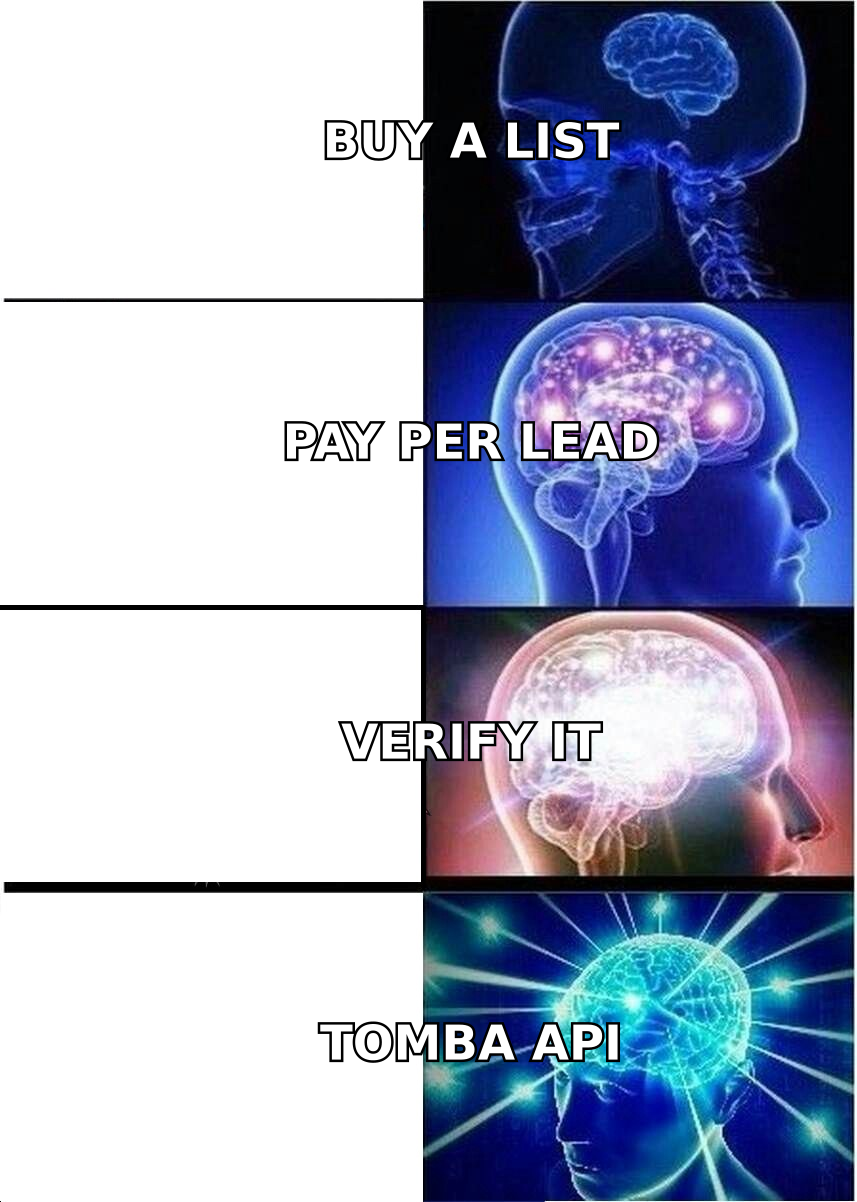
Step 5 deserves a second read. A "99% accuracy guarantee" that refunds credits within 7 days but caps returns at 5% of the order is a very different product from one that credits every hard bounce for 30 days with no cap. Both market themselves identically.
What are the main types of lead marketplaces?#
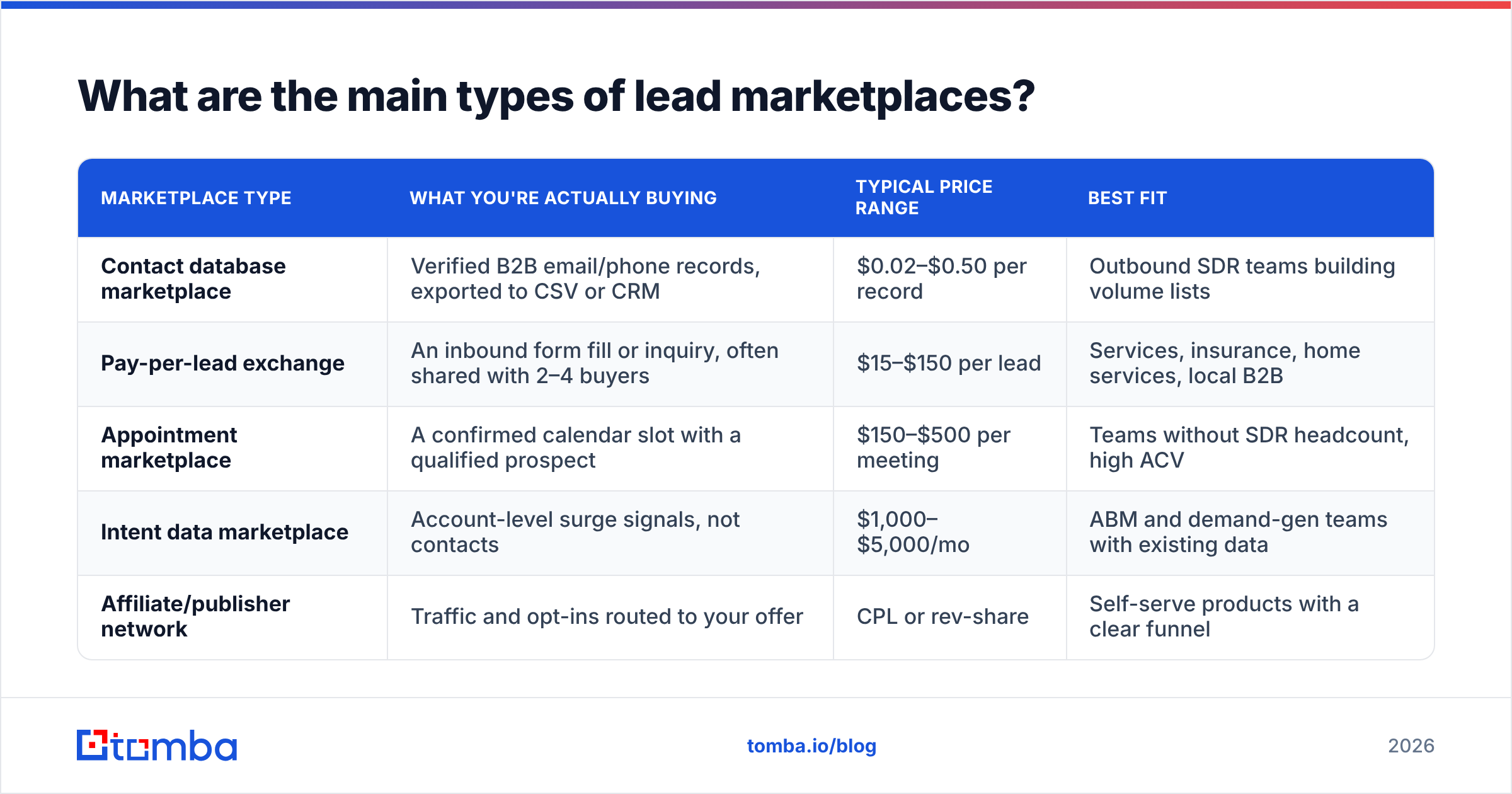
| Marketplace type | What you're actually buying | Typical price range | Best fit |
|---|---|---|---|
| Contact database marketplace | Verified B2B email/phone records, exported to CSV or CRM | $0.02–$0.50 per record | Outbound SDR teams building volume lists |
| Pay-per-lead exchange | An inbound form fill or inquiry, often shared with 2–4 buyers | $15–$150 per lead | Services, insurance, home services, local B2B |
| Appointment marketplace | A confirmed calendar slot with a qualified prospect | $150–$500 per meeting | Teams without SDR headcount, high ACV |
| Intent data marketplace | Account-level surge signals, not contacts | $1,000–$5,000/mo | ABM and demand-gen teams with existing data |
| Affiliate/publisher network | Traffic and opt-ins routed to your offer | CPL or rev-share | Self-serve products with a clear funnel |
The mistake teams make is comparing across rows. A $0.10 database record and a $250 appointment are not competing purchases — one is raw material, the other is a finished good. Compare within a row, then decide which row your funnel actually needs.
Among database marketplaces, platforms like BookYourData built a credible following on a pay-as-you-go model with verified records and no forced annual contract — worth a look if your buying pattern is bursty rather than monthly. Broader marketplaces such as Apollo bundle data with sequencing, which is convenient but makes it harder to isolate what you're paying for; if you already own your sending stack, an Apollo alternative focused purely on data usually costs less per usable contact.
How much does a lead generation marketplace cost in 2026?#
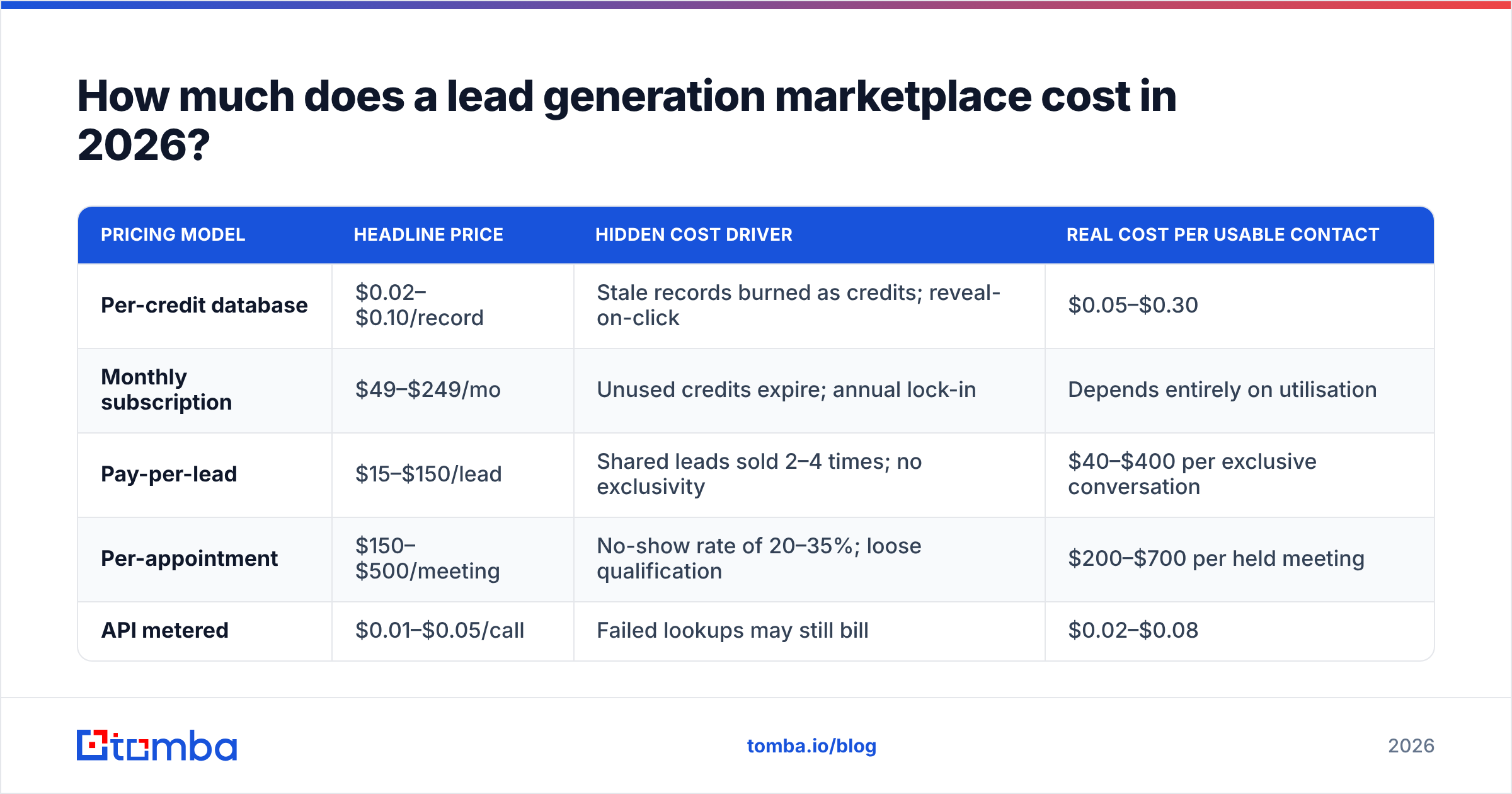
Sticker price is the least useful number on the page. Here is how the models compare once you run them through deliverability:
| Pricing model | Headline price | Hidden cost driver | Real cost per usable contact |
|---|---|---|---|
| Per-credit database | $0.02–$0.10/record | Stale records burned as credits; reveal-on-click | $0.05–$0.30 |
| Monthly subscription | $49–$249/mo | Unused credits expire; annual lock-in | Depends entirely on utilisation |
| Pay-per-lead | $15–$150/lead | Shared leads sold 2–4 times; no exclusivity | $40–$400 per exclusive conversation |
| Per-appointment | $150–$500/meeting | No-show rate of 20–35%; loose qualification | $200–$700 per held meeting |
| API metered | $0.01–$0.05/call | Failed lookups may still bill | $0.02–$0.08 |
For reference, Tomba's own pricing sits in the metered/subscription band: a free tier with 25 searches per month, Starter at $49/mo, Growth at $99/mo, Pro at $249/mo, and custom enterprise terms. You can check current allowances on the Tomba pricing page — the point here isn't the number, it's that you should compute your blended cost per delivered, replied-to contact before you compare anything.
Run this calculation on any quote:
- Cost per record × (1 ÷ deliverability rate) = cost per inbox-reachable contact
- Divide by your reply rate to get cost per conversation
- Divide by your conversion rate to get cost per opportunity
A marketplace selling at $0.04 with 65% deliverability costs $0.062 per reachable contact. One selling at $0.11 with 97% costs $0.113 — but it also doesn't torch your sender reputation with a 35% bounce rate, which is the cost nobody puts in the spreadsheet.
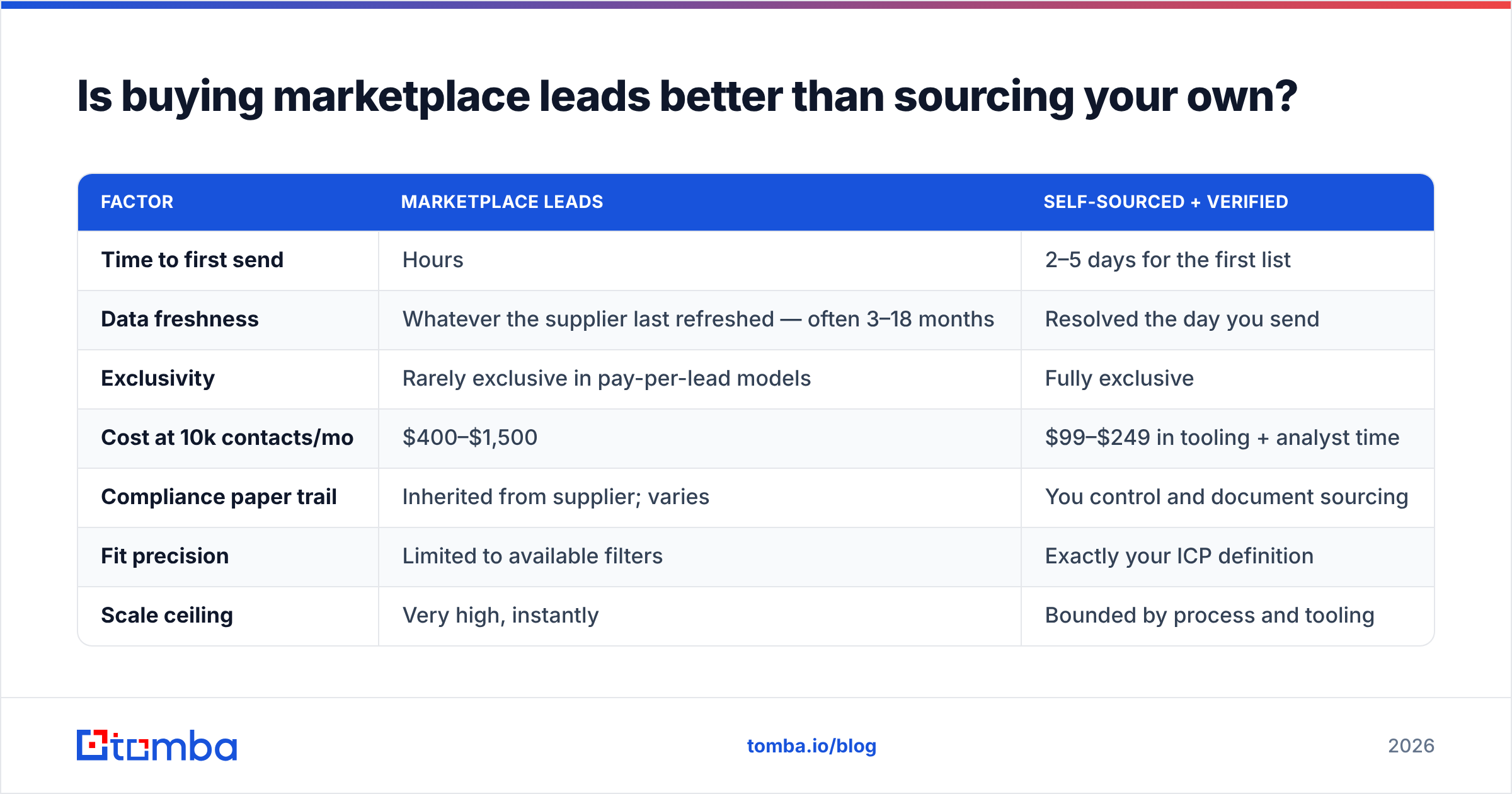
Is buying marketplace leads better than sourcing your own?#
| Factor | Marketplace leads | Self-sourced + verified |
|---|---|---|
| Time to first send | Hours | 2–5 days for the first list |
| Data freshness | Whatever the supplier last refreshed — often 3–18 months | Resolved the day you send |
| Exclusivity | Rarely exclusive in pay-per-lead models | Fully exclusive |
| Cost at 10k contacts/mo | $400–$1,500 | $99–$249 in tooling + analyst time |
| Compliance paper trail | Inherited from supplier; varies | You control and document sourcing |
| Fit precision | Limited to available filters | Exactly your ICP definition |
| Scale ceiling | Very high, instantly | Bounded by process and tooling |
Neither column wins outright. Marketplaces win on speed and on reaching segments you have no organic path into. Self-sourcing wins on freshness, exclusivity, and unit economics once you're past a few thousand contacts a month.
The honest answer for most B2B teams in 2026 is the hybrid: use a marketplace or a B2B database to build the account list — firmographics, funding, tech stack, headcount, hiring signals — then resolve the actual humans at send time. Company-level data ages slowly. Person-level data ages fast, because roughly a quarter of B2B contacts change jobs every year and every one of those changes is a bounce waiting in your CSV.
What quietly destroys ROI on marketplace leads?#
- Shared-lead economics. In pay-per-lead exchanges, the same inquiry often goes to three or four buyers. Speed-to-lead stops being an optimisation and becomes the entire game. If you can't respond in under five minutes, you're buying someone else's conversation.
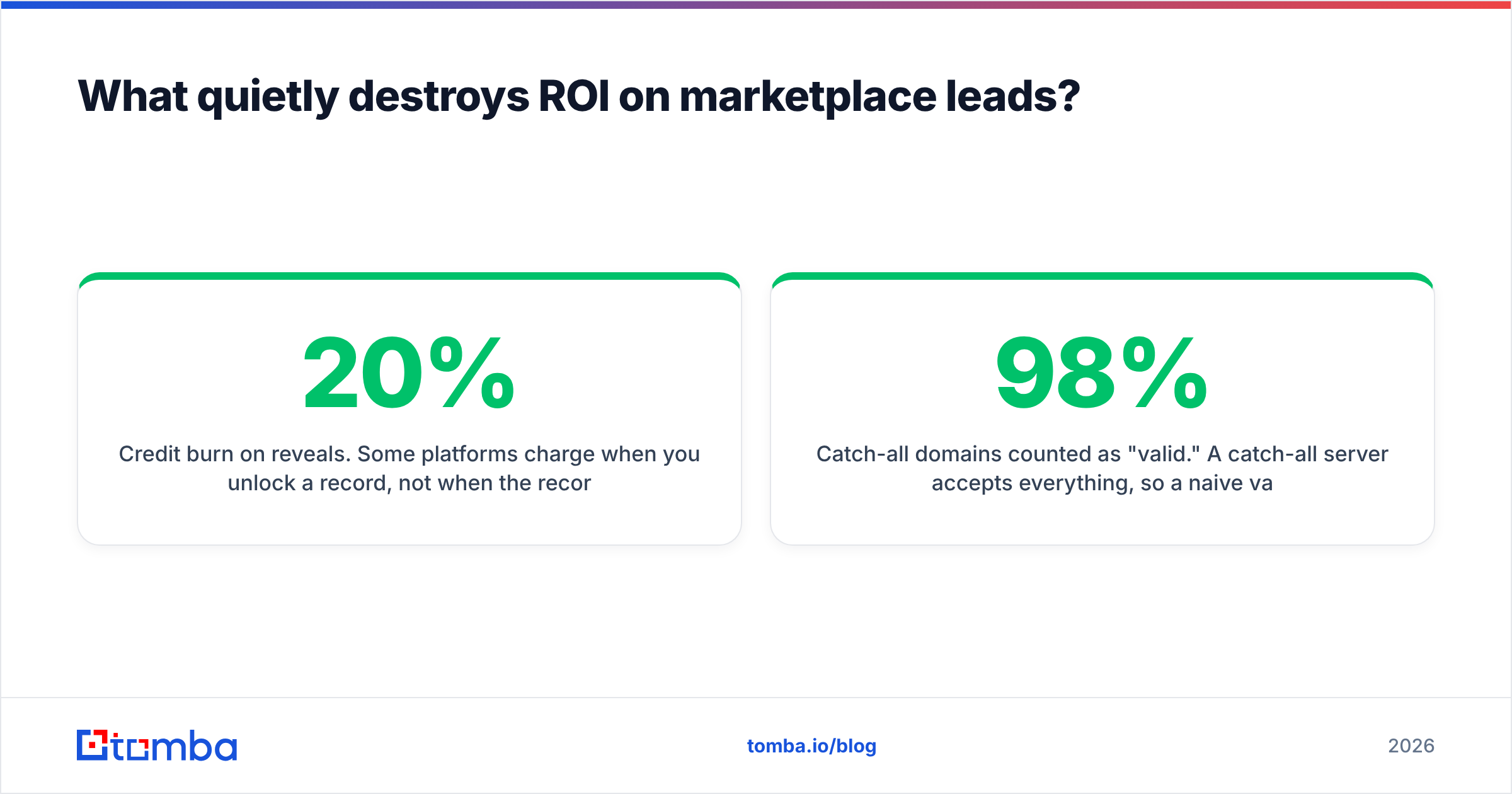
- Credit burn on reveals. Some platforms charge when you unlock a record, not when the record proves valid. Read whether a failed lookup costs a credit — at scale this is a 10–20% tax.
- Catch-all domains counted as "valid." A catch-all server accepts everything, so a naive validator marks it deliverable. It isn't. Run suspected catch-alls through a dedicated catch-all verifier before you send, or you'll ship a list that looks 98% clean and performs like 70%.
- Title inflation in filters. "VP of Marketing" at a 12-person startup and at a 12,000-person enterprise are different buyers. Marketplace filters rarely encode seniority relative to company size.
- Suppression list gaps. Marketplaces almost never know who already opted out of your emails. Deduplicate against your CRM and your unsubscribe list on every import, not every quarter.
- Silent recycling. The same records resold to you next quarter under a new segment name. Fingerprint your imports by email hash so you can see repeat inventory.

How do you vet a lead generation marketplace before you pay?#
Run a paid pilot, never a free sample. Free samples are curated; paid pilots are inventory. Buy the smallest commercial increment the platform sells and put it through this sequence:
- Export 500 records from your actual ICP filter — not a broad segment the vendor suggests.
- Verify all 500 independently. Do not trust the platform's own validity flag. Run them through a third-party email verifier and record hard bounce, catch-all, and unknown rates separately.
- Spot-check 25 records by hand. Open LinkedIn. Is the person still in that role? Is the company still operating? This single step catches more rot than any automated score.
- Check field completeness, not just email validity. How many rows have a direct phone? A real job title rather than a scraped headline? Missing fields are unbilled work for your SDRs.
- Send to 200 and measure. Bounce rate, reply rate, and the ratio of "wrong person" replies. Wrong-person replies are the cleanest signal that the marketplace's title mapping is weak.
- Test the refund process on purpose. Submit three legitimate bounces and see how long the credit takes. A platform that makes this painful during a pilot will make it impossible at scale.
Third-party review platforms help triangulate before you spend — G2 reviews are noisy but the negative ones tend to be specific about refresh cadence and refund friction, which is exactly what vendor pages omit. HubSpot's own research on lead generation benchmarks is a reasonable sanity check on what reply and conversion rates you should expect before you blame the data.
What about compliance and consent?#
Buying data doesn't transfer liability. Under GDPR, legitimate interest can cover B2B outreach in many EU jurisdictions, but you still need to document your sourcing, honour objections immediately, and be able to say where a record came from. Under CAN-SPAM, the bar is lower — accurate headers, a physical address, a working opt-out — but state-level US privacy laws increasingly add deletion rights on top.
Practical requirements before you sign:
- Written provenance. The marketplace should tell you, per record or per supplier, where the data originated. If the answer is vague, treat that inventory as high-risk.
- DPA and sub-processor list. Standard for any vendor touching personal data.
- Deletion propagation. When you delete a contact, does the marketplace stop reselling that record to you? It should, and it should say so in writing.
- Region-level opt-out handling. Some jurisdictions require opt-out honoured within days, not on your next sync.
Transparency about sourcing is a legitimate differentiator — Tomba publishes its data sources for exactly this reason, and any vendor you buy from should be able to do the same on request.
When should you skip the marketplace entirely?#
Skip it when your ICP is small and specific. If your total addressable market is 4,000 companies, you don't need a marketplace — you need a list of those 4,000 domains and a reliable way to find the right three people inside each one. A domain search run against your target account list will produce a fresher, cheaper, fully exclusive dataset than any aggregated inventory, and you'll know exactly how every row was produced.
Skip it when deliverability is fragile. New domain, cold IPs, or a recent reputation dip means you cannot afford a 20% bounce rate from an unverified batch. Source small, verify hard, send slow.
Use it when you need breadth fast: entering a new geography, testing three ICP hypotheses in a quarter, or feeding a paid-media audience where a 70% match rate is acceptable because nothing bounces.
The practical setup#
Build the account list from whatever source is cheapest and broadest — a marketplace, an intent platform, a funding database, a conference attendee list. Then resolve people at send time rather than shipping whatever the export contained. That means a finder that works from name plus domain, a verifier that handles catch-alls honestly, and an API you can call from the same job that builds the campaign.
Tomba's email finder is built for exactly that step: give it a name and a company domain, get back a verified professional address with a confidence score and the sources behind it, in bulk or through the API. Start on the free tier at 25 searches a month to benchmark it against whatever marketplace list you're already running — if your bounce rate drops and your reply rate holds, you've just found the cheapest lead in the funnel.
Related guides#
Ready to find emails that actually work?
Join 150,000+ professionals who stopped guessing and started sending. Free credits on signup — no credit card required.
Get the Tomba newsletter
Practical outbound tactics and product updates — once every two weeks.
About the author