Lead Generation Skills: The 12 That Actually Close Deals
Most lead gen training teaches tactics that expire in six months. Here are the 12 lead generation skills that still compound in 2026, how to score yourself on each, and what to fix first.
TL;DR
- Lead generation skills split into three layers: data (who to contact), judgment (who's worth contacting), and craft (what you say). Most reps over-invest in craft and under-invest in the first two.
- The single highest-leverage skill in 2026 is list construction — a great email to the wrong person loses to an average email to the right one, every time.
- Bounce discipline is now a survival skill, not hygiene. Google and Microsoft both enforce complaint-rate thresholds that make sloppy lists expensive.
- AI has commoditized writing volume, not writing judgment. The skill that survived is knowing which signal to reference, not how fast you can generate 400 variants.
- Use the self-scoring rubric near the end to find your weakest layer, then fix one skill per quarter instead of ten at once.
Lead generation has an odd training problem: almost everything published about it teaches tactics with a shelf life of about eight months, while the underlying skills barely change. Channels rotate. LinkedIn automation gets throttled. A new AI SDR launches every Tuesday. But the person who can define a tight ICP, build a clean list, and write one specific sentence about a prospect's business still outperforms the person who can't — regardless of which tool is in fashion.
This is a breakdown of the lead generation skills that actually compound, ordered by leverage, with a way to score yourself on each.
What are lead generation skills, exactly?#
Lead generation skills are the repeatable capabilities that turn a total addressable market into a set of qualified, contactable, interested buyers. Think of it like fishing: everyone argues about lures (the copy), far fewer people learn to read water (where the fish actually are), and almost nobody maintains their gear (data hygiene). The people who catch fish consistently do all three.
They break into three layers, and the layers are not equally weighted:
- Data skills — sourcing contacts, verifying them, enriching them, and keeping the record current. This is where roughly 50% of outcome variance lives, and where the least training exists.
- Judgment skills — ICP definition, qualification, signal reading, prioritization. Deciding who deserves your next 40 minutes.
- Craft skills — writing, calling, objection handling, follow-up sequencing, social selling. The visible part, and the part everyone practices.
- Systems skills — CRM hygiene, attribution, experiment design, reporting. Unglamorous, but it's what makes the other three improvable instead of anecdotal.
Most teams invert this. They run a copywriting workshop, then feed the new copy into a list scraped last year with a 22% bounce rate.

Which lead generation skills matter most in 2026?#
Here's the ranked set, with a blunt note on how each one has shifted.
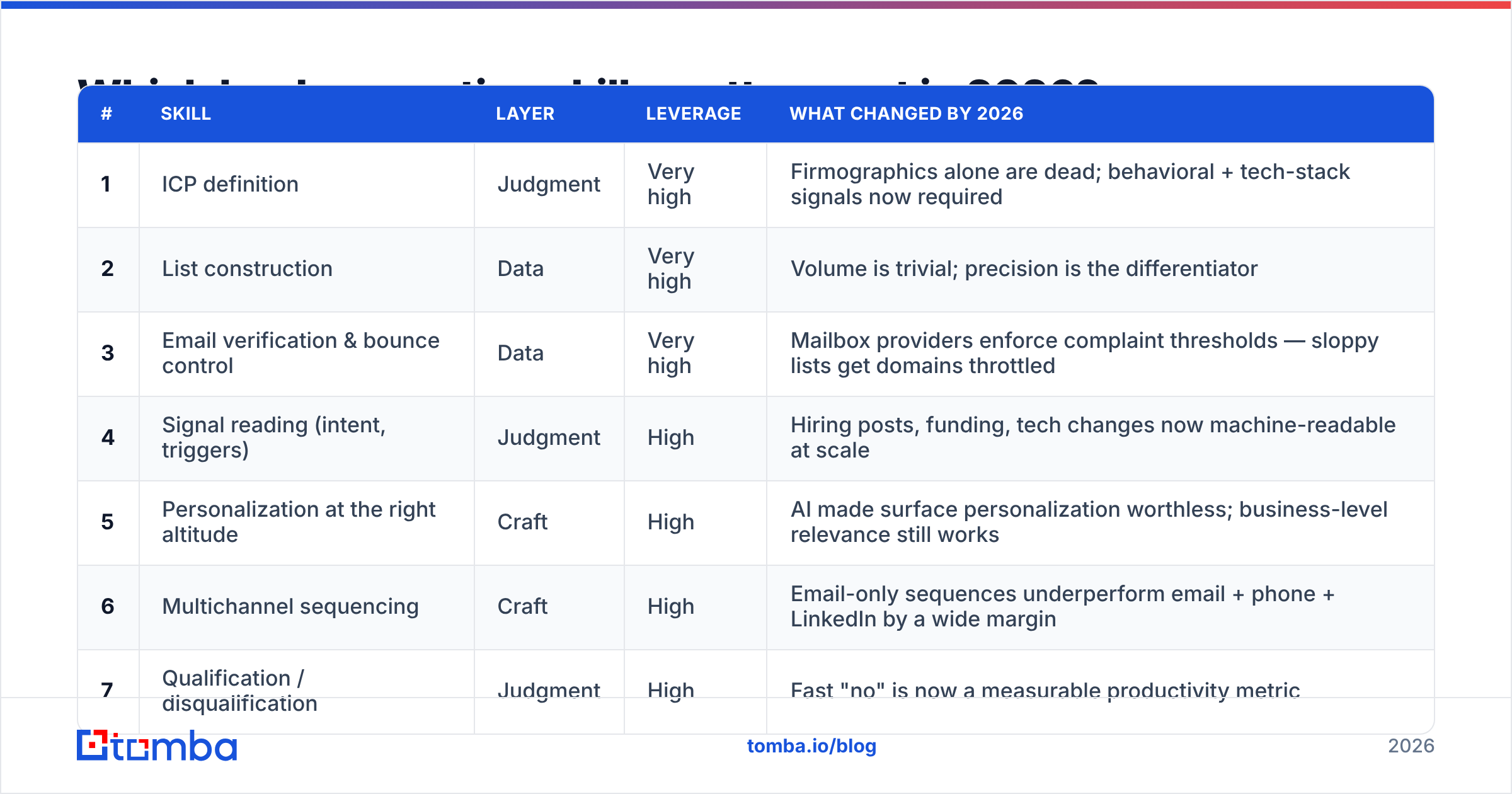
| # | Skill | Layer | Leverage | What changed by 2026 |
|---|---|---|---|---|
| 1 | ICP definition | Judgment | Very high | Firmographics alone are dead; behavioral + tech-stack signals now required |
| 2 | List construction | Data | Very high | Volume is trivial; precision is the differentiator |
| 3 | Email verification & bounce control | Data | Very high | Mailbox providers enforce complaint thresholds — sloppy lists get domains throttled |
| 4 | Signal reading (intent, triggers) | Judgment | High | Hiring posts, funding, tech changes now machine-readable at scale |
| 5 | Personalization at the right altitude | Craft | High | AI made surface personalization worthless; business-level relevance still works |
| 6 | Multichannel sequencing | Craft | High | Email-only sequences underperform email + phone + LinkedIn by a wide margin |
| 7 | Qualification / disqualification | Judgment | High | Fast "no" is now a measurable productivity metric |
| 8 | Cold calling | Craft | Medium-high | Connect rates fell, but call-backed emails still lift reply rate |
| 9 | Copywriting | Craft | Medium | Commoditized generation, scarce judgment |
| 10 | Data enrichment & CRM hygiene | Systems | Medium | Automated, but someone must own field definitions |
| 11 | Experiment design | Systems | Medium | Most teams still A/B test on samples too small to mean anything |
| 12 | Objection handling & follow-up | Craft | Medium | Persistence still beats cleverness at steps 4-7 |
Notice the top three are all pre-writing. That's the whole argument of this post.
Why is list construction the highest-leverage skill?#
Because a message's performance is capped by the relevance of the person receiving it, and no amount of craft raises that ceiling.
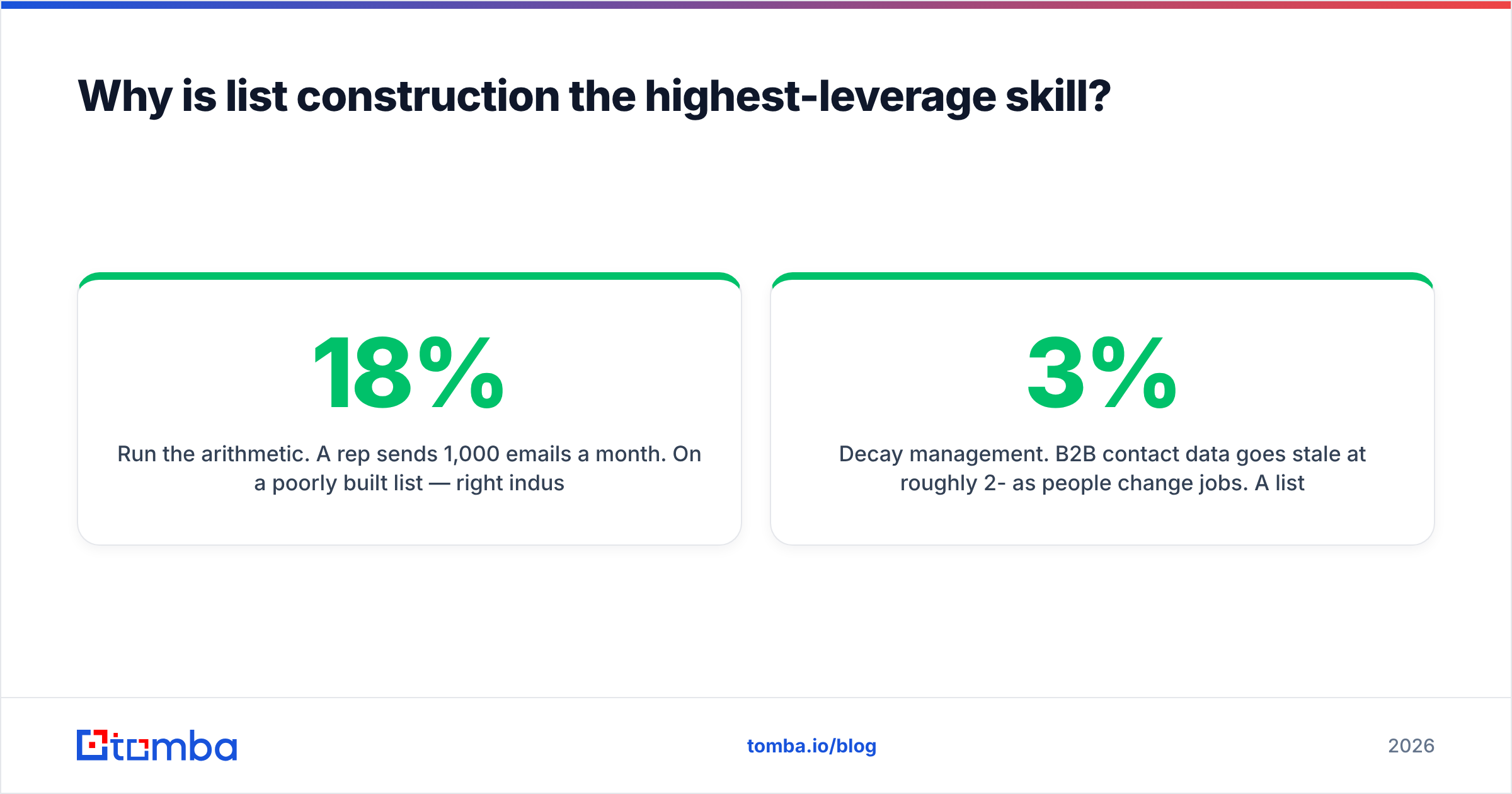
Run the arithmetic. A rep sends 1,000 emails a month. On a poorly built list — right industry, wrong seniority, stale contacts — you might see 18% bounce, 4% reply, and a 15% positive rate inside those replies. That's roughly 5 real conversations. On a tightly built list of the same size, 2% bounce, 9% reply, 35% positive gives you about 31 conversations. Same copy. Same rep. Six times the pipeline.
List construction has four sub-skills worth practicing separately:
- Boundary definition. Write down the exclusion rules before the inclusion rules. "Not agencies, not under 25 employees, not companies that raised in the last 60 days" is more useful than a vague industry filter.
- Source triangulation. Never build from one source. Cross-reference a company list (from a database or a scrape) against a job-board signal and a tech-stack check, then resolve contacts.
- Contact resolution. Turning "VP Marketing at Acme" into a verified, deliverable address. This is where an email finder or domain search does the mechanical work — but the skill is knowing which title patterns to resolve and which to skip.
- Decay management. B2B contact data goes stale at roughly 2-3% per month as people change jobs. A list you built in January is meaningfully different by June. Re-verify before every major send.
If you're building lists manually in a spreadsheet, the Google Sheets and Excel add-ins keep resolution inside the tool you're already in. For anything over a few hundred rows, bulk email finder runs are faster and less error-prone than one-by-one lookups.
How do you build the data skills nobody teaches?#
Data work is treated as an intern task, which is exactly why it's a competitive advantage for anyone who takes it seriously. Four habits separate people who are good at it:
- Know your source hierarchy. Understand where a record came from — crowd-sourced contribution, public web crawl, pattern inference, or a verified SMTP check — because each has a different failure mode. Vendors that publish data sources let you reason about this; ones that don't are asking you to trust a black box.
- Verify in tiers, not binaries. Valid, invalid, and catch-all are three different states requiring three different decisions. A catch-all domain isn't a dead address; it's an unknown one. Use a catch-all verifier to separate risky unknowns from genuinely deliverable ones rather than dumping all of them.
- Treat bounce rate as a budget. Mailbox providers watch complaint and bounce signals closely; Google's own bulk sender guidelines put a hard spam-complaint ceiling in writing. Decide your acceptable bounce rate (2% is a reasonable ceiling) and cut the list until you hit it. This protects sender reputation and, downstream, email deliverability.
- Automate resolution, not judgment. Use the Tomba API or Zapier integration to push verified contacts into your CRM automatically — but never automate the decision about who goes on the list in the first place.
Is cold calling still a lead generation skill worth learning?#
Yes, but for a different reason than it was five years ago.
Connect rates have fallen. Mobile carriers flag more outbound numbers. Nobody disputes that. What the data still supports is that calling changes the performance of your other channels — a prospect who's seen your name on a missed call and then reads your email responds at a measurably higher rate than one who's only ever seen the email.
Treat calling as a signal amplifier, not a standalone channel. That reframes the skill: you're not practicing a 12-minute discovery pitch on a cold dial, you're practicing a 40-second opener that earns either a conversation or a clean disqualification. Getting reliable mobile numbers is the input problem — a phone finder paired with a phone validator is the difference between 60 dials that connect and 60 dials into disconnected lines.
How do you compare lead generation skill levels across a team?#
Score each rep on the three layers independently. Most managers score reps on a single "performance" axis, which hides the actual gap. A rep at 30% of quota might have excellent craft and terrible data hygiene — completely different coaching than a rep with clean lists and a weak opener.
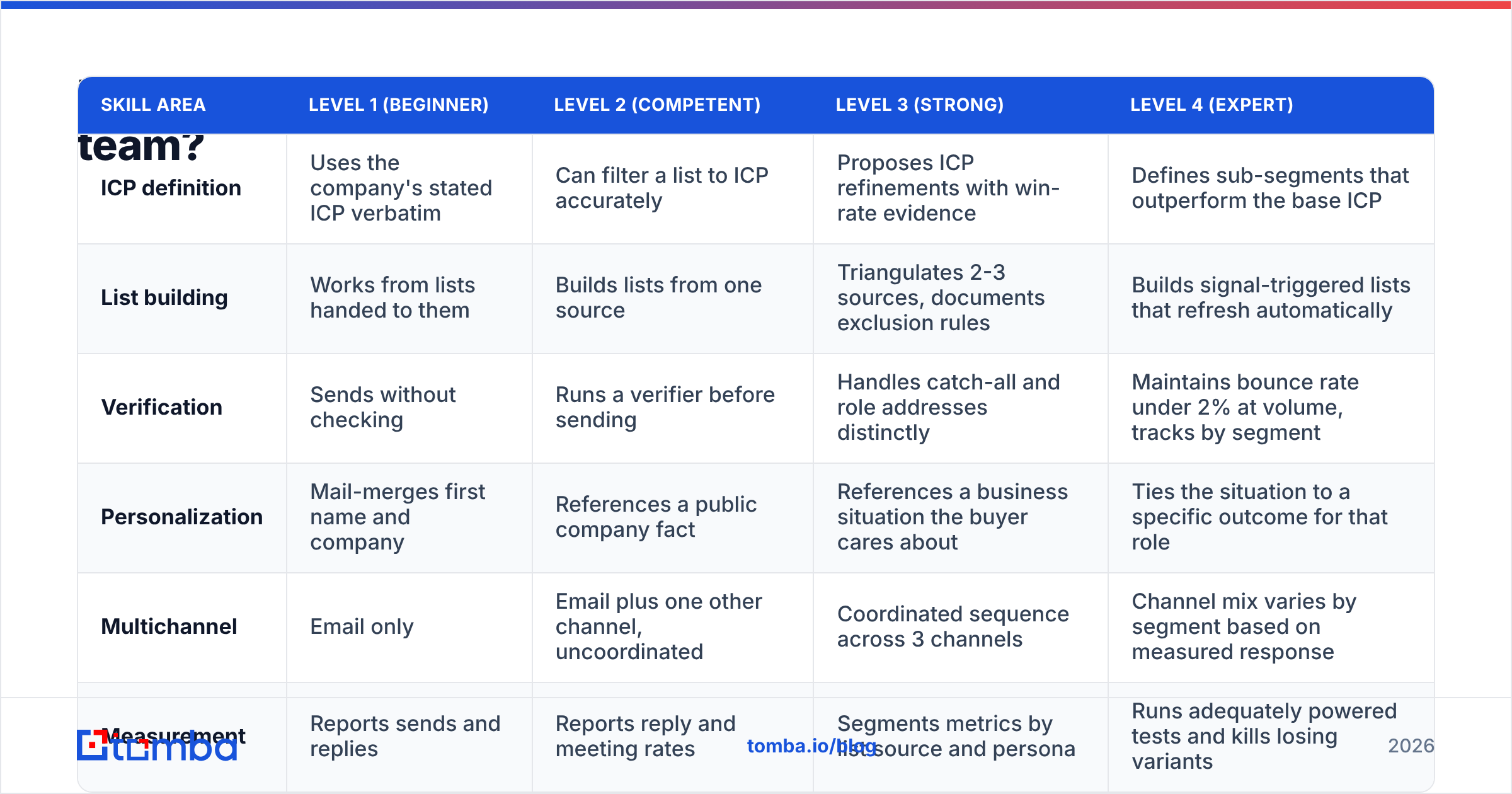
Here's a rubric you can use as-is in a QBR or a one-on-one:
| Skill area | Level 1 (Beginner) | Level 2 (Competent) | Level 3 (Strong) | Level 4 (Expert) |
|---|---|---|---|---|
| ICP definition | Uses the company's stated ICP verbatim | Can filter a list to ICP accurately | Proposes ICP refinements with win-rate evidence | Defines sub-segments that outperform the base ICP |
| List building | Works from lists handed to them | Builds lists from one source | Triangulates 2-3 sources, documents exclusion rules | Builds signal-triggered lists that refresh automatically |
| Verification | Sends without checking | Runs a verifier before sending | Handles catch-all and role addresses distinctly | Maintains bounce rate under 2% at volume, tracks by segment |
| Personalization | Mail-merges first name and company | References a public company fact | References a business situation the buyer cares about | Ties the situation to a specific outcome for that role |
| Multichannel | Email only | Email plus one other channel, uncoordinated | Coordinated sequence across 3 channels | Channel mix varies by segment based on measured response |
| Measurement | Reports sends and replies | Reports reply and meeting rates | Segments metrics by list source and persona | Runs adequately powered tests and kills losing variants |
Score honestly. The most common real-world pattern is Level 3 personalization sitting on top of Level 1 verification — good writing sent into a list that's quietly bouncing 15% of the time.

What's the fastest way to improve each skill?#
Pick one per quarter. Ten simultaneous improvements produce zero measurable ones.
If your weak layer is data: Take your last completed campaign list and re-verify it. Measure how many contacts went stale. Then rebuild that same list from scratch using exclusion rules first. Compare bounce and reply rates on the rebuild. This single exercise teaches more than any course — most people are genuinely shocked by the decay number.
If your weak layer is judgment: Pull your closed-won deals from the last 12 months and your closed-lost. Find the attributes that separate them that are not in your official ICP. Company age, whether the champion was a hire in the last 6 months, tech stack, headcount trajectory. That's your refined ICP. Gartner's B2B buying research is a useful frame for how buying groups actually make these decisions — the committee, not the individual, is your real target.
If your weak layer is craft: Stop writing new sequences. Instead take your best-performing email and write 10 versions that change only the first sentence. Send each to 200 contacts from the same list. This isolates the one variable that decides whether the rest gets read.
If your weak layer is systems: Define five CRM fields precisely and enforce them for one quarter. Lead source, persona, list source, disqualification reason, and next step. Most attribution failures are definition failures, not tooling failures.
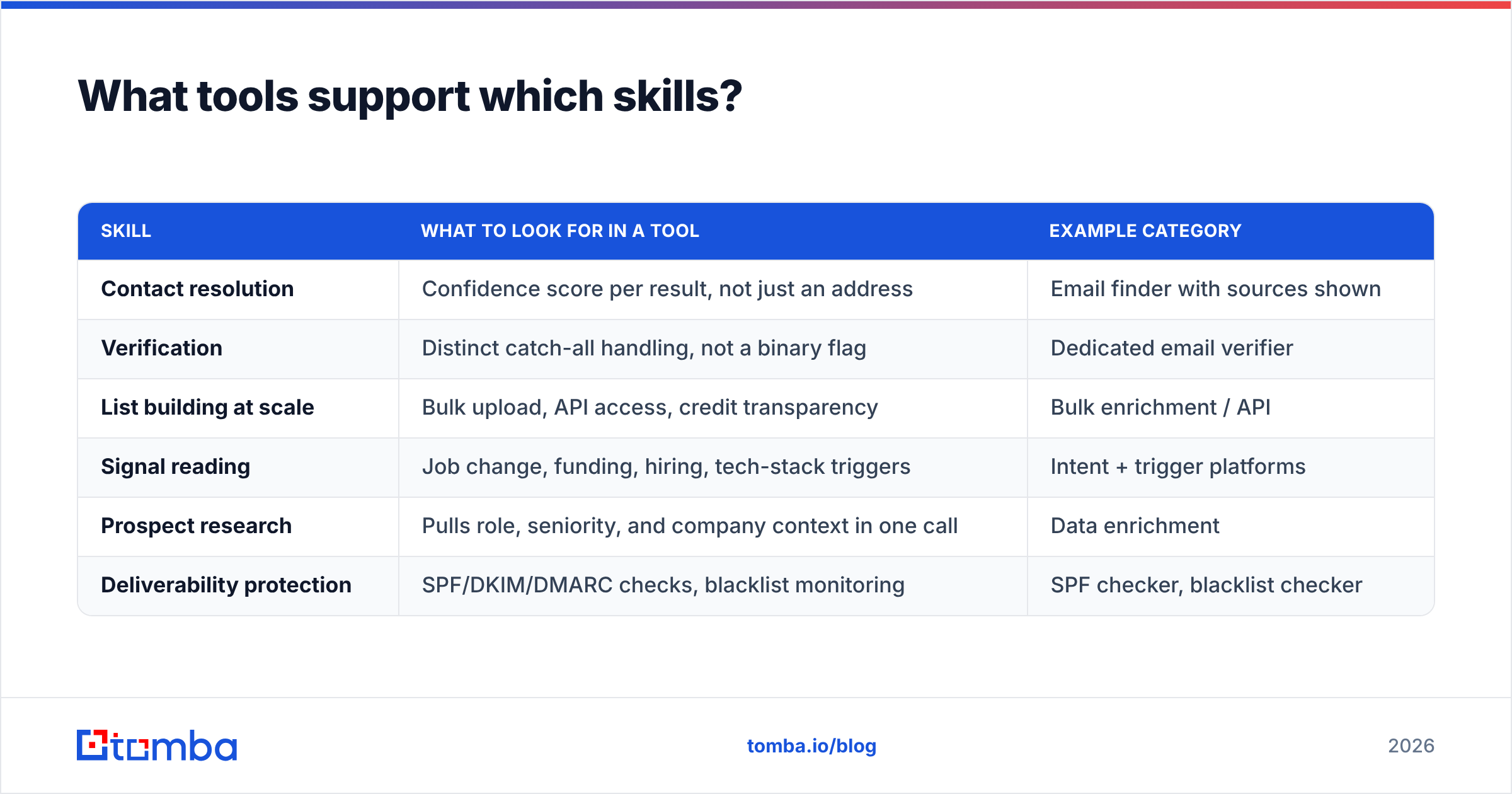
What tools support which skills?#
Tools don't replace skills, but the wrong tool makes a skill harder to practice. Rough mapping:
| Skill | What to look for in a tool | Example category |
|---|---|---|
| Contact resolution | Confidence score per result, not just an address | Email finder with sources shown |
| Verification | Distinct catch-all handling, not a binary flag | Dedicated email verifier |
| List building at scale | Bulk upload, API access, credit transparency | Bulk enrichment / API |
| Signal reading | Job change, funding, hiring, tech-stack triggers | Intent + trigger platforms |
| Prospect research | Pulls role, seniority, and company context in one call | Data enrichment |
| Deliverability protection | SPF/DKIM/DMARC checks, blacklist monitoring | SPF checker, blacklist checker |
Budget matters here too. Skill development is cheaper when tooling is cheap enough to practice with. Tomba pricing starts with a free tier at 25 searches a month, Starter at $49/mo, Growth at $99/mo, and Pro at $249/mo — enough on the free tier to run the "rebuild your last list" exercise above without a purchase order. For comparison shopping across the category generally, G2's lead intelligence grid is a reasonable neutral starting point.
Whichever vendor you land on, the evaluation criterion is the same: does the tool make your judgment better, or does it just make your output bigger? Bigger output on bad judgment is how domains get burned.
What do most lead generation training programs get wrong?#
Three things, consistently.
- They teach channels instead of skills. "LinkedIn prospecting" is not a skill; it's a venue. The underlying skills — signal reading, personalization, follow-up discipline — transfer across venues. Train the skill and the channel takes care of itself.
- They skip the boring middle. Every program covers opener frameworks and closing techniques. Almost none cover list hygiene, disqualification criteria, or how to define a CRM field. That's where the variance actually is.
- They measure activity, not decisions. Dials and sends are inputs. The skill is deciding which 200 of 2,000 possible contacts deserve the effort. Programs that reward activity volume actively train the wrong instinct.
If you're building a team enablement plan, invert the usual order: data hygiene first, ICP second, sequencing third, copy last. It feels backwards and it works.
Where should you start this week?#
Run a three-line diagnostic on your last campaign:
- What was the bounce rate? If it's above 3%, your data layer is your bottleneck and nothing else matters until it's fixed.
- What percentage of replies were "not the right person"? If it's above 15%, your judgment layer is the bottleneck.
- What was the reply rate among people who were the right person and did receive the email? If that's below 5%, now it's a craft problem.
Whichever number is worst is your quarter. Everything else is a distraction.
Start with the layer that caps everything else. Before you rewrite a single subject line, run your current prospect list through Tomba Email Finder and see what the confidence scores tell you about the list you've been trusting. The free tier covers 25 searches a month — enough to test a segment, see the bounce risk you've been carrying, and decide whether your next quarter is a data problem or a copy problem. Most people find out it was never the copy.
Related guides#
// get started
Find, verify and enrich your first contacts today
Start on the free plan with 25 searches a month, then scale when your team is ready.
Free plan · No credit card required · GDPR & CCPA
// about the author