Lead Management Process: A 7-Stage Framework for B2B Teams
Most B2B pipelines don't fail at the close. They lose leads between stages: slow follow-up, bad data, or no clear owner. Here is a 7-stage lead management process that finds those gaps and fixes them.
TL;DR
- A lead management process is the set of steps that takes a contact from first touch to closed deal, or to a clear disqualification. It has seven stages: capture, enrichment, qualification, scoring, routing, nurturing and handoff/review.
- Most pipelines lose leads between stages, not inside them. The usual causes are slow follow-up, incomplete contact data and no clear owner.
- Enrich and verify each record before you score it. If the data is wrong, the score is wrong and so is the routing.
- Write down your definitions (MQL, SQL, disqualified) and your response-time SLAs before you buy more software.
- Review the process every quarter using stage-to-stage conversion rates, not raw lead volume.
What is a lead management process?#
A lead management process is the repeatable system your team uses to capture, qualify, prioritize, assign and follow up with potential buyers until each one either becomes an opportunity or is closed out. Wikipedia's overview of lead management describes it as the methods and practices for acquiring and managing customer inquiries. In a B2B team, those practices end up split across marketing, SDRs, AEs and RevOps.
Think of it like an airport baggage system. Every bag (lead) comes in at check-in (capture), gets a tag (enrichment and scoring), goes onto the right belt (routing) and should reach the right plane (the right rep) on time. Bags rarely go missing at check-in. They go missing at the transfer points. Your pipeline works the same way.
The process is not the same thing as your CRM. The CRM stores the records. The process sets the rules: what counts as a qualified lead, who owns it, how fast they have to act, and what happens when nobody does.
Why does a lead management process matter in 2026?#
Without a defined process, three things happen:
- Leads go cold while nobody owns them. A form fill lands in a shared inbox or an unassigned CRM queue and waits. The often-cited Harvard Business Review research on online sales leads found that companies contacting leads within an hour were far more likely to qualify them than companies that waited longer. The exact multiplier has been debated since, but the direction hasn't changed.
- Reps work the wrong leads. Without scoring, reps choose leads by gut feel or by whatever is newest. High-fit accounts get the same effort as students downloading an ebook.
- Marketing and sales argue about numbers. Marketing reports 400 leads. Sales says 40 were real. Both are right, because nobody agreed on a definition.
In 2026 there's a fourth problem. Inbound volume keeps rising because of AI-generated form fills, content syndication and intent-data lists, and a growing share of it is junk. A process that treats every lead the same will hide the good ones under the noise.
What are the 7 stages of a lead management process?#
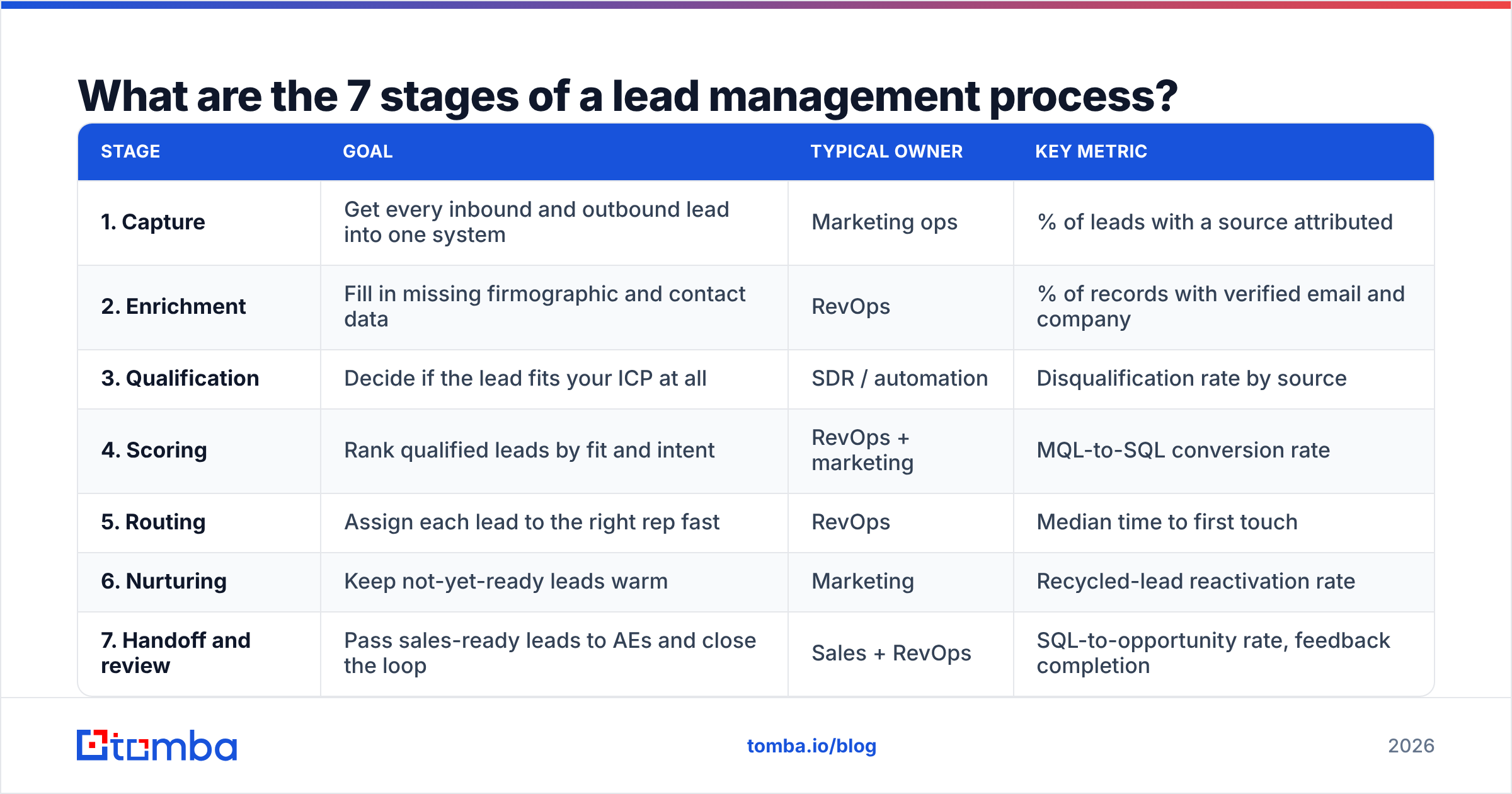
This is the framework we'll use for the rest of the post. Each stage has one job, one owner and one metric to track.
| Stage | Goal | Typical owner | Key metric |
|---|---|---|---|
| 1. Capture | Get every inbound and outbound lead into one system | Marketing ops | % of leads with a source attributed |
| 2. Enrichment | Fill in missing firmographic and contact data | RevOps | % of records with verified email and company |
| 3. Qualification | Decide if the lead fits your ICP at all | SDR / automation | Disqualification rate by source |
| 4. Scoring | Rank qualified leads by fit and intent | RevOps + marketing | MQL-to-SQL conversion rate |
| 5. Routing | Assign each lead to the right rep fast | RevOps | Median time to first touch |
| 6. Nurturing | Keep not-yet-ready leads warm | Marketing | Recycled-lead reactivation rate |
| 7. Handoff and review | Pass sales-ready leads to AEs and close the loop | Sales + RevOps | SQL-to-opportunity rate, feedback completion |
1. Capture#
Every lead source should write to the same place: web forms, chat, webinars, events, outbound lists, partner referrals, product signups. The most common failure here is shadow lists, where an SDR keeps a personal spreadsheet of event leads that never reaches the CRM.
Tag the source and campaign when the lead is created. You can't fix a leaking source if you don't know which source a lead came from.
2. Enrichment#
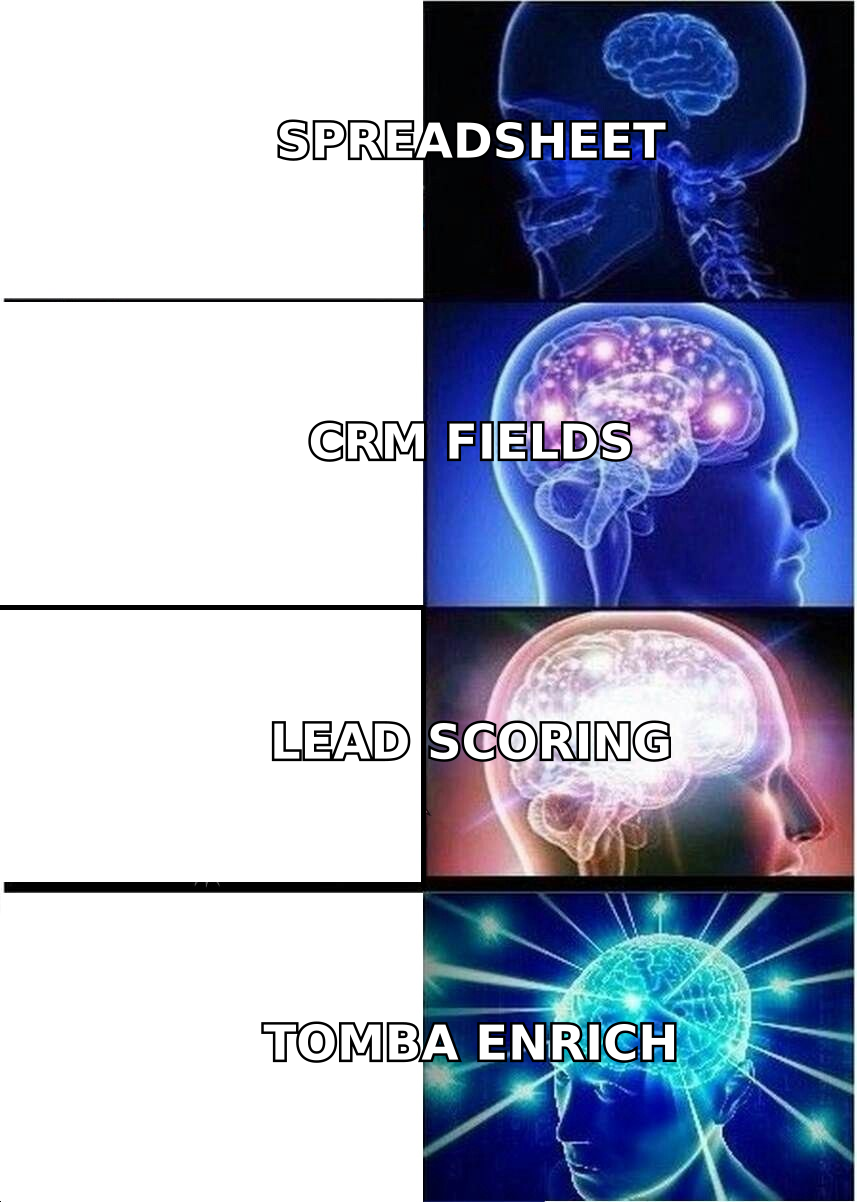
Raw leads are thin. A form might give you a name and a Gmail address. An event badge scan might give you a name and a company with no email. Enrichment adds what's missing: company size, industry, location, job title, work email, phone and LinkedIn URL.
This stage decides whether the rest of the process works. Scoring, routing and personalization all run on these fields. If "company size" is empty, your scoring model can't tell a 12-person agency from a 12,000-person enterprise, and your territory routing fails without telling anyone.
Use data enrichment at the point of capture, not in a quarterly cleanup. Then run every email through an email verifier before any sequence sends to it. A bounced first touch hurts your sender reputation, and the lead doesn't get another chance.
3. Qualification#
Qualification is a yes/no filter, not a ranking. It answers one question: could this lead ever buy from us?
Common disqualifiers:
- Competitors, students, job seekers and vendors pitching you
- Companies outside your serviceable geography
- Company size well below your minimum viable deal
- Personal emails with no company you can match
Automate the obvious disqualifiers so SDRs don't spend time on them. Keep a "disqualified: reason" field so you can check later whether a particular campaign keeps producing junk.
4. Scoring#
Scoring ranks the leads that passed qualification. Most mature teams score two dimensions separately:
- Fit score: how closely the company and contact match your ideal customer profile (industry, size, tech stack, seniority).
- Intent score: how actively they're engaging (pricing page visits, demo requests, repeat email opens, third-party intent signals).
A high-fit, low-intent lead goes to nurturing or targeted outbound. A low-fit, high-intent lead might be worth a quick call but shouldn't go to your enterprise AE. A lead that's high on both is your marketing qualified lead and should be routed immediately.
Keep the model simple at first. Ten well-chosen signals beat fifty signals nobody can explain. HubSpot's documentation on lead scoring is a reasonable reference for how a CRM-native scoring setup is usually structured, even if you don't use HubSpot.
5. Routing#
Routing gets the right lead to the right rep before interest fades. Rules are usually based on territory, account ownership (does an AE already own this account?), segment (SMB vs. mid-market vs. enterprise) and round-robin within a pod.
Two rules matter more than the rest:
- Account matching first. If the lead's company is already an open opportunity or a customer, send it to that owner, not to the next SDR in the round-robin.
- An SLA with a fallback. If the assigned rep hasn't touched the lead within the SLA window, it goes back to the pool or to a manager automatically.
6. Nurturing#
Most qualified leads aren't ready to talk yet. Nurturing keeps them engaged until they are, through content sequences, retargeting, occasional personal check-ins and event invites.
The important part is the recycle rule. When a lead goes cold after sales contact, it shouldn't just sit there. It should return to nurturing with a reason code ("no budget until Q3", "chose competitor", "no response after 6 touches") so marketing can re-engage it at the right time.
7. Handoff and review#
The handoff from SDR to AE is where context gets lost. A good handoff includes the qualification notes, the pain points found, the stakeholders identified and the next step agreed. It shouldn't be just a calendar invite.
Review closes the loop. Once a month, AEs mark whether handed-off leads were actually sales-ready. That feedback goes back into the scoring model. Without it, the scoring model keeps its original assumptions and drifts further from reality every quarter.
Where do most lead management processes leak?#
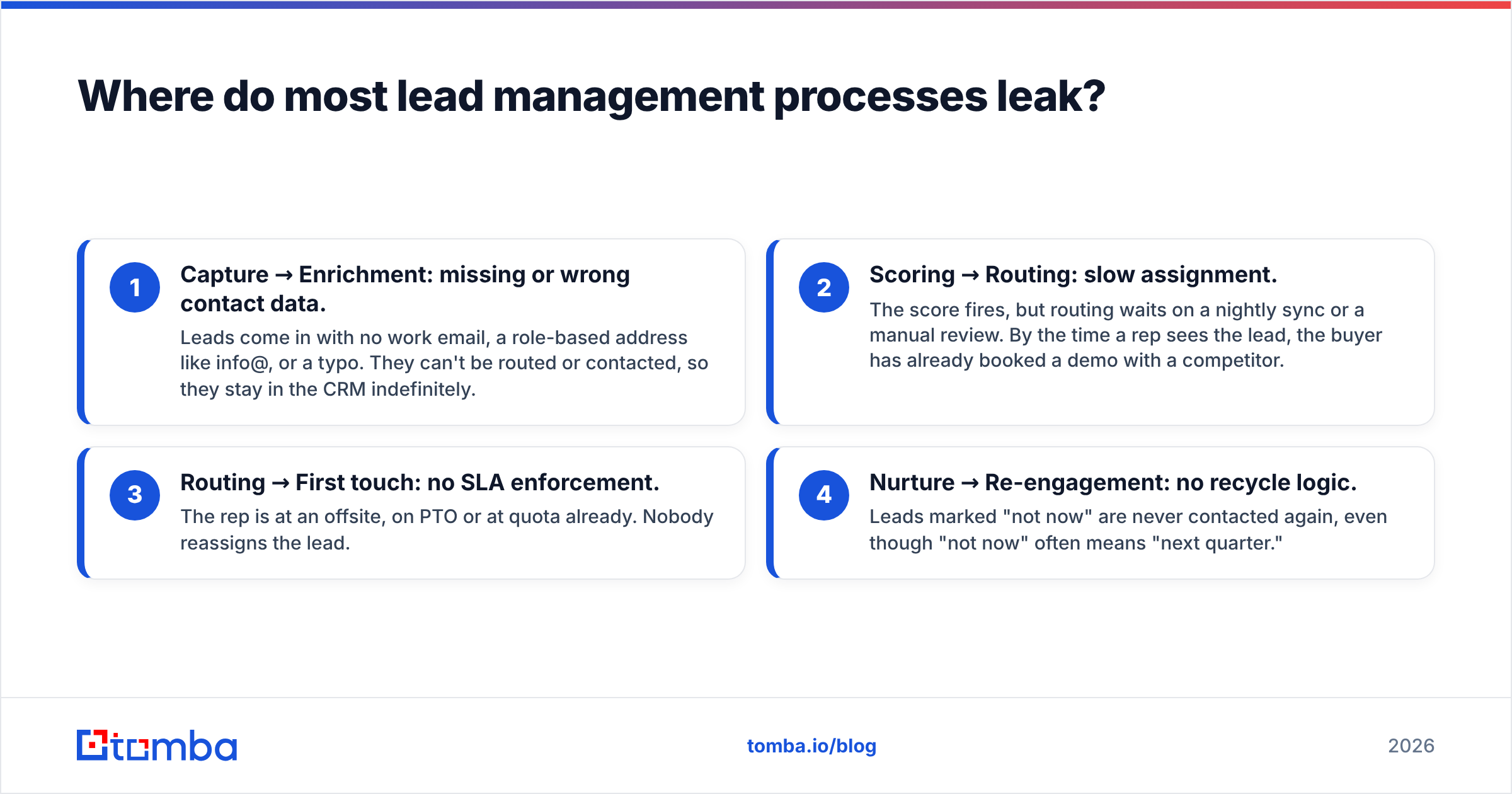
Tracking stage-to-stage conversion usually shows the same four leaks:
- Capture → Enrichment: missing or wrong contact data. Leads come in with no work email, a role-based address like info@, or a typo. They can't be routed or contacted, so they stay in the CRM indefinitely.
- Scoring → Routing: slow assignment. The score fires, but routing waits on a nightly sync or a manual review. By the time a rep sees the lead, the buyer has already booked a demo with a competitor.
- Routing → First touch: no SLA enforcement. The rep is at an offsite, on PTO or at quota already. Nobody reassigns the lead.
- Nurture → Re-engagement: no recycle logic. Leads marked "not now" are never contacted again, even though "not now" often means "next quarter."
Leaks 1 and 2 are data and automation problems. Leaks 3 and 4 are ownership problems. Fixing only one kind won't stop the losses.
Should you run lead management in spreadsheets, a CRM or a full stack?#
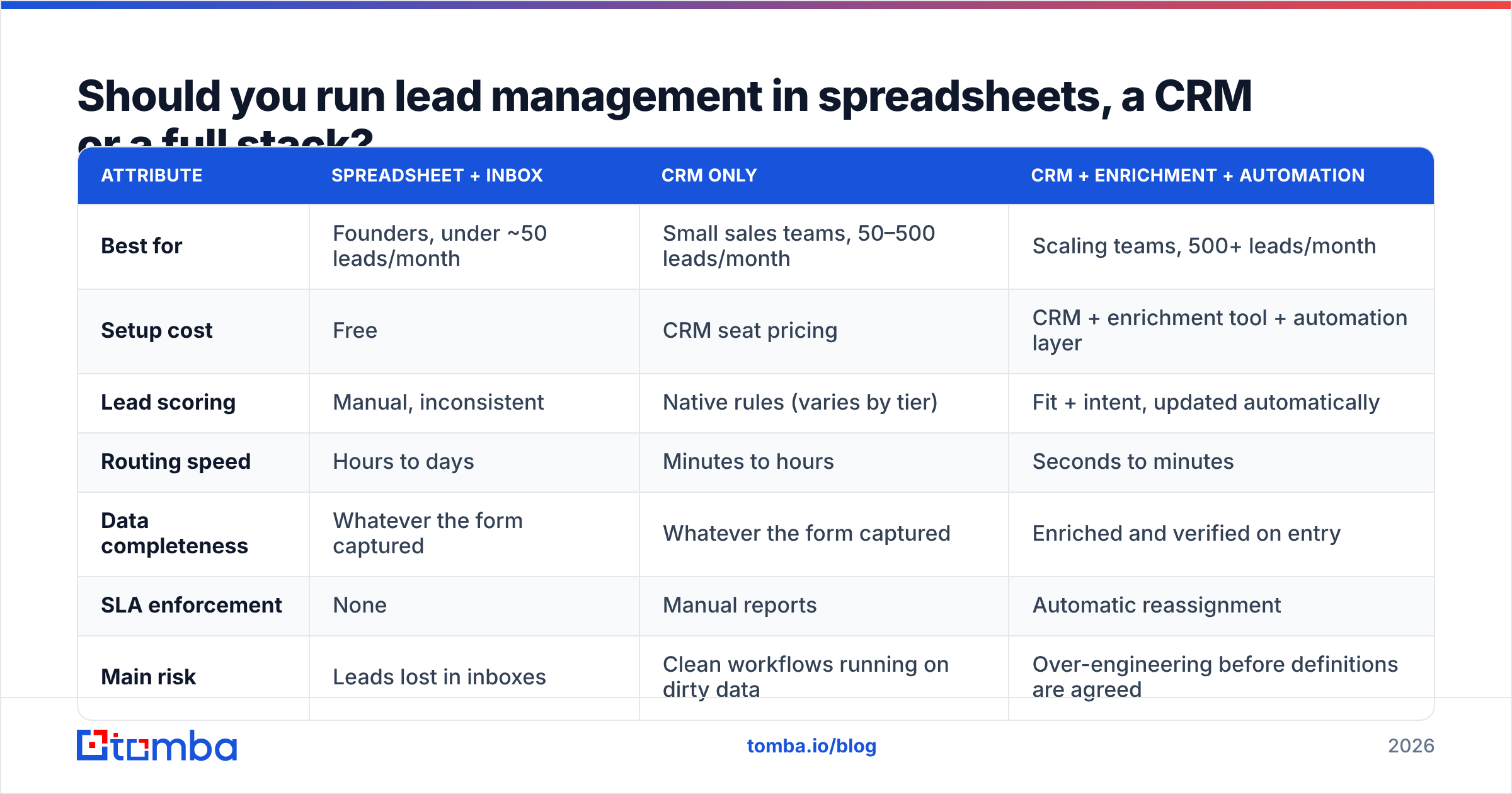
Team size and lead volume should decide this, not what your last company used. Here's how the three common setups compare:
| Attribute | Spreadsheet + inbox | CRM only | CRM + enrichment + automation |
|---|---|---|---|
| Best for | Founders, under ~50 leads/month | Small sales teams, 50–500 leads/month | Scaling teams, 500+ leads/month |
| Setup cost | Free | CRM seat pricing | CRM + enrichment tool + automation layer |
| Lead scoring | Manual, inconsistent | Native rules (varies by tier) | Fit + intent, updated automatically |
| Routing speed | Hours to days | Minutes to hours | Seconds to minutes |
| Data completeness | Whatever the form captured | Whatever the form captured | Enriched and verified on entry |
| SLA enforcement | None | Manual reports | Automatic reassignment |
| Main risk | Leads lost in inboxes | Clean workflows running on dirty data | Over-engineering before definitions are agreed |
The middle column is the most common trap. Teams buy a good CRM such as Salesforce or HubSpot, build detailed workflows, and then feed it half-empty records. The workflows run correctly on bad inputs. An enrichment step on entry is usually a cheaper fix than adding another CRM tier.
How do you build a lead management process from scratch?#
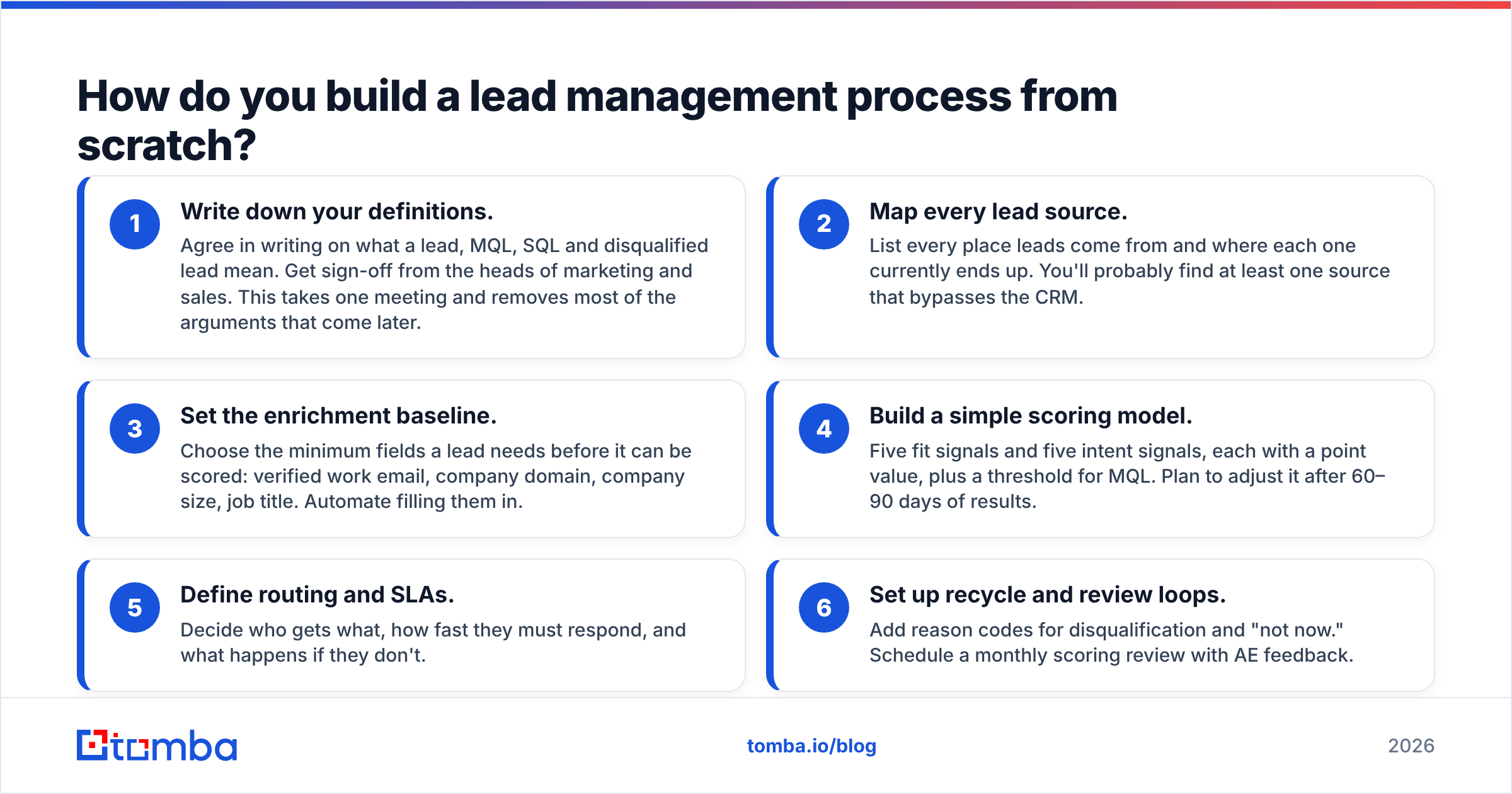
If you're starting from nothing, or rebuilding something that has fallen apart, do it in this order:
- Write down your definitions. Agree in writing on what a lead, MQL, SQL and disqualified lead mean. Get sign-off from the heads of marketing and sales. This takes one meeting and removes most of the arguments that come later.
- Map every lead source. List every place leads come from and where each one currently ends up. You'll probably find at least one source that bypasses the CRM.
- Set the enrichment baseline. Choose the minimum fields a lead needs before it can be scored: verified work email, company domain, company size, job title. Automate filling them in.
- Build a simple scoring model. Five fit signals and five intent signals, each with a point value, plus a threshold for MQL. Plan to adjust it after 60–90 days of results.
- Define routing and SLAs. Decide who gets what, how fast they must respond, and what happens if they don't.
- Set up recycle and review loops. Add reason codes for disqualification and "not now." Schedule a monthly scoring review with AE feedback.
Don't automate a step you haven't done manually at least a few dozen times. Automating a bad process just gets bad results faster.
Which metrics tell you the process is working?#
Don't use lead volume as your main metric. Track these instead:
- Speed to lead: median time from lead creation to first human touch. Measure the median, because averages hide outliers.
- Stage conversion rates: MQL → SQL, SQL → opportunity, opportunity → closed-won. A drop at one stage points to the leak.
- Data completeness: percentage of leads with a verified email and a matched company at the time of scoring.
- Disqualification rate by source: shows which campaigns produce noise.
- Recycled lead reactivation: percentage of "not now" leads that come back and convert within 12 months.
- Rep-level response rate: separates targeting problems from messaging problems.

What are the most common lead management mistakes?#
- Scoring before enriching. A scoring model can't rank what it can't see. Empty fields should mean "enrich first," not zero points.
- One definition of "lead" for every source. A demo request and a webinar attendee aren't equal. Score and route them differently.
- No disqualification reasons. If you don't know why leads are rejected, you can't fix the campaigns sending them.
- Treating the process as marketing's job. Lead management is shared across marketing, sales and RevOps. If only one team owns it, the other two will work around it.
- Never revisiting the model. Your ICP in 2026 isn't the same as it was in 2024. Scoring weights set two years ago are probably wrong now.
- Sending to unverified emails. One bad list can damage domain reputation enough to hurt deliverability for every rep on the team.
How does contact data fit into lead management?#
Every stage after capture depends on the lead record being complete and correct. Scoring needs the company size. Routing needs the domain to match accounts. Sequencing needs a work email that won't bounce. Personalization needs the title and the company's tech stack.
This is why lead management and contact data are closely tied. The teams with the best-run processes usually aren't the ones with the most complex scoring models. They're the ones whose records are complete before any scoring or routing runs. Plenty of solid vendors work in this space, including data providers like BookYourData, all-in-one platforms and finder/verifier tools. Choose the one that best matches your volume and how you capture leads.
Ready to fix the data layer of your lead management process?#
If your leads arrive with names and companies but no reachable email, or your scoring model keeps getting stuck on empty fields, start with enrichment at capture. Tomba Email Finder finds professional email addresses from a name plus a company or domain, so a partial record becomes a contactable lead before it reaches scoring. Pair it with verification and every lead your reps see is complete and reachable. There's a free tier with 25 searches a month, and paid plans start at $49/mo when you're ready to plug it into your CRM workflow.
Related guides#
// get started
Find, verify and enrich your first contacts today
Start on the free plan with 25 searches a month, then scale when your team is ready.
Free plan · No credit card required · GDPR & CCPA
// about the author