9 Best Lead Onion Alternatives for Intent Data and Contacts in 2026
Lead Onion bundles intent signals, website visitor ID and contact reveals from $100/mo. Here are 9 alternatives compared on data depth, pricing model and team fit, from enterprise ABM suites to lean email-first stacks.
TL;DR
- Lead Onion is a buyer-intent platform. It pulls signals from 24 sources, adds website visitor identification and a LinkedIn prospector, and sells contact reveals on credits starting at $100/mo.
- If you want enterprise ABM with predictive account scoring, look at 6sense or Demandbase. If you want raw third-party topic intent to feed tools you already own, look at Bombora.
- If you want contacts and intent in one place, ZoomInfo covers the enterprise end and Apollo covers the budget end.
- If website visitors are your main signal, Dealfront (Leadfeeder), RB2B and Warmly are the specialists.
- Intent data only tells you which accounts to call. You still need verified emails for the people there. Tomba fills that gap from $49/mo, and its Reveal module handles visitor identification too.
What is Lead Onion, and why look for alternatives?#
Lead Onion calls itself an AI-driven buyer-intent platform. It pulls in intent signals (research activity, G2 category browsing, website visits and similar behaviour) and matches them to companies and people who look like they're in-market. On top of that it adds a LinkedIn Prospector that finds contact details from a profile, a G2 Intent module and Website Intent for de-anonymising your own traffic.
Pricing is credit-based. Plans start at $100/mo, each revealed contact (email plus phone) costs one credit, and top-up credits roll over. New users get their first 100 leads free.
That's a reasonable package, so why do teams still look around? These are the reasons we hear most often:
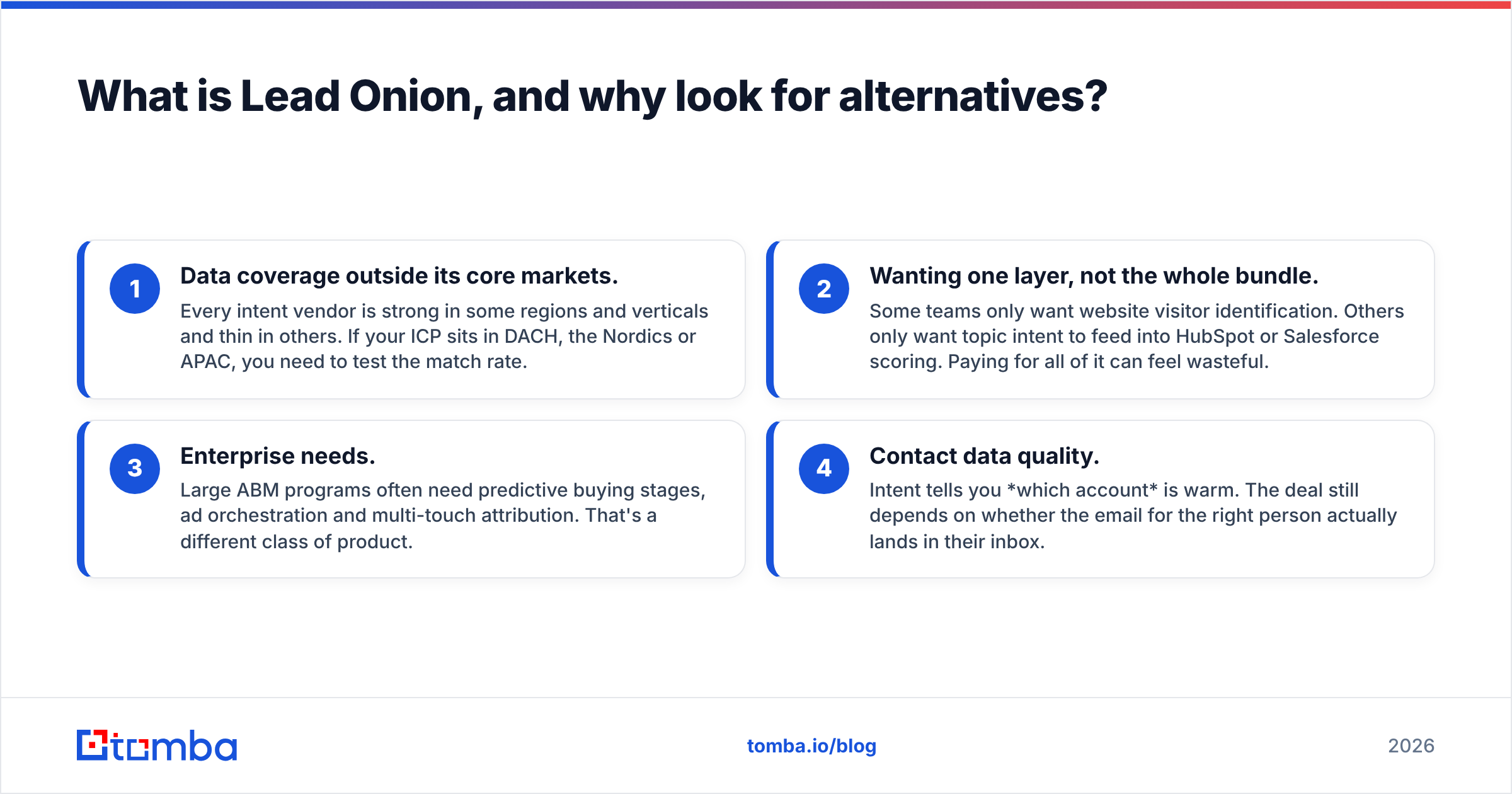
- Data coverage outside its core markets. Every intent vendor is strong in some regions and verticals and thin in others. If your ICP sits in DACH, the Nordics or APAC, you need to test the match rate.
- Wanting one layer, not the whole bundle. Some teams only want website visitor identification. Others only want topic intent to feed into HubSpot or Salesforce scoring. Paying for all of it can feel wasteful.
- Enterprise needs. Large ABM programs often need predictive buying stages, ad orchestration and multi-touch attribution. That's a different class of product.
- Contact data quality. Intent tells you which account is warm. The deal still depends on whether the email for the right person actually lands in their inbox.
The fourth point is the one most comparison posts skip, and it matters most for outbound teams.
What should you look for in a Lead Onion alternative?#
Before you look at logos, decide which job you're hiring the tool for. These five criteria separate the options below:
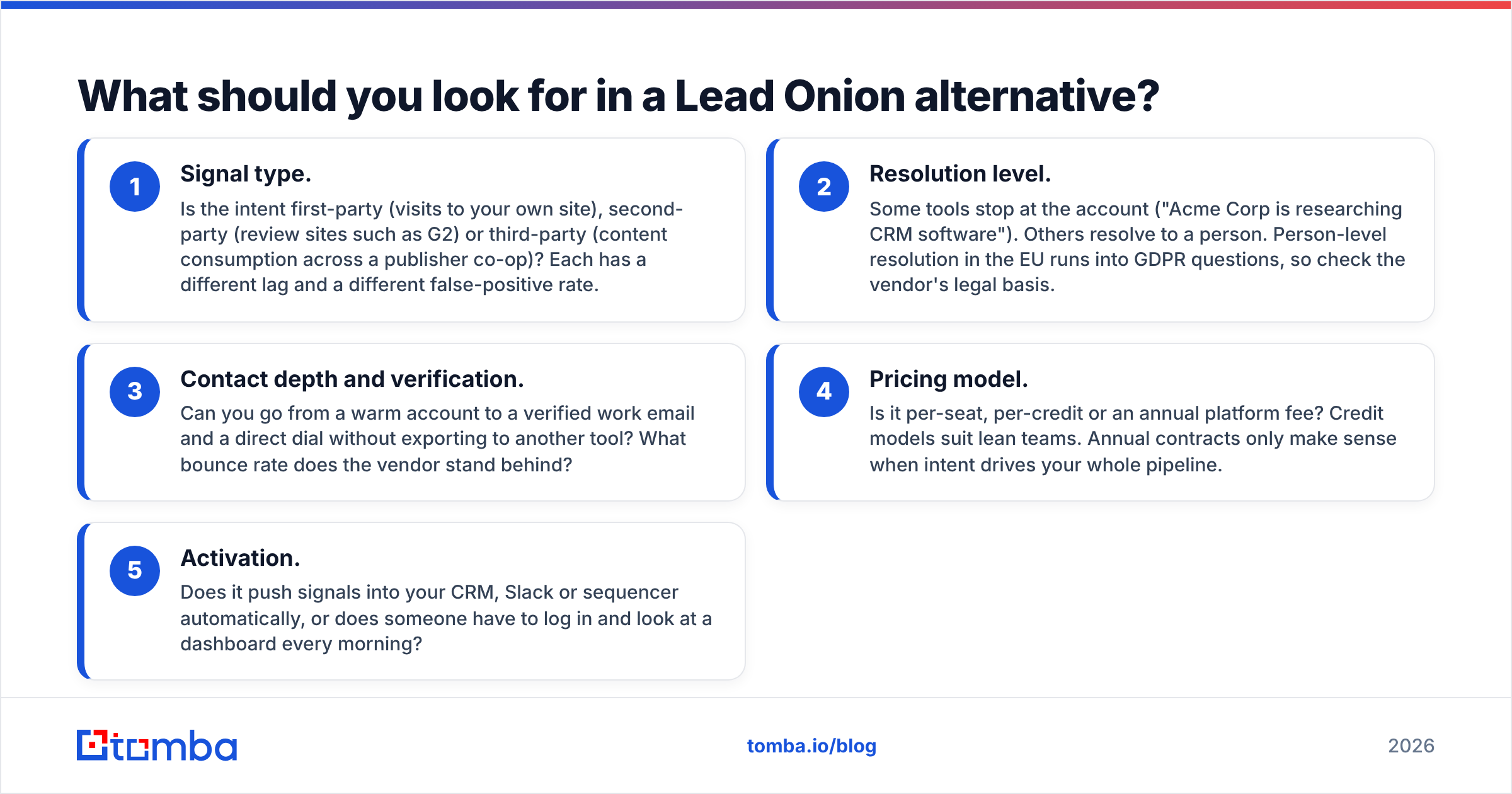
- Signal type. Is the intent first-party (visits to your own site), second-party (review sites such as G2) or third-party (content consumption across a publisher co-op)? Each has a different lag and a different false-positive rate.
- Resolution level. Some tools stop at the account ("Acme Corp is researching CRM software"). Others resolve to a person. Person-level resolution in the EU runs into GDPR questions, so check the vendor's legal basis.
- Contact depth and verification. Can you go from a warm account to a verified work email and a direct dial without exporting to another tool? What bounce rate does the vendor stand behind?
- Pricing model. Is it per-seat, per-credit or an annual platform fee? Credit models suit lean teams. Annual contracts only make sense when intent drives your whole pipeline.
- Activation. Does it push signals into your CRM, Slack or sequencer automatically, or does someone have to log in and look at a dashboard every morning?
If you mostly care about criteria 1 and 2, you're shopping for an intent platform. If criteria 3 and 5 matter more, you're shopping for a data and activation stack, and that list is shorter and cheaper.

Which Lead Onion alternatives are worth shortlisting in 2026?#
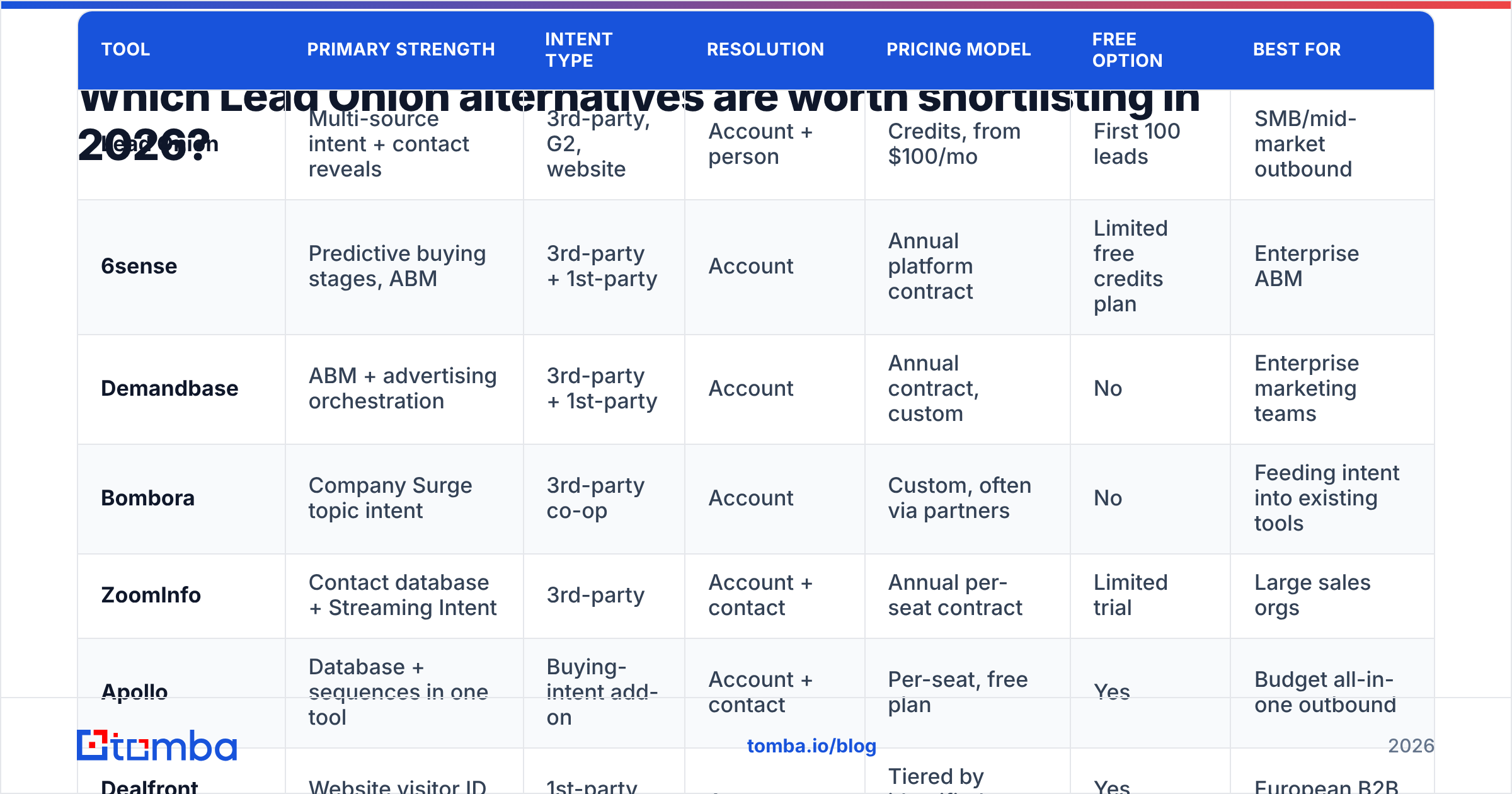
Here's the shortlist side by side. Pricing changes often and several vendors only quote on request, so treat the pricing column as the model, not a final number.
| Tool | Primary strength | Intent type | Resolution | Pricing model | Free option | Best for |
|---|---|---|---|---|---|---|
| Lead Onion | Multi-source intent + contact reveals | 3rd-party, G2, website | Account + person | Credits, from $100/mo | First 100 leads | SMB/mid-market outbound |
| 6sense | Predictive buying stages, ABM | 3rd-party + 1st-party | Account | Annual platform contract | Limited free credits plan | Enterprise ABM |
| Demandbase | ABM + advertising orchestration | 3rd-party + 1st-party | Account | Annual contract, custom | No | Enterprise marketing teams |
| Bombora | Company Surge topic intent | 3rd-party co-op | Account | Custom, often via partners | No | Feeding intent into existing tools |
| ZoomInfo | Contact database + Streaming Intent | 3rd-party | Account + contact | Annual per-seat contract | Limited trial | Large sales orgs |
| Apollo | Database + sequences in one tool | Buying-intent add-on | Account + contact | Per-seat, free plan | Yes | Budget all-in-one outbound |
| Dealfront (Leadfeeder) | Website visitor ID, EU data | 1st-party website | Account | Tiered by identified companies | Yes, limited | European B2B teams |
| RB2B | Person-level visitor ID (US) | 1st-party website | Person (US) | Tiered, free plan | Yes | US-focused SaaS |
| Warmly | Visitor ID + AI chat/outreach | 1st-party + 3rd-party | Account + person | Tiered, custom at scale | Yes, limited | Inbound-heavy teams |
| Tomba | Email finding, verification, enrichment, Reveal | 1st-party website (Reveal) | Account + contact | Free, $49, $99, $249/mo | 25 searches/mo | Turning warm accounts into verified emails |
What are the best Lead Onion alternatives, tool by tool?#
1. 6sense: best for predictive enterprise ABM#
6sense is the tool most people picture when they hear "intent data". It combines anonymous third-party research signals with your first-party data to place accounts in predictive buying stages (target, awareness, consideration, decision, purchase). Marketing uses those stages to run ads and sales uses them to prioritise accounts.
- Pros: Mature predictive models, strong ABM orchestration, deep Salesforce integration.
- Cons: Annual contracts, a long implementation and a real admin burden. Small teams rarely get their money's worth.
- Choose it if: you run a formal ABM program with dedicated marketing ops. Our 6sense alternative page covers lighter options if it turns out to be too much.
2. Demandbase: best for ABM plus advertising#
Demandbase overlaps heavily with 6sense. Its edge is B2B advertising and account-based experiences, and it also sells account intelligence and intent. It suits marketing-led organisations that want targeting, ads and measurement on one platform.
- Pros: Strong ad targeting, good account-level analytics.
- Cons: Enterprise pricing and an enterprise learning curve. Contact-level data isn't its focus.
3. Bombora: best raw third-party intent feed#
Bombora runs a data co-op of B2B publishers and turns content consumption into "Company Surge" scores across thousands of topics. Many other platforms license Bombora data under the hood, so buying direct makes sense when you want to pipe surge scores into your own CRM scoring or ad platforms.
- Pros: Widely trusted co-op data, large topic taxonomy, easy to plug into other tools.
- Cons: Account-level only, no contacts, and it's usually bought through partners or at custom pricing.
4. ZoomInfo: best for large sales teams that want contacts and intent together#

ZoomInfo pairs one of the largest B2B contact databases with Streaming Intent, org charts, technographics and workflow automation. If your org already has a big per-seat budget, it's the closest thing to "everything in one login".
- Pros: Coverage depth, direct dials, a broad feature set.
- Cons: Multi-year annual contracts, strict seat licensing and a price well above Lead Onion's entry tier. Read recent reviews on G2 before you sign, especially the ones about renewals.
5. Apollo: best budget all-in-one#
Apollo combines a large contact database, a Chrome extension, sequences and a dialer, with buying-intent filters on paid tiers. For a small team that wants prospecting and sending in one tool, it's the lowest-friction option on this list.
- Pros: Generous free plan, built-in sequencing, fast onboarding.
- Cons: Email accuracy varies a lot by region and seniority, and intent data is thinner than a dedicated platform's. Many teams verify Apollo exports before sending. See our Apollo alternative breakdown for the trade-offs.
6. Dealfront (Leadfeeder): best for European website visitor ID#
Leadfeeder, now part of Dealfront, identifies which companies visit your site and shows the pages they viewed. Dealfront adds a European-focused company and contact database, which helps if your ICP sits mostly in the EU.
- Pros: Clean UX, strong EU data, GDPR-conscious account-level approach.
- Cons: Account-level only for visitors. Contact coverage outside Europe is thinner.
7. RB2B: best for person-level visitor ID in the US#
RB2B resolves anonymous US website visitors to individual LinkedIn profiles and pushes them into Slack or your CRM. For US-focused SaaS teams with steady inbound traffic, that's a quick way to build a warm outbound list.
- Pros: Person-level resolution, very simple setup, free entry tier.
- Cons: US-only person matching. It depends on traffic volume, and it doesn't give you verified emails by default for every match.
8. Warmly: best for turning visitors into live conversations#
Warmly de-anonymises visitors, layers in intent and then acts on it: AI chat, instant alerts and automated outreach triggered by site behaviour. It's built for teams that want to engage while the buyer is still on the page.
- Pros: Real-time engagement, strong Slack and CRM routing.
- Cons: Costs climb quickly at scale, and it's most useful for teams with meaningful inbound traffic.
9. Tomba: best for turning warm accounts into verified contacts#
Tomba isn't trying to be a 6sense-style intent platform, and it's worth saying so plainly. What it does is the step every intent tool eventually hands off to: you know which company is warm, so now you need the right person's working email.
Email finder by name + domain, domain search for whole teams, and a built-in email verifier with catch-all handling.
Website visitor reveal for first-party intent. It shows which companies visit your site so you can hand them straight to the finder.
Data enrichment that adds firmographics, socials and phone data to a list or CRM record.
Pricing: Free (25 searches/mo), Starter $49/mo, Growth $99/mo, Pro $249/mo, Enterprise custom.
Pros: Transparent monthly pricing, verification included, API/Sheets/CRM integrations, low entry cost.
Cons: No third-party topic intent or predictive buying stages. Pair it with Bombora or 6sense if you need those.
Is an enterprise intent platform better than a lightweight stack?#
Not automatically. Enterprise intent platforms pay off when three things are true:
- You have a defined target account list in the hundreds or thousands.
- Marketing and sales both act on the same account scores.
- Someone owns the platform full-time.
If any of those is missing, the signals pile up in a dashboard nobody opens. Industry analysts such as Gartner have long pointed out that buyers do most of their research before they ever talk to sales. That's exactly why intent matters, and also why stale, unactioned intent is worthless.
For most SMB and mid-market teams, a lighter stack does better than a heavy platform:
- First-party signal: a visitor-ID tool (Dealfront, RB2B, Warmly or Tomba Reveal).
- Optional third-party signal: Bombora surge topics, or Apollo's built-in intent filters.
- Contact layer: a dedicated finder and verifier so every warm account turns into deliverable emails.
- Activation: alerts in Slack, then sequences in your sending tool.
That stack usually costs a fraction of an annual ABM contract, and you can swap out any layer that underperforms without a year-long lock-in.

The catch is the handoff between layers. An intent signal with a guessed or unverified email attached is how teams burn domains. If you're sending to warm accounts, run every address through verification first. Bounce rates above roughly 2-3% damage sender reputation faster than any intent score can make up for.
How do you choose the right Lead Onion alternative for your team?#
Match the tool to your motion rather than to feature checklists:
- You run enterprise ABM with a marketing ops team. Go with 6sense or Demandbase. Budget for implementation time as well as licence cost.
- You want intent scores inside the CRM you already use. Go with Bombora, piped into HubSpot or Salesforce scoring.
- You want one tool for data and sequencing on a tight budget. Go with Apollo, and verify exports before sending.
- Your best leads are already visiting your site. Go with RB2B (US), Dealfront (EU) or Warmly (real-time engagement), paired with a finder for contacts.
- You already know your target accounts and need the right people's emails. Go with Tomba. Domain search the account, find the decision-maker, verify, and push to your sequencer.
- You like Lead Onion's bundle but want a second opinion on data quality. Run a 100-lead bake-off. Use Lead Onion's free first 100 leads next to another tool's free tier on the same account list, and compare match rate, verified-email rate and bounce rate after one send.
That last test is the one that settles most decisions. Vendor demos all look good. Your own ICP data is what tells them apart.
Frequently asked questions#
Is Lead Onion an email finder or an intent data tool?#
It's primarily an intent data platform. Contact reveals (email and phone) are sold as credits on top of the intent layer, and the LinkedIn Prospector finds contact details from profiles.
What is the cheapest Lead Onion alternative?#
Apollo, RB2B, Dealfront and Tomba all have free tiers. For paid plans with public prices, Tomba's Starter plan at $49/mo is below Lead Onion's $100/mo entry point, though it covers contact data and visitor reveal rather than third-party intent.
Can I combine intent data with a separate email finder?#
Yes, and most mature outbound teams do. The intent tool picks the account, and the finder and verifier supply deliverable contacts. Tools with an API or native HubSpot integration make the handoff automatic.
Is person-level visitor identification GDPR compliant?#
It depends on the vendor's data sources and legal basis. For EU traffic, most teams stay at account-level identification and then look up contacts through compliant, verifiable sources.
Where does Tomba fit in your Lead Onion replacement?#
Whichever intent layer you pick, the pipeline still depends on reaching the right person at a warm account with an email that actually delivers. The Tomba Email Finder takes a name and domain, or just a company, and returns verified professional emails. Catch-all checks and enrichment are built in, and plans run from a free tier up to $249/mo. Pair it with the intent source you trust, run your 100-lead bake-off, and send only to addresses you've verified.
Related guides#
// get started
Find, verify and enrich your first contacts today
Start on the free plan with 25 searches a month, then scale when your team is ready.
Free plan · No credit card required · GDPR & CCPA
Get the Tomba newsletter
Product and data updates
// about the author