Lead Qualification and Segmentation: A Practical 2026 Playbook
Most pipelines don't fail because there are too few leads. They fail because reps treat every lead the same. Here's how to qualify, segment, and route leads so the best-fit buyers get attention first.
TL;DR
- Lead qualification answers one question: is this lead worth a rep's time right now? Segmentation answers a different one: which group does this lead belong to, and what message fits that group?
- They work best together. Segment first on fit (firmographics, role, tech stack), then qualify within each segment on intent and readiness.
- Choose a qualification framework that matches your deal size. BANT is fine for fast transactional sales. MEDDIC or MEDDPICC suits enterprise deals with many stakeholders.
- Most scoring models break because the data is bad: wrong titles, dead emails, missing company size. Enrich and verify before you score anything.
- Build one simple scoring model with 5 to 8 inputs, review it every quarter against closed-won data, and route each segment to a separate sequence.
What is lead qualification and segmentation?#
Lead qualification and segmentation are two separate filters that work on the same list of contacts.
Lead qualification decides whether a lead should move forward in your funnel. It looks at fit (does this company look like our customers?) and readiness (do they have a problem, a budget, and a timeline?). The result is a status such as unqualified, marketing qualified lead (MQL), sales qualified lead (SQL), or opportunity.
Segmentation puts leads into groups that share traits so you can treat each group differently. The same idea from market segmentation in classic marketing applies here, but at the level of individual contacts and accounts. Typical groups are "Series B SaaS companies with 50 to 200 employees using HubSpot" or "VP-level finance buyers in manufacturing."
A simple way to hold the difference in your head: segmentation sorts leads into buckets, and qualification ranks the leads inside each bucket. You need both. A lead can be a perfect fit for your mid-market segment and still not be ready to buy for nine months.
Why does lead qualification and segmentation matter in 2026?#
Three things have changed how outbound and inbound teams handle leads:
- Volume is cheap, attention isn't. AI writing tools and bulk data make it trivial to put 10,000 contacts into a sequence. Mailbox providers have tightened their bulk-sender rules, so blasting unsegmented lists now hurts your sender reputation faster than it used to.
- Buying committees are larger. B2B purchases involve more stakeholders than they did a few years ago. Research from firms like Gartner keeps showing that buyers do most of their research before talking to sales. A lead that looks "hot" may just be a researcher with no budget authority.
- Rep time is the real constraint. Every hour spent on a poor-fit lead is an hour not spent on a good one. Qualification protects that time. Segmentation makes the time you do spend more relevant.
If your team complains that "marketing leads are junk" while marketing says "sales doesn't follow up," the usual fix is a shared definition of qualified plus segments both teams agreed on.
What are the main ways to segment B2B leads?#
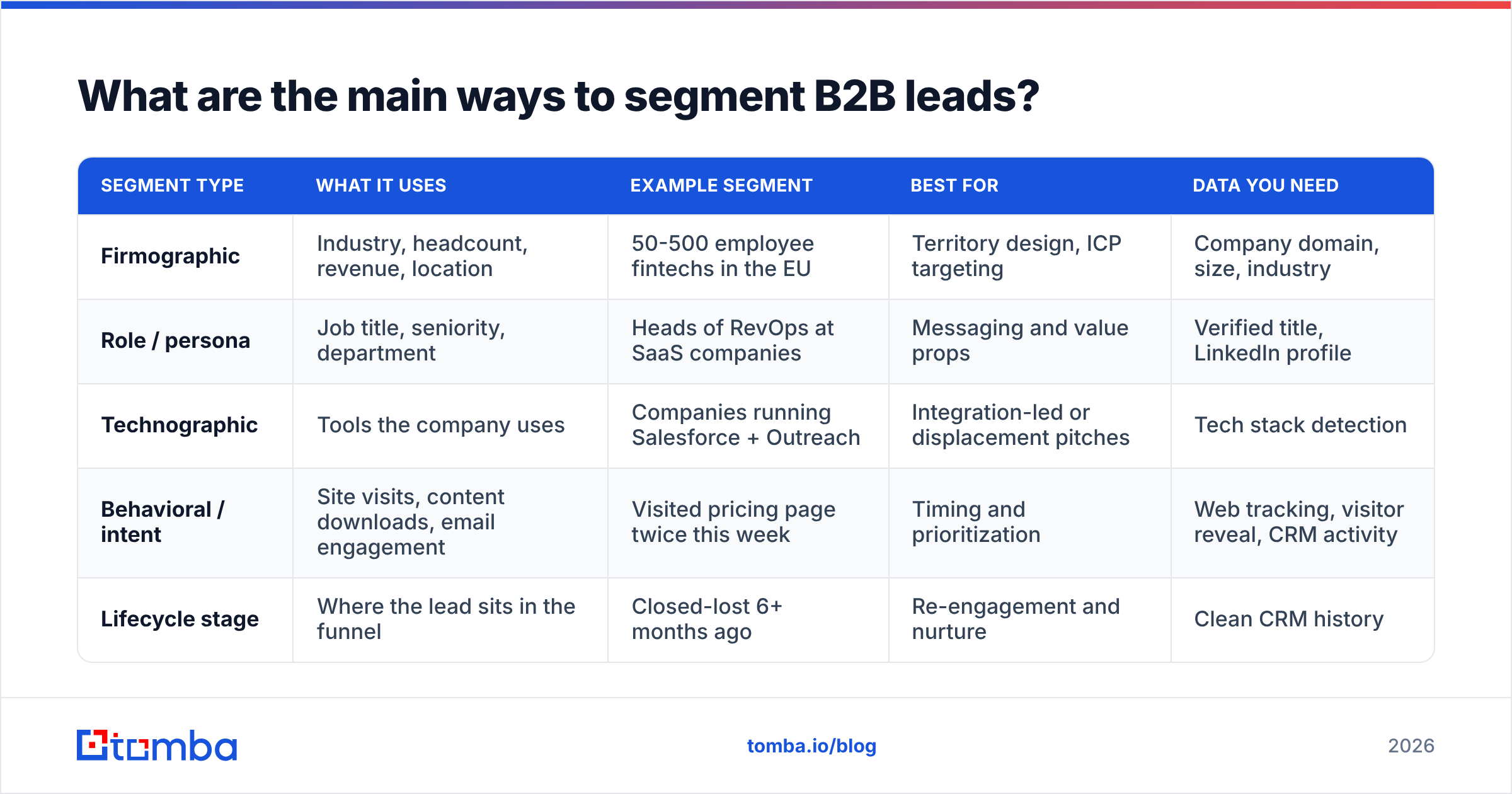
Most B2B teams segment across five dimensions. You don't need all five from day one. Start with firmographic and role-based segments, then add the others once your data can support them.
| Segment type | What it uses | Example segment | Best for | Data you need |
|---|---|---|---|---|
| Firmographic | Industry, headcount, revenue, location | 50-500 employee fintechs in the EU | Territory design, ICP targeting | Company domain, size, industry |
| Role / persona | Job title, seniority, department | Heads of RevOps at SaaS companies | Messaging and value props | Verified title, LinkedIn profile |
| Technographic | Tools the company uses | Companies running Salesforce + Outreach | Integration-led or displacement pitches | Tech stack detection |
| Behavioral / intent | Site visits, content downloads, email engagement | Visited pricing page twice this week | Timing and prioritization | Web tracking, visitor reveal, CRM activity |
| Lifecycle stage | Where the lead sits in the funnel | Closed-lost 6+ months ago | Re-engagement and nurture | Clean CRM history |
A practical rule: if two segments would get the same email, the same rep, and the same offer, merge them. Segments only earn their place if they change what you do.
Which lead qualification framework should you use?#
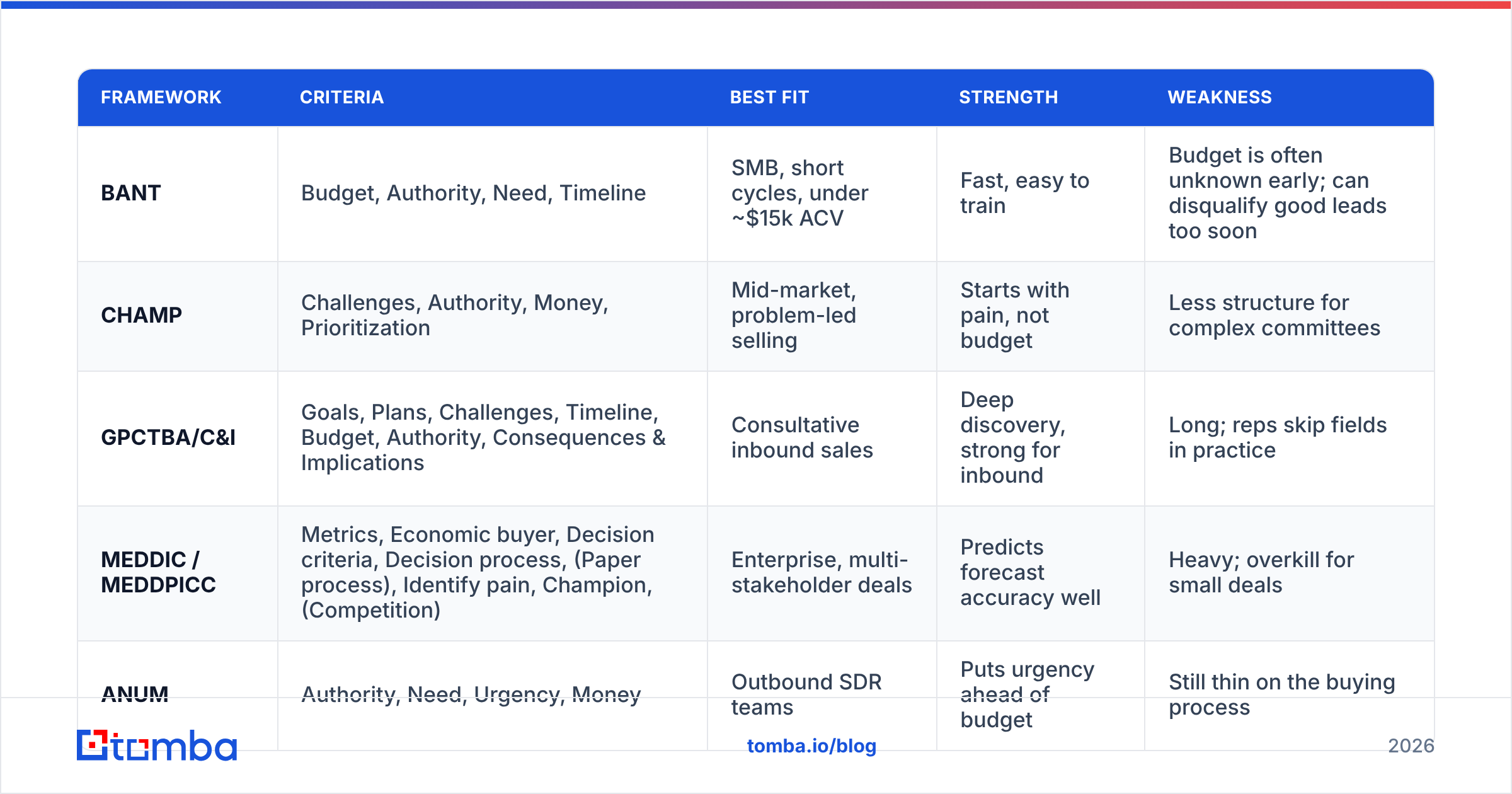
Frameworks give reps a shared checklist for discovery calls and give ops a consistent way to record qualification in the CRM. None of them is universally best. Pick one based on deal size, cycle length, and how many people sign off on a purchase.
| Framework | Criteria | Best fit | Strength | Weakness |
|---|---|---|---|---|
| BANT | Budget, Authority, Need, Timeline | SMB, short cycles, under ~$15k ACV | Fast, easy to train | Budget is often unknown early; can disqualify good leads too soon |
| CHAMP | Challenges, Authority, Money, Prioritization | Mid-market, problem-led selling | Starts with pain, not budget | Less structure for complex committees |
| GPCTBA/C&I | Goals, Plans, Challenges, Timeline, Budget, Authority, Consequences & Implications | Consultative inbound sales | Deep discovery, strong for inbound | Long; reps skip fields in practice |
| MEDDIC / MEDDPICC | Metrics, Economic buyer, Decision criteria, Decision process, (Paper process), Identify pain, Champion, (Competition) | Enterprise, multi-stakeholder deals | Predicts forecast accuracy well | Heavy; overkill for small deals |
| ANUM | Authority, Need, Urgency, Money | Outbound SDR teams | Puts urgency ahead of budget | Still thin on the buying process |
If you sell into both SMB and enterprise, you can run two frameworks: BANT or ANUM for the SMB segment, and MEDDPICC for enterprise. That's a good example of segmentation shaping qualification. The segment decides which checklist the rep uses.
How do you build a lead scoring model that combines both?#
Scoring is where qualification and segmentation become something you can operate. A good model turns fit and intent into a number that decides routing. Here is a process that works for most teams with a CRM and a few months of deal history.
- Pull your last 12 months of closed-won and closed-lost deals. Look for the traits that show up much more often in wins: industry, headcount band, title, tech stack, lead source. That becomes your ideal customer profile (ICP).
- Split the score into fit and intent. Fit (0 to 50) covers who the lead is: company size, industry, seniority, tech stack. Intent (0 to 50) covers what they're doing: pricing page visits, demo requests, replies, event attendance. Keeping them separate stops a very active student from outscoring a quiet VP at a perfect-fit account.
- Limit yourself to 5 to 8 inputs. Models with 30 weighted fields are hard to explain and nearly impossible to debug. If a rep can't tell you why a lead scored 72, they won't trust the score.
- Add negative scoring. Subtract points for personal email domains, competitors, students, job seekers, and countries you can't sell to. This matters as much as the positive signals.
- Set thresholds per segment. A mid-market lead might become an SQL at 60, while enterprise needs 70 plus a named economic buyer. One global threshold usually over-routes small accounts and under-routes big ones.
- Decay intent over time. A pricing page visit from 90 days ago shouldn't carry the same weight as one from yesterday. Reduce intent points on a schedule, for example 25% every 30 days.
Most CRMs support this natively. HubSpot and Salesforce both have lead scoring properties you can build without code, and both let you trigger workflows when a score crosses a threshold.
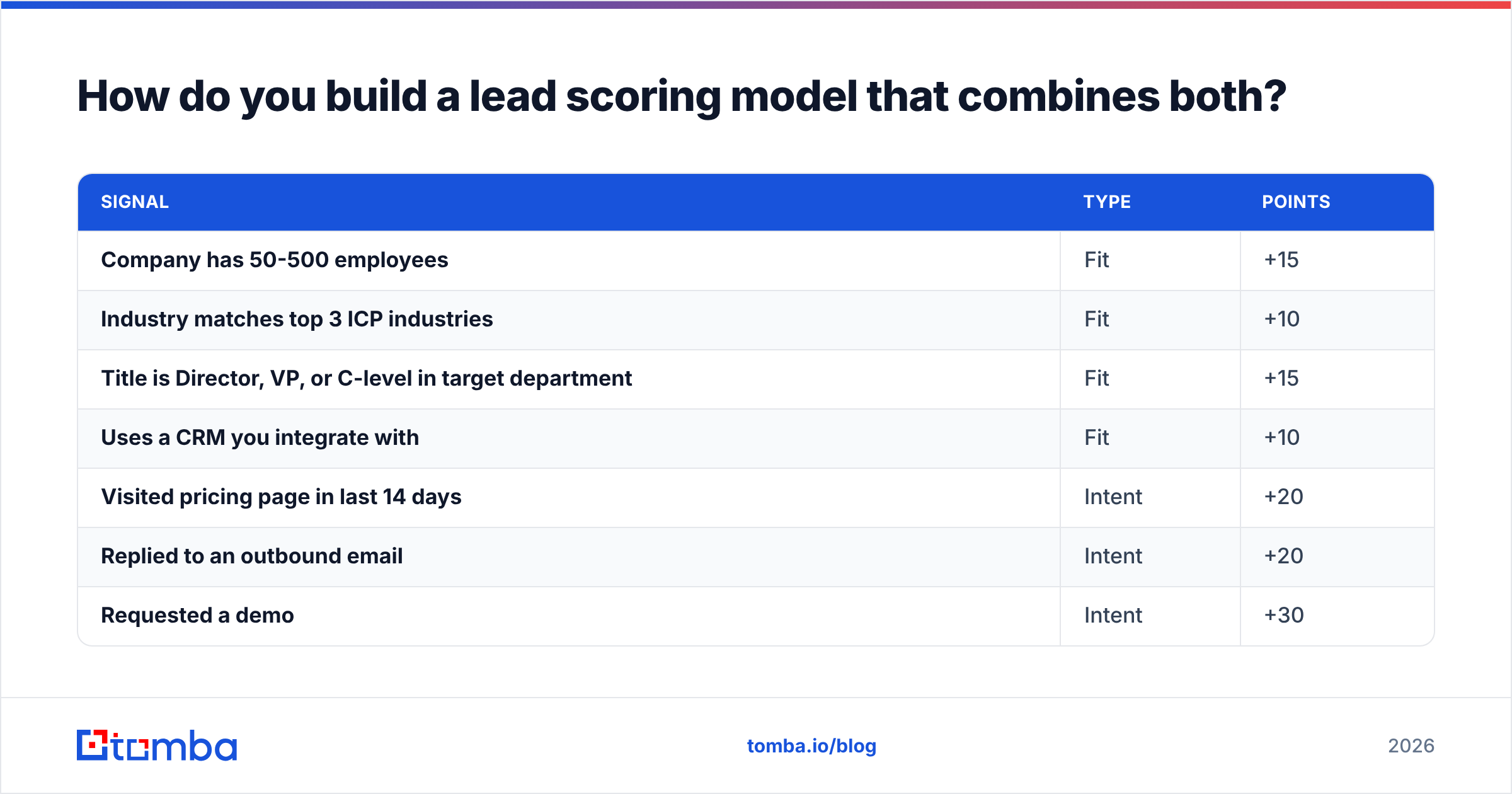
Here's a sample fit-plus-intent model for a mid-market SaaS seller:
| Signal | Type | Points |
|---|---|---|
| Company has 50-500 employees | Fit | +15 |
| Industry matches top 3 ICP industries | Fit | +10 |
| Title is Director, VP, or C-level in target department | Fit | +15 |
| Uses a CRM you integrate with | Fit | +10 |
| Visited pricing page in last 14 days | Intent | +20 |
| Replied to an outbound email | Intent | +20 |
| Requested a demo | Intent | +30 |
| Free email domain (gmail, yahoo, etc.) | Negative | -20 |
| Email bounced or unverifiable | Negative | -30 |
That last row matters more than most teams expect. A contact you can't reach isn't a lead. It's a row in a spreadsheet.
Why does data quality make or break segmentation?#
Every segment and every score depends on fields that are often empty, stale, or wrong. People change jobs. Companies get acquired. Titles like "Growth Ninja" don't map to any seniority band. If 30% of your records are missing headcount, your firmographic segments are fiction.
Data problems show up in three places:
- Wrong segment. A VP of Sales who left six months ago still sits in your "active decision-maker" segment and gets your best sequence.
- Wrong score. Missing company size means the lead gets zero fit points and sinks below leads that are actually worse fits.
- Wrong deliverability. Invalid addresses bounce, and high bounce rates damage your email deliverability for every segment, including the good ones.
The fix is boring but effective: enrich before you segment, and verify before you send. Run inbound form fills and imported lists through data enrichment to fill in company size, industry, and role, then check each address with an email verifier before it reaches a sequence. Tomba, Clearbit-style enrichment APIs, and established data providers such as BookYourData can all fill this role. The right choice depends on your regions, volume, and how you want to pay for credits. What matters is that enrichment happens automatically at the moment of lead creation, not as a quarterly cleanup.
What does a working qualification and segmentation workflow look like?#
Here's an end-to-end flow a small RevOps team can build in a couple of weeks with a CRM, an enrichment tool, and a sequencing tool.
- Capture. A lead arrives from a form, an event list, a website visitor tool, or outbound prospecting.
- Enrich and verify. An automation (native integration, Zapier, or Make) calls your enrichment provider to append company data and title, then verifies the email. Invalid emails get flagged and held back from sequences.
- Segment. Workflow rules assign the lead to a segment based on headcount, industry, and persona. Store the segment in a single dedicated CRM property, not in tags scattered across records.
- Score. Fit and intent scores are calculated. Negative signals are applied.
- Route. Leads above the segment's threshold go to the assigned rep with an SLA (for example, first touch within 4 business hours for demo requests). Leads below the threshold go into a segment-specific nurture.
- Feed back. Every closed-won and closed-lost reason flows back into a quarterly review of the scoring weights and segment definitions.
If you use HubSpot, the HubSpot integration lets enrichment write directly into contact properties, so segmentation rules fire on complete data instead of whatever the prospect typed into your form.
Is lead scoring better than manual qualification?#
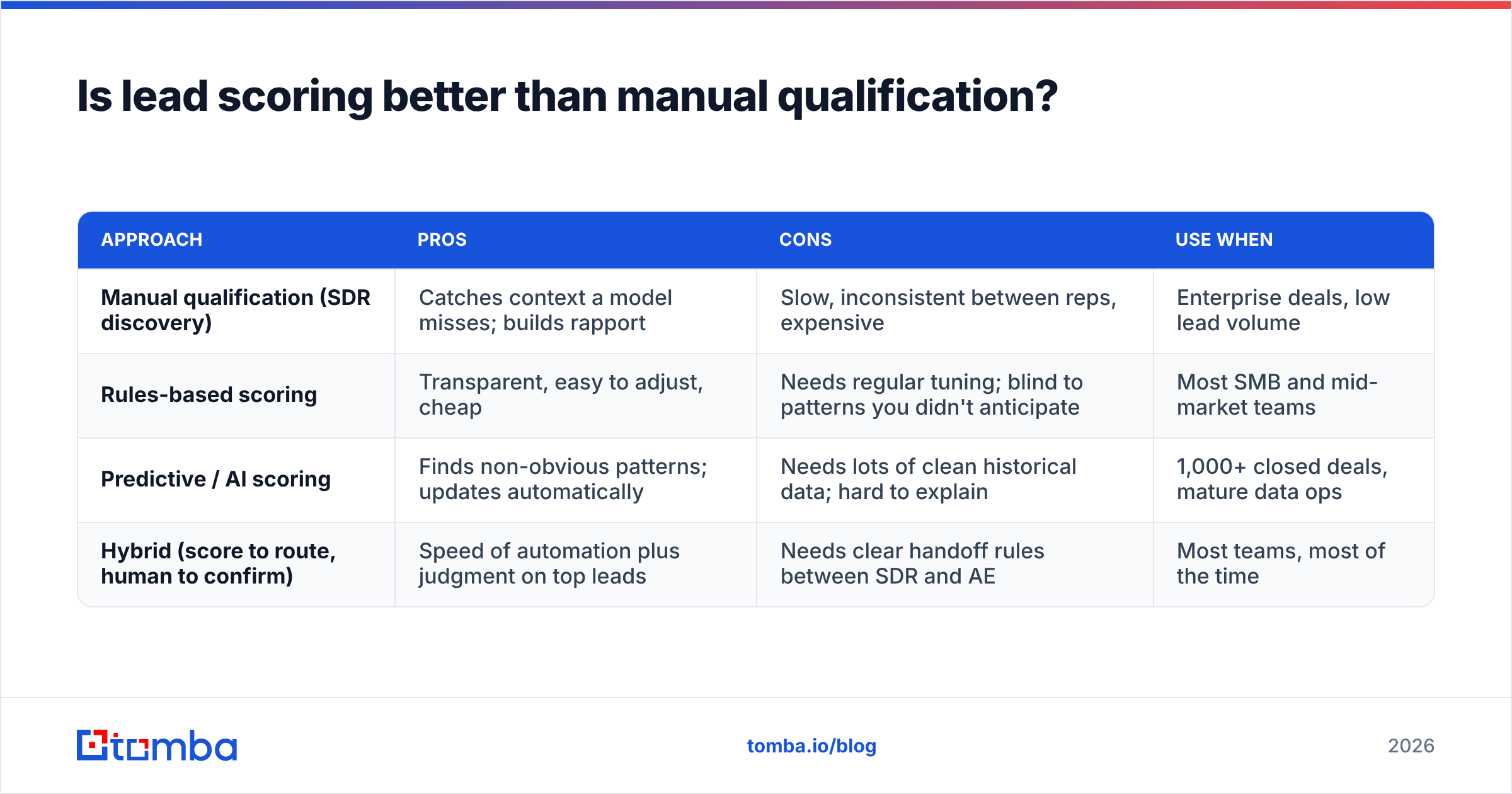
Not on its own. Scoring is good at ranking volume. Humans are good at reading nuance. The best setups use each for what it does well.
| Approach | Pros | Cons | Use when |
|---|---|---|---|
| Manual qualification (SDR discovery) | Catches context a model misses; builds rapport | Slow, inconsistent between reps, expensive | Enterprise deals, low lead volume |
| Rules-based scoring | Transparent, easy to adjust, cheap | Needs regular tuning; blind to patterns you didn't anticipate | Most SMB and mid-market teams |
| Predictive / AI scoring | Finds non-obvious patterns; updates automatically | Needs lots of clean historical data; hard to explain | 1,000+ closed deals, mature data ops |
| Hybrid (score to route, human to confirm) | Speed of automation plus judgment on top leads | Needs clear handoff rules between SDR and AE | Most teams, most of the time |
Predictive scoring is appealing, but it learns from your history. If your historical data is messy, the model will confidently learn the wrong lessons. Get a rules-based model working on clean data first. Then decide whether a predictive layer adds anything.
What mistakes should you avoid?#
These come up again and again in qualification and segmentation projects:
- Too many segments. Twenty segments with 40 leads each means no segment has enough volume to test messaging. Start with three to five.
- Treating MQL as a finish line. Marketing hitting MQL targets while SQL conversion drops is a sign that the MQL definition is too loose. Track MQL-to-opportunity rate by segment.
- Scoring on activity alone. Email opens have been unreliable since mailbox privacy features started auto-loading images. Weight replies and high-intent page visits much more heavily than opens.
- Never disqualifying. A clear "not a fit" status with a reason code (too small, wrong region, no budget, competitor) is useful data. It tells you where your targeting is off.
- Set-and-forget models. Your ICP shifts when you launch new products or move upmarket. Review weights every quarter against actual win data, and document every change.
- Skipping the sales-marketing agreement. Write down the definition of each lifecycle stage, the SLA for follow-up, and who owns each segment. Get both leaders to sign off. It sounds bureaucratic, but it ends most lead-quality arguments.
How do you measure whether it's working?#
Track a small set of metrics by segment, not in aggregate. Averages hide the fact that one segment converts well and another burns rep time.
- Lead-to-SQL conversion rate per segment
- SQL-to-opportunity and opportunity-to-won rates per segment
- Speed to first touch for leads above threshold
- Bounce rate per segment (a rising rate points to a data source problem)
- Reply and response rate per segment and sequence
- Average deal size and sales cycle length per segment
If a segment has high volume, low conversion, and small deals, tighten its threshold or move it to a lower-touch motion. If a segment converts well but has little volume, that's where to invest in more prospecting.
Final take: where should you start?#
If you do nothing else this quarter, do these three things. Define three to five segments based on your actual closed-won data. Pick one qualification framework per segment and put its fields in the CRM. Enrich and verify every lead before it's scored. Clean data plus clear segments will get you further than any complex scoring algorithm.
When you're ready to fill your top segments with contacts that match your ICP, the Tomba Email Finder finds verified professional emails by domain, name, or company, so each new lead arrives with a working address and can go straight into the right segment. Start on the free tier with 25 searches a month, or move to the Starter plan at $49/mo when you're ready to prospect at volume.
Related guides#
// get started
Find, verify and enrich your first contacts today
Start on the free plan with 25 searches a month, then scale when your team is ready.
Free plan · No credit card required · GDPR & CCPA
// about the author