Lead Qualification Automation: How to Score and Route Leads in 2026
Most lead qualification automation fails because of bad input data, not a bad model. Here's how to build fit and intent scoring, routing rules, and data hygiene that your SDRs will actually trust.
TL;DR
- Lead qualification automation takes the "is this lead worth a rep's time?" decision out of inboxes and spreadsheets and turns it into rules or models that run the moment a lead arrives.
- Most setups fail on data, not on the scoring logic. If you don't know a lead's company size, role, or whether their email is real, no model can qualify them.
- The strongest 2026 setups score fit (firmographics, role) and intent (behavior, timing) separately, then route on the two together.
- Start rules-based, prove it against closed-won data, and move to predictive or AI scoring only once you have a few hundred outcomes to learn from.
- Enrichment and email verification sit upstream of every scoring model. Get those right first.
What is lead qualification automation?#
Lead qualification automation is software that decides, without a human in the loop, whether an inbound or outbound lead matches your ideal customer profile and is ready for sales. It then does something with that decision: routes the lead to a rep, drops it into a nurture sequence, or disqualifies it.
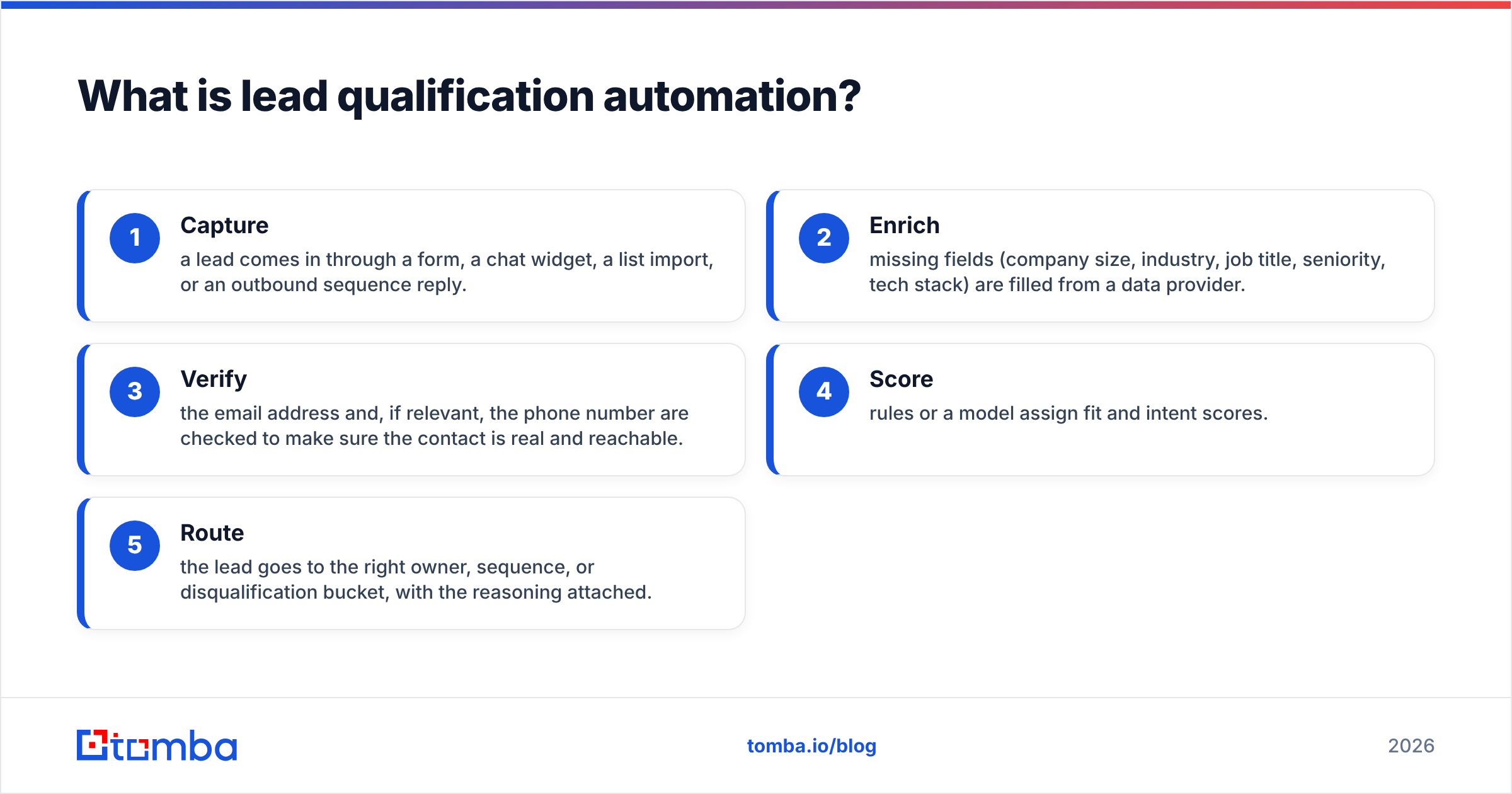
In a manual process, an SDR opens each form fill, Googles the company, checks LinkedIn, guesses at budget, and decides. That takes 5 to 15 minutes per lead and produces inconsistent answers depending on who's working that day. Automation swaps the guessing for a repeatable system:
- Capture: a lead comes in through a form, a chat widget, a list import, or an outbound sequence reply.
- Enrich: missing fields (company size, industry, job title, seniority, tech stack) are filled from a data provider.
- Verify: the email address and, if relevant, the phone number are checked to make sure the contact is real and reachable.
- Score: rules or a model assign fit and intent scores.
- Route: the lead goes to the right owner, sequence, or disqualification bucket, with the reasoning attached.
If you've heard the term lead scoring, that's step four. Lead qualification automation covers the whole pipeline around it, and the steps before scoring are where most of the value is won or lost.
Why does manual lead qualification break at scale?#
Manual qualification works fine at 20 leads a week. At 500 it falls apart, for three reasons.
Speed decays conversion. Inbound leads go cold fast. A demo request that sits in a shared inbox over a weekend is a demo request your competitor probably answered first. Manual triage adds hours or days of delay.
Consistency is impossible. Two SDRs looking at the same lead will disagree about 30% of the time on whether it's qualified. That inconsistency makes your funnel metrics meaningless, because "SQL" means something different depending on who stamped it.
Reps cherry-pick. When humans qualify, they unconsciously favor leads that look easy: recognizable logos, friendly titles. Mid-market accounts with unfamiliar names get ignored even when they fit your ICP perfectly.
Automation doesn't remove judgment. It moves judgment upstream, into the rules you design once and refine over time, instead of spreading it across hundreds of rushed individual calls.
What are the main approaches to automating lead qualification?#
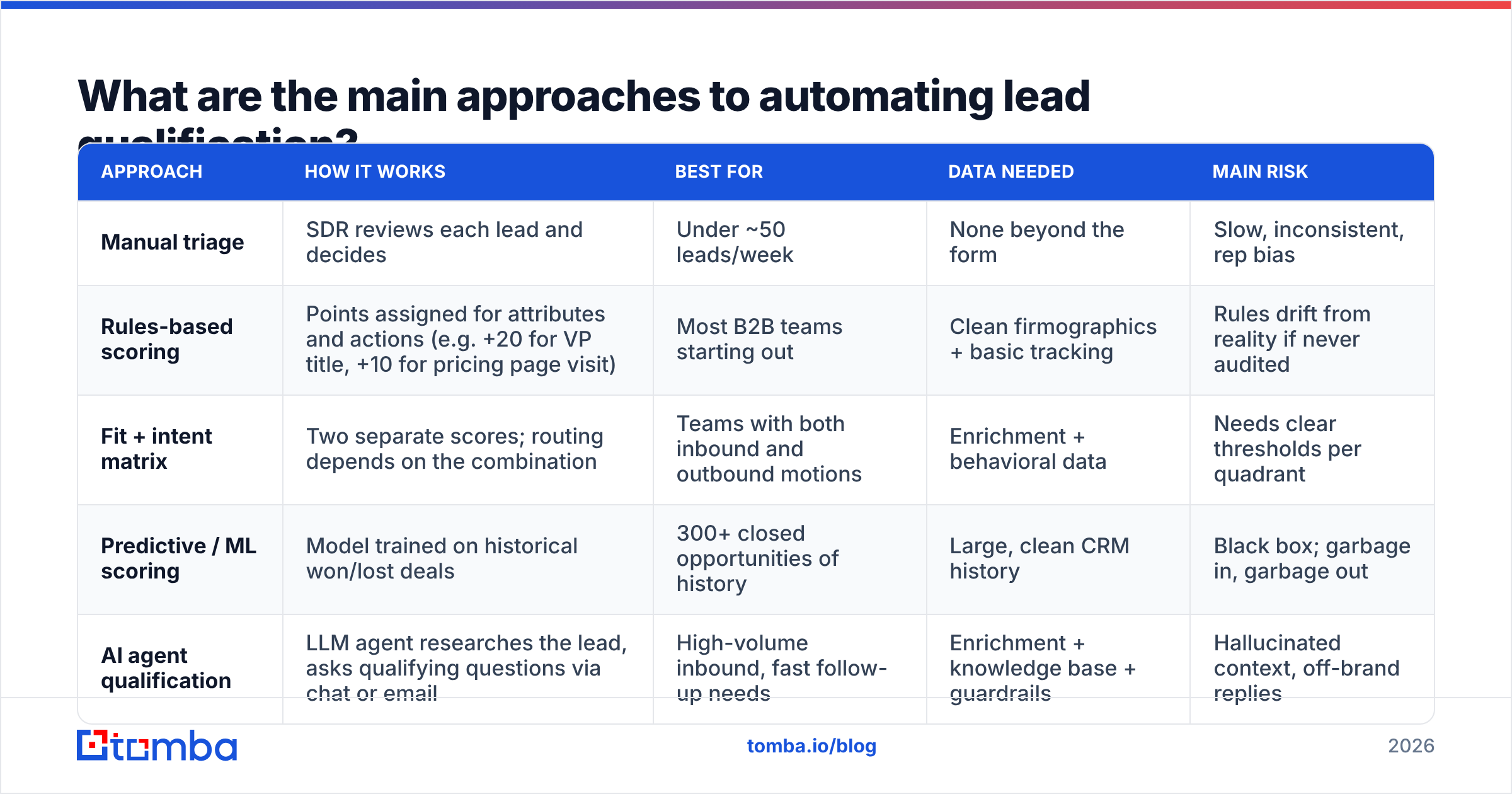
There are three levels of sophistication. Most teams should climb them in order rather than jumping straight to the top.
| Approach | How it works | Best for | Data needed | Main risk |
|---|---|---|---|---|
| Manual triage | SDR reviews each lead and decides | Under ~50 leads/week | None beyond the form | Slow, inconsistent, rep bias |
| Rules-based scoring | Points assigned for attributes and actions (e.g. +20 for VP title, +10 for pricing page visit) | Most B2B teams starting out | Clean firmographics + basic tracking | Rules drift from reality if never audited |
| Fit + intent matrix | Two separate scores; routing depends on the combination | Teams with both inbound and outbound motions | Enrichment + behavioral data | Needs clear thresholds per quadrant |
| Predictive / ML scoring | Model trained on historical won/lost deals | 300+ closed opportunities of history | Large, clean CRM history | Black box; garbage in, garbage out |
| AI agent qualification | LLM agent researches the lead, asks qualifying questions via chat or email | High-volume inbound, fast follow-up needs | Enrichment + knowledge base + guardrails | Hallucinated context, off-brand replies |
A few notes on reading this table honestly:
- Rules-based isn't "beginner." Plenty of mature revenue teams still run on well-maintained rules because they're explainable. A rep can see why a lead scored 85 and argue with it.
- Predictive scoring needs volume. If you've closed 40 deals in your company's history, a model trained on them will mostly learn noise. Vendors rarely say this on their sales pages.
- AI agents qualify conversationally, not statistically. They're great at asking "what's your timeline?" at 2 a.m. They're not a replacement for a scoring model; they feed one.
How do fit scoring and intent scoring differ?#
This split is the most useful idea in lead qualification automation, and it's the one most teams skip.
Fit answers: Would we want this account as a customer if they were ready to buy? It's based on relatively static attributes:
- Company size (employees, revenue)
- Industry and sub-industry
- Geography
- Tech stack (e.g. uses Salesforce, runs on AWS)
- Contact role and seniority
Intent answers: Are they trying to buy something like ours right now? It's based on behavior and timing:
- Pricing or demo page visits
- Repeat visits within a short window
- Content downloads on bottom-of-funnel topics
- Replies to outbound email
- Third-party intent signals (research activity on review sites)
- Trigger events such as a new funding round, a new VP hire, or expansion into a new region
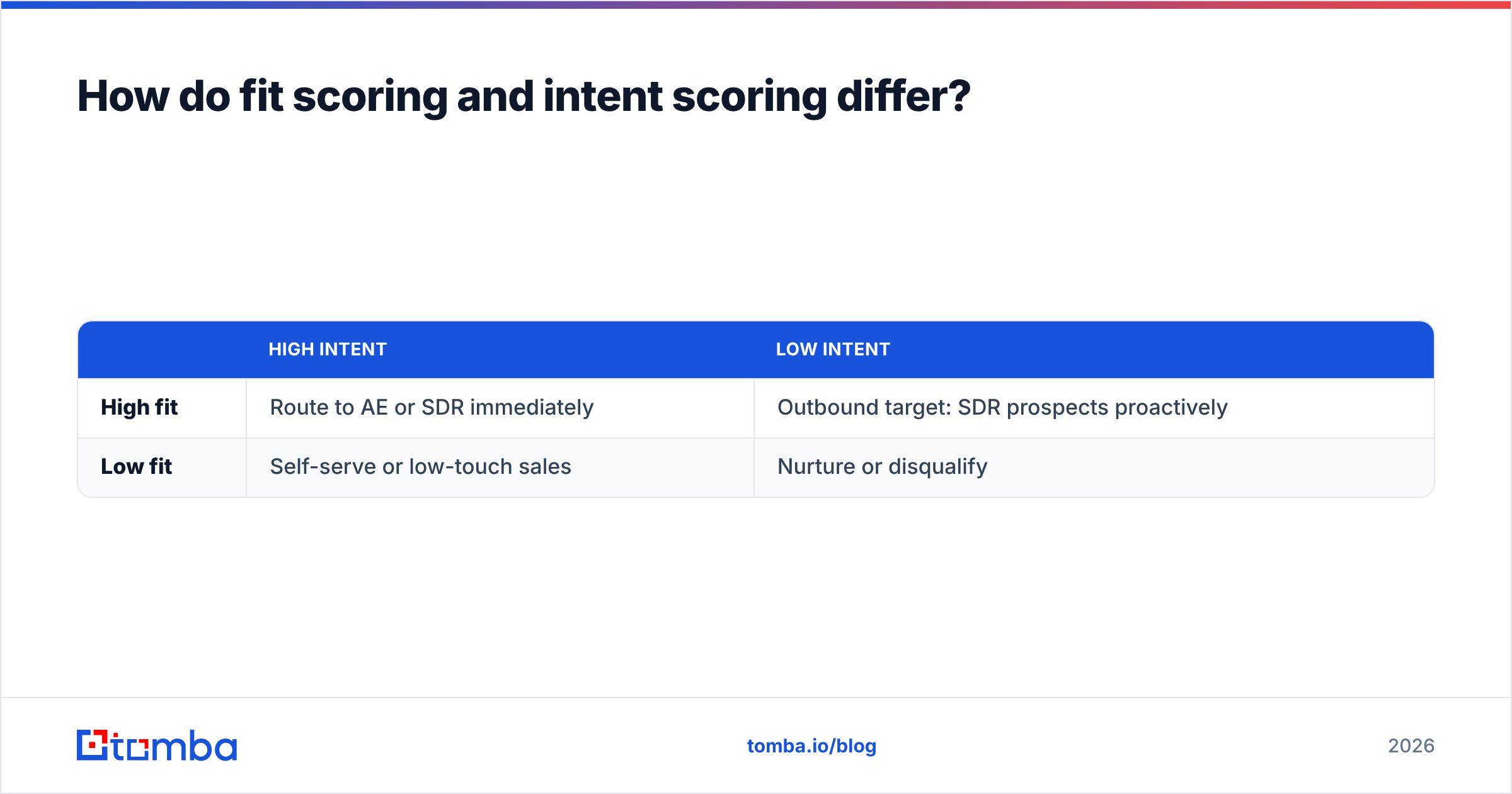
When you blend both into a single number, you lose information. A student who reads every blog post can outscore a VP of Sales at a perfect-fit account who visited your pricing page once. Keeping them separate lets you route on a simple matrix:
| High intent | Low intent | |
|---|---|---|
| High fit | Route to AE or SDR immediately | Outbound target: SDR prospects proactively |
| Low fit | Self-serve or low-touch sales | Nurture or disqualify |
This is also where the marketing qualified lead definition gets clearer. An MQL stops being "anyone who crossed 50 points" and becomes "high fit plus at least moderate intent," which sales will actually accept.
Why is data quality the real bottleneck?#
Every scoring model is a function of its inputs. If the inputs are missing or wrong, the output is confidently wrong, and that's worse than no automation at all, because reps stop trusting the system and go back to spreadsheets.
Here's where lead data typically breaks:
- Form fields are sparse. You asked for name and email to keep conversion rates high. Now you have no company size, no title, no industry. Your fit score is blank.
- Emails are personal or fake.
jdoe1987@gmail.comtells you nothing about the company.test@test.comshould never reach a rep. - Titles are messy. "Head of Growth," "Growth Lead," and "VP Growth & Demand" need to map to the same seniority bucket.
- Data decays. B2B contact data goes stale quickly as people change jobs. A lead that scored well 18 months ago may now belong to a different company.
The fix is to put enrichment and verification in front of scoring, not behind it.
Enrichment fills the gaps. Given an email or a domain, a data enrichment service returns company size, industry, location, and the contact's role, which is exactly what fit scoring needs. If a lead only gives you a personal address, enrichment can often still resolve the company from other signals, and when you're building outbound lists, a domain-based lookup gives you the right contacts at target accounts before they ever enter the funnel.
Verification filters out garbage. Running every new lead through an email verifier before it's scored does two things: it removes fake and mistyped addresses so they never waste a rep's time, and it protects your sending reputation when those leads enter sequences. A hard bounce from an unverified lead hurts every future campaign.
A practical rule: no lead gets a fit score until it has passed verification and enrichment. Leads that can't be enriched get a separate "insufficient data" status and a lightweight manual review, rather than a misleadingly low score.
How do you set up lead qualification automation step by step?#
You don't need a six-month project. A focused team can have a working v1 in two to three weeks.
Define your ICP from closed-won data, not opinions. Pull your last 50 to 100 won deals. What company sizes, industries, and buyer titles show up again and again? Do the same for lost deals and churned customers. Your fit criteria should come from this, not from a brainstorm.
Agree on qualification definitions with sales. Write down, in one sentence each, what counts as an MQL, SAL, and SQL. Get the head of sales to sign off. If sales doesn't agree with the definition, they'll ignore the routing.
Wire up enrichment and verification at the point of capture. Every form, chat, and import should trigger enrichment and email verification before the record lands in your CRM. Most teams do this with a native CRM integration or a tool like Zapier or Make. If you use HubSpot, a direct HubSpot integration keeps the enriched fields synced without a middle layer.
Build a simple rules-based fit score. Five to eight attributes, weighted by how strongly they correlated with wins in step 1. Keep it explainable.
Build a separate intent score. Start with three or four high-signal actions: pricing page visit, demo request, email reply, repeat visit within 7 days. Add decay so a pricing visit from three months ago stops counting.
Set routing rules on the fit/intent matrix. Decide what happens in each quadrant, who owns it, and the SLA (for example, high/high leads get a response within 1 business hour).
Log the reason with every score. Put a short text field on the record: "Fit 82: VP title, 200-500 employees, SaaS. Intent 60: pricing page x2." Reps trust scores they can read.
Review monthly against outcomes. Compare scores to what actually converted. Adjust weights. Retire signals that don't predict anything.
Which tools handle lead qualification automation?#
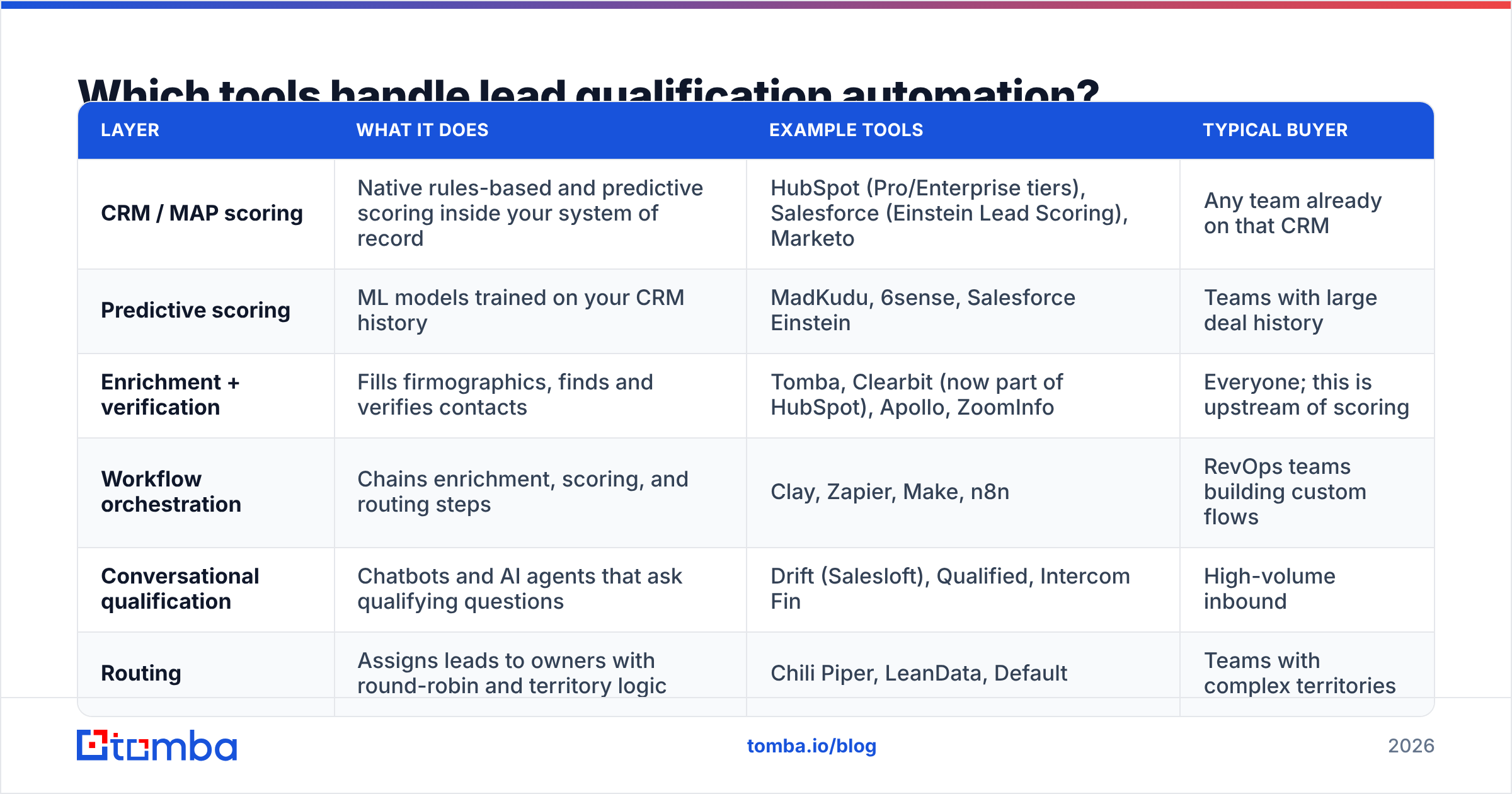
The tooling breaks into layers. You'll usually combine two or three rather than buying one platform that claims to do everything. Review aggregators like G2's lead scoring category are useful for shortlisting, but match the tool to the layer you're missing.
| Layer | What it does | Example tools | Typical buyer |
|---|---|---|---|
| CRM / MAP scoring | Native rules-based and predictive scoring inside your system of record | HubSpot (Pro/Enterprise tiers), Salesforce (Einstein Lead Scoring), Marketo | Any team already on that CRM |
| Predictive scoring | ML models trained on your CRM history | MadKudu, 6sense, Salesforce Einstein | Teams with large deal history |
| Enrichment + verification | Fills firmographics, finds and verifies contacts | Tomba, Clearbit (now part of HubSpot), Apollo, ZoomInfo | Everyone; this is upstream of scoring |
| Workflow orchestration | Chains enrichment, scoring, and routing steps | Clay, Zapier, Make, n8n | RevOps teams building custom flows |
| Conversational qualification | Chatbots and AI agents that ask qualifying questions | Drift (Salesloft), Qualified, Intercom Fin | High-volume inbound |
| Routing | Assigns leads to owners with round-robin and territory logic | Chili Piper, LeanData, Default | Teams with complex territories |
Some honest trade-offs:
- Native CRM scoring is the cheapest to start, since you already pay for it, but it's only as good as the fields in your CRM. That's why enrichment matters.
- Predictive platforms such as 6sense are strong for enterprise account-based motions but are priced and scoped for that; a 10-person startup will usually get more from well-tuned rules.
- Enrichment providers vary most on coverage in specific regions and company sizes. Test with a sample of your own leads before committing, and check how each vendor handles verification. Tomba's plans start with a free tier (25 searches/month) and go up through Starter at $49/mo, Growth at $99/mo, and Pro at $249/mo, which makes it easy to benchmark on a real sample before you scale.
How does AI change lead qualification in 2026?#
AI has shifted lead qualification automation in three concrete ways. None of them remove the need for clean data.
Research agents replace manual lookups. An LLM agent can read a lead's company website, recent news, and job postings, then write a two-line summary: "Series B fintech, hiring 4 SDRs, just launched in Germany." That's the context an SDR used to spend 10 minutes gathering. The risk: agents can confidently invent details. Always ground them in verified enrichment data and link sources.
Conversational qualification runs 24/7. AI chat and email responders can ask BANT or MEDDIC-style questions to inbound leads outside business hours and book meetings for qualified ones. This works best with tight guardrails: a fixed question set, clear handoff rules, and no pricing promises.
Scoring models explain themselves. Newer predictive tools pair a score with a plain-language explanation of the top factors. That closes the old "black box" complaint and makes it easier for reps to accept automated routing.
Analyst firms like Gartner have repeatedly pointed out that B2B buyers now do most of their research before talking to sales. Qualification has to work off the digital signals buyers leave behind, and AI is good at reading those signals at scale, if the underlying contact and company data are accurate.
What mistakes should you avoid?#
- Scoring before enriching. You'll systematically under-score good leads that left sparse form data.
- One blended score. It hides whether a lead is a good fit or just active. Keep fit and intent separate.
- Never decaying intent. A pricing page visit from last quarter isn't a buying signal today.
- Letting marketing set thresholds alone. If sales didn't agree to the MQL definition, they won't work the MQLs.
- Skipping email verification. Invalid addresses inflate your lead counts, waste sequences, and damage deliverability for every campaign that follows.
- Buying predictive scoring too early. Without enough closed-won history, you're paying for a model that can't learn.
- No feedback loop. If reps can't flag "this lead was mis-scored," your model never improves.
Is lead qualification automation worth it for small teams?#
Yes, but keep it light. A three-person sales team doesn't need 6sense. It needs:
- Enrichment and verification on every inbound lead
- A five-rule fit score in the CRM it already uses
- A single "hot" intent trigger (demo request or pricing page visit plus fit score above threshold) that alerts a rep instantly
- A monthly 30-minute review of what converted
That setup costs little beyond the enrichment tool and a CRM you already have, and it usually pays for itself within the first quarter just from faster response times on your best leads.
Where should you start?#
Qualification automation is only as smart as the data you feed it. Before you tune weights or trial an AI agent, make sure every lead entering your funnel has a verified email address and a real company attached. If you're building outbound lists or backfilling contacts for high-fit accounts, Tomba Email Finder lets you find and verify professional email addresses by domain, name, or company, so your scoring model starts from real, reachable contacts instead of guesses. Start on the free tier, run it against a sample of your current leads, and see how many gaps it closes before you change a single scoring rule.
Related guides#
// get started
Find, verify and enrich your first contacts today
Start on the free plan with 25 searches a month, then scale when your team is ready.
Free plan · No credit card required · GDPR & CCPA
// about the author