Lead Qualification Best Practices: 9 Rules That Work in 2026
Most pipelines aren't short on leads. They're short on leads worth a rep's time. Here are nine lead qualification best practices, with frameworks, scoring rules, and the data checks most teams skip.
TL;DR
- Lead qualification decides who gets a rep's time. It isn't a gate you close once. It's a filter you keep running from first touch to the proposal.
- Start with data quality. A lead with a bouncing email or the wrong job title fails before any framework like BANT or MEDDIC comes into play.
- Split qualification into two layers: fit (does this account match your ICP?) and intent (are they doing anything that suggests they're buying now?). Score each one separately.
- Pick one framework that matches your deal size. Use BANT or CHAMP for transactional sales and MEDDIC for complex enterprise cycles. Don't stack three frameworks on top of each other.
- Write down your disqualification rules, review them every quarter against closed-won and closed-lost data, and give leads back to marketing with a reason attached.
What is lead qualification, and why do most teams get it wrong?#
Lead qualification is how you decide whether a prospect is worth sales time and how much of it. It sits between lead generation and the first real sales conversation. In practice it answers three questions: can this company buy, do they need what you sell, and is now the right time?
Teams rarely get it wrong because they chose the wrong framework. They get it wrong because they qualify on bad inputs. A rep runs a solid discovery call with someone who left the company six months ago. A lead-scoring model gives points for "VP" titles scraped from a stale list. An SDR sequence sends 400 emails, and 60 of them bounce, which damages the domain for everyone else on the team.
The second common failure is treating qualification as a single yes-or-no moment. A lead that was a strong marketing qualified lead in March can go cold by June after a budget freeze. Good qualification keeps re-checking.
The third is not writing anything down. When "qualified" means something different to each SDR, pipeline reviews become arguments. Your forecast then depends on who logged the opportunity.
What are the core lead qualification best practices?#
These are the nine practices that make the biggest difference, in the order you should apply them.
- Verify contact data before anything else. Check every email, confirm every title, and match every company to its domain. If you can't reach the person, nothing else about the lead matters.
- Define your ICP in firmographic terms a machine can check. "Mid-market SaaS" is too loose. "50–500 employees, B2B software, North America or EU, uses HubSpot or Salesforce" is something a filter can actually apply.
- Score fit and intent separately. A perfect-fit account with no intent belongs in nurture. A high-intent account with poor fit is often a support ticket dressed up as a lead. Only accounts that score high on both should reach an AE.
- Choose one qualification framework per sales motion. Match it to deal size and cycle length, as shown in the comparison below.
- Write explicit disqualifiers. Examples: student email domains, competitors, companies under your minimum headcount, regions you can't sell into. Disqualifying early saves more time than qualifying well.
- Set a response-time SLA for inbound leads. High-intent inbound leads (a demo request or a pricing page visit plus a form fill) should reach a human within hours, not days.
- Keep MQL, SQL, and SAL as separate stages. Marketing qualifies, sales accepts, and sales then qualifies again. Every handoff needs a timestamp and an owner.
- Recycle leads with a reason code. "Not now – budget Q3" can be acted on later. "Bad lead" can't.
- Audit against closed deals every quarter. Compare the attributes of won deals with those of lost and stalled deals, then adjust your score weights to match.
Why does data quality come before any framework?#
Every framework assumes the person on the other end of the email is real, reachable, and still in the job. That assumption fails more often than most teams realise. B2B contact data decays all the time because people change roles, companies rebrand, and domains move. If your list is a year old, a meaningful share of it is probably wrong.
This matters for qualification in three ways.
Scoring models learn from garbage. If 15% of your "unresponsive" leads never got the email in the first place, your model decides those segments are low-intent when they were actually unreachable.
Bounces hurt deliverability for the whole team. High bounce rates damage your email deliverability, so even your good leads start landing in spam.
Reps lose trust in the system. Once an AE gets three "qualified" leads with dead contact details, they stop taking handoffs seriously.
The fix is simple and cheap. Run every new lead through an email verifier before it enters a sequence or a scoring model. Then fill in the missing firmographic fields (headcount, industry, tech stack) with data enrichment so your ICP filters have something real to check. If the form only captured a name and a company, a domain search can confirm the domain and show who else at the account is worth contacting.
Think of this as step zero. It takes minutes per batch, and it makes every later step more accurate.
Which lead qualification framework should you use?#
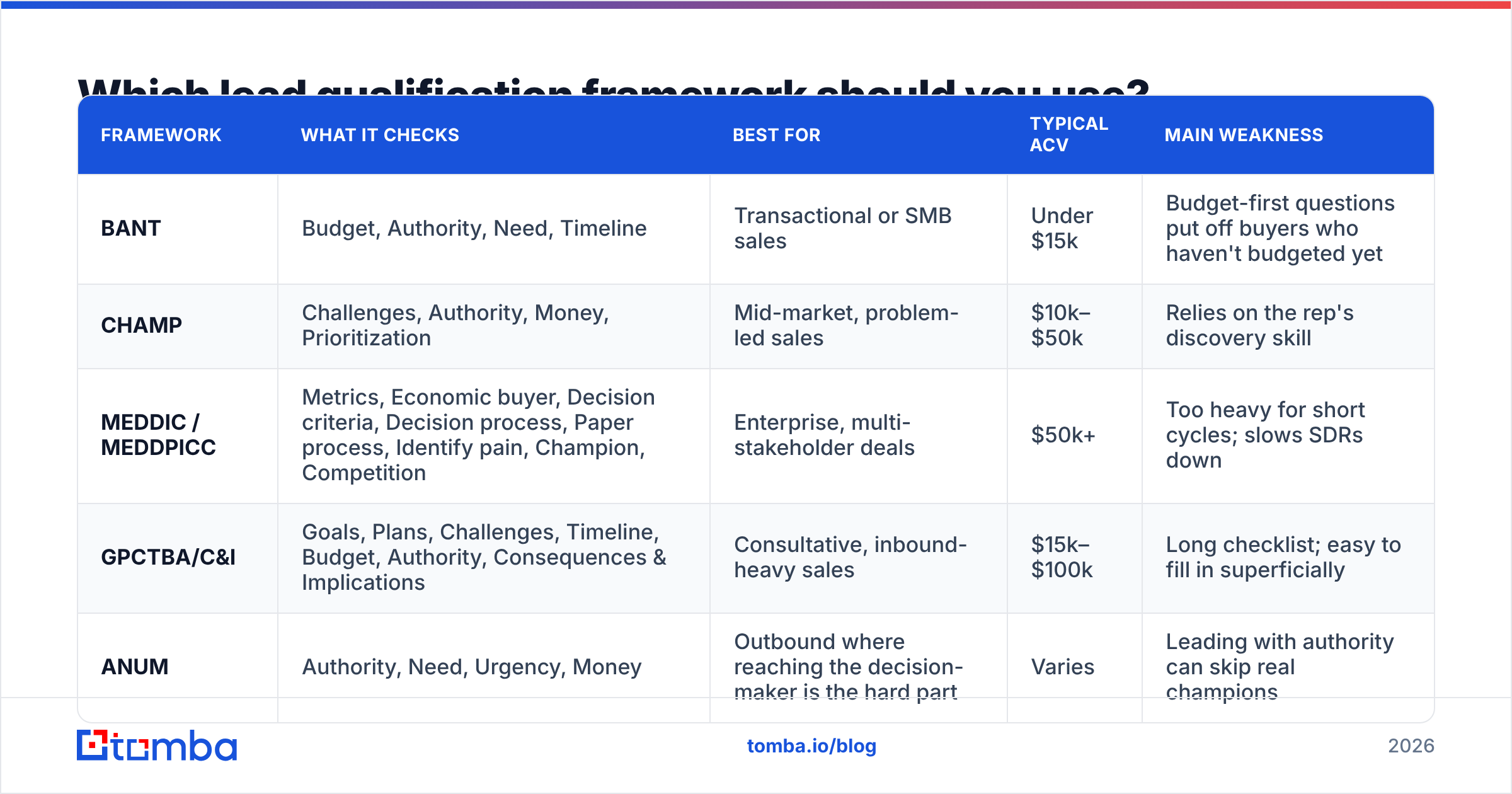
Match the framework to your deal complexity, not to whatever your last sales leader happened to prefer. Here's how the common ones compare.
| Framework | What it checks | Best for | Typical ACV | Main weakness |
|---|---|---|---|---|
| BANT | Budget, Authority, Need, Timeline | Transactional or SMB sales | Under $15k | Budget-first questions put off buyers who haven't budgeted yet |
| CHAMP | Challenges, Authority, Money, Prioritization | Mid-market, problem-led sales | $10k–$50k | Relies on the rep's discovery skill |
| MEDDIC / MEDDPICC | Metrics, Economic buyer, Decision criteria, Decision process, Paper process, Identify pain, Champion, Competition | Enterprise, multi-stakeholder deals | $50k+ | Too heavy for short cycles; slows SDRs down |
| GPCTBA/C&I | Goals, Plans, Challenges, Timeline, Budget, Authority, Consequences & Implications | Consultative, inbound-heavy sales | $15k–$100k | Long checklist; easy to fill in superficially |
| ANUM | Authority, Need, Urgency, Money | Outbound where reaching the decision-maker is the hard part | Varies | Leading with authority can skip real champions |
A few practical notes:
- BANT isn't obsolete, but its order is. Start with need and timeline. Ask about budget once the buyer has agreed there's a problem worth solving.
- MEDDIC is for opportunities, not leads. Use it once an opportunity exists. Making an SDR fill in MEDDIC fields on a cold lead wastes everyone's time.
- A hybrid is fine if it's documented. Plenty of teams use BANT-lite at the SDR stage and MEDDPICC at the AE stage. The rule is that each stage has exactly one checklist, written down in your CRM.
How do you build a lead scoring model that actually predicts revenue?#
Lead scoring turns qualification into numbers so you can route and prioritise automatically. Most scoring models fail because they're built on intuition and never compared with outcomes.
Here's a structure that holds up.
Two scores, not one. Keep a fit score (0–100) based on firmographics and role, and an engagement score (0–100) based on behaviour. Blending them into one number hides the most useful signal, which is that a lead can fit well and do nothing, or engage heavily and fit poorly.
Fit score inputs:
- Company size within your ICP band
- Industry match
- Geography you can sell and support in
- Tech stack signals (for example, they use a CRM you integrate with)
- Seniority and function of the contact
Engagement score inputs:
- High-intent page visits (pricing, integrations, comparison pages)
- Demo or trial requests
- Replies to outbound (score positive replies higher than "not now")
- Webinar attendance, content downloads (low weight on their own)
Negative scoring matters as much as positive. Subtract points for personal email domains, careers-page visits (probably job seekers), competitor domains, and email addresses that fail verification. Too few teams use negative scores.
Add decay. Engagement from 90 days ago shouldn't count as much as engagement from yesterday. A simple rule, such as halving engagement points every 30 days, stops old tire-kickers from sitting at the top of the queue.
Calibrate every quarter. Pull last quarter's closed-won deals and check what their fit and engagement scores were when they were first handed to sales. If half your wins started below your MQL threshold, the threshold is wrong. Both Salesforce and HubSpot include native scoring tools. Their defaults are a starting point, so plan to recalibrate them.
What questions should you ask during a qualification call?#
The questions you ask matter less than the order you ask them in. Start with the problem, then move to the process, and only then to money.
Problem and impact
- "What made you look at this now rather than six months ago?"
- "What happens if nothing changes this quarter?"
- "How are you handling this today, and what does it cost you?"
Process and people
- "Who else would be involved in evaluating something like this?"
- "Have you bought a tool in this category before? How did that process go?"
- "Is there a security or procurement review we should plan for?"
Timeline and money
- "Is there a date driving this, like a renewal, a launch, or a hiring plan?"
- "Is this already budgeted, or would it need a business case?"
The last question is useful because "needs a business case" doesn't disqualify anyone. It tells you that you need to help build one. Treat the answer as information that shapes the next step, not as a pass or fail.
How do you handle disqualification without burning leads?#
Disqualifying a lead should never be a dead end. It should put the lead in a clearly labelled holding pattern.
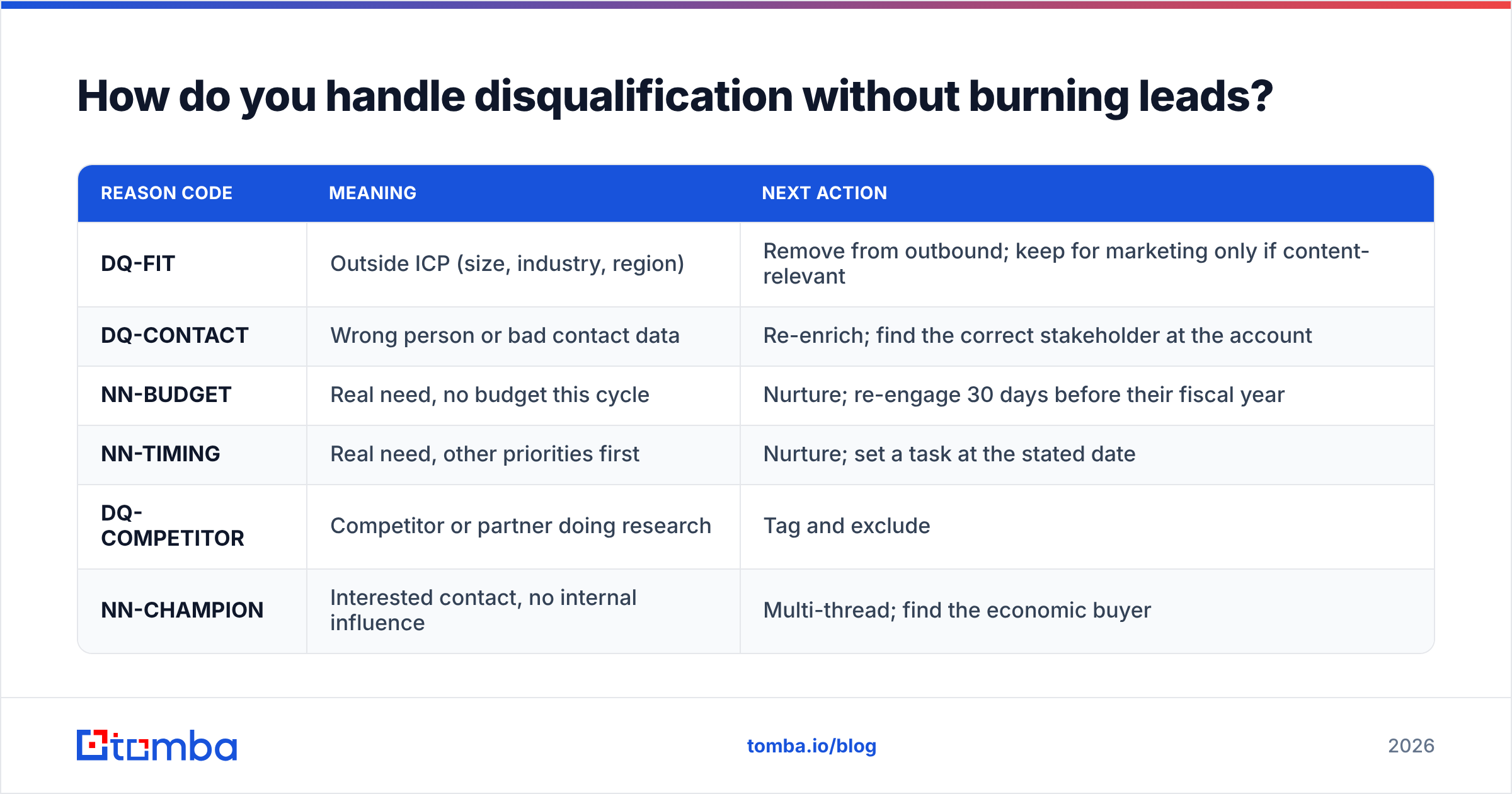
Set up a short list of reason codes and require one whenever a rep disqualifies a lead:
| Reason code | Meaning | Next action |
|---|---|---|
| DQ-FIT | Outside ICP (size, industry, region) | Remove from outbound; keep for marketing only if content-relevant |
| DQ-CONTACT | Wrong person or bad contact data | Re-enrich; find the correct stakeholder at the account |
| NN-BUDGET | Real need, no budget this cycle | Nurture; re-engage 30 days before their fiscal year |
| NN-TIMING | Real need, other priorities first | Nurture; set a task at the stated date |
| DQ-COMPETITOR | Competitor or partner doing research | Tag and exclude |
| NN-CHAMPION | Interested contact, no internal influence | Multi-thread; find the economic buyer |
Pay attention to DQ-CONTACT in particular. When a rep says "this lead is bad", it often means "this person is bad" while the account is fine. Before you throw the account away, look for the right stakeholder at that company. The account might still be a strong fit.

How do sales and marketing agree on what "qualified" means?#
Most MQL-to-SQL disputes come down to one missing document: a service-level agreement that both teams have signed off on.
A usable SLA fits on one page and covers:
- Definitions. Exact fit and engagement thresholds for MQL, and the checklist that turns an MQL into an SQL.
- Volume commitments. Marketing commits to N MQLs per month at the agreed quality. Sales commits to working each one within X hours.
- Follow-up minimums. For example, six touches over 14 days before a lead can go back to marketing.
- Feedback loop. Every rejected MQL gets a reason code, and marketing reviews the rejection mix monthly.
- Shared metrics. MQL-to-SQL conversion, SQL-to-opportunity conversion, and win rate by lead source.
Analyst firms such as Gartner have long pointed out that B2B buyers now spend most of the buying journey researching on their own before they talk to sales. By the time someone fills in a form, they've usually already built a shortlist. That puts real pressure on the SLA: the gap between the MQL and first contact is where you win or lose them.
Which tools support a modern lead qualification process?#
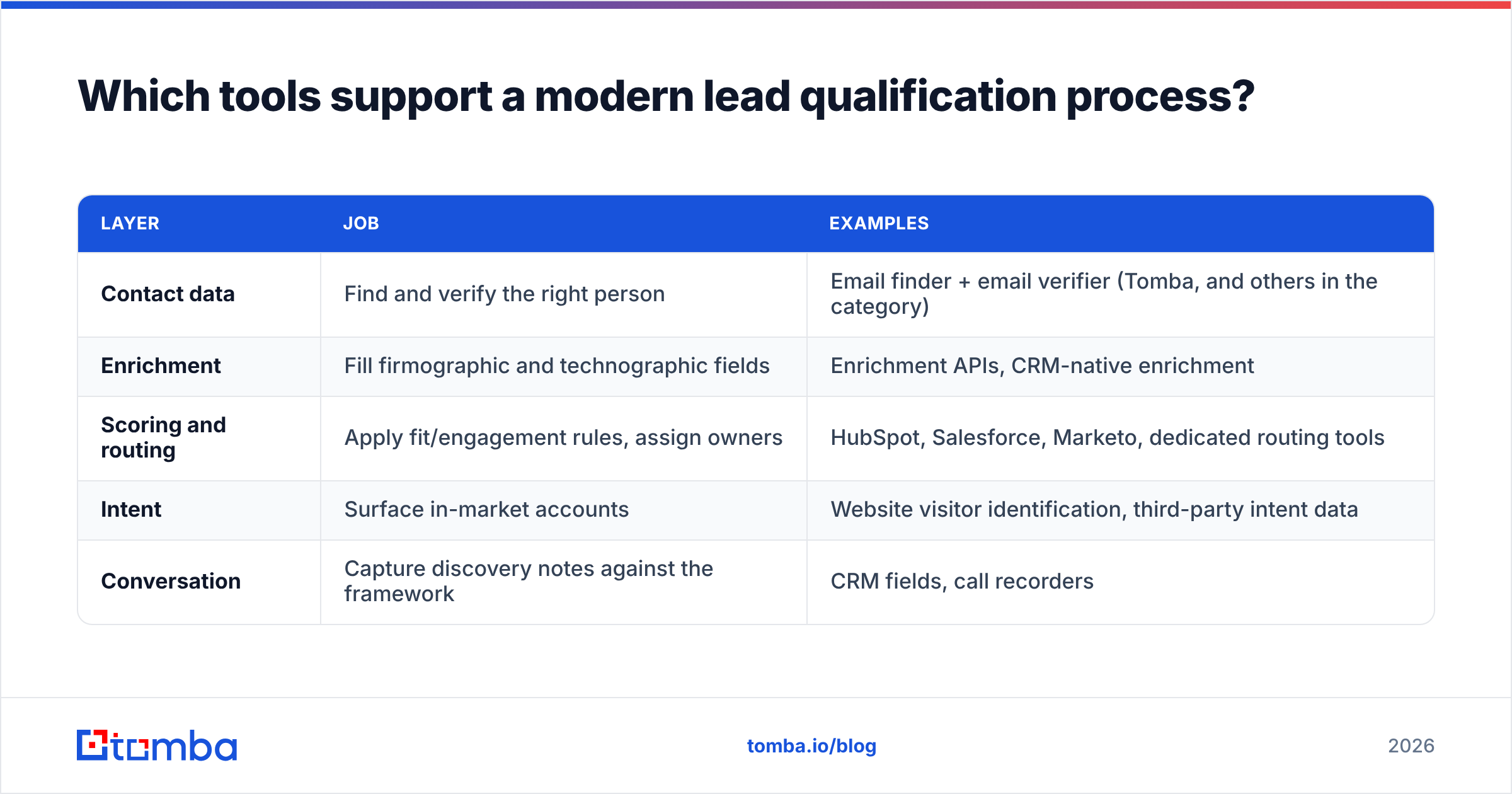
You don't need a big stack, but each of these layers needs something covering it:
| Layer | Job | Examples |
|---|---|---|
| Contact data | Find and verify the right person | Email finder + email verifier (Tomba, and others in the category) |
| Enrichment | Fill firmographic and technographic fields | Enrichment APIs, CRM-native enrichment |
| Scoring and routing | Apply fit/engagement rules, assign owners | HubSpot, Salesforce, Marketo, dedicated routing tools |
| Intent | Surface in-market accounts | Website visitor identification, third-party intent data |
| Conversation | Capture discovery notes against the framework | CRM fields, call recorders |
The contact data layer is the one teams skip most often, and it's the cheapest to fix. Verification and enrichment cost pennies per record. A qualified lead that gets written off because the email bounced costs a lot more.
What does a good lead qualification workflow look like end to end?#
Here's the whole process as one sequence you can adapt:
- Capture. A lead arrives from a form, outbound list, event, or visitor identification.
- Clean. Verify the email, standardise the company and domain, and remove duplicates against the CRM.
- Enrich. Add headcount, industry, region, tech stack, and seniority.
- Auto-disqualify. Apply the hard rules (competitors, personal domains, out-of-region, under the size floor).
- Score. Calculate fit and engagement separately and apply decay.
- Route. High fit plus high engagement goes to an SDR within the SLA. High fit with low engagement goes to targeted outbound. Low fit goes to nurture or out.
- Qualify live. The SDR runs a short, need-first discovery call using your stage-one framework.
- Hand off. An SQL goes to the AE with notes in agreed fields. The AE accepts or rejects it with a reason code.
- Review. Once a quarter, compare scores at handoff with closed outcomes and adjust the weights.
Automate steps 2 through 6. Steps 7 through 9 are where people add value, so give them clean inputs and let them spend their time on conversations.
Where should you start this week?#
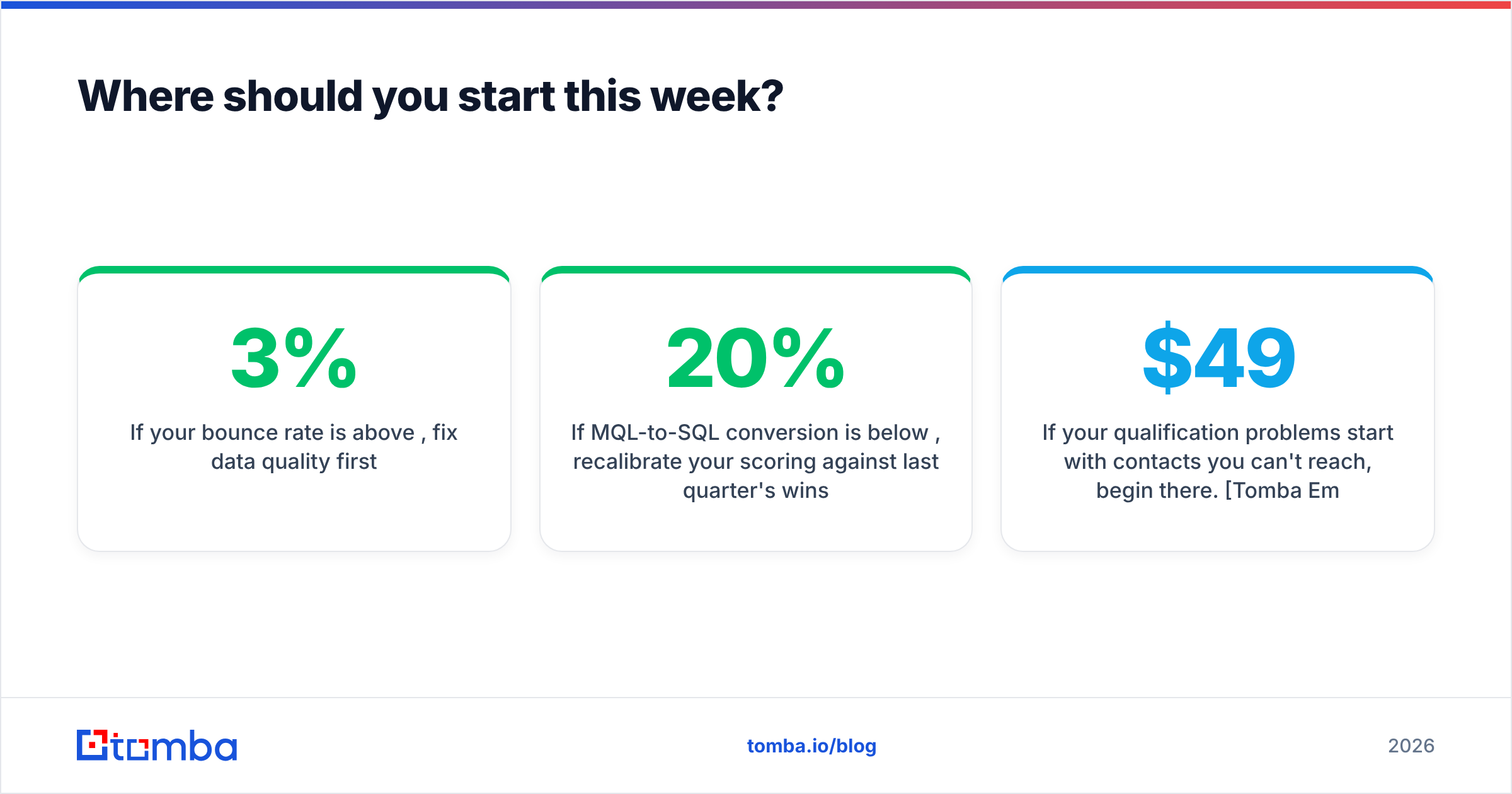
Don't rebuild everything at once. Pick the one fix that removes the most waste:
- If your bounce rate is above 3%, fix data quality first.
- If reps complain about lead quality but can't say why, add reason codes.
- If MQL-to-SQL conversion is below 20%, recalibrate your scoring against last quarter's wins.
- If marketing and sales argue every Monday, write the SLA.
Qualification rewards consistency more than cleverness. A plain BANT-lite checklist on verified, enriched data will beat a sophisticated MEDDPICC rollout running on a stale spreadsheet.
If your qualification problems start with contacts you can't reach, begin there. Tomba Email Finder finds professional email addresses by name, domain, or company, and pairs with verification and enrichment, so every lead that reaches your scoring model is a real person at the right account. The free tier includes 25 searches a month, and paid plans start at $49/mo, which makes it easy to test on your next batch of inbound leads before you change anything else in the process.
Related guides#
// get started
Find, verify and enrich your first contacts today
Start on the free plan with 25 searches a month, then scale when your team is ready.
Free plan · No credit card required · GDPR & CCPA
// about the author