Lead Qualification Framework: BANT vs MEDDIC vs CHAMP (2026)
BANT, MEDDIC, CHAMP, GPCTBA/C&I, ANUM, FAINT: six lead qualification frameworks compared by deal size, sales cycle and team maturity, plus a scoring template you can put in your CRM this week.
TL;DR
- A lead qualification framework is a shared checklist that decides which leads get a rep's time. Choose it based on deal size and sales cycle length, not on what's trendy.
- BANT still suits transactional deals under roughly $15k ACV. MEDDIC (or MEDDPICC) is built for complex enterprise deals with several stakeholders. CHAMP and GPCTBA/C&I sit between the two.
- Every framework fails on bad data. If your firmographics, contact details and job titles are wrong, your scores are guesses.
- Use a two-layer setup: an automated fit score from enriched data, followed by a conversational framework on a live call.
- Write your qualification criteria into CRM fields. A framework that only exists in a slide deck doesn't get used.
What is a lead qualification framework?#
A lead qualification framework is a structured set of questions or criteria that decides whether a lead is worth pursuing, and how hard to pursue it. It turns "this feels like a good lead" into something you can repeat, inspect and score.
A useful comparison is a hospital triage nurse. The nurse doesn't treat every patient the moment they arrive. They run a short, consistent checklist (pulse, breathing, pain level) and send each person to the right queue. Your framework does the same job for your pipeline. It decides who gets a same-day call, who goes into a nurture sequence, and who gets politely disqualified.
In practice, a framework has three parts:
- Criteria: the dimensions you judge, such as budget, authority, need, timing, pain, or economic buyer.
- Evidence standard: what counts as "yes" for each criterion. "They said they have budget" and "they named a budget line and its owner" are very different standards.
- Action rules: what happens at each score threshold, such as route to an AE, keep with the SDR, nurture, or disqualify.
Most teams only get to step 1. That's why the same lead can be marked "qualified" by one rep and "junk" by another.
Why does lead qualification matter more in 2026?#
Buyers now finish much of their research before they talk to sales, and there are more people on the buying committee. Gartner's B2B buying research has pointed out for years that buyers spend only a small share of their journey with suppliers. By the time someone books a demo, they have usually shortlisted vendors already.
That has two consequences for qualification:
- Early signals count for more. Intent data, firmographics and tech stack tell you a lot before anyone replies.
- Disqualifying quickly saves money. Each unqualified demo costs AE time, and it also skews forecasts, inflates the pipeline and hurts your win rate.
A framework makes these trade-offs visible. Without one, reps chase whoever replied most recently.
Which lead qualification frameworks should you know?#
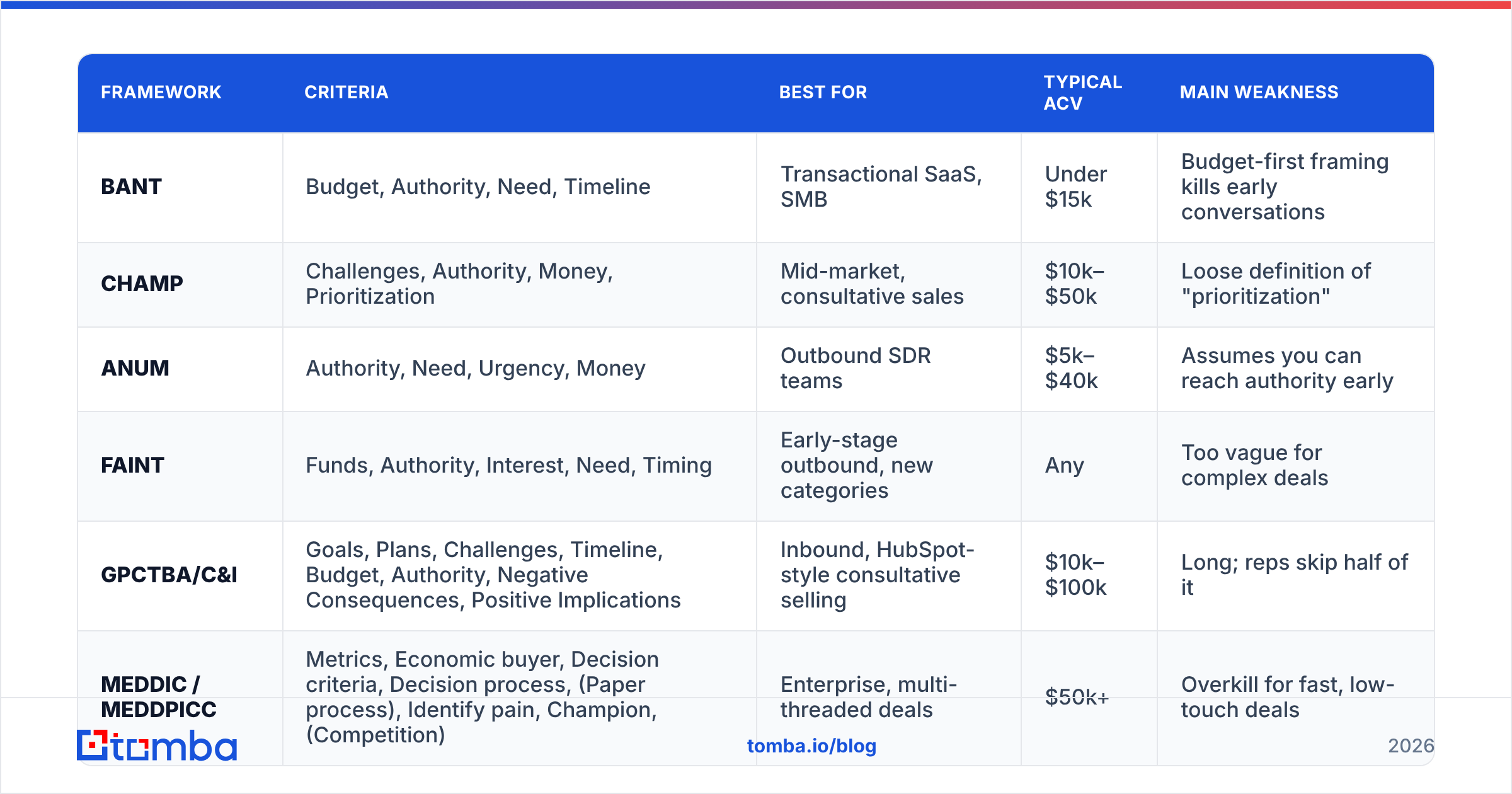
There are six frameworks that most B2B teams use in some form. Here they are side by side:
| Framework | Criteria | Best for | Typical ACV | Main weakness |
|---|---|---|---|---|
| BANT | Budget, Authority, Need, Timeline | Transactional SaaS, SMB | Under $15k | Budget-first framing kills early conversations |
| CHAMP | Challenges, Authority, Money, Prioritization | Mid-market, consultative sales | $10k–$50k | Loose definition of "prioritization" |
| ANUM | Authority, Need, Urgency, Money | Outbound SDR teams | $5k–$40k | Assumes you can reach authority early |
| FAINT | Funds, Authority, Interest, Need, Timing | Early-stage outbound, new categories | Any | Too vague for complex deals |
| GPCTBA/C&I | Goals, Plans, Challenges, Timeline, Budget, Authority, Negative Consequences, Positive Implications | Inbound, HubSpot-style consultative selling | $10k–$100k | Long; reps skip half of it |
| MEDDIC / MEDDPICC | Metrics, Economic buyer, Decision criteria, Decision process, (Paper process), Identify pain, Champion, (Competition) | Enterprise, multi-threaded deals | $50k+ | Overkill for fast, low-touch deals |
BANT: still useful, just not as your opening move#
IBM created BANT decades ago, and it lasts because it's simple. The usual complaint is that "Do you have budget?" in the first call puts buyers off. That complaint is fair, but it's about the order of the questions, not the criteria. Budget, authority, need and timeline still matter. Collect them in the order the conversation allows, and start with need.
CHAMP: BANT turned around#
CHAMP starts with Challenges, which is the fix most modern sellers apply to BANT anyway. It works well for consultative mid-market deals where the buyer may not have a budget line yet and you're effectively helping them build a business case.
ANUM and FAINT: for outbound teams#
Both put authority or funds first because outbound reps are reaching out cold. FAINT adds Interest, which accepts that many outbound prospects haven't recognised the need yet. If your SDRs create demand rather than capture it, one of these two will match reality better than BANT.
GPCTBA/C&I: thorough but long#
HubSpot popularised this one for inbound teams. It's excellent at uncovering the consequences of inaction, and that is what moves deals forward. The downside is length: eight criteria is a lot to cover on a 20-minute discovery call.
MEDDIC and MEDDPICC: the enterprise standard#
MEDDIC came out of PTC in the 1990s and is now the default for enterprise sales. The key idea is the Champion, an internal advocate who sells for you when you aren't there. MEDDPICC adds Paper process and Competition, which helps in procurement-heavy deals.
Is BANT better than MEDDIC?#
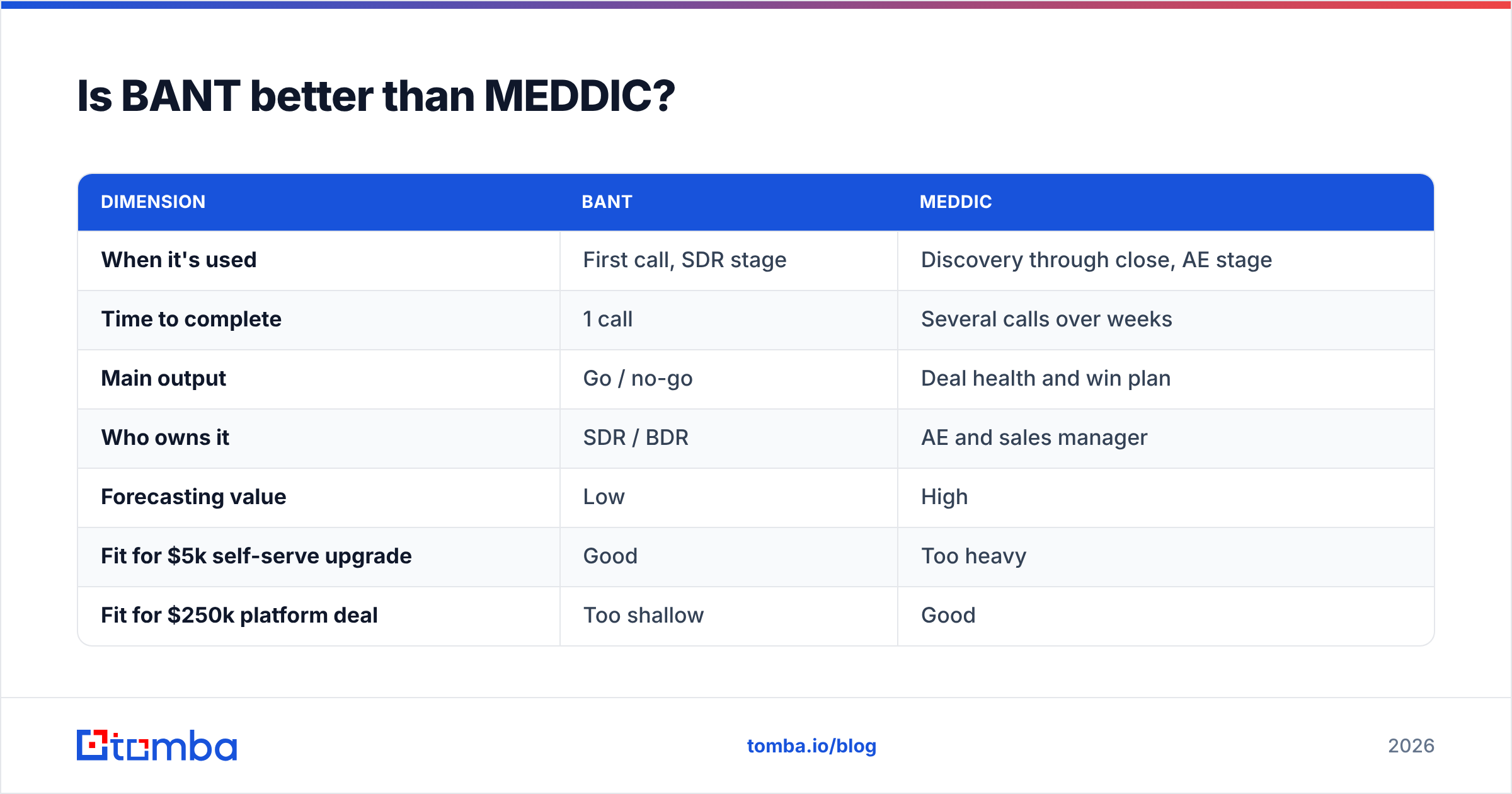
No. They're built for different jobs. BANT tells you whether to keep talking. MEDDIC tells you whether you'll win and how. Comparing them is like comparing a metal detector with an excavator.
Here's how they differ in practice:
| Dimension | BANT | MEDDIC |
|---|---|---|
| When it's used | First call, SDR stage | Discovery through close, AE stage |
| Time to complete | 1 call | Several calls over weeks |
| Main output | Go / no-go | Deal health and win plan |
| Who owns it | SDR / BDR | AE and sales manager |
| Forecasting value | Low | High |
| Fit for $5k self-serve upgrade | Good | Too heavy |
| Fit for $250k platform deal | Too shallow | Good |
Plenty of mature teams use both. SDRs qualify with a light BANT or ANUM pass, and AEs take over with MEDDPICC once a meeting is booked. That handoff is where most pipeline leaks, so define exactly which fields must be filled before an opportunity changes owner.
How do you choose the right lead qualification framework?#
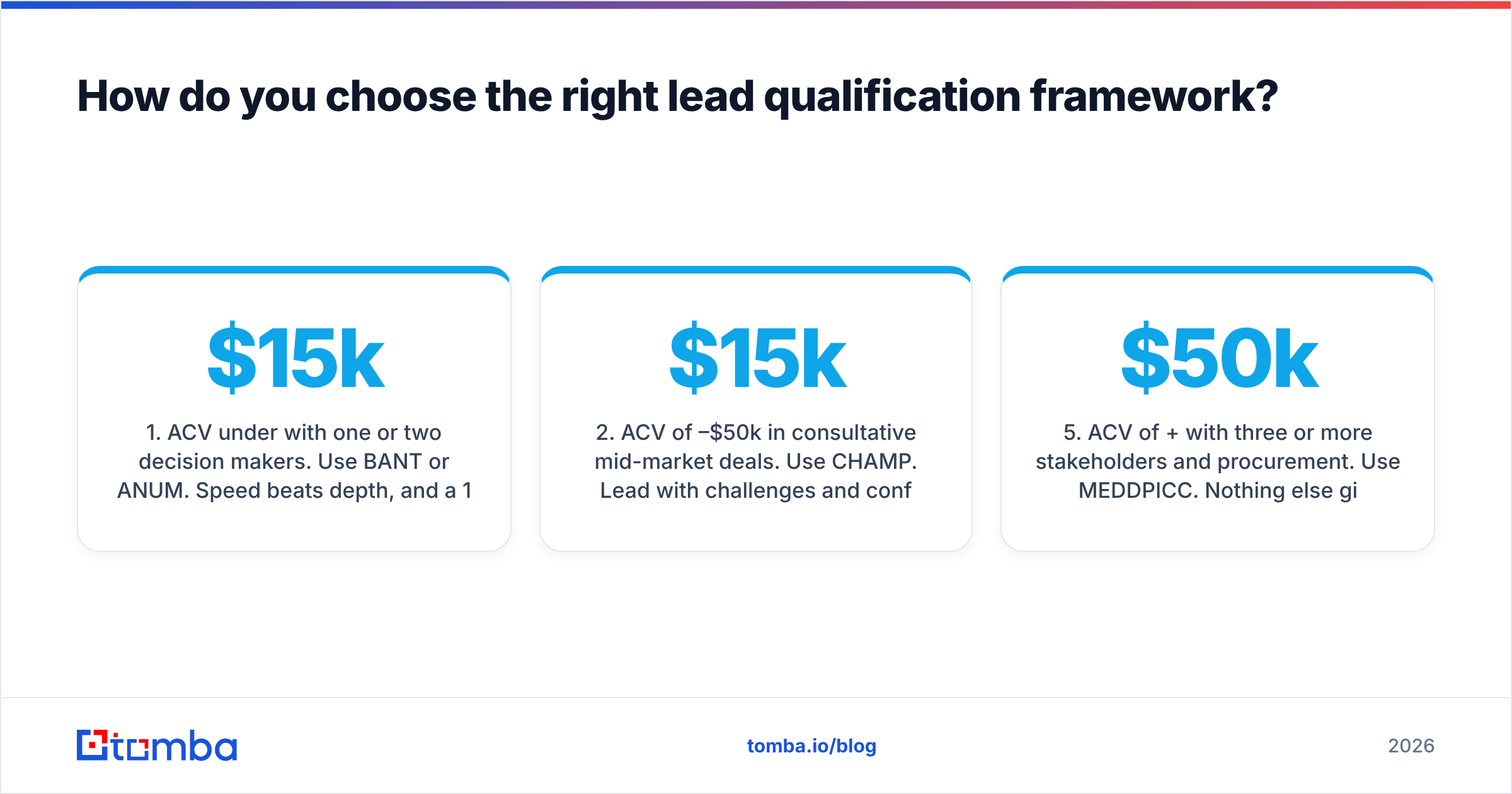
Choose based on three variables: deal size, number of stakeholders, and sales motion (inbound or outbound). Use these as starting points:
- ACV under $15k with one or two decision makers. Use BANT or ANUM. Speed beats depth, and a 15-minute qualification call is enough.
- ACV of $15k–$50k in consultative mid-market deals. Use CHAMP. Lead with challenges and confirm money once the pain is established.
- Inbound-heavy motion with educational content. Use GPCTBA/C&I, but cut it to the five criteria that actually predict closes in your CRM data.
- Outbound into a new category. Use FAINT. Interest is the real gating factor when buyers don't yet know they have the problem.
- ACV of $50k+ with three or more stakeholders and procurement. Use MEDDPICC. Nothing else gives you the forecasting accuracy.
If you're stuck between two options, pick the simpler one. You can always add criteria later. It's much harder to get reps to stop skipping fields they never believed in.
What role does data play in qualification?#
Data does most of the qualifying before a human is involved. Before a rep asks a single BANT question, you can usually answer a good part of the framework with enrichment:
- Authority: job title and seniority from contact data.
- Budget proxy: company size, funding stage and revenue band.
- Need proxy: tech stack (for example, whether they use a competitor), hiring signals and industry.
- Timing proxy: recent funding, leadership changes and intent spikes.
This is the "fit" layer of qualification, and it should be automated. Tools that enrich leads with firmographic and contact data let you score fit as soon as a lead lands in your CRM. Your reps' conversations can then focus on what data can't tell you: real pain, internal politics and urgency.
There's one catch. Qualification is only as good as the contact record behind it. If a lead's email bounces, you can't qualify them at all. If their title is two jobs out of date, your authority score is wrong. Run new leads through an email verifier before they reach a sequence, and refresh contact records on stale opportunities every quarter. Bad data doesn't just waste sends. It makes your framework say "qualified" about someone who left the company in March.
How do you build a lead scoring model from a framework?#
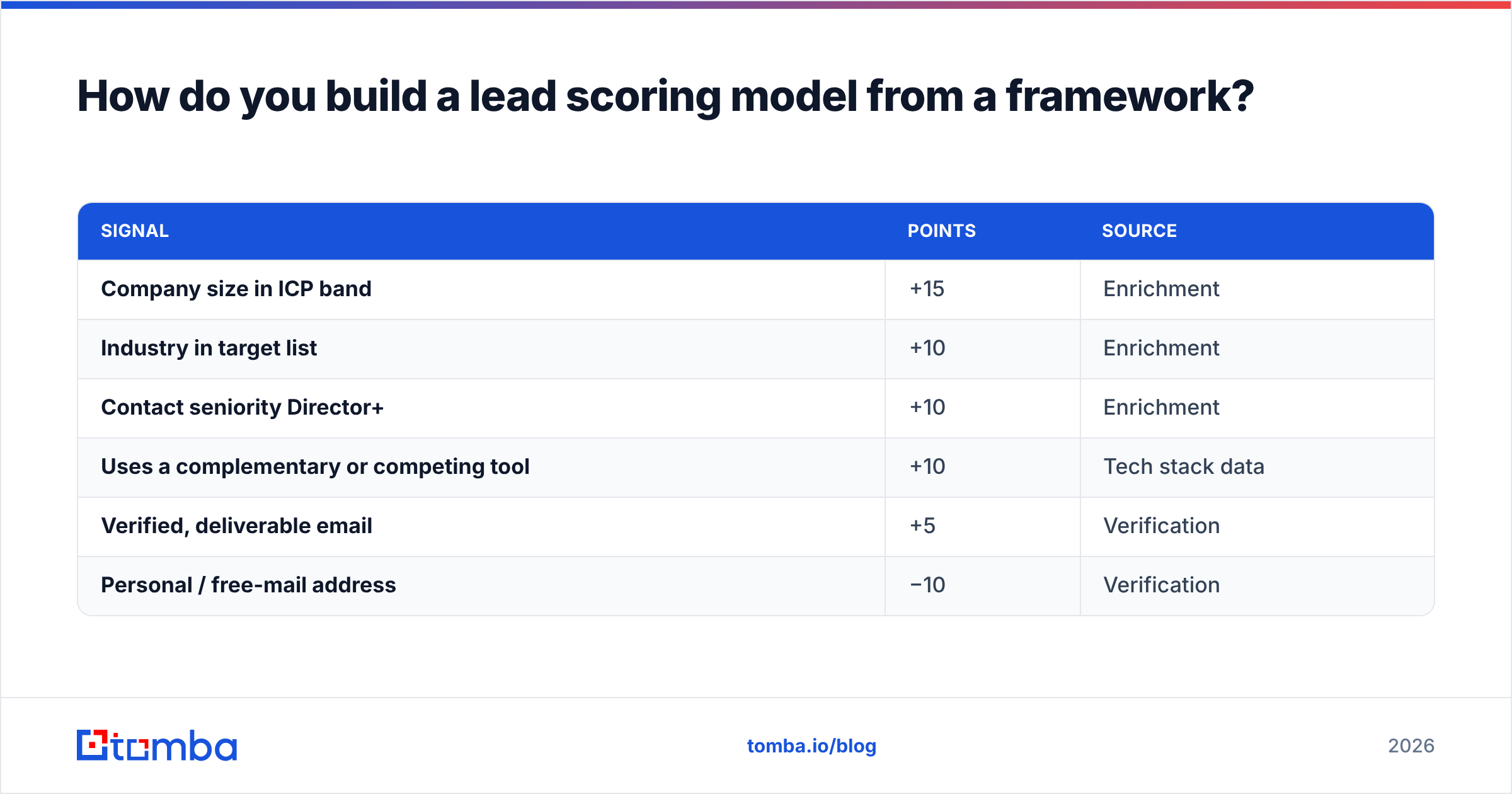
Turn the framework into numbers, then into CRM fields. Here's a practical two-layer model you can adapt.
Layer 1: Fit score (automated, 0–50 points)
| Signal | Points | Source |
|---|---|---|
| Company size in ICP band | +15 | Enrichment |
| Industry in target list | +10 | Enrichment |
| Contact seniority Director+ | +10 | Enrichment |
| Uses a complementary or competing tool | +10 | Tech stack data |
| Verified, deliverable email | +5 | Verification |
| Personal / free-mail address | −10 | Verification |
Layer 2: Framework score (rep-entered, 0–50 points)
Take your chosen framework and give each criterion 0, 5 or 10 points: not discussed, claimed, or evidenced. For CHAMP, that's five criteria... no, four: Challenges, Authority, Money, Prioritization, for up to 40 points. Add 10 for a clear next step on the calendar.
Routing rules
- 70+: Sales-qualified. Route to an AE within 24 hours.
- 45–69: Keep with the SDR and book a second discovery call.
- 25–44: Nurture. This is effectively a marketing qualified lead that isn't ready yet.
- Under 25: Disqualify and record the reason.
The "evidenced" level is where the value is. It forces reps to write down what the buyer actually said rather than a hopeful checkbox. Both HubSpot's CRM and Salesforce let you make those notes required fields at stage change.
What are the most common qualification mistakes?#
Teams usually fail in predictable ways:
- Treating the framework as a script. Reading out "What's your budget? Who's the decision maker?" feels like an interrogation. Put the criteria into a natural discovery conversation.
- Never disqualifying. If fewer than 10–20% of your leads get disqualified, your bar is probably too low, or reps are afraid of empty pipeline reviews.
- Scoring on claims, not evidence. "They said Q3" isn't a timeline. "They need it live before their Q3 board meeting on a date they named" is.
- Ignoring the champion outside MEDDIC. Even in a BANT world, a deal with no internal advocate stalls. Add a champion field whatever framework you use.
- Never recalibrating. Every two quarters, pull closed-won and closed-lost deals and check which criteria actually predicted the outcome. Drop the ones that didn't.
- Qualifying the wrong person. Your contact might be enthusiastic but have no authority. Use account-level contact discovery to find the economic buyer early, rather than finding out in week six.
How do you roll out a new framework without rep revolt?#
Start small, prove the win, then make it official. A rollout that works:
- Pilot with two or three reps for 30 days. Choose one skeptic.
- Add the fields to your CRM before training. If it isn't in the record, it won't happen.
- Run deal reviews with the framework. Managers should ask "Who's the champion?" rather than "How's it going?"
- Share the data. After 60 days, compare pilot conversion rates with the rest of the team.
- Roll it out team-wide with a one-page cheat sheet and example good and bad answers for each criterion.
The deal review is what makes adoption stick. Reps adopt whatever their manager asks about every week.
Frequently asked questions#
What is the best lead qualification framework? There isn't one that's best for everyone. BANT or ANUM fits fast transactional sales, CHAMP fits mid-market consultative deals, and MEDDPICC fits enterprise. Choose by deal size and stakeholder count.
Can I combine frameworks? Yes, and most mature teams do. A common setup is ANUM or BANT at the SDR stage and MEDDPICC at the AE stage, with defined handoff fields between them.
How is lead qualification different from lead scoring? Lead scoring is the numeric output. The framework is the logic that produces it. Scoring can be fully automated from behavioural and firmographic data, while framework criteria like pain and champion still need a conversation.
How often should I update my qualification criteria? Review them every six months against closed-won and closed-lost data, and after any major change to your pricing or ICP.
Ready to qualify on real data instead of guesses?#
Every framework in this guide depends on one thing: getting the right person on the phone or in the inbox. If you're qualifying the wrong contact, or can't reach the economic buyer at all, the framework never gets a chance to work. Tomba Email Finder finds verified professional emails by name, domain or company. That lets you go straight to the decision makers your framework needs and enrich the fit layer of your score before a rep picks up the phone. You can start on the free tier with 25 searches a month, and paid plans start at $49/mo. See the Tomba pricing page to compare plans.
Related guides#
// get started
Find, verify and enrich your first contacts today
Start on the free plan with 25 searches a month, then scale when your team is ready.
Free plan · No credit card required · GDPR & CCPA
// about the author